

1. INTRODUCTION
Forensic officers' main task is to identify the post-mortem history of the dead body, precisely the person's time of death. In general, the post-mortem identification is very complex and cannot be generalized. The circumstances when somebody found the bodies could significantly influence the decomposition process. The biological process of decomposition typically involves specific local insects in the neighborhood where the body was found.
Recent studies using the entomological approach are done by looking at the behavior of insects around the body. Referring to Garc´ıa-Ruilova A. B, et al.[1], who conducted forensic-related research throughout southern Ecuador, found 41 species of diptera on the human body at the scene. Furthermore, referring to Hu, G. et al. [2], conducted research related to female human bodies found in a suitcase in Guangdong, China. the larva can determine the estimated death of the corpse. In contrast to previous studies, Mashaly, A., et al.[3], Conducted a study on nine bodies found in Riyadh, Saudi Arabia. The nine bodies were divided into four cases of murder, two cases of arson, one case of suicide, one case of accident and one case of neglect. After conducting the research, six of the nine cases showed diptera species around the bodies, especially suicides that found more diptera species. Research conducted by Al-Qahtni, AH, et al. [4], in Riyadh, Saudi Arabia, found two cases of death with two different habitats, the first case was found in an outdoor habitat and the second case was found in a semi-closed apartment, with the difference between the places. affect the average temperature in both places. Because habitat is a factor in the attraction of insects to the two bodies.
The insects that usually appear on carcasses, we call it biomass, are flies (diptera) and a type of beetles (coleoptera) [5]. By looking at their life cycle, and the interaction between the involving insects and larvae/instar, we may calculate the time-interval of the post-mortem. The mathematical model is constructed based on the following interaction between insect diptera [5] and biomass. The choice of biomass is rabbit, taken from the experiment by Mashaly A., et al., they analyse the succession patterns of C. albiceps on decomposing rabbit carcasses [5], Boulkenafet F., et al., they determination of benzodiazepines (carbamazepine and clobazam) in rabbit carcass tissues and larvae of three calliphorid flies is described[6], and Ashraf Mashaly, et al., conducted a study on rabbit (Oryctolagus cuniculus L.) carcasses exposed to open and shaded habitats,
*Corresponding author
observed relative abundance of insects and species richness[7]. The dead rabbit was stored in a secure place to prevent other animals from entering the biomass neighborhood. The diptera life cycle start with eggs, instar-1, instar-2, instar-3, pupa, and adult diptera. By reviewing the life cycle, and the feeding and larvae's interacting behavior, one can calculate the interval-time of post-mortem.
According to Gennard [8], the decomposition process in forensic is divided into five stages: the fresh phase, the bloating phase, the decay phase, the dry/post-decay phase, and skeletal remains. The fresh stage begins at the death of the biomass because after the heart stops pumping blood, and a chemical decomposition process occurs, the body of the biomass swells so that at that stage it goes into the bloating stage, because gases causing biomass to bloat are generated by anaerobic bacteria metabolising nutrients[9]. In the bloating phase, the volume of gas in the body increases, which causes an increase in the body's pressure. Because of this pressure, the fluid in the body of biomass will be forced out. The fluids released by the biomass body have ammonia and sulfur. These compounds are in great demand by diptera.
In the initial phase of the decay, the body tissue of biomass weakens due to gas pressure. The feeding process of necrophage insects causes the gas to be released, and body biomass deflates. This decay phase begins the emergence of diptera larval colonies that eat biomass. Furthermore, in the dry or post-decay stage, most of the biomass's body tissue has been eaten up, and the skeleton of the biomass body begins to appear. There is almost no activity from diptera in the skeletal phase because the biomass only leaves bone, cartilage, and hair [10].
We first construct a dynamical model with diptera entering the biomass, and the larvae take care of the decomposition process until the whole biomass was completely consumed. In the model, we construct the dynamics of interaction between diptera and the biomass.
2. MODEL FORMULATION
The mathematical model used to describe the forensic process is shown in Figure 2. This diagram shows the interaction between Diptera and its larvae within the biomass. The main task is to identify the post-mortem interval, i.e., the end of the consumption process within the biomass, and describe the dynamical process of larvae within the biomass. To simplify the problem, we do not specify the larvae stages.
Figure 1: Diagram of the interaction between diptera and biomass
In this model, the diptera life cycle starts with an egg, then becomes an instar or larvae, pupa and finally adults, represented by the variables E, I, P, A, respectively. In reality the instar phase consists of 3 stages, namely; instar-1 (I1), instar-2 (I2), and instar-3 (I3). For simplification, it is assumed that the proportion of the three phases is constant, I1 = a1I3 and I2 = a2I3, where a1 is the average proportion of instar-1 to instar-3 and a2 is the average proportion of instar-2 to instar-3, 0 < a1 < a2 < 1, so it can be written as follows:
\[I = I_1 + I_2 + I_3 = a_1 I_3 + a_2 I_3 + I_3 \tag{1}\]
Furthermore, the biomass used in the simulation is a rabbit, and the carrying capacity for diptera's larvae is K. The list of variables and parameters is given in Table 1 and 2.
Table 1: Description of variables
| Variable | Description | Unit |
|---|---|---|
| E(t) | Number of diptera eggs | egg |
| I(t) | Number of diptera larvae (in biomass equivalent) | gram |
| P (t) | Number of pupa diptera (in biomass equivalent) | gram |
| A(t) | Number of adult diptera (in biomass equivalent) | gram |
| K(t) | Number of biomass (carrying capacity) | instar |
Table 2: Description of parameters
| Parameter | Description | |
|---|---|---|
| λ | Average healthy eggs produced | −1 h |
| c | Logistics competition rate in instar compartment | −1 h |
| α | Egg transition rate to larvae | −1 h |
| η | Transition of instar to pupa | −1 h |
| ρ | Unit conversion | m |
| δ | Transition of pupa to diptera | −1 h |
| µ | Natural death rate of diptera | −1 h |
| ψ | Consumption rate of instar | −1 h |
3. INTERACTION BETWEEN DIPTERA AND BIOMASS
We construct the following interaction model between diptera and biomass as follows.
A. Diptera
- I. Diptera eggs (E)
- I.1 The rate of diptera's eggs per unit time (hour)
λA
I.2 The transition rate of egg to larva is αE, where α is the inverse of the average hatching period of egg. The dynamic of the egg compartment is as follows
\[\frac{dE}{dt} = \lambda A - \alpha E \tag{2}\]
- II. Larva of diptera (I)
- II.1. Reduction rate due to logistical competition among larvae is given by
\[\frac{cI^2}{(k+K)}.\]
Note that, the positive small number k is added to the carrying capacity K to avoid singularity when the biomass is entirely consumed by larvae.
II.2 The reduction in instar is due to the transition from instar to pupa with an average of instars per time (hours)
ηI
The dynamic of the larvae/instar compartment is given by
\[\frac{dI}{dt} = \alpha \rho E - \frac{cI^2}{(k+K)} - \eta I,\tag{3}\] where ρ is mass convertion from egg to larva.
- III. Pupa diptera (P)
- III.1 The transition rate of pupa to adults diptera is given by
The dynamic of pupa compartment is
\[\frac{dP}{dt} = \frac{\eta}{\rho}I - \delta P. \tag{4}\]
IV. Adult diptera (A)
IV.1 The natural death of diptera per unit time (hour)
\(\mu A\)
IV.2 We assume that the diptera gradually leaves the corpse as the biomass is decreasing. The per unit time decrease of diptera is taken as proportional to the total larva's consumption
\[\epsilon(K_0-K)\]
The dynamic of diptera is given by
\[\frac{dA}{dt} = \delta P - \mu A - \epsilon (K_0 - K). \tag{5}\]
B. Reduction of the biomass (K)
The reduction of the biomass is due to the consumption by larvae and natural decomposition
\[\psi I\] and \(\gamma K\), respectively. The dynamic of the carrying capacity K is given by
\[\frac{dK}{dt} = -\psi I - \gamma K. \tag{6}\]
We summarize the interaction between diptera and the biomass as follows:
\[\frac{dE}{dt} = \lambda A - \alpha E\] \[\frac{dI}{dt} = \alpha \rho E - \frac{cI^2}{(k+K)} - \eta I\] \[\frac{dP}{dt} = \eta I - \delta P\] \[\frac{dA}{dt} = \frac{\delta}{\rho} P - \mu A - \epsilon (K_0 - K)\] \[\frac{dK}{dt} = -\psi I - \gamma K.\] (7)
The dynamical model (7) biologically applies only in the period, which is called the post-mortem interval, \([0,\tau]=\{t|K(t)\geq 0\}\). Within this interval, the orbits remain in the non-negative sector in \(\mathbb{R}^5\). This can be easily seen that the vector fields on the non-negative coordinate-planes are facing inward.
Let first consider the case for abundant biomass (dropping the dynamic of K, and take \(\epsilon=0\)) and construct the final composition of egg, larva, pupa. By solving the Equation (7) for constant K, we obtain two equilibria, the trivial zero (E=0,I=0,P=0,A=0) and the coexistence equilibrium
\[Coex = \left\{ A, E = \frac{\lambda A}{\alpha}, I = \frac{\mu A}{\eta}, P = \frac{\mu A}{\delta} \right\}\] (8)
where
\[A = \frac{\eta^2 (\lambda - \mu)(k + K)}{c\mu^2 \rho}.\]
From the coexistence (8), we obtain the final composition of diptera's larvae
\[E:I:P = \frac{\lambda}{\alpha}: \frac{\mu\rho}{\eta}: \frac{\mu\rho}{\delta}.\] (9)
The ratios (9) can be used as the first estimate of the diptera composition after relatively longer period. The stability of the coexistence equilibrium is analyze from the characteristic polynomial
\[\operatorname{Char}(x) = \sum_{i=0}^{4} a_i x^i, \tag{10}\] where
\[a_{4} = \mu\] \[a_{3} = (2\lambda - \mu)\eta + \mu(\mu + \alpha + \delta)\] \[a_{2} = (2\lambda - \mu)(\mu + \alpha + \delta)\eta + \mu(\alpha\mu + \mu\delta + \alpha\delta)\] \[a_{1} = (2\lambda - \mu)(\alpha\mu + \mu\delta + \alpha\delta)\eta + \alpha\mu^{2}\delta\] \[a_{0} = \alpha\delta\eta\mu(\lambda - \mu).\] (11)
All coefficients a1, i = 0..4 are positive since the egg production rate λ is relatively larger then the natural death rate µ of diptera. These conditions are necessary for local stability of Coex. Sufficient condition for local stability will be shown for selection of data in the next section.
4. DESCRIPTION OF DATA
The values of biological parameters for simulation are as follows:
• The egg production rate of diptera λ We assume that half of dipteras is female, lifetime is 30 days [11], productive period is 12 [12], and total egg production during diptera's lifetime is 900 [13]. Then we have
\[\lambda = \lambda_1 \lambda_2 \lambda_3 = \frac{1}{2} \cdot \frac{12}{30} \cdot \frac{900}{720} = 0.25,\] where λ1 is female proportion, λ2 is the probability of productive diptera, and λ3 is the average egg production per hour.
• Mortality rate of diptera
The mortality rate of diptera is the inverse of life-time
\[\mu = \frac{1}{720} = 0.0014\]
• Initial carrying capacity
We assume the biomass is taken as 2000 grams, which is approximately equal to the weight of one rabbit. We take the average weight of intar is 0.03 grams [12], and each instar consumes as much as it's weight per day, or the consumption rate of instar is
\[\chi = \frac{0.03}{24} = 0.00125\] ( grams/ hour)
With this estimate, we assume the initial carrying capacity is
\[K(0) = \frac{2000}{0.00125} = 1.6 \times 10^6.\]
So that, the value of the parameters used can be seen in Table 3. For example, given 100 adult flies, because in one batch it produces 150 eggs, then 100 adult flies produce 1500 eggs, as in the Table 3. Then, suppose the initial value for each variable in the Forensic model is in Table 4.
We assume that 15% of the weight of the biomass is the remaining bones, cartilage, and hair. So that it can be reviewed for 85% by weight of biomass in seeing the interaction between biomass and diptera in the forensic process.
Table 3: Initial Variable Values for Mathematical Model of Forensic Process
| Variables | Values | Reference |
|---|---|---|
| E(0) | 15000 | Assumption |
| I(0) | 0 | Assumption |
| P (0) | 0 | Assumption |
| A(0) | 100 | Assumption |
| K(0) | 1.6 × 10⁶ instar | Compute from [12] |
Table 4: Mathematical Model for Forensic Process Parameter Value
| Parameters | Values | Reference | |
|---|---|---|---|
| λ | 0.25 | [11], [13], & [12] | |
| c | 0.001 | Assumption | |
| α | 1/23 | [13] | |
| η | 1/179 | [13] | |
| δ | 1/143 | [13] | |
| µ | 1/720 | [11] | |
| ψ | 0.5 | Assumption | |
| k | 1 | Assumption | |
| e | 0.00004 | Assumption | |
| K0 | 1.6 × 10⁶ | Assumption | |
| γ | 1/148 | Assumption | |
| ρ | 1 | Assumption | |
5. SIMULATION
In this section, a simulation will be carried out with the data in Table 4 and compared with the results in the field study in [14]. We assume that at the initial time, there are 100 dipteras and each diptera lays 150 eggs. So that the initial value of the variables used is as in Table 3 and the parameter values are given in the Table 4. Simulation results are given in Figure 2, 3, and 4. We assume that 15% of biomass consists of hair, cartilage, and bones, and the simulations are ended when the biomass reaches the value 15%.
It is shown in Figure 2, adult diptera is decreasing and leaving the biomass completely after 120 hours. After 120 hours, there are no more adult diptera and it causes eggs decreases completely disappears at 140 hours, as shown in Figure 3.
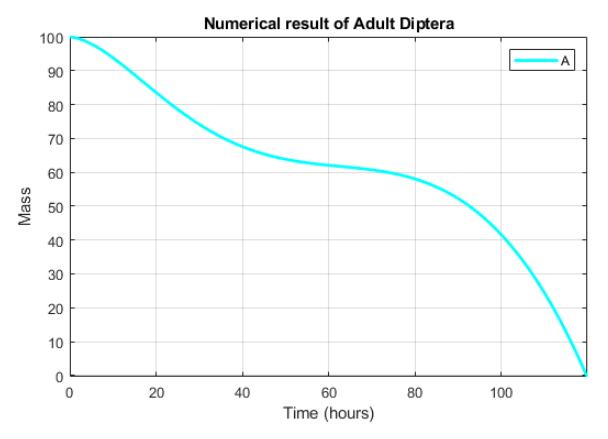
Figure 2: Adult diptera simulation of forensic processes
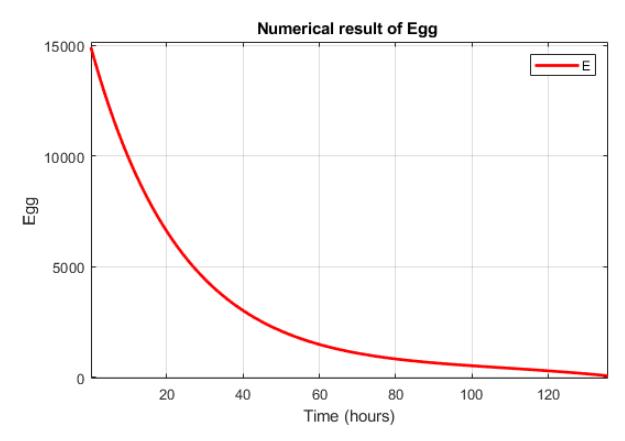
Figure 3: Egg simulation of forensic processes
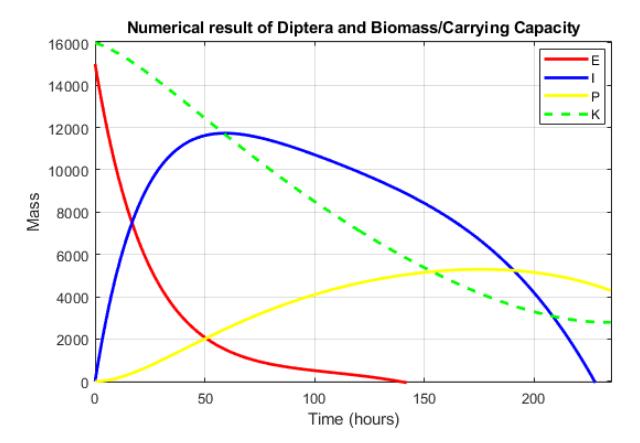
Figure 4: Forensic process simulation
Table 5: Numerical result of Forensics (0-10 days)
| Days | 0 | 1 | 2 | 3 | 4 | 5 |
|---|---|---|---|---|---|---|
| Egg | 15000 | 5616,126688 | 2236,200873 | 1018,035248 | 559,9818101 | 280,706 |
| Instar/Larvae | 0 | 9193,303791 | 11560,92124 | 11583,68365 | 10861,28254 | 9902,5 |
| Pupa | 0 | 694,2350105 | 1910,635107 | 3056,657234 | 3972,145325 | 4639,8 |
| Adult | 100 | 79,52547447 | 64,38508969 | 60,33547395 | 46,48602425 | 0 |
| Carrying Capacity/Biomass | 1600000 | 1457162,71 | 1260835,907 | 1062672,386 | 879160,514 | 714660 |
| Days | 6 | 7 | 8 | 9 | 10 | |
| Egg | 14,17197383 | 0 | 0 | 0 | 0 | |
| Instar/Larvae | 8756,757953 | 7254,271011 | 5113,198852 | 1989,474698 | 0 | |
| Pupa | 5075,026855 | 5281,42729 | 5233,243156 | 4869,677292 | 4295,475221 | |
| Adult | 0 | 0 | 0 | 0 | 0 | |
| Carrying Capacity/Biomass | 570421,0619 | 448498,6771 | 353567,2926 | 293766,4483 | 279148,9884 |
Table 6: Comparing the results of the rabbit decomposition stage with the diptera effect (days)
| Fresh Stage | Bloating Stage | Decay Stage | Advanced Decay Stage | Dry Stage | |
|---|---|---|---|---|---|
| Experimental result | 0 | 1 | 2 - 3 | 4 - 6 | 7 - 19 |
| Numerical result | 0 | 1 | 2 - 3 | 4 - 9 | 10 |
Furthermore, the biomass is completely consumed at 235 hours by instar, as shown in Figure 4. It can be seen in Table 5 that at the day-5 there isn't diptera which present in the biomass, and there isn't eggs after day-6. On the day-10, larvae disappeared when the carrying capacity reaches 15%.
The stage of the biomass decomposition process was obtained, at the initial stage (day-0), namely the fresh stage entering the bloating stage and as many as 100 adult diptera came to lay eggs because they were attracted by the compounds released from the biomass. If we look at Table 5, the instar at day-2 to day-3 has significantly increasing which indicates the decay stage of the biomas. At that stage, the larvae consumption is very high. The period of advanced decay stage is from day-4 to day-9 because there is still a population of larvae in the biomass. The day-10 is the dry stage, which is marked by the absence of larvae and the remaining bone, hair, and cartilage in the biomass.
Comparison between the simulation results with the experimental result in [14] shown in Table 6. it can be seen that the numerical results isn't much different from the experiment in [14].
Although analytical model shown in (9) is not related to the diptera model, it can be used as a rule of thumb estimation for the case of very large biomass. The ratios are shown in Table 7.
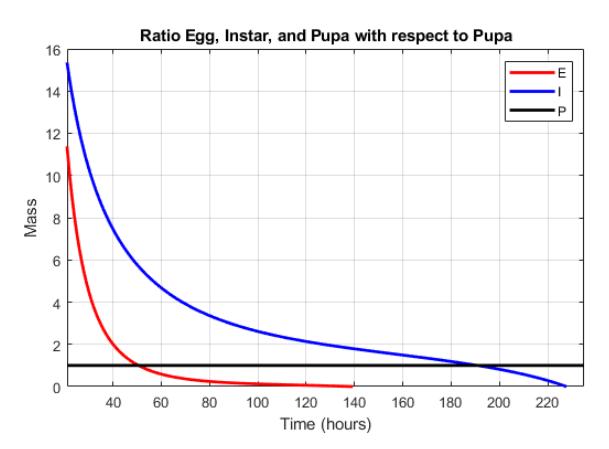
Figure 5: Numerical result of ratio Egg, Instar, and Pupa with respect to Pupa
Table 7: Ratio Egg, Instar, and Pupa with respect to Pupa
| Egg | Instar | Pupa | |
|---|---|---|---|
| Analytical result | 28.75 | 1.25 | 1 |
| Numerical result | 53.55 | 8.05 | 1 |
Figure 4 and Table 5 along with the distribution ratios in Figure 5 represent the dynamics during the post-mortem interval. Identification of the post-mortem time can be measured from the distribution of egg, larvae, and pupa, or the distribution of the ratios.
6. CONCLUSION
We have presented the simulation results which show that at hour-120 or day-5 the diptera is gone. This affects to the eggs, where at the hour-140 or the day-7 there aren't eggs in the biomass. The process of biomass decomposition occurs up to 235 hours or less to ten days. After ten days the dry stage biomass
consisting only of the remains of hair, bones, and cartilage. The results are in agreement with the experimental results in [14].
ACKNOWLEDGEMENT
Part of this work is funded by the Indonesian Ristek Dikti Grant 2020.