

1. INTRODUCTION
Dengue cases has increased in the last 50 years [1] and high social and economic burden caused by dengue transmission should be a warning sign that dengue still poses a risk to human population. Although a number of strategies such as vector controls have been widely implemented, the risk for being infected by dengue is still possible. It has been estimated that almost 400 million cases happen annually with 90 millions showing the clinical symptoms [2]. The existence of asymptomatic cases also contributes to disease transmission cycle which has increased dengue incidence [3]. Furthermore, dengue characteristics may contribute to higher number of secondary infections if strategies against dengue are not perfect. That is, dengue is caused by four distinct serotypes where infected by one of the serotypes provides lifelong immunity to that serotypes but have a higher chance to get more dangerous forms of dengue in secondary infections [4].
The traditional approaches such as vector controls have not been strongly effective in reducing dengue incidence [5]. The use of bacterium such as Wolbachia is promising and has been found to be effective in regions with low and moderate transmission level [6],[7],[8], [9], [10]. The use of vaccine is also promising. It can reduce dengue incidence particularly in areas with high transmission levels [11] ,[12]. However,the current available vaccines are not strongly effective against all dengue serotypes [11],[5], [13], [14]. The vaccine efficacy varies between 50%–80% [14],[15] depending on dengue serotypes and the status of individuals to be vaccinated, and age. As the efficacy of vaccine is not perfect, the vaccinated persons can possibly be attracted by the more dangerous forms of dengue in the secondary infections. Reducing contact between individuals and mosquitoes can also minimize the chance of being infected by dengue. Therefore, an individual participation by taking prevention actions to reduce the contact with mosquitoes plays an essential role in the effort of dengue elimination.
An important aspect for successfully implementing dengue elimination strategies is the human decision to employ the available strategies [16],[17]. For example, when the community awareness is not at sufficient level [16], the elimination strategies cannot be successfully implemented. Furthermore, willingness to pay dengue vaccine is higher when individuals have a sufficient knowledge about dengue viruses [17], which affects human-decision making behavior whether to use vaccine or not. Elsinga et al. [18] pointed out that the community participation in the implementation of dengue elimination strategies is important. In this research, we focus on analyzing the effects of human-decision making behavior on dengue transmission dynamics by using a mathematical model.
The use of a mathematical model to understand complex phenomena is common [12], [19], [20], [21], [22], [23], [24]. A number of mathematical model have been formulated to study the effects of disease transmission dynamics [25], [26], [7], [29], [21], [31], [30], [32]. Understanding human-decision making behavior can be studied by the use of mathematical models [33], [34], [35]. By implementing game-theoretical and related technique to the epidemiological models, researchers have studied the effects of human-decision making behavior on disease transmission dynamics [36], [33], [37], [38]. Researchers mostly investigated humandecision making behavior on the use of vaccine. Little mathematical model has been formulated to understand human-decision making behavior on the use of dengue vaccine or taking prevention action such as the use of bed nets and other intervention strategies to reduce the contact with mosquitoes. Furthermore, an optimal control approach to determine the optimal intervention strategies by the use of Pontryagin minimum principle has been commonly used [25], [29], [39], [21], [22], [40]. The existing work focused on finding the optimal interventions that should be implemented to obtain the minimum number of disease incidence at minimum cost. It is expected that individuals can decide to implement the strategies at suggested level to reach optimal results.
This study aims to understand human decision making behavior on dengue transmission dynamics. In this paper, an integrated epidemiological-game dynamic model framework which couples epidemiological and behavioral models has been formulated and studied. We consider three strategies that individuals can decide: (i) use dengue vaccine, (ii) take the prevention actions to reduce contact with mosquitoes, (iii) none of the two strategies is decided. Finally, we consider the human decision to use vaccine or taking prevention action to reduce contact with mosquitoes as time-dependent controls and use optimal control approach for studying their effects of dengue transmission dynamics. We also estimate the parameter values of the model using the data of dengue incidence in Kupang-city Indonesia. Note that throughout the paper, we use the term 'take prevention actions' to denote an effort taking by individuals to reduce contact with mosquitoes.
2. FORMULATION OF MATHEMATICAL MODEL AND PARAMETER ESTIMATION
We present the model formulation and the parameter estimation. The model consists of epidemiological and behavior model. Schematic representation of the model is given in Figure 1.
2.1. The Epidemiological Model
A deterministic mathematical model is formulated in the form of system of differential equations, where the human and mosquito population is divided into disjoint compartments depending on the status. The human population is divided into susceptible (Hs), vaccinated (Hv), infected (Hi), and recovered (Hr). The mosquito population is divided into susceptible (Ms) and infected (Mi). The total human population is Nh = Hs + Hv + Hi + Hr. The transition from human susceptible and vaccinated class to the exposed class are through forces of infection, which are
\[\lambda_{hs} = (1 - \epsilon x_2) \frac{\beta_h M_i}{N_h}, \lambda_{hv} = (1 - \phi_v) \frac{\beta_h M_i}{N_h},\]
respectively. The parameter 0 ≤ ≤ 1 is efficacy of prevention actions in reducing disease transmission, 0 ≤ x2 ≤ 1 is the fraction of susceptible individuals who choose to take prevention action, φv is the efficacy of vaccination. Flow from susceptible human to vaccinated human is at rate ψsx1 where x1 is the
Epidemiological Model
Figure 1: Schematic representation for epidemiological-behavior model showing the flow of humans and mosquitoes between compartments. The solid lines are the progression lines and the dashed lines are the influence lines.
proportion of susceptible individuals who choose to be vaccinated and \(\psi_s\) is the vaccination rate. The flow from susceptible to infected mosquitoes is determined by the force of infections as
\[\lambda_m = \frac{\beta_m H_i}{N_h}.\]
The parameters \(\beta_h\) and \(\beta_m\) are the transmission rate from mosquitoes to human, and human to mosquitoes respectively. The recovered individuals move to the susceptible class after certain period at \(1/\theta\).
Based on the conceptual framework as shown in Figure 1, the epidemiological model is then governed by the following system of differential equation
\[\frac{dH_s}{dt} = \Lambda_h - \lambda_{hs}H_s - \psi_s x_1 H_s - \mu_h H_s + \theta H_r, \frac{dH_v}{dt} = \psi_s x_1 H_s - \lambda_{hv} H_v - \mu_h H_v, \frac{dH_i}{dt} = \lambda_{hs} H_s + \lambda_{hv} H_v - \gamma_h H_i - \mu_h H_i, \frac{dH_r}{dt} = \gamma_h H_i - \mu_h H_r - \theta H_r, \frac{dM_s}{dt} = \Lambda_m - \lambda_m M_s - \mu_m M_s, \frac{dM_i}{dt} = \lambda_m M_s - \mu_m M_i.\] (1)
with initial conditions
\[H_s(0) = H_{s0} \ge 0, H_v(0) = H_{v0} \ge 0, H_i(0) = H_{i0} \ge 0, H_r(0) = H_{r0} \ge 0,\]
\(M_s(0) = M_{s0} \ge 0, M_i(0) = M_{i0} \ge 0\) (2)
Theorem 2.1. Solution of Model (1) with non-negative initial conditions will remain non-negative for all time \(t \ge 0\).
Proof: From the first equation of Model (1), it gives
\[\frac{dH_s}{dt} + \lambda_{hs}H_s + \psi_s x_1 H_s + \mu_h H_s \ge 0,\] and taking the integration gives
\[\frac{d}{dt} \left[ H_s(t) \exp \left\{ \int_0^t \lambda_{hs}(\omega) d\omega + (\psi_s x_1 + \mu_h) t \right\} \right] \ge 0.\]
This implies that
\[H_s(t) \ge H_s(0) \exp\left\{-\left(\int_0^t \lambda_{hs}(\omega)d\omega + (\psi_s x_1 + \mu_h)t\right)\right\} > 0, \forall t > 0.\]
Using the similar approach, we can show that the other state variables \(H_v\), \(H_i\), \(H_r\), \(M_s\), \(M_i\) are non-negative for all time t > 0.
Consider the biologically feasible region \(\Omega = \Omega_H \times \Omega_V \subset R_+^4 \times R_+^2\), with
\[\Omega_H = \{H_s, H_v, H_i, H_r \in \mathbb{R}^4 | (H_s + H_v + H_i + H_r) \le \frac{\Lambda_h}{\mu_h} \} \quad \text{and}\] \[\Omega_V = \{M_s, M_i \in \mathbb{R}^2 | (M_s + M_i) \le \frac{\Lambda_m}{\mu_m} \}\]
The positivity of the region has been claimed in the following theorem
Theorem 2.2. The region \(\Omega = \Omega_H \times \Omega_V \subset R_+^4 \times R_+^2\) is positively invariant for Model (1) with non-negative initial condition (2)
Proof: Taking the summation for human and mosquito model, we obtain
\[\frac{dN_h}{dt} = \Lambda_h - \mu_h N_h \quad \text{and} \quad \frac{dN_v}{dt} = \Lambda_m - \mu_m N_m\]
Therefore, if \(N_h(0) \geq \frac{\Lambda_h}{\mu_h}\), then \(\frac{dN_h}{dt} \leq 0\) and if \(N_m(0) \geq \frac{\Lambda_m}{\mu_m}\), then \(\frac{dN_m}{dt} \leq 0\), Hence \(N_h(t) \leq N_h(0)e^{-\mu_h t} + \frac{\Lambda_h}{\mu_h} \left(1 - e^{-\mu_h t}\right)\) and \(N_m(t) \leq N_m(0)e^{-\mu_m t} + \frac{\Lambda_m}{\mu_m} \left(1 - e^{-\mu_m t}\right)\). It follows that \(N_h(t) \to \frac{\Lambda_h}{\mu_h}\) and \(N_m(t) \to \frac{\Lambda_m}{\mu_m}\). Hence the region is positively invariant.
2.2. The Behavior Model
We consider the human choice to minimize the probability of being infected by dengue. We consider the susceptible individuals are the players who can choose one of three scenarios: (i) vaccination, (ii) prevention actions to reduce the contact with mosquitoes, (iii) none of them. The payoff for choosing one of these strategies depends on certain costs that should be paid. For example, the payoff for choosing vaccination is that individuals will minimize the chance of being infected by dengue, while the cost that individuals should incur to reach this is the lack of money or inability to afford vaccine. In constructing the behaviour model, we follow approached in [33], [34], [35].
Let \(x_1(t)\) be the fraction of susceptible individuals who choose to be vaccinated at time t and \(x_2(t)\) be the fraction of susceptible individuals who choose to take prevention action to reduce the contact with mosquitoes at time t. The \(x_3(t)=1-x_1(t)-x_2(t)\) is the susceptible individuals who choose neither vaccination or prevention action to reduce the contact with mosquitoes. It is worth mentioning that although individuals choose to take either vaccination or prevention actions to reduce contact with mosquitoes, they still have a chance to be infected by mosquitoes with reduced probability. This is realistic as dengue vaccine is not perfectly effective and individuals can still have a chance being bitten by infected mosquitoes although they have reduced contact with mosquitoes. The payoff for vaccinated individuals is given by
\[P_1 = -r_v - v_d \epsilon_v m_v M_i \tag{3}\] where \(r_v\) is the perceived cost of vaccination, \(v_d\) is the risk of perceived infection due to vaccination, the probability, \(\epsilon_v\), is the perceived efficacy due to vaccination. The payoff for taking prevention actions to reduce contact with mosquitoes is given by
\[P_2 = -r_c - v_c \epsilon_c m_v M_i \tag{4}\] where \(r_c\) is the perceived cost of taking prevention actions (TPA), \(v_c\) is the risk of perceived infection due to taking prevention actions, the probability \(\epsilon_v\) is the perceived efficacy due to taking prevention actions. The payoff of taking none of these two strategies are
\[P_3 = -r_n m_n M_i \tag{5}\] where \(r_n\) is the perceived risk of infections. The parameters \(m_v\) is sensitivity to get dengue infections.
It is assumed that individuals sample and imitate others when deciding which strategy they are going to decide. Individuals sample others at a rate \(\kappa\) and switch their strategies with probability p which is proportional to the expected payoff if the other's individual strategies provide higher payoff. The payoff for switching strategies to \(x_i\) for players in \(x_j\) or \(x_k\) are given by \(\Delta E_{ij} = P_i - P_j\) or \(\Delta E_{ik} = P_i - P_k\). It is noted that if the \(\Delta E_{ij}\) and \(\Delta E_{ik}\) are both positive, it means that switching strategies to \(x_i\) is worthwhile, otherwise it is not. The growth of the equation is given by
\[\frac{dx_i}{dt} = x_j \kappa x_i p \Delta E_{ij} + x_k \kappa x_i p \Delta E_{ik}, \frac{dx_i}{dt} = \tau \left( x_j x_i \Delta E_{ij} + x_k x_i \Delta E_{ik} \right).\] (6)
where \(\tau = \kappa p\) is the imitation or sampling rate. Therefore, the coupled epidemiological model for dengue and human behavior is governed by the following differential equation
\[\frac{dH_s}{dt} = \Lambda_h - \lambda_{hs}H_s - \psi_s x_1 H_s - \mu_h H_s + \theta H_r, \frac{dH_v}{dt} = \psi_s x_1 H_s - \lambda_{hv} H_v - \mu_h H_v, \frac{dH_i}{dt} = \lambda_{hs} H_s + \lambda_{hv} H_v - \gamma_h H_i - \mu_h H_i, \frac{dH_r}{dt} = \gamma_h H_i - \mu_h H_r - \theta H_r, \frac{dM_s}{dt} = \Lambda_m - \lambda_m M_s - \mu_m M_s, \frac{dM_i}{dt} = \lambda_m M_s - \mu_m M_i, \frac{dx_1}{dt} = \tau \left( x_1 x_2 \Delta E_{12} + x_1 (1 - x_2 - x_1) \Delta E_{13} \right), \frac{dx_2}{dt} = \tau \left( x_2 (1 - x_2 - x_1) \Delta E_{23} - x_2 x_1 \Delta E_{12} \right)\] (7)
The disease-free equilibrium is given by
\[(H_s^*, H_v^*, H_i^*, H_r^*, M_s^*, M_i^*, x_1^*, x_2^*) = \left(\frac{\Lambda_h}{\mu_h + \psi_s x_1^*}, \frac{\Lambda_h \psi_s x_1^*}{(\mu_h + \psi_s x_1^*) \mu_h}, 0, 0, \frac{\Lambda_m}{\mu_m}, 0, x_1^*, x_2^*\right)\] where \((x_1^*) \in (0,1)\) and \((x_2^*) \in (0,1)\)
2.3. Reproduction Number
We construct the reproduction number, which is an average number of new infections generated by a single infection in the entirely susceptible population. In general, when the reproduction number is less than unity, an outbreak occurs although in some cases, it may not be the case. For example, when the backward bifurcation occurs, it still leads to stable endemic equilibrium although \(\mathcal{R}_0 < 1\). The reproduction number is obtained by constructing the next generation matrix (NGM) and find the largest eigenvalue of the NGM [41]. First the transmission and the transition matrix have been created, which are
\[\mathcal{T} = \begin{pmatrix} 0 & \frac{(1 - \epsilon x_2)\beta_h \Lambda_h}{N_h(\mu_h + \psi_s x_1^*)} + \frac{(1 - \phi_v)\beta_h \Lambda_h \psi_s x_1^*}{N_h \mu_h(\mu_h + \psi_s x_1^*)} \\ \frac{\beta_m \Lambda_m}{N_h \mu_m} & 0 \end{pmatrix}\](8)
\[\Sigma = \begin{pmatrix} -\gamma_h - \mu_h & 0\\ 0 & -\mu_m \end{pmatrix} \tag{9}\]
The next generation matrix is found by \(-T\Sigma^{-1}\) and is given by
\[NGM = \begin{pmatrix} 0 & \frac{(1 - \epsilon x_2)\beta_h \Lambda_h}{\mu_m (\gamma_h + \mu_h)} + \frac{(1 - \phi_v)\beta_h \Lambda_h \psi_s x_1^*}{\mu_m (\mu_h + \psi_s x_1^*) N_h} + \frac{(1 - \phi_v)\beta_h \Lambda_h \psi_s x_1^*}{\mu_m \mu_h (\mu_h + \psi_s x_1^*) N_h} \end{pmatrix}\](10)
The reproduction number is the spectral radius of the next generation matrix which is given by
\[\mathcal{R}_{0} = \sqrt{\frac{\beta_{h} \Lambda_{h} \beta_{v} \Lambda_{v} (\psi_{s} x_{1}^{*} (1 - \phi_{v}) + \mu_{h} (1 - \epsilon x_{2}))}{\mu_{h} (\gamma_{h} + \mu_{h}) (\mu_{h} + \psi_{s} x_{1}^{*}) \mu_{m}^{2} N_{h}^{2}}}\](11)
The reproduction number comes from infections of susceptible and vaccinated individuals. Let \(R_s\) is the infection of susceptible individuals and \(R_v\) is the infection of vaccinated individuals. It is possible to write the reproduction number as
\[\mathcal{R}_0 = R_s + R_v\] where
\[R_{s} = \frac{\beta_{m}\Lambda_{m}}{N_{h}\mu_{m}} \times \frac{(1 - \epsilon x_{2})\beta_{h}\Lambda_{h}}{\mu_{m}(\mu_{h} + \psi_{s}x_{1}^{*})N_{h}},\] \[R_{v} = \frac{\beta_{v}\Lambda_{m}}{N_{h}\mu_{m}} \times \frac{(1 - \phi_{v})\beta_{h}\psi_{s}x_{1}^{*}\Lambda_{h}}{\mu_{m}\mu_{h}(\mu_{h} + \psi_{s}x_{1}^{*})N_{h}}.\] (12)
The first component of \(R_s\) and \(R_v\), which is \(\frac{\beta_v \Lambda_m}{N_h \mu_m}\), is the infection of mosquitoes. The component \(\frac{(1-\epsilon x_2)\beta_h \Lambda_h}{\mu_m(\mu_h + \psi_s x_1^*)N_h}\) is the proportion of susceptible individuals who has been infected during the lifetime of infected mosquitoes. The term \(\frac{(1-\phi_v)\beta_h \psi_s x_1^* \Lambda_h}{\mu_m \mu_h (\mu_h + \psi_s x_1^*)N_h}\) is the proportion of vaccinated individuals who has been infected during the lifetime of infected mosquitoes.
2.4. Parameter Estimation
We estimate the parameter values using the method in [42]. We use the data of dengue from Kupang regency, East Nusa Tenggara Indonesia and estimate the parameter values using the baseline model in the absence of vaccination. This is realistic as the vaccination has not been widely implemented yet. We use weekly data from Kupang city from week 46 of 2019 to week 14, 2020. In our estimation, we use the methods described in [42]. The algorithm works as follows. First, we estimate the parameter values using the nonlinear square fitting method as provide in MATLAB, we then use the best-fit model to N-times replicated simulated datasets and each simulated datasets is generated by assuming the Poisson error structure. We then re-estimate parameters for each of simulated realization and then using the set of re-estimated parameter values to construct the distribution and confidence interval. Details of the algorithm can be found in [42].
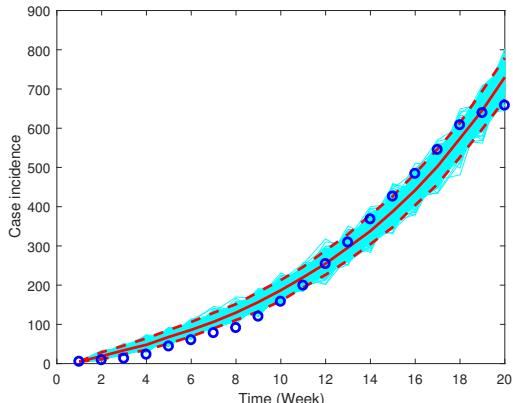
The initial conditions used are \(H_s(0)=434,972\), \(H_v(0)=0\), \(H_i(0)=5\), \(H_r(0)=0\), \(M_s(0)=869,944\), \(M_i(0)=10\). The susceptible population is the approximate population of Kupang City [46] and the infected population is obtained from the data. We estimate the parameters \(\beta_h\) and \(\beta_m\). The other parameter values have been obtained from literature \(\mu_h=1/(65\times52)\) week<sup>-1</sup> [46]; \(\theta=1/24\) week<sup>-1</sup> [43], \(\gamma_h=1\) week<sup>-1</sup> [44], \(\mu_v=1/2\) week<sup>-1</sup>,[45] \(\epsilon=0.5\) (assumed), \(x_2=0.5\) (assumed). The estimated parameter values and the plot between model simulations and data is given in Figure 2. We found that the parameters \(\beta_h=2.1(CI:1.8-2.3)\) and \(\beta_m=0.22, (CI:0.19-0.25)\). Using these parameter values, we obtain the basic reproduction number in the absence of vaccination is 1.17. The result reflects the reality in Kupang city that dengue is still endemic and suggests that an outbreak of dengue is possible if individuals do not take prevention actions.
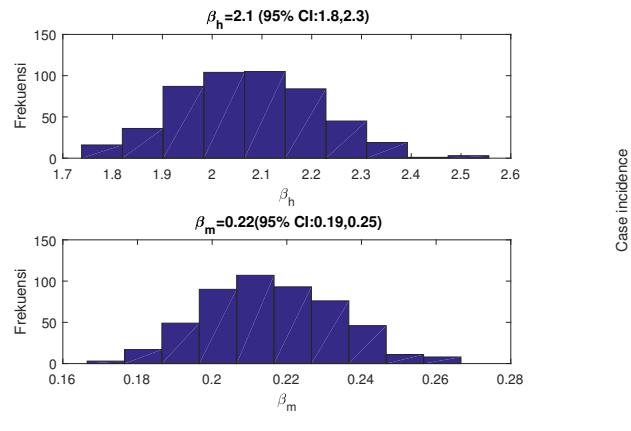
- (a) Frequency distribution of the parameter values.
- (b) Plot of data and model simulation.
Figure 2: (a) Plot of frequency distribution. (b) Plot of model simulation and data
3. NUMERICAL EXPERIMENTS
3.1. Variation of \(x_2^*\) and \(\epsilon\) on the reproduction number
Figure 3 showed the variation in the parameters \(\epsilon\) and \(x_2\) in the reproduction number. We explore this in the case when the vaccination has not been implemented. It shows that when the fraction of individuals who decide to take prevention action is around 0.2 and the efficacy of the prevention action is almost perfect, the basic reproduction number is still greater than unity. The results suggest that the fraction of individuals who decide to take prevention action should be sufficient to ensure the reproduction number goes below unity. It also showed that when the fraction of individuals who take prevention action is around 0.7 and the efficacy is around at the similar level, the reproduction number can go below unity. The results imply that in the absence of vaccination, higher proportion of individuals who decide to take prevention actions is required to reach dengue elimination.
3.2. The effects of initial players
We explore the effects of initial players on two conditions. First, the cost and the probability of perceived efficacy of vaccination is higher than that of taking prevention actions, that is \(r_v > r_c\) and \(\epsilon_v < \epsilon_c\). Second, the cost and the probability of perceived efficacy of vaccination is lower than that of taking prevention actions, that is \(r_v < r_c\) and \(\epsilon_v > \epsilon_c\)
Figure 4 showed the results of different initial players on the dengue transmission dynamics. Figure 4a showed the results when the cost and the probability of perceived efficacy of vaccination strategy is higher than that of taking prevention actions. It showed that when individuals decide to take vaccination only \((x_2 = 0)\), an outbreak takes off, but is possible to stop at the end of the period. On the other hand, when individuals decide to take prevention action only \((x_1 = 0)\), an outbreak takes off and is likely to continue to reach endemic equilibrium. Furthermore, it is interesting to note that when the initial populations who decide each strategy is around 0.1, an outbreak is likely to take off but would stop at the end of the period, although the peak is a slightly higher. It also shows that although initially there is proportion of individuals deciding to take vaccination or taking prevention only, but at the end of the period all individuals decide to take vaccination strategy \((x_2 = 0)\). This is because the cost and the probability of perceived efficacy of vaccination is higher than that of taking prevention action to reduce contact with mosquitoes and hence individuals tend to choose strategies that benefit them. The results suggest that deciding to be vaccinated is sufficient to reduce the dengue transmission dynamics. It is noted that this is the condition when the efficacy of prevention actions, \(\epsilon\), is around 0.25. Therefore, further investigation of the effects of the efficacy of prevention actions is presented in Figure 5 to explore.
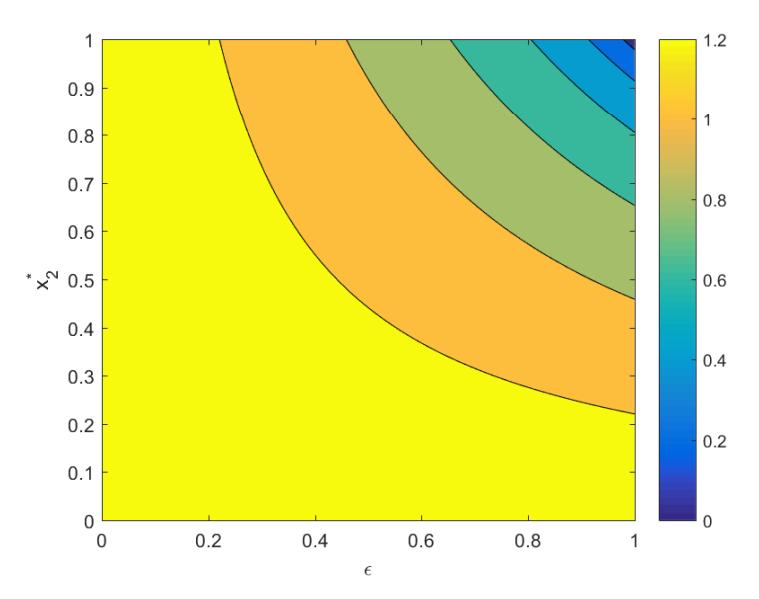
Figure 3: Variation of the steady states of x ∗ 2 and the efficacy of prevention actions on reproduction number.
Figure 4b showed the condition when the cost and probability of perceived efficacy of taking prevention actions is higher than that of vaccination. It is interesting to note that although the cost and the probability of perceived efficacy of taking prevention action is higher than that of vaccination, an outbreak still happens and it goes to endemic equilibrium. On the other hand, although an an outbreak still occurs when individuals decide to be vaccinated only, an outbreak takes off but would stop at the end of the period. The result suggests that the importance of the use of vaccination if the efficacy of taking prevention actions is low ( = 0.25). Further exploration for different efficacy of taking prevention actions () is given in Figure 5. Furthermore, the results show that although the proportion of individuals that choose one of these strategies is not zero at the initial period (x1 = 0.1 and x2 = 0.1), at the end of the periode, all individuals are likely to choose the taking prevention strategies to reduce contact with mosquitoes. This is because the cost and the probability of perceived efficacy of taking prevention action to reduce contact with mosquitoes are higher than that of vaccination, which motivate individuals to choose this strategy.
As per case when the cost and the perceived efficacy are higher than that of vaccination as given in Figure 4b, we explore the same case for different efficacy of prevention actions () and the result is given in Figure 5. It showed that when the efficacy of prevention action increases, an outbreak becomes smaller. It can also be seen that when the efficacy of taking prevention action to reduce contact with mosquitoes is low, it leads to endemic equilibrium but the number of infected individuals would be reduced as its efficacy increases. This indicates that a higher efficacy of prevention actions would minimize the chance of an outbreak occurrence. Therefore, an individuals should take a serious action to reduce the contact with mosquitoes. This can help in reducing dengue incidence particularly when the vaccine is not available yet.
4. HUMAN BEHAVIOR AS TIME-DEPENDENT CONTROLS
In this section, we are interested to investigate human-decision making behavior as time-dependent controls. This aims to compare the optimum fraction of individuals who decide to use vaccine or taking prevention action which can reduce dengue incidence. x1(t) is the individuals who choose vaccination and x2(t) is the individuals who choose to taking prevention actions to reduce contact with mosquitoes. The results are then compared to results from solutions of model with human decision making behavior as shown in model (7).
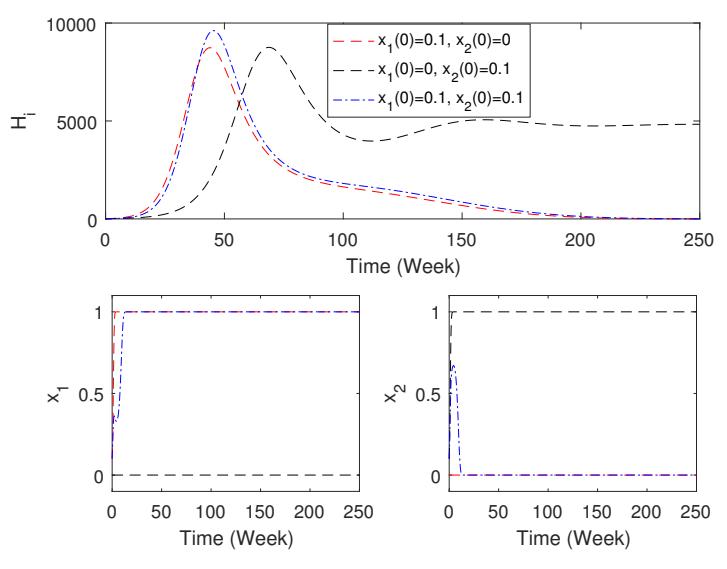
(a) The effects of different initial players when the cost and the probability of perceived efficacy of vaccination is higher than that of taking prevention actions, that is \(r_v > r_c\) and \(\epsilon_v < \epsilon_c\). Here is the vaccine efficacy is 0.74 [14] and the efficacy of taking prevention actions is 0.25. \(r_v = 0.4\) and \(r_c = 0.1\), \(r_n = 0.75\), \(\epsilon_c = 0.2\) and \(\epsilon_v = 0.1\), \(v_d = 0.5\), \(v_c = 0.7\).
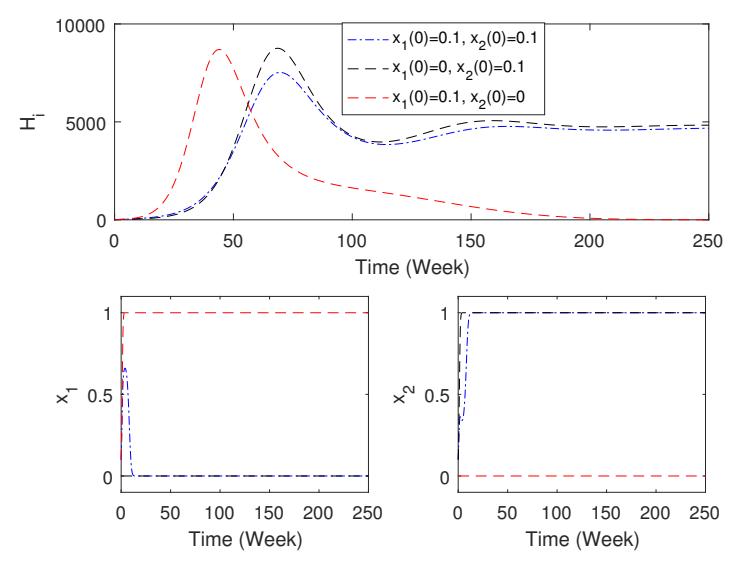
(b) The effects of different initial players when the cost and perceived efficacy of vaccination is lower than that of taking prevention actions, that is \(r_v < r_c\) and \(\epsilon_v > \epsilon_c\). Here is the vaccine efficacy is 0.74 [14] and the efficacy of taking prevention actions is 0.25. \(r_v = 0.1\) and \(r_c = 0.4\), \(r_n = 0.75\), \(\epsilon_c = 0.1\) and \(\epsilon_v = 0.2\), \(v_d = 0.7\), \(v_c = 0.5\).
Figure 4: Plot different initial players for case 1 (a) and case 2 (b).
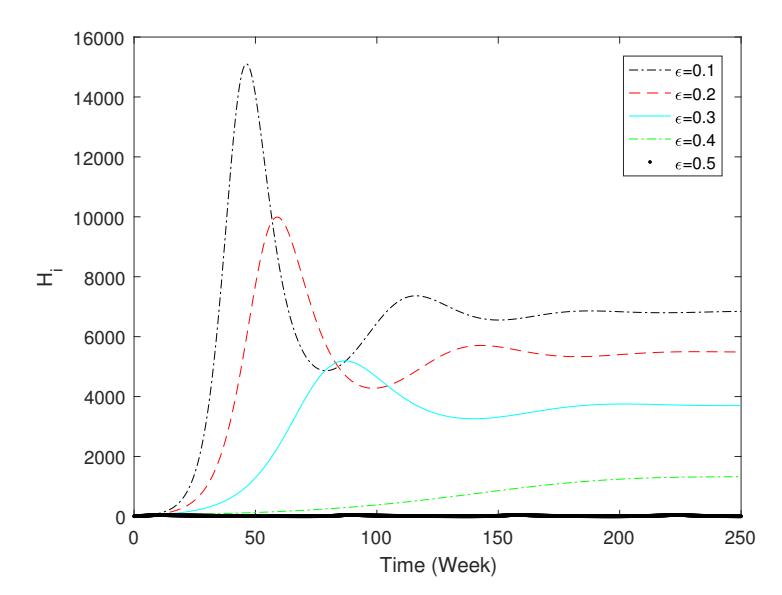
Figure 5: The effects of different efficacy of taking prevention action when the cost and the probability of perceived efficacy of taking prevention actions is higher than that of vaccination.
4.1. Objective Functional
The goal is to minimize the number of infected individuals while also minimize the cost of implementation vaccination and the other prevention actions. The objective functional is the following
\[J(x_1, x_2) = \int_0^{t_f} (A_1 H_i + A_2 x_1 H_s + A_3 x_1^2 + A_4 x_2^2) dt, \tag{13}\]
subject to Equation (1), where \(x_1\) and \(x_2\) are replaced by \(x_1(t)\) and \(x_2(t)\). The \(t_f\) is the final time for control implementation, and the control set \(\mathcal{X}\), is defined as
\[\mathcal{X} = \{(x_1, x_2) | x_i \text{ is Lebesque measurable}, 0 \le x_i \le x_{imax}, i = 1, 2\}\].
The coefficients \(A_1\), \(A_2\), \(A_3\), and \(A_4\) are the balancing coefficients associated with infected individuals and the implementation of controls. The coefficient \(A_1\) is the cost of infected individuals, \(A_2\) is the cost of taking vaccination strategy. The coefficients \(A_3\) and \(A_4\) are the quadratic terms representing an increase in the resource needed to accommodate high levels of control. The quadratic terms are often used to represent non-linear cost of implementing the controls [25], [27], [26].
4.2. Characterization of controls
We write the Hamiltonian function as
\[\mathcal{H} = (A_{1}H_{i} + A_{2}x_{1}H_{s} + A_{3}x_{1}^{2} + A_{4}x_{2}^{2}) + L_{HS}(\Lambda_{h} - \lambda_{hs}H_{s} - \psi_{s}x_{1}H_{s} - \mu_{h}H_{s} + \theta H_{r}) + L_{HV}(\psi_{s}x_{1}H_{s} - \lambda_{hv}H_{v} - \mu_{h}H_{v}) + L_{Hi}(\lambda_{hs}H_{s} + \lambda_{hv}H_{v} - \gamma_{h}H_{i} - \mu_{h}H_{i}) + L_{Hr}(\gamma_{h}H_{i} - \mu_{h}H_{r}) + L_{Ms}(\Lambda_{m} - \lambda_{m}M_{s} - \mu_{m}M_{s}) + L_{Mi}(\lambda_{m}M_{s} - \mu_{m}M_{i}).\] (14)
A system of equation describing the adjoint variables is found by \(\frac{dL_k}{dt} = -\frac{\partial \mathcal{H}}{\partial k}\) where \(k = H_s, H_v, H_i, H_r, M_s, M_i\). Hence a system of differential equations for adjoint variables are governed by
\[\frac{dL_{Hs}}{dt} = -A_2 x_1 - \frac{L_{Hi} (1 - \epsilon x_2) \beta_h M_i}{N_h} - L_{Hs} \left( -\frac{(1 - \epsilon x_2) \beta_h M_i}{N_h} - \psi_s x_1 - \mu_h \right) - L_{Hv} \psi_s x_1, \frac{dL_{Hv}}{dt} = -\frac{L_{Hi} (1 - \phi_v) \beta_h M_i}{N_h} - L_{Hv} \left( -\frac{(1 - \phi_v) \beta_h M_i}{N_h} - \mu_h \right), \frac{dL_{Hi}}{dt} = -A_1 - L_{Hi} (-\gamma_h - \mu_h) - L_{Hr} \gamma_h - \frac{L_{Mi} \beta_v M_s}{N_h} + \frac{L_{Ms} \beta_v M_s}{N_h}, \frac{dL_{Hr}}{dt} = -L_{Hr} (-\theta - \mu_h) - L_{Hs} \theta, \frac{dL_{Ms}}{dt} = -\frac{L_{Mi} \beta_v H_i}{N_h} - L_{Ms} \left( -\frac{\beta_v H_i}{N_h} - \mu_v \right), \frac{dL_{Mi}}{dt} = \frac{(1 - \epsilon x_2) \beta_h H_s}{N_h} \left( L_{Hs} - L_{Hi} \right) + \frac{(1 - \phi_v) \beta_h H_v}{N_h} \left( L_{Hv} - L_{Hi} \right) + L_{Mi} \mu_v.\] (15)
The transversality conditions for each adjoint at final times are
\[L_{Hs}(t_f) = 0, L_{Hv}(t_f) = 0, L_{Hi}(t_f) = 0, L_{Hr}(t_f) = 0, L_{Ms}(t_f) = 0, \text{ and } L_{Mi}(t_f) = 0.\] (16)
To characterize optimal control, we set the partial derivative of the Hamiltonian with respect to control variables \(x_1\) and \(x_2\) is equal to zero and it is subject to their bounds. Optimal controls characterization are given by
\[x_1^*(t) = \max\left(\min\left(\frac{H_s(\psi_s(L_{Hs} - L_{Hv}) - A_2)}{2A_3}, 1\right), 0\right)\] (17)
\[x_2^*(t) = \max\left(\min\left(\frac{\epsilon\beta_h H_s M_i (L_{Hi} - L_{Hs})}{2A_4 N_h}, 1\right), 0\right)\] (18)
This leads to the following theorem.
Theorem 4.1. There exists optimal control \(x_1^*\) and \(x_2^*\) that minimizes the objective function (13) over the control set \(\mathcal{X}\) subject to the system (1). Then there exists the adjoint variables as given in (15) with transversality condition as in (16) and the optimal controls \(x_1^*\) and \(x_2^*\) are given in Equation (17) and (17).
4.3. Numerical Simulations
In this section, we present the numerical simulations of the optimal controls. We use the backward-forward sweep algorithm as given in [28]. Let \(y_i\) for i=1, 2, 3, 4, 5, 6 denote \(H_s\), \(H_v\), \(H_i\), \(H_r\), \(M_s\), \(M_i\), respectively. Let \(L_i\) for i=1,...,6 denote the adjoint variables \(L_{Hs}\), \(L_{Hv}\), \(L_{Hi}\), \(L_{Hr}\), \(L_{Ms}\), \(L_{Mi}\). The algorithm works as follows.
- 1) Initial guess for \(x_1\) and \(x_1\) over the interval \([0,t_f]\) is made 2) While \(\frac{\|y^{(k)}-y^{(k-1)}\|}{\|y^{(k)}\|} > \delta\), do the following three step (step 3-5).
- Solve the state system (Model (1)) forward in time using the 4-th order Runge-Kutta method.
- Solve the costate system (Equation (15)) backward in time using the transversality condition (16) and the stored values of \(x_1, x_2\) and \(y_i\).
- Update \(x_1\) and \(x_2\) by entering new value for \(y_i\) and and \(L_i\) into (17) and (18).
- The iteration for updating \(x_1\) and \(x_2\) continues until convergence criteria are achieved
The numerical simulations for model with time-dependent controls are given in Figure 6.
Figure 6 showed that both controls should be in the highest level to obtain the minimum number of infected individuals. Furthermore, the efficacy of taking prevention action (\(\epsilon\)) should be higher to reach the minimum level of dengue incidence. However, this situation may not be reached the since not all individuals decide to take both controls as given in Figure 4a and 4b. Therefore, an efficacy of prevention actions should be high to reach optimal reduction in dengue incidence. An efficacy of taking prevention action can increase if individuals take serious actions to reduce contact with mosquitoes.
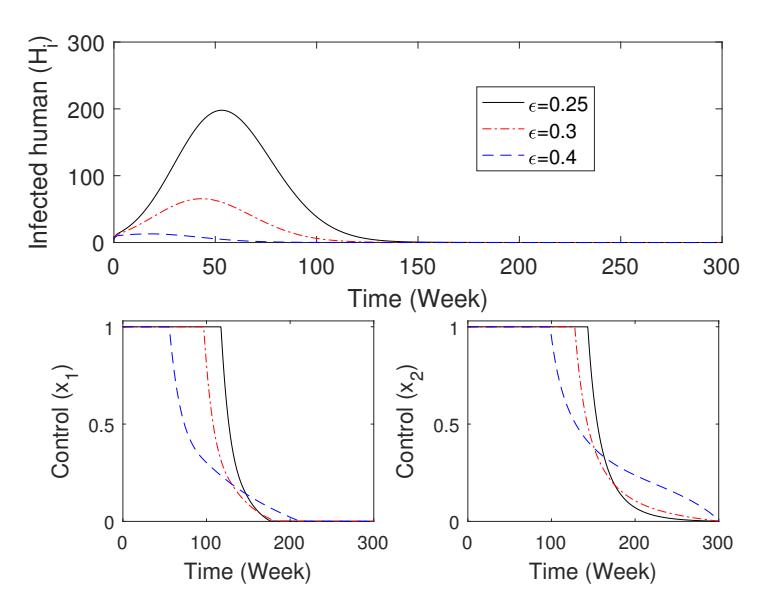
Figure 6: Plot of Infected human with time-dependent controls (top) and control profiles (bottom) for different efficacy of prevention actions.
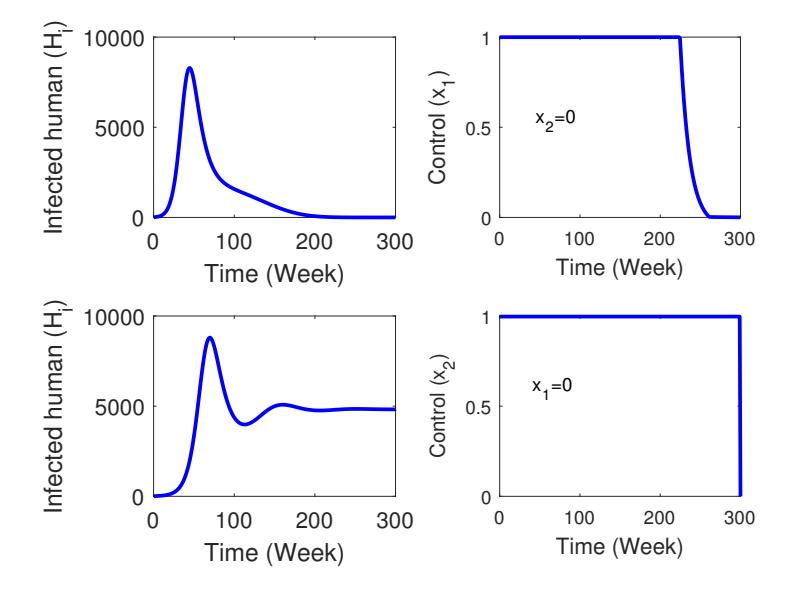
Figure 7: Plot of infected human with time-dependent controls and control profiles with vaccination only (top plot) and reducing contact with mosquitoes only (bottom). Here is the vaccine efficacy is 0.74 [14] and the efficacy of taking prevention actions is 0.25.
Figure 7 shows the infected human and control profile when a single intervention only has been implemented: (i) the scenario when vaccination only has been implemented by setting \(x_2 = 0\) and (ii) the scenario when the taking prevention only to reduce contact with mosquitoes has been implemented by setting \(x_1 = 0\).
The result shows that the dynamics are similar to the case for human-decision making behaviour when they decide to choose vaccination only or taking prevention only (compare Figures 7 and 4). The results imply that both intervention should be implemented to obtain higher reduction in dengue cases as shown in Figure 6.
5. DISCUSSION AND CONCLUSIONS
This work presents and analyses the effects of human decision making behavior on three strategies: (i) taking vaccination, (ii) taking the actions to reduce contact with mosquitoes, and (iii) not decide either (i) or (ii). An epidemiological model coupled with behavior model has been formulated to understand the effects of human decision making behaviour on dengue transmission dynamics. The model is parameterized to the data of dengue incidence of Kupang city, Indonesia.
We computed the reproduction number of dengue and found that the reproduction number is around 1.15 and use this to assess the effects of steady states \(x_2^*\) and the efficacy of prevention actions to reduce contact with mosquitoes. The reproduction number is similar to that in other areas such as West Java [26], Cali Colombia [47]. We found that the reproduction number can go below unity if the \(x_2^*\) is around 0.6 and the efficacy of prevention action \(\epsilon\) is around 0.8. This suggests the importance of efficacy of prevention actions and the proportion of individuals who decide to take prevention actions when no vaccine is not available yet.
The numerical simulations of the model have been carried out to investigate the effects of human decision making behavior on dengue transmission dynamics. We perform under three scenarios: (i) individuals choose vaccination only \((x_1 \neq 0, \text{ and } x_2 = 0)\), individuals choose prevention action to reduce contact with mosquitoes only \((x_1 = 0, \text{ and } x_2 \neq 0)\), and individuals choose either vaccination or prevention actions \((x_1 \neq 0, \text{ and } x_2 \neq 0)\)\(x_2 \neq 0\)). For each scenarios, two cases have been investigated: (i) the cost and the probability of perceived efficacy of vaccination is higher than that of taking prevention actions and (ii) the cost and the probability of perceived efficacy of vaccination is lower than that of taking prevention action. When the cost and the probability of perceived efficacy of vaccination is higher than that of taking prevention actions, individuals are likely to choose the vaccination strategy. An outbreak still happens but will stop at the end of period. On the other hand, when the cost and the probability of perceived efficacy of vaccination is lower than that of prevention action, individuals are likely to choose the prevention action strategy and an outbreak is smaller or does not take off when the efficacy of prevention actions in reducing dengue transmission, \(\epsilon\), is high. The efficacy of the prevention actions hold an essential role in reducing dengue incidence when no vaccine is available yet. We conducted an optimal control approach to understand how many proportion of individuals should choose either strategy to get optimal reduction in dengue. It has been found that an optimal reduction in dengue can be obtained if the majority of individuals implement both strategies. The challenge to achieve this is that not all individuals choose both strategies. There are several options which aid in reducing dengue incidence based on our analysis. First, if the vaccine is available, majority of individuals should be vaccinated if the efficacy of prevention action is low i.e individuals do not seriously take actions to reduce contact with mosquitoes. However, further analysis should be done to understand the effects of vaccination on secondary infections since the efficacy of candidates of vaccine is not perfect [15], [14]. Second, individuals should take prevention actions seriously and hence the efficacy in reducing dengue transmission is high. Third, the both strategies have been implemented at appropriate level. This may reduce dengue transmission. If the vaccine is available and the efficacy of prevention action is low, the first option should be implemented to minimize the number of dengue infections. To date, as the vaccine has not been available yet, the second option should be a chosen strategy to reduce dengue incidence. The success of second option can be reached if the efficacy of prevention action is high. Therefore, individuals should be aware of the importance of prevention action and they can take the serious actions to reduce contact with mosquitoes.
Further work can be done to obtain comprehensive understanding of dengue transmission dynamics under several intervention strategies. For example, since the efficacy of vaccine is not perfect, the effects of vaccination of secondary infections needs to be explored further. Furthermore, an analysis on the implementation of integrated strategies such as the use of Wolbachia bacterium and the other vector control with vaccine and reduced contact with mosquitoes can be conducted to obtain the comprehensive understanding of the effects of available dengue elimination strategies on disease transmission. Our model is a single serotype dengue model and hence the dynamics of secondary infections cannot be studied. Therefore, to obtain a comprehensive understanding of the effects of vaccination strategy on secondary infections, a multiserotype dengue model would be formulated and studied. This is a subject of future work.
ACKNOWLEDGMENT
The author acknowledges funding from Ministry of Education and Culture, Research, and Technology of Indonesia through Penelitian Dasar 2021-2023.