

1. INTRODUCTION
Dengue fever is a mosquito-borne disease that spread over the world in both tropical and sub-tropical country. In recent decades, dengue case has increase rapidly around the world. It is estimated 390 million dengue infection per year. Based on WHO data from 2010 untill 2016, the number of cases increased over 1.16 million [17]. Dengue is caused by a virus of Flaviviridae family that has four distinct serotypes, that is DEN 1-4. Dengue virus is transmitted by female mosquitoes mainly of the species Aedes aegypti and to lesser extent, Aedes albopictus.
To deal with dengue, several strategy of vector control through larval eradication program, repellent and insecticides has been applied [9]. However, the prevention of dengue epidemic using vector control through environmental management (by eliminating larval resting places or other objects susceptible to keep water) or chemical methods (through insecticides) remains inadequate since it only permits to delay the outbreak of the epidemic [5]. On a national scale, not many example of successful vector control through active disease monitoring and insecticides, although the prevention is integrated by community [2]. In practice, vector control through environmental management and chemical methods have frequently failed to reduce vector transmission of the dengue outbreak. So far, Ae. aegypti control program and environment management had limited impact on dengue transmission in urban areas and even less in rural areas. Besides, insecticides have high cost and increasing level of resistance of Ae. aegypti [8]. Due to limitation of vector control and there are no specific treatment of dengue, nowadays dengue vaccine development has become a major advance in the control of disease [19].
Dengue vaccines have been under development since 1920s and until now its development has been challenging. In the last decade, the scope and intensity of dengue vaccine has increased, although the licensed vaccine is not yet available. The uniqueness of the dengue viruses has made dengue vaccine development against each serotypes difficult. Several vaccine candidates are currently being evaluated in clinical studies
∗Corresponding Author
Received July 28th, 2022, Revised October 1st, 2022, Accepted for publication November 28th, 2022. Copyright ©2022 Published by Indonesian Biomathematical Society, e-ISSN: 2549-2896, DOI:10.5614/cbms.2022.5.2.3
[15]. A safe, effective and affordable dengue vaccine against the four strains would represents an important tool of reducing dengue morbidity and mortality. Mathematical modeling has been a useful and powerful tool to analise disease dynamic and for the proposition of strategies. So in this work will study about mathematical model of dengue fever involving vaccination campaign. Previous work of epidemic model with vaccination has been studied in [5] with control constant. The models is a system of nonlinear differential equations in susceptible-infected-recovery (SIR) for human population compartment and susceptible-infected (SI) compartment for mosquito population. Control is simply evaluated to a given constant value. Rodrigues in [14] solved dengue epidemic model with control optimization problem by using optimal control theory. Rodrigues model is SIR form for human population and ASI (aquatic-susceptible-infected) form for mosquito population. In this paper we will study an SIR+SI model considering the aim is to control the disease through vaccination, not vector control.
In a large population of epidemic outbreak consist many different individuals in various scope. A few key characteristics which are relevant to the infection under consideration must be defined to reduce the diversity in modeling [12]. However, there are uncertainty factors that can be considered for more realistic model. In reality, dengue dynamic in population is disturbed by uncertainty measurement, that is quantity of measurements in each compartment of the system is uncertain. The main concern is to integrate this uncertainty into a mathematical model with disturbances. The disturbances measurement usually unknown, so disturbances will be defined as a noise or statistical error random vector multiplied with a gain matrix that consist a covariance matrix of transitions probabilities between compartments. This disturbance represents how the transfer between compartment effect to the system.
Next, we aim to solve control problem for this dengue epidemic model with disturbances in order to minimize the infected humans (H2 control problem) and reduce the disturbances (H∞ control problem) with vaccination consisting input. To achieve the control law that have the combination of those two control problems, so we propose a novel mixed H2 − H∞ control. Then, we use state-dependent Riccati equation (SDRE) to provides design framework for nonlinear system. SDRE method is a powerful general design method which provides a systematic and effective design [16]. SDRE have many benefits in its computational advantage, stability, usefulness in control and have wide range of application [4]. First, we transform nonlinear system to a state-dependent coefficient (SDC) system. Furthermore, based on SDC system, we construct SDRE that satisfy the desired design criteria. By solving the SDRE, the optimal and robust control solution is found to satisfy mixed performance criteria guaranteeing the optimality of nonlinear quadratic with inherit stability property in combination with H∞ type disturbance reduction. In this paper, we will adapt a mixed H2 − H∞ performance criteria with SDRE approach proposed by Wang et. al. in [16]. Then, the proposed mixed H2 − H∞ control law of dengue epidemic model is demonstrated by simulations. The effectiveness of the performance of the control is compared to non-control and H∞ control scheme. The purpose of this work is to contribute a useful control framework and a flexible design method for nonlinear systems with disturbance control to achieve a mixed NLQR and H∞ performance by SDRE method.
The paper is organized as follows: In the second section, the dengue fever model with vaccination control is introduced. In the third section, the system model of dengue fever with control and disturbance is formulated in SDC form and of the mixed H2 − H∞ with SDRE controller for this control problem is derived. The fourth section contains the simulation result and the analysis. Finally, the conclusion is summarized in the fifth section.
2. DENGUE FEVER MODEL WITH VACCINATION CONTROL
In this section, a dengue fever model with vaccination will be formulated. The human population is divided into three compartments: susceptible (Sh), infected (Ih) and resistant (Rh). Then, the mosquito population is divided into susceptible (Sm) and infected (Im). This study will focused on disease eradication with vaccine, not a vector control. The vaccine is assumed to give temporary immunity, that is the resistant human can turn back to be susceptible. It is based on how dengvaxia vaccine that makes antibodies and protect against all four types but how long it last still on research [3].
It is assumed that total human population (Nh) is constant, so Nh = Sh + Ih + Rh and so total mosquito population Nm is constant, that is Nm = Sm + Im. Then, newborn of human and adult mosquito is a susceptible. There is no disease-related death for humans and mosquitoes. The control u(0 ≤ u ≤ 1) denotes the proportion of susceptible humans that one decides to vaccinate at time t. A random mass vaccination with waning immunity is chosen because the vaccine still on development process. Then, a parameter θ associated with control u represents the waning immunity process. It is assumed that for every times t, a \(\theta\) proportion of vaccinated human came back to susceptible. The values of this is chosen. Then, we assume that individuals are recruited into population from birth rate of the total population as a susceptible, that is \(\mu_h N_h\). Then, the susceptible human has contact with infected mosquitoes bites at rate b that can transfer the disease at chance \(\beta_{mh}\) and became infected at rate \(b\beta_{mh}\frac{I_mS_h}{N_h}\). Infected humans will be resistant after vaccination at rate \(uS_h\). In this scheme, waning immunity process caused resistant human back to be susceptible at \(\theta uR_h\). Infected human have natural recovery rate from dengue disease, so this will lead to infected human decreasing at rate \(\eta_h I\). It is assumed that all human compartments has natural mortality for each \(\mu_h S_h, \mu_h I_h, \mu_h R_h\). On the other side, mosquitoes population are requited to the population from natural birth rate \(\mu_m N_m\) as a susceptible. Then if susceptible mosquito bites infected human at rate b and probability \(\beta_h m\), so mosquitoes become infected at rate \(b\beta_{hm} \frac{I_h S_m}{N_h}\). Each mosquitoes compartments decreased from natural death at rate \(\mu_m S_m, \mu_m I_m\). Figure 1 shows the epidemiological scheme between human and mosquito population.
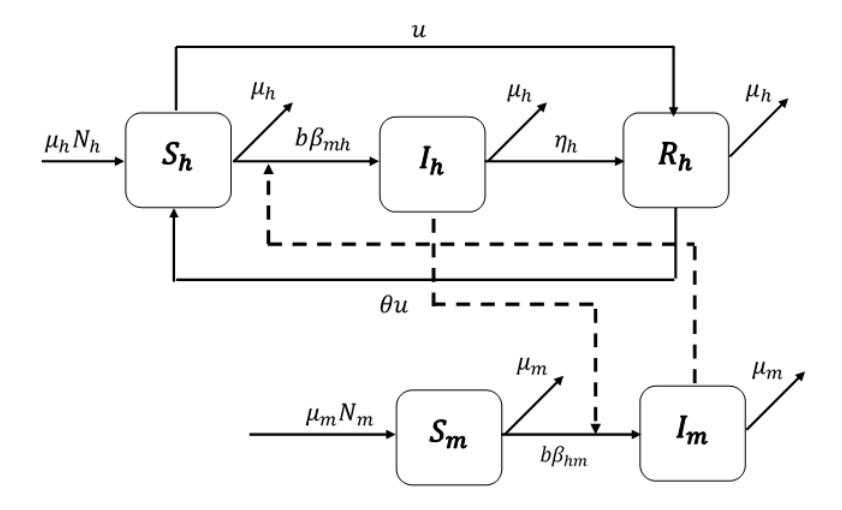
Figure 1: Dengue transmissions between compartments.
Then, the parameters used in this paper are described as in Tabel 1
| Unit | Valı | |
|---|---|---|
| n of humans | in days | 71x |
| n of adult magazitasa | in days | 00 |
| Parameter | Description | Unit | Value | references |
|---|---|---|---|---|
| \(\frac{1}{\mu_h}\) | Average lifespan of humans | in days | 71x365 | [14] |
| \(\frac{\frac{\mu_h}{1}}{\mu_m}\) | Average lifespan of adult mosquitoes | in days | 90 | [10] |
| \(\overset{\mu_{b}^{m}}{b}\) | Average number of bites on humans by mosquitoes | bites per days | 1 | [13] |
| \(\beta_{hm}\) | Transmission probability from infected mosquitoes | per bites | 0.375 | [14] |
| \(\beta_{mh}\) | Transmission probability from infected humans | per bites | 0.375 | [14] |
| \(\eta_h\) | Human recovery rate | in days | \(\frac{1}{3}\) | [14] |
Table 1: Parameters of dengue model.
A simple model of dengue is described by a system of five differential equations:
\[\frac{dS_h}{dt} = \mu_h N_h - \left(b\beta_{mh} \frac{I_m}{N_h} + \mu_h + u\right) S_h + \theta u R_h,\] \[\frac{dI_h}{dt} = b\beta_{mh} \frac{I_m}{N_h} S_h - (\eta_h + \mu_h) I_h,\] \[\frac{dR_h}{dt} = \eta_h I_h + u S_h - (\theta u + \mu_h) R_h,\] \[\frac{dS_m}{dt} = \mu_m N_m - \left(b\beta_{hm} \frac{I_h}{N_h} + \mu_m\right) S_m,\] \[\frac{dI_m}{dt} = b\beta_{hm} \frac{I_h}{N_h} S_m - \mu_m I_m.\] (1)
To simplify the analysis, we normalize the system above by define
\[s_h = \frac{S_h}{N_h}, i_h = \frac{I_h}{N_h}, r_h = \frac{R_h}{N_h}, s_m = \frac{S_m}{N_m}, i_m = \frac{I_m}{N_m}.\] (2)
Considering total population of human satisfy
\[\frac{N_h}{dt} = S_h + I_h + R_h, \frac{dN_h}{dt} = \frac{dS_h}{dt} + \frac{dI_h}{dt} + \frac{dR_h}{dt}.\] (3)
By substituting equations in Model (1) corresponded with (3), we obtain
\[\frac{dN_h}{dt} = \mu_h N_h - \left( b\beta_{mh} \frac{I_m}{N_h} + \mu_h + u \right) S_h + \theta u R_h + b\beta_{mh} \frac{I_m}{N_h} S_h - (\eta_h + \mu_h) I_h + \eta_h I_h + u S_h - (\theta u + \mu_h) R_h = \mu_h (N_h - (S_h + I_h + R_h)) = \mu_h (N_h - N_h) = 0.\] so that Nh constant. Write
\[\begin{array}{rcl} N_h & = & s_h N_h + i_h N_h + r_h N_h, \\ 1 & = & s_h + i_h + r_h, \\ r_h & = & 1 - s_h - i_h. \end{array}\]
Next, mosquitoes population satisfy
\[\begin{array}{rcl} N_m & = & S_m + I_m \\ \frac{dN_m}{dt} & = & \frac{dS_m}{dt} + \frac{dI_m}{dt}. \end{array} \tag{5}\]
Substitute Equations (1) that correspond to (5), so we have
\[\frac{dN_m}{dt} = \mu_m N_m - \left( b\beta_{hm} \frac{I_h}{N_h} + \mu_m \right) S_m + b\beta_{hm} \frac{I_h}{N_h} S_m - \mu_m I_m = \mu_m (N_m - (S_m + I_m)) = \mu_m (N_m - N_m) = 0,\] and we have Nm is constant, write
\[N_m = s_m N_m + i_m N_m,\]
\[1 = s_m + i_m,\]
\[i_m = 1 - s_m.\]
By derivating (2), we have
\[\dot{s}_{h} = \mu_{h} - \left(b\beta_{mh}\frac{i_{m}N_{m}}{N_{h}} + \mu_{h} + u\right)s_{h} + \theta u r_{h}, \dot{i}_{h} = b\beta_{mh}\frac{i_{m}N_{m}}{N_{h}}s_{h} - (\eta_{h} + \mu_{h})i_{h}, \dot{r}_{h} = \eta_{h}i_{h} + u s_{h} - (\theta u + \mu_{h})r_{h}, \dot{s}_{m} = \mu_{m} - (b\beta_{hm}i_{h} + \mu_{m})s_{m}, \dot{i}_{m} = b\beta_{hm}i_{h}s_{m} - \mu_{m}i_{m}.\] (6)
The basic reproduction number R0 of the system (6) is when the control u = 0. R0 is the key measure in estimating the ability of a new pathogen to spread. It is defined as the average number of secondary transmissions from one infected person; when R0 is greater than 1, the epidemic is growing. The R0 values have important implications for disease control. Basic reproduction number of the system given as
\[\mathcal{R}_0 = \sqrt{\frac{b^2 \beta_{hm} \beta_{mh} N_m}{N_h \mu_m (\mu_h + \eta_h)}}.\] the endemic condition accur when b 2βhmβmhNm > Nhµm(µh + ηh).
The Nm and Nh in equation are a number that represents the total population of mosquito (Nm) and total populations of human (Nh) that is a constant, but the term Nm/Nh on the normalized systems model is a proportion. Especially for the simulation, the value of Nm/Nh chosen so that 0 < Nm/Nh ≤ 1 holds. The The system (6) above is our basic dengue model that will be used to design a control system that disturbed in the next section.
3. STATE-DEPENDENT RICCATI EQUATION APPROACH ON DENGUE MODEL WITH DISTURBANCE
In the previous section, the dengue fever model has been constructed. In this section, we will construct dengue fever model taking into account the presence of the disturbance. This is based on the fact that the dynamics of the spread of the disease in the population is influenced by various factors from outside and inside so that the dynamics of the population is disturbed. This disturbance can be caused by measurements uncertainty of the model that can affect system's compartments. So, the transfer between each compartment is selected as the disturbances that represented by a covariance matrix and a random vector as a gain matrix. Then, the model with disturbances will be solved with State-dependent Riccati Equation (SDRE) approach.
The State-Dependent Riccati Equation (SDRE) strategy has become very popular within the control community, it has a powerful point that providing a very effective algorithm for synthesizing nonlinear feedback controls by allowing nonlinearities in the system states while additionally offering great design flexibility through state-dependent weighting matrices. SDRE is an approximation method with non-linear system parameterization to linear form. SDRE makes it easy to complete the system without linear because it is simpler in terms of computation and effectiveness [4]. Then, a feedback controller is designed to optimize the objective function regarding the disturbances of the system with SDRE approach. In control theory, there are two control problems that are often used, namely H2 control problem and H∞ control problem. H2 control aims to looking for a controller that stabilizes the system and optimizes the performance of the H2 [18] which is a Linear Quadratic Regulator problem (LQR) [16]. While the control H∞ aims to determine the controller that minimizes disturbance to the system [6]. In this study, we want a controller that can minimize the objective function related to reducing the number of infections through vaccination and at the same time reduce the effects of system disturbances. Therefore, using control problem H2 − H∞ that accommodates the combination of performance control H2 and H∞. The steps for working on this control design in the following subsections.
3.1. State-dependent Coefficient (SDC) System
Assume a nonlinear system
\[\dot{x} = f(x, u), z = g(x).\] (7)
Each f(x,u) and g(x) are nonlinear functions. Let \(x \in \mathbb{R}^n\) is state system dynamics, an input \(u \in \mathbb{R}^m\), an output \(z \in \mathbb{R}^p\), the normal random disturbance \(w \in \mathbb{R}^q\). based on [11], the SDRE transform (7) into an state-dependent coefficient (SDC) system in the following.
\[\dot{x} = A_u(x)x + B_u(x)u + F_u(x)w,\] \[z = C_u(x)x.\] (8)
The parametization of SDC System (8) must satisfies the pair of \(\{A_u(x), B_u(x)\}\) controllable and \(\{C_u(x), A_u(x)\}\) observable for \(x \in \Omega\) so that the closed-loop solution is a local asymtotically stable as explained in [11].
3.2. Dengue Model with SDC Form
Based on the previous subsection, the control design using SDC form. The nonlinear system is transformed into state-dependent parameterization. Let
\[x = \begin{bmatrix} s_h & i_h & r_h & s_m & i_m \end{bmatrix}^T. \tag{9}\]
Firstly, disturbance will be added into the deterministic nonlinear system. We define the disturbances as noise or statistics error. The disturbance defined as a gain matrix, denoted as F(x) that consist covariance matrix of probability transfer multiplied by a standard normal random vector w. Adopted from [1] and [12], the covariance matrix of transition probability obtained from possibilities in changes in the state x for a small time interval \(\Delta t\), assuming at most one change can occur. As mentioned before, the birth rate \(\mu_h\) increase the human population, but doesn't effect other compartments. Assume that in interval time \(\Delta t\), \(s_h \to s_h + 1\), and the probability of \(p_1 = \mu_h \Delta t\). Vector transition corresponding to \(\mu_h\) is \(\Delta X = \begin{bmatrix} X_1 & X_2 & X_3 & X_4 & X_5 \end{bmatrix}^T = \begin{bmatrix} \Delta s_h & \Delta i_h & \Delta r_h & \Delta s_m & \Delta i_m \end{bmatrix}^T = \begin{bmatrix} 1 & 0 & 0 & 0 & 0 \end{bmatrix}^T\). The vector transition and transition probabilities for each compartment are presented in Table 2.
Define the covariance matrix as
\[E[(\Delta x)(\Delta x)] = \sum_{i=1}^{10} p_i(\Delta X)_i(\Delta X)_i^T.\]
The gain matrix F as follow
\[F = \frac{E[(\Delta x)(\Delta x)]}{\Delta t},\] with \(E[(\Delta x)(\Delta x)]\) is covariance matrix that obtained from the normalized system when u=0 as derived in 6 and \(\Delta t\) is time interval. Then, write
\[F = \begin{bmatrix} F_{1,1} & -F_{1,2} & 0 & 0 & 0\\ -F_{1,2} & F_{2,2} & -F_{2,3} & 0 & 0\\ 0 & -F_{2,3} & F_{3,3} & 0 & 0\\ 0 & 0 & 0 & F_{4,4} & -F_{4,5}\\ 0 & 0 & 0 & -F_{4,5} & F_{5,5} \end{bmatrix},\](10)
with
\[\begin{array}{lll} F_{1,1} & = & \mu_h + b\beta_{mh}i_ms_hN_m/N_h + \mu_hs_h, \\ F_{1,2} & = & b\beta_{mh}i_ms_hN_m/N_h, \\ F_{2,2} & = & b\beta_{mh}i_ms_hN_m/N_h + (\eta_h + \mu_h)i_h, \\ F_{2,3} & = & \eta_hi_h, \\ F_{3,3} & = & \eta_hi_h + \mu_hr_h, \\ F_{4,4} & = & \mu_m + b\beta_{hm}i_hs_m + \mu_ms_m, \\ F_{4,5} & = & b\beta_{hm}i_hs_m, \\ F_{5,5} & = & b\beta_{hm}i_hs_m + \mu_mi_m. \end{array}\]
Let w is standard normal distributed random variable denoted as follow
\[w = [w_1 \quad w_2 \quad w_3 \quad w_4 \quad w_5]^T. \tag{11}\]
In this paper the dengue model with disturbance constructed by adding disturbance matrix F(x)w to the model (6), written by
\[\dot{s}_{h} = \mu_{h} - \left(b\beta_{mh}\frac{i_{m}N_{m}}{N_{h}} + \mu_{h} + u\right)s_{h} + \theta u r_{h} + F_{1,1}w_{1} - F_{1,2}w_{2},\] \[\dot{i}_{h} = b\beta_{mh}\frac{i_{m}N_{m}}{N_{h}}s_{h} - (\eta_{h} + \mu_{h})i_{h} - F_{1,2}w_{1} + F_{2,2}w_{2} - F_{2,3}w_{3},\] \[\dot{r}_{h} = \eta_{h}i_{h} + u s_{h} - (\theta u + \mu_{h})r_{h} - F_{2,3}w_{2} + F_{3,3}w_{3},\] \[\dot{s}_{m} = \mu_{m} - (b\beta_{hm}i_{h} + \mu_{m})s_{m} + F_{4,4}w_{4} - F_{4,5}w_{5},\] \[\dot{i}_{m} = b\beta_{hm}i_{h}s_{m} - \mu_{m}i_{m} - F_{4,5}w_{5} + F_{5,5}w_{5}.\] \[(12)\]
From this system, a feedback control scheme using State-Dependent Riccati Equation (SDRE) will be designed. First, we transform Model (12) to state dependent coefficient (SDC) form. By algebraic manipulation, the SDC system with disturbance from (12) written as follow
\[\dot{x} = A(x)x + B(x)u + F(x)w,\tag{13}\] with
\[A(x) = \begin{bmatrix} -b\beta_{mh}i_{m}N_{m}/N_{h} & \mu_{h} & \mu_{h} & 0 & 0\\ 0 & -\eta_{h} - \mu_{h} & 0 & 0 & b\beta_{mh}s_{h}N_{m}/N_{h}\\ 0 & \eta_{h} & -\mu_{h} & 0 & 0\\ 0 & 0 & 0 & -b\beta_{hm}i_{h} & \mu_{m}\\ -b\beta_{hm}s_{m} & 0 & -b\beta_{hm}s_{m} & b\beta_{hm} & -\mu_{m} \end{bmatrix},\](14)
\[B(x) = \begin{bmatrix} -s_h + \theta r_h \\ 0 \\ s_h - \theta r_h \\ 0 \\ 0 \end{bmatrix}, \tag{15}\]
\[F(x) = F\].
In the next section, we will construct a control problem of model with disturbance then the problem will be solved by a mixed \(H_2 - H_{\infty}\) with SDRE approach adapting a proposed performance criteria from Wang, et.al. [16].
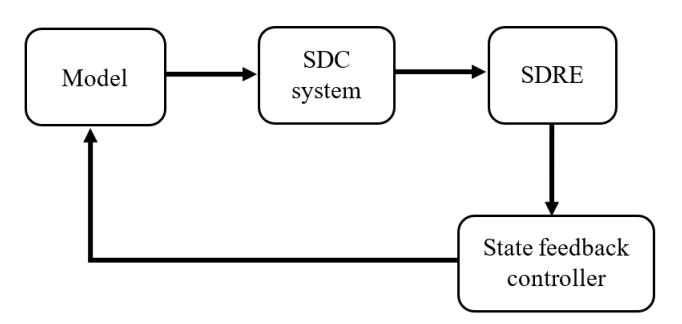
Figure 2: Control design scheme.
Table 2: Transition vector and probability.
| Transition Vector | Transition Probabilities |
|---|---|
| \[\Delta X_1 = \begin{bmatrix} 1 & 0 & 0 & 0 & 0 \end{bmatrix}^T\] | \[p_1 = \mu_h \Delta t\] |
| \[\Delta X_2 = \begin{bmatrix} -1 & 1 & 0 & 0 & 0 \end{bmatrix}^T\] | \[p_2 = b\beta_{mh} \frac{i_m N_m}{N_h} \Delta t\] |
| \[\Delta X_3 = \begin{bmatrix} 0 & -1 & 1 & 0 & 0 \end{bmatrix}^T\] | \[p_3 = \eta_h i_h \Delta t\] |
| \[\Delta X_4 = \begin{bmatrix} 0 & 0 & 0 & -1 & 1 \end{bmatrix}^T\] | \[p_4 = b\beta_{hm}i_hs_m\Delta t\] |
| \[\Delta X_5 = \begin{bmatrix} -1 & 0 & 0 & 0 & 0 \end{bmatrix}^T\] | \[p_5 = \mu_h s_h \Delta t\] |
| \[\Delta X_6 = \begin{bmatrix} 0 & -1 & 0 & 0 & 0 \end{bmatrix}^T\] | \[p_6 = \mu_h i_h \Delta t\] |
| \[\Delta X_7 = \begin{bmatrix} 0 & 0 & -1 & 0 & 0 \end{bmatrix}^T\] | \[p_7 = \mu_h r_h \Delta t\] |
| \[\Delta X_8 = \begin{bmatrix} 0 & 0 & 0 & -1 & 0 \end{bmatrix}^T\] | \[p_8 = \mu_m s_m \Delta t\] |
| \[\Delta X_9 = \begin{bmatrix} 0 & 0 & 0 & 0 & -1 \end{bmatrix}^T\] | \[p_9 = \mu_m i_m \Delta t\] |
| \[\Delta X_{10} = \begin{bmatrix} 0 & 0 & 0 & 1 & 0 \end{bmatrix}^T\] | \[p_{10} = \mu_m \Delta t\] |
3.3. \(H_2 - H_{\infty}\) Control Design with SDRE
In this section, we will apply the methods to form a controller that minimizes the infected human and reducing the disturbance. In general, step we use to design the control is shown at Figure 2. The objective of \(H_2\) control problem is to find the controller that stabilizes the system and optimizes \(H_2\) performance [18] that has linear quadratic regulator (LQR) problem [16]. Besides, the objective of \(H_{\infty}\) control problem is to find the controller that minimizes disturbance of the system [6]. The disturbance reduction implying the \(H_{\infty}\) control that is ensure the stability of the system and and guarantees the gain bounded by \(\theta\) [16]. To get a mixed \(H_2 - H_{\infty}\) with SDRE approach, Wang et. al in [16] define a mix performance criteria for the controller
Desired objective for this control problem is the decreasing of infected human \(i_h\), so the output y of this design is given by
\[y = i_h = C(x)x, (16)\] with
\[C(x) = [0 \quad 1 \quad 0 \quad 0 \quad 0].\]
It is shown in Appendix that A(x), B(x), and C(x) satisfies the pair \(\{A(x), B(x)\}\) controllable and \(\{C(x), A(x)\}\) observable in \(D = \{x \in \mathbb{R}^5 | x \neq 0\}\). We aim to minimizes the infected human through vaccination and a proportion of susceptible human vaccinated so that the susceptible become resistant, that is \(H_2\) performance that denoted by LQR problem \(\int_0^T (u^2 + s_h^2 + i_h^2) dt\). in SDC form, can be written by
\[\int_0^T x^T Q(x)x + u^T R u \, dt,\tag{17}\]
with
\[R = 1, (18)\]
\[\text{[rumus tidak dapat ditampilkan dengan baik — lihat PDF asli]}\]
Next, the feedback controller should reduce the disturbance in the system. Therefore, in this study, the control must satisfies \(H_{\infty}\) performance criteria problem. To find a feedback controller that accommodates \(H_2\) in (17) and \(H_\infty\) and (26) performance by SDRE. Assume that the controller is a state feedback, that is
\[u = K(x)x. (20)\]
The state feedback gain K(x) will be designed so the close-loop system
\[A_c(x) = A_u(x) + B_u(x)K(x), \tag{21}\] is asymtotically stable. Given a Lyapunov function
\[V = x^T P(x)x \le 0, (22)\]
\(P(x) \le 0\) is a function that satisfies the following performance criteria
\[\dot{V} = x^T Q(x) x + u^T R u + z^T z - \gamma^2 w^T w \le 0, \tag{23}\]
\[\dot{V} = x^T Q(x) x + u^T R u + z^T z - \gamma^2 w^T w \le 0,\] \[V(T) + \int_0^T [x^T Q(x) x + u^T R u + z^T z - \gamma^2 w^T w] dt \le V(0).\] (23)
Q(x) is a positive semi-definite matrix and R is positive definite matrix. Note that \(\int_0^T x^T Q(x) x + u^T R u \, dt\)in the (24) represents \(H_2\) performance in (17), an LQR control problem that always a semi-definite positive. For V(0) = 0 and V(T) > 0,
\[\int_0^T z^T z dt \le \int_0^T \gamma^2 w^T w dt, \tag{25}\] or
\[\sup_{||w||_2 \neq 0} \frac{||z||_2^2}{||w||_2^2} \le \gamma^2. \tag{26}\]
Inequality (26) is a \(H_{\infty}\) control objective that presented by Wang, etc (2017). From Lyapunov function (22), System (13) and Control (20), and by simplifying the notation by drop the argument x, performance criteria (23) become
\[x^{T}P(Ax + BKx + Fw) + (Ax + BKx + Fw)^{T}Px + x^{T}\dot{P}x + x^{T}Qx + x^{T}K^{T}BKx + x^{T}C^{T}Cx - \gamma^{2}w^{T}w \le 0.\] (27)
By schur complement and ensure the stability of the system by setting the quadratic function (22), the state-feedback gain K(x) = K in (20) derived as follow
\[K = -R^{-1}B^TP.\] and P is positive definite solution of SDRE
\[0 = PA + A^{T}P + Q + C^{T}C + \gamma^{-2}PFF^{T}P - PB^{T}R^{-1}B^{T}P.\]
The control is a proportion of susceptible human that decides to vaccinate at time t, so u value lies between \((0 \le u \le 1)\). To ensure the controller u satisfies this limitation, therefore the optimal feedback controller is
\[u^* = min(1, maks(u, 0)) = min(1, maks(Kx, 0)).\] (28)
Note that if Q(x) = 0 and R = 1, this feedback gain controller above satisfies th \(H_{\infty}\) controller proposed by Hammet in [7].
4. SIMULATION
In this section, we present the numerical results of mixed H2 − H∞ control with SDRE for dengue model with disturbance. The simulations were carried out using a chosen θ = 0.05 that represents proportion of resistant who come back to susceptible at time t and initial value of state is (sh,0, ih,0, rh,0, sm,0, im,0) = (0, 9; 0, 1; 0; 0, 8; 0, 2) for 200 days observation. In this numerical simulation three cases are chosen to see
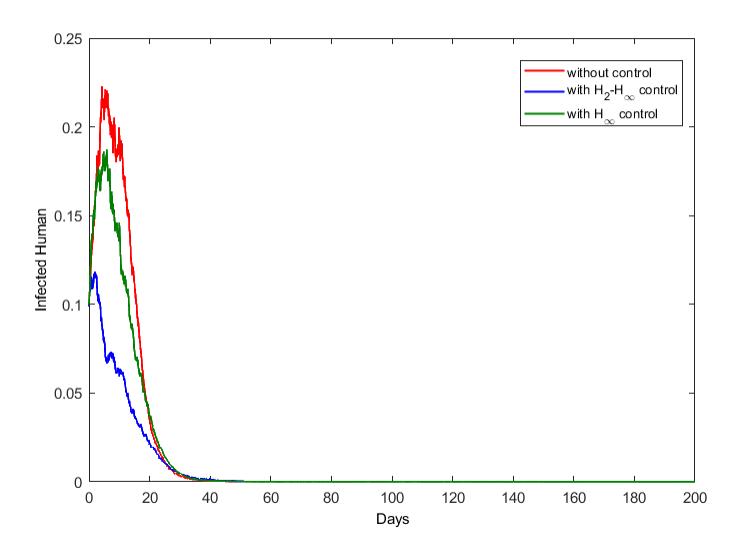
Figure 3: Infected Human.
how the mixed control behave on decreasing the infected human, that is H2 − H∞ control, H∞ control and without control. The comparison of infected human compartment with H2 − H∞ control, H∞ control and without control for showed in Figure 3. Then control is given in Figure 4. It shows from Figure 3 that the mixed H2 − H∞ control can reduce the infected human more effective than H∞ control because it is associated by H2 performance to optimizes the objective from ancient time. The difference of H2 − H∞ and H∞ control effectiveness is caused by its value that is showed by Figure 4. H2 −H∞ control has more effort that have to use full control at the beginning to decrease the infected human as in Figure 3. Besides, H∞ control has a lower initial value, that is 0.2067. Along the period, H2 − H∞ and H∞ control have similar dynamic that is from initial value it decrease to zero, then become full at 15th-17th days associated with the peak of infected mosquitoes peak and then dramatically decreasing to zero. The increasing of the control can be seen as second preventive step against infected mosquito because in this work we assume that vaccinated individuals go back to susceptible.
Next, the disturbance reduction effectiveness of control can be evaluated by comparing value difference each two iteration. We wish that the population dynamic doesn't have big difference or noise at each time in order to have less randomness and the system be more precise. The less jumping value means less disturbance. The difference of each two value per iteration for infected human compartment given in Figure 5. It can be seen from Figure 5 that each of H2 − H∞ and H∞ control con reduce the disturbance in general. Then, the maximum difference value can be reduced by 53.42%using H2 −H∞ control and 16.46% using H∞ control. So, the mixed H2−H∞ control effectively decrease both of infected human and maximum disturbance effect than H∞. SDRE and H2 − H∞ are quite common method in engineering, but it performance can be used in epidemiological case and interpret the dynamics well.
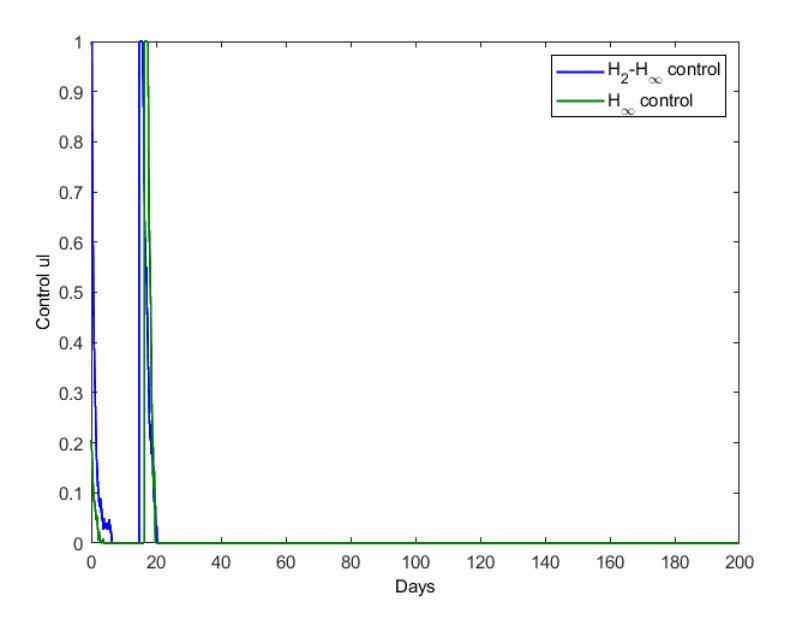
Figure 4: Infected Human.
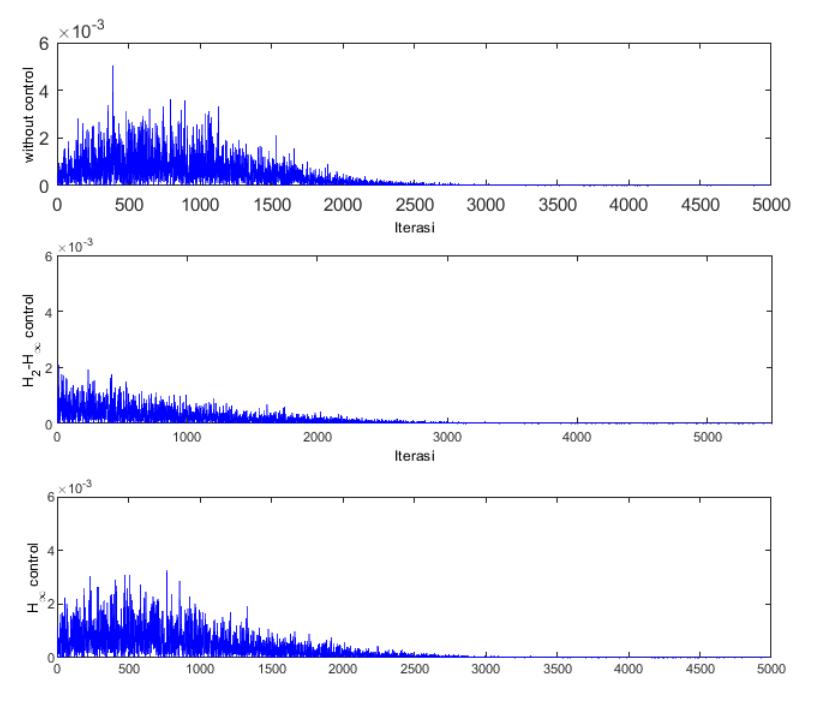
Figure 5: Infected Human.
5. CONCLUSION
Dengue fever has become world health problem in recent decades. Due to the limitation of vector control, dengue vaccine plays an important role in disease eradication and its development has become a major advance to control the disease. Vaccination program aims to reduce the prevalence of dengue disease. Vaccine assumed to be imperfect, that is give temporary protection. Furthermore, the vaccine control is defined as a new control variable that represents the proportion of susceptible human that decides to vaccinate at each time. In the third part of the paper, considering that the disease transmission can be disturbed by measurement uncertainty of the model that can affect system's compartments. the disturbance is defined by a gain matrix that consist covariance matrix transition probabilities between compartments multiplied by a random vector. Then, in order to decrease the infected and disturbance, a mixed H2 − H∞ control with SDRE method for dengue model is derived. Based on simulation result, this control effectively decrease both of objective, and its performance is better than H∞ control. With this control scheme, control is given two times in infection period. The first is to reduce the infected human and the second is to prevent second infection from infected mosquito because the vaccine is short-time protection.
ACKNOWLEDGEMENT
Parts of this article were funded by research grant.