Ali Reza Ashrafia , Ahmad Gholamib , Zeinab Mehranianb
aDepartment of Pure Mathematics, Faculty of Mathematical Sciences, University of Kashan, Kashan 87317-53153, I. R. Iran bDepartment of Mathematics, University of Qom, Qom, I. R. Iran
ashrafi@kashanu.ac.ir, a.gholami@qom.ac.ir, mehranian.z@gmail.com
The power graph P(G) of a group G is the graph with group elements as vertex set and two elements are adjacent if one is a power of the other. The aim of this paper is to compute the automorphism group of the power graph of several well-known and important classes of finite groups.
Keywords: power graph, automorphism group Mathematics Subject Classification: 05C25 DOI:10.5614/ejgta.2017.5.1.8
1. Introduction
The investigation of graphs associated to algebraic structures is very important, because such graphs are closely related to automata theory [8] and have valuable applications [9]. In this paper we describe the automorphism groups of the undirected power graphs of the dicylic groups T4n, the semidihedral groups SD8n, and the groups U6n and V8n appearing in the textbook of James and
Received: 15 January 2016, Revised: 19 February 2017, Accepted: 22 February 2017.
Liebeck [7]. For even n, V8n is described in [6]. These groups have the following presentations:
\[T_{4n} = \langle a, b \mid a^{2n} = 1, a^n = b^2, b^{-1}ab = a^{-1} \rangle,\] \[SD_{8n} = \langle a, b \mid a^{4n} = b^2 = 1, bab = a^{2n-1} \rangle,\] \[U_{6n} = \langle a, b \mid a^{2n} = b^3 = 1, b^{-1}ab = a^{-1} \rangle,\] \[V_{8n} = \langle a, b \mid a^{2n} = b^4 = 1, aba = b^{-1}, ab^{-1}a = b \rangle.\]
A directed graph Γ = (V, E) consists of a nonempty set V of vertices and a set E of ordered pairs of distinct vertices called edges. An undirected graph (or graph for short) is given by a set V of vertices and set E of edges which are unordered pairs of distinct vertices.
The directed power graph of a semigroup G is a graph in which V (P(G)) = G and two distinct elements x and y are adjacent if and only if y is a power of x. This directed graph was firstly introduced by Kelarev and Quinn in their seminal paper [10]. In the mentioned paper, they gave a very technical description of the structure of the power graphs of all finite abelian groups. Kelarev and his co-workers [11, 12, 13], studied some other classes of semigroups by directed power graph.
The undirected power graph P(G) (or power graph for short) of a semigroup G was introduced by Chakrabarty et al. in [5]. It is proved that if G is finite group then P(G) is connected if and only if G is periodical and if G is a finite group then P(G) is complete if and only if G is cyclic of order 1 or p m, where p is prime and m ≥ 1 is a natural number. They also obtained exact formula for the number of edges in a finite power graph. Cameron and Ghosh [3] proved that the only finite group whose automorphism group is the same as its power graph is the Klein group of order 4. They also conjectured that two finite groups with isomorphic power graphs have the same number of elements of each order that proved by Cameron in [4]. Mirzargar et al. [15], considered some graph theoretical properties of a power graph that can be related to its group theoretical properties and in [17], the authors considered the problem of 2−connectivity of the power graphs into account and in [2] this problem is solved in some classes of finite simple groups.
The proper power graph P(G) of a group G is obtained from the power graph of G by deleting the identity element as a vertex. The power graph of a group is always connected, since identity element is adjacent to every other vertex. Moghaddamfar et al. [16] proved that P ? (G) is connected if and only if G has a unique minimal subgroup. Further, P ? (G) is shown to be bipartite if and only if no element of G has order greater than 3, and to be planar if and only if no element of G has order greater than 6. We refer to [1] for a complete survey of recent results on this topic.
Throughout this paper our graph theory notations are standard and can be taken from the standard books on graph theory or [8]. To simplify our figures, the power graph of the cyclic group of order n is denoted by Zn. Other notations are standard and can be taken from the book of James and Liebeck [7] or [8].
In this paper we prove the following results:
Theorem 1.1.
\[\operatorname{Aut}(\mathcal{P}(T_{4n})) \cong \begin{cases} S_{2n-2} \times S_2 \times (S_2 \wr S_n), & \text{if $n$ is a power of $2$} \\ \prod_{d|2n} S_{\phi(d)} \times (S_2 \wr S_n), & \text{otherwise} \end{cases}, \\ \operatorname{where } n \geq 3, \\ \operatorname{Aut}(\mathcal{P}(SD_{8n})) \cong \begin{cases} S_{4n-2} \times S_{2n} \times (S_2 \wr S_n), & \text{if $n$ is a power of $2$} \\ \prod_{d|4n} S_{\phi(d)} \times S_{2n} \times (S_2 \wr S_n), & \text{otherwise} \end{cases}, \\ \operatorname{where } n \geq 2, \\ \operatorname{Aut}(\mathcal{P}(U_{6n})) \cong \begin{cases} \prod_{d|3n} S_{\phi(d)} \times \prod_{d|2n,d\nmid n} S_{\phi(d)} \wr S_3 & k = 0 \\ \prod_{d|2n,d\nmid n} S_{\phi(d)} \wr S_3 \times \prod_{d|n} S_{\phi(d)} \times \prod_{d|3n,d\nmid t} S_{\phi(d)} \wr S_3 & k = 1 \\ \prod_{d|2n,d\nmid n} S_{\phi(d)} \wr S_3 \times \prod_{d|n} S_{\phi(d)} \times \prod_{d|3t,d\nmid t} S_{\phi(d)} \wr S_3 & k \geq 2 \end{cases} \\ \operatorname{where } k \text{ is nonnegative integer and satisfies } n = 3^k t \text{ and some positive integer $t$ such that $3 \nmid t$,} \\ \operatorname{Aut}(\mathcal{P}(V_{8n})) \cong \begin{cases} S_{2n} \times S_2 \wr S_n \times \prod_{d|2n,d\nmid n} S_{\phi(d)} \wr S_2 \times \prod_{d|2n} S_{\phi(d)} & k = 0, \\ S_{2n+1} \times S_2 \wr S_n \times \prod_{d|1} S_{\phi(d)}^{k-1} \times S_{2k}^2 \times S_{2k} \wr S_2 & t = 1, k \geq 1 \\ S_{2n} \times S_2 \wr S_n \times \prod_{d|t} S_{\phi(d)}^{k-1} \times \prod_{s=2}^k \prod_{d|2^{st}, d\nmid 2^{s-1} t} S_{\phi(d)}^2 & \times 1, k \geq 1 \end{cases}\]
where \(n = 2^k t\) for a nonnegative k and some positive odd integer t.
We also describe the automorphism groups of the undirected power graphs of the first Mathieu group \(M_{11}\) and first Janko group \(J_1\).
Theorem 1.2.
\[Aut(\mathcal{P}(M_{11})) \cong (S_{10} \wr S_{144}) \times (S_4 \wr S_{396}) \times (S_2 \wr S_{55}) \times ((S_6 \wr S_3) \times (S_2 \wr S_4) \times S_2) \wr S_{165}, Aut(\mathcal{P}(J_1)) \cong (S_{10} \wr S_{1596}) \times (S_6 \wr S_{4180}) \times (S_{18} \wr S_{1540}) \times ((S_2 \times S_8 \times S_4 \times (S_4 \wr S_3) \times (S_2 \wr S_5)) \wr S_2) \wr S_{1463}.\]
2. Power Graph Descriptions
Our proof of Theorem 1.1 relies upon the authors' earlier description of the power graphs of these groups [14].
Theorem 2.1.
\[\text{[rumus tidak dapat ditampilkan dengan baik — lihat PDF asli]}\]
Suppose \(\Gamma_1 = (V_1, E_1)\) and \(\Gamma_2 = (V_2, E_2)\) are graphs with disjoint vertex sets. The union \(\Gamma_1 \cup \Gamma_2\) is the graph with \(V(\Gamma_1 \cup \Gamma_2) = V_1 \cup V_2\) and \(E(\Gamma_1 \cup \Gamma_2) = E_1 \cup E_2\). For positive integers n, we write \(n\Gamma\) to denote the union of n disjoint copies of \(\Gamma\).
Theorem 2.2. Suppose Γ = n1Γ1 ∪ n2Γ2 ∪ · · · ∪ ntΓt with Γi 6∼= Γj for i 6= j. Then, Aut(Γ) = Aut(Γ1) o Sn1 × Aut(Γ2) o Sn2 × · · · × Aut(Γt) o Snt .
Let Γ = (V, E) be a graph, and for each v ∈ V , let ∆v be a graph. Following Sabidussi [18, p. 396], the Γ−join of {∆v}v∈V is the graph Γ[{∆v}v∈V ] with
\[V(\Gamma[\{\Delta_v\}_{v \in V}]) = \{(x, y) \mid x \in V \& y \in V(\Delta_x)\},\]
\[E(\Gamma[\{\Delta_v\}_{v \in V}]) = \{(x, y)(x', y') \mid xx' \in E \text{ or } x = x' \& yy' \in E(\Delta_x)\}.\]
We represent the Γ−join pictorially by a graph Γ whose vertices are labeled by other graphs. In graph join diagrams, we abbreviate Zn = P(Zn). Note that P(Z2) is an edge and P(Z4) is the complete graph on four vertices.
Theorem 2.3. The following are hold:
- (1) In P(T4n), there is an element a of order 2 adjacent to every other element. P(T4n)\{e, a} ∼= T ∪nZ2, where T is the power graph of Z2n with the identity an element to order 2 removed.
- (2) The power graph of SD8n is depicted in 1. In this figure, D denotes the power graph of Z4n with the identity and element a to order 2 removed.
- (3) The power graph of U6n is depicted in Figure 2.
- (4) For odd integers n, P(V8n) is isomorphic to the nested graph join of Figure 3.
- (5) For n = 2k , P(V8n) is isomorphic to the nested graph join of Figure 4.
- (6) For n = 2k t, where k is positive and t is positive odd integer P(V8n) is isomorphic to the nested graph join of Figure 5.
The identity of a group is adjacent to every vertex in its power graph. If there is no other such vertex, then the identity is fixed by every automorphism and P(G) = P ? (G). More generally, if A is the set of all vertices adjacent to every vertex in a graph Γ, then Aut(Γ) is isomorphic to S|A|× Aut(Γ − A). By [5], the power graph of a group is complete if and only if the group is isomorphic to a cyclic group of prime power order.
Observe that if two elements of a group generate the same cyclic subgroup, then they have the same neighbors in the power graph of the group. In particular, there is an automorphism of the power graph which swaps two such elements while fixing every other vertex of the power graph. For the reason we often see direct summands of the form Sφ(d) . Cameron and Ghosh [3] proved that the only finite group whose automorphism group is the same as its power graph is the Klein group of order 4.
Suppose G is a finite group and x ∈ G. Then the degree of x in P(G) can be calculated by deg(x) = |{g ∈ G | hxi ≤ hgi or hgi ≤ hxi}|.
If n = 1 then P(T4) ∼= K4 and so Aut(K4) ∼= S4, and if n = 2 then Aut(P(T8)) ∼= C2 × C2 × S4. The other cases are considered in the following theorem:
Theorem 2.4. Suppose \(n \geq 3\) is a natural number. Then
\[\operatorname{Aut}(\mathcal{P}(T_{4n})) \cong \begin{cases} S_{2n-2} \times S_2 \times (S_2 \wr S_n), & n \text{ is a power of } 2\\ \prod_{d|2n} S_{\phi(d)} \times (S_2 \wr S_n), & otherwise \end{cases}\]
Proof. By Theorem 2.3, the power graph of \(T_{4n}\) can be constructed from a copy of \(\mathcal{P}(\mathbb{Z}_{2n})\) and n copies of \(K_4\) that all of them have a common edge ea such that o(a)=2. Note that vertices e and a have maximum degrees between vertices of \(\mathcal{P}(T_{4n})\). On the other hand,
\[\mathcal{P}(T_{4n}) - \{e, a\} \cong \tilde{\mathcal{P}}(\mathbb{Z}_{2n}) \cup \underbrace{K_2 \cup \cdots \cup K_2}_{n},\]
where \(\tilde{\mathcal{P}}(\mathbb{Z}_{2n}) \cong \mathcal{P}(\mathbb{Z}_{2n}) - \{e, a\}\). We now assume that n is a power of 2. Then deg(e) = deg(a) and \(\tilde{\mathcal{P}}(\mathbb{Z}_{2n})\) is complete graph of order 2n - 2. Therefore,
\[Aut(\mathcal{P}(T_{4n})) = Aut(\tilde{\mathcal{P}}(\mathbb{Z}_{2n})) \times Aut(K_2) \times Aut(K_2) \wr S_n \cong S_{2n-2} \times S_2 \times S_2 \wr S_n.\]
Otherwise, \(deg(e) \neq deg(a)\) and by Theorem 2.1,
\[Aut(\tilde{\mathcal{P}}(\mathbb{Z}_{2n})) \cong S_{\phi(2n)} \times \prod_{1,2,2n \neq d \mid 2n} S_{\phi(d)} \cong \prod_{d \mid 2n} S_{\phi(d)}.\]
Therefore,
\[Aut(\mathcal{P}(T_{4n})) = Aut(\tilde{\mathcal{P}}(\mathbb{Z}_{2n})) \times Aut(K_2) \wr S_n \cong \prod_{d|2n} S_{\phi(d)} \times (S_2 \wr S_n),\]
which completes the proof.
It is easy to see that if n=1 then \(Aut(\mathcal{P}(SD_8))\cong C_2\times (S_2\wr S_2)\). The other cases, are studied in the following theorem:
Theorem 2.5. Suppose \(n \ge 2\) is a natural number. Then,
\[Aut(\mathcal{P}(SD_{8n})) \cong \begin{cases} S_{4n-2} \times S_{2n} \times (S_2 \wr S_n), & n \text{ is a power of } 2\\ \prod_{d|4n} S_{\phi(d)} \times S_{2n} \times (S_2 \wr S_n), & otherwise \end{cases}\]
Proof. By Theorem 2.3, the power graph of \(SD_{8n}\) is a union of \(\mathcal{P}(\mathbb{Z}_{4n})\), n copies of \(\mathcal{P}(\mathbb{Z}_4)\) that share an edge and 2n copies of \(\mathcal{P}(\mathbb{Z}_2)\), all of them are connected to each other in the identity element of \(SD_{8n}\), Figure 1. Suppose \(n \geq 2\) and \(\tilde{\mathcal{P}}(\mathbb{Z}_{4n}) \cong \mathcal{P}(\mathbb{Z}_{4n}) - \{e, a\}\), where o(a) = 2. It is clear that the identity has maximum degree in \(\tilde{\mathcal{P}}(\mathbb{Z}_{4n})\) and so \(Aut(\mathcal{P}^*(SD_{8n})) = Aut(\mathcal{P}(SD_{8n}))\). On the other hand,
\[\mathcal{P}^*(SD_{8n}) - \{a\} = \tilde{\mathcal{P}}(\mathbb{Z}_{4n}) \cup \underbrace{K_2 \cup \cdots \cup K_2}_{n} \cup \underbrace{K_1 \cup \cdots \cup K_1}_{2n}.\]
We now assume that n is a power of 2. Then \(\tilde{\mathcal{P}}(\mathbb{Z}_{4n}) \cong K_{4n-2}\) and \(Aut(\tilde{\mathcal{P}}(\mathbb{Z}_{4n})) \cong S_{4n-2}\), So
\[Aut(\mathcal{P}(SD_{8n})) \cong S_{4n-2} \times S_{2n} \times (S_2 \wr S_n)\]
Otherwise, by Theorem 2.1,
\[Aut(\tilde{\mathcal{P}}(\mathbb{Z}_{4n})) \cong S_{\phi(4n)} \times \prod_{1,2,4n \neq d \mid 4n} S_{\phi(d)} \cong \prod_{d \mid 4n} S_{\phi(d)}.\]
Therefore,
\[Aut(\mathcal{P}(SD_{8n})) = Aut(\tilde{\mathcal{P}}(\mathbb{Z}_{4n})) \times S_{2n} \times Aut(K_2) \wr S_n \cong \prod_{d \mid 4n} S_{\phi(d)} \times S_2 \times (S_2 \wr S_n),\]
proving our result.
The power graph of the group \(U_{6n}\) is depicted in Figure 2 and in three cases that \(3 \nmid n\), \(3 \mid n\) and \(9 \nmid n\), and \(9 \mid n\), respectively.
Theorem 2.6. Suppose \(n = 3^k t\), where k is a non-negative integer and t is a positive integer such that \(3 \nmid t\) and \(k \geq 0\). Then
\[Aut(\mathcal{P}(U_{6n})) \cong \begin{cases} \prod_{d|3n} S_{\phi(d)} \times \prod_{d|2n,d\nmid n} S_{\phi(d)} \wr S_3, k = 0 \\ \prod_{d|2n,d\nmid n} S_{\phi(d)} \wr S_3 \times \prod_{d|n} S_{\phi(d)} \times \prod_{d|n,d\nmid t} S_{\phi(d)} \wr S_3, k = 1 \\ \prod_{d|2n,d\nmid n} S_{\phi(d)} \wr S_3 \times \prod_{d|n} S_{\phi(d)} \times \prod_{d|3t,d\nmid t} S_{\phi(d)} \wr S_3 \times \prod_{d|n,d\nmid 3t} S_{\phi(d)} \wr S_2, k \geq 2 \end{cases}\]
Proof. Our main proof consider three cases as follows:
1. k=0. In this case, the power graph can be constructed from a copy of \(\mathcal{P}(\mathbb{Z}_{3n})\) and three copies of \(\mathcal{P}(\mathbb{Z}_{2n})\) all of them share a subgraph isomorphic to \(\mathcal{P}(\mathbb{Z}_n)\), Figure 2. Since the identity has maximum degree, \(Aut(\mathcal{P}^*(U_{6n})) \cong Aut(\mathcal{P}(U_{6n}))\). Define \(\tilde{\mathcal{P}}(\mathbb{Z}_{3n}) = \mathcal{P}(\mathbb{Z}_{3n}) - \mathcal{P}(\mathbb{Z}_n)\) and \(\tilde{\mathcal{P}}(\mathbb{Z}_{2n}) = \mathcal{P}(\mathbb{Z}_{2n}) - \mathcal{P}(\mathbb{Z}_n)\). Thus,
\[Aut(\mathcal{P}^*(U_{6n})) = Aut(\tilde{\mathcal{P}}(\mathbb{Z}_{3n})) \times Aut(\mathcal{P}(\mathbb{Z}_n)) \times Aut(\tilde{\mathcal{P}}(\mathbb{Z}_{2n})) \wr S_3,\] \[\cong \prod_{d|3n,d\nmid n} S_{\phi(d)} \times \prod_{d|n} S_{\phi(d)} \times \prod_{d|2n,d\nmid n} S_{\phi(d)} \wr S_3,\] \[\cong \prod_{d|3n} S_{\phi(d)} \times \prod_{d|2n,d\nmid n} S_{\phi(d)} \wr S_3.\]
2. k=1. By Theorem 2.3, the power graph can by constructed from three copies of \(\mathcal{P}(\mathbb{Z}_{2n})\) and four copies of \(\mathcal{P}(\mathbb{Z}_n)\) in such a way that all copies of \(\mathcal{P}(\mathbb{Z}_{2n})\) share a subgraph isomorphic to \(\mathcal{P}(\mathbb{Z}_n)\) and three of four copies of \(\mathcal{P}(\mathbb{Z}_n)\) share in a subgraph isomorphic to \(\mathcal{P}(\mathbb{Z}_t)\), Figure 2. Define \(\tilde{\mathcal{P}}(\mathbb{Z}_n) = \mathcal{P}(\mathbb{Z}_n) - \mathcal{P}(\mathbb{Z}_t)\) and \(\tilde{\mathcal{P}}(\mathbb{Z}_{2n}) = \mathcal{P}(\mathbb{Z}_{2n}) - \mathcal{P}(\mathbb{Z}_n)\). Since \(Aut(\mathcal{P}^*(U_{6n})) \cong Aut(\mathcal{P}(U_{6n}))\),
\[Aut(\mathcal{P}^{*}(U_{6n})) = Aut(\tilde{\mathcal{P}}(\mathbb{Z}_{2n})) \wr S_{3} \times Aut(\tilde{\mathcal{P}}(\mathbb{Z}_{n})) \times Aut(\mathcal{P}(\mathbb{Z}_{t})) \times Aut(\tilde{\mathcal{P}}(\mathbb{Z}_{n})) \wr S_{3},\] \[\cong \prod_{d|2n,d\nmid n} S_{\phi(d)} \wr S_{3} \times \prod_{d|n,d\nmid t} S_{\phi(d)} \times \prod_{d|t} S_{\phi(d)} \times \prod_{d|n,d\nmid t} S_{\phi(d)} \wr S_{3},\] \[\cong \prod_{d|2n,d\nmid n} S_{\phi(d)} \wr S_{3} \times \prod_{d|n} S_{\phi(d)} \times \prod_{d|n,d\nmid t} S_{\phi(d)} \wr S_{3}.\]
3. \(k \geq 2\). By Theorem 2.3, the power graph can be constructed from three copies of \(\mathcal{P}(\mathbb{Z}_{2n})\), three copies of \(\mathcal{P}(\mathbb{Z}_n)\), four copies of \(\mathcal{P}(\mathbb{Z}_{3t})\) and a copy of \(\mathcal{P}(\mathbb{Z}_t)\), see Figure 3. Define \(\tilde{\mathcal{P}}(\mathbb{Z}_{3t}) = \mathcal{P}(\mathbb{Z}_{3t}) - \mathcal{P}(\mathbb{Z}_t)\), \(\tilde{\mathcal{P}}(\mathbb{Z}_n) = \mathcal{P}(\mathbb{Z}_n) - \mathcal{P}(\mathbb{Z}_{3t})\) and \(\tilde{\mathcal{P}}(\mathbb{Z}_{2n}) = \mathcal{P}(\mathbb{Z}_{2n}) - \mathcal{P}(\mathbb{Z}_n)\). Therefore,
\[Aut(\mathcal{P}^{*}(U_{6n})) = Aut(\tilde{\mathcal{P}}(\mathbb{Z}_{2n})) \wr S_{3} \times Aut(\tilde{\mathcal{P}}(\mathbb{Z}_{n})) \times Aut(\tilde{\mathcal{P}}(\mathbb{Z}_{3t}))\] \[\times Aut(\mathcal{P}(\mathbb{Z}_{t})) \times Aut(\tilde{\mathcal{P}}(\mathbb{Z}_{3t})) \wr S_{3} \times Aut(\tilde{\mathcal{P}}(\mathbb{Z}_{n})) \wr S_{2},\] \[\cong \prod_{d|2n,d\nmid n} S_{\phi(d)} \wr S_{3} \times \prod_{d|n,d\nmid 3t} S_{\phi(d)} \times \prod_{d|3t,d\nmid t} S_{\phi(d)} \times \prod_{d\mid t} S_{\phi(d)}\] \[\times \prod_{d|3t,d\nmid t} S_{\phi(d)} \wr S_{3} \times \prod_{d|n,d\nmid 3t} S_{\phi(d)} \wr S_{2},\] \[\cong \prod_{d|2n,d\nmid n} S_{\phi(d)} \wr S_{3} \times \prod_{d|n} S_{\phi(d)} \times \prod_{d|3t,d\nmid t} S_{\phi(d)} \wr S_{3} \times \prod_{d|n,d\nmid 3t} S_{\phi(d)} \wr S_{2}.\]
This completes the proof.
Suppose \(n=2^kt\), where k is a non-negative and t is an odd positive integer. The power graph of the group \(V_{8n}\) is depicted in Figures 3, 4 and 5, in three cases that k=0, \((t=1,k\geq 1)\) and \(t>1,k\geq 1\), respectively. It can easily be seen that if n=1 then \(Aut(\mathcal{P}(V_8))\cong S_4\times S_3\). The other cases will be studies in the following theorem:
Theorem 2.7. Suppose \(n = 2^k t\), where k is a non-negative and t is an odd positive integer. Then
\[Aut(\mathcal{P}(V_{8n})) \cong \begin{cases} S_{2n} \times S_2 \wr S_n \times \prod_{d|2n,d\nmid n} S_{\phi(d)} \wr S_2 \times \prod_{d|2n} S_{\phi(d)} & k = 0 \\ S_{2n+1} \times S_2 \wr S_n \times \prod_{l=1}^{k-1} S_{2^l}^2 \times S_{2^k} \wr S_2 & t = 1, k \ge 1 \end{cases}\] \[\text{[rumus tidak dapat ditampilkan dengan baik — lihat PDF asli]}\]
Proof. Suppose \(n \geq 3\) is odd. From Figure 3, one can see that the identity has maximum degree. This shows that \(Aut(\mathcal{P}^*(V_{8n})) = Aut(\mathcal{P}(V_{8n}))\). On the other hand, \(\mathcal{P}^*(V_{8n}) = F^* \cup \underbrace{K_1 \cup \cdots \cup K_1}_{2n}\)
and so \(Aut(\mathcal{P}^*(V_{8n})) \cong S_{2n} \times Aut(F^*)\). Consider the element a of order 2 in F and \(F^{**} = F^* - \{a\}\). Since a has maximum degree, \(Aut(F^{**}) \cong Aut(F^*)\). Define \(\tilde{\mathcal{P}}(\mathbb{Z}_{2n}) = \mathcal{P}(\mathbb{Z}_{2n}) - \mathcal{P}(\mathbb{Z}_n) - \mathcal{P}(\mathbb{Z}_2)\). We have:
\[Aut(F^{**}) \cong S_2 \wr S_n \times Aut(\tilde{\mathcal{P}}(\mathbb{Z}_{2n})) \wr S_2 \times Aut(\tilde{\mathcal{P}}(\mathbb{Z}_{2n})) \times Aut(\mathcal{P}(\mathbb{Z}_n))\] \[\cong S_2 \wr S_n \times \prod_{d|2n,d\nmid n} S_{\phi(d)} \wr S_2 \times \prod_{d|2n,d\nmid n} S_{\phi(d)} \times \prod_{d|n} S_{\phi(d)}\] \[\cong S_2 \wr S_n \times \prod_{d|2n,d\nmid n} S_{\phi(d)} \wr S_2 \times \prod_{d|2n} S_{\phi(d)}.\]
This completes the proof of part (1).
For part (2), we first assume that k=1. Then \(Aut(\mathcal{P}(V_{16})) \cong S_5 \times (S_2 \wr S_2) \wr S_2\), as desired. If \(k \geq 2\) then by Figure 4, \(Aut(\mathcal{P}^*(V_{8n})) \cong Aut(\mathcal{P}(V_{8n}))\) and \(\mathcal{P}^*(V_{8n})) = \underbrace{K_1 \cup \cdots \cup K_1}_{2n+1} \cup R^* \cup S^*\)
which implies that \(\mathcal{P}^*(V_{8n}) \cong S_{2n+1} \times Aut(R^*) \times Aut(S^*)\). On the other hand, \(Aut(S^*) \cong S_2 \wr S_n\). So, it is enough to calculate \(Aut(R^*)\). To do this, we define \(\mathcal{P}(\tilde{\mathbb{Z}}_{2^l}) = \mathcal{P}(\mathbb{Z}_{2^l}) - \mathcal{P}(\mathbb{Z}_{2^{l-1}}), 2 \leq l \leq k+1\). Then
\[Aut(R^*) = \prod_{l=2}^k (Aut(\mathcal{P}(\tilde{\mathbb{Z}}_{2^l})))^2 \times Aut(\mathcal{P}(\tilde{\mathbb{Z}}_{2^{k+1}})) \wr S_2,\] \[\cong \prod_{l=2}^k S_{2^{l-1}}^2 \times S_{2^k} \wr S_2,\] \[\cong \prod_{l=1}^{k-1} S_{2^l}^2 \times S_{2^k} \wr S_2.\]
This proved the part (2).
To prove (3), we note that by Figure 5, one can see that \(Aut(\mathcal{P}^*(V_{8n})) = Aut(\mathcal{P}(V_{8n}))\) and \(\mathcal{P}^*(V_{8n}) \cong \underbrace{K_1 \cup \cdots \cup K_1}_{2n} \cup J^*\). Hence \(Aut(\mathcal{P}^*(V_{8n})) \cong S_{2n} \times Aut(J^*)\). Again we assume that a
is an element of order 2 in J. It is clear that a has maximum degree in J. If \(J^{**} = J^* - \{a\}\) then \(Aut(J^{**}) \cong Aut(J^*)\). Define \(\tilde{\mathcal{P}}(\mathbb{Z}_{2^{s_t}}) = \mathcal{P}(\mathbb{Z}_{2^{s_t}}) - \mathcal{P}(\mathbb{Z}_{2^{s-1}t})\), \(1 \leq s \leq k+1\). Then
\[Aut(J^{**}) \cong S_2 \wr S_n \times Aut(\mathcal{P}(\mathbb{Z}_t)) \times Aut(\mathcal{P}(\tilde{\mathbb{Z}}_{2t}))^3\]\[\times \prod_{s=2}^k Aut(\mathcal{P}(\tilde{\mathbb{Z}}_{2^{s_t}}))^2 \times Aut(\mathcal{P}(\tilde{\mathbb{Z}}_{2^{k+1}t})) \wr S_2.\]
Since t is odd, P(Zt) = P ˜(Z2t) and so Aut(P(Zt)) ∼= Aut(P ˜(Z2t)). Therefore,
\[Aut(J^{**}) \cong S_2 \wr S_n \times Aut(\mathcal{P}(\mathbb{Z}_t))^4 \times \prod_{s=2}^k Aut(\mathcal{P}(\tilde{\mathbb{Z}}_{2^{s_t}}))^2 \times Aut(\mathcal{P}(\tilde{\mathbb{Z}}_{2^{k+1}t})) \wr S_2\] \[\cong S_2 \wr S_n \times \prod_{d|t} S_{\phi(d)}^4 \times \prod_{s=2}^k \prod_{\substack{d|2^{s_t} \\ d\nmid 2^{s-1}t}} S_{\phi(d)}^2 \times \prod_{\substack{d|2^{k+1}t \\ d\nmid 2^{k}t}} S_{\phi(d)} \wr S_2.\]
This completes the proof.
Figure 1. The power graph of the semi−dihedral group SD8n.
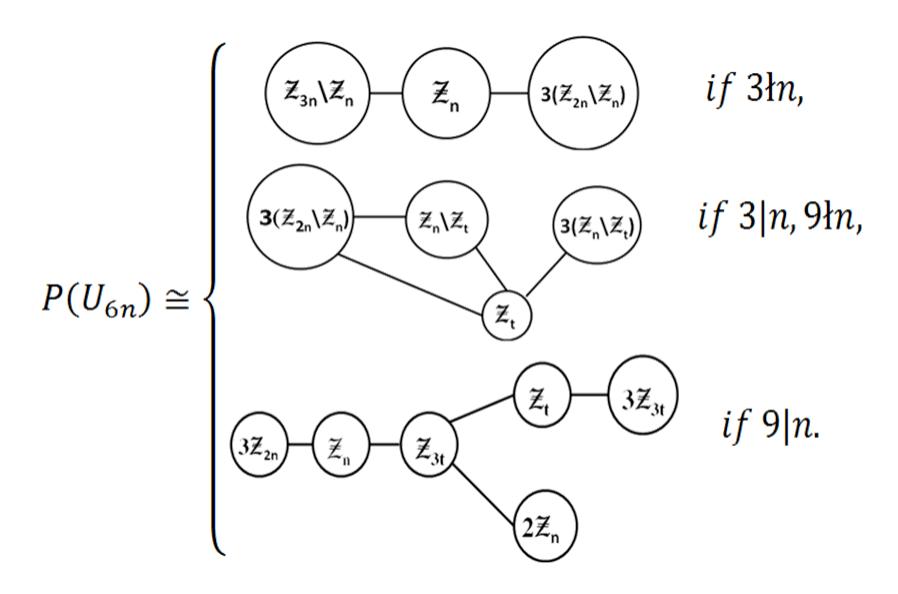
Figure 2. The power graph of U6n.
3. Concluding Remarks
In this paper the automorphism group of the power graphs of some families of finite groups are computed. The present authors [14] asked the following question:
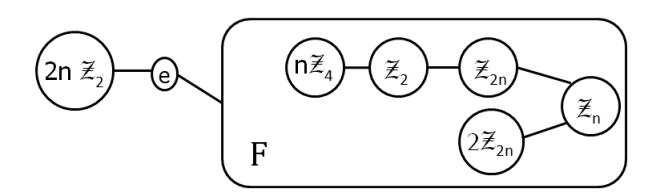
Figure 3. The graph P(V8n), where n is odd.
Figure 4. The graph P(V8n), where n = 2k .
Figure 5. The graph P(V8n), where n = 2k t, k is positive and t is positive odd integer.
Figure 6. The graph P(M11).
Figure 7. The graph \(\mathcal{P}(J_1)\).
Question. What is the automorphism group of \(\mathcal{P}(G)\), where G is a sporadic group?
In this section, the automorphism group of \(\mathcal{P}(M_{11})\) and \(\mathcal{P}(J_1)\) are computed. We start this section by computing the automorphism group of the first Mathieu group.
Proposition 3.1. The automorphism group of the power graph of the first Matheiu group \(M_{11}\) is isomorphic to
\[(S_{10} \wr S_{144}) \times (S_4 \wr S_{396}) \times (S_2 \wr S_{55}) \times ((S_6 \wr S_3) \times (S_2 \wr S_4) \times S_2) \wr S_{165}.\]
Proof. In [14] it is proved that the power graph of \(\mathcal{P}(M_{11})\) has exactly 7920 vertices. This graph can be constructed from 165 copies of a graph L, Figure 6, 55 copies of \(\mathcal{P}(\mathbb{Z}_3)\), 396 copies of \(\mathcal{P}(\mathbb{Z}_5)\) and 144 copies of \(\mathcal{P}(\mathbb{Z}_{11})\), all connected to each other in the identity group of \(M_{11}\).
On the other hand, it is clear that \(Aut(\mathcal{P}^*(M_{11})) \cong Aut(\mathcal{P}(M_{11}))\) and so
\[\mathcal{P}^*(M_{11}) \cong 165L^* \cup 144\mathcal{P}^*(\mathbb{Z}_{11}) \cup 396\mathcal{P}^*(\mathbb{Z}_5) \cup 55\mathcal{P}^*(\mathbb{Z}_3).\]
Therefore,
\[Aut(\mathcal{P}^*(M_{11})) \cong Aut(L^*) \wr S_{165} \times S_{10} \wr S_{144} \times S_4 \wr S_{396} \times S_2 \wr S_{55}.\]
To complete the proof, we have to compute \(Aut(L^*)\). Suppose a is an element of order 2 in \(L^*\) and \(L^{**} = L^* - \{a\}\). Since this element has maximum degree in \(L^*\), \(Aut(L^*) \cong Aut(L^{**})\). Thus, \(Aut(L^{**}) \cong S_6 \wr S_3 \times S_2 \wr S_4 \times S_2\), which completes the proof.
Proposition 3.2. The automorphism group of the power graph of the first Janko group \(J_1\) is isomorphic to
\[(S_{10} \wr S_{1596}) \times (S_6 \wr S_{4180}) \times (S_{18} \wr S_{1540}) \times ((S_2 \times S_8 \times S_4 \times (S_4 \wr S_3) \times (S_2 \wr S_5)) \wr S_2) \wr S_{1463}.\]
Proof. In [14] it is proved that the Janko group \(J_1\) has exactly 175560 elements and its power graph is a union of 1463 copies of a graph K, Figure 7, 1540 copies of \(\mathcal{P}(\mathbb{Z}_{19})\), 1596 copies of \(\mathcal{P}(\mathbb{Z}_{11})\) and 4180 copies of \(\mathcal{P}(\mathbb{Z}_7)\), all connected to each other in the identity group of \(J_1\). Obviously, \(Aut(\mathcal{P}^*(J_1)) \cong Aut(\mathcal{P}(J_1))\) and
\[\mathcal{P}^*(J_1) \cong 1463K^* \cup 1596\mathcal{P}^*(\mathbb{Z}_{11}) \cup 4180\mathcal{P}^*(\mathbb{Z}_7) \cup 1540\mathcal{P}^*(\mathbb{Z}_{19}).\]
Therefore,
\[Aut(\mathcal{P}^*(J_1)) \cong Aut(K^*) \wr S_{1463} \times S_{10} \wr S_{1596} \times S_6 \wr S_{4180} \times S_{18} \wr S_{1540}.\]
Suppose a is an element of order 2 in \(K^*\) and \(K^{**}=K^*-\{a\}\). Since a has maximum degree in \(K^*\), \(Aut(K^*)\cong Aut(K^{**})\). Thus,
\[Aut(K^{**}) \cong ((S_2 \times S_8 \times S_4 \times (S_4 \wr S_3) \times (S_2 \wr S_5)) \wr S_2.\]
This completes the proof.
The following general problem is most important and worth considering.
Problem 1. Investigate properties of the diameters of the power graphs.
Suppose \(\mathcal{F}\) is the set of all groups which can be constructed from symmetric group by direct or wreath product. Our calculations with small group theory of GAP [19] suggests the following conjecture.
Conjecture 1. The automorphism group of the power graph of each group is a member of \(\mathcal{F}\).
Acknowledgement
We are very thankful from the referee for his/her suggestions and helpful remarks. The research of the authors is partially supported by the University of Kashan under grant number 159020/26.
References
- [1] J. Abawajy, A.V. Kelarev and M. Chowdhury, Power graphs: a survey, Electron. J. Graph Theory Appl. 1 (2013), 125–147.
- [2] N. Akbari and A.R. Ashrafi, Note on the power graph of finite simple groups, Quasigroups Related Systems 23 (2015), 165–173.
- [3] P.J. Cameron and S. Ghosh, The power graph of a finite group, Discrete Math. 311 (2011), 1220–1222.
- [4] P.J. Cameron, The power graph of a finite group, II, J. Group Theory 13 (2010), 779–783.
- [5] I. Chakrabarty, S. Ghosh and M.K. Sen, Undirected power graphs of semigroups, Semigroup Forum 78 (2009), 410–426.
- [6] M.R. Darafsheh and N.S. Poursalavati, On the existence of the orthogonal basis of the symmetry classes of tensors associated with certain groups, SUT J. Math. 37 (2001), 1–17.
- [7] G. James and M. Liebeck, Representations and Characters of Groups, 2 nd ed., Cambridge University Press, New York, 2001.
- [8] A.V. Kelarev, Graph Algebras and Automata, Monographs and Textbooks in Pure and Applied Mathematics, Marcel Dekker, Inc., New York, 257 (2003).
- [9] A. Kelarev, J. Ryan, J. Yearwood, Cayley graphs as classifiers for data mining: The influence of asymmetries, Discrete Math. 309 (2009), 5360–5369.
- [10] A.V. Kelarev and S.J. Quinn, A combinatorial property and power graphs of groups, Contributions to General Algebra 12 Vienna, 1999, pp. 229–235, Heyn, Klagenfurt, 2000.
- [11] A.V. Kelarev, S.J. Quinn and R. Smolikova, Power graphs and semigroups of matrices, Bull. Austral. Math. Soc. 63 (2001), 341–344.
- [12] A.V. Kelarev and S.J. Quinn, Directed graphs and combinatorial properties of semigroups, J. Algebra 251 (2002), 16–26.
- [13] A.V. Kelarev and S.J. Quinn, A combinatorial property and power graphs of semigroups, Comment. Math. Univ. Carolinae 45 (2004), 1–7.
- [14] Z. Mehranian, A. Gholami and A.R. Ashrafi, A note on the power graph of a finite group, Int. J. Group Theory 5 (1) (2016), 1–10.
- [15] M. Mirzargar, A.R. Ashrafi and M.J. Nadjafi-Arani, On the power graph of a finite group, Filomat 26 (2012), 1201–1208.
- [16] A.R. Moghaddamfar, S. Rahbariyan and W.J. Shi. Certain properties of the power graph associated with a finite group, J. Algebra Appl. 13 (2014) 1450040 (18 pages).
- [17] G.R. Pourgholi, H. Yousefi-Azari and A.R. Ashrafi, The undirected power graph of a finite group, Bull. Malays. Math. Sci. Soc. 38 (2015), 1517–1525.
- [18] G. Sabidussi, Graph Derivatives, Math. Z. 76 (1961), 385–401.
- [19] The GAP Team, GAP Groups, Algorithms, and Programming, Version 4.5.5, 2012, (http://www.gap-system.org).