Padmapriya P., Veena Mathad
Department of Studies in Mathematics University of Mysore, Manasagangotri Mysuru - 570 006, India
padmapriyap7@gmail.com, veena mathad@rediffmail.com
Let G = (V, E) be a simple connected graph. The eccentric-distance sum of G is defined as ξ ds(G) = X {u,v}⊆V (G) [e(u) + e(v)]d(u, v), where e(u) is the eccentricity of the vertex u in G
and d(u, v) is the distance between u and v. In this paper, we establish formulae to calculate the eccentric-distance sum for some graphs, namely wheel, star, broom, lollipop, double star, friendship, multi-star graph and the join of Pn−2 and P2.
Keywords: eccentricity, star, path, broom, lollipop graph, double star, complete k-partite Mathematics Subject Classification : 05C10 DOI:10.5614/ejgta.2017.5.1.6
1. Introduction
Let G be a simple connected graph with the vertex set V (G) and the edge set E(G). The degree of a vertex u ∈ V (G) is denoted by d(u) and is the number of vertices adjacent to u. For vertices u, v ∈ V (G), the distance d(u, v) is defined as the length of any shortest path connecting u and v in G and D(u) denotes the sum of distances between u and all other vertices of G. The eccentricity e(u) of a vertex u is the largest distance between u and any other vertex v of G, i.e., e(u) = max{d(u, v); v ∈ V (G)}. Let Kn, Pn, Wn, Cn and K1,n−1 denote a complete graph, path, wheel, cycle and star on n vertices, respectively [14].
Received: 4 October 2016, Revised: 15 January 2017, Accepted: 28 January 2017.
The Wiener index is defined as the sum of all distances between unordered pairs of vertices
\[W(G) = \sum_{\{u,v\} \subseteq V(G)} d(u,v).\]
It is considered as one of the most used topological index with high correlation with many physical and chemical indices of molecular compounds (for the recent survey on Wiener index see [4, 5]).
The parameter DD(G) called the degree distance of G was introduced by Dobrynin and Kochetova [6] and Gutman [13] as a graph-theoretical descriptor for characterizing alkanes; it can be considered as a weighted version of the Wiener index and is defined as
\[DD(G) = \sum_{\{u,v\} \subseteq V(G)} [d(u) + d(v)]d(u,v) = \sum_{u \in V(G)} d(u)D(u)\]
where the summation goes over all pairs of vertices in G. In fact, when G is a tree on n vertices, it has been demonstrated that Wiener index and degree distance are closely related by (see [15, 19]) DD(G) = 4W(G) − n(n − 1).
Sharma, Goswami and Madan [26] introduced a distance-based molecular structure descriptor, eccentric connectivity index (ECI) defined as
\[\xi^{c}(G) = \sum_{v \in V(G)} e(v)d(v).\]
The index ξ c (G) was successfully used for mathematical models of biological activities of diverse nature [9, 11, 12, 22, 25, 26]. The investigation of its mathematical properties started only recently (for a survey on eccentric connectivity index see [17]). In [8, 18, 23, 28], the extremal graphs in various class of graphs with maximal or minimal ECI are determined. In [1, 2, 7] the authors determined the closed formulae for the eccentric connectivity index of nanotubes and nanotori.
Recently, a novel graph invariant for predicting biological and physical properties eccentricdistance sum was introduced by S.Gupta, M.Singh and A.K.Madan [12]. This topological index has vast potential application in structure activity/property relationships of molecules and it also displays high discriminating power with respect to both biological activities and physical properties; see[12]. The authors in [12] have shown that some structure activity and quantitative structure property studies using eccentric-distance sum were better than the corresponding values obtained using the Wiener index. It is also interesting to study the mathematical property of this topological index. The eccentric-distance sum (EDS) of G is defined as
\[\xi^{ds}(G) = \sum_{u \in V(G)} e(u)D(u).\]
The eccentric-distance sum can be defined alternatively as
\[\xi^{ds}(G) = \sum_{\{u,v\} \subseteq V(G)} [e(u) + e(v)] d(u,v).\]
Yu, Feng and Ilic [27] identified the extremal unicyclic graphs of given girth having the ´ minimal and second minimal EDS; they also characterized trees with minimal EDS among the n-vertex trees of a given diameter. Hua, Xu and Shu[16] obtained the sharp lower bound on EDS of n-vertex cacti. Ilic, Yu and Feng [20] studied various lower and upper bounds for the EDS in ´ terms of other graph invariant including the Wiener index, the degree distance index, the eccentric connectivity index and so on.
In this paper we establish formulae to calculate the eccentric-distance sum for some graphs, namely wheel, star, broom graph, lollipop, double star, friendship, multi-star graph and Pln graph.
2. Main Results
M. J. Morgan et al. calculated the eccentric-distance sum for complete graph, cycle graph and path graph.
Proposition 2.1. [3] \[1.\xi^{ds}(K_n) = n(n-1)\]
\[2.\xi^{ds}(C_n) = \begin{cases} \frac{n^4}{8}, & \text{if } n \text{ is even} \\ \frac{n(n-1)^2(n+1)}{8}, & \text{if } n \text{ is odd.} \end{cases}\]
\[3.\xi^{ds}(P_n) = \begin{cases} \frac{25n^4 - 16n^3 - 28n^2 + 16n}{96}, & \text{if $n$ is even} \\ \frac{25n^4 - 16n^3 - 34n^2 + 16n + 9}{96}, & \text{if $n$ is odd.} \end{cases}\]
Proposition 2.2. ξ ds(Wn) = (n − 1)(4n − 9)
Proof. e(v1) = 1 and e(vi) = 2 where, i = 2, 3, . . . , n. Then,
\[\xi^{ds}(W_n) = \sum_{\{v_i, v_j\} \subseteq V(W_n)} [e(v_i) + e(v_j)] d(v_i, v_j)\] \[= (1+2)1(n-1) + (2+2)1(2) + (2+2)2(n-4)\] \[+ (2+2)1 + (2+2)2(n-4) + (2+2)1 + (2+2)2(n-5)\] \[+ \dots + (2+2)1 + (2+2)2(1) + (2+2)1\] \[= (n-1)(4n-9).\]
The eccentric-distance sum of some graphs | Padmapriya P. et al.
Proposition 2.3. \(\xi^{ds}(K_{1,n-1}) = (n-1)(4n-5)\)
Proof. \(e(v_0) = 1\) and \(e(v_i) = 2\) where, i = 1, 2, 3, ..., n - 1. Then,
\[\xi^{ds}(K_{1,n-1}) = (1+2)1(n-1) + (2+2)2(n-2) + (2+2)2(n-3) + \dots + (2+2)2(1)\]
= \((n-1)(4n-5)\).
Definition 2.1. [23] The broom graph \(B_{n,d}\) is a graph consisting of a path \(P_d\), together with (n-d) end vertices all adjacent to the same end vertex of \(P_d\).
Theorem 2.1. The eccentric-distance sum of a broom graph \(B_{n,d}\) is
\[\xi^{ds}(P_{d+1}) + (n-d-1) \left[ \frac{d}{2} (d^2 - 3d + 4n) + \sum_{k=\frac{d}{2}}^{d} k^2 + \sum_{k=1}^{\frac{d}{2}-1} (d-k)k \right],\]
when d is even,
\[\xi^{ds}(P_{d+1}) + (n-d-1) \left[ \frac{d}{2} (d^2 - 3d + 4n) + \sum_{k=\frac{d-1}{2}+1}^{d} k^2 + \sum_{k=1}^{\frac{d-1}{2}} (d-k)k \right],\]
when d is odd.
Proof. Let \(\{v_1, v_2, \dots, v_d, u_1, u_2, \dots, u_{n-d}\}\) be the set of n vertices of the broom graph \(B_{n,d}\). We consider the following cases.
Case(i): d is even.
\[e(v_1) = d, \ e(v_2) = e(v_d) = d - 1, \ e(v_3) = e(v_{d-1}) = d - 2, \dots, \ e(v_{\frac{d}{2}}) = e(v_{\frac{d}{2}+2}) = \frac{d}{2} + 1,\]
\(e(v_{\frac{d}{2}+1}) = \frac{d}{2}, \text{ and } e(u_1) = e(u_2) = \dots = e(u_{n-d}) = d. \text{ Then,}\)
\[\text{[rumus tidak dapat ditampilkan dengan baik — lihat PDF asli]}\] \[\text{[rumus tidak dapat ditampilkan dengan baik — lihat PDF asli]}\] \[+ (d+d)2\left[(n-d-1)+(n-d-2)+\cdots + 2+1\right]\] \[= \xi^{ds}(P_{d+1}) + (n-d-1)\left[\frac{d}{2}(d^2-3d+4n) + \sum_{k=\frac{d}{2}}^{d}k^2 + \sum_{k=1}^{\frac{d}{2}-1}(d-k)k\right].\]
Case(ii): d is odd.
\[e(v_1) = d, \ e(v_2) = e(v_d) = d - 1, \ e(v_3) = e(v_{d-1}) = d - 2, \dots, \ e(v_{\frac{d+1}{2}-1}) = e(v_{\frac{d+1}{2}+2}) = \frac{d-1}{2} + 2, \ e(v_{\frac{d+1}{2}}) = e(v_{\frac{d+1}{2}+1}) = \frac{d-1}{2} + 1, \ \text{and} \ e(u_1) = e(u_2) = \dots = e(u_{n-d}) = d. \ \text{Then,}\]
\[\xi^{ds}(B_{n,d}) = \xi^{ds}(P_{d+1}) + \{[d+d]d + [(d-1)+d](d-1) + [(d-2)+d](d-2) + \cdots + \left[\left(\frac{d-1}{2}+2\right)+d\right]\left(\frac{d-1}{2}+2\right) + \left[\left(\frac{d-1}{2}+1\right)+d\right]\left(\frac{d-1}{2}+1\right) + d\left[\left(\frac{d-1}{2}+1\right)+d\right]\left(\frac{d-1}{2}+1\right) + \left[\left(\frac{d-1}{2}+2\right)+d\right]\left(\frac{d-1}{2}-1\right) + \cdots + \left[(d-2)+d\right]2 + \left[(d-1)+d\right]1\}\left(n-d-1\right) + (d+d)2\left[(n-d-1)+(n-d-2)+\cdots+2+1\right]\] \[= \xi^{ds}(P_{d+1}) + (n-d-1)\left[\frac{d}{2}(d^2-3d+4n) + \sum_{k=\frac{d-1}{2}+1}^{d}k^2 + \sum_{k=1}^{\frac{d-1}{2}}(d-k)k\right].\]
Definition 2.2. [23] The lollipop graph \(L_{n,d}\) is a graph obtained from a complete graph \(K_{n-d}\) and a path \(P_d\), by joining one of the end vertices of \(P_d\) to all the vertices of \(K_{n-d}\).
Figure 2. Lollipop graph \(L_{10,5}\)
Theorem 2.2. The eccentric-distance sum of a lollipop graph Ln,d is
\[\xi^{ds}(P_{d+1}) + (n-d-1) \left[ \frac{d^2}{2}(d+1) + d(n-d) + \sum_{k=\frac{d}{2}}^{d} k^2 + \sum_{k=1}^{\frac{d}{2}-1} (d-k)k \right],\]
when d is even,
\[\xi^{ds}(P_{d+1}) + (n-d-1) \left[ \frac{d^2}{2}(d+1) + d(n-d) + \sum_{k=\frac{d-1}{2}+1}^{d} k^2 + \sum_{k=1}^{\frac{d-1}{2}} (d-k)k \right],\]
when d is odd.
Proof. Let {v1, v2, . . . , vd, u1, u2, . . . , un−d} be the set of n vertices of the lollipop graph Ln,d. We consider the following cases.
Case(i): d is even.
\[\xi^{ds}(L_{n,d}) = \xi^{ds}(P_{d+1}) + \{[d+d]d + [(d-1)+d](d-1) + [(d-2)+d](d-2) + \cdots + \left[\left(\frac{d}{2}+2\right)+d\right]\left(\frac{d}{2}+2\right) + \left[\left(\frac{d}{2}+1\right)+d\right]\left(\frac{d}{2}+1\right) + \left[\frac{d}{2}+d\right]\frac{d}{2} + \left[\left(\frac{d}{2}+1\right)+d\right]\left(\frac{d}{2}-1\right) + \cdots + \left[(d-2)+d\right]2 + \left[(d-1)+d\right]1\}(n-d-1) + d(n-d-1)(n-d) = \xi^{ds}(P_{d+1}) + (n-d-1)\left[\frac{d^2}{2}(d+1) + d(n-d) + \sum_{k=\frac{d}{2}}^{d}k^2 + \sum_{k=1}^{\frac{d}{2}-1}(d-k)k\right].\]
Case(ii): d is odd.
\[\xi^{ds}(L_{n,d}) = \xi^{ds}(P_{d+1}) + \{[d+d]d + [(d-1)+d](d-1) + [(d-2)+d](d-2) + \cdots + \left[\left(\frac{d-1}{2}+2\right)+d\right]\left(\frac{d-1}{2}+2\right) + \left[\left(\frac{d-1}{2}+1\right)+d\right]\left(\frac{d-1}{2}+1\right) + d\left[\left(\frac{d-1}{2}+1\right)+d\right]\left(\frac{d-1}{2}+1\right) + \left[\left(\frac{d-1}{2}+2\right)+d\right]\left(\frac{d-1}{2}-1\right) + \cdots + [(d-2)+d]2 + [(d-1)+d]1\}(n-d-1) + d(n-d-1)(n-d)\] \[= \xi^{ds}(P_{d+1}) + (n-d-1)\left[\frac{d^2}{2}(d+1) + d(n-d) + \sum_{k=\frac{d-1}{2}+1}^{d} k^2 + \sum_{k=1}^{\frac{d-1}{2}} (d-k)k\right].\]
Definition 2.3. [21] A double star graph \(S_{n,m}\) is a graph constructed from \(K_{1,n-1}\) and \(K_{1,m-1}\) by joining their centers \(v_0\) and \(u_0\). The vertex-set \(V(S_{n,m})\) is \(V(K_{1,n-1}) \cup V(K_{1,m-1}) = \{v_0, v_1, \ldots, v_{n-1}, u_0, u_1, \ldots, u_{m-1}\}\) and the edge-set \(E(S_{n,m}) = \{v_0u_0, v_0v_i, u_0u_j | 1 \le i \le (n-1); 1 \le j \le (m-1)\}\). Therefore, a double star graph is bipartite.
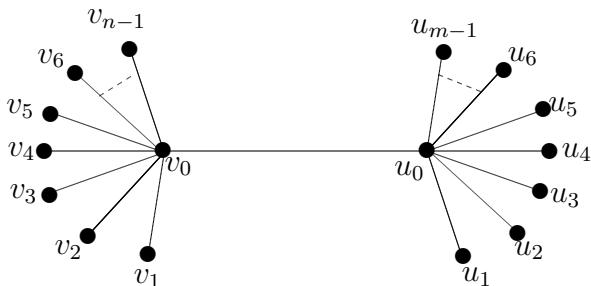
Figure 3. Double star graph \(S_{n,m}\).
Theorem 2.3. The eccentric-distance sum of a double star graph \(S_{n,m}\) is 3[(n-2)(2n-1) + m(2m+5) + 6(n-1)(m-1) - 5].
Proof. \(e(v_0) = 2 = e(u_0)\) and \(e(v_i) = 3 = e(u_j)\) where, i = 1, 2, ..., n-1 and j = 1, 2, ..., m-1. Then,
\[\xi^{ds}(S_{n,m}) = [(3+2)1 + (3+2)2 + (3+3)3(m-1)](n-1)\] \[+ (2+2)1 + (2+3)2(m-1) + (2+3)1(m-1)\] \[+ (3+3)2(n-2) + (3+3)2(n-3) + \dots + (3+3)2(1)\] \[+ (3+3)2(m-2) + (3+3)2(m-3) + \dots + (3+3)2(1)\] \[= 3[(n-2)(2n-1) + m(2m+5) + 6(n-1)(m-1) - 5].\]
Definition 2.4. [13] The friendship (or Dutch windmill or fan) graph \(F_n\) is a graph constructed by joining n copies of the cycle graph \(C_3\) with a common vertex.
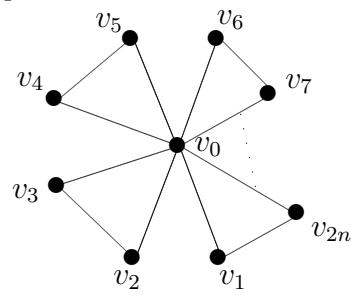
Figure 4. Friendship graph \(F_n\)
Theorem 2.4. The eccentric-distance sum of friendship graph \(F_n\) is 2n(8n-3).
Proof. \(e(v_0) = 1\) and \(e(v_i) = 2\) where, \(i = 1, 2, \dots, 2n\). Then,
\[\xi^{ds}(F_n) = (2+2)1 + (2+2)2(2n-2) + (2+2)2(2n-2) + (2+2)1 + (2+2)2(2n-4) + (2+2)2(2n-4) + (2+2)1 + (2+2)2(2n-6) + (2+2)2(2n-6) \vdots + (2+2)1 + (2+2)2(2) + (2+2)2(2) + (2+2)1 + (1+2)1(2n) = 2n(8n-3).\]
Definition 2.5. [24] Consider the star graph \(K_{1,n}\) with vertex set \(\{v_0, v_1, v_2, \ldots, v_n\}\), introduce an edge to each of the pendant vertices \(v_1, v_2, \ldots, v_n\) to get the resulting graph \(K_{1,n,n}\) with vertices \(\{v_0, v_1, \ldots, v_n, v_{n+1}, \ldots, v_{2n}\}\), again introduce an edge to each of the pendant vertices \(v_{n+1}, \ldots, v_{2n}\), to get the graph \(K_{1,n,n,n}\). Repeating this (m-1) times we get a graph \(K_{1,n,n,n}\) called
multi-star graph with (mn+1) vertices \(v_0, v_1, v_2, \ldots, v_n, v_{n+1}, \ldots, v_{2n}, v_{2n+1}, \ldots, v_{3n}, \ldots, v_{(m-1)n+1}, \ldots, v_{mn}\) and mn edges, as shown in Figure 5.
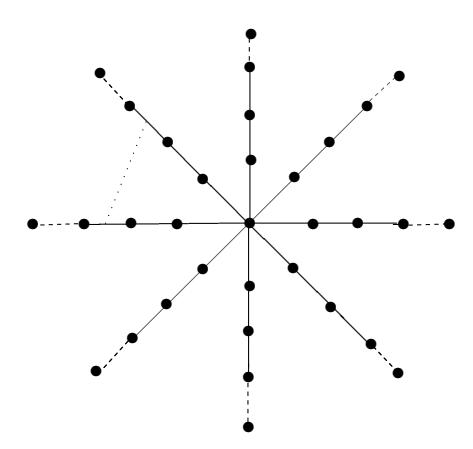
Figure 5. Multi-star graph \(K_{1,\underbrace{n,n,\ldots,n}_{m-times}}\)
Theorem 2.5. The eccentric-distance sum of a multi-star graph \(K_{1,n,n,\dots,n}\) is
\[\frac{nm}{6}(m+1)(8m+1) + n(n+1) \left\{ m \left[ 2\sum_{k=1}^{m} (k+1)k + \sum_{k=1}^{m-1} (m+1+k)(m-k) \right] \right\}\]
The eccentric-distance sum of some graphs | Padmapriya P. et al.
\[+\sum_{k=1}^{m} k + \frac{1}{2} \left[ \sum_{k=1}^{m} k(k+1)^{2} + \sum_{k=1}^{m-1} (k+1)(k+2) \right] + 1 + \sum_{k=1}^{m} (m+k)(m-k)(m-k+1) \right] + \sum_{k=1}^{m} (m+k)(m-k)(m-k+1)\]
Proof.
\[\begin{split} & \xi^{ds} \left(K_{\underbrace{1,n,n,\ldots,n}_{m \text{-times}}}\right) \\ & = \{[m+(m+1)]1 + [m+(m+2)]2 + \cdots + [m+(m+m)]m\}n \\ & + \{[(m+1)+(m+1)]2 + [(m+1)+(m+2)]3 + \cdots + [(m+1)+(m+m)](m+1)\} \\ & [(n-1)+(n-2)+(n-3)+\cdots + 2+1] \\ & + \{[(m+2)+(m+1)]3 + [(m+2)+(m+2)]4 + \cdots + [(m+2)+(m+m)](m+2)\} \\ & [(n-1)+(n-2)+(n-3)+\cdots + 2+1] \\ & \vdots \\ & + \{[(m+m)+(m+1)](m+1) + [(m+m)+(m+2)](m+2) + \cdots \\ & + [(m+m)+(m+m)](m+m)\}[(n-1)+(n-2)+(n-3)+\cdots + 2+1] \\ & + \{[(m+m)+(m+m)](m+m)\}[(n-1)+(n-2)+(n-3)+\cdots + 2+1] \\ & + \{[(m+1)+(m+2)]1 + [(m+1)+(m+3)]2 + \cdots + [(m+1)+(m+m)](m-1)\}n \\ & + \{[(m+2)+(m+3)]1 + [(m+2)+(m+4)]2 + \cdots + [(m+2)+(m+m)](m-2)\}n \\ & \vdots \\ & + \{[(m+(m-1))+(m+m)]1\}n \\ & = \frac{nm}{6}(m+1)(8m+1) + n(n+1) \left\{m \left[2\sum_{k=1}^{m}(k+1)k + \sum_{k=1}^{m-1}(m+1+k)(m-k)\right] \\ & + \sum_{k=1}^{m}k + \frac{1}{2}\left[\sum_{k=1}^{m}k(k+1)^2 + \sum_{k=1}^{m-1}(k+1)(k+2)\right] + 1\right\} \\ & + \frac{n}{2}\left[\sum_{k=1}^{m-1}(m+k+1)k(k+1) + \sum_{k=1}^{m-1}(m+k)(m-k)(m-k+1)\right]. \end{split}\]
Definition 2.6. [24] \(Pl_n\) \((n \ge 3)\) is a graph obtained by the join of \(P_{n-2}\) and \(P_2\), as shown in Figure 6.
The eccentric-distance sum of some graphs | Padmapriya P. et al.
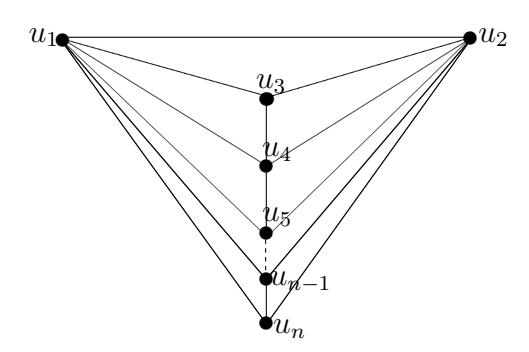
Figure 6. \(Pl_n\) graph, \(n \geq 3\).
Theorem 2.6. The eccentric-distance sum of \(Pl_n\) \((n \ge 6)\) graph is \(4n^2 + 19n - 29\).
Proof. \[e(u_1)=1=e(u_2)\] and \(e(u_i)=2\) where, \(i=3,4,\ldots,n\). Then, \[\xi^{ds}(Pl_n)=(1+2)1(n-2)+(1+1)1+(1+2)1(n-2)\\+(2+2)1+(2+2)2(n-4)\\+(2+2)1+(2+2)2(n-5)\] \[\vdots\\+(2+2)1+(2+2)2(1)\\+(2+2)1\\=4n^2+19n-29.\]
Acknowledgement
The authors are thankful to the University Grants Commission, Government of India, for the financial support under the Basic Science Research Fellowship. UGC vide No.F.25 -1/2014 - 15(BSR)/7 - 349/2012(BSR), January 2015.
References
- [1] A.R. Ashrafi, T. Došlić and M. Saheli, The eccentric connectivity index of TUC<sub>4</sub>C<sub>8</sub>(R) nanotubes, MATCH Commun. Math. Comput. Chem. 65 (2011), 221–230.
- [2] A.R. Ashrafi, M. Saheli and M. Ghorbani, The eccentric connectivity index of nanotubes and nanotori, J. Comput. Appl. Math. 235 (2011), 4561–4566.
- [3] M. Azari and A. Iranmanesh, Computing the eccentric-distance sum for graph operations, Discrete Appl. Math. 161 (2013), 2827-2840.
- [4] A. Dobrynin, R. Entringer and I. Gutman, Wiener index of trees: theory and applications, Acta Appl. Math. 66 (2001), 211–249.
- [5] A. Dobrynin, I. Gutman, S. Klavzar and P. ˇ Zigert, Wiener index of hexagonal systems, ˇ Acta Appl. Math. 72 (2002), 247–294.
- [6] A. Dobrynin and A.A. Kochetova, Degree distance of a graph: A degree analogue of the Wiener index, J. Chem. Inf. Comput. Sci. 34 (1994), 1082–1086.
- [7] T. Dosli ˇ c and M. Saheli, Eccentric connectivity index of composite graphs, manuscript, ´ (2009).
- [8] T. Dosli ˇ c, M. Saheli and D. Vuki ´ cevi ˇ c, Eccentric connectivity index: Extremal graphs and ´ values, Iran. J. Math. Chem. 1 (2010), 45–56.
- [9] H. Dureja, S. Gupta and A.K. Madan, Predicting anti-HIV-1 activity of 6-arylbenzonitriles: Computational approach using superaugmented eccentric connectivity topochemical indices, J. Mol. Graph. Model. 26 (2008), 1020–1029.
- [10] J.A. Gallian, Dynamic Survey DS6: Graph Labeling, Electronic J. Combinatorics (2007), 1–58.
- [11] S. Gupta, M. Singh and A.K. Madan, Application of graph theory: Relationship of eccentric connectivity index and Wieners index with anti-inflammatory activity, J. Math. Anal. Appl. 266 (2002), 259–268.
- [12] S. Gupta, M. Singh and A.K. Madan, Eccentric-distance sum: A novel graph invariant for predicting biological and physical properties, J. Math. Anal. Appl. 275 (2002), 386–401.
- [13] I. Gutman, Selected properties of the Schultz molecular topological index, J. Chem. Inf. Comput. Sci. 34 (1994), 1087–1089.
- [14] F. Harary, Graph Theory, Addison Wesley, Reading Mass (1969).
- [15] H. Hua, Wiener and Schultz molecular topological indices of graphs with specified cut edges, MATCH Commun. Math. Comput. Chem. 61 (2009), 643–651.
- [16] H.B. Hua, K.X. Xu and W.N. Shu, A short and unified proof of Yu et al.s two results on the eccentric-distance sum, J. Math. Anal. Appl. 382 (2011), 364–366.
- [17] A. Ilic, Eccentric connectivity index, in: I. Gutman, B. Furtula (Eds.), Novel Molecular ´ Structure Descriptors Theory and Applications II, in: Math. Chem. Monogr. 9 University of Kragujevac (2010).
- [18] A. Ilic and I. Gutman, Eccentric connectivity index of chemical trees, ´ MATCH Commun. Math. Comput. Chem. 65 (2011), 731–744.
- [19] A. Ilic, S. Klav ´ zar and D. Stevanovi ˇ c, Calculating the degree distance of partial hamming ´ graphs, MATCH Commun. Math. Comput. Chem. 63 (2010), 411–424.
- [20] A. Ilic, G. Yu and L. Feng, On the eccentric-distance sum of graphs, ´ J. Math. Anal. Appl. 381 (2011), 590–600.
- [21] D. Indriati, Widodo, I. E. Wijayanti and K. A. Sugeng, On total irregularity strength of double-star and related graphs, Procedia Computer Science 74 (2015), 118–123.
- [22] V. Kumar, S. Sardana and A.K. Madan, Predicting anti-HIV activity of 2, 3-diaryl-1, 3 thiazolidin-4-ones: Computational approach using reformed eccentric connectivity index, J. Mol. Model. 10 (2004), 399–407.
- [23] M.J. Morgan, S. Mukwembi, H.C. Swart, On the eccentric connectivity index of a graph, Discrete Math. 311 (2011), 1229–1234.
- [24] S. Ramakrishnan and J. B. Babujee, Degree Distance of Some Planar Graphs, International Journal of Computing Algorithm, 03 (2014), 541–544.
- [25] S. Sardana and A.K. Madan, Predicting anti-HIV activity of TIBO derivatives: a computational approach using a novel topological descriptor, J. Mol. Model. 8 (2002), 258– 265.
- [26] V. Sharma, R. Goswami, A.K. Madan, Eccentric connectivity index: A novel highly discriminating topological descriptor for structure property and structure activity studies, J. Chem. Inf. Comput. Sci. 37 (1997), 273–282.
- [27] G. Yu, L. Feng and A. Ilic, On the eccentric-distance sum of trees and unicyclic graphs, ´ J. Math. Anal. Appl. 375 (2011), 99–107.
- [28] B. Zhou and Z. Du, On eccentric connectivity index, MATCH Commun. Math. Comput. Chem. 63 (2010), 181–198.