Suk J. Seoa , Peter J. Slaterb
aComputer Science Department, Middle Tennessee State University, Murfreesboro, TN 37132, U.S.A. bMathematical Sciences Department and Computer Science Department, University of Alabama in Huntsville Huntsville, AL 35899, U.S.A.
sseo@mtsu.edu, slater@uah.edu and pslater@cs.uah.edu
A distinguishing set for a graph G = (V, E) is a dominating set D, each vertex v ∈ D being the location of some form of a locating device, from which one can detect and precisely identify any given "intruder" vertex in V (G). As with many applications of dominating sets, the set D might be required to have a certain property for hDi, the subgraph induced by D (such as independence, paired, or connected). Recently the study of independent locating-dominating sets and independent identifying codes was initiated. Here we introduce the property of open-independence for openlocating-dominating sets.
Keywords: distinguishing sets, open-independent sets, open-locating-dominating sets, open-independent, open-locating-dominating sets AMS subject classification: 05C69 DOI:10.5614/ejgta.2017.5.2.2
1. Introduction
For a graph G = (V, E) that represents a facility, an "intruder" in the system might be a thief, saboteur or fire. If G represents a multiprocessor network with each vertex representing one processor, an "intruder" might be a malfunctioning processor. We assume that certain vertices will
Received: 15 December 2015, Revised 4 April 2017, Accepted: 19 May 2017.
be the locations of detectors, each detector having some capability to identify the location of an intruder vertex.
For u, v ∈ D, let d(u, v) denote the distance in G between u and v. Some detectors, like sonar devices, can be assumed to determine the distance to the intruder vertex x anywhere in the system. Much work has been done on locating sets as introduced in Slater [36] (and also called metric bases as independently introduced in Harary and Melter [11]). An (ordered) set X = {x1, x2, ..., xk} ⊆ V (G) is a locating set if for every w ∈ V (G) the ordered k-tuple (d(x1, w), d(x2, w), ..., d(xk, w)) uniquely determines w. We say that a vertex x resolves vertices u and v if d(x, u) 6= d(x, v). Then X is locating if for every two vertices u and v at least one xi ∈ X resolves u and v. For the recently introduced centroidal bases described in Foucaud, Klasing and Slater [9] the set of detectors in X provide just an ordering of the relative distances to an intruder vertex, not the exact distances.
Some detectors (heat sensors, motion detectors, etc.) have a limited range. The open neighborhood of vertex v is N(v) = {w ∈ V (G) : uw ∈ E(G)} = {w ∈ V (G) : d(v, w) = 1}, and the closed neighborhood N[v] = N(v) ∪ {v} = {w ∈ V (G) : d(v, w) ∈ {0, 1}}. Vertex set D ⊆ V (G) is dominating if ∪x∈DN[x] = V (G). For S ⊆ V (G) the distance d(w, S) = min{d(x, w) : x ∈ S}, so D is dominating if for every w ∈ V (G) we have d(w, D) ∈ {0, 1}. Vertex set D is an open dominating set (also called a total dominating set) if ∪x∈DN(x) = V (G), that is for every vertex w (including w ∈ D) there is a vertex x ∈ D with d(w, x) = 1.
For the case in which a detector at v can determine if the intruder is at v or if the intruder is in N(v) (but which element in N(v) can not be determined), as introduced in Slater [37, 38, 39], a locating-dominating set L ⊆ V (G) is a dominating set for which, given any two vertices u and v in V (G) − L, one has N(u) ∩ L 6= N(v) ∩ L, that is, for any two distinct vertices u and v (including ones in L) there is a vertex x ∈ L with d(x, u) ∈ {0, 1} and d(x, u) 6= d(x, v) or d(x, v) ∈ {0, 1} and d(x, u) 6= d(x, v). Every graph G has a locating-dominating set, namely V (G), and the locating-dominating number LD(G) is the minimum cardinality of such a set. See, for example, [3, 8, 17].
As introduced by Karpovsky, Charkrabarty and Levitin [22], an identifying code C ⊆ V (G) is a dominating set for which given any two vertices u and v in V (G) one has N[u] ∩ C 6= N[v] ∩ C, that is, there is a vertex x ∈ C with d(x, u) ≤ 1 and d(x, v) ≥ 2 or d(x, v) ≤ 1 and d(x, u) ≥ 2. See, for example, [2, 4, 25]. Graph G has an identifying code when for every pair of vertices u and v we have N[u] 6= N[v], and the identifying code number IC(G) is the minimum cardinality of such a set.
When a detection device at vertex v can determine if an intruder is in N(v) but will not/can not report if the intruder is at v itself, then we are interested in open-locating-dominating sets as introduced for the k-cubes Qk by Honkala, Laihonen and Ranto [21] and for all graphs by Seo and Slater [26, 27]. An open dominating set S ⊆ V (G) is an open-locating-dominating set if for all u and v in V (G) one has N(u) ∩ S 6= N(v) ∩ S, that is, there is a vertex x ∈ S with d(x, u) = 1 6= d(x, v) or d(x, v) = 1 6= d(x, u). A graph G has an open-locating-dominating set when no two vertices have the same open neighborhood, and OLD(G) is the minimum cardinality of such a set. See, for example, [5, 16, 21, 28, 29, 30, 31, 32, 33]. Lobstein [24] maintains a bibliography, currently with more than 300 entries, for work on these topics.
Dominating sets D have many applications (see Haynes, Hedetniemi and Slater [12, 13]), and in many cases the subgraph generated by D, denoted hDi, is required to have an additional property
such as independence, paired, or connected. Recently, independent locating-dominating sets and independent identifying codes have been introduced in Slater [42]. Not all graphs have independent locating-dominating sets (respectively, independent identifying codes), and there is no forbidden subgraph characterization of such graphs. In fact, we have the following.
Theorem A (Slater [42]) Simply deciding, for a given input graph G, if G has an independent locating-dominating set is NP-complete.
Theorem B (Slater [42]) Simply deciding, for a given input graph G, if G has an independent identifying code is NP-complete.
Note that, by definition, an open dominating set S can not be independent, each v ∈ S must be open dominated by some x ∈ N(v). In this paper we consider "open-independence" and introduce open-independent, open-locating-dominating sets.
2. Open-independent sets; open-independent-dominating sets; open-independent, open dominating sets
Assuming every vertex is the possible location of an intruder and that a detector at vertex v can not detect an intruder at w ∈ V (G) if d(v, w) ≥ 2, in order for every intruder to be detectable we require a dominating set for the detectors. Vertex set D ⊆ V (G) is dominating if every vertex w not in D is adjacent to a vertex v ∈ D, equivalently, (a) ∪x∈DN[x] = V (G) or (b) V (G) − D is enclaveless (Note that a set E ⊆ V (G) is defined to be enclaveless if every vertex in E is adjacent to at least one vertex V (G) − E.). Also, S ⊆ V (G) is independent if no two vertices in S are adjacent. Now, R ⊆ V (G) is dominating when condition (1) below holds, and R is independent when (2) below holds.
- (1) for every v ∈ V (G), |N[v] ∩ R| ≥ 1.
- (2) for every v ∈ R, |N[v] ∩ R| ≤ 1.
Obviously every v ∈ R satisfies |N[v] ∩ R| ≥ 1, so condition (2) could be replaced with v ∈ R implies |N[v] ∩ R| = 1. We use ≤ for what follows in (4).
For open domination, one assumes that a vertex v does not dominate itself. An intruder (thief, saboteur, fire) at v might prevent its own detection; a malfunctioning processor might not detect its own miscalculations. Vertex set R ⊆ V (G) is open-dominating if ∪v∈RN(v) = V (G) or, equivalently, if condition (3) holds.
(3) for every v ∈ V (G), |N(v) ∩ R| ≥ 1.
Now we define R ⊆ V (G) to be open-independent if (4) holds. That is, R is independent if each vertex v ∈ R is dominated by R at most (equivalently, exactly) once, and R is open-independent if each vertex v ∈ R is open-dominated by R at most once.
The open-independence number for a graph G denoted by OIND(G) is the maximum cardinality of an open-independent set for G. Note that OIND(G) ≥ β(G), where β(G) denotes the maximum cardinality of an independent set for G.
(4) for every v ∈ R, |N(v) ∩ R| ≤ 1.
Figure 1. Graphs G11, G7, and G12.
The domination number γ(G) is the minimum cardinality of a dominating set, a dominating set of cardinality γ(G) being called a γ(G)-set whereas any dominating set is called a γ-set. Similar terminology is used for other parameters. The independent domination number (which could be denoted γIND(G)) is traditionally denoted by i(G) and is the minimum cardinality of a dominating set D for which every component of hDi is a singleton. We let γOIND(G) denote the minimum cardinality of an open-independent dominating set D, a dominating set D for which each component of hDi has cardinality at most two, hDi = jK1∪ kK2. Clearly γ(G) ≤ γOIND(G) ≤ i(G).
The open (or total) domination number, the minimum cardinality of an open dominating set is denoted γt or γ OP . We let γ OP OIND denote the open-independent, open domination number, the minimum cardinality of an open dominating set D for which every component of hDi is a K2, when such a set exists. If so, then γ OP (G) ≤ γ OP OIND(G). Note, for example, that the 5-cycle C5 does not have an open-independent, open dominating set.
For the graph G11 in Figure 1(a) the set {u, v, w} is the minimum dominating set which is open-independent and γ(G11) = γOIND(G11) = 3; i(G) = 4 = |{u, w, x, y}|; and γ OP (G11) = 4 = |{u, v, w, z}| = γ OP OIND(G11). In Figure 1(b) the graph G12 has the minimum dominating set {f, g, h} and a minimum open independent dominating set {g, h, i, j, k}, so γ(G12) = 3 < 5 = γOIND(G12), and the graph G7 has the minimum open dominating set {a, b, c} and the minimum open independent, open dominating set {a, b, d, e}, with γ op(G7) = 3 < 4 = γ OP OIND(G7).
Open-independent, open dominating sets have been considered in another context by Studer, Haynes, and Lawson [43]. As introduced in Haynes and Slater [14, 15], a paired dominating set D is a dominating set for which hDi has a perfect matching. Studer, et al. [43] define an openindependent, open dominating set as an induced-paired dominating set.
As noted, in this paper we are interested in distinguishing sets and will consider open-independent, open-locating-dominating sets.
3. Open-independent, open-locating-dominating sets
For an open-locating-dominating set S each v ∈ V (G) has a distinct set of detectors, N(v)∩S. A graph G has an open-locating-dominating set (OLD-set) if and only if no two vertices u and v
have the same open neighborhood, that is N(u) 6= N(v). Clearly, OLD(G) ≤ OLDOIND(G) in this case. For an open-independent, OLD-set S, the subgraph < S > must have each component of order two. We let OLDOIND(G) be the minimum cardinality of an open-independent OLD(G)-set when such a set exists. For the tree T8 in Figure 2, OLD(T8) = 5 and OLDOIND(T8) = 6.
Figure 2. γ OP (T8) = OLD(T8) = 5 and OLDOIND(T8) = 6.
For the tree T9 in Figure 3, there is an open-independent, open-dominating set of size four, but there does not exist an OLD-set (and, hence, no OLDOIND-set). Note that the 5-cycle does not have an open-independent, open-dominating set (and, hence, no OLDOIND-set).
Figure 3. γ OP OIND(T9) = 4 and OLD(T9) is not defined.
Proposition 3.1. If S is any OLDOIND-set for a graph G and v is an endpoint, degGv = 1, with N(v) = {w}, then {v, w} ⊆ S. In particular, {v, w} is contained in any OLDOIND(G)-set.
Proof. Because N(v) = w, any open dominating set S must contain w. Because S is openindependent, N(w) contains exactly one element of S, and because S is open-locating if N(w) ∩
S = {x} with x 6= v we have the contradiction that N(v) ∩ S = {w} = N(x) ∩ S. Hence, v ∈ S.
Figure 4. H, G1[H] and G2[H].
For any connected graph H of order n ≥ 2, let G1[H] be obtained by adding for each v ∈ V (H) two vertices v 0 and v 00 and edges vv0 and v 0 v 00, and let G2[H] be obtained from H by further adding vertices v 000 and v 0000 and edges vv000 and v 000v 0000. Then every G1[H] and G2[H] have OLD-sets, and G2[H] has an OLDOIND-set while G1[H] does not.
Hence, we have the following.
Theorem 3.1. For every graph H there are graphs G1 and G2 with Has an induced subgraph where G1 does not have an OLDOIND-set but G2 does have an OLDOIND-set.
There is no forbidden subgraph characterization of the set of graphs which have OLDOINDsets, nor of the set of graphs which do not have OLDOIND-sets. In fact, simply deciding for a given graph G if G has an OLDOIND-set is an NP-complete problem. As noted in Garey and Johnson [10], Problem 3-SAT is NP-complete.
3-SAT
INSTANCE. Sets U = {u1, u2, ..., un} and U = {u1, u2, ..., un} and collection C = {c1, c2, ..., cm} of 3-element subsets of U ∪ U.
QUESTION. Does there exist a satisfying truth assignments for C, that is, a subset S of U ∪U of order n with |S ∩ {ui , ui}| = 1 for 1 ≤ i ≤ n with S ∩ cj 6= ∅ for 1 ≤ j ≤ m?
XOIOLD (existence of an open-independent, open-locating-dominating set)
INSTANCE. A graph G.
QUESTION. Does G have an OLDOIND-set?
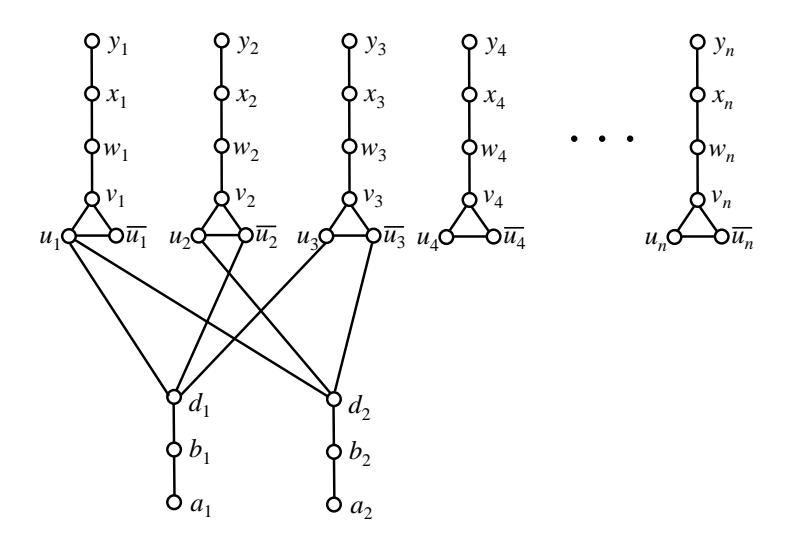
Figure 5. \(c_1 = \{u_1, \overline{u}_2, u_3\}, c_2 = \{u_1, u_2, \overline{u}_3\}, \text{ etc.}\)
Theorem 3.2. Simply deciding, for a given graph G, if G has an open-independent, OLD-set is an NP-complete decision problem. That is, XOIOLD is NP-complete.
Proof. One can easily verify in polynomial time if a given set \(S \subseteq V(G)\) is an \(OLD_{OIND}\)-set, so \(XOIOLD \in NP\).
We can reduce the known NP-complete 3-SAT problem to XOIOLD in polynomial time as follows. For each \(u_i \in U\) let \(G_i\) be the 6-vertex graph illustrated in Figure 5 with \(V(G_i) = \{u_i, \overline{u}_i, v_i, w_i, x_i, y_i\}\) and \(E(G_i) = \{u_i\overline{u}_i, u_iv_i, \overline{u}_iv_i, v_iw_i, w_ix_i, x_iy_i\}\). For each clause \(c_j \in C\) let \(H_j\) be the 3-vertex graph with \(V(H_j) = \{a_j, b_j, d_j\}\) and \(E(H_j) = \{a_jb_j, b_jd_j\}\). Interconnect the clause components and literal components by adding edges \(d_jc_{j,1}, d_jc_{j,2}\) and \(d_jc_{j,3}\) for \(1 \leq j \leq m\) where \(c_j = \{c_{j,1}, c_{j,2}, c_{j,3}\} \in C\), as illustrated in Figure 5. Let G be the resulting graph of order 6n + 3m.
Assume there is a satisfying truth assignment \(S\subseteq U\cup \overline{U}\). Form \(W\subseteq V(G)\) by letting \(\{y_i,x_i,v_i,a_j,b_j\}\subseteq W\) for \(1\leq i\leq n,\) \(1\leq j\leq m\). For \(1\leq i\leq n,\) add \(u_i\) to W if the literal \(u_i\in S\), otherwise the literal \(\overline{u}_i\in S\) and one adds \(\overline{u}_i\) to S. Then \(< W >\) consists of 4n+2m vertices inducing 2n+m independent edges. Note that \(N(a_j)=\{b_j\}\subseteq W,\) \(b_j\in N(d_j)\cap W\) but \(|N(d_j)\cap W|\geq 2\) because S is satisfying. It is easily seen that G has W as an open-independent, OLD-set.
Assume G has an \(OLD_{OIND}\)-set W. By Proposition 3.1 we have \(\{y_i, x_i\} \subseteq W\) with \(w_i \notin W\) for \(1 \leq i \leq n\), and \(\{a_j, b_j\} \subseteq W\) with \(d_j \notin W\) for \(1 \leq j \leq m\). Because \(N(y_i) \cap W = \{x_i\}\) and \(N(w_i) \cap W \neq N(y_i) \cap W\), each \(v_i \in W\). Now \(v_i \in W\) implies the open-independent, dominating set W has \(|N(v_i) \cap W| = 1\), so W contains exactly one of \(u_i\) and \(\overline{u}_i\). Let \(S = W \cap (U \cup \overline{U})\). Because W is an OLD-set \(N(a_j) \cap W = \{b_j\} \subsetneq N(d_j) \cap W\), and we have \(N(d_j) \cap (U \cup \overline{U}) \neq \emptyset\). That is, S must be a satisfying truth assignment.
Theorem 3.3. If the girth of G satisfies g(G) ≥ 5 and W ⊆ V (G), then W is an OLDOIND-set if and only if (1) each v ∈ W is open-dominated exactly once, and (2) each v /∈ W is open-dominated at least twice.
Proof. Assume W is an OLDOIND-set for G. Because W is open-independent and open-dominating, each v ∈ W has |N(v) ∩ W| = 1. If v /∈ W, then W open-dominates v implies there is a vertex w ∈ N(v) ∩ W. As noted |N(w) ∩ W| = 1, say N(w) ∩ W = {x}. Then N(x) ∩ W = {w} 6= N(v) ∩ W implies that |N(v) ∩ W| ≥ 2.
Assume conditions (1) and (2) hold for W ⊆ V (G). Then W is open-dominating. Assume v ∈ W has |N(v) ∩ W| = 1. For N(v) ∩ W = {w}, we have N(w) ∩ W = {v} and x ∈ N(w) − {v} implies that x /∈ W, so x is open-dominated at least twice. Thus v is the only vertex with N(v) ∩ W = {w}. Assume v /∈ W, let {x, y} ⊆ N(v) ∩ W. No other vertex u has {x, y} ⊆ N(u) ∩ W or else u, x, v, y is a 4-cycle and g(G) ≤ 4. Thus N(v) ∩ W uniquely distinguishes v.
Assume W is an OLDOIND-set for path Pn : v1, v2, ..., vn. By Proposition 3.1 we have {v1, v2} ⊆ W, v3 ∈/ W, {v4, v5} ⊆ W, v6 ∈/ W, ...{vn−1, vn} ⊆ W.
Proposition 3.2. Path Pn has an OLDOIND-set W if and only if n ≡ 2(mod 3) and OLDOIND(P3k+2) = 2k + 2.
Figure 6. Some trees with OLDOIND-sets.
Theorem 3.4. (Seo and Slater [26]) A tree T has an OLD-set if and only if no two endpoints of T have the same neighbor.
Similar to the characterization given in Studer, et al. [43] for open-independent dominating sets in trees, we can recursively define the collection of pairs (T, W) where T is a tree and W is the unique OLDOIND(T)-set. First note that the tree At of order 2t + 1 in Figure 6 has OLDOIND(At) = 2t and V (At) − x is the unique OLDOIND(At)-set for t ≥ 2.
Theorem 3.5. If Tn is a tree of order n with an OLDOIND-set, then the OLDOIND(T)-set W is unique and Tn can be obtained recursively from P2 by a sequence of operations OP1 and OP2 defined as follows.
(OP1) Let T ∗ be a tree with OLDOIND(T)-set W and let z ∈ W. The tree T is obtained from T ∗ by adding a P3 : x, w, v and adding the edge zx.
(OP2) Let T ∗ be a tree with OLDOIND(T)-set W and let z be any vertex in T ∗ . The tree T is obtained from T ∗ by adding an At with t ≥ 2 and adding the edge zx.
Proof. We first observe that if T is obtained from T ∗ by (OP1), then W ∪ {w, v} is an OLDOINDset for T, and if T is obtained from T ∗ by (OP2), then W ∪ {w1, v1, ..., wt , vt} is an OLDOIND-set for T.
Assume tree T has OLDOIND-set W. If T is a path, then Proposition 3.2 shows that T can be obtained from P2 by a sequence of (OP1)-operations and there is a unique OLDOIND-set for T. If T is not a path, select a vertex y with deg y ≥ 3 where all or all but one of the branches at y are paths. Suppose y, u1, u2, ..., uj is a branch path with j ≥ 3. By Proposition 1 we must have {uj−1, uj} ⊆ W and uj−2 ∈/ W. Also uj−3 (possibly uj−3 = y) must be in W or else N(uj )∩W = N(uj−2)∩W = {uj−1}. Let T ∗ = T − {uj , uj−1, uj−2}. Since W is an OLDOINDset of T and N(uj ) ∩ V (T ∗ ) = ∅ and N(uj−1) ∩ V (T ∗ ) = ∅, W − {uj , uj−1} is an OLDOIND-set of T ∗ . So T is obtainable from T ∗ by (OP1) where z = uj−3. Because W is an OLD-set, y can not be the support vertex of two or more endpoints. If y is adjacent to an endpoint x and y, u1, u2 is a branch path, Proposition 1 would imply that {u1, u2} ⊆ W and {x, y} ⊆ W, so W would not be open-independent. Now y can be assumed to have deg y − 1 = b branch paths of length two. We have a subgraph Ab with vertices {y, w1, v1, ..., wb, vb} with b ≥ 2. Let N(y) = {w1, w2, ..., wb, z}, and T can be obtained from T ∗ = T − {y, w1, v1, ..., wb, vb} by (OP2).
4. OLDOIND% for infinite grids
Much work has been done on distinguishing sets (LD-sets, IC-sets and OLD-sets) in infinite grids (hexagonal, square, triangular, tumbling block, etc). See, for example, [1, 6, 7, 18, 19, 20, 22, 23, 26, 28, 29, 30, 40, 41].
For a given vertex x in a dominating set D in a graph G, the share sh(x; D) is defined in Slater [41] as a measure of how much domination the individual vertex x does. For example, in graph H1 of Figure 7 we have N[3] = {2, 3, 4, 5, 6, 9} and sh(3; {3, 4, 7}) = 1/2 + 1/2 + 1/2 + 1/3 + 1/2 + 1/3 = 8/3. Also, sh(4; {3, 4, 7}) = 1 + 1/2 + 1/2 + 1/2 + 1/3 + 1/2 + 1/3 = 11/3, and sh(7; {3, 4, 7}) = 1/3 + 1/2 + 1 + 1/2 + 1/3 = 8/3. Note that Σv∈Dsh(v; D) = |V (G)| = n for any dominating set D and that |D| ≥ |V (G)|/MAXv∈V sh(v; D).
Similarly, the open share shop(x; D) is defined in Seo and Slater [26] for open dominating set D. Specifically, if D is open dominating and x ∈ D then, for each y ∈ N(x), let
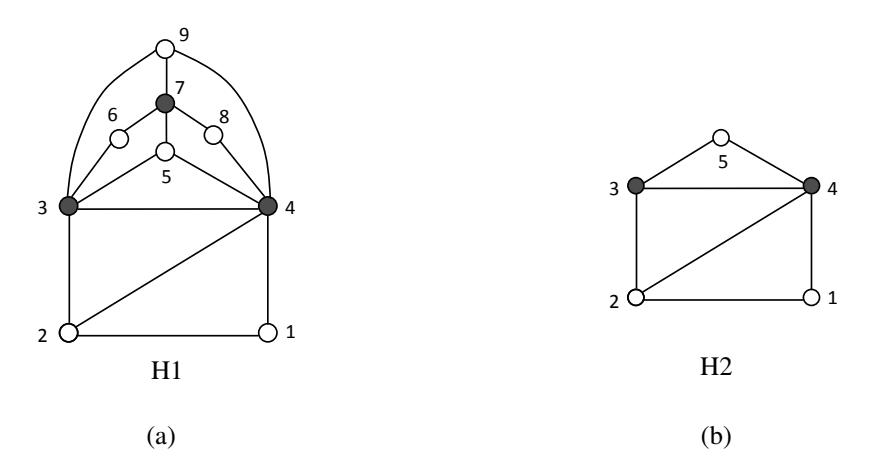
Figure 7. Graphs H1 and H2.
shop(x; D(y)) = 1/|N(y) ∩ D| and let shop(x; D) = Σy∈N(x)shop(x; D(y)). For example, in Figure 7 D = {3, 4} is an open dominating set for the graph H2. We have N(3) = {2, 4, 5} and shop(3; D) = shop(3; D(2)) + shop(3; D(4)) + shop(3; D(5)) = 1/2 + 1 + 1/2 = 2. Also, N(4) = {1, 2, 3, 5} and shop(4; D) = shop(4; D(1)) + shop(4; D(2)) + shop(4; D(3)) + shop(4; D(5)) = 1 + 1/2 + 1 + 1/2 = 3. Note that Σx∈Dshop(x; D) = |V (G)|, and if shop(w; D) ≥ shop(x; D) for all x ∈ D, then |D| ≥ |V (G)|/shop(w; D).
In this paper, we will focus on open-locating-dominating sets along with open-shares of vertices.
Percentage parameters for measuring density for locally-finite, countably infinite graphs were defined in Slater [41]. For example, for the γ(G) parameter we have γ%(G) defined as follows as the minimum possible percentage of vertices in a dominating set of G. The closed k-neighborhood of vertex v is the set of vertices at distance at most k from v, Nk [v] = {w ∈ V (G) : d(v, w) ≤ k}. For S ⊆ V (G), the density of S is dens(S) = maxv∈V (G) lim supk→∞(|S ∩ Nk [v]|/|Nk [v]|). Then, for example, the domination percentage of G is γ%(G) = min{dens(S) : S ⊆ V (G) is dominating}. Let HEX, SQ, and TRI denote the infinite hexagonal, square and triangular grid graphs, respectively.
Theorem 4.1. (Seo and Slater [26]) OLD%(HEX) = 1/2.
The darkened vertices of HEX in Figure 8 form an OLD%(HEX)-set D achieving the value 1/2, and D is an open-independent set. Hence we have the following.
Theorem 4.2. OLDOIND%(HEX) = OLD%(HEX) = 1/2.
Figure 9(a) illustrates that OLD%(SQ) = 2/5, but OLDOIND%(SQ) > OLD%(SQ).
Theorem 4.3. (Seo and Slater [26]) OLD%(SQ) = 2/5.
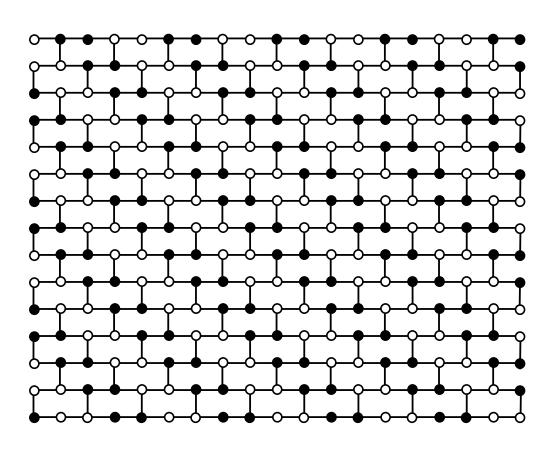
Figure 8. OLD%(HEX) = 1/2 = OLDOIND%(HEX).
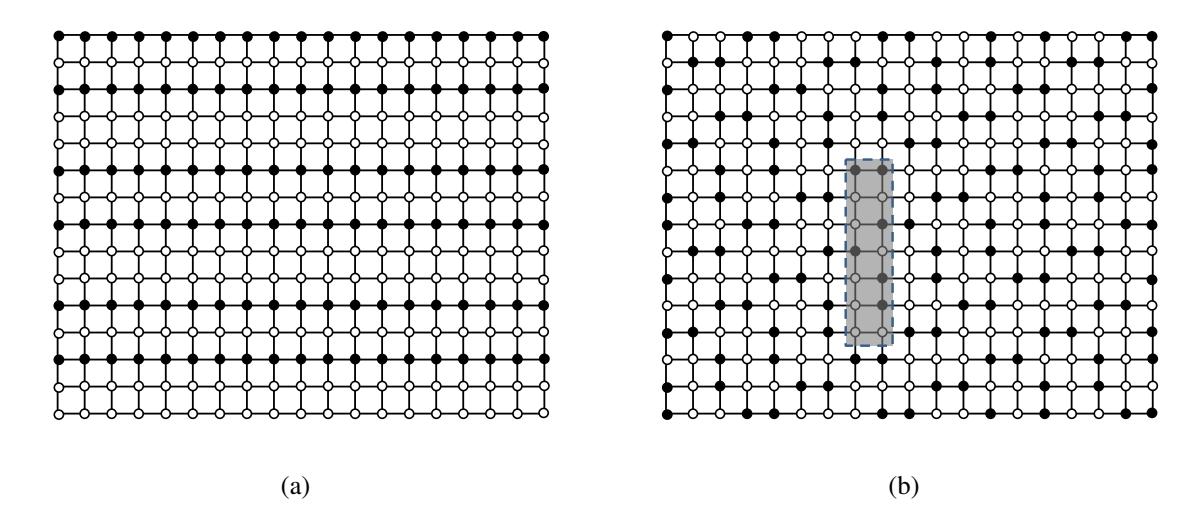
Figure 9. OLD%(SQ) = 2/5 and OLDOIND%(SQ) = 3/7.
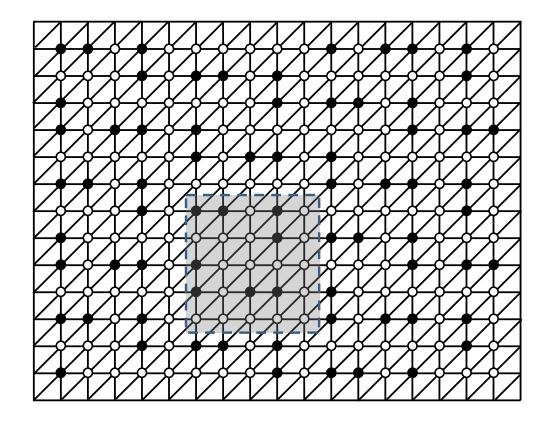
Figure 10. OLDOIND%(T RI) ≤ 8/25.
Theorem 4.4. OLDOIND%(SQ) = 3/7.
Proof. The set of darkened vertices in Figure 9(b) shows that OLDOIND%(SQ) ≤ 3/7. To see that OLDOIND%(SQ) ≥ 3/7 we use a straightforward share argument. Let D be an OLDOIND%(SQ) set. We have V (SQ) = Z × Z and N((i, j)) = {(i − 1, j),(i, j + 1),(i + 1, j),(i, j − 1)}. We will show that shop(x; D) ≤ 7/3 for every x ∈ D, and hence OLDOIND%(SQ) ≥ 7/3. Without loss of generality, assume x = (0, 0) ∈ D. Exactly one neighbor of x is also in D, and we can assume that (1, 0) ∈ D. In particular, shop(x; D((1, 0)) = 1. Any other vertex y ∈ N(x) is open dominated at least twice by D, so shop(x, D(y)) ≤ 1/2 for each y ∈ {(−1, 0),(0, 1),(0, −1)}. Suppose all three of these vertices give (0,0) a share value of 1/2.
Case 1. N((−1, 0))∩D = {(0, 0),(−2, 0)}. Then (−1, 1) ∈/ D with D∩{(−1, 0),(0, 1)} = ∅, and so N((−1, 1))∩D = {(−2, 1),(−1, 2)}. Similarly, N((−1, −1))∩D = {(−2, −1),(−1, −2)}. But then {(−2, 1),(−2, 0),(−2, −1)} ⊆ D, contradicting the open independence of D.
Case 2. N((−1, 0)) ∩ D 6= {(0, 0),(−2, 0)}. Then one of (−1, 1) and (-1,-1) is in D, say (-1, 1). Because shop((0, 0); D((0, 1)) = 1/2 we have N((0, 1)) ∩ D = {(0, 0),(−1, 1)}. Also, shop((0, 0); D((−1, 0)) = 1/2 implies N((−1, 0)) ∩ D = {(0, 0),(−1, 1)} = N(0, 1) ∩ D, contradicting the fact that D must distinguish (0,1) and (-1,0).
Because shop(x; D) < 1 + 1/2 + 1/2 + 1/2, we have shop(x; D) ≤ 1 + 1/2 + 1/2 + 1/3 = 7/3 for every x ∈ D. As noted, this implies OLDOIND%(SQ) ≥ 7/3.
Theorem 4.5. (Kincaid, Oldham, and Yu [23]) OLD%(T RI) = 4/13.
Figure 10 shows that OLDOIND%(T RI) ≤ 8/25. To date, the best we have is that: OLDOIND%(T RI) ∈ [4/13, 8/25].
5. Open independent sets
In this paper we focused on open-independence for OLD-sets. Of interest is the parameter OIND itself, as well as the lower open independence parameter oind where oind(G) is the minimum cardinality of a maximally open-independent set.
References
- [1] Y. Ben-Haim and S. Litsyn, Exact Minimum Density of Codes Identifying Vertices in the Square Grid. SIAM Journal on Discrete Mathematics 19 (2005), 69–82.
- [2] N. Bertrand, I. Charon, O. Hudry and A. Lobstein, Identifying and locating-dominating codes on chains and cycles, European Journal of Combinatorics 25 (2004), 969–987.
- [3] M. Blidia, M. Chellali, R. Lounes and F. Maffray, Characterizations of trees with unique minimum locating-dominating sets, Journal of Combinatorial Mathematics and Combinatorial Computing 76 (2011), 225–232.
- [4] M. Blidia, M. Chellali, F. Maffray, J. Moncel and A. Semri, Locating-domination and identifying codes in trees, Australasian Journal of Combinatorics 39 (2007), 219–232.
- [5] M. Chellali, N. J. Rad, S. J. Seo and P. J. Slater, On Open Neighborhood Locating-dominating in Graphs, Electronic Journal of Graph Theory and Applications 2 (2014), 87–98.
- [6] G.D. Cohen, I. Honkala, A. Lobstein and G. Zemor, Bounds for Codes Identifying Vertices ´ in the Hexagonal Grid, SIAM Journal on Discrete Mathematics 13 (2000), 492–504.
- [7] A. Cukierman and G. Yu, New bounds on the minimum density of an identifying code for the infinite hexagonal grid, Discrete Applied Mathematics 161 (2013), 2910–2924.
- [8] G. Exoo, V. Junnila and T. Laihonen, Locating-dominating codes in cycles, Australasian Journal of Combinatorics 49 (2011), 177–194.
- [9] F. Foucaud, R. Klasing, and P. J. Slater, Centroidal bases in graphs, Networks 64 (2014), 96–108.
- [10] M.R. Garey and D. S. Johnson, Computers and intractability: A guide to the theory of NPcompleteness, W.H. Freeman, (1979).
- [11] F. Harary and R. Melter, On the metric dimension of a graph, Ars Combinatoria 2 (1976), 191–195.
- [12] T.W. Haynes, S.T. Hedetniemi, and P.J. Slater, Fundamentals of Domination in graphs, Marcel Dekker, Inc., (1998).
- [13] T.W. Haynes, S.T. Hedetniemi, and P.J. Slater, Domination in Graphs: Advanced Topics, Marcel Dekker, Inc., (1998).
- [14] T.W. Haynes and P.J. Slater, Paired domination and the paired-domatic number, Congressus Numerantium 109 (1995), 67–72.
- [15] T.W. Haynes and P.J. Slater, Paired domination in graphs, Networks 32 (1998), 199–206.
- [16] M. Henning and A. Yeo, Distinguishing-transversal in hypergraphs and identifying open codes in cubic graphs, Graphs and Combinatorics Published online: 30 March 2013.
- [17] C. Hernando, M. Mora, and I. M. Pelayo, Nordhaus-Gaddum bounds for locating domination, European Journal of Combinatorics 36 (2014), 1–6.
- [18] I. Honkala, An optimal locating-dominating set in the infinite triangular grid, Discrete Mathematics 306 (2006), 2670–2681.
- [19] I. Honkala, An optimal strongly identifying code in the infinite triangular grid, Electronic Journal of Combinatorics 17 (2010), R91.
- [20] I. Honkala and T. Laihonen, On locating-domination sets in infinite grids, European Journal of Combinatorics 27 (2006), 218–227.
- [21] I. Honkala, T. Laihonen, and S. Ranto, On strongly identifying codes, Discrete Mathematics 254 (2002), 191–205.
- [22] M.G. Karpovsky, K. Chakrabarty and L.B. Levitin, On a new class of codes for identifying vertices in graphs, IEEE Transactions on Information Theory IT-44 (1998), 599–611.
- [23] R. Kincaid, A. Oldham, and G. Yu, On optimal open locating-dominating sets in infinite triangular grids, Mar 28 2014 math.CO arXiv:1403.7061v1
- [24] A. Lobstein, Watching systems, identifying, locating-dominating and discriminating codes in graphs, http://www.infres.enst.fr/ lobstein/debutBIBidetlocdom.pdf.
- [25] J. Moncel, On graphs on n vertices having an identifying code of cardinality dlog2(n + 1)e, Discrete Applied Mathematics 154 (2006), 2032–2039.
- [26] S.J. Seo and P.J. Slater, Open neighborhood locating-dominating sets, Australasian Journal of Combinatorics 46 (2010), 109–120.
- [27] S.J. Seo and P.J. Slater, Open neighborhood locating-dominating in trees, Discrete Applied Mathematics 159 (2011), 484–489.
- [28] S.J. Seo and P.J. Slater, Open neighborhood locating-domination for infinite cylinders, Proceedings of ACM SE (2011) 334–335.
- [29] S.J. Seo and P.J. Slater, Open neighborhood locating-domination for grid-like graphs, Bulletin of the Institute of Combinatorics and its Applications 65 (2012), 89–100.
- [30] S.J. Seo and P.J. Slater, Graphical parameters for classes of tumbling block graphs, Congressus Numerantium 213 (2012), 155–168.
- [31] S.J. Seo and P.J. Slater, Open locating-dominating interpolation for trees, Congressus Numerantium 215 (2013), 145–152.
- [32] S.J. Seo and P.J. Slater, OLD Trees with maximum degree three, Utilitas Mathematica 94 (2014), 361–380.
- [33] S.J. Seo and P.J. Slater, Fault Tolerant Detectors for Distinguishing Sets in Graphs, Discussiones Mathematicae Graph Theory, in press.
- [34] J.L. Sewell, Ph. D. Dissertation, in preparation.
- [35] J.L. Sewell and P.J. Slater, Fault tolerant identifying codes and locating-dominating sets, in preparation.
- [36] P.J. Slater, Leaves of trees, Congressus Numerantium 14 (1975), 549–559.
- [37] P.J. Slater, Domination and location in graphs, National University of Singapore, Research Report 93 (1983).
- [38] P.J. Slater, Dominating and location in acyclic graphs, Networks 17 (1987), 55–64.
- [39] P.J. Slater, Dominating and reference sets in graphs, Journal of Mathematical and Physical Sciences 22 (1988), 445–455.
- [40] P.J. Slater, Locating dominating sets and locating-dominating sets. Graph Theory, Combinatorics, and Applications: Proceedings of the 7th Quadrennial International Conference on the Theory and Applications of Graphs 2 (1995), 1073–1079.
- [41] P.J. Slater, Fault-tolerant locating-dominating sets, Discrete Mathematics 249 (2002), 179– 189.
- [42] P.J. Slater, Independent locating dominating sets and independent identifying codes, Submitted for publication.
- [43] D.S. Studer, T.W. Haynes, and L.M. Lawson, Induced-Paired Domination in Graphs, Ars Combinatoria 57 (2000), 111–128.