Anak Agung Gede Nguraha , Rinovia Simanjuntakb
aDepartment of Civil Engineering, University of Merdeka Malang Jalan Terusan Raya Dieng 62–64 Malang, Indonesia bCombinatorial Mathematics Research Group Faculty of Mathematics and Natural Sciences, Institut Teknologi Bandung Jalan Ganesa 10 Bandung, Indonesia
aag.ngurah@unmer.ac.id, rino@math.itb.ac.id
A graph G of order p and size q is called super edge-magic if there exists a bijective function f from V (G) ∪ E(G) to {1, 2, 3, · · · , p + q} such that f(x) + f(xy) + f(y) is a constant for every edge xy ∈ E(G) and f(V (G)) = {1, 2, 3, · · · , p}. The super edge-magic deficiency of a graph G is either the smallest nonnegative integer n such that G ∪ nK1 is super edge-magic or +∞ if there exists no such integer n. In this paper, we study the super edge-magic deficiency of join product graphs. We found a lower bound of the super edge-magic deficiency of join product of any connected graph with isolated vertices and a better upper bound of the super edge-magic deficiency of join product of super edge-magic graphs with isolated vertices. Also, we provide constructions of some maximal graphs, ie. super edge-magic graphs with maximal number of edges.
Keywords: super edge-magic graph, super edge magic deficiency, join product graph, maximal graph Mathematics Subject Classification : 05C78 DOI:10.5614/ejgta.2017.5.2.5
1. Introduction
Let G be a finite and simple graph of order |V (G)| and size |E(G)|. A graph G is edgemagic if there exists a bijective function f : V (G) ∪ E(G) → {1, 2, 3, · · · , |V (G)| + |E(G)|} such that f(x) + f(xy) + f(y) = k is a constant, called the magic constant of f, for every
Received: 14 March 2017, Revised: 15 July 2017, Accepted: 3 September 2017.
edge xy of G. In such a case f is called an edge-magic labeling of G. The concepts of edgemagic graphs and edge-magic labelings introduced by Kotzig and Rosa in 1970 [11]. Motivated by the concept of edge-magic labelings, Enomoto, Llado, Nakamigawa, and Ringel [5] introduced ´ the concepts of super edge-magic labelings and super edge-magic graphs as follows: A super edge-magic labeling of a graph G is an edge-magic labeling f of G with the extra condition that f(V (G)) = {1, 2, 3, · · · , |V (G)|}. A graph having a super edge-magic labeling is a super edgemagic graph. In [6], Figueroa-Centeno et al. provided a useful characterization of a super edgemagic graph that we state in the following lemma.
Lemma 1.1. [6] A graph G is super edge-magic if and only if there exists a bijective function f : V (G) → {1, 2, · · · , |V (G)|} such that the set S = {f(x) + f(y) : xy ∈ E(G)} is a set of |E(G)| consecutive integers.
In light of above result, it suffices to exhibit the vertex labeling of a super edge-magic graph. The next lemma proved by Enomoto et al. [5] gives sufficient condition for un-existence of super edge-magic labeling of a graph.
Lemma 1.2. [5] If G is a super edge-magic graph, then |E(G)| ≤ 2|V (G)| − 3.
In [11], Kotzig and Rosa proved that for every graph G there exists a nonnegative integer n such that G ∪ nK1 is edge-magic. This fact motivated them to introduced the concept of edge-magic deficiency of a graph. The edge-magic deficiency of a graph G, µ(G), is the smallest nonnegative integer n such that G ∪ nK1 is an edge-magic graph. Motivated by Kotzig and Rosa's concept of edge-magic deficiency, Figueroa-Centeno et al. [7] introduced the concept of super edge-magic deficiency of a graph. The super edge-magic deficiency of a graph G, µs(G), is either the smallest nonnegative integer n such that G ∪ nK1 is a super edge-magic graph or +∞ if there exists no such n.
Some papers concerning on the super edge-magic deficiency of graphs have been published. The super edge-magic deficiency of cycles, complete graphs, complete bipartite graphs K2,m, disjoin union of cycles, and some forest with two components can be found in [7, 8]. The super edge-magic deficiency of some classes of chain graphs, wheels, fans, double fans, and disjoint union of complete bipartite graphs can be found in [13, 14]. The super edge-magic deficiency of complete bipartite graphs Km,n and disjoin union of stars are investigated in [10]. The super edgemagic deficiency of some classes of unicyclic graphs are studied in [1, 2] . The latest developments in these and other types of graph labelings can be found in [9].
2. Super edge-magic deficiency of join product graphs
Join product of two graphs is their graph union with additional edges that connect all vertices of the first graph to each vertex of the second graph. The join product of graphs G and H is denoted by G + H. Hence,
\[V(G+H) = V(G) \cup V(H)\]
and
\[E(G+H)=E(G)\cup E(H)\cup \{xy:x\in V(G),y\in V(H)\}.\]
Ngurah and Simanjuntak [12] studied super edge-magic deficiency of the join product of a path, a star, and a cycle, respectively, with isolated vertices. We gave the lower and upper bounds of super edge-magic deficiency of \(P_n + mK_1\), \(K_{1,n} + mK_1\), and \(C_n + mK_1\), respectively. We also gave the following result.
Lemma 2.1. [12] For any integer \(m \ge 1\), \(\mu_s(P_4 + mK_1) = m - 1\) and \(\mu_s(P_6 + mK_1) = 2(m - 1)\).
In 2008, Ngurah et al. [14] studied super edge-magic deficiency of \(P_n + 2K_1\). They have the following result and conjectured that for any odd integer n, \(\mu_s(P_n + 2K_1) = \frac{n-1}{2}\).
Theorem 2.1. [14] For any even integer \(n \ge 2\), \(\mu_s(P_n + 2K_1) = \frac{n-2}{2}\).
In this section, we study super edge-magic deficiency of join product of any connected graphs with isolated vertices. Notice that the only connected graphs of order 1 and 2 are \(K_1\) and \(K_2\), respectively. It is well known that \(K_1+mK_1\) and \(K_2+mK_1\) are super edge-magic for any integers \(m\geq 1\). In other words, for any integers \(m\geq 1\), \(\mu_s(K_1+mK_1)=\mu_s(K_2+mK_1)=0\). Here, we study super edge-magic deficiency of \(G+mK_1\) where G is any connected graph with \(|V(G)|\geq 3\). Our first result provides a lower bound of its super edge-magic deficiency.
Lemma 2.2. If G is a connected graphs with \(|V(G)| \ge 3\) and \(m \ge 2\), then \(\mu_s(G + mK_1) \ge \lfloor \frac{1}{2}(|E(G)| + (m-2)|V(G)|) \rfloor - (m-2)\) and this bound is tight.
Proof. It is clear that \(G+mK_1\) is a graph of order |V(G)|+m and size \(|E(G)|+m|V(G)| \geq (m+1)|V(G)|-1\). By Lemma 1.2, \(G+mK_1\) is not super edge-magic. Again, by Lemma 1.2, the graph \((G+mK_1) \cup tK_1\), where \(t = \lfloor \frac{1}{2}(|E(G)|+(m-2)|V(G)|) \rfloor - (m-1)\), is not a super edge-magic graph. Hence, we have the desire result.
The bound provides \(\mu_s(P_4+mK_1) \ge m-1\), \(\mu_s(P_6+mK_1) \ge 2(m-1)\), and \(\mu_s(P_n+2K_1) \ge \frac{n-2}{2}\). Base on Lemma 2.1 and Theorem 2.1, the lower bound is tight.
In [12], Ngurah and Simanjuntak also showed the finiteness of the super edge-magic deficiency of the join product of any super edge-magic graph with isolated vertices. We proved the following result.
Theorem 2.2. [12] Let G be a super edge-magic graph of order p with a super edge-magic labeling f. For any integer \(m \ge 1\), \(\mu_s(G + mK_1) \le max(S) + (m-2)p - m\), where \(S = \{f(u) + f(v) : uv \in E(G)\}\).
In the next theorem, we provide a better upper bound than the one in Theorem 2.2.
Theorem 2.3. Let G be a super edge-magic graph of order p and size \(q \ge 1\) with a super edge-magic labeling f. For any integer \(m \ge 1\),
\[\mu_s(G+mK_1) \le \begin{cases} p+1-min(S), & \text{if } m=1, \\ (m-2)(p-1)+(q-1), & \text{if } m \ge 2, \end{cases}\]
where \(S = \{f(x) + f(y) : xy \in E(G)\}.\)
Proof. By Lemma 1.1, S is a set of q consecutive integers. Define H = G + mK1, m ≥ 1, as a graph with
\[V(H) = V(G) \cup \{v_1, v_2, \dots, v_m\}\]
and
\[E(H) = E(G) \cup \{xv_i : x \in V(G), 1 \le i \le m\}.\]
Next, define an injective function g of H as follows.
\[\text{[rumus tidak dapat ditampilkan dengan baik — lihat PDF asli]}\]
where α = p + 2 − min(S).
Next, we consider two cases depending on the value of m.
Case 1: m = 1.
It is easy to verify that S0 = {g(x)+g(y) : xy ∈ E(G)} = 2α+S = {2α+min(S), 2α+min(S)+ 1, . . . , 2α+max(S)} and S1 = {g(v1)+g(x) : x ∈ V (G)} = {α+2, α+3, . . . , α+p+1}. Also, it can be checked that max(S1) + 1 = min(S0). Thus, {g(u) + g(v) : uv ∈ E(H)} = S1 ∪ S0 is a set of p + q consecutive integers. We can also check that the largest vertex label used is p + α. So, there exist p+α−(p+1) = p+1−min(S) labels are not utilized. For each number between 1 and p+α that has not been used as a label, we introduce a new isolated vertex labeled with that number. Hence, by Lemma 1.1, g can be extended to a super edge magic labeling of H∪(p+1−min(S))K1 with magic constant 3α + p + 1 + max(S). Thus, µs(G + K1) ≤ p + 1 − min(S).
Case 2: m ≥ 2.
It can be checked that under the labeling g, Si = {g(vi) + g(x) : x ∈ V (G)} = {2α + max(S) + (i − 2)p + 1, 2α + max(S) + (i − 2)p + 2, . . . , 2α + max(S) + (i − 1)p}, 2 ≤ i ≤ m. Also, it can be checked that max(S0) + 1 = min(S2), and for 2 ≤ i ≤ m − 1, max(Si) + 1 = min(Si+1). Hence, {g(u) + g(v) : uv ∈ E(H)} = S1 ∪S0 ∪ m i=2 Si is a set of mp + q consecutive integers. The largest vertex label used is α + max(S) + (m − 2)p. By a similar argument as in Case 1, g can be extended to a super edge-magic labeling of H ∪((m−2)(p−1) + (q −1))K1 with magic constant 3α + 2max(S) + (m − 1)p + (m − 2)p + 1. Thus, µs(G + mK1) ≤ (m − 2)(p − 1) + (q − 1).
By combining Lemma 2.2 and Theorem 2.3, the super edge-magic deficiency of join product of a path, a star, or a cycle with isolated vertices can be stated as follows (also see [12]).
Corollary 2.1. Let m ≥ 2 be an integer.
- For any integers n ≥ 3, the super edge-magic deficiency of Pn + mK1 satisfies b 1 2 (n(m − 1) − 1)c − (m − 2) ≤ µs(Pn + mK1) ≤ (m − 1)(n − 1) − 1.
- For any integers n ≥ 2, the super edge-magic deficiency of K1,n + mK1 satisfies b 1 2 ((n + 1)(m − 1) − 1)c − (m − 2) ≤ µs(K1,n + mK1) ≤ n(m − 1) − 1.
- For any odd integers n ≥ 3, the super edge-magic deficiency of Cn+mK1 satisfies b 2 n(m− 1)c − (m − 2) ≤ µs(Cn + mK1) ≤ (n − 1)(m − 1).
3. Constructions of maximal graphs
As a consequence of Lemma 1.2, maximal number of edges of a super edge-magic graph G is 2|V(G)|-3. A super edge-magic graph G which satisfy |E(G)|=2|V(G)|-3 is called maximal. In this section, we seek for some maximal graphs. First, we study the maximality of graphs obtained from chain graphs by adding or deleting an edge of the chain graphs. A chain graph with blocks \(B_1, B_2, B_3, \cdots, B_k\), denoted by \(C[B_1, B_2, \cdots, B_k]\), is defined as a graph such that for every i, \(B_i\) and \(B_{i+1}\) have a common vertex in such a way that the block-cut-vertex graph is a path. The concept of a chain graph was firstly introduced by Barrientos in 2002 [3]. If \(B_i = H\), for every i, then \(C[B_1, B_2, \cdots, B_k]\) denoted by kH-path. Hence, \(kK_4\)-path is a chain graph with k blocks where each block is identical and isomorphic to the complete graph \(K_4\). If \(c_1, c_2, \ldots, c_{k-1}\) are the consecutive cut vertices of \(C[B_1, B_2, \cdots, B_k]\), then (k-2)-tuple \((d_1, d_2, \ldots, d_{k-2})\) where \(d_i\) is the distance between \(c_i\) and \(c_{i+1}\), \(1 \le i \le k-2\) is called the string of \(C[B_1, B_2, \cdots, B_k]\).
For every integer \(k \ge 3\), let \(H = kK_4\)-path be a graph with vertex set and edge set as follows.
\[V(H) = \{x_i, y_i : 1 \le i \le k\} \cup \{c_i : 1 \le i \le k+1\}\]
and
\[E(H) = \{c_i c_{i+1}, c_i x_i, c_i y_i, x_i y_i, x_i c_{i+1}, y_i c_{i+1} : 1 \le i \le k\}.\]
As we can see, H is a graph of order 3k+1 and size 6k. Ngurah et al. [13] proved that \(\mu_s(H)=1\). The following vertex labeling f is an alternative vertex labeling that extends to a super edge-magic labeling of \(H \cup K_1\).
\[f(u) = \begin{cases} 3i - 2, & \text{if } u = x_i, \ 1 \le i \le k, \\ 3i - 1, & \text{if } u = c_i, \ 1 \le i \le k + 1, \\ 3i, & \text{if } u = y_i, \ 1 \le i \le k, \\ 3k + 1, & \text{if } u = K_1. \end{cases}\]
From now on f refers to this vertex labeling.
It is clear that by removing one edge from H, the resulting graph has number of edges satisfying the maximal condition. We shall study two of such graphs. Let j be an integer where \(1 \leq j \leq k\) and let \(H_{[j]} = H - \{x_j y_j\}\) and \(H^{[j]} = H - \{c_j c_{j+1}\}\). It is clear that for every \(1 \leq j \leq k\), \(H_{[j]}\) and \(H_{[k+1-j]}\) (resp. \(H^{[j]}\) and \(H^{[k+1-j]}\)) are isomorphic,. So, it is suffices to study maximality of \(H_{[j]}\) (resp. \(H^{[j]}\)) for \(1 \leq j \leq \lceil \frac{k}{2} \rceil\).
Theorem 3.1. For every integers \(k \geq 3\) and \(1 \leq j \leq \lceil \frac{k}{2} \rceil\), \(H_{[j]}\) and \(H^{[j]}\) are maximal.
Proof. Define a labeling g as follows.
For case j = 1,
\[g(u) = \begin{cases} f(u), & \text{if } u = c_1, x_1, \\ f(x_{i+1}), & \text{if } u = x_i, \ 2 \le i \le k-1, \\ f(K_1), & \text{if } u = x_k, \\ f(x_2), & \text{if } u = y_1, \\ f(y_{i-1}), & \text{if } u = c_i, \ 2 \le i \le k, \\ f(c_i), & \text{if } u = y_i, \ 2 \le i \le k. \end{cases}\]
For case \(j = 2, 3, \ldots, \lceil \frac{k}{2} \rceil\),
\[g(u) = \begin{cases} f(u), & \text{if } u = c_i, x_i, \ 1 \le i \le j, \\ f(u), & \text{if } u = y_i, \ 1 \le i \le j - 1, \\ f(x_{i+1}), & \text{if } u = x_i, \ j \le i \le k - 1, \\ f(K_1), & \text{if } u = x_k, \\ f(x_{j+1}), & \text{if } u = y_j, \\ f(y_{i-1}), & \text{if } u = c_i, \ j + 1 \le i \le k + 1, \\ f(c_i), & \text{if } u = y_i, \ j + 1 \le i \le k. \end{cases}\]
It can be checked that g is a bijection from \(V(H_{[j]})\) to \(\{1,2,3,\ldots,3k+1\}\) and for \(1 \leq j \leq \lceil \frac{k}{2} \rceil\), \(\{g(u)+g(v): uv \in E(H_{[j]})\} = \{3,4,5,\ldots,6k+1\}\). By Lemma 1.1, g can be extended to a super edge-magic labeling of \(H_{[j]}\). Also, it is easy to verify that for \(1 \leq j \leq \lceil \frac{k}{2} \rceil\), \(g(x_j)+g(y_j)=g(c_j)+g(c_{j+1})\). Hence, g can be extended to a super edge-magic labeling of \(H^{[j]}\).
Now, we consider \(H - \{c_1x_1\}\) and \(H - \{x_1c_2\}\).
Theorem 3.2. For every integer \(k \ge 3\), \(H - \{c_1x_1\}\) and \(H - \{x_1c_2\}\) are maximal.
Proof. Define a labeling of \(H - \{x_1c_2\}\) and \(H - \{c_1x_1\}\) as follows.
\[h(u) = \begin{cases} f(x_1), & \text{if } u = c_1, \\ f(c_1), & \text{if } u = x_1, \ x_1 \in V(H - \{x_1c_2\}), \\ f(x_2), & \text{if } u = y_1, \ y_1 \in V(H - \{x_1c_2\}), \\ f(c_1), & \text{if } u = y_1, \ y_1 \in V(H - \{c_1x_1\}), \\ f(x_2), & \text{if } u = x_1, \ x_1 \in V(H - \{c_1x_1\}), \\ f(K_1), & \text{if } u = x_k, \\ f(x_{i+1}), & \text{if } u = x_k, \\ f(X_i), & \text{if } u = x_k, \\ f(y_i), & \text{if } u = c_{i+1}, \ 1 \le i \le k, \\ f(c_i), & \text{if } u = y_i, \ 2 \le i \le k. \end{cases}\]
It is a routine procedure to verify that h can be extended to a super edge-magic labeling of \(H - \{x_1c_1\}\) and \(H - \{x_1c_2\}\).
Notice that for every \(1 \le i \le k\), \(H - \{c_i x_i\}\) and \(H - \{x_{k+1-i} c_{k+2-i}\}\) (resp. \(H - \{x_i c_{i+1}\}\)) and \(H - \{x_{k+1-i} c_{k+1-1}\}\)) are isomorphic. Also, it can be checked that \(H - \{c_i x_i\}\) and \(H - \{c_i y_i\}\) (resp. \(H - \{x_i c_{i+1}\}\)) and \(H - \{y_i c_{i+1}\}\)) are isomerphic. Referring to these facts and the afore-mentioned results, we propose the following problems.
Problem 1. For every integers \(k \geq 3\) and \(2 \leq j \leq \lceil \frac{k}{2} \rceil\), study the super edge-magicness of \(H - \{c_j x_j\}\) and \(H - \{x_j c_{j+1}\}\).
Next, consider the graph F[k], where F[k] is a graph obtained from the graph \(H=kK_4\)-path by attaching a pendant vertex z to the vertex \(c_{k+1}\) of H. Hence, F[k] is chain graph with k+1 blocks where the first k blocks are \(K_4\) and the last block is a \(K_2\). It can be checked that the labeling h(x)=f(x) for every vertex \(x\in V(H)\) and h(z)=3k+1 can be extended to a super edge-magic labeling of F[k]. Thus F[k] is a maximal graph. Hence, we have the following result.
Theorem 3.3. For every integer \(k \ge 3\), F[k] is maximal.
Next, we investigate the maximality of chain graphs \(G(k)=C[B_1,B_2,\cdots,B_k]\) which satisfy the following conditions. i). If \(k\geq 3\) is an odd integer, then \(B_1,B_3,\ldots,B_k\) are one of the graphs in Figure 1 (a) and \(B_2,B_4,\ldots,B_{k-1}\) are the graph in Figure 1 (b). ii). If \(k\geq 4\) is an even integer, then \(B_1,B_3,\ldots,B_{k-1}\) are one of the graphs in Figure 1 (a), \(B_2,B_4,\ldots,B_{k-2}\) are the graph in Figure 1 (b), and \(B_k\) is one of the graphs in Figure 1 (c). The chain graphs \(G(k)=C[B_1,B_2,\cdots,B_k]\) are constructed from blocks \(B_1,B_2,\ldots,B_k\) by identifying vertex \(x_{3,j}\) and vertex \(y_{1,j+1},1\leq j\leq k-1\), and we denote these new vertices by \(c_1,c_2,\ldots,c_{k-1}\). Thus, G(k) is a graph of order 5k+1 and size 10k-1. The string of G(k) is \((d_1,d_2,\ldots,d_{k-2})\) where \(d_i=2\) when i is odd and \(d_i=2\) or 3 when i is even. We shall prove that G(k) is maximal.
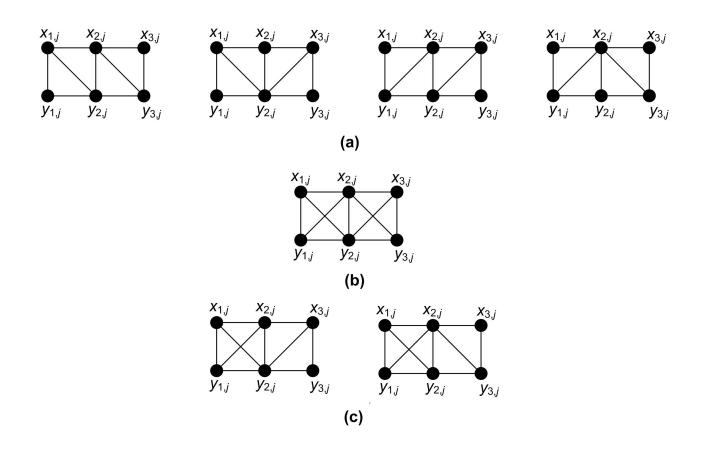
Figure 1. The blocks of the graphs \(G(k) = C[B_1, B_2, B_3, \dots, B_k]\).
Theorem 3.4. For every integer \(k \geq 3\), G(k) is maximal.
Proof. It is not hard to verify that the following labeling is a super edge-magic labeling of G(k).
\[h(u) = \begin{cases} (1,3,2,4,6), & \text{if } u = (x_{1,1},x_{2,1},y_{1,1},y_{2,1},y_{3,1}), \\ (7,9,8,10), & \text{if } u = (x_{1,2},x_{2,2},y_{2,2},y_{3,2}), \\ 5, & \text{if } u = c_1, \\ 12, & \text{if } u = c_2, \\ 5+10j, & \text{if } u = c_{2j+1}, \ 1 \leq j \leq \lfloor \frac{k-2}{2} \rfloor, \\ 12+10j, & \text{if } u = c_{2j+2}, \ 1 \leq j \leq \lfloor \frac{k-3}{2} \rfloor, \\ h(x_{i,1})+10j, & \text{if } u = x_{i,2j+1}, \ 1 \leq i \leq 2, \ 1 \leq j \leq \lfloor \frac{k-1}{2} \rfloor, \\ h(y_{i,1})+10j, & \text{if } u = y_{i,2j+1}, \ 2 \leq i \leq 3, \ 1 \leq j \leq \lfloor \frac{k-2}{2} \rfloor, \\ h(y_{i,2})+10j, & \text{if } u = y_{i,2j+1}, \ 2 \leq i \leq 3, \ 1 \leq j \leq \lfloor \frac{k-2}{2} \rfloor, \\ 5k, & \text{if } u = y_{3,k}, \ k \text{ is odd}, \\ 5k+1, & \text{if } u = y_{3,k}, \ k \text{ is even}. \end{cases}\]
Next, we consider graphs obtaining from ladders Lm = Pm × P2, m ≥ 2, by adding a diagonal in each rectangle of Lm. We denote such a graph by G[m]. Hence, G[m] can be defined as a graph with the vertex and edge sets as follows.
\[V(G[m]) = \{u_j, v_j | 1 \le j \le m\}\]
\[E(G[m]) = \{u_j v_j | 1 \le j \le m\} \cup \{u_j u_{j+1}, v_j v_{j+1} | 1 \le j \le m-1\} \cup \mathbb{S},\]
where S = {ei : ei is either ujvj+1 or vjuj+1, 1 ≤ i ≤ m−1}. It can be checked that |E(G[m])| = 2|V (G[m])| − 3.
Theorem 3.5. For any integer m ≥ 2, G[m] is maximal.
Proof. It is easy to verify that the bijection h : V (G[m]) → {1, 2, . . . , 2m} defined by
\[h(x) = \begin{cases} 2i, & \text{if } x = u_j, \ 1 \le j \le m, \\ 2i - 1, & \text{if } x = v_j, \ 1 \le j \le m, \end{cases}\]
can be extended to a super edge-magic labeling of G[m] with magic constant 6m.
Our results presented in Theorems 3.1, 3.2, 3.3, 3.4, and 3.5, give impression that graphs satisfy the maximal condition are super edge-magic. However, it is not the case. As an example Pn + K1, which satisfies the maximal condition, is super edge-magic if and only if 1 ≤ n ≤ 6 (see [7]).
Acknowledgement
The first author has been supported by "Hibah Desentralisasi - Fundamental 2015", 016/SP2H/P/K7/KM/2015, from the Directorate General of Higher Education, Indonesia.
References
- [1] A. Ahmad and F. A. Muntaner-Batle, On super edge-magic deficiency of unicyclic graphs, Util. Math., to appear.
- [2] A. Ahmad, I. Javaid and M. F. Nadeem, Further results on super edge-magic deficiency of unicyclic graphs, Ars Combin. 99 (2011), 129–138.
- [3] C. Barrientos, Graceful labeling of chain and corona graphs, Bull. Inst. Combin. Appl. 34 (2002), 17–26.
- [4] G. Chartrand and L. Lesniak, Graphs and Digraphs, fifth edition, Chapman & Hall/CRC, Boca Raton, London, New York, Washington, D.C. (2011).
- [5] H. Enomoto, A. Llado, T. Nakamigawa, and G. Ringel, Super edge magic graphs, SUT J. Math. 34 (1998), 105–109.
- [6] R.M. Figueroa-Centeno, R. Ichishima and F.A. Muntaner-Batle, The place of super edgemagic labelings among other classes of labelings, Discrete Math. 231 (2001), 153–168.
- [7] R.M. Figueroa-Centeno, R. Ichishima and F.A. Muntaner-Batle, On the super edge-magic deficiency of graphs, Electron. Notes Discrete Math. 11 (2002), 299–314.
- [8] R.M. Figueroa-Centeno, R. Ichishima and F.A. Muntaner-Batle, Some new results on the super edge-magic deficiency of graphs, J. Combin. Math. Combin. Comput. 55 (2005), 17– 31.
- [9] J.A. Gallian, A dinamic survey of graph labelings, Electron. J. Combin. 16 (2016) # DS6.
- [10] R. Ichishima and A. Oshima, On the super edge-magic deficiency and α-valuations of graphs, J. Indones. Math. Soc., Special Edition (2011), 59–69.
- [11] A. Kotzig and A. Rosa, Magic valuation of finite graphs, Canad. Math. Bull. 13 (4) (1970), 451–461.
- [12] A.A.G. Ngurah and R. Simanjuntak, Super edge-magic deficiency of join-product graphs, Util. Math., to appear.
- [13] A.A.G. Ngurah, E.T. Baskoro and R. Simanjuntak, On super edge-magic deficiency of graphs, Australas. J. Combin. 40 (2008), 3–14.
- [14] A.A.G. Ngurah, R. Simanjuntak, E.T. Baskoro, and S. Uttunggadewa, On super edge-magic strength and deficiency of graphs, Lecture Notes Comp. Sci. 4535 (2008), 144–154.