Shehnaz Akhter, Rashid Farooq
School of Natural Sciences, National University of Sciences and Technology, H-12 Islamabad, Pakistan.
shehnazakhter36@yahoo.com, farook.ra@gmail.com
A resolving set W is a set of vertices of a graph G(V, E) such that for every pair of distinct vertices u, v ∈ V (G), there exists a vertex w ∈ W satisfying d(u, w) 6= d(v, w). A resolving set with minimum number of vertices is called metric basis of G. The metric dimension of G, denoted by dim(G), is the minimum cardinality of a resolving set of G. In this paper, we consider (3, 6) fullerene and (4, 6)-fullerene graphs and compute the metric dimension for these fullerene graphs. We also give conjecture on the metric dimension of (3, 6)-fullerene and (4, 6)-fullerene graphs.
Keywords: resolving set, metric dimension, fullerene graph
Mathematics Subject Classification : 05C12
DOI: 10.5614/ejgta.2019.7.1.7
1. Introduction
The metric dimension was initially studied by Slater [16] and Harary and Melter [7]. They characterized the metric dimension of trees. Metric dimension has several applications in robot navigation [9], chemistry [3], sonar [16] and combinatorical optimization [13]. Let G be a molecular graph, that is, a representation of the structural formula of a chemical compound in terms of graph theory. The vertices and edges of G correspond to atoms and chemical bonds, respectively. For u, v ∈ V (G), the length of a shortest path from u to v is called the distance between u and v and is denoted by d(u, v). A graph G is said to be k-connected if there does not exist a set of less than k vertices whose removal disconnects the graph G. A planar graph G is a graph that can be drawn in such a way that no two edges cross each other. A cubic graph G is a graph in which all vertices have degree 3.
Received: 25 July 2017, Revised: 13 September 2018, Accepted: 28 December 2018.
A vertex w of G resolves a pair u, v of vertices if d(w, u) 6= d(w, v). Let W = {w1, w2, . . . , wk} ⊂ V (G). The metric representation of a vertex v ∈ V (G) with respect to W is the k-tuple
\[r(v|W) = (d(v, w_1), d(v, w_2), \dots, d(v, w_k)).\]
If every pair of distinct vertices of G have a distinct metric representation then the ordered set W is called a resolving set of G. A resolving set of minimum cardinality is called the metric basis for G and this cardinality is the metric dimension of G, denoted by dim(G). If dim(G) = k, then G is said to be k-dimensional. Several variations of metric dimension have been discussed in the literature, like resolving dominating sets [2], independent resolving sets [4], local metric sets [11], resolving partitions [5] and strong metric generators [13].
In 1985, Kroto et al. [8] discovered fullerene molecule and since then, scientists took a great interest in the fullerene graphs. A (k, 6)−fullerene graph is a 3-connected cubic plane graph whose faces have sizes k and 6. The only values of k for which a (k, 6)−fullerene graph exists are 3, 4 and 5. A (5, 6)−fullerene is an ordinary fullerene and constructed from pentagons and hexagons. Fowler et al. [6] discussed the mathematical properties of (5, 6)−fullerene.
A (3, 6)-fullerene graph have attained attention due to the similarity of its structure with ordinary fullerenes. The Eulers formula implies that a (3, 6)-fullerene graph has exactly four faces of size 3 and (n/2) − 2 hexagons. If the triangles in (3, 6)-fullerene have no common edge then it is called isolated triangular rules (ITR).
A (4, 6)-fullerene graph is a mathematical model of a boron-nitrogen fullerene. The Eulers formula implies that a (4, 6)-fullerene graph has exactly six square faces and (n/2) − 4 hexagons. If the six quadrangles in (4, 6)-fullerene don't have common edge, then it is called isolated square rules (ISR).
Ashrafi et al. [1] calculated the topological indices of (3, 6)- and (4, 6)-fullerene graphs. Koorepazan-Moftakhar et al. [10] find the automorphism group and fixing number of (3, 6)- and (4, 6)-fullerene graphs.
Siddiqui et al. [14, 15] calculated the metric dimension and partition dimension of Nanotubes. Rajan, et al. [12] calculated the metric dimension of enhanced hypercube networks. In this paper, we consider (3, 6)-fullerene and (4, 6)-fullerene graphs and compute their metric dimension. We also give conjecture on the metric dimension of (3, 6)-fullerene and (4, 6)-fullerene graphs.
2. Metric dimension of (3,6)-fullerene graphs
Let F1[n], F2[n], F3[n] and F4[n] are the graphs of (3, 6)-fullerene depicted in Figures ??-4 with order 8n + 4, 12n + 4, 16n − 32 and 24n, respectively. In this section, we find the metric dimension of F1[n], F2[n], F3[n] and F4[n] fullerene graphs.
Theorem 2.1. The metric dimension of fullerene graph F1[n] is 3.
Proof. Let {z1, z2, z3} and {z4, z5, z6} be the vertex sets of outer triangles of F1[n]. Let W = {z2, z3, z5} ⊂ V (F1[n]). We show that W is a resolving set of F1[n]. For this we give the representation of vertices in V (F1[n]) \ W with respect to W. The representation of vertices z1, z4 and z6 is given by:
\[r(z_1|W) = (1,1,2), \quad r(z_4|W) = (2,2,1), \quad r(z_6|W) = (3,3,1).\]
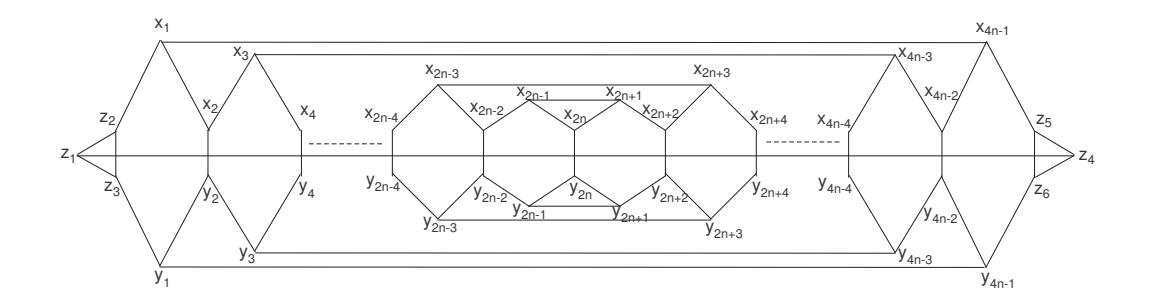
Figure 1. The Graph \(F_1[n]\).
The representation of vertices of upper half of the fullerene graph \(F_1[n]\) is given by:
\[r(x_i|W) = \begin{cases} (i, i+1, i+1), & \text{if } 1 \le i \le 2n-1, \\ (2n, 2n+1, 2n), & \text{if } i = 2n, \\ (4n-i+1, 4n-i+2, 4n-i), & \text{if } 2n+1 \le i \le 4n-1. \end{cases}\]
The representation of vertices of lower half of the fullerene graph \(F_1[n]\) is given by:
\[r(y_i|W) = \begin{cases} (i+1, i, i+2), & \text{if } 1 \le i \le 2n-1, \\ (2n-1, 2n-2, 2n-1), & \text{if } i = 2n, \\ (4n-i+2, 4n-i+1, 4n-i+1), & \text{if } 2n+1 \le i \le 4n-1. \end{cases}\]
All the vertices of \(F_1[n]\) have different representation with respect to W, this implies that W is a resolving set of \(F_1[n]\). Thus the metric dimension of \(\dim(F_1[n]) \leq 3\).
On the other hand, we show that \(\dim(F_1[n]) \geq 3\) by proving that there is no resolving set W' such that |W'| = 2. Let \(A = \{z_1, z_2, z_3, z_4, z_5, z_6\}\) be the set of vertices of outer triangles of \(F_1[n]\). Suppose on contrary that \(\dim(F_1[n]) = 2\) and W' is a resolving set with |W'| = 2, then there are following cases:
Case 1. If both vertices of W' are in upper half of the fullerene graph \(F_1[n]\), then the representations of pair of vertices \(z_4\), \(z_6\) and \(z_1\), \(z_3\) are the same. Thus W' is not a resolving set of \(F_1[n]\).
Case 2. If both vertices of W' are in lower half of the fullerene graph \(F_1[n]\), then the representations of pair of vertices \(z_4\), \(z_5\) and \(z_1\), \(z_2\) are the same. Thus W' is not a resolving set of \(F_1[n]\).
Case 3. If one vertex of W' is from \(\{x_1, x_2, \dots, x_{4n-1}\}\) and other vertex is from \(\{y_1, y_2, \dots, y_{4n-1}\}\), then the pair of vertices \(z_1, z_5\) or \(z_2, z_6\) have the same representation with respect to W'. Thus W' is not a resolving set of \(F_1[n]\).
Case 4. If one vertex from upper half of fullerene graph \(F_1[n]\) and one from the set of vertices A in W', then the representation of some vertices in \(\{x_1, x_2, \cdots, x_{4n-1}\}\) and \(\{y_1, y_2, \cdots, y_{4n-1}\}\) is the same. Therefore W' is not a resolving set in this case.
Case 5. If one vertex from lower half of fullerene graph \(F_1[n]\) and one from the set of vertices A in W', then the representation of some vertices in \(\{x_1, x_2, \cdots, x_{4n-1}\}\) and \(\{y_1, y_2, \cdots, y_{4n-1}\}\) is the same. Therefore W' is not a resolving set in this case.
Case 6. If both vertices of W' belongs to the set of vertices A, then we have the following subcases:
- If \(W' = \{z_2, z_5\}\) or \(W' = \{z_2, z_6\}\), then the representation of pair of vertices \(x_1, z_1\) or \(x_1, z_3\) are the same. Similarly if \(W' = \{z_3, z_5\}\) or \(W' = \{z_3, z_6\}\), then the representation of pair of vertices \(y_1, z_1\) or \(y_1, z_2\) are the same.
- \(\bullet\) All other possible subsets of A, then the representation of remanning pair of vertices of set A is the same.
Thus, in every subcase we get a contradiction.
From above cases, we conclude that there is no resolving set W' containing two vertices of \(F_1[n]\). Thus the metric dimension of \(F_1[n]\) is 3. This completes the proof.
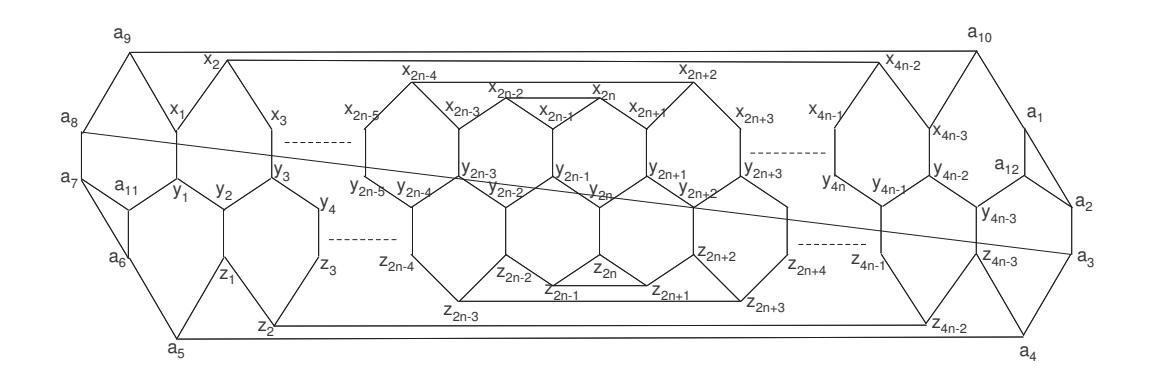
Figure 2. The Graph \(F_2[n]\).
Theorem 2.2. The metric dimension of fullerene graph \(F_2[n]\) is 3.
Proof. Let \(\{a_1, a_2, a_{12}\}\) and \(\{a_6, a_7, a_{11}\}\) be the vertex sets of outer triangles of \(F_2[n]\). Let \(W = \{a_1, a_2, a_{11}\} \subset V(F_2[n])\). We show that W is a resolving set of \(F_2[n]\). For this purpose, we give the representation of vertices in \(V(F_2[n]) \setminus W\) with respect to W. The representation of outer vertices of the fullerene graph \(F_2[n]\) is given below:
\[r(a_3|W) = (2,1,3), \quad r(a_4|W) = (3,2,3), \quad r(a_5|W) = (4,3,2),\]
\(r(a_6|W) = (5,4,1), \quad r(a_7|W) = (4,3,1), \quad r(a_8|W) = (3,2,2),\)
\(r(a_9|W) = (2,3,3), \quad r(a_{10}|W) = (1,2,4), \quad r(a_{12}|W) = (1,1,5).\)
The representation of vertices of upper half of the fullerene graph \(F_2[n]\) is given below:
\[r(x_i|W) = \begin{cases} (i+2, i+3, i+1), & \text{if } 1 \le i \le 2n-2, \\ (2n, 2n+1, 2n), & \text{if } i = 2n-1, \\ (4n-i-1, 4n-i, 4n-i), & \text{if } 2n \le i \le 4n-2, \\ (2, 3, 5), & \text{if } i = 4n-3. \end{cases}\]
The representation of middle vertices of the fullerene graph \(F_2[n]\) for n=1 is given below:
\[r(y_i|W) = \begin{cases} (4n-i, 4n-i, i), & \text{if } i = 2n-11, \\ (4n-i, 4n-i, 4n-i), & \text{if } i = 4n-2. \end{cases}\]
The representation of middle vertices of the fullerene graph \(F_2[n]\) for \(n \ge 2\) is given below:
\[r(y_i|W) = \begin{cases} (4,5,1), & \text{if } i = 1, \\ (i+3,i+3,i), & \text{if } 2 \le i \le 2n-2, \\ (4n-i,4n-i,i), & \text{if } 2n-1 \le i \le 2n, \\ (4n-i,4n-i,4n-i+1), & \text{if } 2n+1 \le i \le 4n-5, \\ (4n-i,4n-i,4n-i+3), & \text{if } 4n-4 \le i \le 4n-2. \end{cases}\]
The representation of vertices of lower half of the fullerene graph \(F_2[n]\) is given below:
\[r(z_i|W) = \begin{cases} (5,4,3), & \text{if } i = 1, \\ (i+3,i+3,i+2), & \text{if } 2 \le i \le 2n-2, \\ (2n+1,2n+1,2n+1), & \text{if } i = 2n-1, \\ (4n-i,4n-i,4n-i+1), & \text{if } 2n \le i \le 4n-3. \end{cases}\]
However all pair of vertices can easily be resolved by the set W. Thus the set W is a resolving set of \(F_2[n]\) and \(\dim(F_2[n]) \leq 3\). Now, we show that \(\dim(F_2[n]) \geq 3\) by showing that there is no resolving set W' such that |W'| = 2. Let \(A = \{a_1, a_2, a_3, \cdots, a_{12}\}\), \(B = \{x_1, x_2, \cdots, x_{4n-3}\}\), \(C = \{y_1, y_2, \cdots, y_{4n-3}\}\) and \(D = \{z_1, z_2, \cdots, z_{4n-3}\}\) be the sets of vertices of \(F_2[n]\). Suppose on contrary that \(\dim(F_2[n]) = 2\) and W' is a resolving set with |W'|. Then there are following possibilities:
Case 1. The pair of vertices \(a_1\), \(a_2\) and \(a_7\), \(a_8\) have the same distance from the vertices of set B, C and D. Then any subset of B, C and D is not a resolving set of \(F_2[n]\).
Case 2. If both vertices of W' are from set of vertices A, then some vertices of A have same representation. Therefore W' is not a resolving set of \(F_2[n]\).
Thus in every case we get a contradiction. Thus we conclude that there is no resolving set W' containing two vertices of \(F_2[n]\). Thus the metric dimension of \(F_2[n]\) is 3. This completes the proof.
Figure 3. The Graph \(F_3[n]\).
Theorem 2.3. The metric dimension of fullerene graph \(F_3[n]\) is 3.
Proof. Let {z1, z2, z3} and {z4, z5, z6} be the vertex sets of outer triangles and {a1, a2, a3, a4, a5, a6} be the vertices of outer hexagonal of F3[n]. Let W = {a5, z2, z5} ⊂ V (F3[n]). We need to show that W is a resolving set of F3[n]. For this purpose, first we give the representation of vertices in V (F3[n]) \ W with respect to W. The representation of outer vertices of fullerene graph F3[n] is given by:
\[r(a_1|W) = (2,3,4), \quad r(a_2|W) = (3,4,3), \quad r(a_3|W) = (2,5,2),\]
\(r(a_4|W) = (1,4,3), \quad r(a_6|W) = (1,2,5).\)
The representation of vertices of outer triangles in F3[n] is given by:
\[r(z_1|W) = (2, 1, 6), \quad r(z_3|W) = (3, 1, 7),\]
\(r(z_4|W) = (3, 6, 1), \quad r(z_6|W) = (4, 7, 1).\)
The representation of vertices of upper half of the fullerene graph F3[n] is given by:
\[r(x_i|W) = \begin{cases} (3,2,5), & \text{if } i = 1, \\ (i+2,i+1,i+2), & \text{if } 2 \le i \le 2n, \\ (2n+3,2n+2,2n+2), & \text{if } i = 2n+1, \\ (4n-i+5,4n-i+4,4n-i+3), & \text{if } 2n+2 \le i \le 4n, \\ (4,5,2), & \text{if } i = 4n+1. \end{cases}\]
The representation of middle vertices of the fullerene graph F3[n] for n = 1 is given by:
\[r(b_1|W) = (4, 1, 5), \quad r(b_2|W) = (4, 2, 4), \quad r(b_3|W) = (5, 3, 3),\]
\(r(b_4|W) = (5, 4, 2), \quad r(b_5|W) = (5, 5, 1).\)
The representation of middle vertices of the fullerene graph F3[n] for n ≥ 2 is given by:
\[r(b_i|W) = \begin{cases} (4, i, i+5), & \text{if } i \in \{1, 2\}, \\ (i+2, i, i+3), & \text{if } 3 \leq i \leq 2n-1, \\ (i+2, i, 4n-i+2), & \text{if } i \in \{2n, 2n+1\}, \\ (2n+3, 2n+2, 2n), & \text{if } i = 2n+2, \\ (4n-i+5, 4n-i+5, 4n-i+2), & \text{if } 2n+3 \leq i \leq 4n-1, \\ (5, 4n-i+7, 4n-i+2), & \text{if } i \in \{4n, 4n+1\}. \end{cases}\]
The representation of middle vertices of the fullerene graph F3[n] is given by:
\[r(c_i|W) = \begin{cases} (i+1,i+1,i+5), & \text{if } i \in \{1,2\}, \\ (i+1,i+1,i+4), & \text{if } 3 \le i \le 2n-1, \\ (i+1,i+1,4n-i+3), & \text{if } i \in \{2n,2n+1\}, \\ (2n+2,2n+3,2n+1), & \text{if } i = 2n+2, \\ (4n-i+4,4n-i+6,4n-i+3), & \text{if } 2n+3 \le i \le 4n-1, \\ (4n-i+4,4n-i+7,4n-i+3), & \text{if } i \in \{4n,4n+1\}. \end{cases}\]
The representation of vertices of lower half of the fullerene graph \(F_3[n]\) is given by:
\[r(y_i|W) = \begin{cases} (1,3,5), & \text{if } i = 1, \\ (i,i+2,i+3), & \text{if } 2 \le i \le 2n, \\ (2n+1,2n+2,2n+2), & \text{if } i = 2n+1, \\ (4n-i+3,4n-i+5,4n-i+4), & \text{if } 2n+2 \le i \le 4n, \\ (2,5,3), & \text{if } i = 4n+1. \end{cases}\]
Therefore the set W resolves all the vertices in \(V(F_3[n]) \setminus W\). Thus \(\dim(F_3[n]) \leq 3\). Now we show that \(\dim(F_3[n]) \geq 3\). For this we show that there does not exists any resolving set W' with two vertices. Let \(A = \{a_1, a_2, a_3, a_4, a_5, a_6\}\), \(B = \{z_1, z_2, z_3, z_4, z_5, z_6\}\), \(C = \{x_1, x_2, \cdots, x_{4n+1}\}\), \(D = \{b_1, b_2, \cdots, b_{4n+1}\}\), \(E = \{c_1, c_2, \cdots, c_{4n+1}\}\) and \(F = \{y_1, y_2, \cdots, y_{4n+1}\}\) be the sets of vertices of \(F_3[n]\). Then there are following cases:
Case 1. If both vertices of W' are in the set of vertices C, then the vertices of A and D have the same representation. Therefore W' is not a resolving set of \(F_3[n]\).
Case 2. If both vertices of W' are in the set of vertices D, then the vertices of B and C have the same representation. Therefore W' is not a resolving set of \(F_3[n]\).
Case 3. The vertices of set A have same distance from the vertices of B. Therefore the resolving set is not the subset of A or B.
Case 4. If both vertices of W' are in the set of vertices F, then the vertices of A and E have the same representation. Therefore W' is not a resolving set of \(F_3[n]\).
Case 5. If both vertices of W' are in the set of vertices E, then the vertices of B and F have the same representation. Therefore W' is not a resolving set of \(F_3[n]\).
Thus, in every case we get a contradiction. From above cases, we conclude that there is no resolving set W' with exactly two vertices of \(F_3[n]\). Thus the metric dimension of \(F_3[n]\) is 3. This completes the proof.
Figure 4. The Graph \(F_4[n]\).
Theorem 2.4. The metric dimension of fullerene graph F4[n] is 3.
Proof. Let W = {a3, a7, a8} ⊂ V (F4[n]). We need to show that W is a resolving set of F4[n]. First we give the representation of vertices of F4[n] \ W with respect to W.
\[r(a_1|W) = (2, 4n + 2, 4n + 2), \quad r(a_2|W) = (1, 4n + 1, 4n + 1), \quad r(a_4|W) = (1, 4n + 1, 4n),\]
\(r(a_5|W) = (4n + 2, 2, 2), \qquad r(a_6|W) = (4n + 1, 1, 1).\)
The representation of vertices of upper half of the fullerene graph F4[n] is given below:
\[r(x_i|W) = \begin{cases} (3,4n+i,4n+i+1), & \text{if } i = 1, \\ (i,4n-i+2,4n-i+3), & \text{if } 2 \le i \le 4n, \\ (4n+1,3,4), & \text{if } i = 4n+1. \end{cases}\]
The representation of middle vertices of the fullerene graph F4[n] is given below:
\[r(y_i|W) = (i, 4n - i, 4n - i + 1), 1 \le i \le 4n - 1,\]
\[r(z_i|W) = (i + 1, 4n - i + 1, 4n - i), 1 \le i \le 4n - 1.\]
The representation of vertices of lower half of the fullerene graph F4[n] is given below:
\[r(b_i|W) = \begin{cases} (3,4n+2,4n+1), & \text{if } i = 1, \\ (i+1,4n-i+3,4n-i+2), & \text{if } 2 \le i \le 4n, \\ (4n+2,3,3), & \text{if } i = 4n+1. \end{cases}\]
All vertices of V (F4[n]) \ W can be resolved with respect to W. Thus W is a resolving set of F4[n] and dim(F4[n]) ≤ 3.
On the other hand, we show that dim(F4[n]) ≥ 3 by proving that there is no resolving set W0 with cardinality 2. Suppose on contrary that dim(F4[n]) = 2 and W0 is a resolving set of F4[n] with |W0 | = 2. Let A = {a1, a2, ·, a8}, B = {x1, x2, · · · , x4n+1}, C = {y1, y2, · · · , y4n+1}, D = {z1, z2, · · · , z4n+1} and E = {b1, b2, · · · , b4n+1} be the sets of vertices of F4[n]. The pairs of vertices a1, a3 and a5, a7 have the same distance with the vertices of set B. The pairs of vertices a2, a4 and a6, a8 have the same distance with the vertices of set C. The pairs of vertices a2, a3 and a6, a7 have the same distance with the vertices of set D. Similarly, The pairs of vertices a1, a4 and a5, a8 have the same distance with the vertices of set C. Therefore, there is no a resolving set W0 with cardinality 2 of F4[n]. Thus dim(F4[n]) = 3. This completes the proof.
3. Metric dimension of (4,6)-fullerene graphs
Suppose G1[n], G2[n] and G3[n] are depicted in Figures 5-7 with order 8n, 8n+4 and 12n+12 respectively. In this subsection we find the metric dimension of G1[n], G2[n] and G3[n] fullerene graphs.
Theorem 3.1. The metric dimension of fullerene graph G1[n] is 3 for n ≥ 2.
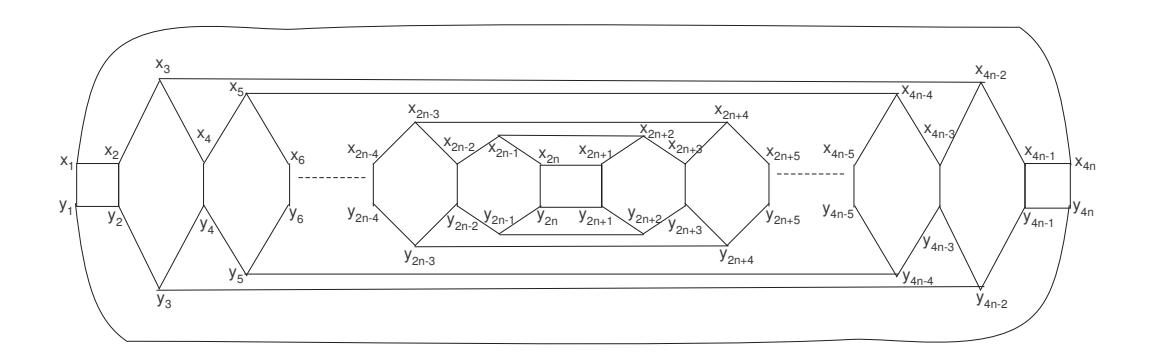
Figure 5. The Graph \(G_1[n]\).
Proof. For a set \(W = \{x_1, y_1, x_{4n}\} \subset V(G_1[n])\), we need to show that W is a resolving set of \(G_1[n]\). First we show that \(\dim(G_1[n]) \neq 2\). There are following cases:
Case 1. If both vertices are in the upper half of \(G_1[n]\) and the resolving set is \(W' = \{x_s, x_t\}\), \(1 \le s \le t \le 4n\). Then the representations of \(x_i\) and \(y_{i+1}\), \(2n+1 \le i \le 4n-1\) are the same. Similarly the representations of \(x_{i+1}\) and \(y_i\), \(1 \le i \le 2n-1\) are the same. Therefore the resolving set of \(G_1[n]\) is not a subset of \(\{x_1, x_2, \cdots, x_{4n}\}\).
Case 2. If both vertices are in the lower half of \(G_1[n]\) and the resolving set is \(W' = \{y_s, y_t\}\), \(1 \le s \le t \le 4n\). Then the representations of \(x_{i+1}\) and \(y_i\), \(2n+1 \le i \le 4n-1\) are the same. Similarly the representations of \(x_i\) and \(y_{i+1}\), \(1 \le i \le 2n-1\) are the same. Therefore the resolving set is not a subset of \(\{y_1, y_2, \cdots, y_{4n}\}\).
Case 3. If one vertex belongs to the set of vertices \(\{x_1, x_2, \dots, x_{4n}\}\) and other is in the set of vertices \(\{y_1, y_2, \dots, y_{4n}\}\). Without loss of generality, we can suppose that the resolving set is \(W' = \{x_s, y_t\}, 1 \le s \le 4n\) and \(1 \le t \le 4n\).
If s = t, then the representation of pairs of vertices \(x_{s+1}, x_{s-1}\) and \(y_{t-1}, y_{t+1}\) are the same.
If s < t, then the representation of \(x_i\), i > s and \(y_j\), j < 4n are the same.
If s > t, then the representation of \(x_i\), i < 4n and \(y_j\), j > t are the same.
Thus, in every subcase we get a contradiction. From above cases, we conclude that there is no resolving set W' with |W'|=2. Thus \(\dim(G_1[n])\geq 3\). Now we show that \(\dim(G_1[n])\leq 3\). For this purpose we give the representation of the vertices in \(V(G_1[n])\setminus W\) with respect to W. The representation of vertices of upper half of the fullerene graph \(G_1[n]\) is given below:
\[r(x_i|W) = \begin{cases} (i-1, i, i), & \text{if } 2 \le i \le 2n, \\ (4n-i+1, 4n-i+2, 4n-i), & \text{if } 2n+1 \le i \le 4n-1. \end{cases}\]
The representation of vertices of lower half of the fullerene graph \(G_1[n]\) is given below:
\[r(y_i|W) = \begin{cases} (i, i-1, i+1), & \text{if } 2 \le i \le 2n, \\ (4n-i+2, 4n-i+1, 4n-i+1), & \text{if } 2n+1 \le i \le 4n. \end{cases}\]
This implies that all vertices of \(V(G_1[n]) \setminus W\) can be resolved with respect to W. Thus W is a resolving set of \(G_1[n]\). Therefore \(\dim(G_1[n]) = 3\) for \(n \ge 2\). This completes the proof.
Figure 6. The Graph \(G_2[n]\).
Theorem 3.2. The metric dimension of fullerene graph \(G_2[n]\) is 3.
Proof. Let \(W = \{x_1, y_1, x_{4n+2}\} \subset V(G_2[n])\). We show that W is a resolving set of \(G_2[n]\). First we give the representation of vertices in \(V(G_2[n]) \setminus W\) with respect to W. The representation of vertices of upper half of the fullerene graph \(G_2[n]\) is given by:
\[r(x_i|W) = \begin{cases} (i-1,i,i), & \text{if } 2 \le i \le 2n+1, \\ (4n-i+3,4n-i+4,4n-i+2), & \text{if } 2n+2 \le i \le 4n+1. \end{cases}\]
The representation of vertices of lower half of the fullerene graph \(G_2[n]\) is given by:
\[r(y_i|W) = \begin{cases} (i, i-1, i+1), & \text{if } 2 \le i \le 2n+1, \\ (4n-i+4, 4n-i+3, 4n-i+3), & \text{if } 2n+2 \le i \le 4n+2. \end{cases}\]
This implies that W is a resolving set of \(G_2[n]\) and \(\dim(G_2[n]) \leq 3\). Now we show that \(\dim(G_2[n]) \geq 3\) by proving that W' is a resolving set of \(G_2[n]\) with |W'| = 2. There are following possibilities:
Case 1. If both vertices are in the upper half of \(G_2[n]\) and the resolving set is \(W' = \{x_s, x_t\}\), \(1 \le s \le t \le 4n\). Then the representation of \(x_i\) and \(y_{i+1}\), \(2n+2 \le i \le 4n-1\) is the same. Similarly the representation of \(x_{i+1}\) and \(y_i\), \(1 \le i \le 2n\) is the same. Therefore the resolving set of \(G_2[n]\) is not a subset of \(\{x_1, x_2, \cdots, x_{4n}\}\).
Case 2. If both vertices are in the lower half of \(G_1[n]\) and the resolving set is \(W' = \{y_s, y_t\}\), \(1 \le s \le t \le 4n\). Then the representation of \(x_{i+1}\) and \(y_i\), \(2n+2 \le i \le 4n-1\) is the same. Similarly the representation of \(x_i\) and \(y_{i+1}\), \(1 \le i \le 2n\) is the same. Therefore the resolving set of \(G_2[n]\) is not a subset of \(G_2[n]\) is not a subset of \(G_2[n]\).
Case 3. If one vertex belongs to the set of vertices \(\{x_1, x_2, \dots, x_{4n}\}\) and other is in the set of vertices \(\{y_1, y_2, \dots, y_{4n}\}\). Without loss of generality, we can suppose that the resolving set of \(G_2[n]\) is \(W' = \{x_s, y_t\}\), \(1 \le s \le 4n\) and \(1 \le t \le 4n\).
If s = t, then the representation of pair of vertices \(x_{s+1}, x_{s-1}\) and \(y_{t-1}, y_{t+1}\) is the same.
If s < t, then the representation of \(x_i\), i > s and \(y_i\), j < 4n is the same.
If s > t, then the representation of \(x_i\), i < 4n and \(y_j\), j > t is the same.
From above cases, we conclude that there is no resolving set W' for \(G_2[n]\) with |W'|=2. Thus \(\dim(G_2[n])=3\). This completes the proof.
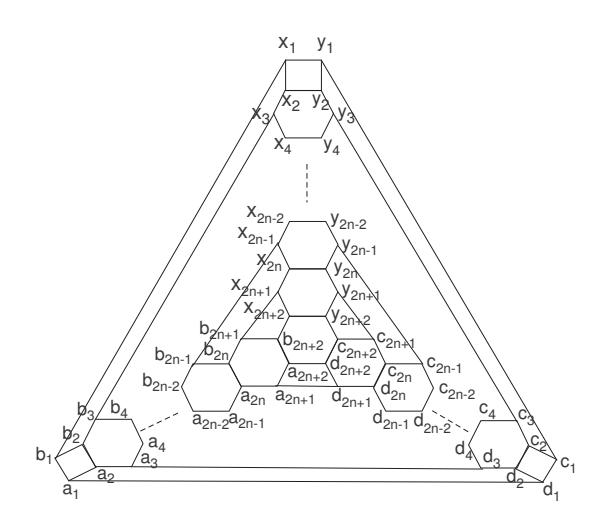
Figure 7. The Graph \(G_3[n]\).
Theorem 3.3. The metric dimension of fullerene graph \(G_3[n]\) is 3.
Proof. Let \(\{x_1, y_1, a_1, b_1, c_1, d_1\}\) be the set of outer vertices of \(G_3[n]\). The vertex \(x_1\) and \(y_1\) have the same distance from other vertices and \(a_1\) and \(b_1\) have the same distance from other vertices of \(G_3[n]\). Similarly \(c_1\) and \(d_1\) have the same distance from other vertices of \(G_3[n]\). Thus any metric basis will contain either \(x_1\) or \(y_1\), \(a_1\) or \(b_1\) and \(c_1\) or \(d_1\). There are 6 boundary vertices in \(G_3[n]\). Hence any metric basis of \(G_3[n]\) should contain at least 3 nodes of \(G_3[n]\). Let \(W = \{x_1, a_1, c_1\} \subset V(G_3[n])\), we need to show that W is a resolving set of \(G_3[n]\). Then the representation of vertices in \(V(G_3[n]) \setminus W\) with respect to W for \(n \geq 2\) is given by:
\[r(x_i|W) = (i-1, i+1, i+1), \quad \text{if} \quad 2 \le i \le 2n+2,\] \[r(y_i|W) = (i, i+2, i), \quad \text{if} \quad 1 \le i \le 2n+2,\] \[r(a_i|W) = (i+1, i-1, i+1), \quad \text{if} \quad 2 \le i \le 2n+2,\] \[r(b_i|W) = (i, i, i+2), \quad \text{if} \quad 1 \le i \le 2n+2,\] \[r(c_i|W) = (i+1, i+1, i-1), \quad \text{if} \quad 2 \le i \le 2n+2,\] \[r(d_i|W) = (i+2, i, i), \quad \text{if} \quad 1 \le i \le 2n+2.\]
The representation of vertices of \(V(G_3[n]) \setminus W\) with respect to W for n = 1 is given by:
\[r(x_i|W) = \begin{cases} (i-1,i+1,i+1), & \text{if } 2 \le i \le 2n+1, \\ (i-1,i,i), & \text{if } i = 2n+2. \end{cases}\] \[r(y_i|W) = \begin{cases} (i,i+2,i), & \text{if } 1 \le i \le 2n+1, \\ (i,i+1,i), & \text{if } i = 2n+2. \end{cases}\] \[\text{[rumus tidak dapat ditampilkan dengan baik — lihat PDF asli]}\]
Hence there are no two vertices having the same representations. Thus W = {x1, c1, a1} is a resolving set of G3[n]. Therefore dim(G3[n]) = 3. This completes the proof.
4. Conclusion and open problems
In this paper, we considered some (3, 6)-fullerene and (4, 6)-fullerene graphs and computed the metric dimension for these fullerene graphs. All (3, 6)-fullerene and (4, 6)-fullerene graphs considered in this paper have metric dimension 3. It will be interesting to prove or disprove the following statement:
"All (3, 6)-fullerene and (4, 6)-fullerene graphs have metric dimension 3."
Acknowledgement
This research is supported by the Higher Education Commission of Pakistan under grant No. 20-3067/NRPU /R&D/HEC/12
References
- [1] A.R. Ashrafi and Z. Mehranian, Topological study of (3, 6)− and (4, 6)−fullerenes, Topological Modelling of Nanostructures and Extended Systems, Springer Netherlands, (2013), 487–510.
- [2] R.C. Brigham, G. Chartrand, R.D. Dutton and P. Zhang, Resolving domination in graphs, Math. Bohem. 128 (1) (2003), 25–36.
- [3] G. Chartrand, L. Eroh, M.A. Johnson and O.R. Oellermann, Resolvability in graphs and the metric dimension of a graph, Discrete Appl. Math. 105 (2000), 99–113.
- [4] G. Chartrand, C. Poisson and P. Zhang, Resolvability and the upper dimension of graphs, Comput. Math. Appl. 39 (2000), 19–28.
- [5] G. Chartrand, E. Salehi and P. Zhang, The partition dimension of a graph, Aequationes Math. 59 (2000), 45–54.
- [6] P.W. Fowler and D.E. Manolopoulos, An Atlas of Fullerenes, Oxford Univ Press Oxford, (1995).
- [7] F. Harary and R.A. Melter, On the metric dimension of a graph, Ars Combin. 2 (1976), 191– 195.
- [8] H.W. Kroto, J.R. Heath, S.C. OBrien, R.F. Curl and R.E. Smalley, C60: buckminsterfullerene, Nature 318 (1985), 162–163.
- [9] S. Khuller, B. Raghavachari and A. Rosenfeld, Landmarks in graphs, Discrete Appl. Math. 70 (3) (1996), 217–229.
- [10] F. Koorepazan-Moftakhar, A.R. Ashrafi and Z. Mehranian, Automorphism group and fixing number of (3, 6)- and (4, 6)−fullerene graphs, Electron. Notes Discrete Math. 45 (2014), 113–120.
- [11] F. Okamoto, B. Phinezyn and P. Zhang, The local metric dimension of a graph, Math. Bohem. 135 (3) (2010), 239–255.
- [12] B. Rajan, I. Rajasingh, M.C. Monica and P. Manuel, Metric dimension of enhanced hypercube networks, J. Combin. Math. Combin. Comput. 67 (2008), 5–15.
- [13] A. Sebo and E. Tannier, On metric generators of graphs, ¨ Math. Oper. Res. 29 (2) (2004), 383–393.
- [14] H.M.A. Siddiqui and M. Imran, Computation of metric dimension and partition dimension of Nanotubes, Journal of Computational and Theoretical Nanoscience 12 (2) (2015), 199–203.
- [15] H.M.A. Siddiqui and M. Imran, Computing metric and partition dimension of 2−Dimensional lattices of certain Nanotubes, Journal of Computational and Theoretical Nanoscience 11 (12) (2014), 2419–2423.
- [16] P.J. Slater, Leaves of trees, Congr. Numer. 14 (1975), 549–559.