Hilda Assiyatun, Budi Rahadjeng1∗ , Edy Tri Baskoro
Combinatorial Mathematics Research Group, Faculty of Mathematics and Natural Sciences, Institut Teknologi Bandung, Jalan Ganesa 10 Bandung, Indonesia
hilda@math.itb.ac.id, budi.rahadjeng@students.itb.ac.id, ebaskoro@math.itb.ac.id
Let F, G, and H be simple graphs. The notation F → (G, H) means that if all the edges of F are arbitrarily colored by red or blue, then there always exists either a red subgraph G or a blue subgraph H. The size Ramsey number of graph G and H, denoted by rˆ(G, H) is the smallest integer k such that there is a graph F with k edges satisfying F → (G, H). In this research, we will study a modified size Ramsey number, namely the connected size Ramsey number. In this case, we only consider connected graphs F satisfying the above properties. This connected size Ramsey number of G and H is denoted by rˆc(G, H). We will derive an upper bound of rˆc(nK2, H), n ≥ 2 where H is 2Pm or 2K1,t, and find the exact values of rˆc(nK2, H), for some fixed n.
Keywords: connected size Ramsey number, disconnected graph, matching
Mathematics Subject Classification : 05D10, 05C55
DOI: 10.5614/ejgta.2019.7.1.9
1. Introduction
All graphs in this paper are finite, undirected, and simple. Let F, G, and H be graphs. The number of vertices and edges of graph F will be denoted by |V (F)| and |E(F)|, respectively. The notation F → (G, H) means that in any red-blue coloring of the edges of F there exists a red
Received: 19 February 2018, Revised: 19 August 2018, Accepted: 5 January 2019.
1 Permanent Affiliation: Universitas Negeri Surabaya, Indonesia.
*Corresponding author.
copy of G or a blue copy of H in F. We denote F 9 (G, H) to mean that there is some red-blue coloring of the edges of F such that F contains neither a red G nor a blue H. This coloring is called a (G, H)-coloring of F.
The size Ramsey number for a pair of graphs G and H, denoted by rˆ(G, H), is the smallest integer k such that there is a graph F with k edges satisfying F −→ (G, H). The concept of size Ramsey number of a graph was introduced by Erdos et al. in [2]. A survey of results about the size ˝ Ramsey number for a pair of graphs can be seen in [4]. There are only a few results concerning the size Ramsey number for a pair of graphs, namely the size Ramsey numbers involving a complete graph, a star, a cycle or a path. Further results have also been obtained, for instance the size Ramsey number for some regular graphs [5] and the size Ramsey of a directed path [6].
A matching, denoted by nK2, n ≥ 2, is the graph consisting of 2n vertices and n independent edges. In 1978, Burr et.al [1] determined the size Ramsey number for a pair of graphs involving matching, rˆ(nK1,s, mK1,t) = (n+m−1)(s+t−1), for positive integers s, t, m, and n. The smallest graphs F satisfying this size Ramsey number are (m+n−1)K1,(s+t−1) and lK3∪(m+n−l−1)K1,3 for s = t = 2, 1 ≤ l ≤ m + n − 1, namely (m + n − 1)K1,(s+t−1) → (nK1,s, mK1,t) or lK3∪(m+n−l−1)K1,3 → (nK1,2, mK1,2). These two graphs are disconnected. The other result on the size Ramsey number involving matching was obtained by Erdos and Faudree [3]. They ˝ showed that rˆ(2K2, Pm) = m + 1, where the smallest graph satisfying the size Ramsey number is a Cm+1, namely Cm+1 → (2K2, Pm). Note that in this case, we have a connected smallest graph F satisfying F → (G, H).
Therefore, in general we have either connected or disconnected graph F with smallest size and satisfying F → (G, H), for given G and H. In this paper, we are interested in finding a connected graph F with minimum size and satisfying F → (G, H). The smallest size of a connected graph F so that F → (G, H) is called the connected size Ramsey number and denoted by rˆc(G, H).
Some results on the connected size Ramsey number for a pairs of graphs were established. Rahadjeng et al. [8] determined the connected size Ramsey number for the pairs (2K2, K1,m) and (3K2, K1,m). Then, in [7], they showed that rˆc(nK2, K1,3) = 4n − 1, for n ≥ 2.
In this paper, we will determine an upper bound of rˆc(nK2, H), n ≥ 2 where H is isomorphic to 2Pm or 2K1,t. We also determine the exact values of rˆc(nK2, H) for some fixed n.
2. Main Results
In this section, we present the following results.
Theorem 2.1. For \[m \geq 2\], \(\hat{r}_c(2K_2, 2P_m) = 2m + 1\).
Proof. First, we will show that rˆc(2K2, 2Pm) ≤ 2m + 1. To do this, we will define the connected graph F having 2m + 1 edges satisfying F → (2K2, 2Pm). Consider the graph F = C2m+1. Let µ be any red-blue coloring of F such that there is no red 2K2. Then, there is no red edge in F or a red subgraph in F is isomorphic to either P2 or P3. Let us consider a subgraph F 0 = F − E(Pi) with i = 2 or 3. Certainly, F 0 is isomorphic to either a path P2m+1 or P2m. Since the necessary condition of the path containing 2Pm is having at least 2m vertices, then obviously F 0 contains 2Pm. Hence, F → (2K2, 2Pm).
Now, we will show that \(\hat{r}_c(2K_2, 2P_m) \ge 2m + 1\). Let G be a connected graph with \(|E(G)| \le 2m\). We will show that \(G \nrightarrow (2K_2, 2P_m)\). We are going to prove it by using the number of vertices of G.
First, we assume that |V(G)|=2m+1. In this case, G is a tree. Let \(P=v_1,v_2,...,v_k\) be the longest path in G, with \(k \leq 2m+1\). Choose one vertex of V(P), say \(v_i\), so that \(G-v_i\) contains no \(2P_m\). Color all edges incident with \(v_i\) by red and all edges in \(G-v_i\) by blue. By this coloring, there is a \((2K_2, 2P_m)\)-coloring on F. Thus, \(G \rightarrow (2K_2, 2P_m)\).
Next, suppose that \(|V(G)| \leq 2m\). Let us consider a complete graph \(K_{2m}\). For every \(v \in V(K_{2m})\), \(K_{2m} - v \not\supseteq 2P_m\). Since all graphs of order 2m and size 2m are proper subgraphs of \(K_{2m}\), then we can color all edges of G with red-blue so that there exists a \((2K_2, 2P_m)\)-coloring in G. Thus, \(G \to (2K_2, 2P_m)\).
Theorem 2.2. \[\hat{r}_c(nK_2, 2P_3) \leq \begin{cases} 3n+1, & \textit{for } n=3,4,5,6,7, \\ 5(\frac{n}{2})+4, & \textit{for even } n, n \geq 8, \\ 5\left(\frac{n+1}{2}\right)+2, & \textit{for odd } n, n \geq 9. \end{cases}\]
Proof. We will find a connected graph F such that \(F \to (nK_2, 2P_3)\). First, we will prove for the case of \(n \in [3, 7]\). Let us consider the graph \(F = C_{3n+1}\).
Let \(\mu\) be any red-blue coloring of F that maximizes the number of red edges and contains no red \(nK_2\). The red subgraph of F contains at most 2(n-1) edges. The remaining edges, which are blue, are at least 3n+1-2(n-1)=n+3. This blue subgraph consists of at most n-1 disjoint paths. By the pigeon-hole principle, there are at least two disjoint paths of length 2. Thus F contains blue \(2P_3\). Hence \(F \to (nK_2, 2P_3)\).
For the case of even n and \(n \geq 8\), we consider the graph in Figure 1. The graph G contains \((\frac{n}{2}+1)\) disjoint cycles of length 4 and \(\frac{n}{2}\) disjoint edges. Thus, the number of edges of G is \(4(\frac{n}{2}+1)+\frac{n}{2}=5(\frac{n}{2})+4\). Let \(\mu\) be any red-blue coloring of G such that there is no red \(nK_2\).
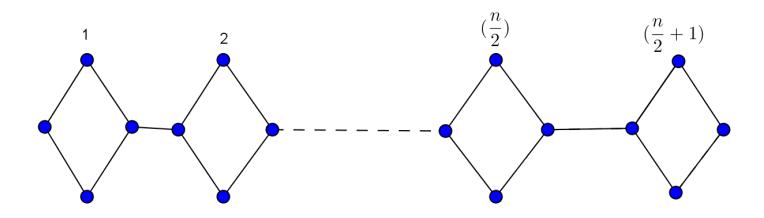
Figure 1. The graph \(G \to (nK_2, 2P_3)\), for even n.
Observe that for each 4-cycle in G, we find at most two red \(K_2\). Since G contains no red \(nK_2\), we have at most \((\frac{n}{2}-1)\) 4-cycles containing two red \(K_2\) and one 4-cycle containing at most one red \(K_2\). As a consequence, we have at least one 4-cycle whose all edges are blue and one 4-cycle which at least 2 consecutive edges are blue. Since those two 4-cycles are separated by at least an edge, G contains a blue \(2P_3\). Thus, \(G \to (nK_2, 2P_3)\).
For the case of odd \(n, n \geq 9\), let consider the graph in Figure 2. The graph F contains \(\left(\frac{n+1}{2}\right)\) disjoint cycles of length 4, \(\left(\left(\frac{n+1}{2}\right)-1\right)\) disjoint edges and one star \(K_{1,3}\). Thus, the number of edges of F is \(4\left(\frac{n+1}{2}\right)+\left(\left(\frac{n+1}{2}\right)-1\right)+3=5\left(\frac{n+1}{2}\right)+2\).
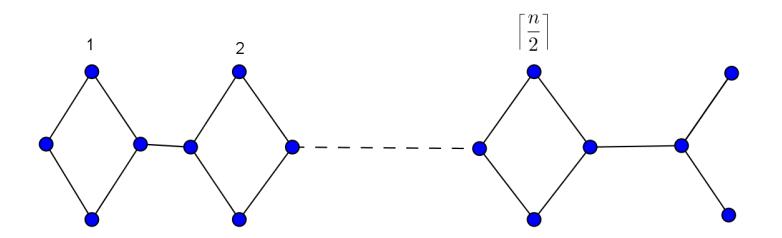
Figure 2. The graph \(F \to (nK_2, 2P_3)\), for odd n.
Let \(\mu\) be any red-blue coloring of F such that there is no red \(nK_2\). By a similar argument as in the case for even n, there are at most \((\frac{n+1}{2}-1)\) 4-cycles containing red \(2K_2\). As a consequence, we have at least one 4-cycle which all edges are blue and a blue star \(K_{1,3}\). Thus, \(G \to (nK_2, 2P_3)\). \(\square\)
Theorem 2.3. \(\hat{r}_c(3K_2, 2P_3) = 10.\)
Proof. According Theorem 2.2, \(\hat{r}_c(3K_2, 2P_3) \leq 10\). Now, we will prove that \(\hat{r}_c(3K_2, 2P_3) \geq 10\). Suppose that F is a connected graph with \(|E(F)| \leq 9\). We will show that \(F \nrightarrow (3K_2, 2P_3)\). Decompose F into two connected subgraph \(F_1\) and \(F_2\) with \(|E(F_1)| \leq 3\) and \(|E(F_2)| \leq 6\). Consider that the subgraph \(F_1\) is isomorphic to a star \(K_{1,3}\) or a cycle \(C_3\) or a path \(P_4\). If \(F_1\) is a star \(K_{1,3}\) or a cycle \(C_3\), then color all edges in \(F_1\) with red. According Theorem 2.1 \(\hat{r}_c(2K_2, 2P_3) = 7\), then there is a \((2K_2, 2P_3)\) — coloring in \(F_2\). Therefore, F contains at most two red \(K_2\) and no blue \(2P_3\). So, \(F \nrightarrow (3K_2, 2P_3)\).
Now, suppose that \(F_1\) is a path \(P_4\). We claim there are at most 2 common vertices of \(F_1\) and \(F_2\). Suppose there are 3 common vertices of \(F_2\) and \(F_1\). Consider the following graph. Let \(v_i^1\) and \(v_i^2\) be vertices of \(F_1\) and \(F_2\), respectively. Since \(F_2\) is connected, there is a vertex \(v_k^2\) of \(F_2\) adjacent

to \(v_j^2\), j=5 or 6 or 7. Therefore, if we remove the vertex \(v=v_2^1\), the graph F-v is connected. Hence, this is the same as the previous case, namely when \(F_1\) is a star \(K_{1,3}\). So, there are at most two common vertices of \(F_1\) and \(F_2\), as claimed.
By Theorem 2.1, there is a \((2K_2, 2P_3)\) – coloring in \(F_2\). Observe that, if there are at least two blue paths in \(F_2\), the longest one is \(P_4\). Therefore, we color two consecutive edges in \(F_1\) with red and the other edge with blue so that the blue edge of \(F_1\) is adjacent to the longest blue path in \(F_2\) (if any). Otherwise, the blue edge of \(F_1\) is adjacent to the red edges of \(F_2\). In this coloring, F contains at most two red \(K_2\) and no blue \(2P_3\). So, \(F \rightarrow (3K_2, 2P_3)\). Thus, \(\hat{r}_c(3K_2, 2P_3) \geq 10\). Combining the two inequalities, we have \(\hat{r}_c(3K_2, 2P_3) = 10\).
Theorem 2.4. rˆc(nK2, 2P3) = 3n + 1, for n = 3, 4, 5, 6, 7.
Proof. By Theorem 2.2, we obtain rˆc(nK2, 2P3) ≤ 3n + 1. Now, we will prove rˆc(nK2, 2P3) ≥ 3n + 1. Suppose that F is a connected graph with |E(F)| ≤ 3n. We will show that F 9 (nK2, 2P3). We proceed by induction on n. The assertion is true for n = 3. Furthermore, we may assume that rˆc(kK2, 2P3) ≥ 3k + 1, for all n ≤ k ≤ 6.
Let F 0 be a connected graph with |E(F 0 )| ≤ 3(k + 1). Decompose F 0 into two connected subgraphs F1 and F2 with |E(F1)| ≤ 3 and |E(F2)| ≤ 3k. Consider that the subgraph F1 isomorphic to a star K1,3 or a cycle C3 or a path P4. If F1 is a star K1,3 or a cycle C3, then color all edges in F1 with red. Next, by the induction hypothesis, there is a (kK2, 2P3)− coloring in F2. By combining the coloring in F1 and F2, there exists at most k red K2 and no blue 2P3 in F 0 . So, F 9 ((k + 1)K2, 2P3).
Now, assume that F1 is a path P4. There are at most two common vertices of F1 and F2, as in the previous theorem, namely x and y. Consider (kK2, 2P3)− coloring in F2, that maximizes the number of red edges and minimizes the length of blue paths. If at most one of x and y is adjacent with a blue edge in F2, then we color two consecutive edges in F1 with red and the other edge with blue so that the blue edge in F2 is adjacent with red edges in F1. If both x and y are adjacent with blue edges in F2, we claim that the longest blue path in F2 is P4. Suppose the longest blue path in F2 is P5. Let F 0 2 = F2 − P5. Observe that |F 0 2 | ≤ 3k − 4. We can view the coloring in F 0 2 as a chain of alternating blue and red subgraphs, starting with a blue subgraph and ending with a red subgraph. As the number of red edges is maximized, there are at least 2(k − 1) red edges in F 0 2 . Thus, the number of edges in F 0 2 is at least (k − 1) + 2(k − 1) = 3k − 3, a contradiction. So, the longest blue path in F2 is P4, as claimed. Color two consecutive edges in F1 with red and the other edge with blue so that the blue edge in F1 is adjacent with the longest blue path of F2 (if any). In this coloring, F 0 contains at most k red K2 and no blue 2P3. So, F 0 9 ((k + 1)K2, 2P3). Thus, rˆc((k + 1)K2, 2P3) ≥ 3(k + 1) + 1.
Combining the two inequalities, we conclude that rˆc(nK2, 2P3) = 3n + 1, for 3 ≤ n ≤ 7.
Theorem 2.5. rˆc(8K2, 2P3) = 24.
Proof. By Theorem 2.2, we obtain rˆc(8K2, 2P3) ≤ 24. Now, we will prove rˆc(8K2, 2P3) ≥ 24. Suppose that F is a connected graph with |E(F)| ≤ 23. We will show that F 9 (8K2, 2P3). Decompose F into two connected subgraphs F1 and F2 with |E(F1)| ≤ 2 and |E(F2)| ≤ 21. Color all edges in F1 with red. According to Theorem 2.4, rˆc(7K2, 2P3) = 22. Thus there is a (7K2, 2P3)− coloring in F2. By combining the coloring in F1 and F2, there are at most 7 red K2 and no blue 2P3 in F. So, F 9 (8K2, 2P3). Hence, rˆc(8K2, 2P3) ≥ 24. Combining the two inequalities, we may conclude that rˆc(8K2, 2P3) = 24.
Theorem 2.6. For m ≥ 3, n ≥ 3, rˆc(nK2, 2K1,m) = mn + m + n.
Proof. First, we will show that rˆc(nK2, 2K1,m) ≤ mn+m+n. Let G be a graph obtained from one cycle C2n+1 and (n+1) stars K1,m−1 by identifying the vertex of degree m−1 of K1,m−1 to the vertices of C2n+1, where two vertices of C2n+1 are adjacent and the other n − 1 vertices have distance two from the other, as depicted in Figure 3. The graph G has 2n+1+(m−1)(n+1) = mn+m+n edges.
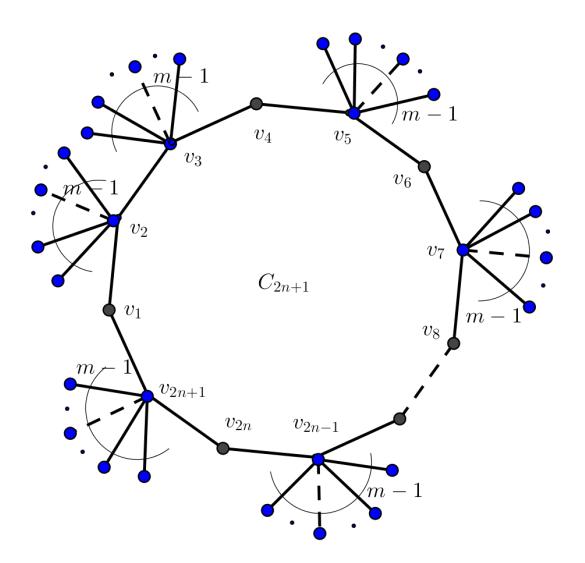
Figure 3. The graph G satisfy G → (nK2, 2K1,m).
Let µ be any red-blue coloring of G such that there is no red nK2. Then, all edges of G are colored by blue or the red subgraph G∗ of G forms a path of length at most 2(n − 1) or a subgraph containing at most (n − 1) stars K1,i, i ≤ m + 1. Let G0 be a subgraph of G without edges of the red subgraph G∗ . This subgraph G0 forms a path of length at least 3 having at least two vertices of degree ≥ m or a disconnected graph containing 2 disjoint K1,m. Hence, G contains a blue 2K1,m. So, G → (nK2, 2K1,m). Thus, rˆc(nK2, 2K1,m) ≤ mn + m + n.
Now, we will show that rˆc(nK2, 2K1,m) ≥ mn + m + n. Let G be a connected graph with |E(G)| ≤ mn + m + n − 1. We will show that G 9 (nK2, 2K1,m). Consider the following cases.
Case 1. ∆(G) < m.
Color all edges in G with blue. By this coloring, there is a (nK2, 2K1,m)− coloring in G.
Case 2. ∆(G) ≥ m.
Let A be the set of vertices of degree at least m in G. If |A| ≤ n − 1, then color all edges incident with all vertices in A by red and the other edges by blue. By this coloring, there is a (nK2, 2K1,m)− coloring in G.
Next, we assume that |A| ≥ n. Since |E(G)| ≤ mn + m + n − 1, there are at most n disjoint K1,m in G, otherwise G has at least mn + m + n edges, a contradiction.
Suppose G contains at most n disjoint stars K1,m.
Let C be the set of centers of n disjoint K1,m. Observe that, the remaining edges of G are at least m. We consider these remaining edges. If these edges induce no K1,m, then we choose n − 1 vertices of C and then color all edges incident with these vertices by red. Next, we color the remaining edges of G with blue. By this coloring, we obtain a (nK2, 2K1,m)-coloring in G.
Now, suppose these edges induce a K1,m with center u. Since G is connected, then at least one vertex of the K1,m is adjacent to a vertex of C, say vi0 . Therefore, u and vi0 have distance at most 2. If u is adjacent to vi0 , we color all edges incident with u by red. Next, choose at most (n − 2) vertices of C that are different with vi0 (if any) and color all edges incident with these vertices by red. By coloring all the remaining edges of G by blue, we obtain a (nK2, 2K1,m)-coloring in G. Suppose u is not adjacent to vi0 . In this case, we choose a path P3 connecting u and vi0 and color the P3 with red. Furthermore, similar as in the previous case, choose at most (n − 2) vertices of C that are different with vi0 (if any) and color all edges incident with these vertices by red. By giving the blue color to the remaining edges of G, we obtain a (nK2, 2K1,m)− coloring in G. Hence, in all cases, we have that G 9 (nK2, 2K1,m).
Acknowledgement
This research has been partially supported by Research Grant: "Penelitian Dasar Unggulan Perguruan Tinggi (PDUPT)" and "Penelitian Disertasi Doktor", the Ministry of Research, Technology and Higher Education, Indonesia.
References
- [1] S.A. Burr, P. Erdos, R.J. Faudree, C.C. Rousseau, R.H. Schelp, Ramsey minimal graphs for ˝ multiple copies, Nederl. Akad. wetensch, Proc. Ser. A81 (1978), 187–195.
- [2] P. Erdos, R. J. Faudree, C.C. Rousseau, R.H. Schelp, The size Ramsey number, ˝ Period. Math. Hungar. 9 (1-2) (1978), 145–161.
- [3] P. Erdos, R.J Faudree, Size Ramsey numbers involving matching, ˝ Finite and infinite sets, Colloq. Math. Soc. Janos Bolyai ´ 37 (1981), 247–264.
- [4] R.J. Faudree, R.H. Schelp, A survey of results on the size Ramsey number, in Paul Erdos and ˝ his mathematics II (Budapest, 1999), Bolyai Soc. Math. Stud. 11 (2002), 291–309.
- [5] H. Bielak, Note size Ramsey number for some regular graphs, Discrete Math. 309 (2012), 6446–6449.
- [6] I. Ben-Eliezer, M. Krivelevich, B. Sudakov, The size Ramsey of a directed path, J. Combin. Theory 102 (2012), 743–755.
- [7] B. Rahadjeng, E.T. Baskoro, H. Assiyatun, Connected size Ramsey numbers for matchings vs small stars or cycles, Proc. Indian Acad. Sci. Math. Sci. 127 (5) (2017), 787–792.
- [8] B. Rahadjeng, E.T. Baskoro, H. Assiyatun, Connected size Ramsey numbers of matchings and stars, AIP Conf. Proc., 1707, 020015 (2016); doi :10.1063/1.4940816.