Electronic Journal of Graph Theory and Applications
Distinguishing index of Kronecker product of two graphs
Saeid Alikhani, Samaneh Soltani
Department of Mathematics, Yazd University, 89195-741, Yazd, Iran
alikhani@yazd.ac.ir, s.soltani.ad1989@gmail.com
The distinguishing index D'(G) of a graph G is the least integer d such that G has an edge labeling with d labels that is preserved only by a trivial automorphism. The Kronecker product \(G \times H\) of two graphs G and H is the graph with vertex set \(V(G) \times V(H)\) and edge set \(\{\{(u,x),(v,y)\}|\{u,v\}\in E(G) \ and \ \{x,y\}\in E(H)\}\). In this paper we study the distinguishing index of Kronecker product of two graphs.
Keywords: distinguishing number, distinguishing index, Kronecker product
Mathematics Subject Classification: 05C15, 05C60
DOI: 10.5614/ejgta.2021.9.1.7
1. Introduction and definitions
Let G=(V,E) be a simple graph of order \(n\geqslant 2\). The open neighborhood of a vertex subset \(W\subseteq V\) is denoted by \(N_G(W)\). The automorphism group of G is denoted by \(\operatorname{Aut}(G)\). A labeling of G, \(\phi:V\to\{1,2,\ldots,r\}\), is said to be r-distinguishing, if no non-trivial automorphism of G preserves all of the vertex labels. Formally, \(\phi\) is r-distinguishing if for every non-trivial \(\sigma\in\operatorname{Aut}(G)\), there exists x in V such that \(\phi(x)\neq\phi(x\sigma)\). The distinguishing number of a graph G, D(G), is the minimum integer r such that G has a labeling that is r-distinguishing ([1]). Similar to this definition, Kalinowski and Pilśniak [15] have defined the distinguishing index D'(G) of G which is the least integer d such that G has an edge colouring with d colours that is preserved only by a trivial automorphism. If a graph has no nontrivial automorphisms, its distinguishing number
Received: 11 January 2017, Revised: 28 March 2020, Accepted: 16 December 2020.
is 1. In other words, D(G)=1 for the asymmetric graphs. The other extreme, D(G)=|V(G)|, occurs if and only if \(G=K_n\). The distinguishing index of some examples of graphs was exhibited in [15]. The distinguishing number and the distinguishing index of some graph products has been studied in literature (see [2, 3, 4, 12, 13]). The Cartesian product of graphs G and H is a graph, denoted \(G \square H\), whose vertex set is \(V(G) \times V(H)\). Two vertices (g,h) and (g',h') are adjacent if either g=g' and \(hh' \in E(H)\), or \(gg' \in E(G)\) and h=h'. Denote \(G \square G\) by \(G^2\), and recursively define the k-th Cartesian power of G as \(G^k=G \square G^{k-1}\). A non-trivial graph G is called prime if \(G=G_1 \square G_2\) implies that either \(G_1\) or \(G_2\) is \(K_1\). Two graphs G and G are called relatively prime if G is the only common factor of G and G. We need knowledge of the structure of the automorphism group of the Cartesian product, which was determined by Imrich [11], and independently by Miller [17].
Theorem 1.1. [11, 17] Suppose \(\psi\) is an automorphism of a connected graph G with prime factor decomposition \(G = G_1 \square G_2 \square \ldots \square G_r\). Then there is a permutation \(\pi\) of the set \(\{1, 2, \ldots, r\}\) and there are isomorphisms \(\psi_i : G_{\pi(i)} \to G_i\), \(i = 1, \ldots, r\), such that
\[\psi(x_1, x_2, \dots, x_r) = (\psi_1(x_{\pi(1)}), \psi_2(x_{\pi(2)}), \dots, \psi_r(x_{\pi(r)})).\]
The Kronecker product is one of the (four) most important graph products and seems to have been first introduced by K. Čulik, who called it the cardinal product [8]. Weichsel [20] proved that the Kronecker product of two nontrivial graphs is connected if and only if both factors are connected and at least one of them possesses an odd cycle. If both factors are connected and bipartite, then their Kronecker product consists of two connected components ([2]). The Kronecker product \(G \times H\) of graphs G and H is the graph with vertex set \(V(G) \times V(H)\) and edge set \(\{\{(u,x),(v,y)\}|\{u,v\}\in E(G) \text{ and }\{x,y\}\in E(H)\}\). The terminology is justified by the fact that the adjacency matrix of a Kronecker graph product is given by the Kronecker matrix product of the adjacency matrices of the factor graphs; see [20] for details. However, this product is also known under several different names including categorical product, tensor product, direct product, weak direct product, cardinal product and graph conjunction. The Kronecker product is commutative and associative in an obvious way. It is computed that \(|V(G \times H)| = |V(G)|.|V(H)|\) and \(|E(G \times H)| = 2|E(G)|.|E(H)|\). We recall that graphs with no pairs of vertices with the same open neighborhoods are called R-thin. In continue, we need the following theorem:
Theorem 1.2. [10] Suppose \(\varphi\) is an automorphism of a connected non-bipartite R-thin graph G that has a prime factorization \(G = G_1 \times G_2 \times \ldots \times G_k\). Then there exists a permutation \(\pi\) of \(\{1, 2, \ldots, k\}\), together with isomorphisms \(\varphi_i : G_{\pi(i)} \to G_i\), such that
\[\varphi(x_1, x_2, \dots, x_k) = (\varphi_1(x_{\pi(1)}), \varphi_2(x_{\pi(2)}), \dots, \varphi_k(x_{\pi(k)})).\]
2. Distinguishing number of Kronecker product of two graphs
We begin with the distinguishing number of Kronecker product of complete graphs. The results of this section has presented in the "International conference on theoretical computer science and discrete mathematics, ICTCSDM 2016" and has published by authors in its proceeding [2]. Because of this, we just state the results and for the proof, readers can see [2].
Theorem 2.1. [2] Let k, n, and d be integers so that \(d \ge 2\) and \((d-1)^k < n \le d^k\). Then
\[D(K_k \times K_n) = \begin{cases} d, & \text{if } n \leq d^k - \lceil \log_d k \rceil - 1, \\ d+1, & \text{if } n \geq d^k - \lceil \log_d k \rceil + 1. \end{cases}\]
If \(n = d^k - \lceil \log_d k \rceil\), then \(D(K_k \times K_n)\) is either d or d + 1.
It is known that connected non-bipartite graphs have unique prime factor decomposition with respect to the Kronecker product [16]. If such a graph G has no pairs u and v of vertices with the same open neighborhoods, then the structure of automorphism group of G depends on that of its prime factors exactly as in the case of the Cartesian product. As said before graphs with no pairs of vertices with the same open neighborhoods are called R-thin and it can be shown that a Kronecker product is R-thin if and only if each factor is R-thin.
Theorem 2.2. [2] Let G and H be two simple connected, relatively prime graphs, non-bipartite R-thin graphs, then \(D(G \times H) = D(G \square H)\).
Imrich and Klavzar in [13] proved that the distinguishing number of k-th power with respect to the Kronecker product of a non-bipartite, connected, R-thin graph different from \(K_3\) is two.
Theorem 2.3. [13] Let G be a nonbipartite, connected, R-thin graph different from \(K_3\) and \(\times G^k\) the k-th power of G with respect to the Kronecker product. Then \(D(\times G^k) = 2\) for \(k \ge 2\). For the case \(G = K_3\) we have \(D(K_3 \times K_3) = 3\) and \(D(\times K_3^k) = 2\) for \(k \ge 3\).
Proposition 2.1. [2] If \(K_{m,n}\) and \(K_{p,q}\) are complete bipartite graphs such that \(q \ge p\) and \(m \ge n\) then the distinguishing number of \(K_{m,n} \times K_{p,q}\) is
\[D(K_{m,n} \times K_{p,q}) = \begin{cases} mq+1, & m=n, p=q, \\ mq, & \text{otherwise.} \end{cases}\]
Corollary 2.1. [2] Let \(m, n \ge 3\) be two integers. The distinguishing number of Kronecker product of star graphs \(K_{1,n}\) and \(K_{1,m}\) is \(D(K_{1,n} \times K_{1,m}) = mn\).
Before we state the next result we need some additional information about the distinguishing number of complete multipartite graphs. Let \(K_{a_1^{j_1},a_2^{j_2},...,a_r^{j_r}}\) denote the complete multipartite graph that has \(j_i\) partite sets of size \(a_i\) for \(i=1,2,\ldots,r\) and \(a_1>a_2>\ldots>a_r\).
Theorem 2.4. [7] Let \(K_{a_1j_1,a_2j_2,...,a_rj_r}\) denote the complete multipartite graph that has \(j_i\) partite sets of size \(a_i\) for i=1,2,...,r, and \(a_1>a_2>...>a_r\). Then
\[D(K_{a_1^{j_1}, a_2^{j_2}, \dots, a_r^{j_r}}) = \min\{p : \binom{p}{a_i} \geqslant j_i \text{ for all i}\}.\]
Theorem 2.5. [2] If G and H are two simple connected, relatively prime graphs such that \(G \times H\) has \(j_i\) R-equivalence classes of sie \(a_i\) for i = 1, ..., r, and \(a_1 > a_2 > ... > a_r\) then
\[D(G \square H) \leqslant D(G \times H) \leqslant \min\{p : \binom{p}{a_i} \geqslant j_i \text{ for all i}\}.\]
By using the concept of the Cartesian skeleton we can obtain an upper bound for Kronecker product of R-thin graphs. For this purpose we need the following preliminaries from [10]: The Boolean square of a graph G is the graph \(G^s\) with \(V(G^s) = V(G)\) and \(E(G^s) = \{xy \mid N_G(x) \cap N_G(y) \neq \emptyset\}\). An edge xy of the Boolean square \(G^s\) is dispensable if it is a loop, or if there exists some \(z \in V(G)\) for which both of the following statements hold:
- (1) \(N_G(x) \cap N_G(y) \subset N_G(x) \cap N_G(z)\) or \(N_G(x) \subset N_G(z) \subset N_G(y)\).
- (2) \(N_G(y) \cap N_G(x) \subset N_G(y) \cap N_G(z)\) or \(N_G(y) \subset N_G(z) \subset N_G(x)\).
The Cartesian skeleton S(G) of a graph G is the spanning subgraph of the Boolean square \(G^s\) obtained by removing all dispensable edges from \(G^s\).
Proposition 2.2. [10] If H and K are R-thin graphs without isolated vertices, then \(S(H \times K) = S(H) \square S(K)\).
Proposition 2.3. [10] Any isomorphism \(\varphi: G \to H\), as a map \(V(G) \to V(H)\), is also an isomorphism \(\varphi: S(G) \to S(H)\).
Now we are ready to give an upper bound for Kronecker product of R-thin graphs.
Theorem 2.6. [2] If G and H are R-thin graphs without isolated vertices, then \(D(G \times H) \leq D(S(G) \square S(H))\).
3. Distinguishing index of Kronecker product of two graphs
In this section we investigate the distinguishing index of Kronecker product of two graphs. Let us start with the Kronecker product power of \(K_2\). It can be seen that \(\times K_2^n\) is disjoint union of \(2^{n-1}\) number of \(K_2\), and so \(D'(\times K_2^n) = 2^{n-1}\) for \(n \ge 2\).
Let ij be the notation of the vertices the Kronecker product \(P_m \times P_n\) of two paths of order m and n where \(0 \le i \le m-1\) and \(0 \le j \le n-1\). From [14], we know that \(P_m \times P_n\) is bipartite, the number of vertices in even component of \(P_m \times P_n\) is \(\lceil mn/2 \rceil\) while that in odd component is \(\lfloor mn/2 \rfloor\) (see Figure 1). It can be easily computed that distinguishing index of \(P_m \times P_n\) is two, unless \(D'(P_3 \times P_2) = 3\) and \(D'(P_3 \times P_3) = 4\), because \(P_3 \times P_2\) is disjoint union \(P_3 \cup P_3\), and \(P_3 \times P_3\) is disjoint union \(K_{1,4} \cup C_4\).
The distinguishing index of the square of cycles and for arbitrary power of complete graphs with respect to the Cartesian, Kronecker and strong product has been considered by Pilśniak [18]. In particular, she proved that \(D'(\times C_m^2)=2\) for the odd value of \(m\geqslant 5\), and \(D'(\times K_n^r)=2\) for any \(n\geqslant 3\) and \(r\geqslant 2\).
Let us state and prove the following lemma concerning the Kronecker product \(K_2 \times H\).
Lemma 3.1. If H is a graph with D'(H) = d, then \(D'(K_2 \times H) \leq d + 1\). If H is bipartite then \(d \leq D'(K_2 \times H) \leq d + 1\).
Proof. Let f be an automorphism of bipartite graph \(K_2 \times H\) with partite sets \(\{(v_1, x) | x \in V(H)\}\) and \(\{(v_2, x) | x \in V(H)\}\). Since f preserves the adjacency and non-adjacency relations, so \(f(v_i, x) = 0\)
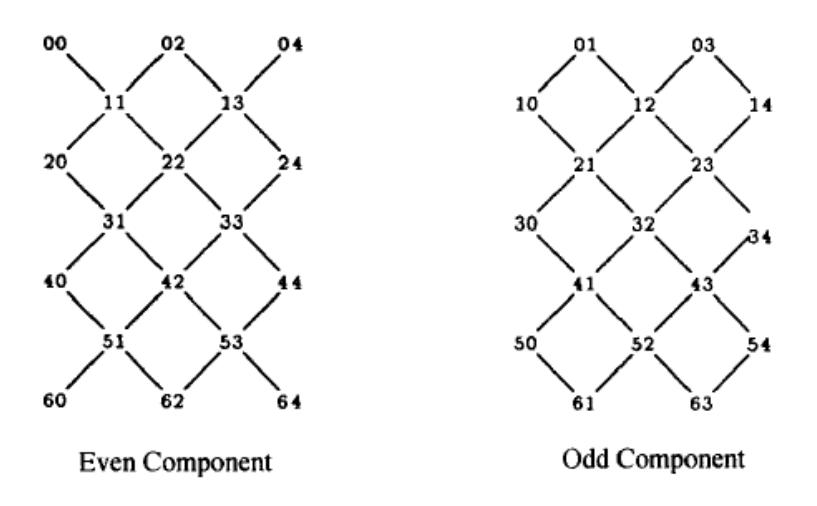
Figure 1. Graph \(P_7 \times P_5\).
\((v_i, \varphi(x))\) for all \(x \in V(H)\) or \(f(v_i, x) = (v_j, \varphi(x))\) for all \(x \in V(H)\) where \(i, j \in \{1, 2\}, i \neq j\), and \(\varphi \in Aut(H)\).
Let L be a distinguishing edge labeling of H. If \((v_1,h_1)(v_2,h_2)\) be an arbitrary edge of \(K_2 \times H\), then we assign it the label of the edge \(h_1h_2\) in H. Now suppose that hh' is an edge of H and fix it. We change the label of the edge \((v_1,h)(v_2,h')\) to a new label. If f is an automorphism of \(K_2 \times H\) preserving the labeling, then with respect to the label of the two edges \((v_1,h)(v_2,h')\) and \((v_1,h')(v_2,h)\) we have \(f(v_i,h)=(v_i,\varphi(x))\) for i=1,2 and some \(\varphi\in \operatorname{Aut}(H)\). On the other hand \(\varphi\) is the identity, because we labeled the edges of \(K_2 \times H\) by the distinguishing edge labeling L of H. Therefore this labeling is distinguishing. If H is bipartite then \(K_2 \times H = H \cup H\), and so the result follows.
Remark 3.1. Let \((G,\phi)\) denote the labeled version of G under the labeling \(\phi\). Given two distinguishing k-labelings \(\phi\) and \(\phi'\) of G, we say that \(\phi\) and \(\phi'\) are equivalent if there is some automorphism of G that maps \((G,\phi)\) to \((G,\phi')\). We denote by D(G,k) the number of inequivalent k-distinguishing labelings of G which was first considered by Arvind and Devanur [5] and Cheng [6] to determine the distinguishing numbers of trees. In Lemma 3.1, if H is bipartite and D(H,d)=1 then \(D'(K_2\times H)=d+1\); otherwise, i.e., if H is bipartite and D(H,d)>1 then \(D'(K_2\times H)=d\).
Proposition 3.1. If \(m \ge 4\) and \(n \ge 2\), then \(D'(P_m \times K_{1,n}) = n\). Also \(D'(P_2 \times K_{1,n}) = n + 1\) and \(D'(P_3 \times K_{1,n}) = 2n\).
Proof. The consecutive vertices of \(P_m\) are denoted by \(0, 1, \ldots, m-1\) and the central vertex of \(K_{1,n}\) by 0, and its pendant vertices by \(1, \ldots, n\). Since \(K_{1,n}\) and \(P_m\) are connected and bipartite, their Kronecker product consists of two connected components (see Figure 2).
If m is odd, then we label the edges (10,0i) and (j0,(j+1)i) with label i where \(1 \le i \le n\) and \(0 \le j \le m-1\). We label the remaining edges with an arbitrary label, say 1. Using Figure 2 and regarding to the number of pendant vertices we can obtain that this labeling is distinguishing and \(D'(K_{1,n} \times P_m) = n\). If m is even, then we label the edges (10,0i), (00,1i), and (j0,(j+1)i)
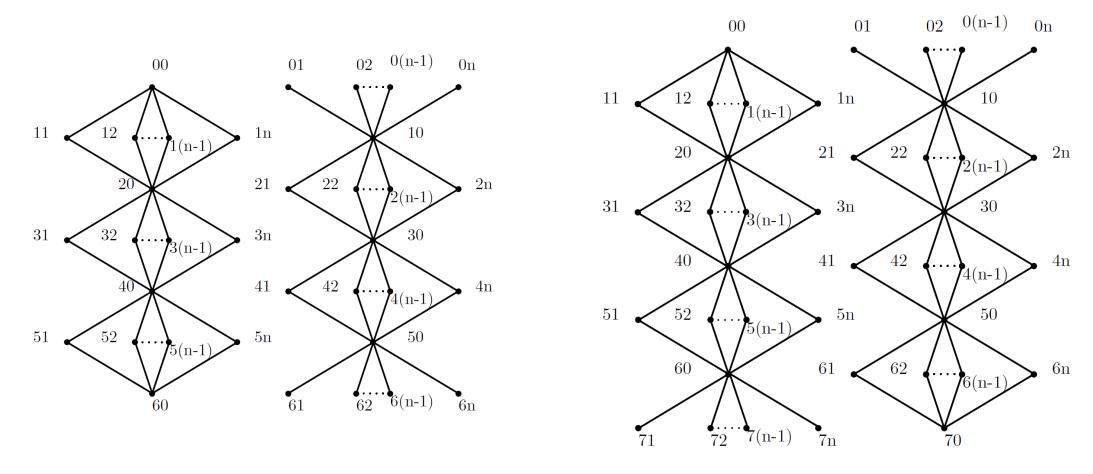
Figure 2. Graphs \(K_{1,n} \times P_7\) and \(K_{1,n} \times P_8\).
with label i for \(1 \le i \le n\) and \(2 \le j \le m-2\). Also we label the edges ((m-2)0, (m-3)i) with label 1 and the edges (10, 2i) with label 2 for \(1 \le i \le n\). We label the remaining edges with an arbitrary label, say 1. With a similar argument we can conclude that this labeling is distinguishing and \(D'(P_m \times K_{1,n}) = n\). Since \(K_{1,n} \times P_2\) is disjoint union \(K_{1,n} \cup K_{1,n}\), and \(K_{1,n} \times P_3\) is disjoint union \(K_{1,2n} \cup G\) where G is a graph with \(D'(G) \le n\), so \(D'(K_{1,n} \times P_2) = n+1\) and \(D'(K_{1,n} \times P_3) = 2n\).
Proposition 3.2. If \(n \ge m \ge 3\), then \(D'(K_{1,n} \times K_{1,m}) = nm\).
Proof. By definition, \(K_{1,n} \times K_{1,m}\) is disjoint union \(K_{1,nm} \cup K_{n,m}\), and hence \(D'(K_{1,n} \times K_{1,m}) = \max\{D'(K_{1,nm}), D'(K_{n,m})\}\). On the other hand \(D'(K_{n,m}) \leqslant \lceil \sqrt[m]{n} \rceil + 1\) (by Corollary 3.8 from [19]). Therefore \(D'(K_{1,n} \times K_{1,m}) = D'(K_{1,nm}) = nm\).
Theorem 3.1. Let X be a connected non-bipartite R-thin graph which has a prime factorization \(X = G \times H\) where G and H are simple and \(\max\{D'(G), D'(H)\} \geqslant 2\). Then \(D'(X) \leqslant D'(K_{D'(G),D'(H)})\).
Proof. Let the sets \(\{a_{i1},\ldots,a_{is_i}\}\) where \(1\leqslant i\leqslant D'(G)\) and the sets \(\{b_{j1},\ldots,b_{jt_j}\}\) where \(1\leqslant j\leqslant D'(H)\) be the partitions of the edges set G and H by its distinguishing edge labeling, respectively, i.e., the label of \(a_{ij}\) is i for \(1\leqslant j\leqslant s_i\) and the label of \(b_{ij}\) is i for \(1\leqslant j\leqslant t_i\). If \(a_{ij}\) is the edge of G between v and v', and \(b_{pq}\) is the edge of H between w and w', then \(2e_{pq}^{ij}\) means the two edge (v,w)(v',w') and (v,w')(v',w) of X. Regarding to above partitions we can partition the edge set of X as the sets \(E_p^{ij}=\{2e_{pq}^{ij}\mid 1\leqslant q\leqslant t_p\}\), where \(1\leqslant i\leqslant D'(G)\), \(1\leqslant j\leqslant s_i\), and \(1\leqslant p\leqslant D'(H)\). Set \(E_p^i=\bigcup_{j=1}^{i}E_p^{ij}\) (see Figure 3). If we assign the all elements of \(E_p^i\), the label of the edge \(z_iz_p'\) of complete bipartite graph \(K_{D'(G),D'(H)}\) with parts \(\{z_1,\ldots,z_{D'(G)}\}\) and \(\{z_1',\ldots,z_{D'(H)}'\}\), then we have a distinguishing edge labeling of X by Theorem 1.2, and so the result follows.
Theorem 3.2. Let X be a connected non-bipartite R-thin graph which has a prime factorization \(X = G \times H\) where G and H are simple and D'(G) = D'(H) = 1. Then \(D'(X) \leq 2\).
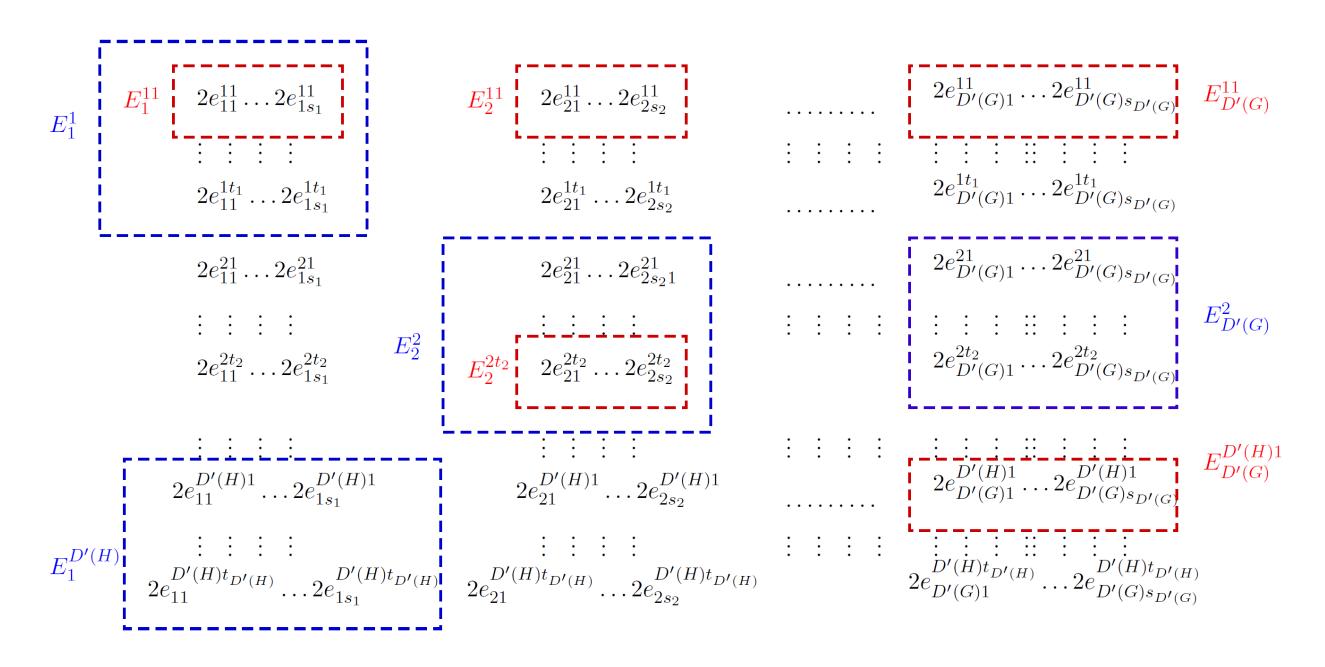
Figure 3. The partition of the edge set of X in Theorem 3.1.
Proof. If G and H are non-isomorphic then \(|\operatorname{Aut}(X)|=1\) by Theorem 1.2, and so D'(X)=1. Otherwise, \(D'(G\times G)=2\) because, \(G\times G\) is a symmetric graph and we have a 2-distinguishing edge labeling of it as follows: according to notations of Theorem 3.1, if we label the all elements of \(E_1^{11}\) with label 1, and all elements of \(E_1^{1j}\) with label 2 for every \(2\leqslant j\leqslant |E(G)|\), then we have a 2-distinguishing edge labeling of \(G\times G\).
We conclude this section with a general bound.
We say that a graph G is almost spanned by a subgraph H if G - v, the graph obtained from G by removal of a vertex v and all edges incident to v, is spanned by H for some \(v \in V(G)\). The following two observations will play a crucial role in this section.
Lemma 3.2. [19] If a graph G is spanned or almost spanned by a subgraph H, then \(D'(G) \leq D'(H) + 1\).
Lemma 3.3. Let G be a graph and H be a spanning subgraph of G. If Aut(G) is a subgroup of Aut(H), then \(D'(G) \leq D'(H)\).
Proof. If we call the edges of G which are the edges of H, H-edges, and the others non-H-edges, then since \(\operatorname{Aut}(G) \subseteq \operatorname{Aut}(H)\), we can conclude that each automorphism of G maps H-edges to H-edges and non-H-edges to non-H-edges. So assigning each distinguishing edge labeling of H to G and assigning non-H-edges a repeated label we make a distinguishing edge labeling of G. \(\square\)
Since for two distinct connected non-bipartite R-thin prime graphs we have \(\operatorname{Aut}(G \times H) = \operatorname{Aut}(G \square H)\), so a direct consequence of Lemmas 3.2 and 3.3 is as follows:
- (i) If G and H are two simple connected graphs, then \(D'(G \times H) \leq D'(G \square H) +\)Theorem 3.3. 1.
- (ii) If G and H are two connected non-bipartite R-thin prime graphs, then \(D'(G \times H) \leq\)\(D'(G\Box H)\).
Corollary 3.1. If G is a connected non-bipartite R-thin prime graph, then \(D'(\times G^k) = 2\) for any \(k \geqslant 2\), with the only exception \(D'(\times K_2^2) = 3\).
Proof. It follows immediately by Part (ii) of Theorem 3.3 and that \(D'(\Box G^k) = 2\) for any \(k \ge 2\) by Theorem 2.7 of [9].
Acknowledgement
The authors would like to express their gratitude to the referee for her/his careful reading and helpful comments.
References
- [1] M.O. Albertson and K.L. Collins, Symmetry breaking in graphs, Electron. J. Combin. 3 (1996), R18.
- [2] S. Alikhani and S. Soltani, The distinguishing number of Kronecker product of two graphs, ICTCSDM 2016, LNCS 10398 (2017), 341-346.
- [3] S. Alikhani and S. Soltani, Distinguishing number and distinguishing index of certain graphs, Filomat, 31:14 (2017), 4393-4404.
- [4] S. Alikhani and S. Soltani, Distinguishing number and distinguishing index of lexicographic product of two graphs, Discuss. Math. Graph Theory 38 (2018), 853-865.
- [5] V. Arvind and N. Devanur, Symmetry breaking in trees and planar graphs by vertex coloring, In Proceedings of the Nordic Combinatorial Conference, 2004.
- [6] C. Cheng, On computing the distinguishing numbers of trees and forests, Electron. J. Combin., 13 (2006), R11.
- [7] K.L. Collins and A.N. Trenk, The distinguishing chromatic number, Electron. J. Combin. 13 (2006), R16.
- [8] K. Čulik, Zur theorie der graphen, Casopis Pešt. Mat. 83 (1958), 135–155.
- [9] A. Gorzkowska, R. Kalinowski, and M. Pilśniak, The distinguishing index of the Cartesian product of finite graphs, Ars Math. Contem., 12 (2017), 77–87.
- [10] R. Hammack, W. Imrich and S. Klavzar, Handbook of product graphs (second edition), Taylor & Francis group (2011).
- [11] W. Imrich, Automorphismen und das kartesische Produkt von Graphen, O sterreich. Akad.Wiss. Math.-Natur. Kl. S.-B. II 177 (1969), 203–214.
- [12] W. Imrich, J. Jerebic and S. Klaˇvzar, The distinguishing number of Cartesian products of complete graphs, European J. Combin. 29 (4), (2008), 922–929.
- [13] W. Imrich and S. Klaˇvzar, Distinguishing Cartesian powers of graphs, J. Graph Theory 53.3 (2006), 250–260.
- [14] P.K. Jha, Kronecker products of paths and cycles: Decomposition, factorization and bipancyclicity, Discrete Math. 182 (1), (1998), 153–167.
- [15] R. Kalinowski and M. Pil´sniak, Distinguishing graphs by edge colourings, European J. Combin. 45 (2015), 124–131.
- [16] R. McKenzie, Cardinal multiplication of structures with a reflexive relation, Fund. Math. 70 (1971), 59–101.
- [17] D.J. Miller, The automorphism group of a product of graphs, Proc. Amer. Math. Soc. 25 (1970), 24–28.
- [18] M. Pil´sniak, Edge motion and the distinguishing index, Theor. Comput. Sci. 678 (2017), 56– 62.
- [19] M. Pil´sniak, Improving upper bounds for the distinguishing index, Ars Math. Contem. 13 (2017), 259-274.
- [20] P.M. Weichsel, The Kronecker product of graphs, Proc. Amer. Math. Soc. 13 (1962), 47–52.