
Electronic Journal of Graph Theory and Applications
Yu-Chang Liang<sup>a</sup>, Tsai-Lien Wong<sup>b</sup>, Xuding Zhu<sup>c</sup>
\(chase 2369219@hotmail.com,\ tlwong@math.nsysu.edu.tw,\ xudingzhu@gmail.com\)
A proper total weighting of a graph G is a mapping \(\phi\) which assigns to each vertex and each edge of G a real number as its weight so that for any edge uv of G, \(\sum_{e \in E(v)} \phi(e) + \phi(v) \neq \sum_{e \in E(u)} \phi(e) + \phi(u)\). A (k, k')-list assignment of G is a mapping L which assigns to each vertex v a set L(v) of k permissible weights and to each edge e a set L(e) of k' permissible weights. An L-total weighting is a total weighting \(\phi\) with \(\phi(z) \in L(z)\) for each \(z \in V(G) \cup E(G)\). A graph G is called (k, k')-choosable if for every (k, k')-list assignment L of G, there exists a proper L-total weighting. As a strenghtening of the well-known 1-2-3 conjecture, it was conjectured in [ Wong and Zhu, Total weight choosability of graphs, J. Graph Theory 66 (2011), 198-212] that every graph without isolated edge is (1,3)-choosable. It is easy to verified this conjecture for trees, however, to prove it for wheels seemed to be quite non-trivial. In this paper, we develop some tools and techniques which enable us to prove this conjecture for generalized Halin graphs.
Keywords: total weighting, (k, k')-matrix, Halin graphs Mathematics Subject Classification: 05C22, 05C20, O5C78
DOI: 10.5614/ejgta.2021.9.1.2
1. Introduction
A total weighting of G is a mapping \(\phi: V(G) \cup E(G) \to R\). A total weighting \(\phi\) is proper if for any edge uv of G,
\[\sum_{e \in E(u)} \phi(e) + \phi(u) \neq \sum_{e \in E(v)} \phi(e) + \phi(v),\]
Received: 11 May 2017, Revised: 21 October 2020, Accepted: 14 December 2020.
<sup>a</sup>Department of Applied Mathematics, National Pingtung University, Pingtung, Taiwan 90003.
<sup>b</sup>Department of Applied Mathematics, National Sun Yat-sen University, Kaohsiung, Taiwan 80424.
<sup>c</sup>Department of Mathematics, Zhejiang Normal University, China.
where E(v) is the set of edges incident to v. A total weighting φ with φ(v) = 0 for all vertices v is also called an edge weighting.
Proper edge weighting (also called vertex colouring edge weighting) of graphs was introduced in [9]. It was conjectured in [9] that every graph with no isolated edges has a proper edge weighting φ with φ(e) ∈ {1, 2, 3} for e ∈ E(G). This conjecture, now called the 1-2-3 Conjecture, has received a lot of attention [1, 2, 7, 9, 10, 11, 13, 17]. It still remains open, and the best partial result on this conjecture was proved in [10]: every graph with no isolated edge has a proper edge weighting φ with φ(e) ∈ {1, 2, 3, 4, 5} for all e ∈ E(G).
Proper total weighting was first studied in [13]. It was conjectured in [13] that every graph has a proper total weighting φ with φ(z) ∈ {1, 2} for all z ∈ V (G) ∪ E(G). This conjecture, now called the 1-2 Conjecture has also received a lot of attention and the best partial result was proved in [8]: for any graph G, there is a proper total weighting φ with φ(v) ∈ {1, 2} for each vertex v and φ(e) ∈ {1, 2, 3} for each e ∈ E(G).
A total list assignment of G is a mapping L which assigns to each element z ∈ V (G)∪ E(G) a set L(z) of real numbers as permissible weights. An L-total weighting is a total weighting φ with φ(z) ∈ L(z) for each z ∈ V (G) ∪ E(G). Assume ψ : V (G) ∪ E(G) → {1, 2, . . .} is a mapping which assigns to each vertex or edge z of G a positive integer. A total list assignment L of G is called a ψ-total list assignment of G if |L(z)| = ψ(z) for all z ∈ V (G) ∪ E(G). A graph G is called ψ-choosable if for every ψ-list assignment L of G, there exists a proper L-total weighting. A graph G is called (k, k′ )-choosable if G is ψ-choosable, where ψ(v) = k for each vertex v and ψ(e) = k ′ for each edge e.
The list version of total weighting are studied in a few papers [6, 12, 14, 19, 18, 20] It is known [20] that G is (k, 1)-choosable if and only if G is (vertex) k-choosable. So the concept of (k, k′ ) choosability is a common generalization of vertex choosability, edge weighting and total weighting of graphs. As strengthening of the 1-2-3 conjecture and the 1-2 conjecture, it was conjectured in [6, 20] that every graph with no isolated edges is(1, 3)-choosable and conjectured in [20] that every graph is (2, 2)-choosable. These two conjectures are called the (1, 3)-choosability conjecture and the (2, 2)-choosability conjecture, respectively.
In the study of total weighting of graphs, one main algebraic tool is Combinatorial Nullstellensatz.
For each z ∈ V (G) ∪ E(G), let xz be a variable associated to z. Fix an arbitrary orientation D of G. Consider the polynomial
\[P_G(\lbrace x_z : z \in V(G) \cup E(G) \rbrace) = \prod_{e = uv \in E(D)} \left( \left( \sum_{e \in E(u)} x_e + x_u \right) - \left( \sum_{e \in E(v)} x_e + x_v \right) \right).\]
Assign a real number φ(z) to the variable xz, and view φ(z) as the weight of z. Let PG(φ) be the evaluation of the polynomial at xz = φ(z). Then φ is a proper total weighting of G if and only if PG(φ) 6= 0. The question is under what condition one can find an assignment φ for which PG(φ) 6= 0.
An index function of G is a mapping η which assigns to each vertex or edge z of G a nonnegative integer η(z). An index function η of G is valid if P z∈V ∪E η(z) = |E|. Note that |E|
is the degree of the polynomial \(P_G(\{x_z:z\in V(G)\cup E(G)\})\). For a valid index function \(\eta\), let \(c_\eta\) be the coefficient of the monomial \(\prod_{z\in V\cup E} x_z^{\eta(z)}\) in the expansion of \(P_G\). It follows from the Combinatorial Nullstellensatz [3, 5] that if \(c_\eta\neq 0\), and L is a list assignment which assigns to each \(z\in V(G)\cup E(G)\) a set L(z) of \(\eta(z)+1\) real numbers, then there exists a mapping \(\phi\) with \(\phi(z)\in L(z)\) such that
\[P_G(\phi) \neq 0\].
Therefore, to prove that a graph G is (k, k')-choosable, it suffices to show that there exists an index function \(\eta\) with \(\eta(v) \leq k-1\) for each vertex v and \(\eta(e) \leq k'-1\) for each edge e and \(c_{\eta} \neq 0\).
The coefficient \(c_{\eta}\) is related to the permanent of the matrix below (see Equation (1)).
We write the polynomial \(P_G(\{x_z : z \in V(G) \cup E(G)\})\) as
\[P_G(\{x_z : z \in V(G) \cup E(G)\}) = \prod_{e \in E(D)} \sum_{z \in V(G) \cup E(G)} A_G[e, z] x_z.\]
Then for \(e \in E(G)\) and \(z \in V(G) \cup E(G)\), if e = (u, v) (oriented from u to v), then
\[A_G[e,z] = \begin{cases} 1, & \text{if } z = v, \text{ or } z \neq e \text{ is an edge incident to } v, \\ -1, & \text{if } z = u, \text{ or } z \neq e \text{ is an edge incident to } u, \\ 0, & \text{otherwise.} \end{cases}\]
Now \(A_G\) is a matrix, whose rows are indexed by the edges of G and the columns are indexed by edges and vertices of G. Given a vertex or edge z of G, let \(A_G(z)\) be the column of \(A_G\) indexed by z. For an index function \(\eta\) of G, let \(A_G(\eta)\) be the matrix, each of its column is a column of \(A_G\), and each column \(A_G(z)\) of \(A_G\) occurs \(\eta(z)\) times as a column of \(A_G(\eta)\). It is known [4] and easy to verify that for a valid index function \(\eta\) of G,
\[c_{\eta} = \frac{1}{\prod_{z \in V \cup E} \eta(z)!} \operatorname{per}(A_{G}(\eta)), \tag{1}\]
where per(A) denotes the permanent of the square matrix A. Recall that if A is an \(m \times m\) matrix, then
\[per(A) = \sum_{\sigma \in S_m} A[i, \sigma(i)],\]
where \(S_m\) is the symmetric group of order m.
A square matrix A is permanent-non-singular if \(per(A) \neq 0\). A square matrix of the form \(A_G(\eta)\) is called an (a,b)-matrix if \(\eta(v) \leq a\) for each vertex v and \(\eta(e) \leq b\) for each edge e. Motivated by an edge weighting and an total weighting problem of graphs, the following two conjectures were proposed in [6] and [20], respectively.
Conjecture 1. Every graph G has a permanent-non-singular (1,1)-matrix.
Conjecture 2. Every graph G without isolated edges has a permanent-non-singular (0, 2)-matrix.
Conjecture 1 and Conjecture 2 have been studied in many papers (see [16] for a survey of partial results on these two conjectures), and both conjectures remain largely open. It is easy to verify both conjectures for trees. However, proving these two conjectures for wheels seem to be quite non-trivial. It was proved in [14] that Conjecture 1 is true for wheel, and in [21] for Halin graphs. Quite surprising, Conjecture 2 remained open for wheels for a long time. In this paper, we develop some tools and techniques and settle Conjecture 2 for generalized Halin graphs.
2. Main theorem and some observations
A \(Halin\ graph\) is a planar graph obtained by taking a plane tree T (an embedding of a tree on the plane) without degree 2 vertices by adding a cycle connecting the leaves of the tree cyclically. If the tree T is allowed to have degree 2 vertices, then the resulting graph is called a \(generalized\ Halin\ graph\).
Theorem 2.1. Every generalized Halin graph G has a permanent-non-singular (0,2)-matrix.
We will prove this theorem in the next two sections. In the proof, we shall frequently use the following observations:
Observation 1. If A is a matrix whose columns are integral liner combinations of columns of \(A_G\) and \(\operatorname{per}(A) \neq 0\) and each olumn \(A_G(z)\) occurs in at most \(\eta(z)\) times in the combinations, then there is an index function \(\eta'\) with \(\eta'(z) \leq \eta(z)\) and \(\operatorname{per}(A_G(\eta')) \neq 0\). Moreover, if \(\operatorname{per}(A) \neq 0 \pmod{p}\) for some prime p, then \(\operatorname{per}(A_G(\eta')) \neq 0 \pmod{p}\).
This can be derived directly from the multilinear property of permanent.
Observation 2. ([20]) For an edge e = uv of G,
\[A_G(e) = A_G(u) + A_G(v). (2)\]
The above follows easily from the definition of the matrix \(A_G\) (cf. [20]):
A balloon is a graph obtained by attaching a path to a cycle (i.e., identify one end vertex of a path with a vertex of a cycle). If the cycle is of odd length, then the balloon is called an odd balloon. The path could be a single vertex, in which case the balloon is simply a cycle. If the path is not a single vertex, then the unique vertex of degree 1 is called the root of the balloon. Otherwise, the root of the balloon (which is a cycle) is an arbtriary vertex of the cycle.
Observation 3. If B is an odd balloon with root v, then \(2A_G(v)\) is an integral linear combination of \(A_G(e)\) for \(e \in E(B)\).
Indeed, if \(P=(v_1,v_2,\ldots,v_k)\) and \(C=(u_1,u_2,\ldots,u_{2p+1})\) and the balloon is obtained by identifying \(v_k\) with \(u_1\), let \(e_i=v_iv_{i+1}\) (for \(1\leq i\leq k-1\)) and \(e_i'=u_iu_{i+1}\) (for \(1\leq i\leq 2p+1\) and \(u_{2p+2}=u_1\)), then
\[2A_G(v_1) = 2A_G(e_1) - \ldots + (-1)^k 2A_G(e_{k-1}) + (-1)^{k-1} (A_G(e_1') - \ldots + A_G(e_{2p+1}')).\]
3. Non-bipartite generalized Halin graphs
In this section, we consider non-bipartite generalized Halin graphs.
Lemma 3.1. Let G be a connected non-bipartite graph. If there is a matrix A whose columns consists of vertex columns of \(A_G\) and \(per(A) \neq 0 \pmod{p}\) for some odd prime p, then G has a permanent-non-singular (0, p-1)-matrix.
Proof. Since p is an odd prime, by replacing each column \(A_G(v)\) with \(2A_G(v)\) in A, the resulting matrix A' has \(\operatorname{per}(A') = 2^n \operatorname{per}(A) \neq 0 \pmod p\). Since G is connected and non-bipartite, for any vertex v, there is an odd balloon B of G with root v. By Observation 3, \(2A_G(v)\) can be written as an integral linear combination of edge columns of G. By Observation 1, there is an index function \(\eta\) with \(\eta(v) = 0\) for each vertex v such that \(\operatorname{per}(A_G(\eta)) \neq 0 \pmod p\). It is obvious that if \(\eta'\) is an index function for which \(\eta'(e) \geq p\) for some edge e, then \(\operatorname{per}(A_G(\eta')) = 0 \pmod p\). Therefore \(\eta(e) \leq p-1\) for each \(e \in E(G)\). I.e., \(A_G(\eta)\) is a permanent-non-singular (0, p-1)-matrix of G.
Corollary 3.1. If p is a prime, G is a connected non-bipartite (p-1)-degenerate graph, then G has a permanent-non-singular (0, p-1)-matrix.
Proof. Order the vertices \(v_1, v_2, \ldots, v_n\) in such a way that each vertex \(v_i\) has back-degree \(d_i \leq p-1\), i.e., \(v_i\) has at most p-1 neighbours \(v_j\) with j < i. Let A be the matrix consisting \(d_i\) copies of the column of \(A_G\) indexed by \(v_i\) for \(i=1,2,\ldots,n\). It is easy to verify that \(|\operatorname{per}(A)| = \prod_{i=1}^n d_i!\). Hence \(\operatorname{per}(A) \neq 0 \pmod p\). It follows from Lemma 3.1 that G has a permanent-non-singular (0,p-1)-matrix.
Lemma 3.2. Assume p is an odd prime, G is a connected non-bipartite graph, v is a vertex of G of degree d and G-v has a permanent-non-singular (0,p-1)-matrix \(A_{G-v}(\eta)\). If there are t edge disjoint odd balloons \(B_1, B_2, \ldots, B_t\) with root v such that for any \(1 \le i \le t\) and \(e \in B_i\), \(\eta(e) = 0\) and \(t \ge d/(p-1)\), then G has a permanent-non-singular (0,p-1)-matrix.
Proof. Let \(\eta'(z) = \eta(z)\) except that \(\eta'(v) = d\). Let A' be obtained from \(A_G(\eta')\) by replacing each copy of \(A_G(v)\) by \(2A_G(v)\). Then \(per(A_G(\eta')) = 2^d d! per(A_{G-v}(\eta)) \neq 0\). By Observation 3, each copy of \(2A_G(v)\) can be written as integral linear combination of edge columns \(A_G(e)\) for \(e \in E(B_i)\), i.e., \(\sum_{e \in E(B_i)} a_{i,e} A_G(e)\) for each i, where \(a_{i,e}\) are integers. As \(t \geq d/(p-1)\), we can replace the d copies of \(2A_G(v)\) with integral linear combinations \(\sum_{e \in E(B_i)} a_{i,e} A_G(e)\), so that each \(B_i\) is used at most p-1 times. Therefore we can write each columns of \(A_G(\eta')\) as linear combination of edge columns of \(A_G\), and each edge column is used at most p-1 times. So G has a permanent-non-singular (0,p-1)-matrix.
By Lemma 3.1, to prove that a non-bipartite generalized Halin graph G has a permanent-non-singular (0,2)-matrix, it suffices to show that there is a matrix A consisting of vertex columns of \(A_G\) and \(\operatorname{per}(A) \neq 0 \pmod 3\). By Equation (1), this is equivalent to the existence of a valid index function \(\eta\) of G such that \(\eta(v) \leq 2\) for each vertex v, \(\eta(e) = 0\) for each edge e and \(c_\eta \neq 0 \pmod 3\).
Recall that the graph polynomial of G is defined as \(Q_G(\{x_v:v\in V(G)\})=\prod_{uv\in E(\vec{G})}(x_u-x_v)\), where \(\vec{G}\) is an orientation of G. So \(Q_G\) is obtained from \(P_G\) by letting \(x_e=0\) for each edge e of G. Therefore, if \(\eta(e)=0\) for all edges e, \(c_\eta\) is indeed the coefficient of the monomial \(\prod_{v\in V(G)}x_v^{\eta(v)}\) in the expansion of the graph polynomial \(Q_G\) of G. For the purpose of calculating \(c_\eta\) for such an index function \(\eta\), we use a result of Alon and Tarsi [5].
A sub-digraph H (not necessarily connected) of a directed graph D is called Eulerian if the in-degree \(d_H^-(v)\) of every vertex v of H is equal to its out-degree \(d_H^+(v)\). An Eulerian sub-digraph H is even if it has an even number of edges, otherwise, it is odd. Let EE(D) and EO(D) denote the sets of even and odd Eulerian subgraphs of D, respectively. The following result was proved in [5].
Lemma 3.3. [5] Let D = (V, E) be an orientation of an undirected graph G, and \(d_i\) is the outdegree of \(v_i\) in D. Then the coefficient of \(\prod_{i=1}^n x_{v_i}^{d_i}\) in the graph polynomial of G is \(\pm (|EE(D)| - |EO(D)|)\).
Lemma 3.4. Let G be a non-bipartite generalized Halin graph. Then G has a permanent-non-singular (0,2)-matrix.
Proof. Assume G is obtained from a tree plane T by adding edges connecting its leaves into a cycle C. We choose non-leave vertex of T as the root of T. If T has an even number of leaves, then we orient the edges of G in such a way that the edges in the tree T are all oriented towards to the root vertex, and orient the edges of C so that it becomes a directed cycle. In such an orientation D of G, by repeated deleting sink vertices (that must isolated vertices in any Eulerian subgraph), the resulting graph is a directed even cycle C. As D has no odd Eulerian sub-digraph, and has 2 even Eulerian sub-digraph (the empty digraph and C). As each vertex has out-degree at most 2. The conlcusion follows from Lemmas 3.1, 3.3 and Observation 2.
Assume T has an odd number of leaves. Hence C is an odd cycle.
Assume first that G is not a wheel. Let v be a non-leaf vertex of T all its sons are leaves. Assume v has k leaf sons \(v_1, v_2, \ldots, v_k\).
If k is even, then we orient the cycle C as a directed cycle, orient the tree T with all edges towards the root, except that the edge \(vv_k\) is oriented from v to \(v_k\). Straightforward counting shows that among Eulerian sub-digraphs of D containing the directed edge \(vv_k\), k/2 are odd and k/2-1 are even. The empty Eulerian subgraph is even, and the directed cycle is odd. Hence \(|EE(D)| - |OE(D)| \neq 0 \pmod{3}\). As each vertex has out-degree at most 2, we are done.
If k is odd, then we oriented the edges of T as in the case that k is even, except that the edge in C oriented towards \(v_k\) is reversed as an edge oriented away from \(v_k\) (so \(v_k\) becomes a source vertex in the cycle C). Straightforward counting shows that among Eulerian sub-digraphs of D containing the directed edge \(v_k\), (k-1)/2 are even and (k-1)/2 are odd.
There is one even Eulerian sub-digraph not using the edge \(vv_k\) (the empty sub-digraph) and no odd Eulerian sub-digraph not using the edge \(vv_k\). Again each vertex has out-degree at most 2, we are done.
Assume G is an odd wheel with \(V(G) = \{w, v_1, v_2, \dots v_n\}\), and w is the center of the wheel. If \(n \leq 5\), then it can be checked directly that G has a permanent-non-singular (0, 2)-matrix. Assume \(n \geq 7\). Consider the graph \(G - v_n\). We order the vertices of \(G - v_n\) as \(v_1, w, v_2, \dots, v_{n-1}\). Then
each vertex has back-degree at most 2. As in the proof of Corollary 3.1, for the index function \(\eta\) with \(\eta(w)=1,\eta(v_i)=2\) for \(i=2,3,\ldots,n-1\), \(\operatorname{per}(A_G(\eta))\neq 0\pmod 3\). It is easy to check that each vertex \(w,v_2,v_3,\ldots,v_{n-1}\) is the root of an odd balloon in \(G-v_n\) that does not contain any edge incident to \(v_1\), and does not contain the edges \(v_{n-1}w\) and \(v_2w\). By Observation 3 (cf. the proof of Lemma 3.1), we know that there is an index function \(\eta'\) of \(G-v_n\) with \(\operatorname{per}(A_{G-v_n}(\eta'))\neq 0\pmod 3\) such that \(\eta'(v)=0\) for all \(v\in V(G-v_n), \eta'(e)\leq 2\) for any edge e of \(G-v_n\), and \(\eta'(e)=0\) for \(e\in E(v_n)\cup E(v_1)\cup \{v_{n-1}w,v_2w\}\). Now the vertex \(v_n\) is the root of two edge disjoint odd balloons \(B_1\) with \(V(B_1)=\{v_n,w,v_{n-1}\}\) and \(B_2\) with \(V(B_2)=\{v_n,v_1,v_2,w\}\). As \(2\geq d_G(v_n)/2\), by Lemma 3.2, G has a permanent-non-singular (0,2)-matrix. \(\square\)
4. Bipartite generalized Halin graphs
Lemma 4.1. If p is a prime, G is a connected bipartite (p-1)-degenerate graph, v is a vertex of degree 1, then G has a permanent-non-singular matrix in which each edge column occurs at most p-1 times, the vertex column indexed by v occurs once and there are no other vertex column.
Proof. Order the vertices \(v_1, v_2, \ldots, v_n\) in such a way that each vertex \(v_i\) has back-degree \(d_i \le p-1\), i.e., \(v_i\) has at most p-1 neighbours \(v_j\) with j < i, and \(v_n = v\). Let A be the matrix consisting \(d_i\) copies of the column of \(A_G\) indexed by \(v_i\) for \(i = 1, 2, \ldots, n\). Similarly, \(|\operatorname{per}(A)| = \prod_{i=1}^n d_i! \ne 0 \pmod{p}\).
Assume \(A_G(v_i)\) is a column in A indexed by \(v_i\) and \(i \neq n\). Let A' be the matrix obtained from A by replacing \(A_G(v_i)\) by \(A_G(v)\). Since A' has two copies of the column \(A_G(v)\), which has only one nonzero entry, we know that \(\operatorname{per}(A') = 0\). Therefore, if we replace \(A_G(v_i)\) by \(A_G(v_i) \pm A_G(v)\), the resulting matrix has the same permanent as A.
For each vertex column in A of the form \(A_G(v_i)\) for \(i \neq n\), we replace it by \(A_G(v_i) \pm A_G(v)\), where the \(\pm\) sign is determined by the parity of the distance between the two vertices \(v_i\) and v: if the distance is odd, then choose +, and otherwise choose -. Denote the resulting matrix by \(A^*\). Then \(\operatorname{per}(A^*) = \operatorname{per}(A') \neq 0 \pmod{p}\).
Similarly as in the proof of Corollary 3.1, each column of \(A^*\) other than the column indexed by v can be written as an integral linear combination of edge columns of \(A_G\). As in the proof of Lemma 3.1, there is a matrix \(A^\#\) consisting of edges columns of \(A'_{G'}\) plus one column indexed by v, such that \(per(A^\#) \neq 0 \pmod{p}\), where each edge column occurs at most p-1 in \(A^\#\).
Assume G is a graph and X, Y are subsets of V(G). We denote by E[X, Y] the set of edges with one end vertex in X and one end vertex with Y. Let E[X] = E[X, X].
Lemma 4.2. Assume G is a connected graph, and \(V(G) = X \cup Y\) is a partition of G. If the subgraph H induced by edges in \(E[X] \cup E[X,Y]\) has a permanent-non-singular (0,2) matrix A which contains no columns indexed by edges in E[X,Y] and G[Y] is 2-degenerate, then G has a permanent-non-singular (0,2)-matrix.
Proof. Assume G[Y] has connected components \(G[Y_1], G[Y_2], \ldots, G[Y_q]\). For each \(1 \le i \le q\), let \(e_i = x_i y_i\) be an edge connecting \(x_i \in X\) to \(y_i \in Y_i\). Let \(G_i = G[Y_i] + e_i\). By Lemma 4.1, \(G_i\) has a permanent-non-singular matrix \(A_i\) in which each edge column occurs at most twice, the vertex column index by \(x_i\) occurs once and there are no other vertex column.
Let \(\eta_i\) be the index function of \(G_i\) so that \(A_i = A_{G_i}(\eta_i)\).
Let \(A'_i\) be the matrix obtained from \(A_i\) by deleting the column indexed by \(x_i\) and the row index by \(e_i\). Since the column indexed by \(x_i\) has only one nonzero entry, we conclude that \(per(A'_i) \neq 0\).
Let A be a permanent-non-singular (0,2) matrix of H which contains no columns indexed by edges in E[X,Y]. Let \(\eta\) be the index function of H so that \(A=A_H(\eta)\).
For each edge e of G, let
\[\eta'(e) = \begin{cases} \eta(e), & \text{if } e \in E[X], \\ \eta_i(e), & \text{if } e \in E(G_i), \\ 0, & \text{if } e \in E[X, Y] - \{e_1, e_2, \dots, e_q\}. \end{cases}\]
Let \(A' = A_G(\eta')\). Note that \(\eta'(e) \leq 2\) for each edge e of G. Now A' is of the form
\[A' = \left[ \begin{array}{ccc} A & & * \\ & A'_1 & & \\ & & \ddots & \\ \mathbf{0} & & A'_q & \end{array} \right]\]
Therefore \(per(A') = per(A)per(A'_1) \dots per(A'_q) \neq 0\), and hence A' is a permanent-non-singular (0,2)-matrix of G.
Observe that any proper subgraph of a generalized Halin graph G is 2-degenerate. Therefore to prove that a generalized Halin graph G has a permanent-non-singular (0,2)-matrix, by Lemma 4.2, it suffices to find a partition \(V(G) = X \cup Y\) so that \(G[X] \cup E[X,Y]\) has a permanent-non-singular (0,2) matrix which contains no columns indexed by edges in E[X,Y].
Let G be an oriented graph and e be an edge in G. We call e a \(sink\ edge\) if all edges e' adjacent to e are oriented towards e (i.e, towards the common end vertex of e and e') and a \(source\ edge\) if all edges e' adjacent to e are oriented away from e.
Lemma 4.3. Assume G is a connected graph and \(X \cup Y\) is a partition of V(G). If there is an orientation of edges in \(E[X] \cup E[X,Y]\) and a mapping \(\phi : E[X] \cup E[X,Y] \to E[X]\) such that for each \(e \in E[X] \cup E[X,Y]\), \(\phi(e) \neq e\) is a source or a sink edge incident to e, and for each \(e \in E[X]\), \(|\phi^{-1}(e)| \leq 2\), then the subgraph \(H = G[X] \cup E[X,Y]\) has a permanent-non-singular (0,2) matrix which contains no columns indexed by edges in E[X,Y].
Proof. Let H be the subgraph of G induced by edges in \(E[X] \cup E[X,Y]\). Let D be an orientation of edges in H, and \(\phi\) be a mapping from \(E[X] \cup E[X,Y] \to E[X]\) such that for each \(e \in E[X] \cup E[X,Y]\), \(\phi(e)\) is a source or a sink edge incident to e, and for each \(e \in E[X]\), \(|\phi^{-1}(e)| \leq 2\).
Let \(\eta(e) = |\phi^{-1}(e)|\) for each edge \(e \in E[X]\). We shall show that \(A_H(\eta)\) has non-zero permanant. Note that the column vector \(A_H(e)\) is non-negative if e is a sink edge and non-positive if e is a source edge. Thus to prove that \(A_H(\eta)\) has non-zero permanant, it suffices to find a one-to-one mapping \(\pi\) between the rows and columns of \(A_H(\eta)\) such that for each row e, the entry
AH(η)[e, π(e)] 6= 0. The rows of AH (η) are indexed by edges in G[X]∪ E[X, Y ] and columns are indexed by a multiset of edges in E[X], with each e ∈ E[X] occurs η(e) = |φ −1 (e)| times. Since edges in φ −1 (e) are incident to e, the mapping φ is such a one-to-one mapping.
Lemma 4.4. Let G be a bipartite generalized Halin graph. Then G has a permanent-non-singular (0, 2)-matrix.
Proof. By Lemma 4.2, it suffices to choose a set X such that the subgraph H = G[X] ∪ E[X, Y ] has a a permanent-non-singular (0, 2) matrix which contains no columns indexed by edges in E[X, Y ]. In all the figures below, vertices of X are indicated by open dots, and vertices of Y are indicated by solid dots.
Recall that G is obtained from a plane tree T by adding a cycle connecting its leaves in order. If T is a path, by choosing X with three consecutive vertices and using twice of edges in E[X] as column vectors, then it can easily be verified that this is a permanent-non-singular (0, 2)-matrix of H. Assume T is not a path. We choose a vertex r ∈ V (T) of degree at least 3 as the root of T. Let v1 be a leaf with maximum depth. Since G is bipartite, the father v2 of v1 has only one son (i.e. d(v2) = 2). Let v3 be the father of v2.
Case 1: v3 has two or three sons.
Let w be a leaf son of v3 and choose X = {v3, v2, v1, w}. We orient the edges in H so that v3 is a sink vertex and v1 is a source vertex.
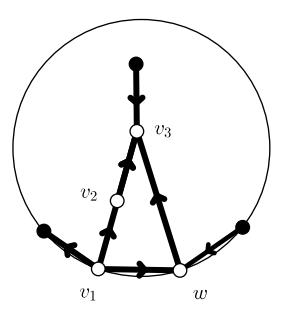
Figure 1. X and H
If v3 has two sons, as depicted in Figure 1, then let A be the matrix consisting two copies of columns of AH indexed by v1v2, v2v3, v3w and one copy of the column of AH indexed by v1w. I.e.,
Total weight choosability for Halin graphs Yu-Chang Liang et al.
\[A = \begin{bmatrix} v_1 v_2, v_1 v_2, v_2 v_3, v_2 v_3, v_3 w, v_3 w, v_1 w \\ -1 & -1 & 0 & 0 & 0 & 0 & -1 \\ 0 & 0 & 1 & 1 & 0 & 0 & -1 \\ -1 & -1 & 0 & 0 & 1 & 1 & 0 \\ -1 & -1 & 0 & 0 & 1 & 1 & 0 \\ 0 & 0 & 1 & 1 & 1 & 1 & 0 \\ 0 & 0 & 0 & 1 & 1 & 1 & 1 \end{bmatrix}\]
Then per(A) = -24, and we are done.
If \(v_3\) has three sons, as depicted in Figure 2, we choose twice the columns of \(A_H\) indexed by \(v_1v_2, v_2v_3, v_3w, v_1w\).
Figure 2. X and H
Then
\[A = \begin{bmatrix} v_1v_2, v_1v_2, v_3w, v_3w, v_2v_3, v_2v_3, v_1w, v_1w \\ -1 & -1 & 0 & 0 & 0 & 0 & -1 & -1 \\ 0 & 0 & 0 & 0 & 1 & 1 & -1 & -1 \\ -1 & -1 & 1 & 1 & 0 & 0 & 0 & 0 \\ -1 & -1 & 1 & 1 & 0 & 0 & 0 & 0 \\ 0 & 0 & 1 & 1 & 1 & 1 & 0 & 0 \\ 0 & 0 & 0 & 0 & 1 & 1 & -1 & -1 \\ 0 & 0 & 1 & 1 & 1 & 1 & 0 & 0 \end{bmatrix}\]
Then per(A) = -48 and we are done.
Case 2: \(v_3\) has at least four sons or \(v_3\).
Let X be the set consisting \(v_3\) and all its descendants. Let Y = V - X. Again, orient the edges of H so that \(v_3\) is a sink vertex, and all vertices at distance 2 from \(v_3\) are source vertices as in Figure 3.
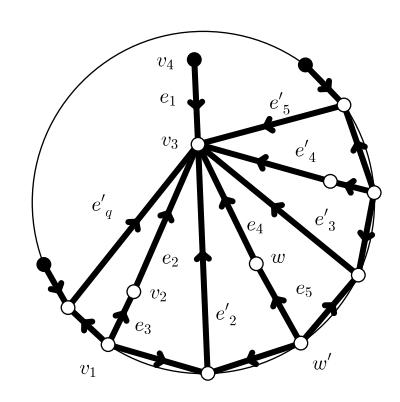
Figure 3. X and H
Then all the edges in \(E[X] \cap E(T)\) are source or sink edges.
As \(v_3\) has at least four sons, there is at least one son, say \(w \neq v_2\), such that w is not a leaf of T. Let w' be the son of w (note that since G is bipartite, if a son of \(v_3\) is not a leaf of T, then it has exactly one son), and \(v_4\) be the father of \(v_3\). Let \(e_1 = v_3v_4\), \(e_2 = v_3v_2\), \(e_3 = v_2v_1\), \(e_4 = v_3w\) and \(e_5 = ww'\).
Each edge e in \(E[X] \cap E(T)\) is either incident to \(v_3\) or is of the form uu', where u is a son of \(v_3\) and u' is the son of u. Let \(\phi: E[X] \cup E[X,Y] \to E[X]\) be the mapping defined as follows: Cyclically order the edges of \(E[X] - \{e_4\}\) incident to \(v_3\) as \(e'_1, e'_2, \ldots, e'_q\), and \(e'_1 = e_2\). Let \(\phi(e'_i) = e'_{i+1}\), where the indices are modulo q. Let \(\phi(e_4) = e_5\). For each son u of \(v_3\) which is not a leaf of T, let u' be the son of u, and let \(\phi(uu') = uv_3\). In particular, \(\phi(e_3) = e_2\) and \(\phi(e_5) = e_4\).
Assume \(e \in (E[X] - E(T)) \cup E[X, Y]\). If \(e = e_1\), then \(\phi(e_1) = e_4\). Otherwise \(e \in E(C)\), if e is to the left of \(v_1\), then \(\phi(e)\) is the tree edge incident to e and to the right of e; if e is to the right of \(v_1\), then \(\phi(e)\) is the tree edge incident to e and to the left of e. (In particular, both cycle edges incident to \(v_1\) are mapped to \(e_3 = v_1v_2\)).
It is easy to verify that for each \(e \in E[X] \cup E[X,Y]\), \(\phi(e)\) is a source or a sink edge incident to \(e \in E[X]\), and for each \(e \in E[X]\), \(|\phi^{-1}(e)| \le 2\). So it follows from Lemma 4.3 that the subgraph \(H = G[X] \cup E[X,Y]\) has a (0,2) matrix which contains no columns indexed by edges in E[X,Y].
Case 3: \(v_3\) has only one son.
Let \(v_4\) be the father of \(v_3\). If there is a son w of \(v_4\) with \(d_T(w) \ge 3\), then the depth of w is the same as \(v_3\). We choose w to play the role of \(v_3\), and we are in Cases 1 and 2. Hence, we may assume that each son of \(v_4\) has degree at most two in T. Let X be the set consisting of \(v_4\) and all the descendants of \(v_4\) that have distance at most 2 to \(v_4\). Let Y = V - X. Orient the edges in \(E[X] \cup E[X,Y]\) so that \(v_4\) is a sink vertex, and all vertices at distance 2 from \(v_4\) are source vertices as in Figure 4.
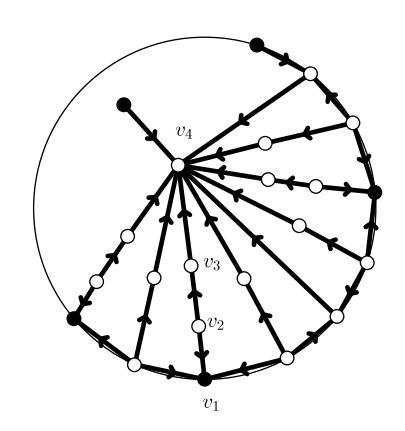
Figure 4. X and H
In this orientation, all the edges in E[X] ∩ E(T) are source or sink edges. Similarly as in the previous case, it is easy to find a mapping φ : E[X] ∪ E[X, Y ] → E[X] such that for each e ∈ E[X] ∪ E[X, Y ], φ(e) is a source or a sink edge incident to e, and for each e ∈ E[X], |φ −1 (e)| ≤ 2. By Lemma 4.3, the subgraph H = G[X] ∪ E[X, Y ] has a (0, 2) matrix which contains no columns indexed by edges in E[X, Y ].
This completes the proof of Lemma 4.4.
It was proved in [22] that every graph G has a permanent-non-singular (1, 2)-matrix. However, the following two conjectures which are weaker than Conjectures 1 and 2, respectively, remain open.
Conjecture 3. There is a constant k such that every graph G has a permanent-non-singular (k, 1) matrix.
Conjecture 4. There is a constant k such that every graph G without isolated edges has a permanentnon-singular (0, k)-matrix.
Acknowledgement
This paper is finished while the 2nd author is visiting Professor Shinya Fujita at Yokohama City University. She thanks the hospitality of Professor Fujita and Yokohama City University.
References
- [1] L. Addario-Berry, R.E.L. Aldred, K. Dalal, and B.A. Reed, Vertex colouring edge partitions, J. Combin. Theory Ser. B, 94 (2005), 237–244.
- [2] L. Addario-Berry, K. Dalal, C. McDiarmid, B.A. Reed, and A. Thomason, Vertex-colouring edge-weightings, Combinatorica 27 (2007), 1–12.
- [3] N. Alon, Combinatorial Nullstellensatz, Combin. Prob. Comput. 8 (1999), 7–29.
- [4] N. Alon and M. Tarsi, A nowhere zero point in linear mappings, Combinatorica 9 (1989), 393–395.
- [5] N. Alon and M. Tarsi, Colorings and orientations of graphs, Combinatorica 12 (1992), 125– 134.
- [6] T. Bartnicki, J. Grytczuk and S. Niwczyk, Weight choosability of graphs, J. Graph Theory 60 (2009), 242–256.
- [7] G.J. Chang, C. Lu, J. Wu, and Q.L. Yu, Vertex coloring 2-edge weighting of bipartite graphs, Taiwanese Journal of Mathematics 15 (4) (2011), 1807–1813.
- [8] M. Kalkowski, A note on 1, 2-Conjecture, manuscript.
- [9] M. Karo´nski, T. Łuczak, and A. Thomason, Edge weights and vertex colours, J. Combin. Theory Ser. B 91 (2004), 151–157.
- [10] M. Kalkowski, M. Karo´nski, and F. Pfender, Vertex-coloring edge-weightings: towards the 1-2-3- Conjecture, J. Combin. Theory Ser. B 100 (2010), 347–349.
- [11] H. Lu, Q. Yu, and C.-Q. Zhang, Vertex-coloring 2-edge-weighting of graphs, European J. Combin. 32 (2011) 21–27.
- [12] H. Pan and D. Yang, On total weight choosability of graphs, J. Comb. Optim. 25 (2013), 766–783.
- [13] J. Przybyło and M. Wo´zniak, On a 1-2 conjecture, Discrete Math. Theor. Comput. Sci. 12 (2010), 101–108.
- [14] J. Przybyło and M. Wo´zniak, Total weight choosability of graphs, Electron. J. Combin. 18 (2011), no. 1, Paper 112, 11 pp.
- [15] U. Schauz, Algebraically solvable problems: describing polynomials as equivalent to explicit solutions, Electron. J. Combin. 15 (2008), no. 1, Research Paper 10, 35 pp.
- [16] B. Seamone, The 1-2-3 conjecture and related problems: a survey, submitted (http://arxiv.org/abs/1211.5122).
- [17] T. Wang and Q. L. Yu, A note on vertex-coloring 13-edge-weighting, Frontier Math. 4 in China, 3 (2008), 1–7.
- [18] T. Wong, D. Yang, and X. Zhu, List total weighting of graphs, Fete of combinatorics and computer science, 337–353, Bolyai Soc. Math. Stud., 20, Janos Bolyai Math. Soc., Budapest, 2010.
- [19] T. Wong, J. Wu, and X. Zhu, Total weight choosability of Cartesian product of graphs, European J. Combinatorics 33 (2012), 1725–1738.
- [20] T. Wong and X. Zhu, Total weight choosability of graphs, J. Graph Theory 66 (2011), 198– 212.
- [21] T. Wong and X. Zhu, Permanent index of matrices associated with graphs, Electron. J. Combin. 24 (2017), no. 1, Paper 1.25, 11 pp
- [22] T. Wong and X. Zhu, Every graph is (2, 3)-choosable, Combinatorica 36 (2016), 121–127.