
Kiki A. Sugenga,b, Peter Johna , Michelle L. Lawrencea , Lenny F. Anwara , Martin Bacaˇ c , Andrea Semanicov ˇ a-Fe ´ nov ˇ cˇ´ıkova´ c,d
kiki@sci.ui.ac.id, peter.john@sci.ui.ac.id, michelle.leticia@ui.ac.id, lenni.fitri@sci.ui.ac.id, martin.baca@tuke.sk, andrea.fenovcikova@tuke.sk
Let G = (V (G), E(G)) be a graph with the nonempty vertex set V (G) and the edge set E(G). Let Zn be the group of integers modulo n and let k be a positive integer. A modular irregular labeling of a graph G of order n is an edge k-labeling φ : E(G) → {1, 2, . . . , k}, such that the induced weight function σ : V (G) → Zn defined by σ(v) = P u∈N(v) φ(uv) (mod n) for every vertex v ∈ V (G) is bijective. The minimum number k such that a graph G has a modular irregular k-labeling is called the modular irregularity strength of a graph G, denoted by ms(G). In this paper, we determine the exact values of the modular irregularity strength of some families of flower graphs, namely rose graphs, daisy graphs and sunflower graphs.
Keywords: modular irregular labeling, modular irregularity strength, daisy graphs, rose graphs, sunflower graphs Mathematics Subject Classification: 05C15, 05C78 DOI: 10.5614/ejgta.2023.11.1.3
Received: 15 August 2022, Revised: 2 October 2022, Accepted: 21 December 2022.
aDepartment of Mathematics, Faculty of Mathematics and Natural Sciences, Universitas Indonesia, Depok, Indonesia
bCenter for Research Collaboration on Graph Theory and Combinatorics, Indonesia
cDepartment of Applied Mathematics and Informatics, Technical University of Kosice, Slovak Republic ˇ
dDivision of Mathematics, Saveetha School of Engineering, SIMATS, Chennai, India
1. Introduction
Let G = (V (G), E(G)) be a graph with the nonempty vertex set V (G) and the edge set E(G). In this paper all graphs are simple of order n. The degree of a vertex v is denoted by deg(v) and we shall denote the maximum degree of G by ∆(G). A graph is called regular if degree of each vertex is equal, while a graph with the different degree for all vertices is called an irregular graph. A biregular graph is a graph having vertices either of degree d1 or of degree d2. In this paper we consider two families of biregular graphs.
A mapping which sends a set of graph elements to a set of numbers is called a labeling. In 1988, Chartrand et al. in [7] defined an irregular labeling as an edge k-labeling φ : E(G) → {1, 2, . . . , k}, where k is a positive integer, such that the vertex weights are different for all vertices. The function w(v) = P u∈N(v) φ(uv) is called the weight of a vertex v ∈ V (G) and N(v) stands for the neighborhood of the vertex v. The minimum number k such that a graph G has an irregular k-labeling is called the irregularity strength of a graph G and is denoted by s(G). This graph invariant has attracted much attention see [1, 2, 6, 8, 9, 11, 12]. People alsi study the variation on irregular labeling, as an example total irregular labeling where the label is definied for vertices and edges, see [10, 13] as examples.
In 2020, Baca et al. [5] introduced a variation of an irregular labeling which is called a modular ˇ irregular labeling. Let G be a graph of order n and let Zn be a group of integers modulo n. A modular irregular labeling of a graph G is an edge k-labeling φ : E(G) → {1, 2, . . . , k} P such that the induced function σ : V (G) → Zn defined for every vertex v ∈ V (G) by σ(v) = u∈N(v) φ(uv) (mod n) is bijective. The sum σ(v) = wtφ(v) is called the modular weight of the vertex v. The minimum number k such that a graph G has modular irregular k-labeling is called the modular irregularity strength of a graph G, denoted by ms(G). If there exists no such labeling for the graph G then we put ms(G) = ∞.
For some classes of graphs their modular irregularity strength is known. Baca et al. in [5] ˇ obtained the precise values of this graph invariant of paths Pn for n ≥ 3, stars K1,n for n ≥ 2, triangular graphs Tn for n ≥ 3, cycles Cn for n ≥ 3, and gear graphs Gn for n ≥ 3. In 2021, Bacaˇ et al. [4] characterized the modular irregularity strength of fan graphs Fn for n ≥ 2. In the same year, Baca et al. in [3] found the modular irregularity strength of wheels ˇ Wn. Sugeng et al. in [14] provided the results for the modular irregularity strength of double-stars Sk,k and friendship graphs fn.
2. Known Results
Chartrand et al. in [7] proved the following lemma.
Lemma 2.1. [7] Let G be a connected graph of order n ≥ 3 and let G have ni vertices with degree i, then
\[s(G) \ge \max_{1 \le i \le \Delta(G)} \left\{ \frac{n_i - 1}{i} + 1 \right\}.\]
Baca et al. in [5] stated the following theorem. ˇ
Theorem 2.1. [5] Let G be a graph with no component which has order \(\leq 2\). Then
\[s(G) \le ms(G)\].
Theorem 2.2. [5] If G is a graph of order n, \(n \equiv 2 \pmod{4}\), then G has no modular irregular k-labeling, i.e., \(ms(G) = \infty\).
3. New Results
In this section, we determine the modular irregularity strength of three families of flower graphs, which are the rose graphs (also known as the middle graph of cycles), daisy graphs and sunflower graphs.
Rose Graphs
The rose graph is also known as a middle graph of a cycle. The middle graph M(G) of a connected graph G is a graph whose vertex set is \(V(G) \cup E(G)\) where two vertices are adjacent if and only if either they are adjacent edges in G or one is a vertex in G and the other is an edge in G incident with it. Let \(v_1, v_2, \ldots, v_n\) be the vertices of the cycle \(C_n\), \(n \geq 3\) and let the n edges of \(C_n\) be \(v_1v_2, v_2v_3, \ldots, v_{n-1}v_n, v_nv_1\). Thus the rose graph \(M(C_n)\) can be constructed from the cycle \(C_n\) with vertices \(v_1, v_2, \ldots, v_n\) and n isolated vertices \(w_1, w_2, \ldots, w_n\) and then connecting every two vertices \(v_i, v_{i+1}\) with \(w_i\), for \(i = 1, 2, \ldots, n\) where \(v_{n+1} = v_1\). Thus \(M(C_n)\) contains n vertices of degree 2 and n vertices of degree 4. Thus according to Lemma 2.1 and Theorem 2.1 we have that
\[ms(M(C_n)) \ge s(M(C_n)) \ge \max\left\{\frac{n-1}{2} + 1, \frac{n-1}{4} + 1\right\} = \frac{n+1}{2}.\]
As the irregularity strength is an integer we get
\[ms(M(C_n)) \ge s(M(C_n)) \ge \left\lceil \frac{n+1}{2} \right\rceil.\] (1)
Theorem 3.1. Let \(M(C_n)\) be a rose graph with \(n \geq 3\), then
\[ms(M(C_n)) = \begin{cases} \frac{n}{2} + 1, & \text{when } n \text{ is even,} \\ \infty, & \text{when } n \text{ is odd.} \end{cases}\]
Proof. We consider two cases according to the parity of n.
Case 1. When n is odd then \(|V(M(C_n))| = 2n \equiv 2 \pmod{4}\). Thus, following Theorem 2.2, the graph does not have a modular irregular labeling.
Case 2. When n is even we label the edges of \(M(C_n)\) as follows.
\[\varphi_1(v_i v_{i+1}) = \frac{n}{2}, for i = 1, 2, ..., n-1, \varphi_1(v_1 v_n) = \frac{n}{2}, for i = 1, 2, ..., \frac{n}{2} + 1, \varphi_1(v_i w_i) = \begin{cases} i, & \text{for } i = 1, 2, ..., \frac{n}{2} + 1, \\ n+2-i, & \text{for } i = \frac{n}{2} + 2, \frac{n}{2} + 3, ..., n, \end{cases}\]
\[\varphi_1(v_{i+1}w_i) = \begin{cases} i, & \text{for } i = 1, 2, \dots, \frac{n}{2}, \\ n+1-i, & \text{for } i = \frac{n}{2}+1, \frac{n}{2}+2, \dots, n-1, \end{cases}\]\[\varphi(v_1w_n) = 1.\]
It is easy to see that the maximal edge label is \(\frac{n}{2}+1\). Thus \(\varphi_1\) is an \((\frac{n}{2}+1)\)-labeling of \(M(C_n)\).
Now we check the induced modular weights of the vertices in \(M(C_n)\). For the vertices \(v_i\), i = 1, 2, ..., n we have the following:
\[wt_{\varphi_1}(v_1) = \varphi_1(v_1v_2) + \varphi_1(v_1v_n) + \varphi_1(v_1w_1) + \varphi_1(v_1w_n) = \frac{n}{2} + \frac{n}{2} + 1 + 1 = n + 2,\] for \(i = 2, 3, \dots, \frac{n}{2} + 1\) \[wt_{\varphi_1}(v_i) = \varphi_1(v_iv_{i+1}) + \varphi_1(v_{i-1}v_i) + \varphi_1(v_iw_i) + \varphi_1(v_iw_{i-1}) = \frac{n}{2} + \frac{n}{2} + i + (i - 1)\] \[= n + 2i - 1.\]
i.e., the corresponding modular weights are \(1, n+3, n+5, \ldots, 2n-1\),
\[\begin{split} wt_{\varphi_1}(v_{\frac{n}{2}+2}) &= \varphi_1(v_{\frac{n}{2}+2}v_{\frac{n}{2}+3}) + \varphi_1(v_{\frac{n}{2}+1}v_{\frac{n}{2}+2}) + \varphi_1(v_{\frac{n}{2}+2}w_{\frac{n}{2}+2}) + \varphi_1(v_{\frac{n}{2}+2}w_{\frac{n}{2}+1}) \\ &= \frac{n}{2} + \frac{n}{2} + \frac{n}{2} + \frac{n}{2} = 2n \equiv 0 \pmod{2n}, \end{split}\]
for \[i = \frac{n}{2} + 3, \frac{n}{2} + 4, \dots, n - 1\]
\[wt_{\varphi_1}(v_i) = \varphi_1(v_i v_{i+1}) + \varphi_1(v_{i-1} v_i) + \varphi_1(v_i w_i) + \varphi_1(v_i w_{i-1}) = \frac{n}{2} + \frac{n}{2} + (n+2-i) + (n+2-i) = 3n+4-2i,\]
i.e., the corresponding modular weights are \(n + 6, n + 8, \dots, 2n - 2\),
\[wt_{\varphi_1}(v_n) = \varphi_1(v_1v_n) + \varphi_1(v_{n-1}v_n) + \varphi_1(v_nw_n) + \varphi_1(v_nw_{n-1}) = \frac{n}{2} + \frac{n}{2} + 2 + 2 = n + 4.\]
Now we check the weights of the vertices \(w_i\), i = 1, 2, ..., n.
For \[i=1,2,\ldots,\frac{n}{2}\] \(wt_{\varphi_1}(w_i)=\varphi_1(v_iw_i)+\varphi_1(v_{i+1}w_i)=i+i=2i,\) i.e., the corresponding modular weights are \(2,4,\ldots,n,\) \(wt_{\varphi_1}(w_{\frac{n}{2}+1})=\varphi_1(v_{\frac{n}{2}+1}w_{\frac{n}{2}+1})+\varphi_1(v_{\frac{n}{2}+2}w_{\frac{n}{2}+1})=(\frac{n}{2}+1)+\frac{n}{2}=n+1,\) for \(i=\frac{n}{2}+2,\frac{n}{2}+3,\ldots,n-1,\) \(wt_{\varphi_1}(w_i)=\varphi_1(v_iw_i)+\varphi_1(v_{i+1}w_i)=(n+2-i)+(n+1-i)=2n+3-2i,\) i.e., the corresponding modular weights are \(5,7,\ldots,n-1,\) \(wt_{\varphi_1}(w_n)=\varphi_1(v_nw_n)+\varphi_1(v_1w_n)=2+1=3.\)
Combining the previous we get that the modular weights of all vertices constitute the set \(\{0, 1, \dots, 2n-1\}\). Thus according to (1) we have \(ms(M(C_n)) = \frac{n}{2} + 1\) for n even, \(n \ge 4\).
Figure 1 illustrates a modular irregular 5-labeling of \(M(C_8)\).
Immediately from the previous theorem we get the result for the irregularity strength of the rose graph \(M(C_n)\) for even n.
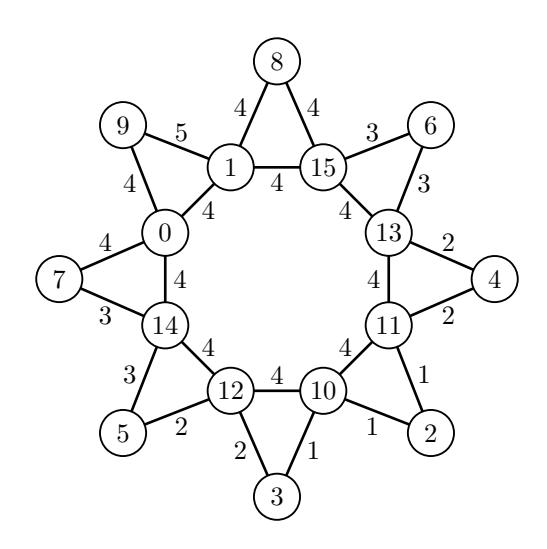
Figure 1. A modular irregular 5-labeling of \(M(C_8)\).
Corollary 3.1. Let \(M(C_n)\) be a rose graph with n even, \(n \geq 4\), then
\[s(M(C_n)) = \frac{n}{2} + 1.\]
Daisy Graphs
The daisy graph \(DK_n\) is constructed from the complete graph \(K_n\) with vertices \(v_1, v_2, \ldots, v_n\) and n isolated vertices \(w_1, w_2, \ldots, w_n\) such that the vertices \(v_i, v_{i+1}\) are connected to \(w_i\) for \(i = 1, 2, \ldots, n\) where \(v_{n+1} = v_1\). A daisy graph \(DK_n\) has n vertex of degree 2 and n vertices of degree n+1. Based on Lemma 2.1 and Theorem 2.1 we have that
\[ms(DK_n) \ge s(DK_n) \ge \max\left\{\frac{n-1}{2} + 1, \frac{n-1}{n+1} + 1\right\} = \frac{n+1}{2}.\]
Since \(s(DK_n)\) is an integer so
\[ms(DK_n) \ge s(DK_n) \ge \left\lceil \frac{n+1}{2} \right\rceil.\] (2)
Theorem 3.2. Let \(DK_n\) be a daisy graph with \(n \geq 3\), then
\[ms(DK_n) = \begin{cases} \frac{n}{2} + 1, & \text{when } n \text{ is even,} \\ \infty, & \text{when } n \text{ is odd.} \end{cases}\]
Proof. We again distinguish two cases, when n is odd and when n is even.
Case 1. When n is odd then \(|V(DK_n)| = 2n \equiv 2 \pmod{4}\). By Theorem 2.2 we obtain that there does not exist a modular irregular labeling of \(DK_n\) in this case.
Case 2. When n is even we define a suitable edge labeling \(\varphi_2\) of \(DK_n\) in the following way.
\[\varphi_2(v_i v_{i+1}) = \begin{cases} 1, & \text{for } i = 1, 3, \dots, n-1, \\ 2, & \text{for } i = 2, 4, \dots, n-2, \end{cases}\]
\[\begin{split} \varphi_2(v_1v_n) &= 2, \\ \varphi_2(v_1v_j) &= 1, & \text{for } j = 3, 4, \dots, n-1, \\ \varphi_2(v_iv_j) &= 1, & \text{for } i = 2, 3, \dots, n-2 \text{ and } i+2 \leq j \leq n, \\ \varphi_2(v_iw_i) &= \begin{cases} i, & \text{for } i = 1, 2, \dots, \frac{n}{2}+1, \\ n+2-i, & \text{for } i = \frac{n}{2}+2, \frac{n}{2}+3, \dots, n, \end{cases} \\ \varphi_2(v_{i+1}w_i) &= \begin{cases} i, & \text{for } i = 1, 2, \dots, \frac{n}{2}, \\ n+1-i, & \text{for } i = \frac{n}{2}+1, \frac{n}{2}+2, \dots, n-1, \end{cases} \\ \varphi_2(v_1w_n) &= 1. \end{split}\]
Evidently the labeling \(\varphi_2\) is an \((\frac{n}{2}+1)\)-labeling.
Now we evaluate the modular vertex weights under the labeling \(\varphi_2\). We use the fact every vertex \(v_i\), \(i=1,2,\ldots,n\), is in the subgraph \(K_n\) of \(DK_n\) incident with one edge labeled by 2 and with n-2 edges labeled by 1. Thus
\[wt_{\varphi_2}(v_1) = \sum_{j \neq i} \varphi_2(v_1 v_j) + \varphi_2(v_1 w_1) + \varphi_2(v_1 w_n) = n + 1 + 1 = n + 2,\] for \(i = 2, 3, \dots, \frac{n}{2} + 1\) \[wt_{\varphi_2}(v_i) = \sum_{j \neq i} \varphi_2(v_i v_j) + \varphi_2(v_i w_i) + \varphi_2(v_i w_{i-1}) = n + i + (i - 1) = n + 2i - 1,\]
i.e., the corresponding modular weights are \(1, n+3, n+5, \ldots, 2n-1\),
\[wt_{\varphi_2}(v_{\frac{n}{2}+2}) = \sum_{j \neq \frac{n}{2}+2} \varphi_2(v_{\frac{n}{2}+2}v_j) + \varphi_2(v_{\frac{n}{2}+2}w_{\frac{n}{2}+2}) + \varphi_2(v_{\frac{n}{2}+2}w_{\frac{n}{2}+1}) = n + \frac{n}{2} + \frac{n}{2} = 2n\] \[\equiv 0 \pmod{2n},\]
for \[i = \frac{n}{2} + 3, \frac{n}{2} + 4, \dots, n - 1\]
\[wt_{\varphi_2}(v_i) = \sum_{j \neq i} \varphi_2(v_i v_j) + \varphi_2(v_i w_i) + \varphi_2(v_i w_{i-1}) = n + (n + 2 - i) + (n + 2 - i)\]
\[= 3n + 4 - 2i,\]
i.e., the corresponding modular weights are \(n + 6, n + 8, \dots, 2n - 2\),
\[wt_{\varphi_2}(v_n) = \sum_{j \neq n} \varphi_2(v_n v_j) + \varphi_2(v_n w_n) + \varphi_2(v_n w_{n-1}) = n + 2 + 2 = n + 4,\]
for \[i = 1, 2, \dots, \frac{n}{2}\]
\[wt_{\varphi_2}(w_i) = \varphi_2(v_i w_i) + \varphi_2(v_{i+1} w_i) = i + i = 2i,\]
i.e., the corresponding modular weights are \(2, 4, \ldots, n\),
\[wt_{\varphi_2}(w_{\frac{n}{2}+1}) = \varphi_2(v_{\frac{n}{2}+1}w_{\frac{n}{2}+1}) + \varphi_2(v_{\frac{n}{2}+2}w_{\frac{n}{2}+1}) = (\frac{n}{2}+1) + \frac{n}{2} = n+1,\] for \(i = \frac{n}{2} + 2, \frac{n}{2} + 3, \dots, n-1\) \[wt_{\varphi_2}(w_i) = \varphi_2(v_iw_i) + \varphi_2(v_{i+1}w_i) = (n+2-i) + (n+1-i) = 2n+3-2i,\]
i.e., the corresponding modular weights are \(5, 7, \ldots, n-1\),
\[wt_{\varphi_2}(w_n) = \varphi_2(v_n w_n) + \varphi_2(v_1 w_n) = 2 + 1 = 3.\]
Therefore, the modular weights of vertices constitute the set \(\{0, 1, \dots, 2n-1\}\). By combining this result with (2) we conclude that \(ms(DK_n) = \frac{n}{2} + 1\) for even \(n \ge 4\).
Figure 2 gives an example of a modular irregular 4-labeling of \(DK_6\).
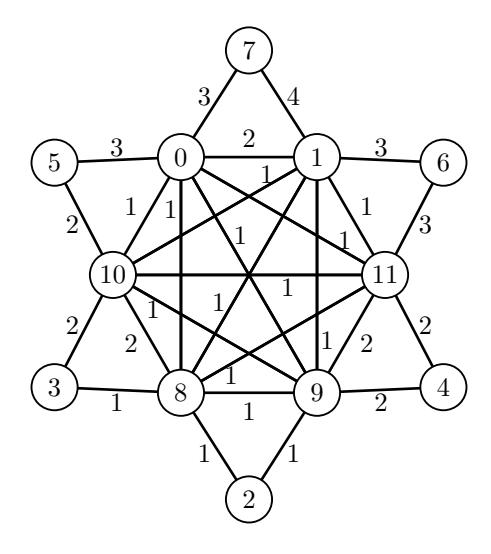
Figure 2. A modular irregular 4-labeling of \(DK_6\).
From Theorem 3.2 we have also the following result for the irregularity strength of \(DK_n\).
Corollary 3.2. Let \(DK_n\) be a daisy graph with n even, \(n \geq 4\), then
\[s(DK_n) = \frac{n}{2} + 1.\]
Sunflower Graphs
A wheel \(W_n\), \(n \geq 3\), is a graph obtained by joining all vertices of a cycle on n vertices to a further vertex c. Let us denote the vertices of degree 3 in \(W_n\) by \(v_1, v_2, \ldots, v_n\) such that the edges of \(W_n\) are \(cv_1, cv_2, \ldots, cv_n, v_1v_2, v_2v_3, \ldots, v_{n-1}v_n\) and \(v_1v_n\). A sunflower graph \(Sf_n\) is a graph constructed from a wheel \(W_n\) and n additional vertices \(w_1, w_2, \ldots, w_n\) where \(w_i\) is adjacent to \(v_i\) and \(v_{i+1}\), \(i=1,2,\ldots,n\) with \(v_{n+1}=v_1\). A sunflower graph \(Sf_n\) has one vertex of degree n, n vertices of degree n and n vertices of degree n. According to Lemma 2.1 and Theorem 2.1 we obtain the following lower bound
\[ms(Sf_n) \ge s(Sf_n) \ge \left\lceil \frac{n+1}{2} \right\rceil.\] (3)
Theorem 3.3. Let \(Sf_n\) be a sunflower graph, \(n \geq 3\), then
\[ms(Sf_n) = \begin{cases} 3, & \textit{when } n = 3, \\ 4, & \textit{when } n = 5, \\ \left\lceil \frac{n+1}{2} \right\rceil, & \textit{otherwise}. \end{cases}\]
Proof. The proof consists of five cases.
Case 1. By (3) we get that \(ms(Sf_3) \geq 2\). By a contradiction we prove that \(ms(Sf_3) \neq 2\). Assume that \(Sf_3\) admits a modular irregular 2-labeling. Then as \(Sf_3\) contains three vertices of degree 2 their weights must be 2, 3 and 4. On the other side the maximal vertex weight is at most 10 and can be obtained only on a vertex of degree 5. Because \(Sf_3\) has 7 vertices we get that the set of the vertex weights must consists of numbers \(2, 3, \ldots, 8\), i.e., the modular vertex weights are \(0, 1, \ldots, 6\). As the sum of the weights \(2+3+\cdots+8=35\) we get a contradiction because the sum of all vertex weights must be even as every edge label contributes twice to the vertex weights.
Case 2. According to (3) we have that \(ms(Sf_5) \ge 3\). Assume that \(Sf_5\) has a modular irregular 3-labeling. Under this labeling the five vertices of degree 2 must have weights 2, 3, 4, 5 and 6. The other vertices have degree 5 and thus the maximal vertex weight is at most 15 and can be obtained as the sum of five labels 3. The graph \(Sf_5\) is of order 11. Thus the set of the vertex weights must be \(\{2, 3, \ldots, 12\}\), i.e., the modular weights are \(0, 1, \ldots, 10\). A contradiction as the sum of the vertex weights is 77.
Case 3. When n=7 we consider the modular irregular 4-labeling of \(Sf_7\) illustrated on Figure 3.
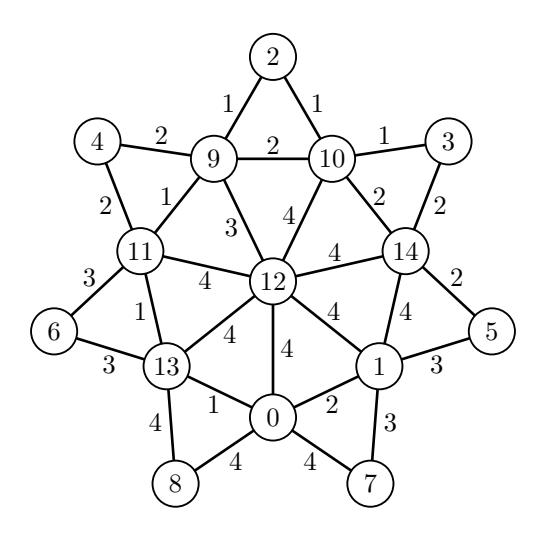
Figure 3. A modular irregular 4-labeling of \(Sf_7\).
Case 4. When n is even, \(n \ge 4\), we define an edge labeling \(\varphi_3\) of \(Sf_n\) such that
\[\varphi_3(cv_i) = 2, \qquad \text{for } i = 1, 2, \dots, n, \varphi_3(v_i v_{i+1}) = \begin{cases} \frac{n}{2}, & \text{for } i = 1, \\ \frac{n}{2} - 1, & \text{for } i = 2, 3, \dots, n, \end{cases} \varphi_3(v_{i+1} w_i) = \begin{cases} \frac{n}{2} + 1, & \text{for } i = 1, \\ \frac{n}{2} + 2 - i, & \text{for } i = 2, 3, \dots, \frac{n}{2} + 1, \\ i - \frac{n}{2}, & \text{for } i = \frac{n}{2} + 2, \frac{n}{2} + 3, \dots, n, \end{cases}\]
\[\varphi_3(v_i w_i) = \begin{cases} \frac{n}{2}, & \text{for } i = 1, \\ \frac{n}{2} + 2 - i, & \text{for } i = 2, 3, \dots, \frac{n}{2} + 1, \\ i - \frac{n}{2} - 1, & \text{for } i = \frac{n}{2} + 2, \frac{n}{2} + 3, \dots, n. \end{cases}\]
As the maximal edge label is \(\frac{n}{2} + 1\) we get that \(\varphi_3\) is an \((\frac{n}{2} + 1)\)-labeling. The corresponding modular edge weights are the following.
\[wt_{\varphi_3}(v_1) = \varphi_3(cv_1) + \varphi_3(v_nv_1) + \varphi_3(v_1v_2) + \varphi_3(w_nv_1) + \varphi_3(w_1v_1) = 2 + (\frac{n}{2} - 1) + \frac{n}{2} + \frac{n}{2} + \frac{n}{2} = 2n + 1 \equiv 0 \pmod{(2n+1)},\] \[wt_{\varphi_3}(v_2) = \varphi_3(cv_2) + \varphi_3(v_1v_2) + \varphi_3(v_2v_3) + \varphi_3(w_1v_2) + \varphi_3(w_2v_2) = 2 + \frac{n}{2} + (\frac{n}{2} - 1) + (\frac{n}{2} + 1) + \frac{n}{2} = 2n + 2 \equiv 1 \pmod{(2n+1)},\] \[\text{for } i = 3, 4, \dots, \frac{n}{2} + 1\] \[wt_{\varphi_3}(v_i) = \varphi_3(cv_i) + \varphi_3(v_{i-1}v_i) + \varphi_3(v_{i}v_{i+1}) + \varphi_3(w_{i-1}v_i) + \varphi_3(w_iv_i) = 2 + (\frac{n}{2} - 1) + (\frac{n}{2} - 1) + (\frac{n}{2} + 3 - i) + (\frac{n}{2} + 2 - i) = 2n + 5 - 2i,\]
i.e., the corresponding modular weights are \(n+3, n+5, \ldots, 2n-1\),
\[wt_{\varphi_2}(v_{\frac{n}{2}+2}) = \varphi_3(cv_{\frac{n}{2}+2}) + \varphi_3(v_{\frac{n}{2}+1}v_{\frac{n}{2}+2}) + \varphi_3(v_{\frac{n}{2}+2}v_{\frac{n}{2}+3}) + \varphi_3(w_{\frac{n}{2}+1}v_{\frac{n}{2}+2}) + \varphi_3(w_{\frac{n}{2}+2}v_{\frac{n}{2}+2}) = 2 + (\frac{n}{2} - 1) + (\frac{n}{2} - 1) + 1 + 1 = n + 2,\]
for \[i = \frac{n}{2} + 3, \frac{n}{2} + 4, \dots, n\]
\[wt_{\varphi_3}(v_i) = \varphi_3(cv_i) + \varphi_3(v_{i-1}v_i) + \varphi_3(v_iv_{i+1}) + \varphi_3(w_{i-1}v_i) + \varphi_3(w_iv_i) = 2 + (\frac{n}{2} - 1) + (\frac{n}{2} - 1) + (i - 1 - \frac{n}{2}) + (i - \frac{n}{2} - 1) = 2i - 2,\]
i.e., the corresponding modular weights are \(n+4, n+6, \ldots, 2n-2\),
\[wt_{\varphi_3}(w_1) = \varphi_3(v_2w_1) + \varphi_3(v_1w_1) = (\frac{n}{2} + 1) + \frac{n}{2} = n + 1,\]
for \(i = 2, 3, \dots, \frac{n}{2} + 1\)
\[wt_{\varphi_3}(w_i) = \varphi_3(v_{i+1}w_i) + \varphi_3(v_iw_i) = (\frac{n}{2} + 2 - i) + (\frac{n}{2} + 2 - i) = n + 4 - 2i,\]
i.e., the corresponding modular weights are \(2, 4, \ldots, n\),
for \[i = \frac{n}{2} + 2, \frac{n}{2} + 3, \dots, n\]
\(wt_{\varphi_3}(w_i) = \varphi_3(v_{i+1}w_i) + \varphi_3(v_iw_i) = (i - \frac{n}{2}) + (i - \frac{n}{2} - 1) = 2i - n - 1,\)
i.e., the corresponding modular weights are \(3, 5, \ldots, n-1\),
\[wt_{\varphi_3}(c) = \sum_{i=1}^{n} \varphi_3(cv_i) = 2n.\]
Thus the modular vertex weights are \(0, 1, \ldots, 2n\) which means that for even \(n \ge 4\) the labeling \(\varphi_3\) is a modular irregular \((\frac{n}{2}+1)\)-labeling of \(Sf_n\).
Case 5. When n is odd, \(n \ge 9\), we consider the following labeling \(\varphi_4\) of \(Sf_n\)
\[\varphi_4(cv_i) = \begin{cases} 5, & \text{for } i = 1, 2, \frac{n+1}{2}, \\ 4, & \text{otherwise,} \end{cases}\]
\[\begin{split} \varphi_4(v_iv_{i+1}) &= \begin{cases} \frac{n-5}{2}, & \text{for } i=1 \text{ and } i=\frac{n+1}{2}, \frac{n+3}{2}, \dots, n, \\ \frac{n-3}{2}, & \text{for } i=2,3,\dots, \frac{n-1}{2}, \end{cases} \\ \varphi_4(v_{i+1}w_i) &= \begin{cases} \frac{n+1}{2}-i, & \text{for } i=1,2,\dots, \frac{n-1}{2}, \\ i-\frac{n-1}{2}, & \text{for } i=\frac{n+1}{2}, \frac{n+3}{2},\dots, n, \end{cases} \\ \varphi_4(v_iw_i) &= \begin{cases} \frac{n+3}{2}-i, & \text{for } i=1,2,\dots, \frac{n-1}{2}, \\ i-\frac{n-1}{2}, & \text{for } i=\frac{n+1}{2}, \frac{n+3}{2},\dots, n. \end{cases} \end{split}\]
Evidently \(\varphi_4\) is an \(\frac{n+1}{2}\)-labeling. Now we evaluate the modular edge weights induced by the labeling \(\varphi_4\).
\[\begin{split} wt_{\varphi_4}(v_1) &= \varphi_4(cv_1) + \varphi_4(v_nv_1) + \varphi_4(v_1v_2) + \varphi_4(w_nv_1) + \varphi_4(w_1v_1) = 5 + \frac{n-5}{2} + \frac{n-5}{2} + \frac{n+1}{2} \\ &\quad + \frac{n+1}{2} = 2n+1 \equiv 0 \pmod{(2n+1)}, \\ wt_{\varphi_4}(v_2) &= \varphi_4(cv_2) + \varphi_4(v_1v_2) + \varphi_4(v_2v_3) + \varphi_4(w_1v_2) + \varphi_4(w_2v_2) = 5 + \frac{n-5}{2} + \frac{n-3}{2} \\ &\quad + \frac{n-1}{2} + \frac{n-1}{2} = 2n, \\ \text{for } i = 3, 4, \dots, \frac{n-1}{2} \\ wt_{\varphi_4}(v_i) &= \varphi_4(cv_i) + \varphi_4(v_{i-1}v_i) + \varphi_4(v_iv_{i+1}) + \varphi_4(w_{i-1}v_i) + \varphi_4(w_iv_i) = 4 + \frac{n-3}{2} \\ &\quad + \frac{n-3}{2} + (\frac{n+3}{2} - i) + (\frac{n+3}{2} - i) = 2n + 4 - 2i, \end{split}\]
i.e., the corresponding modular weights are \(n + 5, n + 7, \dots, 2n - 2\),
\[\begin{split} wt_{\varphi_4}(v_{\frac{n+1}{2}}) &= \varphi_4(cv_{\frac{n+1}{2}}) + \varphi_4(v_{\frac{n-1}{2}}v_{\frac{n+1}{2}}) + \varphi_4(v_{\frac{n+1}{2}}v_{\frac{n+3}{2}}) + \varphi_4(w_{\frac{n-1}{2}}v_{\frac{n+1}{2}}) \\ &+ \varphi_4(w_{\frac{n+1}{2}}v_{\frac{n+1}{2}}) = 5 + \frac{n-3}{2} + \frac{n-5}{2} + 1 + 1 = n + 3, \end{split}\]
for \[i = \frac{n+3}{2}, \frac{n+5}{2}, \dots, n\]
\[wt_{\varphi_4}(v_i) = \varphi_4(cv_i) + \varphi_4(v_{i-1}v_i) + \varphi_4(v_iv_{i+1}) + \varphi_4(w_{i-1}v_i) + \varphi_4(w_iv_i) = 4 + \frac{n-5}{2} + \frac{n-5}{2} + (i - \frac{n+1}{2}) + (i - \frac{n-1}{2}) = 2i - 1,\]
i.e., the corresponding modular weights are \(n+2, n+4, \ldots, 2n-1\),
for \[i = 1, 2, \dots, \frac{n-1}{2}\]
\[wt_{\varphi_4}(w_i) = \varphi_4(v_{i+1}w_i) + \varphi_4(v_iw_i) = (\frac{n+1}{2} - i) + (\frac{n+3}{2} - i) = n + 2 - 2i,\]
i.e., the corresponding modular weights are \(3, 5, \ldots, n\),
\[wt_{\varphi_4}(w_{\underline{n+1}}) = \varphi_3(v_{\underline{n+3}} w_{\underline{n+1}}) + \varphi_3(v_{\underline{n+1}} w_{\underline{n+1}}) = 1 + 1 = 2,\]
for \[i = \frac{n+3}{2}, \frac{n+5}{2}, \dots, n\]
\[wt_{\varphi_4}(w_i) = \varphi_4(v_{i+1}w_i) + \varphi_4(v_iw_i) = (i - \frac{n-1}{2}) + (i - \frac{n-1}{2}) = 2i - n + 1,\]
i.e., the corresponding modular weights are \(4, 6, \ldots, n+1\),
\[wt_{\varphi_4}(c) = \sum_{i=1}^n \varphi_4(cv_i) = 5 \cdot 3 + 4 \cdot (n-3) = 4n + 3 \equiv 1 \pmod{(2n+1)}.\]
According to the previous we get that the modular vertex weights are \(0, 1, \ldots, 2n\). Thus for odd \(n \geq 9\) the labeling \(\varphi_4\) is a modular irregular \(\frac{n+1}{2}\)-labeling of \(Sf_n\). This concludes the proof. \(\square\)
We conclude the results with the following corollary.
Corollary 3.3. Let Sf n be a sunflower graph, n = 4 or n ≥ 6, then
\[s(Sf_n) = \left\lceil \frac{n+1}{2} \right\rceil.\]
4. Conclusion
In this paper, we determined the modular irregularity strength for three families of flower graphs which are rose graphs, daisy graphs and sunflower graphs. The first two of these families of flower graphs are biregular. For the future research we propose to find the modular irregularity strengths of other biregular graphs.
Acknowledgement
This research has been funded by Universitas Indonesia Research Grant PUTI Q2 No NKB-654/UN2.RST/HKP.05.00/2022. The research for this article was also supported by the Slovak Research and Development Agency under the contract APVV-19-0153 and by VEGA 1/0243/23.
References
- [1] M. Aigner and E. Triesch, Irregular assignments of trees and forests, SIAM J. Discrete Math. 3 (1990), 439–449.
- [2] D. Amar and O. Togni, Irregularity strength of trees, Discrete Math. 190 (1998), 15–38.
- [3] M. Baca, M. Imran, and A. Semani ˇ cov ˇ a-Fe ´ nov ˇ cˇ´ıkova, Irregularity and modular irregularity ´ strength of wheels, Mathematics 9 (2021), 2710, 14 pages.
- [4] M. Baca, Z. Kim ˇ akov ´ a, M. Lascs ´ akov ´ a, and A. Semani ´ cov ˇ a-Fe ´ nov ˇ cˇ´ıkova, The irregularity ´ and modular irregularity strength of fan graphs, Symmetry 13(4) (2021), 605, 13 pages.
- [5] M. Baca, K. Muthugurupackiam, K.M. Kathiresan, and S. Ramya, Modular irregularity ˇ strength of graphs, Electron. J. Graph Theory Appl. 8 (2020), 435–443.
- [6] T. Bohman and D. Kravitz, On the irregularity strength of trees, J. Graph Theory 45 (2004), 241–254.
- [7] G. Chartrand, M.S. Jacobson, J. Lehel, O.R. Oellermann, S. Ruiz, and F. Saba, Irregular networks, Congr. Numer. 64 (1988), 187–192.
- [8] R.J. Faudree, M.S. Jacobson, J. Lehel, and R.H. Schelp, Irregular networks, regular graphs and integer matrices with distinct row and column sums, Discret. Math. 76 (1989), 223–240.
- [9] A. Frieze, R.J. Gould, M. Karonski, and F. Pfender, On graph irregularity strength, J. Graph Theory 41 (2002), 120–137.
- [10] D. Indriati, W. Widodo, I.E. Wijayanti, K.A. Sugeng, and I. Rosyida, Totally irregular total labeling of some caterpillar graphs, Electron. J. Graph Theory Appl. 8 (2020), 247–254.
- [11] M. Kalkowski, M. Karonski,and F. Pfender, A new upper bound for the irregularity strength of graphs, SIAM J. Discret. Math. 25 (3) (2011), 1319–1321.
- [12] P. Majerski and J. Przybyło, On the irregularity strength of dense graphs, SIAM J. Discret. Math. 28 (2014), 197–205.
- [13] R. Simanjuntak, S. Susilawati, and E.T. Baskoro, Total vertex irregularity strength for trees with many vertices of degree two, Electron. J. Graph Theory Appl. 8 (2020), 415–421.
- [14] K.A. Sugeng, Z.Z. Barack, N. Hinding, and R. Simanjuntak, Modular irregular labeling on double-star and friendship graphs, J. Math. 2021 (2021), art. no. 4746609, 6 pages.