Electronic Journal of Graph Theory and Applications
On (F, H)-sim-magic labelings of graphs
Yeva Fadhilah Ashari<sup>a</sup>, A.N.M. Salman<sup>a,b</sup>, Rinovia Simanjuntak<sup>*,a,b</sup>, Andrea Semaničová-Feňovčíková<sup>c</sup>, Martin Bača<sup>c</sup>
<sup>a</sup>Combinatorial Mathematics Research Group, Faculty of Mathematics and Natural Sciences, Institut Teknologi Bandung, Indonesia
yevafadhilahashari@s.itb.ac.id, msalman@math.itb.ac.id, rino@itb.ac.id, andrea.fenovcikova@tuke.sk, martin.baca@tuke.sk
A simple graph G(V,E) admits an H-covering if every edge in G belongs to a subgraph of G isomorphic to H. In this case, G is called H-magic if there exists a bijective function \(f:V\cup E\to \{1,2,\ldots,|V|+|E|\}\), such that for every subgraph H' of G isomorphic to H, \(wt_f(H')=\sum_{v\in V(H')}f(v)+\sum_{e\in E(H')}f(e)\) is constant. Moreover, G is called H-supermagic if \(f:V(G)\to \{1,2,\ldots,|V|\}\). This paper generalizes the previous labeling by introducing the (F,H)-sim-(super) magic labeling. A graph admitting an F-covering and an H-covering is called (F,H)-sim-(super) magic if there exists a function f that is F-(super)magic and H-(super)magic at the same time. We consider such labelings for two product graphs: the join product and the Cartesian product. In particular, we establish a sufficient condition for the join product G+H to be \((K_2+H,2K_2+H)\)-sim-supermagic and show that the Cartesian product \(G\times K_2\) is \((C_4,H)\)-sim-supermagic, for H isomorphic to a ladder or an even cycle. Moreover, we also present a connection between an G-labeling of a tree G and a G-labeling of the Cartesian product G-sim-supermagic labeling of the Cartesian product G-sim-supermagic labeling of the Cartesian product G-sim-supermagic labeling of the Cartesian product G-sim-supermagic labeling of the Cartesian product G-sim-supermagic labeling of the Cartesian product G-sim-supermagic labeling of the Cartesian product G-sim-supermagic labeling of the Cartesian product G-sim-supermagic labeling of the Cartesian product G-sim-supermagic labeling of the Cartesian product G-sim-supermagic labeling of the Cartesian product G-sim-supermagic labeling of the Cartesian product G-sim-supermagic labeling of the Cartesian product G-sim-supermagic labeling of the Cartesian product G-sim-supermagic labeling of the Cartesian product G-sim-supermagic labeling of the Cartesian product G-sim-supermagic labeling of the Cartesian product G-sim-supermagic labeling of the Cartesian product G
\(\text{[rumus tidak dapat ditampilkan dengan baik — lihat PDF asli]}\)
DOI: 10.5614/ejgta.2023.11.1.5
Received: 2 July 2022, Revised: 6 January 2023, Accepted: 4 February 2023.
<sup>b</sup>Center for Research Collaboration on Graph Theory and Combinatorics, Indonesia
<sup>c</sup>Department of Applied Mathematics and Informatics, Technical University in Košice, Slovakia
*corresponding author
1. Introduction
The graphs considered in this paper are finite and simple. Let G be a graph, with the vertex set V(G) and the edge set E(G). The cardinalities of V(G) and E(G) are called the order and the size of G, respectively. A labeling f of G is a map that assigns certain elements of G to positive or non-negative integers. In this paper, we consider a total labeling of G as a bijective function \(f:V(G)\cup E(G)\to \{1,2,\ldots,|V(G)|+|E(G)|\}\). Under a total labeling f, the weight of a vertex \(v\in V(G)\) is \(wt_f(v)=f(v)+\sum_{vw\in E(G)}f(vw)\) and the weight of an edge \(vw\in E(G)\) is \(wt_f(vw)=f(v)+f(vw)+f(w)\).
Simanjuntak et al. [27] introduced an (a,d)-edge-antimagic total labeling ((a,d)-EAT) as a total labeling f where the set of edge-weights \(\{wt_f(vw)|vw\in E(G)\}\) constitutes a set of an arithmetic progression \(\{a,a+d,\ldots,a+(|E(G)|-1)d\}\) for two integers a>0 and \(d\geq 0\). When d=0, the (a,0)-edge(vertex)-antimagic labeling was previously known as the edge-magic total labeling (EMT) and was introduced by Kotzig and Rosa [15] in 1970. When G has EMT or (a,d)-EAT labelings and the corresponding f labeling has the property \(f(V(G))=\{1,2,\ldots,|V(G)|\}\), we say that G is super edge-magic total (SEMT) or super (a,d)-edge-antimagic total ((a,d)-SEAT), respectively.
Another variation of magic labeling called vertex-magic total labeling was introduced by Mac-Dougal et al. [17]. A vertex-magic total labeling (VMT) of G is a total labeling where there exists a positive integer k such that the vertex-weight \(wt_f(v) = k\) for every vertex v of G. If \(\{wt_f(v)|v\in V(G)\} = \{a,a+d,\ldots,a+(|V(G)|-1)d\}\) for two integers a>0 and \(d\geq 0\), the labeling f of G is called (a,d)-vertex-antimagic total labeling ((a,d)-VAT), that was first introduced by Bača et al. [3]. Comprehensive surveys about the existence of magic and antimagic graphs can be found in [4,5,11,29].
In 2005, as an extension of the edge-magic total labeling, Gutiérez and Lladó [12] introduced an H-magic labeling of a graph. A graph G admits an H-covering if every edge in E(G) belongs to a subgraph of G isomorphic to a given graph H. A total labeling f of G is an H-magic labeling if there exists a positive integer k such that \(wt(H') = \sum_{v \in V(H')} f(v) + \sum_{e \in E(H')} f(e) = k\) for every subgraph H' of G isomorphic to H. In this case, G is called an H-magic graph. If \(f(V) = \{1, 2, \ldots, |V(G)|\}\), then G is said to be an H-supermagic graph. Current results on H-magic labelings can be seen in the survey [11].
In 2005, Exoo et al. [9] asked whether there exists a labeling of a graph that is simultaneously vertex-magic and edge-magic and called such labeling totally magic. Subsequently, in 2005, Bača et al. [6] extended a similar question for (a,d)-EAT labeling and (a,d)-VAT labelings; and defined the totally antimagic total (TAT) labeling.
Motivated by the two notions above, it is interesting to ask a similar question by considering the subgraph covering in G. Suppose that G simultaneously admits an F-covering and an H-covering. We propose a new notion of a labeling called an (F, H)-sim-magic labeling as a bijective function \(f: V(G) \cup E(G) \rightarrow \{1, 2, \ldots, |V(G)| + |E(G)|\}\) where there exist two positive integers \(k_F\) and \(k_H\) (not necessarily the same) such that
\[wt_f(F') = \sum_{v \in V(F')} f(v) + \sum_{e \in E(F')} f(e) = k_F\]
and
\[wt_f(H') = \sum_{v \in V(H')} f(v) + \sum_{e \in E(H')} f(e) = k_H,\]
for each subgraph F ′ of G isomorphic to F and each subgraph H′ of G isomorphic to H. We say that G is (F, H)-sim-magic. Furthermore, if f(V (G)) = {1, 2, . . . , |V (G)|}, G is said to be (F, H)-sim-supermagic.
The simplest example of a (F, H)-sim-magic graph can be deduced from previously known H-magic labelings. For odd m and n at least three, the disjoint union of m cycles mCn is both SEMT [10] and Cn-supermagic [1, 18]. Although the Cn-supermagic labelings described in [1, 18] are not SEMT, the SEMT labeling of 3C3 described in [10] is also C3-supermagic (see Figure 1). This implies that 3C3 is (K2, C3)-sim-supermagic.
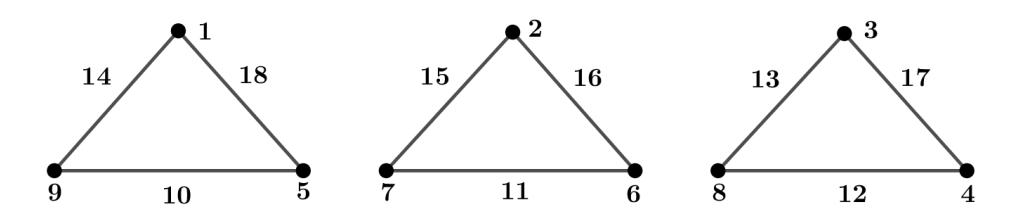
Figure 1. A (K2, C3)-sim-supermagic graph.
An interesting fact for (F, H)-sim-magic labeling is that although a graph is both F-magic and H-magic, such a graph does not need to be (F, H)-sim-magic. An example is the fan Fn with vertex-set V (Fn) = {vi |0 ≤ i ≤ n} and edge-set E(Fn) = {vivi+1|1 ≤ i ≤ n − 1} ∪ {v0vi |1 ≤ i ≤ n}. It is known that, for every n ≥ 3, Fn is EMT (see [28]) and C3-supermagic (see [21]). However, for every n ≥ 3, Fn is not (K2, C3)-sim-magic as stated in the following theorem.
Theorem 1.1. Let n ≥ 3 be a positive integer. A fan Fn is not (K2, C3)-sim-magic.
Proof. Suppose that Fn is a (K2, C3)-sim-magic graph and let f be a (K2, C3)-sim-magic labeling of Fn with a magic constant pair (k1, k2). Consider the weights of two C3 cycles v0v1, v1v2, v2v0 and v0v2, v2v3, v3v0. As these weights are equal, we have
\[\sum_{i=0}^{2} f(v_i) + f(v_0 v_1) + f(v_1 v_2) + f(v_2 v_0) = \sum_{i=1}^{3} f(v_i) + f(v_0 v_2) + f(v_2 v_3) + f(v_3 v_0),\]
and so
\[f(v_1) + f(v_1v_0) + f(v_1v_2) = f(v_3) + f(v_2v_3) + f(v_0v_3).\] (1)
Adding f(v0) to both sides of Equation (1) and using the fact that all edges have the same edge weight, we obtain f(v1v2) = f(v2v3), a contradiction.
In this paper, we study simultaneous labelings for two product graphs: the join product and Cartesian product graphs. In particular, we investigate a sufficient condition for the join product
graph G+H to be \((K_2+H,2K_2+H)\)-sim-supermagic (Section 3). We construct \((C_4,H)\)-sim-supermagic labelings for the Cartesian product \(G\times K_2\), where H is isomorphic to a ladder or an even cycle (Section 4). Finally, in the last section, we provide relationships between an \(\alpha\)-labeling of a tree T and a \((C_4,C_6)\)-sim-supermagic labeling of the Cartesian product \(T\times K_2\).
Throughout the paper, we shall use the following definitions and notations. The degree of a vertex v is denoted by \(\deg(v)\). For a connected graph H, a graph G is H-free if G does not contain H as a subgraph. Notations for some classes of graphs can be seen in Table 1.
| Notation | Notes | |||
|---|---|---|---|---|
| \(C_n\) | A cycle on \(n\) vertices, \(n \geq 3\). | |||
| \(K_n\) | A complete graph on \(n\) vertices, \(n \ge 1\). | |||
| \(K_{1,n}\) | A star with one internal vertex and \(n\) leaves, \(n \geq 2\). | |||
| \(P_n\) | A path on \(n\) vertices, \(n \geq 2\). | |||
| \(S_{n_1,n_2,\ldots,n_k}\) | A caterpillar is a graph derived from a path \(P_k\), \(k \ge 2\), where | |||
| for \(i \in \{1, 2,, k\}\), each \(v_i \in V(P_k)\) is adjacent to \(n_i \ge 0\) additional leaves. | ||||
Table 1. Classes of graphs
2. Balanced and Anti Balanced Multisets
A multiset is a generalization of a set where repetition of elements is allowed. Let a and b be two integers. We use the notation [a,b] to define the set of consecutive integers \(\{a,a+1,\ldots,b\}\). So \([a,b]=\emptyset\), if a>b. For an integer k, the addition k+[a,b] means [a+k,b+k] and for a multiset of integers Y, we denote \(\sum_{x\in Y} x\) by \(\sum Y\). Let x be an element of a multiset Y. Then, the multiplicity of x, denoted by \(m_Y(x)\), is the number of occurrences of x in Y. Let X and Y be two multisets. A multiset sum \(X\biguplus Y\) is a union of X and Y, where \(m_X\biguplus Y\) is \(m_X(x)+m_Y(x)\) for each \(x\in X\biguplus Y\). For example, if \(X=\{a\}\) and \(Y=\{a,a,b\}\), then, \(X\biguplus Y=\{a,a,a,b\}\).
We shall utilize the notions of a k-balanced partition of a multiset introduced by Maryati et al. [19] and a \((k, \delta)\)-anti balanced partition of a multiset introduced by Inayah et al. [13] to construct labelings in Sections 3 and 4. Let k and \(\delta\) be two positive integers, and X be a multiset containing positive integers. X is said to be \((k, \delta)\)-anti balanced if there exist k subsets of X, say \(X_1, X_2, \ldots, X_k\), such that for every \(i \in [1, k]\), \(|X_i| = \frac{|X|}{k}\), \(|Y_{i=1}| = X_i = X_i\), and for each \(i \in [1, k-1]\), \(\sum X_{i+1} - \sum X_i = \delta\). For every \(i \in [1, k]\), \(X_i\) is called a \((k, \delta)\)-anti balanced subset of X. In the case that there exists a positive integer \(\theta\) such that \(\sum X_i = \theta\) for every \(i \in [1, k]\), then X is called k-balanced with \(X_i\)s as k-balanced subsets of X.
Lemma 2.1. [18] Let x, y, and k be three integers, where \(1 \le x < y\) and k > 1. If X = [x, y] and |X| is a multiple of 2k, then X is k-balanced with \(\sum X_i = \frac{|X|}{2k}(x+y)\) for every \(i \in [1, k]\).
Lemma 2.2. Let x and k be positive integers, \(k \ge 2\). If
\[X = \begin{cases} [x, x + 2k - 1], & \text{for odd } k; \\ [x, x + 2k] \setminus \{x + \frac{k}{2}\}, & \text{for even } k, \end{cases}\]
then X is (k, 1)-anti balanced with \(\sum X_i = 2x + i + 3 \left\lfloor \frac{k}{2} \right\rfloor\) for every \(i \in [1, k]\).
Proof. For each \(i \in [1,k]\), define \(X_i = \{a^i,b^i\}\), where \(a^i = x - 1 + \left\lceil \frac{i+1}{2} \right\rceil + 2(1-(i \mod 2)) \left\lfloor \frac{k}{2} \right\rfloor\) and \(b^i = x + \left\lfloor \frac{k}{2} \right\rfloor + \left\lceil \frac{i}{2} \right\rceil + 2(i \mod 2) \left\lfloor \frac{k}{2} \right\rfloor\). Thus, \(\biguplus_{i=1}^k X_i = X\) and we have \(|X_i| = 2\) and \(\sum X_i = 2x + i + 3 \left\lfloor \frac{k}{2} \right\rfloor\) for each \(i \in [1,k]\). Since \(\sum X_{i+1} - \sum X_i = 1\) for every \(i \in [1,k-1]\), X is a (k,1)-anti balanced.
Lemma 2.3. Let x and k be positive integers, \(k \ge 2\). If X = [x, x + 2k - 1], then X is (k, 2)-anti balanced with \(\sum X_i = 2(x + i - 1) + k\) for every \(i \in [1, k]\).
Proof. Define \(X_i = \{x-1+i, x+i+k-1\}\) for each \(i \in [1, k]\). Hence, \(\biguplus_{i=1}^k X_i = X, |X_i| = 2,\) and \(\sum X_i = 2(x+i-1)+k\) for every \(i \in [1, k]\). We have that X is (k, 2)-anti balanced since \(\sum X_{i+1} - \sum X_i = 2\) for every \(i \in [1, k-1]\).
3. Labelings for Join Product Graphs
Let \(G \cup H\) denote the disjoint union of G and H. Then, the join product G + H of two disjoint graphs G and H is the graph \(G \cup H\) together with all the edges joining vertices of G and vertices of G. The study of G-magicness of join product graphs has been conducted for some particular families of graphs, as summarized in Table 2.
| Join product | H | Reference |
|---|---|---|
| \(P_n + K_1, n \ge 3\) | \(C_3\) | Ngurah et al. [21] and Ovais et al. [22] |
| _ | Ovais et al. [22] | |
| \(C_n + K_1\), \(n\) odd, \(n \ge 5\) | \(C_3\) | Lladó and Moragas [16] |
| \(n \text{ even, } n \geq 4\) | \(C_3\) | Roswitha et al. [25] |
| \(C_n + K_1, n \ge 3\) | \(C_4\) | Semaničová-Feňovčíková et al. [26] |
| \[K_{1,n} + K_1, n \ge 3\] | \(C_3\) | Ngurah et al. [21] |
| \[nK_2 + K_1, n \ge 2\] | \(C_3\) | Lladó and Moragas [16] |
Table 2. Known join product graphs which are H-magic
The following theorem provides a sufficient condition for the join product graph G+H to be \((K_2+H,2K_2+H)\)-sim-supermagic.
Theorem 3.1. Let G and H be two connected graphs such that G admits a \(2K_2\)-covering and G+H contains exactly |E(G)| subgraphs isomorphic to \(K_2+H\). If G is SEMT, then G+H is \((K_2+H,2K_2+H)\)-sim-supermagic.
Proof. Let g be a super edge-magic total (SEMT) labeling of G with the magic constant \(m_g\). Let \(V(G) = \{v_i | v_i = g^{-1}(i) \text{ and } i \in [1, p]\}, V(H) = \{u_i | i \in [1, r]\}, E(G) = \{e_i | i \in [1, q]\}, \text{ and } E(H) = \{k_i | i \in [1, s]\}.\) Hence, |V(G)| = p, |E(G)| = q, |V(H)| = r, |E(H)| = s. Thus, \(V(G + H) = V(G) \cup V(H)\) and \(E(G + H) = E(G) \cup E(H) \cup \{u_i v_i | i \in [1, r] \text{ and } j \in [1, p]\}.\)
Consider Y = [1, p + q + r + s + pr] as the set of all labels of vertices and edges in G + H. Then, we divide the proof into three cases.
Case 1. r is even.
Partition Y into five subsets, namely \(A=[1,r],\,B=r+[1,p],\,C=(r+p)+[1,p\,r],\,D=(r+p+1)\)
p(r)+[1,q] and \(E=(r+p+p\,r+q)+[1,s]\). Since r is even, |C| is a multiple of 2p. By Lemma 2.1, we have that C is p-balanced with \(\sum C_i=\frac{pr}{2p}(r+p+1+r+p+pr)=\frac{1}{2}r(p(r+2)+2r+1)\) for each \(i\in[1,p]\).
Next, label the vertices and edges in G+H by total labeling f as defined in the following steps.
- 1. For each \(i \in [1, r], f(u_i) = i\).
- 2. For each \(i \in [1, p]\), \(f(v_i) = i + r\).
- 3. For each \(j \in [1, p]\) and \(i \in [1, r]\), \(f(u_i v_j) = m_i\), where \(m_i \in C_j\).
- 4. For each \(e_i \in E(G)\) and \(i \in [1, q]\), \(f(e_i) = g(e_i) + r + pr\).
- 5. For each \(k_i \in E(H)\) and \(i \in [1, s]\), \(f(k_i) = m_i\), where \(m_i \in E\) and no two distinct edges in E(H) are assigned the same number.
Thus, we get \(\bigcup_{i=1}^r \{f(u_i)\} = A\), \(\bigcup_{i=1}^p \{f(v_i)\} = B\), \(\bigcup_{j=1}^p \{f(u_iv_j)|i \in [1,r]\} = C\), \(\{f(v_iv_j)|v_iv_j \in E(G)\} = D\), and \(\{f(u_iu_j)|u_iu_j \in E(H)\} = E\). Clearly, f is a bijective function from \(V(G + H) \cup E(G + H)\) to Y.
Let F be a subgraph of G+H isomorphic to \(K_2+H\). It is clear that F contains exactly one edge of E(G), say \(v_xv_y\) for some distinct \(x,y\in [1,p]\). Then, \(V(F)=V(H)\cup \{v_x,v_y\}\) and \(E(F)=E(H)\cup \{v_xv_y\}\cup \{u_iv_j|j\in \{x,y\},i\in [1,r]\}\). Thus,
\[wt_f(F) = \sum_{i=1}^r f(u_i) + f(v_x) + f(v_y) + \sum_{e \in E(H)} f(e) + f(v_x v_y) + \sum_{i=1}^r [f(u_i v_x) + f(u_i v_y)]\] \[= [g(v_x) + g(v_y) + g(v_x v_y)] + 3r + pr + \frac{1}{2}r(r+1) + s(r+p+pr+q) + \sum_{i=1}^s i + r(p(r+2) + 2r + 1).\]
Since \([g(v_x) + g(v_y) + g(v_xv_y)] = m_q\), we see that \(wt_f(F)\) is independent of F.
Now, let F' be a subgraph of G+H isomorphic to \(2K_2+H\). It is clear that F' contains two non-adjacent edges of E(G). Then, \(wt_f(F')=2wt_f(F)-\left(\sum_{u\in V(H)}f(u)+\sum_{e\in E(H)}f(e)\right)\). So, \(wt_f(F')\) is independent of F'.
Case 2. r is odd and p is odd.
Partition Y into five subsets, namely A=[1,r], B=r+[1,2p], C=(r+2p)+[1,p(r-1)], D=(r+p+pr)+[1,q], and E=(r+p+pr+q)+[1,s]. By Lemma 2.2, B is (p,1)-anti balanced with \(\sum B_i=2(r+1)+3\left\lfloor\frac{p}{2}\right\rfloor+i\) for every \(i\in[1,p].\) Since g is an injective function, \(g^{-1}(i)=v_i\) for every \(i\in[1,p].\) This gives \(\sum B_i=2(r+1)+3\left\lfloor\frac{p}{2}\right\rfloor+i=2(r+1)+3\left\lfloor\frac{p}{2}\right\rfloor+g(v_i)\) for every \(i\in[1,p].\) The cardinality of C is a multiple of 2p. By Lemma 2.1, C is p-balanced with \(\sum C_i=\frac{p(r-1)}{2p}(r+2p+1+r+2p+p(r-1))=\frac{1}{2}(r-1)(2r+3p+pr+1)\) for every \(i\in[1,p].\) Next, label the vertices and edges in G+H by total labeling f as defined in the following steps.
- 1. For each \(i \in [1, r], f(u_i) = i\).
- 2. For each \(i \in [1, p]\), \(f(v_i) = \min\{x | x \in B_i\}\).
- 3. For each \(i \in [1, p]\), \(f(u_1v_i) = b_i\), where \(b_i \in B_i \setminus \{f(v_i)\}\).
- 4. For each \(j \in [1, p]\) and \(i \in [2, r]\), \(f(u_i v_j) = m_i\), where \(m_i \in C_j\).
- 5. For each \(e_i \in E(G)\) and \(i \in [1, q]\), \(f(e_i) = g(e_i) + r + pr\).
- 6. For each \(k_i \in E(H)\) and \(i \in [1, s]\), \(k_i = m_i\), where \(m_i \in E\) and no two distinct edges are assigned the same number.
Thus, we get \(\bigcup_{i=1}^r \{f(u_i)\} = A\), \(\bigcup_{i=1}^p \{f(v_i), f(u_1v_i)\} = B\), \(\bigcup_{j=1}^p \{f(u_iv_j)|\ i \in [2, r]\} = C\), \(\{f(v_iv_j)|v_iv_j \in E(G)\} = D\), and \(\{f(u_iu_j)|u_iu_j \in E(H)\} = E\). Clearly, f is a bijective function from \(V(G+H) \cup E(G+H)\) to Y.
Let F be a subgraph of G+H isomorphic to \(K_2+H\). It is clear that F contains exactly one edge of E(G), say \(v_xv_y\) for some distinct \(x,y\in [1,p]\). Then, \(V(F)=V(H)\cup \{v_x,v_y\}\) and \(E(F)=E(H)\cup \{v_xv_y\}\cup \{u_iv_j|j\in \{x,y\},i\in [1,r]\}\). Thus,
\[wt_f(F) = \sum_{i=1}^r f(u_i) + f(v_x) + f(v_y) + \sum_{e \in E(H)} f(e) + f(v_x v_y) + \sum_{i=1}^r \left[ f(u_i v_x) + f(u_i v_y) \right]\] \[= \left[ g(v_x) + g(v_y) + g(v_x v_y) \right] + 4(r+1) + 6 \left\lfloor \frac{p}{2} \right\rfloor + r + pr + \frac{1}{2}r(r+1)\] \[+ s(r+p+pr+q) + \frac{1}{2}s(s+1) + (r-1)(2r+3p+pr+1).\]
Since \([g(v_x) + g(v_y) + g(v_xv_y)] = m_g\), we see that \(wt_f(F)\) is independent on the choosing of F. Now, let F' be a subgraph of G+H isomorphic to \(2K_2+H\). It is clear that F' contains two non-adjacent edges of E(G). Thus, \(wt_f(F') = 2wt_f(F) - \left(\sum_{v \in V(H)} f(v) + \sum_{e \in E(H)} f(e)\right)\). So, \(wt_f(F')\) is independent of F'.
Case 3. r is odd and p is even.
Partition Y into five subsets, \(A = [1, r-1] \cup \{r + \frac{p}{2}\}\), \(B = [r, r+2p] \setminus \{r + \frac{p}{2}\}\), C = (r+2p) + [1, p(r-1)], D = (r+p+pr) + [1, q], and E = (r+p+pr+q) + [1, s]. By Lemma 2.2, B is (p, 1)-anti balanced with \(\sum B_i = 2r + i + 3\lfloor \frac{p}{2} \rfloor\) for each \(i \in [1, p]\). Since g is an injective function, \(g^{-1}(i) = v_i\) for every \(i \in [1, p]\). Therefore, \(\sum B_i = 2r + 3\lfloor \frac{p}{2} \rfloor + i = 2r + 3\lfloor \frac{p}{2} \rfloor + g(v_i)\) for every \(i \in [1, p]\).
Now, the cardinality of C is a multiple of 2p. By Lemma 2.1, we have that C is p-balanced with \(\sum C_i = \frac{p(r-1)}{2p}(r+2p+1+r+2p+pr) = \frac{1}{2}(r-1)(2r+3p+pr+1)\) for every \(i \in [1,p]\).
Next, label the vertices and edges in G+H by the total labeling f defined in the following steps.
- 1. For each \(i \in [2, r]\), \(f(u_i) = i 1\), and \(f(u_1) = r + \frac{p}{2}\).
- 2. For each \(i \in [1, p]\), \(f(v_i) = \min\{x | x \in B_i\}\).
- 3. For each \(i \in [1, p]\), \(f(u_1v_i) = b_i\), where \(b_i \in B_i \setminus \{f(v_i)\}\).
- 4. For each \(j \in [1, p]\) and \(i \in [2, r]\), \(f(u_i v_j) = m_i\), where \(m_i \in C_j\).
- 5. For each \(e_i \in E(G)\) and \(i \in [1, q]\), \(f(e_i) = g(e_i) + r + pr\).
- 6. For each \(k_i \in E(H)\) and \(i \in [1, s]\), \(f(k_i) = m_i\), where \(m_i \in E\) and no two distinct edges are assigned the same number.
Then, \(\bigcup_{i=1}^r \{f(u_i)\} = A\), \(\bigcup_{i=1}^p \{f(v_i), f(u_1v_i)\} = B\), \(\bigcup_{j=1}^p \{f(u_iv_j)|i \in [2,r]\} = C\), \(\{f(v_iv_j)|v_iv_j \in E(G+H)\} = D\) and \(\{f(u_iu_j)|u_iu_j \in E(G+H)\} = E\). Clearly, f is a bijective function from \(V(G+H) \cup E(G+H)\) to Y.
Let F be a subgraph of G + H isomorphic to K2 + H. Then F contains exactly one edge of E(G), say vxvy for some distinct x, y ∈ [1, p]. Then, F has the form V (F) = V (H) ∪ {vx, vy} and E(F) = E(H) ∪ {vxvy} ∪ {uivj |j ∈ {x, y}, i ∈ [1, r]}. Thus,
\[wt_{f}(F) = \sum_{i=1}^{r} f(u_{i}) + f(v_{x}) + f(v_{y}) + \sum_{e \in E(H)} f(e) + f(v_{x}v_{y}) + \sum_{i=1}^{r} f(u_{i}v_{x}) + \sum_{i=1}^{r} f(u_{i}v_{y})\] \[= [g(v_{x}) + g(v_{y}) + g(v_{x}v_{y})] + \sum_{i=2}^{r} i + \sum_{i=1}^{s} i + p(r^{2} + r(s+3) + s - \frac{5}{2}) + 6\lfloor \frac{p}{2} \rfloor\] \[+2r^{2} + rs + qs + 4r.\]
Since [g(vx) + g(vy) + g(vxvy)] = mg, we see that wtf (F) is independent on the choosing of F. Now, let F ′ be a subgraph of G + H isomorphic to 2K2 + H. F ′ contains two non-adjacent edges of E(G). Thus, wtf (F ′ ) = 2wtf (F) − P v∈V (H) f(v) + P e∈E(H) f(e) . So, wtf (F ′ ) is independent of F ′ .
An example of the labeling depicted in the proof of Theorem 3.1 can be seen in Figure 2 where a (K5, 2K2 + C3)-sim-supermagic labeling of S2,0,0,2 + C3 is presented.
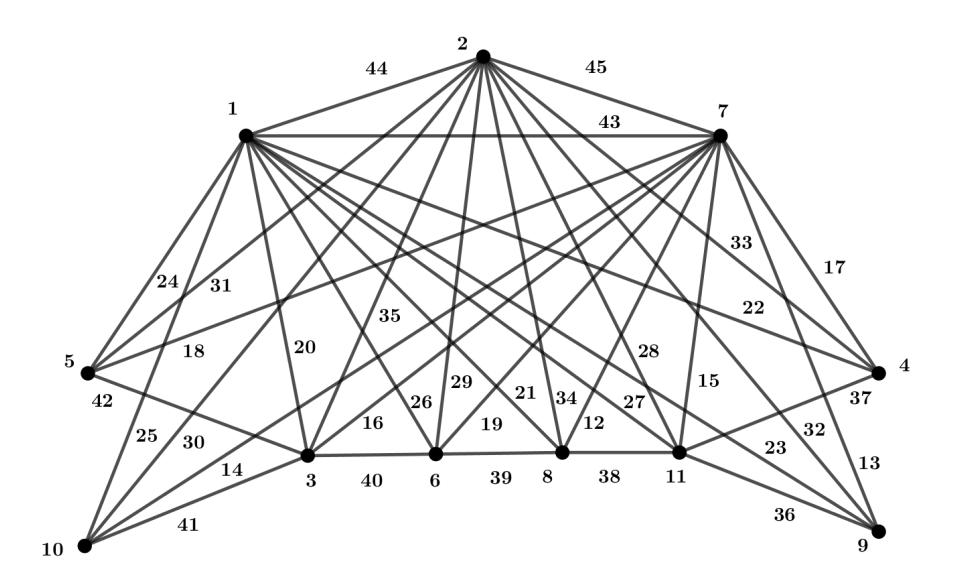
Figure 2. A (K5, 2K2 + C3)-sim-supermagic labeling of S2,0,0,2 + C3
The following corollary is a consequence of Theorem 3.1 with H = K1.
Corollary 3.1. Let G be a C3-free connected graph containing a P5. If G is SEMT graph, then G + K1 is (C3, 2K2 + K1)-sim-supermagic.
This corollary enlarges the classes of graphs known to be C3-supermagic; since up to date, only the following join product graphs were known to be C3-supermagic: Pn+K1, Cn+K1, K1,n+K1, and nK2 + K1, where n ≥ 3 [16, 21, 22, 25].
4. Labelings for Cartesian Product Graphs
The Cartesian product of two graphs G and H, denoted by G × H, is a graph whose vertex set is V (G) × V (H) = {(u, v)|u ∈ V (G), u ∈ V (H)} and for which two vertices (u1, v1) and (u2, v2) are adjacent if and only if either u1u2 ∈ E(G) and v1 = v2 or v1v2 ∈ E(H) and u1 = u2.
In this section, we shall study (F, H)-sim-supermagic labeling for the Cartesian product of an arbitrary graph G with K2. The following notations are used or vertices and edges in G × K2 For each x ∈ V (G), let x and x ′ be the corresponding vertices in the two copies of G in G × K2, and so xx′ ∈ E(G × K2). For each xy ∈ E(G), denote by xy and x ′ y ′ the corresponding edges in the two copies of G in G × K2.
We summarize the Cartesian product graphs G × K2 known to be H-magic in Table 3.
| Cartesian product | H | Conditions and Reference |
|---|---|---|
| G × K2 | C4 | G C4-free and SEMT of odd size [16] is |
| Pm × K2 | C4 | m ≥ 3 [21] |
| × mK1,n K2 | C4 | ≥ ≥ m 2 and n 1 [1] |
| s(Pn+1 × K2) ∪ k(Pn × K2) | C4 | s ≥ 1, k ≥ 1 n ≥ 2 and [1] |
| m(Pn × K2) | C4 | m ≥ 2 and n ≥ 2 [23] |
| × Pn K2 | C2m | n ≥ ∈ ⌊ ⌋ n 4 and m [3, + 1] [20] 2 |
| Pn × K2 | Pm × K2 | n ≥ 4 m ∈ [3, n − 1] and [20] |
| G × K2 | C4 | G is C4-free, SEMT and a connected (p, q)-graph |
| where p or q is odd [14] | ||
| (2G) × K2 | C4 | G C4-free, connected, bipartite (with is |
| U V G partite sets and ) and has a SEMT labeling | ||
| f f(U) = [1, |U|] such that [14] |
Table 3. G × K2 that are H-magic
In [20], Ngurah et al. constructed (Pm × K2)-supermagic labelings of the ladder Pn × K2 for every m ∈ [3, n − 1]. A more general result by Baca et al. [7] established the following sufficient conditions for the Cartesian product G1 ×G2 to be (H ×G2)-supermagic as stated in the following theorem. On the other hand, in [14] and [16] it was proved that if G is connected of odd order or size, C4-free, and SEMT, then G × K2 admits a C4-supermagic labeling.
Theorem 4.1. [7] Let G1 be a graph of odd order p1 ≥ 3 admitting an H-covering given by t subgraphs isomorphic to H. If G2 is a graph of even order q2 ≥ 2 and odd size p2 ≥ 3 and the graph G1 × G2 contains exactly t subgraphs isomorphic to H × G2, then G1 × G2 is (H × G2) supermagic.
In the next theorem, we enlarge the classes of graphs known to be (Pm × K2)-supermagic [20] and extend sufficient conditions for the existence of a C4-supermagic labeling of G × K2 [14, 16] without considering a SEMT labeling of G. Furthermore, our result settles the remaining cases of Theorem 4.1 for p2 = 1 and q2 = 2.
Theorem 4.2. Let G be a C4-free connected graph of odd order p ≥ 5. If G admits a Pm-covering for some m ∈ [3, p − 1], then G × K2 is (C4, Pm × K2)-sim-supermagic.
Proof. Let p and q be the order and the size of G, respectively. Consider A=[1,3p+2q] as the set of integers used to label vertices and edges in \(G\times P_2\). Now, partition A into three sets W=[1,2p], X=[2p+1,3p], and Y=[3p+1,3p+2q]. Since p is odd, by Lemma 2.2, W is (p,1)-anti balanced with \(\sum W_i=2+i+3\left\lfloor\frac{p}{2}\right\rfloor\) for every \(i\in[1,p].\) Now, since |Y|=2q, Lemma 2.1 ensures that Y is q-balanced with \(\sum Y_j=\frac{2q}{2q}(3p+1+3p+2q)=6p+2q+1\) for each \(j\in[1,q].\)
Let g and h be bijections from V(G) to [1,p] and from E(G) to [1,q], respectively. Next, define a total labeling f of \(G \times K_2\). For each \(x \in V(G)\), label x and x' in \(G \times K_2\) by the elements of \(W_{g(x)}\) chosen so that f(x) < f(x') and define f(xx') = 3p - g(x) + 1. For each \(xy \in E(G)\), define f as a bijection from \(\{xy, x'y'\}\) to \(Y_{h(xy)}\) with f(xy) < f(x'y'). Hence, \(\bigcup_{v \in V(G \times K_2)} \{f(v)\} = W\) and \(\bigcup_{e \in E(G \times K_2)} \{f(e)\} = X \cup Y\). Consequently, f is a bijective function from \(V(G \times K_2) \cup E(G \times K_2)\) to A.
Since G is \(C_4\)-free, there are q subgraphs of \(G \times K_2\) isomorphic to \(C_4\). Let F be a subgraph of \(G \times K_2\) isomorphic to \(C_4\). Then, \(V(F) = \{x, x', y, y'\}\) and \(E(F) = \{xx', yy', xy, x'y'\}\), where \(x, y \in V(G)\) and \(xy \in E(G)\). Therefore,
\[wt_f(F) = f(x) + f(x') + f(y) + f(y') + f(xx') + f(yy') + f(xy) + f(x'y')\] \[= \sum_{g(x)} W_{g(x)} + \sum_{g(y)} W_{g(y)} + 3p - g(x) + 1 + 3p - g(y) + 1 + \sum_{g(x)} Y_{h(xy)}\] \[= 12p + 6 \left\lfloor \frac{p}{2} \right\rfloor + 2q + 7,\]
which is independent of F.
Moreover, as G admits a \(P_m\)-covering for some \(m \in [3, p-1]\), we have that \(G \times K_2\) admits a \((P_m \times K_2)\)-covering. Let \(H = x_1 x_2 \dots x_m\) be a subgraph of G isomorphic to \(P_m\). For each H, denote by \(H' = x_1' x_2' \dots x_m'\) the corresponding subgraph in G'. Thus, for each H, we obtain H'' with \(V(H'') = \{x_1, x_2, \dots, x_m, x_1', x_2', \dots, x_m'\}\) and \(E(H'') = E(H) \cup E(H') \cup \{xx' | x \in V(H)\}\) as the corresponding subgraph in \(G \times K_2\) isomorphic to \(P_m \times K_2\). We can verify that there are exactly t subgraphs of \(G \times K_2\) isomorphic to \(P_m \times K_2\), where t is the number of subgraphs isomorphic to \(P_m\) in G. Thus,
\[wt_{f}(H'') = \sum_{v \in V(H)} f(v) + \sum_{v \in V(H')} f(v) + \sum_{e \in E(H)} f(e) + \sum_{e \in E(H')} f(e) + \sum_{v \in V(H)} f(vv')\] \[= \sum_{v \in V(H)} [f(v) + f(v')] + \sum_{e \in E(H)} [f(e) + f(e')] + \sum_{v \in V(H)} [3p - g(v) + 1]\] \[= \sum_{v \in V(H)} \left[ \sum_{e \in E(H)} W_{g(v)} \right] + \sum_{e \in E(H)} \left[ \sum_{e \in E(H)} Y_{h(e)} \right] + \sum_{v \in V(H)} [3p - g(v) + 1]\] \[= 3m \left| \frac{p}{2} \right| + 4m + 9mp + 2mq - 6p - 2q - 1,\]
which is independent of H''. Hence, \(G \times K_2\) is \((C_4, P_m \times K_2)\)-sim-supermagic.
An example of the labeling in the proof of Theorem 4.2 is depicted in Figure 3.
In [20], Ngurah et al. showed that the ladder \(P_n \times K_2\) is \(C_{2m}\)-supermagic for every \(m \in [3, \lfloor \frac{n}{2} \rfloor + 1]\). Then it is natural to ask for which graphs G, the Cartesian product \(G \times K_2\) is
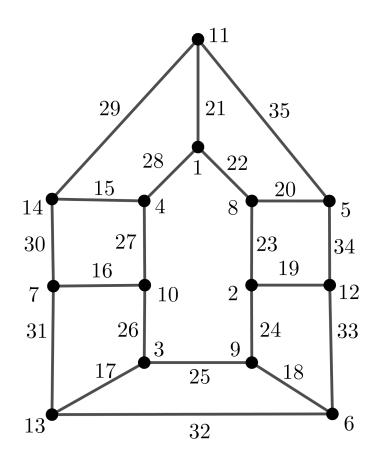
Figure 3. A (C4, Pm × K2)-sim-supermagic labeling of C7 × K2 for every m ∈ [3, 6].
(C2x, C2y)-sim-supermagic for some x, y ∈ -3, n 2 + 1 . We will answer this question in Theorem 4.3, but to do so, we need to recall the following notion that was first introduced by Simanjuntak et al. [27]. An injective function f from V (G) onto the set {1, 2, . . . , |V (G)|} is called (a, d)-edgeantimagic vertex labeling ((a, d)-EAV) if the set of edge-weights {w(xy) = f(x) + f(y)|xy ∈ E(G)} = {a, a + d, . . . , a + (|E(G)| − 1)d}, where a > 0 and d ≥ 0 are two integers. A graph G is said to be an (a, d)-edge-antimagic vertex ((a, d)-EAV) graph if G has an (a, d)-EAV labeling. In [4], it was shown that a connected graph G that is not a tree has no (a, d)-EAV labeling for d ̸= 1.
Lemma 4.1. [4] Let G be a connected graph that is not a tree. If G has an (a, d)-EAV labeling, then d = 1.
The next theorem describes a construction of a (C2x, C2y)-sim-supermagic labeling of G × K2 from an (a, 2)-EAV labeling for some x, y ∈ -3, n 2 + 1 . Due to Lemma 4.1, we restrict our consideration to trees.
Theorem 4.3. Let m, n and p be positive integers where 3 ≤ m < p. Let G be a tree on p vertices where p ≥ 5, such that G admits a Pm-covering for some m ∈ -3, n 2 + 1 . If G is an (a, 2)-EAV graph, then G × K2 is (C2x, C2y)-sim-supermagic for all x, y ∈ [2, m].
Proof. Let p and q be the order and the size of G, respectively. Let g : V (G) → {1, 2, . . . , p} be an (a, 2)-EAV labeling of G.
Since |V (G× K2)| = 2p and |E(G× K2)| = p+ 2q, the set of labels used to label vertices and edges of G×K2 is A = [1, 3p+2q]. Now, partition A into three sets W = [1, 2p], X = [2p+1, 3p] and Y = [3p + 1, 3p + 2q]. By Lemma 2.3, W is (p, 2)-anti balanced with PWi = 2i + p for every i ∈ [1, p]. According to Lemma 2.3, Y is (q, 2)-anti balanced with PYj = 6p + q + 2j for each j ∈ [1, q].
Next, define a total labeling f of G× K2. For each x ∈ V (G), label the corresponding vertices x and x ′ in G × K2 by the elements of Wg(x) chosen so that f(x) < f(x ′ ). For each x ∈ V (G), define f(xx′ ) = 3p + 1 − g(x). Now, for each xy ∈ E(G), label the corresponding edges xy and
x'y' in \(G \times K_2\) by the elements of \(Y_r\) where \(r = \frac{1}{2}(2q + a - g(x) - g(y))\) such that f(xy) < f(x'y'). It follows easily that f depends on g. Then, f is a bijective function from \(V(G \times K_2) \cup E(G \times K_2)\) to A.
Since G admits a \(P_m\)-covering for some \(m \in \left[3, \left\lfloor \frac{n}{2} \right\rfloor + 1\right]\), \(G \times K_2\) admits \(C_{2z}\)-covering for every \(z \in [2,m]\). Let \(H = x_1x_2\dots x_z\) be a subgraph of G isomorphic to \(P_z\) for an arbitrary \(z \in [2,m]\). For each H, denote by \(H' = x_1'x_2'\dots x_z'\) the corresponding subgraph in G'. Thus, for each H, we obtain H'' as the corresponding subgraph in \(G \times K_2\) isomorphic to \(C_{2z}\) where \(V(H'') = V(H) \cup V(H')\) and \(E(H'') = E(H) \cup E(H') \cup \{x_1x_1', x_2x_2'\}\). We can verify that there are exactly t subgraphs of \(G \times K_2\) isomorphic to \(C_{2z}\), where t is the number of subgraphs in G isomorphic to \(P_z\). Thus,
\[wt_{f}(H'') = \sum_{v \in V(H)} f(v) + \sum_{v \in V(H')} f(v) + \sum_{uv \in E(H)} f(uv) + \sum_{uv \in E(H')} f(uv) + f(x_{1}x'_{1}) + f(x_{2}x'_{2})\] \[= \sum_{v \in V(H)} [f(v) + f(v')] + \sum_{uv \in E(H)} [f(uv) + f(u'v')] + 3p + 1 - g(x_{1}) + 3p + 1 - g(x_{2})\] \[= \sum_{v \in V(H)} \left[ \sum_{v \in V(H)} W_{g(v)} \right] + \sum_{uv \in E(H)} \left[ \sum_{v \in E(H)} Y_{\frac{1}{2}(2q+a-g(u)-g(v))} \right] + 6p + 2 - g(x_{1}) - g(x_{2})\] \[= 7zp + 3zq - 3q + az - a + 2,\]
which is independent of H''.
Therefore, \[G \times K_2\] is \((C_{2x}, C_{2y})\)-sim-supermagic for all \(x, y \in [2, m]\).
An example of the labeling in Theorem 4.3 can be seen in Figure 4.
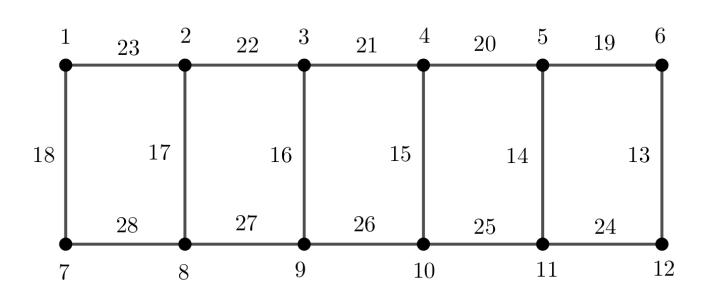
Figure 4. A \((C_4, C_{2m})\)-sim-supermagic labeling of \(P_6 \times K_2\) for m=3 and 4
Note that the preceding theorem enlarges the classes of graphs known to be \(C_{2m}\)-supermagic, as stated in Table 3. For instance, since every path \(P_n\) was shown to be (3,2)-EAV [27], an immediate consequence of Theorem 4.3 is that the ladder \(P_n \times K_2\) is \((C_4, C_{2m})\)-sim-supermagic for every \(m \in [3, \lfloor \frac{n}{2} \rfloor + 1]\).
In [2], Bača and Barrientos described a connection between an \(\alpha\)-labeling and an (a,2)-EAV labeling of graphs. An injective mapping \(f:V(G)\to [0,|E(G)|]\) is said to be graceful labeling if |f(x)-f(y)| are distinct for each \(xy\in E(G)\). A graceful labeling f is called an \(\alpha\)-labeling if there exists an integer \(\lambda\) such that for each edge xy either \(f(x)\leq \lambda < f(y)\) or \(f(y)\leq \lambda < f(x)\) [24].
A graph G that admits an α-labeling is said to be an α-graph. From the definition of α-labeling, it follows that an α-graph is necessarily bipartite.
Let {A, B} be the natural bipartition of the vertex set of an α-graph. Baca and Barrientos [2] ˇ presented the following theorem.
Theorem 4.4. [2] A tree T is a (3, 2)-EAV graph if and only if T is an α-graph and ||A|−|B|| ≤ 1, where {A, B} is the natural bipartition of the vertex set of T.
Theorem 4.3 together with Theorem 4.4 implies the relationship between an α-labeling of a tree T and a (C4, C6)-sim-supermagic labeling of the Cartesian product T × K2. Let n ≥ 2 be a positive integer and let T be an α-tree and ||A| − |B|| ≤ 1, where {A, B} is the natural bipartition of the vertex set of T. It is clear that T × K2 admits a C4-covering and a C6-covering only if T is not isomorphic to a star.
Corollary 4.1. Let T be an α-tree not isomorphic to a star on at least five vertices and let ||A| − |B|| ≤ 1, where {A, B} is the natural bipartition of the vertex set of T. Then T × K2 is (C4, C6) sim-supermagic.
Figure 5 illustrates a (C4, C6)-sim-supermagic labeling of product graph S2,1,0,1 × K2.
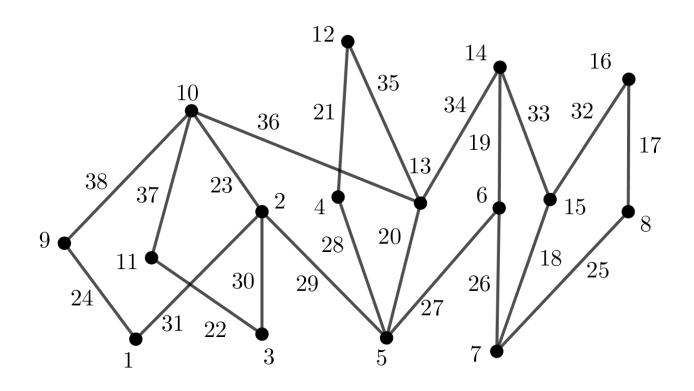
Figure 5. A (C4, C6)-sim-supermagic labeling of S2,1,0,1 × K2.
A perfect matching of a graph is a matching (i.e., an independent edge set) in which every vertex of the graph is incident to exactly one edge of the matching. Brankovic et al. [8] posed the following conjecture for α-trees.
Conjecture 1. [8] All trees with maximum degree three and a perfect matching have an α-labeling.
Consider a tree T with a perfect matching. Since T is bipartite, by a perfect matching in T, we have a natural bipartition of the vertex-set of T, namely A and B, such that ||A| − |B|| ≤ 1. As a direct consequence of Corollary 4.1 and Conjecture 1, the following holds.
Theorem 4.5. Let T be a tree on at least five vertices that are not isomorphic to a star, with a maximum degree three and containing a perfect matching. If Conjecture 1 is true, then T × K2 is (C4, C6)-sim-supermagic.
Although all our results in this section are restricted to trees, the proof of Theorem 7 in [16] implied that Cn × K2 is (C4, C2m)-sim-supermagic for each odd n ≥ 5 and m = 2. Thus, it is interesting to seek conditions such that a Cartesian product of a non-tree graph G with K2 admits a (C4, C2m)-sim-supermagic labeling.
Acknowledgement
Y.F. Ashari is supported by the PKPI/Sandwich-like-PMDSU Scholarship funded by the Indonesian Ministry of Research and Technology. Salman is supported by "Program Penelitian dan Pengabdian kepada Masyarakat-Institut Teknologi Bandung" (P3MI-ITB). R. Simanjuntak is supported by Penelitian Dasar Unggulan Perguruan Tinggi 2021-2023 No. 2/E1/KP.PTNBH/2021 funded by Indonesian Ministry of Education, Culture, Research and Technology. A. Semanicov ˇ a-´ Fenov ˇ cˇ´ıkova and M. Ba ´ ca are supported by the Slovak Research and Development Agency under ˇ contract No. APVV-19-0153.
References
- [1] M. Asif, G. Ali, M. Numan, and A. Semanicov ˇ a-Fe ´ nov ˇ cˇ´ıkova, Cycle-supermagic labeling for ´ some families of graphs, Util. Math. 103 (2017), 51–59.
- [2] M. Baca and C. Barrientos, Graceful and edge-antimagic labelings, ˇ Ars Combin. 96 (2010) 505–513.
- [3] M. Baca, F. Bertault, J.A. MacDougall, M. Miller, R. Simanjuntak, and Slamin, Vertex- ˇ antimagic total labelings of graphs, Discuss. Math. Graph Theory 23 (2003), 67–83.
- [4] M. Baca and M. Miller, Super Edge-Antimagic Graphs: A Wealth of Problems and Some ˇ Solutions, Brown Walker Press, Boca Raton (2008).
- [5] M. Baca, M. Miller, J. Ryan, and A. Semani ˇ cov ˇ a-Fe ´ nov ˇ cˇ´ıkova, Magic and Antimagic Graphs: ´ Attributes, Observations and Challenges in Graph Labelings, Springer International Publushing, Switzerland AG (2019).
- [6] M. Baca, M. Miller, O. Phanalasy, J. Ryan, and A. Semani ˇ cov ˇ a-Fe ´ nov ˇ cˇ´ıkova, A.A. Sillasen, ´ Totally antimagic total graphs, Australas. J. Combin. 61 (2015), 42–56.
- [7] M. Baca, A. Semani ˇ cov ˇ a-Fe ´ nov ˇ cˇ´ıkova, M.A. Umar, and D. Welyyanti, On ´ H-antimagicness of Cartesian product of graphs, Turkish J. Math. 42 (2018), 339–348.
- [8] L. Brankovic, C. Murch, J. Pond, and A. Rosa, Alpha-size of trees with maximum degree three and perfect matching, In Proceedings of the 16th Australasian Workshop on Combinatorial Algorithms, Ballarat, Australia (2005), pp. 47–56.
- [9] G. Exoo, A.C.H. Ling, and J.P. McSorley, N.C.K. Philips, W.D. Wallis, Totally magic graphs, Discrete Math. 254 (2002), 103–113.
- [10] R.M. Figueroa-Centeno, R. Ichishima, and F.A. Muntaner-Batle, On super edge-magic graphs, Ars Combin. 64 (2002), 81–95.
- [11] J.A. Gallian, A dynamic survey of graph labeling, Electron. J. Combin., 23 (2020), #DS6.
- [12] A. Gutierrez and A. Llad ´ o, Magic coverings, ´ J. Combin. Math. Combin. Comput. 55 (2005), 43–56.
- [13] N. Inayah, R. Simanjuntak, A.N.M. Salman, and K.I.A. Syuhada, Super (a, d)-H-antimagic total labelings for shackles of a connected graph H, Australas. J. Combin. 57 (2013), 127– 138.
- [14] T. Kojima, On C4-supermagic labelings of the Cartesian product of paths and graphs, Discrete Math. 313 (2013), 164–173.
- [15] A. Kotzig and A. Rosa, Magic valuations of finite graphs, Canad. Math. Bull. 13 (1970), 451–461.
- [16] A. Llado and J. Moragas, Cycle-magic graphs, ´ Discrete Math. 307 (2007), 2925–2933.
- [17] J.A. MacDougall, M. Miller, Slamin, and W.D. Wallis, Vertex-magic total labelings of graphs, Util. Math. 61 (2002), 3–21.
- [18] T.K. Maryati, A.N.M. Salman, and E.T. Baskoro, Supermagic coverings of the disjoint union of graphs and amalgamations, Discrete Math. 313(4) (2013), 397–405.
- [19] T.K. Maryati, A.N.M. Salman, E.T. Baskoro, J. Ryan, and M. Miller, On H-supermagic labelings for certain shackles and amalgamations of a connected graph, Util. Math. 83 (2010), 333–342.
- [20] A.A.G. Ngurah, A.N.M. Salman, and I.W. Sudarsana, On supermagic coverings of fans and ladders, SUT J. Math. 46 (2010), 67–78.
- [21] A.A.G. Ngurah, A.N.M. Salman, and L.Susilowati, H-supermagic labelings of graphs, Discrete Math. 310 (2010), 1293–1300.
- [22] A. Ovais, M.A. Umar, M. Baca, and A. Semani ˇ cov ˇ a-Fe ´ nov ˇ cˇ´ıkova, Fans are cycle-antimagic, ´ Australas. J. Combin. 68 (2017), 94-105.
- [23] S.T.R. Rizvi, K. Ali, and M. Hussain, Cycle-supermagic labelings of the disjoint union of graphs, Util. Math. 104 (2017), 215–226.
- [24] A. Rosa, On certain valuations of the vertices of a graph, Theory of Graphs, Internat. Symposium, Rome, July 1996, Gordon and Breach, N. Y. and Dunod Paris (1967), 349–355.
- [25] M. Roswitha, E.T. Baskoro, T.K. Maryati, N.A. Kurdhi, and I. Susanti, Further results on cycle-supermagic labeling, AKCE Int. J. Graphs Comb. 10(2) (2013), 211–220.
- [26] A. Semanicov ˇ a-Fe ´ nov ˇ cˇ´ıkova, M. Ba ´ ca, M. Lascs ˇ akov ´ a, M. Miller, and J. Ryan, Wheels are ´ cycle-antimagic, Electron. Notes Discrete Math. 48 (2015), 11–18.
- [27] R. Simanjuntak, M. Miller, and F. Bertault, Two new (a, d)-antimagic graph labelings, In Proceedings of the 11th Australasian Workshop on Combinatorial Algorithms, Hunter Valley, Australia (2000), pp. 179–189.
- [28] Slamin, M. Baca, Y. Lin, M. Miller, and R. Simanjuntak, Edge-magic total labelings of ˇ wheels, fans and friendship graphs, Bull. Inst. Combin. Appl. 35 (2002), 89–98.
- [29] W.D. Wallis, Magic Graphs, Birkausher Basel, Boston ¨ (2001).