Tetravalent non-normal Cayley graphs of order 5p 2
Soghra Khazaei, Hesam Sharifi
Department of Mathematics, Faculty of Science, Shahed University, Tehran, Iran
Correspondence: hsharifi@shahed.ac.ir
In this paper, we explore connected Cayley graphs on non-abelian groups of order 5p 2 , where p is a prime greater than 5, and Sylow p-subgroup is cyclic with respect to tetravalent sets that encompass elements with different orders. We prove that these graphs are normal; however, they are not normal edge-transitive, arc-transitive, nor half-transitive. Additionally, we establish that the group is a 5-CI-group.
Keywords: Cayley graph, normal edge-transitive, arc-transitive, graph automorphism, group automorphism.
Mathematics Subject Classification : 20D60, 05B25
DOI: 10.5614/ejgta.2024.12.1.8
1. Introduction and Preliminary
Suppose G is a group and S is a subset of G that does not include 1. The Cayley graph associated with (G, S), denoted by Cay(G, S), is a directed graph with the vertex set G and the edge set consisting of (u, v) ∈ G×G when uv−1 ∈ S. We notice that the Cayley graph Cay(G, S), may depend on the choice of S, and is connected if and only if S generates G. Also, we care that the edge set can be identified with set of ordered pairs {(g, sg)|g ∈ G, s ∈ S}. The Cay(G, S) can be considered as an undirected graph when S is closed under taking inverse i.e., S = S −1 . The degree of each vertex is easily seen to be S. Following the definitions in [7], the graph Γ is called vertex-transitive, edge-transitive or arc-transitive if the automorphism group Aut(Γ), acts
Received: 10 December 2022, Revised: 20 December 2023, Accepted: 25 February 2024.
transitively on vertex-set, edge-set or arc-set of \(\Gamma\), respectively. A half-transitive graph is one that is vertex-set and edge-set transitive, but not arc-transitive.
Assume that \(\Gamma = Cay(G,S)\). Let \(\rho(G) = \{\rho_g \mid g \in G\}\), where for \(g \in G\), the map \(\rho_g : G \to G\) is given by \(\rho_g(x) = xg\). It is evident that, \(\rho_g \in \mathbb{A}ut(\Gamma)\). The set \(\rho(G)\) forms a subgroup isomorphic to G) in \(\mathbb{A}ut(\Gamma)\). Therefore, since \(\rho(G) \leqslant \mathbb{A}ut(\Gamma)\), acting right regularly on the vertices of \(\Gamma\), \(\Gamma\) is vertex-transitive. However \(\Gamma\) is not edge-transitive in general.
Some notations used here are as follows. In a graph \(\Gamma\), the distance between two vertices u and v, denoted by d(u,v), is the number of edge in a shortest path connecting them. Let us introduce the \(D_i(u) = \{v \in V(\Gamma) \mid d(u,v) = i\}\). For Semi-direct product of K by H in which H act on K, we write \(K \rtimes H\). \(\mathbb{Z}_n\) denotes a cyclic group of order n as well as the ring of integers modulo n, by \(\mathbb{Z}_n^{\times}\) we mean the multiplicative group consisting of the elements in \(\mathbb{Z}_n\), which are coprime to n. By \(\mathbb{A}ut(G,S) = \{\sigma \in \mathbb{A}ut(G) | \sigma(S) = S\}\). It is easy to see that \(\mathbb{A}ut(G,S)\) is a subgroup of the automorphisms group of Cay(G,S). For two subsets S and T of G such that \(1 \notin S\), \(1 \notin T\), \(S = S^{-1}\) and \(T = T^{-1}\), if there is a \(f \in Aut(G)\) such that f(S) = T, then S and T said to be equivalent and it can verified that in this case we have \(Cay(G,S) \cong Cay(G,T)\) and Cay(G,S) is normal if and only if Cay(G,T) is normal.
Let's review some fundamental facts about normal edge-transitive Cayley graphs.
A Cayley graph \(\Gamma = Cay(G,S)\) is called normal if \(\rho(G)\) is a normal subgroup of \(\mathbb{A}ut(\Gamma)\), i.e, \(N_{\mathbb{A}ut(\Gamma)}(\rho(G)) = \mathbb{A}ut(\Gamma)\); and \(\Gamma\) is called normal edge-transitive or normal arc-transitive if \(N_{\mathbb{A}ut(\Gamma)}(\rho(G))\) is transitive on the edges or arcs of \(\Gamma\), respectively.
Lemma 1.1. ([2, Lemma 2.1] or [7]) For a Cayley graph \(\Gamma = Cay(G, S)\), we have \(N_{\mathbb{A}ut(\Gamma)}(\rho(G)) = \rho(G) \rtimes \mathbb{A}ut(G, S)\).
Therefore, \(\Gamma\) is normal edge-transitive when \(\rho(G) \rtimes \mathbb{A}ut(G,S)\) is transitive on the edge-set of \(\Gamma\).
Lemma 1.2. ([7, Proposition 1(c)]) Consider the Cayley graph \(\Gamma = Cay(G, S)\). Then the following are equivalent:
- (i) \(\Gamma\) is normal edge-transitive;
- (ii) \(S = T \cup T^{-1}\), where T is an \(\mathbb{A}ut(G, S)\)-orbit in G;
moreover, \(\rho(G) \rtimes \mathbb{A}ut(G,S)\) is transitive on the arcs of \(\Gamma\) if and only if \(\mathbb{A}ut(G,S)\) is transitive on S.
Lemma 1.3. ([9, Proposition 1.5]) Let A = Aut(Cay(G, S)). The following are equivalent:
- (i) \(\rho(G) \leq A\).
- (ii) \(\mathbb{A}ut(\Gamma) = \rho(G) \rtimes \mathbb{A}ut(G, S)\).
- (iii) \(A_1 \leqslant Aut(G, S)\), where \(A_1\) is the stabilizer of the identity 1 of G in A.
Definition 1.1. A Cayley graph Cay(G,S) is called a CI-graph, if whenever \(Cay(G,S) \cong Cay(G,T)\) for some subset T of G then S be equivalent to T, i.e., \(T=\alpha(S)\) for some \(\alpha \in \mathbb{A}ut(G)\). The group G is called an m-CI-group if every Cayley graph over G of valency at most m is a CI-graph, and G is a CI-group if every Cayley graph over G is a CI-graph.
In [8], all the normal edge-transitive Cayley graphs of modular groups of order 8n, where n is a natural number, are determind and in [1, 5, 6] all the tetravalent edge-transitive Cayley graphs on non-Abelian groups of order \(p^2\), \(3p^2\), \(4p^2\) are determined. In [11] all connected cubic non-normal Cayley graphs of order \(2p^2\) are studied.
In this paper, motivated by [1, 4, 6, 10], we determine the structure of Cayley graphs of Frobenius group G of order \(5p^2\) with cyclic kernel of order \(p^2\), with respect to tetravalent sets, i.e., |S|=4, such that exactly two elements are same order.
Let G be a finite group of order \(5p^2\) with cyclic Sylow p-subgroups of order \(p^2\), where p is a prime number greater than 5. It is not difficult to see, by the Sylow theorems, if the Sylow p-subgroup of G is cyclic then G is isomorphic to \(\langle x,y|x^5=y^{p^2}=1,x^{-1}yx=y^k\rangle\) where \(1< k< p^2, p\nmid k, xyx^{-1}=y^{k^4}\), \(k^5\equiv 1\ (\text{mod}p^2)\) and \(o(x^iy^j)=5\), for \(1\leq i\leq 4, 0\leq j< p^2\).
Lemma 1.4. ([4, Lemma 2.5]) Suppose G is a finite group of order \(5p^2\) with cyclic Sylow p-subgroups of order \(p^2\), where p is a prime number greater than 5. Then \(\mathbb{A}ut(G) \cong \mathbb{Z}_{p^2} \rtimes \mathbb{Z}_{p^2}^{\times}\), where \(\mathbb{Z}_{p^2}^{\times}\) denotes the group of the units (invertible elements) of the ring \(\mathbb{Z}_{p^2}\).
Proof. Suppose that f is an automorphism of G. Therefore for the generators x and y of G, f(x) and f(y) must be of order 5 and \(p^2\), respectively. In fact, \(f(x) \in \{x^i y^j \mid 1 \leqslant i < 5, \ 0 \leqslant j < p^2\}\) and \(f(y) \in \{y^j \mid (j,p)=1\}\). We claim that \(f(x)=xy^j, \ 0 \leqslant j < p^2\). We shall prove this claim by the following steps:
Step 1. \(f(x) \neq x^2 y^j\), \(0 \le j < p^2\).
Suppose that \(f(x) = x^2 y^j\) and \(f(y) = y^{j'}\). On the other hand \(x^{-1}yx = y^k\). Thus, we have
\[\begin{split} f(y^k) &= f(x^{-1}yx) = f(x)^{-1}f(y)f(x) = y^{-j}x^{-2}y^{j'}x^2y^j \\ &= y^{-j}x^{-1}(x^{-1}y^{j'}x)xy^j = y^{-j}x^{-1}(y^{kj'})xy^j = y^{-j}y^{k^2j'}y^j = y^{k^2j'}. \end{split}\]
Also,
\[f(y) = y^{j'} \Rightarrow f(y^k) = y^{kj'}.\]
Therefore,
\[y^{kj'} = y^{k^2j'} \Rightarrow p^2 \mid (k^2 - k)j' \Rightarrow p^2 \mid (k^2 - k).\]
Since \(p \nmid k\), we have \(p^2 \mid k-1\), contradicting to \(1 < k < p^2\). Thus \(f(x) \neq x^2 y^j\) with \(0 \le j \le p^2\).
Step 2. \(f(x) \neq x^3 y^j\), \(0 \le j < p^2\).
Suppose that \(f(x) = x^3y^j\) for some \(0 \leqslant j < p^2\). Similar to the first step, we conclude \(p^2 \mid k(k^2-1)\), since \(1 < k < p^2\), \(p^2 \mid k^2-1\). That is a contradiction. Because if \(p^2 \mid k^2-1\)
is true then there are three cases. First, if p|k+1 and p|k-1, then this is invalid because p is odd. Secondly, if \(p^2|k+1\) then \(p^2=k+1\), due to \(1 < k < p^2\). Beside, \(k^5 \equiv 1\) (mode \(p^2\)). So we have: \((p^2-1)^5 \equiv 1\) (mode \(p^2\)). But this implies \(-1 \equiv 1\) (mode \(p^2\)), which is impossible. Third case i.e., \(p^2|k-1\) does not occur when \(1 < k < p^2\).
Step 3. \(f(x) \neq x^4 y^j\), \(0 \leqslant j < p^2\). Suppose that \(f(x) = x^4 y^j\) for some \(0 \leqslant j < p^2\). Again, similar to the first case, we have \(p^2 \mid k(k^3-1)\). In the way, \(p^2 \mid k^3-1\), makes a contradiction, owing to if \(p^2 \mid k^3-1\) then \(p^2 \mid k^5-k^2\), also, \(k^5 \equiv 1 \pmod{p^2}\), thus \(p^2\) will divide \(k^2-1\). But, in Step 2 we showed that this does not happen.
Therefore, there are \(p^2\) cases for the image of f on x and the image of f on y has \(\phi(p^2)\) cases, where \(\phi\) is the Euler function. Hence, all states are totally \(p^3(p-1)\).
Elements of S are of the form \(x^iy^j\), with \(0 \le i \le 4\) and \(0 \le j < p^2\). Since \(G = \langle S \rangle\) and the inverses of \(x^3y^j\) and \(x^4y^j\) are \(x^2y^{j'}\) and \(xy^{j'}\), respectively, we conclude that \(S = S_i\) with \(i \in \{1, 2, 3, 4, 5\}\), where if \(x^iy^j \in S\) then \((x^iy^j)^{-1} \in S\).
\[S_{1} = \{xy^{j}, xy^{j'}, (xy^{j})^{-1}, (xy^{j'})^{-1}\}, j \not\equiv j' \pmod{p^{2}};\] \[S_{2} = \{xy^{j}, x^{2}y^{j'}, (xy^{j})^{-1}, (x^{2}y^{j'})^{-1}\}, j' \not\equiv j(k+1) \pmod{p^{2}};\] \[S_{3} = \{x^{2}y^{j}, (x^{2}y^{j})^{-1}, x^{2}y^{j'}, (x^{2}y^{j'})^{-1}\}, \quad (j \not\equiv j' \pmod{p^{2}});\] \[S_{4} = \{xy^{j}, (xy^{j})^{-1}, y^{j'}, y^{-j'}\}, \quad (j', p) = 1;\] \[S_{5} = \{x^{2}y^{j}, (x^{2}y^{j})^{-1}, y^{j'}, y^{-j'}\}, \quad (j', p) = 1\]
Lemma 1.5. ([4, Main Theorem]) Let G be a finite group of order \(5p^2\) with cyclic Sylow p-subgroup where p is a prime number greater than 5. There exists exactly three tetravalent subsets \(S_i\) of G, \(1 \le i \le 3\), such that for each i, \(G = \langle S_i \rangle\), all elements of \(S_i\) are of order 5 and one of the following holds.
- (1) \(S_1 = \{x, xy, x^{-1}, (xy)^{-1}\}\), and each element of \(S_1\) has order 5; \(\Gamma = Cay(G, S_1)\) is normal, normal edge transitive and edge transitive, but it is not arc-transitive. \(\mathbb{A}ut(G, S_1) \cong \mathbb{Z}_2\) and \(\mathbb{A}ut(\Gamma) \cong \rho(G) \rtimes \mathbb{Z}_2\).
- (2) \(S_2 = \{x^2, xy, x^{-2}, (xy)^{-1}\}\), and each element of \(S_2\) has order 5; \(\Gamma = Cay(G, S_2)\) is normal but it is not normal edge transitive and arc-transitive. \(Aut(G, S_2)\) is trivial and \(Aut(\Gamma) \cong \rho(G)\).
- (3) \(S_3 = \{x^2, x^2y, x^{-2}, (x^2y)^{-1}\}\), and each element of \(S_3\) has order 5; \(\Gamma = Cay(G, S_3)\) is normal, normal edge transitive and edge transitive, but it is not arc-transitive; \(\mathbb{A}ut(G, S_1) \cong \mathbb{Z}_2\) and \(\mathbb{A}ut(\Gamma) \cong \rho(G) \rtimes \mathbb{Z}_2\).
We are interested in the Cayley graph \(\Gamma = Cay(G, S)\) with \(|S| = 4, 1 \notin S\), \(S = S^{-1}\), \(G = \langle S \rangle\) and elements of S are of order 5 and \(p^2\). Our main result is the following.
Main Theorem. Let G be a finite group of order \(5p^2\) with cyclic Sylow subgroups, where p is a prime number greater than 5 and let S be a subset of G satisfying the following conditions (1) |S| = 4, (2) \(S = S^{-1}\), \(1 \notin S\), (3) S contains elements of order 5 and elements of order \(p^2\). Then one of the following holds.
- (1) \(S_4 = \{x, y, x^{-1}, y^{-1}\}\), where x and y are of order 5 and \(p^2\), respectively. \(\Gamma_4 = Cay(G, S_4)\) is normal but it is not normal edge transitive, nor edge transitive, nor arc-transitive, nor normal arc-transitive. \(Aut(G, S_4) \cong \mathbb{Z}_2\) and \(Aut(\Gamma_4) \cong \rho(G) \rtimes \mathbb{Z}_2\).
- (2) \(S_5 = \{x^2, y, x^{-2}, y^{-1}\}\), where \(x^2\) and y are of order 5 and \(p^2\), respectively. \(\Gamma_5 = Cay(G, S_5)\) is normal but it is not normal edge transitive, nor edge transitive, nor arc-transitive, nor normal arc-transitive. \(\mathbb{A}ut(G, S_5) \cong \mathbb{Z}_2\) and \(\mathbb{A}ut(\Gamma_5) \cong \rho(G) \rtimes \mathbb{Z}_2\).
2. \(\Gamma_4 = Cay(G, S_4)\)
In this section Cayley graph \(Cay(G, S_4)\) is denoted by \(\Gamma_4\).
Lemma 2.1. \(S_4\) is equivalent to \(\{x, y, x^{-1}, y^{-1}\}.\)
Proof. Let's remind that \(S_4 = \{xy^j, y^{j'}, (xy^j)^{-1}, y^{-j'}\}\), where \(0 \le j < p\) and (j', p) = 1. It is sufficient to consider \(f \in \mathbb{A}ut(G)\) such that \(f(x) = xy^j\) and \(f(y) = y^{j'}\). Since \((j', p^2) = 1\), there exists such an automorphism f.
Theorem 2.1. \(\mathbb{A}ut(G, S_4) \cong \mathbb{Z}_2\).
Proof. Suppose that \(f \in Aut(G, S_4)\). By order of elements of \(S_4\) and proof of Lemma 1.4, clearly f(x) = x and for f(y) we have two cases; f(y) = y or \(f(y) = y^{-1}\). In the first case, f = id and in the second case o(f) = 2.
Lemma 2.2. If \(\varphi \in \mathbb{A}ut(\Gamma_4)_g\) and \(\varphi(xg) = xg\), then \(\varphi(x^ig) = x^ig\) for \(1 \leqslant i \leqslant 4\).
Proof. Because \(x^{4}g \in D_{1}\left(g\right)\) and \(\varphi\) preserves distance, so:
\[\varphi(x^4g) \in \varphi(D_1(g)) = D_1(\varphi(g)) = D_1(g) = \{xg, x^4g, yg, y^{-1}g\}\]
= \(\{\varphi(xg), x^4g, yg, y^{-1}g\}.\)
Since \(\varphi\) is one-to-one, so \(\varphi(x^4g) \in \{x^4g, yg, y^{-1}g\}\). On the other hand \((x^2g, x^3g)\) is an edge and \(x^2g \in D_1(xg)\), \(x^3g \in D_1(x^4g)\), so there exists a member of \(\varphi(D_1(xg))\) that is adjacent with a member of \(\varphi(D_1(x^4g))\). But if \(\varphi(x^4g) = yg\) or \(y^{-1}g\), these members don't exist. Thus \(\varphi(x^4g) = x^4g\). \(x^2g\) and \(x^3g\) are only vertices \(D_1(xg)\) and \(D_1(x^4g)\) that are adjacent, so \(\varphi\) will fix them.
Similarly, if \(\varphi(xg)=x^{-1}g\), then \(\varphi(x^ig)=x^{-i}g\) for \(1\leqslant i\leqslant 4\) and if \(\varphi(x^{-1}g)=xg\), then \(\varphi(x^{-i}g)=x^ig\) for \(1\leqslant i\leqslant 4\).
Lemma 2.3. If \(\varphi \in \mathbb{A}ut(\Gamma_4)_g\), then \(\varphi(xg) \notin \{yg, y^{-1}g\}\).
Proof. If \(\varphi(xg) = yg\), then according to the above description, \(\varphi(x^{-1}g) \neq xg\), thus \(\varphi(x^{-1}g) = yg\)\(y^{-1}q\). \((x^2q, x^3q)\) is an edge and \(x^2q \in D_1(xq)\), \(x^3q \in D_1(x^4q)\), so there exists a member of \(\varphi\left(D_{1}\left(xg\right)\right)=D_{1}\left(yg\right)\) that is adjacent with a member of \(\varphi\left(D_{1}\left(x^{4}g\right)\right)=D_{1}\left(y^{-1}g\right)\), but these members do not exist. Similarly \(\varphi(xg) \neq y^{-1}g\).
Lemma 2.4. If \(\varphi \in \mathbb{A}ut(\Gamma_4)_q\) and \(\varphi(yg) = yg\), then \(\varphi(y^ig) = y^ig\) for \(1 \leqslant i < p^2\).
Proof. We prove that if \(\varphi \in \mathbb{A}ut(\Gamma_4)_{y^{i-2}g}\) and \(\varphi \in \mathbb{A}ut(\Gamma_4)_{y^{i-1}g}\), then \(\varphi \in \mathbb{A}ut(\Gamma_4)_{y^ig}\). Since \(\varphi\) is one-to-one, \(\varphi(D_1(y^{i-1}g)) = D_1(y^{i-1}g)\) and the fact that
\[D_1(y^{i-1}g) = \{y^{i-2}g, x^{i-1}yg, x^4y^{i-1}g, y^ig\}\]\[= \{\varphi(y^{i-2}g), x^{i-1}yg, x^4y^{i-1}g, y^ig\},\]
we have
\[\varphi\left(x^{i-1}yg\right), \varphi\left(x^{4}y^{i-1}g\right), \varphi\left(y^{i}g\right) \in \left\{x^{i-1}yg, x^{4}y^{i-1}g, y^{i}g\right\}.\]
We know, \(x^3y^{i-1}q \in D_1(x^4y^{i-1}q), x^2y^{i-1}q \in D_1(x^{i-1}yq)\) and \((x^3y^{i-1}q, x^2y^{i-1}q)\) is an edge, therefore we have
\[\varphi\left(x^{3}y^{i-1}g\right) \in \varphi\left(D_{1}\left(x^{4}y^{i-1}g\right)\right) = D_{1}(\varphi\left(x^{4}y^{i-1}g\right)),\]\[\varphi\left(x^{2}y^{i-1}g\right) \in \varphi\left(D_{1}\left(xy^{i-1}g\right)\right) = D_{1}(\varphi\left(xy^{i-1}g\right))\]
and \((\varphi(x^3y^{i-1}g), \varphi(x^2y^{i-1}g))\) is an edge. Since there is no element of \(D_1(y^ig)\) adjacent to an element of \(D_1(xy^{i-1}q)\) or an element of \(D_1(x^4y^{i-1}q)\). Therefore, we have
\[\varphi\left(xy^{i-1}g\right), \varphi\left(x^{4}y^{i-1}g\right) \in \left\{xy^{i-1}g, x^{4}y^{i-1}g\right\}.\]
Thus \(\varphi(y^i g) = y^i g\) and the lemma is proved.
Lemma 2.5. If \(\varphi \in \mathbb{A}ut(\Gamma_4)_q\) and \(\varphi(yg) = y^{-1}g\), then \(\varphi(y^ig) = y^{-i}g\) for \(1 \leqslant i < p^2\).
Proof. Since \(\varphi(yg) = y^{-1}g\), \(\varphi(D_1(yg)) = D_1(\varphi(yg)) = D_1(y^{-1}g)\), we have
\[\{\varphi(g), \varphi(xyg), \varphi(x^{4}yg), \varphi(y^{2}g)\}\\] \[= \{\varphi(g), xy^{-1}g, x^{4}y^{-1}g, y^{-2}g\}.\]
On the other hand \(x^2yg \in D_1(xyg)\), \(x^3yg \in D_1(x^4yg)\) and \((x^2yg, x^3yg)\) is an edge, thus we have
\[\varphi(x^2yg) \in \varphi(D_1(xyg)) = D_1(\varphi(xyg)),\]
\[\varphi(x^3yg) \in \varphi(D_1(x^4yg)) = D_1(\varphi(x^4yg))\]
and \((\varphi(x^2yg), \varphi(x^3yg))\) is an edge. Due to the fact that, do not exists any element of \(D_1(y^{-2}g)\)adjacent to an element of \(D_1(xy^{-1}g)\) or \(D_1(x^4y^{-1}g)\), we see that
\[\varphi\left(xyg\right), \varphi\left(x^{4}yg\right) \in \left\{xy^{-1}g, x^{4}y^{-1}g\right\}.\]
Tetravalent non-normal Cayley graphs of order 5p 2 | S. Khazaei and H. Sharifi
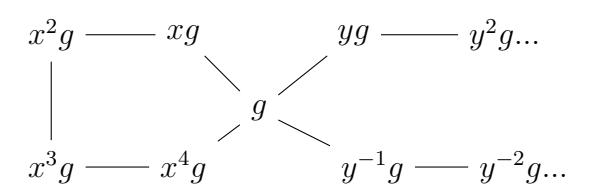
Figure 1. The state of g with its neighboring vertices in the conditions of Lemma 2.6
There for ϕ (y 2 g) = y −2 g.
Now, it's sufficient that prove: if ϕ (y i−2 g) = y −(i−2)g and ϕ (y i−1 g) = y −(i−1)g, then ϕ (y i g) = y −i g. In Figure 1, replace "g" by "y i−1 g" and "y −(i−1)g". since ϕ (y i−1 g) = y −(i−1)g and ϕ is automorphism, we have
\[\{\varphi(xy^{i-1}g), \varphi(x^4y^{i-1}g)\} = \{xy^{-(i-1)}g, x^4y^{-(i-1)}g\}\]
and
\[\left\{\varphi\left(y^{i}g\right),\varphi\left(y^{i-2}g\right)\right\}=\left\{y^{-i}g,y^{-(i-2)}g\right\}=\left\{y^{-i}g,\varphi\left(y^{i-2}g\right)\right\}.\]
Thus ϕ(y i g) = y −i g.
Lemma 2.6. If ϕ ∈ Aut(Γ4)g, then ϕ(xg) = xg.
Proof. We know that xg ∈ D1 (g), so we have
\[\varphi(xg) \in \varphi(D_1(g)) = D_1(\varphi(g)) = D_1(g) = \{xg, x^4g, yg, y^{-1}g\}.\]
On the contrary assume that ϕ(xg) 6= xg. Thus by Lemma 2.3 we have ϕ(xg) = x −1 g, so we encounter with two cases for ϕ(yg):
Case 1. ϕ(yg) = yg; by definition of group, x −1 yx = y k . so xg, xyk g and y k g, xyk g are two edges of graph. since ϕ preserves distance, so we have:
\[2 = d(y^k g, xg) = d(\varphi(y^k g), \varphi(xg)) = d(y^k g, x^{-1}g) > 2\]
which is a contradiction.
Case 2. ϕ(yg) = y −1 g; by Lemma 2.5, we have:
\[2 = d(y^k g, xg) = d(\varphi(y^k g), \varphi(xg)) = d(y^{-k} g, x^{-1} g) > 2\]
which is a contradiction. Therefore this case does not happen.
Using Lemma 2.6, if ϕ ∈ Aut(Γ4)1, then one of the following two cases occurs: ϕ(x) = x, ϕ(y) = y or ϕ(x) = x, ϕ(y) = y −1 .
Lemma 2.7. For Cayley graph Γ4, if ϕ ∈ Ag, and ϕ fixes all the elements of D1(g), then it fix all the elements of D2(g).
Proof. We know that
\[\text{[rumus tidak dapat ditampilkan dengan baik — lihat PDF asli]}\]
\[x^{4}y^{-1}g, xy^{-1}g, x^{4}y^{-k^{4}}g, x^{4}y^{k^{4}}g\].
In fact by Lemmas 2.6 and 2.4, we conclude that \(\varphi\) keeps fixed them.
Immediately, the following result is obtained.
Corollary 2.1. If \(\varphi \in \mathbb{A}ut(\Gamma_4)_1\) and \(\varphi\) fixes all the elements of \(S_4\), then \(\varphi = id\).
Proof. Since graph is connected, it suffices to show that for every natural \(i \ge 2\), the statement
\[g' \in D_i(1) \Rightarrow \varphi(g') = g'\]
holds. By Lemma 2.7 the statement is true for i=2. Now assume that the statement is true for \(1 \le i \le n\), and we will show that the statement holds for n+1. Let \(g' \in D_{n+1}(1)\). Hence, there is a sequence of adjacent vertices
\[1 = g'_0, g'_1, \dots, g'_{n-1}, g'_n, g'_{n+1}.\]
Clearly \(g'_{n-1} \in D_{n-1}(1)\) and \(g'_n \in D_n(g)\). Therefore by hypothesis, \(\varphi\left(g'_{n-1}\right) = g'_{n-1}\) and \(\varphi\left(g'_n\right) = g'_n\). By applying Lemma 2.7 for \(g := g'_n\) and \(\varphi\left(g'_{n-1}\right) = g'_{n-1}\), we conclude that \(\varphi\left(g'_{n+1}\right) = g'_{n+1}\), or equivalently \(\varphi\left(g'\right) = g'\).
Lemma 2.8. If \(\varphi \in \mathbb{A}ut(\Gamma_4)_1\) such that \(\varphi(x) = x\), \(\varphi(y) = y^{-1}\) and \(f \in \mathbb{A}ut(G, S_4)\) is non trivial, then \(\varphi = f\)
Proof. Since \(\varphi \circ f(1) = 1\), \(\varphi \circ f(x) = x\) and \(\varphi \circ f(y) = y\), by Corollary 2.1, the statement is obtained.
Theorem 2.2. \(\mathbb{A}ut(\Gamma_4)_1 \cong \mathbb{Z}_2\).
Proof. By Lemmas 2.6 and 2.8 and Corollary 2.1, the proof is straightforward. \(\Box\)
Therefore, the first part of the main theorem is a consequence of Theorems 2.1 and 2.2 and Lemmas 1.2 and 1.3.
3. \(\Gamma_5 = Cay(G, S_5)\)
We remind that \(S_5 = \{x^2y^j, (x^2y^j)^{-1}, y^{j'}, y^{-j'}\}\) where (j', p) = 1. In this section Cayley graph \(Cay(G, S_5)\) is denoted by \(\Gamma_5\).
Lemma 3.1. \(S_5\) is equivalent to \(\{x^2, x^{-2}, y, y^{-1}\}\).
Proof. It is sufficient, consider \(f \in \mathbb{A}ut(G)\) such that \(f(x) = xy^i\) and \(f(y) = y^{\alpha}\), where i have two following cases
\[\text{[rumus tidak dapat ditampilkan dengan baik — lihat PDF asli]}\]
We also set \(\alpha = j'\). Therefore, \(f(x^2) = x^2 y^j\) and \(f(y) = y^{j'}\).
From now on, we use the above mentioned equivalent for \(S_5\).
Theorem 3.1. \(\mathbb{A}ut(G, S_5) \cong \mathbb{Z}_2\).
Proof. If we consider \(f \in Aut(G, S_5)\), then by attention to the orders of elements of \(S_5\) and proof of Lemma 1.4, we have, \(f(x^2) = x^2\) and f(y) equals to y or \(y^{-1}\).
Assume that f(y)=y. Then \(x^2=f(x^2)=f(x)^2=xy^ixy^i=x^2y^{i(k+1)}\). Hence, \(p^2\mid i(k+1)\). We know, \(p\nmid k+1\), i.e., (p,k+1)=1, because otherwise, for some integer r,k=rp-1, we will have and so, \(p^2\mid k^5-1\), thus \(1\equiv k^5 \pmod{p^2}\equiv 5rp-1\); hence, \(p^2\mid 5rp-2\), which is a contradiction. Thus \(p^2\mid i\), then i=0. Therefore, f(x)=x and f(y)=y, i.e., f=id.
Now assume that \(f(y) = y^{-1}\). Since \(f(x^2) = x^2\), similar to the previous case i = 0. Thus, f(x) = x. It means that f is an element of order 2.
Lemma 3.2. If \(\varphi \in \mathbb{A}ut(\Gamma_5)_g\) and \(\varphi(x^2g) = x^2g\), then \(\varphi(x^ig) = x^ig\) for \(1 \leqslant i \leqslant 4\).
Proof. Since \(x^{3}g \in D_{1}\left(g\right)\) and \(\varphi\) preserves distance, so we have
\[\varphi(x^3g) \in \varphi(D_1(g)) = D_1(\varphi(g)) = D_1(g) = \{x^2g, x^3g, yg, y^{-1}g\}\]
= \(\{\varphi(x^2g), x^3g, yg, y^{-1}g\}.\)
Since \(\varphi\) is one-to-one, \(\varphi(x^3g) \in \{x^3g, yg, y^{-1}g\}\). On the other hand \((x^4g, xg)\) is an edge and \(x^4g \in D_1(x^2g), xg \in D_1(x^3g)\), so there exists a member of \(\varphi(D_1(x^2g))\) that is adjacent with a member of \(\varphi(D_1(x^3g))\). But if \(\varphi(x^3g) = yg\) or \(y^{-1}g\), such members do not exist. Thus \(\varphi(x^3g) = x^3g\). Also \(x^4g\) and xg are the only vertices in \(D_1(x^2g)\) and \(D_1(x^3g)\) respectively, which adjacent, so \(\varphi\) fixes them. \(\square\)
Similarly, if \(\varphi(x^2g)=x^3g\), then \(\varphi(x^{-i}g)=x^ig\) for \(1\leqslant i\leqslant 4\) and if \(\varphi(x^3g)=x^2g\), then \(\varphi(x^{-i}g)=x^ig\) for \(1\leqslant i\leqslant 4\).
Lemma 3.3. If \(\varphi \in \mathbb{A}ut(\Gamma_5)_g\), then \(\varphi(x^2g) \notin \{yg, y^{-1}g\}\).
Proof. If \(\varphi\left(x^2g\right)=yg\), then according to above description, \(\varphi\left(x^3g\right)\neq x^2g\), thus \(\varphi\left(x^3g\right)=y^{-1}g\). Also \((x^4g,xg)\) is an edge and \(x^4g\in D_1\left(x^2g\right)\) and \(xg\in D_1\left(x^3g\right)\), so there exists a member of \(\varphi\left(D_1\left(x^2g\right)\right)=D_1\left(yg\right)\) that is adjacent with a member of \(\varphi\left(D_1\left(x^3g\right)\right)=D_1\left(y^{-1}g\right)\), but there are no such elements.
Similarly \(\varphi\left(x^{2}g\right)\neq y^{-1}g\) and the result now follows.
Lemma 3.4. If \(\varphi \in \mathbb{A}ut(\Gamma_5)_g\) and \(\varphi(yg) = yg\), then \(\varphi(y^ig) = y^ig\) for \(1 \leqslant i < p^2\).
Proof. we prove that If ϕ ∈ Aut(Γ5)y i−2g and ϕ ∈ Aut(Γ5)y i−1g , then ϕ ∈ Aut(Γ5)y ig for i > 2. Since ϕ is one-to-one, ϕ (D1 (y i−1 g)) = D1 (y i−1 g) and
\[D_1(y^{i-1}g) = \{y^{i-2}g, x^2y^{i-1}g, x^3y^{i-1}g, y^ig\} =\]
\[\{\varphi(y^{i-2}g), x^2y^{i-1}g, x^3y^{i-1}g, y^ig\}.\]
So
\[\varphi\left(x^2y^{i-1}g\right), \varphi\left(x^3y^{i-1}g\right), \varphi\left(y^ig\right) \in \left\{x^2y^{i-1}g, x^3y^{i-1}g, y^ig\right\}.\]
We know
\[xy^{i-1}g \in D_1(x^3y^{i-1}g), x^4y^{i-1}g \in D_1(x^2y^{i-1}g)\]
and (xyi−1 g, x4 y i−1 g) is an edge, therefore we have
\[\varphi\left(xy^{i-1}g\right) \in \varphi\left(D_1\left(x^3y^{i-1}g\right)\right) = D_1(\varphi\left(x^3y^{i-1}g\right))\]
\[\varphi(x^4y^{i-1}g) \in \varphi(D_1(x^2y^{i-1}g) = D_1(\varphi(x^2y^{i-1}g))\]
and (ϕ (xyi−1 g), ϕ (x 4 y i−1 g)) is and edge. Because there is no element of D1 (y i g) adjacent to an element of D1 (x 2 y i−1 g) or an element of D1 (x 3 y i−1 g). So we have
\[\varphi(x^2y^{i-1}g), \varphi(x^3y^{i-1}g) \in \{x^2y^{i-1}g, x^3y^{i-1}g\}.\]
Thus ϕ (y i g) = y i g and the lemma is proved.
Lemma 3.5. If ϕ ∈ Aut(Γ5)g and ϕ(yg) = y −1 g, then ϕ(y i g) = y −i g for 1 6 i < p2 .
Proof. Since ϕ(yg) = y −1 g, ϕ (D1 (yg)) = D1(ϕ(yg)) = D1(y −1 g), we have
\[\begin{split} & \{\varphi(g), \varphi(x^{2}yg), \varphi(x^{3}yg), \varphi(y^{2}g)\} \\ & = \left\{\varphi\left(g\right), x^{2}y^{-1}g, x^{3}y^{-1}g, y^{-2}g\right\}, \end{split}\]
On the other hand, since x 4 yg ∈ D1 (x 2 yg), xyg ∈ D1 (x 3 yg) and (x 4 yg, x3 yg) is an edge, thus we have
\[\varphi(x^4yg) \in \varphi(D_1(x^2yg)) = D_1(\varphi(x^2yg)),\]
\[\varphi(xyg) \in \varphi(D_1(x^3yg)) = D_1(\varphi(x^3yg))\]
and (ϕ (x 4 yg), ϕ (xyg)) is an edge. Due to fact that, do not exists any element of D1 (y −2 g) adjacent to an element of D1 (x 2 y −1 g) or D1 (x 3 y −1 g), we see that
\[\varphi(x^2yg), \varphi(x^3yg) \in \{x^2y^{-1}g, x^3y^{-1}g\}.\]
There for ϕ (y 2 g) = y −2 g.
Tetravalent non-normal Cayley graphs of order 5p 2 | S. Khazaei and H. Sharifi
x 2 g x 3 g xg x 4 g g yg y −1 g y 2 g... y −2 g...
Figure 2. The state of g with its neighboring vertices in the conditions of Lemma 3.5
Now, it's sufficient that prove: if ϕ (y i−2 g) = y −(i−2)g and ϕ (y i−1 g) = y −(i−1)g, then ϕ(y i g) = y −i g.
In Figure 2, replace "g" by "y i−1 g" and "y −(i−1)g". since ϕ (y i−1 g) = y −(i−1)g and ϕ is automorphism, we have
\[\{\varphi(x^2y^{i-1}g), \varphi(x^3y^{i-1}g)\} = \{x^2y^{-(i-1)}g, x^3y^{-(i-1)}g\}\]
and
\[\left\{\varphi\left(y^{i}g\right),\varphi\left(y^{i-2}g\right)\right\}=\left\{y^{-i}g,y^{-(i-2)}g\right\}=\left\{y^{-i}g,\varphi\left(y^{i-2}g\right)\right\}.\]
Thus ϕ (y i g) = y −i g.
Lemma 3.6. If ϕ ∈ Aut(Γ5)g, then ϕ(x 2 g) = x 2 g.
Proof. We know x 2 g ∈ D1 (g), so we have
\[\varphi(x^2g) \in \varphi(D_1(g)) = D_1(\varphi(g)) = D_1(g) = \{x^2g, x^3g, yg, y^{-1}g\}.\]
On the contrary assume that ϕ(x 2 g) 6= x 2 g. Thus by Lemma 3.3, we have ϕ(x 2 g) = x 3 g.
Then we have two cases for ϕ(y):
Case 1. ϕ(yg) = yg; by definition of group, x −1 yx = y k . so (x 2 g, x2 y k 2 g) and y k 2 g, x2 y k 2 g are two edges of graph. since ϕ preserves distance, so we have
\[2 = d(y^{k^2}g, x^2g) = d(\varphi(y^{k^2}g), \varphi(x^2g)) = d(y^{k^2}g, x^3g) > 2,\]
which is a contradiction.
Case 2. ϕ(yg) = y −1 g; similar to the previous case, we conclude
\[2 = d(y^{k^2}g, x^2g) = d(\varphi(y^{k^2}g), \varphi(x^2g)) = d(y^{-k^2}g, x^3g) > 2,\]
which is a contradiction, therefore this case does not happen.
Corollary 3.1. If ϕ ∈ Aut(Γ5)g, then ϕ(xg) = xg.
Proof. By applying Lemma 3.6 for g := x 2 g and g := x 4 g, it follows.
Similar to Lemma 2.7, we have the following lemma.
Lemma 3.7. For Cayley graph Γ5, if ϕ ∈ Ag, and ϕ fixes all the elements of D1(g), then it fixes all the elements of D2(g).
Proof. We know
\[\text{[rumus tidak dapat ditampilkan dengan baik — lihat PDF asli]}\]
\[x^3y^{-1}g, x^2yg, x^3yg, y^2g, y^{-2}g\].
Already by Lemma 3.4 and Corollary 3.1, we know, ϕ keeps fixed them.
Corollary 3.2. If ϕ ∈ Aut(Γ5)1 and ϕ fixes all the elements of D1(g), then ϕ = id.
Proof. It follows immediately from Lemma 3.7 and graph connectivity.
Lemma 3.8. Let ϕ ∈ Aut(Γ5)1. If ϕ(y) = y, then ϕ = id. If ϕ(y) = y −1 , then ϕ = f, where f is non-identity element of Aut(G, S5).
Proof. The first case is obtained using Corollaries 3.1, 3.2 and graph connectivity. In the second case, since ϕ ◦ f(x) = x, ϕ ◦ f(y) = y and ϕ ◦ f ∈ Aut(Γ5)1, by Corollary 3.2, ϕ ◦ f = id and because f is of order 2, so we have ϕ = f.
Theorem 3.2. Aut(Γ5)1 ∼= Z2.
Proof. The statement is a consequence of Lemma 3.8 and Corollary 3.1.
Therefore, Lemmas 1.2, 1.3 and Theorems 3.1, 3.2 prove the second part of the Main Theorem.
Lemma 3.9. Γ1 Γ3.
But,
Proof. Suppose that there exists an automorphism ϕ : Γ1 → Γ3, so for some g ∈ G, we have ϕ (1) = g. On other hand, since Γ3 is vertex-transitive, there exsits ψ ∈ Aut(Γ3) such that ψ (g) = 1, therefore, ψ ◦ ϕ (1) = 1. Thus, without loss of generality, we assume ϕ (1) = 1. Now, since ϕ is isomorphism and {1, x} is an edge of Γ1, {1, ϕ (x)} is an edge of Γ3. Therefore, ϕ (x) ∈ n x 2 , x3 , x2 y,(x 2 y) −1 o . In the following, we show that ϕ (x) can't be equal to any of these 4 elements.
Case 1. ϕ (x) 6= x 2 . Because, if ϕ (x) = x 2 , then ϕ (x 2 ) = x 4 , and ϕ (xy) ∈ n x 2 y,(x 2 y) −1 o . On the other hand, D2 (x 2 ) ∩ D3 (xy) = y −1 , y−k , x2 y k in Γ1. Since ϕ is isomorphism, D2 (ϕ (x 2 )) ∩ D3 (ϕ (xy)) has 3 elements in Γ3.
\[D_2(x^4) \cap D_3(x^2y) = D_2(x^4) \cap D_3((x^2y)^{-1}) = \{x^4y^{k^2}, y^{-1}\}\]
which is a contradiction with isomorphism ϕ.
Case 2. ϕ (x) 6= x 3 . Because, if ϕ (x) = x 3 , then ϕ (x 3 ) = x 4 , and ϕ (xy) ∈ n x 2 y,(x 2 y) −1 o . If ϕ (xy) = (x 2 y) −1 , then ϕ (xy) −1 = x 2 y. On the other hand, D2 (x 3 ) ∩ D3 (xy) −1 =
\(\left\{ x^{3}y^{-k^{3}},y^{k^{4}},y^{k^{3}}\right\} \text{ in }\Gamma_{1}\text{, then, }D_{2}\left(x^{4}\right)\cap D_{3}\left(x^{2}y\right) \text{ has 3 elements, but }D_{2}\left(x^{4}\right)\cap D_{3}\left(x^{2}y\right)=0\)\(\{x^4y^{k^2}, y^{-1}\}\), which is a contrary to the fact that an isomorphism. So we consider \(\varphi(xy) = x^2y\). suppose that \(\sigma' \in Aut(G, S_1)\), so \(\sigma'(x) = xy\), \(\sigma'(y) = y^{-1}\) and \(\sigma \in Aut(G, S_3)\) are non trivial. Let \(\psi = \sigma \circ \varphi \circ \sigma'\). \(\psi\) defines an isomorphism from \(\Gamma_1\) to \(\Gamma_3\), such that \(\psi(1) = 1\) and \(\psi(x) = x^2\). But by case 1, there is no such isomorphism.
Case 3. \(\varphi(x) \neq x^2y\). we assume that \(\varphi(x) = x^2y\). Let \(\psi = \varphi \circ \sigma'\) (where \(\sigma' \in Aut(G, S_1)\) is non trivial). Obviosly, \(\psi(1) = 1\) and \(\psi(x) \in \{x^2, x^3\}\). But by case 1 and case 2, there is no such isomorphism.
Case 4. \(\varphi(x) \neq (x^2y)^{-1}\). If \(\varphi(x) = (x^2y)^{-1}\), then clearly \(\varphi(x) \in \{x^2, x^3\}\). Let \(\psi = \varphi \circ \sigma'\)similar to the previous case, \(\psi\) is a isomorphism that \(\psi(1) = 1\) and \(\psi(x) \in \{x^2, x^3\}\), which is a contradiction with cases 1 and 2.
Therefore, by these four cases the proof is complete.
Lemma 3.10. \(\Gamma_4 \ncong \Gamma_5\).
Proof. Suppose that \(\varphi: \Gamma_4 \to \Gamma_5\) is an isomorphism. Without loss of generality, we assume that \(\varphi(1)=1\). Based on Figures 1 and 2, we have \(\varphi(x)\in\{x^2,x^3\}\) and \(\varphi(y)\in\{y,y^{-1}\}\). Let's consider both possible cases.
Case 1. If \(\varphi(y) = y\), then \(\varphi(y^i) = y^i\). However, since \(d(y^k, x) = 2\) in \(\Gamma_4\), if \(\varphi(x) = x^2\), then \(d(y^k, x^2) = d(\varphi(y^k), \varphi(x)) = 2\) in \(\Gamma_5\), which leads to a contradiction. Similarly, if \(\varphi(x) = x^3\), then \(d(y^k, x^3) = d(\varphi(y^k), \varphi(x)) = 2\) in \(\Gamma_5\), resulting in a contradiction. Therefore, this case is not possible.
Case 2. If \(\varphi(y) = y^{-1}\), then clearly \(\varphi(y^{-1}) = y\). According to Lemma 2.8 and Theorem 2.2, there exists a non-trivial element f belongs to \(Aut(G, S_4)\) such that f(x) = x and \(f(y) = y^{-1}\). Let \(\psi = \varphi \circ f\). Consequently, \(\psi\) is an isomorphism between the graphs \(\Gamma_4\) and \(\Gamma_5\) with \(\psi(1) = 1\)and \(\psi(y) = \varphi(f(y)) = \varphi(y^{-1}) = y\). Therefore, \(\psi\) induse an isomorphic between \(\Gamma_4\) and \(\Gamma_5\) with the condition \(\psi(y) = y\), which is a contradiction similar to Case 1.
Lemma 3.11. Cayley graphs Cay(G,S) with |S| = 4 are CI-graph.
Proof. We know that there are five subsets non equivalent for S. By Lemma 1.5, \(Aut(\Gamma_1)_1 \ncong\)\(Aut(\Gamma_2)_1\). Therefore \(\Gamma_1 \ncong \Gamma_2\). Also by Lemma 3.9, \(\Gamma_1 \ncong \Gamma_3\). On the other hand, by Main Theorem \(\Gamma_4\) and \(\Gamma_5\) are not edge transitive, but by Lemma 1.5, \(\Gamma_1\) is edge transitive. Consequently, \(\Gamma_4\) and \(\Gamma_5\) can't isomorphism with \(\Gamma_1\). According Lemma 1.5, Theorem 2.2 and Theorem 3.2, since \(Aut(\Gamma_2)_1 \ncong Aut(\Gamma_3)_1\), \(Aut(\Gamma_2)_1 \ncong Aut(\Gamma_4)_1\) and \(Aut(\Gamma_2)_1 \ncong Aut(\Gamma_5)_1\), so \(\Gamma_2 \ncong \Gamma_3\), \(\Gamma_2 \ncong \Gamma_4\)And \(\Gamma_2 \ncong \Gamma_5\) respectively. Morever, \(\Gamma_3 \ncong \Gamma_4\) and \(\Gamma_3 \ncong \Gamma_5\), because, by Lemma 1.5, \(\Gamma_3\) is normal edge-transitive, while \(\Gamma_4\) and \(\Gamma_5\) aren't normal edge transitive. Finally, by Lemma 3.10, \(\Gamma_4 \ncong \Gamma_5\). This completes the proof.
Lemma 3.12. G is a 5-CI-graph.
Proof. According to the order and relation between the generators of the group, the order of elements of S can't be 1,2,3 and 5. Therefore by Lemma 3.11 and Definition 1.1, the statement holds.
4. Conclusion
In this paper, we consider Cayley graphs on Frobenius group of orders 5p 2 , where p > 5 is prime, with cyclic Sylow p-subgroup and with respect to tetravalent sets. In [4], we investigate graph automorphism and group automorphism determining all connected tetravalent normal edge transitive Cayley graphs on non-Abelian groups of order 5p 2 with respect to tetravalent sets and same order elements. the main result of which was the form of Lemma 1.5. In this paper, we have focus on the tetravalent sets with different orders. We prove that these graphs are normal; but, they are not normal edge-transitive, arc-transitive, nor half- transitive. Also, we show that the group is a 5-CI-group. This can be an interesting research problem to investigate Cayley graphs on Frobenius groups of order qp2 .
Acknowledgement
The authors would like to express their gratitude to the referee for his/her exact comments which made it possible to present the paper in this final form.
References
- [1] M.R. Darafsheh and M. Abdollahi, On Connected Tetravalent Cayley Graphs of a Nonabelian Group of Order 3p 2 , Algebra. Colloq. 24 (2017), 467-480.
- [2] C.D. Godsil, On the full automorphism group of a graph, Combinatorica, 1 (1981), 243-256.
- [3] X.H. Hua, S.J. Xu, and Y.P. Deng, Tetravalent edge-transitive Cayley graphs of P GL(2, p), Acta. Math. Appl. Sin. 29 (2013), 837-842.
- [4] S. Khazaei and H. Sharifi, On connected tetravalent normal edge-transitive Cayley graphs of non-Abelian groups of order 5p 2 , Turk. J. Math. 44 (2020), 524-537.
- [5] C.H. Li, Z. Liu, and Z.P. Lu, The edge-transitive tetravalent Cayley graphs of square-free order, Discrete. Math. 312 (2012), 1952-1967.
- [6] Y. Pakravash and A. Iranmanesh, Normal edge-transitive Cayley graphs on non-Abelian groups of order 4p 2 , where p is a prime number, Bull. Iranian Math. Soc. 43 (2017), 951- 974.
- [7] C.E. Praeger, Finite normal edge-transitive Cayley graphs, Bull. Austral. Math. Soc. 60 (1999), 207-220.
- [8] H. Sharifi and M.R. Darafsheh, On tetravalent normal edge-transitive Cayley graphs on the modular group, Turk. J. Math. 41 (2017), 1308-1312.
- [9] M.Y. Xu, Automorphism groups and isomorphisms of Cayley digraphs, Discrete. Math. 182 (1998), 309-319.
- [10] J.X. Zhou, Tetravalent non-normal Cayley graphs of order 4p, Electron. J. Comb. 16 (2009), 9-18.
- [11] H.X. Yu, J.X. Zhou, and L. Wang, Cubic Cayley graphs of order 2p 2 , Adv. Math(China). 35 (2006), 581-589.