Anak Agung Gede Ngurah∗a , Rinovia Simanjuntakb,c, Edy Tri Baskorob,c
Jalan Terusan Raya Dieng 62–64 Malang, Indonesia
aag.ngurah@unmer.ac.id, {rino, ebaskoro}@itb.ac.id
A graph G of order p and size q is called edge-magic total if there exists a bijection ϕ from V (G)∪ E(G) to the set {1, 2, . . . , p+q} such that ϕ(s) +ϕ(st) +ϕ(t) is a constant for every edge st in E(G). An edge-magic total graph with ϕ(V (G)) = {1, 2, . . . , p} is called super edge-magic total. Furthermore, the edge-magic deficiency of a graph G is the smallest integer n ≥ 0 such that G ∪ nK1 is edge-magic total. The super edge-magic deficiency of a graph G is either the smallest integer n ≥ 0 such that G ∪ nK1 is super edge-magic total or +∞ if there exists no such integer n. In this paper, we study the (super) edge-magic deficiency of join product graphs and 2-regular graphs.
Keywords: (super) edge-magic graph, (super) edge magic deficiency, join product graph, 2-regular graph
Mathematics Subject Classification : 05C78
DOI: 10.5614/ejgta.2025.13.1.4
1. Introduction
Let G be a finite and simple graph with vertex set V (G) and edge set E(G) such that p = |V (G)| and q = |E(G)|. An edge-magic total labeling (EMTL) of a graph G is a bijection ϕ : V (G) ∪ E(G) → {1, 2, · · · , p + q} such that ϕ(s) + ϕ(st) + ϕ(t) is a constant k, called the magic
Received: 9 July 2019, Revised: 27 January 2025, Accepted: 2 February 2025.
aDepartment of Civil Engineering, Universitas Merdeka Malang
bCombinatorial Mathematics Research Group, Faculty of Mathematics and Natural Sciences,
Institut Teknologi Bandung, Indonesia cCenter for Reseach Collaboration on Graph Theory and Combinatorics, Indonesia
∗corresponding author
constant of ϕ, for every st ∈ E(G). An EMTL ϕ of G is called a super edge-magic total labeling (SEMTL) if ϕ(V (G)) = {1, 2, · · · , p}. A graph that admits a (S)EMTL is called (super) edgemagic total ((S)EMT). The notions of an EMTL and an EMT graph were introduced in [12] while the concepts of a SEMTL and a SEMT graph were introduced in [3].
The next lemma provides necessary and sufficient conditions for a graph to be a SEMT graph.
Lemma 1.1. [4] A graph G is SEMT if and only if there exists a bijection ϕ : V (G) → {1, 2, · · · , p} such that the set S = {ϕ(s) + ϕ(t) : st ∈ E(G)} is a set of q consecutive integers.
In [12], Kotzig and Rosa also introduced the notion of edge-magic deficiency (EMD) of a graph. The EMD of a graph G, µ(G), is the minimum integer n ≥ 0 such that G ∪ nK1 is an EMT graph. Kotzig and Rosa proved that every graph has finite EMD. Figueroa-Centeno et al. [5] introduced the notion of super edge-magic deficiency (SEMD) of a graph. The SEMD of a graph G, µs(G), is defined as either the minimum integer n ≥ 0 such that G ∪ nK1 is a SEMT graph or +∞ if there exists no such integer n. Thus, a (S)EMT graph is a graph with zero (S)EMD. Unlike the EMD, not all graphs have finite SEMD. Lemma 1.2 provides necessary conditions for a graph to have infinite SEMD.
Lemma 1.2. [5] If G is a graph with q ≡ 2 (mod 4) edges and every vertex of G has even degrees, then µs(G) = +∞.
Several papers dealing with (S)EMD of graphs for instants see [1, 14, 15, 16, 17, 18]. The latest developments in these labelings can be found in [7]. Here, we study the (S)EMD of join product graphs and 2-regular graphs.
2. SEMD of Join Product Graphs
The join product of two graphs G and H, G + H, is a graph having vertex set V (G) ∪ V (H) and edge set E(G) ∪ E(H) ∪ {st : s ∈ V (G), t ∈ V (H)}. If H is an isolated vertex, then it is denoted by G+K1. To present the results on SEMD of join product graphs, we need the following lemma. First, we define a star Sn as a graph with n + 1 vertices where one vertex has degree n and n vertices have degree one.
Lemma 2.1. Let G be a graph with p ≥ 8 vertices and q = 2p − 3 edges. If µs(G) = 0, then 2C3, C3 ∪ S3 or 2S3 are subgraphs of G.
Proof. Let ϕ be a SEMTL of G. Since q = 2p − 3, then {ϕ(s) + ϕ(t) : st ∈ E(G)} is a unique set S = {3, 4, 5, . . . 2p − 1}. To get 3, 4, and 5 in S, vertices with labels 1, 2, and 3 should form a cycle C3 or vertices with labels 1, 2, 3, and 4 should form a star S3, where vertices with labels 2, 3, and 4 are adjacent to the vertex with label 1. In a similar way, vertices with labels p, p − 1, and p − 2 should form a cycle C3 or vertices with labels p, p − 1, p − 2 and p − 3 should form a star S3. Since p ≥ 8, so 1, 2, 3, 4, p − 3, p − 2, p − 1 and p are distinct integers. Thus, we have desire results.
Lemma 2 is not true in reverse. Let's look at graph G in Figure 1 as an example. This graph has p = 8 vertices, q = 2p−3 = 13 edges, and having subgraphs isomorphic to 2C3, C3∪S3, and 2S3. Suppose µs(G) = 0 with a SEMTL ϕ. Then, {ϕ(u) + ϕ(v) : uv ∈ E(G)} = {3, 4, 5, . . . , 15}. So,
\[5\phi(z) + \phi(v_1) + \phi(v_2) + \phi(v_3) + 2\phi(u) = \sum_{i=3}^{15} i - 2\sum_{i=1}^{8} i = 45.\]
It can be verified that we do not get a SEMTL of G for any solutions of this equation. Thus, µs(G) ≥ 1. By this fact and the labeling of G ∪ K1 in Figure 1, we conclude that µs(G) = 1.
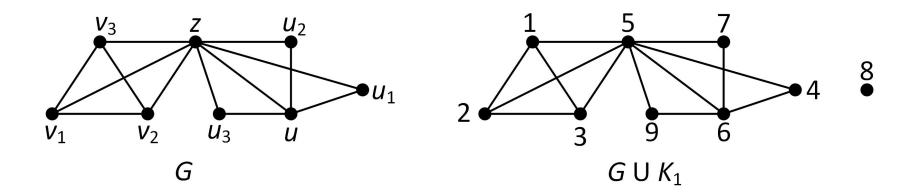
Figure 1. A grap G with 8 vertices and 13 edges having subgraphs 2C3, C3 ∪ S3, and 2S3 and a vertex labeling of G ∪ K1.
In [19], Ngurah and Simanjuntak proved the following lemma. They also showed that the lemma is attainable by some classes of trees and forests.
Lemma 2.2. [19] Let G be a graph without cycle and isolated vertices. If the SEMD of G + K1 is zero, then G is a tree or a forest.
We now relax the condition of the Lemma 2.2 as in Lemma 2.3. The proof of Lemma 2.3 is identical to the proof of Lemma 2.2.
Lemma 2.3. Let G be a graph without isolated vertices. If µs(G + K1) = 0, then G is a tree, a forest, a union of cycles and trees, or a union of unicyclic graphs and trees.
The corona product, G ⊙ H, of two graphs G and H is defined as the graph formed by taking one copy of G and |V (G)| copies of H, then connecting the ith vertex of G to every vertex in the ith copy of H. If H is an isolated vertex, then it is denoted by G ⊙ K1. The next results show that Lemma 2.3 is attainable.
Theorem 2.1. a) µs([Cn ∪ Pm] + K1) = 0 if and only if n = 3 and 2 ≤ m ≤ 4. b) µs([(C3 ⊙ K1) ∪ Pm] + K1) = 0 if and only if 2 ≤ m ≤ 4.
Proof. a) First, let Fn,m = [Cn ∪ Pm] + K1 be a graph with V (Fn,m) = {xi : 1 ≤ i ≤ n} ∪ {yj : 1 ≤ j ≤ m} ∪ {z} and E(Fn,m) = {xixi+1 : 1 ≤ i ≤ n − 1} ∪ {xnx1} ∪ {yjyj+1 : 1 ≤ j ≤ m − 1} ∪ {zxi , zyj : 1 ≤ i ≤ n, 1 ≤ j ≤ m}. Thus, Fn,m has p = n + m + 1 vertices and q = 2n + 2m − 1 = 2(n + m + 1) − 3 edges.
Next, we show that, for m ≥ 5, µs(F3,m) > 0. For m ≥ 5, suppose that µs(F3,m) = 0 with a SEMTL ϕ. Then, S = {ϕ(u) + ϕ(v) : uv ∈ E(F3,m)} = {3, 4, 5, . . . , 2m + 7}. Notice that F3,m has no subgraphs isomorphic to 2S3. By Lemma 2.1, we should consider the following cases.
Case 1. Vertices with labels 1, 2, 3 and vertices with label p = m + 4, p - 1, p - 2 form a \(2C_3\). If \(\{\phi(x_1), \phi(x_2), \phi(x_3)\} = \{1, 2, 3\}\) and \(\phi(z) \in \{p, p - 1, p - 2\}\) then, we fail to get 6 in S. If \(\{\phi(x_1), \phi(x_2), \phi(x_3)\} = \{p, p - 1, p - 2\}\) and \(\phi(z) \in \{1, 2, 3\}\) then, we fail to get 2p - 4 in S.
Case 2. Vertices with labels 1, 2, 3 form a \(C_3\) and vertices with labels p, p-1, p-2, p-3 form a \(S_3\).
In this case, it is easy to check that we fail to get 6 in S.
Case 3. Vertices with labels p, p-1, p-2, form a \(C_3\) and vertices with label 1, 2, 3, 4 form a \(S_3\).
In this case, we fail to get 2p-4 in S. Thus, for \(m \ge 5\), \(\mu_s(F_{3,m}) > 0\).
Now, we show that, for any \(n \geq 4\) and \(m \geq 2\), \(\mu_s(F_{n,m}) > 0\). Since, for \(n \geq 4\) and m > 2, \(F_{n,m}\) is a graph with \(|V(F_{n,m})| \geq 8\) and has no subgraphs isomorphic to \(2C_3\), \(C_3 \cup S_3\) and \(2S_3\), by Lemma 2.1, \(\mu_s(F_{n,m}) > 0\). Thus, the remaining case is to show that \(\mu_s(F_{4,2}) > 0\). Let \(\mu_s(F_{4,2}) = 0\) and let \(\phi\) be a SEMTL of \(F_{4,2}\). Then, \(4\phi(z) + \sum_{i=1}^4 \phi(x_i) = 32\). It is simple to confirm that none of the equation's solutions result in a SEMTL of \(F_{4,2}\). Thus, \(\mu_s(F_{4,2}) > 0\).
Finally, we show that, for \(2 \le m \le 4\), \(\mu_s(F_{3,m}) = 0\). Define a vertex labeling \(\phi\) as follows. \(\{\phi(x_1), \phi(x_2), \phi(x_3)\} = \{1, 2, 3\}\), \(\phi(z) = 5\), for m = 2, set \(\{\phi(y_1), \phi(y_2)\}\) to \(\{4, 6\}\), for m = 3, set \(\{\phi(y_1), \phi(y_2), \phi(y_3)\}\) to \(\{4, 6, 7\}\), and for m = 4, set \(\{\phi(y_1), \phi(y_2), \phi(y_3), \phi(y_4)\}\) to \(\{4, 6, 8, 7\}\).
b) Let \(H_m = [(C_3 \odot K_1) \cup P_m] + K_1\) be a graph with \(V(H_m) = \{u_i, v_i : 1 \le i \le 3\} \cup \{w_j : 1 \le j \le m\} \cup \{z\}\) and \(E(H_m) = \{u_i u_{i+1} : 1 \le i \le 2\} \cup \{u_3 u_1\} \cup \{u_i v_i : 1 \le i \le 3\} \cup \{w_j w_{j+1} : 1 \le j \le m-1\} \cup \{zu_i, zv_i, zw_j : 1 \le i \le 3, 1 \le j \le m\}\). Thus \(H_m\) has p = m+7 vertices and q = 2m+11 = 2(m+7)-3 edges.
First, we prove that, for \(2 \le m \le 4\), \(\mu_s([(C_3 \odot K_1) \cup P_m] + K_1) = 0\). Define a vertex labeling \(\phi\) as follows. \((\phi(u_1), \phi(u_2), \phi(u_3)) = (1, 2, 3)\), \((\phi(v_1), \phi(v_2), \phi(v_3)) = (5, 6, 4)\), \(\phi(z) = 8\), for m = 2, set \(\{\phi(w_1), \phi(w_2)\}\) to \(\{7, 9\}\), for m = 3, set \((\phi(w_1), \phi(w_2), \phi(w_3))\) to (7, 9, 10), and for m = 4, set \((\phi(w_1), \phi(w_2), \phi(w_3), \phi(w_4))\) to (7, 9, 11, 10). It is simple to confirm that \(\phi\) extends to a SEMTL of \([(C_3 \odot K_1) \cup P_m] + K_1\) for \(2 \le m \le 4\).
Next, suppose that, for any \(m \geq 5\), \(\mu_s(H_m) = 0\). Then, there exists a SEMTL \(\phi\) of \(H_m\) such that \(S = \{\phi(u) + \phi(v) : uv \in E(H_m)\} = \{3, 4, 5, \dots, 2p-1\}\), in which we note that 2p-1=2m+13. By Lemma 2.1, we should consider three cases.
Case 1. Vertices with labels 1, 2, 3 and vertices with labels p, p-1, p-2 form a \(2C_3\). If \((\phi(u_1), \phi(u_2), \phi(u_3)) = (1, 2, 3)\) and \(\phi(z) \in \{p, p-1, p-2\}\) then, to get 6, 7, and 8 in S, set \((\phi(v_1), \phi(v_2), \phi(v_3))\) to (5, 6, 4) or (6, 4, 5). Thus, we fail to get 9 in S. If \((\phi(u_1), \phi(u_2), \phi(u_3)) = (p, p-1, p-2)\) and \(\phi(z) \in \{1, 2, 3\}\) then, to get 2p-4, 2p-5, and 2p-6, set \((\phi(v_1), \phi(v_2), \phi(v_3))\) to (p-5, p-3, p-4) or (p-4, p-5, p-3). In this case, it is not possible to get 2p-7 in S.
Case 2. Vertices with labels 1, 2, 3 form a \(C_3\) and vertices with labels p, p-1, p-2, p-3 form a \(S_3\).
If \((\phi(u_1), \phi(u_2), \phi(u_3)) = (1, 2, 3)\) and \(\phi(z) \in \{p, p-1, p-2, p-3\}\) then, by a similar argument as in the Case 1, we fail to get 9 in S. If \(\phi(z) \in \{1, 2, 3\}\) and \((\phi(u_1), \phi(u_2), \phi(u_3), \phi(v_1)) = (p, p-2, p-3, p-1)\), then we fail to get 2p-4 in S. If \(\phi(z) \in \{1, 2, 3\}\) and \((\phi(u_1), \phi(u_2), \phi(u_3), \phi(v_1)) = (p, p-1, p-3, p-2)\), then we fail to get either 2p-5 or 2p-6 in S.
Case 3. Vertices with labels p, p-1, p-2 form a \(C_3\) and vertices with labels 1, 2, 3, 4 form a \(S_3\).
By a similar argument as in the Case 2, this case also do not lead to a SEMTL of \(H_m\).
Case 4. Vertices with labels 1, 2, 3, 4 and vertices with labels p, p-1, p-2, p-3 form a \(2S_3\). If \(\phi(z) \in \{1, 2, 3, 4\}\) and \((\phi(u_1), \phi(u_2), \phi(u_3), \phi(v_1)) = (p, p-2, p-3, p-1)\), then we fail to get 2p-4 in S. If \(\phi(z) \in \{1, 2, 3, 4\}\) and \((\phi(u_1), \phi(u_2), \phi(u_3), \phi(v_1)) = (p, p-1, p-3, p-2)\), then we fail to get either 2p-5 or 2p-6 in S. If \((\phi(u_1), \phi(u_2), \phi(u_3), \phi(v_1)) = (1, 3, 4, 2)\) and \(\phi(z) \in \{p, p-1, p-2, p-3\}\) then, it is not possible to get 6 in S. If \((\phi(u_1), \phi(u_2), \phi(u_3), \phi(v_1)) = (1, 2, 4, 3)\) and \(\phi(z) \in \{p, p-1, p-2, p-3\}\) then, it is not possible to get either 7 or 8 in S. Thus, \(\mu_s(H_m) > 0\), if \(m \ge 5\). This complete the proof of part b).
3. (S)EMD of 2-Regular Graphs
In [8], Holden et al. proved that \(C_5 \cup (2t)C_3\), \(C_4 \cup (2t-1)C_3\), and \(C_7 \cup (2t)C_3\) are strong vertex-magic total (SVMT) graphs. It is easy to verify that a (S)VMT 2-regular graph is equivalent to a (S)EMT 2-regular graph. Based on these results, they posed the Conjecture 1.
Conjecture 1. [8]. Let G be a 2-regular graph of odd order. The graph G is SVMT if and only if G is not one of \(C_4 \cup C_3\), \(C_4 \cup 3C_3\) or \(C_5 \cup 2C_3\).
Cichacz et al. [2] provide a partial solution to Conjecture 1, introducing a method for generating (S)VMT labelings of 2-regular graphs.
Theorem 3.1. [2]. Let \(k \geq 1\) be an integer and \(F = \bigcup_{i=1}^k C_{n_i}\) be a 2-regular graph. If F is a (S)VMT graph, then \(G = \bigcup_{i=1}^k C_{mn_i}\) is a (S)VMT graph for every odd \(m \geq 3\).
In [6], Figueroa-Centeno et al. provided the following result.
Theorem 3.2. [6]. If a 3-colorable graph G is (S)EMT, then mG is (S)EMT for any odd integer m.
As mentioning in [7], Ichishima and Oshima [11] investigate the SEMD of 2-regular graphs \(C_m \cup C_n\) for m = 3, 4, 5, 7 and any n. Krisnawati et al. [13] investigate the SEMD of a 2-regular graph with three components, namely \(2C_3 \cup C_n\). In the next theorem, we study the SEMD of a 2-regular graph \(2C_4 \cup C_n\).
Theorem 3.3. Let \(n \ge 4\) be a positive integer. Then
\[\mu_s(2C_4 \cup C_n) = \begin{cases} 0, & \text{if } n \equiv 1 \pmod{2}, \\ 1, & \text{if } n = 4 \text{ and } n \equiv 8, 12 \pmod{16}, \\ +\infty, & \text{if } n \equiv 2 \pmod{4}, \end{cases}\]
and \(\mu_s(2C_4 \cup C_n) \le 2\), if \(4 < n \equiv 0, 4 \pmod{16}\).
Proof. First, let \(H = 2C_4 \cup C_n\) be a graph with \(V(H) = \{u_i, v_i : 1 \le i \le 4\} \cup \{w_i : 1 \le i \le n\}\) and \(E(H) = \{u_i u_{i+1}, v_i v_{i+1} : 1 \le i \le 3\} \cup \{u_4 u_1, v_4 v_1\} \cup \{w_i w_{i+1} : 1 \le i \le n-1\} \cup \{w_n w_1\}.\)
Next, we show that the graph H is SEMT if and only if n is odd. If H is a SEMT graph then its magic constant is \(\frac{1}{2}(5n+43)\). So, n should be an odd integer. Next, for odd \(n \geq 5\) define \(\phi: V(H) \longrightarrow \{1, 2, \ldots, n+8\}\) as follows. \((\phi(u_1), \phi(u_2), \phi(u_3), \phi(u_4)) = (1, \frac{1}{2}(n+1))\)
9), 2, \(\frac{1}{2}(n+13)\)), \((\phi(v_1), \phi(v_2), \phi(v_3), \phi(v_4)) = (3, \frac{1}{2}(n+15), 5, \frac{1}{2}(n+17))\). When n=7, label \((\phi(w_1), \phi(w_2), \phi(w_3), \phi(w_4), \phi(w_5), \phi(w_6), \phi(w_7)\) with (6, 7, 13, 9, 14, 4, 15). When \(n \geq 9\), define \(\phi(w_1) = 4, \phi(w_2) = \frac{1}{2}(n+11), \phi(w_3) = n+7, \phi(w_4) = \frac{1}{2}(n+7),\) and label the remaining vertices as follows.
Case 1. \(n \equiv 1 \pmod{4}\).
\[\phi(w_i) = \begin{cases} \frac{1}{2}(2n+21-i), & \text{if } i = 5, 9, 13, \dots, n, \\ \frac{1}{2}(n+9-i), & \text{if } i = 6, 10, 14, \dots, n-3, \\ \frac{1}{2}(2n+17-i), & \text{if } i = 7, 11, 15, \dots, n-2, \\ \frac{1}{2}(n+13-i), & \text{if } i = 8, 12, 16, \dots, n-1. \end{cases}\]
Case 2. \(7 < n \equiv 3 \pmod{4}\).
\[\phi(w_i) = \begin{cases} n+8, & \text{if } i=5, \\ n+6, & \text{if } i=7, \\ 6, & \text{if } i=n-1, \\ \frac{1}{2}(n+9-i), & \text{if } i=6,10,14,\ldots,n-5, \\ \frac{1}{2}(n+13-i), & \text{if } i=8,12,16,\ldots,n-3, \\ \frac{1}{2}(2n+17-i), & \text{if } i=9,13,17,\ldots,n-2, \\ \frac{1}{4}(2n+21-i), & \text{if } i=11,15,19,\ldots,n. \end{cases}\]
It can be checked that \(\{\phi(x) + \phi(y) : xy \in E(H)\} = \{\frac{1}{2}(n+11), \frac{1}{2}(n+13), \dots, \frac{1}{2}(3n+25)\}.\)By Lemma 1.1, H is a SEMT graph.
Now, we prove that, for n=4 and \(n\equiv 8,12 \pmod{16}\), \(\mu_s(H)=1\). If n=4, \(\mu_s(3C_4)=1\)have been proved in [10] (see Corollary 3.6). Next, for \(n \equiv 8,12 \pmod{16}\), consider the graph \(H \cup K_1\) and define \(\phi: V(H \cup K_1) \longrightarrow \{1, 2, \dots, n+9\}\) as follows. \((\phi(u_1), \phi(u_2), \phi(u_3), \phi(u_4)) =\)\((1, \frac{1}{2}(n+10), 2, \frac{1}{2}(n+14)), (\phi(v_1), \phi(v_2), \phi(v_3), \phi(v_4)) = (4, \frac{1}{2}(n+12), 5, \frac{1}{2}(n+16)), \phi(w_1) = 3, \phi(w_2) = \frac{1}{2}(n+24), \phi(w_i) = \frac{1}{2}(i+9) \text{ for } i = 3, 5, 7, \dots, n-1, \phi(w_n) = \frac{1}{2}(n+22), \text{ and}\)\(\phi(K_1) = \frac{1}{4}(3n + 28).\)
Case 3. \(n \equiv 8 \pmod{16}\).
\[\phi(w_i) = \begin{cases} \frac{1}{2}(n+20), & \text{if } i = 4, \\ \frac{1}{2}(n+22+i), & \text{if } i = 6, 14, 22, \dots, \frac{n}{2} - 6, \\ & \cup i = 8, 16, 24, \dots, \frac{n}{2} - 4, \\ & \cup i = 10, 18, 26, \dots, \frac{n}{2} - 2, \\ \frac{1}{2}(n+6+i), & \text{if } i = 12, 20, 28, \dots, \frac{n}{2}, \\ \frac{1}{2}(n+20+i), & \text{if } i = \frac{n}{2} + 2, \frac{n}{2} + 4, \frac{n}{2} + 6, \dots, n-2. \end{cases}\]
Case 4. \(n \equiv 12 \pmod{16}\).
\[\phi(w_i) = \begin{cases} \frac{1}{2}(n+26), & \text{if } i = 4, \\ \frac{1}{2}(n+18), & \text{if } i = 6, \\ \frac{1}{2}(n+22+i), & \text{if } i = 8, 16, 24, \dots, \frac{n}{2} - 6, \\ & \cup i = 10, 18, 26, \dots, \frac{n}{2} - 4, \\ & \cup i = 12, 20, 28, \dots, \frac{n}{2} - 2, \\ \frac{1}{2}(n+6+i), & \text{if } i = 14, 22, 30, \dots, \frac{n}{2}, \\ \frac{1}{2}(n+20+i), & \text{if } i = \frac{n}{2} + 2, \frac{n}{2} + 4, \frac{n}{2} + 6, \dots, n-2. \end{cases}\]
It is simple to confirm that, by Lemma 1.1, \(H \cup K_1\) a SEMT graph. Hence, \(\mu_s(H) = 1\) for n = 4 and \(n \equiv 8, 12 \pmod{16}\).
Next, we show that, or \(4 < n \equiv 0, 4 \pmod{16}, \mu_s(H) \leq 2\). Let us consider the graph \(H \cup 2K_1\) and define \(\phi: V(H \cup 2K_1) \longrightarrow \{1, 2, \dots, n+10\}\) as follows. \((\phi(u_1), \phi(u_2), \phi(u_3), \phi(u_4)) = (1, \frac{1}{2}(n+10), 2, \frac{1}{2}(n+14), (\phi(v_1), \phi(v_2), \phi(v_3), \phi(v_4)) = (4, \frac{1}{2}(n+12), 5, \frac{1}{2}(n+16)), \phi(w_1) = 3, \phi(w_2) = \frac{1}{2}(n+24), \phi(w_4) = \frac{1}{2}(n+26), \phi(w_6) = \frac{1}{2}(n+18), \phi(w_i) = \frac{1}{2}(i+9), i = 3, 5, 7, \dots, n-1,\) and \(\phi(w_n) = \frac{1}{2}(n+22)\).
Case 1. \(n \equiv 0 \pmod{16}\).
\[\phi(\{2K_1\}) = \{\frac{1}{4}(3n+40), n+7\}\]
and
\[\phi(w_i) = \begin{cases} \frac{1}{2}(n+22+i), & \text{if } i = 8, 16, 24, \dots, \frac{n}{2} - 8, \\ & \cup i = 10, 18, 26, \dots, \frac{n}{2} - 6, \\ & \cup i = 12, 20, 28, \dots, \frac{n}{2} - 4, \end{cases}\] \[\text{[rumus tidak dapat ditampilkan dengan baik — lihat PDF asli]}\]
Case 2. \(4 < n \equiv 4 \pmod{16}\).
\[\phi(\{2K_1\}) = \{\frac{1}{4}(3n+36), n+8\}\]
and
\[f(w_i) = \begin{cases} \frac{1}{2}(n+22+i), & \text{if } i = 8, 16, 24, \dots, \frac{n}{2} - 2, \\ & \cup i = 10, 18, 26, \dots, \frac{n}{2} - 8, \\ & \cup i = 12, 20, 28, \dots, \frac{n}{2} - 6, \\ \frac{1}{4}(3n+48), & \text{if } i = \frac{n}{2}, \\ \frac{1}{4}(3n+52), & \text{if } i = \frac{n}{2} + 2, \\ \frac{1}{2}(n+6+i), & \text{if } i = 14, 22, 30, \dots, \frac{n}{2} + 4, \end{cases}\]
The labeling of \(w_i\) when i is even and \(i \ge \frac{n}{2} + 6\) is determined by the following subcases. Subcase 2.1. \(4 < n \equiv 4 \pmod{48}\).
\[\phi(w_i) = \begin{cases} \frac{1}{2}(n+24+i), & \text{if } i = \frac{n}{2}+6, \frac{n}{2}+12, \frac{n}{2}+18, \dots, n-14, \\ & \cup i = \frac{n}{2}+8, \frac{n}{2}+14, \frac{n}{2}+20, \dots, n-12, \\ n+10, & \text{if } i = n-8, \\ n+7, & \text{if } i = n-6, \\ n+9, & \text{if } i = n-2, \\ \frac{1}{2}(n+12+i), & \text{if } i = \frac{n}{2}+10, \frac{n}{2}+16, \frac{n}{2}+22, \dots, n-4. \end{cases}\]
Subcase 2.2. \(n \equiv 20 \pmod{48}\).
When n=20, define \(\phi(w_{16})=26\) and \(\phi(w_{18})=29\). When \(n\geq 68\), label the remaining vertices by the following formula.
\[\phi(w_i) = \begin{cases} \frac{1}{2}(n+24+i), & \text{if } i = \frac{n}{2}+6, \frac{n}{2}+12, \frac{n}{2}+18, \dots, n-16, \\ & \cup i = \frac{n}{2}+8, \frac{n}{2}+14, \frac{n}{2}+20, \dots, n-14, \\ n+9, & \text{if } i = n-10, \\ n+6, & \text{if } i = n-8, \\ n+10, & \text{if } i = n-4, \\ n+7, & \text{if } i = n-2, \\ \frac{1}{2}(n+12+i), & \text{if } i = \frac{n}{2}+10, \frac{n}{2}+16, \frac{n}{2}+22, \dots, n-6. \end{cases}\]
Subcase 2.3. Subcase \(n \equiv 36 \pmod{48}\).
\[\phi(w_i) = \begin{cases} \frac{1}{2}(n+24+i), & \text{if } i = \frac{n}{2}+6, \frac{n}{2}+12, \frac{n}{2}+18, \dots, n-6, \\ & \cup i = \frac{n}{2}+8, \frac{n}{2}+14, \frac{n}{2}+20, \dots, n-4, \\ \frac{1}{2}(n+12+i), & \text{if } i = \frac{n}{2}+10, \frac{n}{2}+16, \frac{n}{2}+22, \dots, n-2. \end{cases}\]
By Lemma 1.1, \(H \cup 2K_1\) is a SEMT graph. Thus, \(\mu_s(H) \le 2\) for \(n \equiv 0, 4 \pmod{16}\). Finally, as a direct consequence of Lemma 1.2, \(\mu_s(H) = +\infty\), if \(n \equiv 2 \pmod{4}\).
The following corollary is a direct consequence of applying Theorem 3.2 to the Theorem 3.3.
Corollary 3.1. Let \(l \equiv 2 \pmod{4}\), \(m \equiv 1 \pmod{2}\) and \(n \geq 4\) be positive integers. Then
\[\mu_s(lC_4 \cup mC_n) = \begin{cases} 0, & \text{if } n \equiv 1 \text{ (mod 2)}, \\ +\infty, & \text{if } n \equiv 2 \text{ (mod 4)}, \end{cases}\]
\(\mu_s(lC_4 \cup mC_n) \le m\), if n = 4 and \(n \equiv 8, 12 \pmod{16}\), and \(\mu_s(lC_4 \cup mC_n) \le 2m\), if \(4 < n \equiv 0, 4 \pmod{16}\).
The following result is obtained by applying Theorems 3.1 and 3.2 to the facts that \(\mu_s(2C_4 \cup C_n) = 0\) for \(n \equiv 1 \pmod 2\) and \(\mu_s(2C_4 \cup C_n) = +\infty\) for \(n \equiv 2 \pmod 4\).
Corollary 3.2. Let \(l \equiv 2 \pmod{4}\), \(m \equiv 1 \pmod{2}\), \(n \geq 4\) and r be positive integers. Then
\[\mu_s(lC_{4(2r+1)} \cup mC_{n(2r+1)}) = \begin{cases} 0, & \text{if } n \equiv 1 \text{ (mod 2)}, \\ +\infty, & \text{if } n \equiv 2 \text{ (mod 4)}, \end{cases}\]
Unresolved issues related to these results are detailed as follows.
Open Problem 1. Determine the exact value of \(\mu_s(2C_4 \cup C_n)\) when \(n \equiv 0, 4\) (mod 16). Further, for \(l \equiv 2 \pmod{4}\) and \(m \equiv 1 \pmod{2}\), find the upper bound of the \(\mu_s(lC_{4(2r+1)} \cup mC_{n(2r+1)})\) when \(n \equiv 0 \pmod{4}\).
In [2], Chicacz et al. prove that \(2C_n\) is VMT for \(n \in \{4,6,8,10\}\) and posed a conjecture that, for even value of n, the graph \(2C_n\) is VMT. We able to give support of the validity of this conjecture by proving \(2C_n\) is EMT for \(n \in \{5,7,9,11,12,13,14\}\), see Figure 2. Theorem 3.4 is a direct consequence of applying Theorems 3.1 and 3.2 to these results.
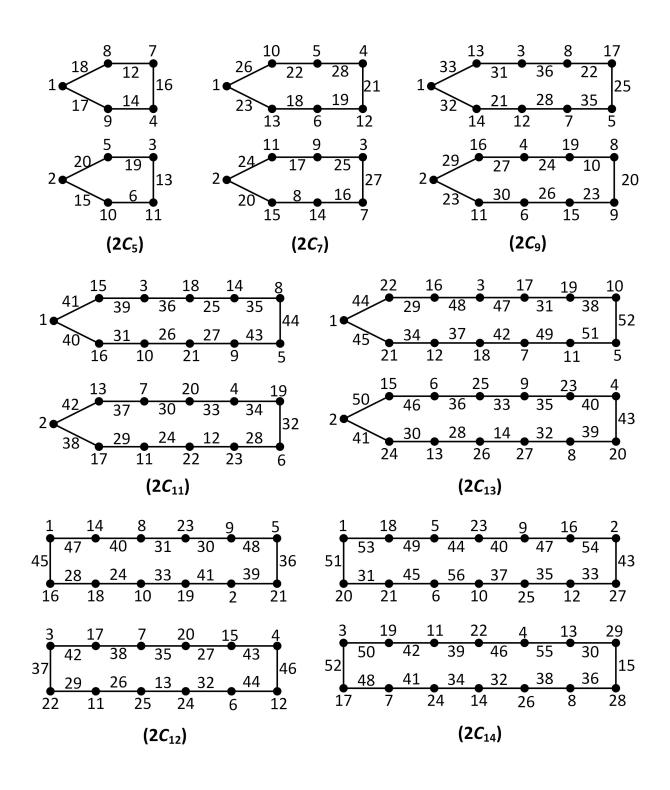
Figure 2. An EMTL of 2Cn for n ∈ {5, 7, 9, 11, 12, 13, 14}.
Theorem 3.4. Let m ≡ 2(mod 4), r be positive integers and n ∈ {5, 7, 9, 11, 12, 13, 14}. Then mCn(2r+1) has zero EMD.
Based on Theorem 3.4, the following conjecture is proposed.
Conjecture 2. For any integers m ≡ 2 (mod 4), n ≥ 3, and r ≥ 1, the 2-regular graph mCn(2r+1) has zero EMD.
A graph H ∪ kK1 is called pseudo super edge-magic (PSEM) if there exists a bijection ϕ : V (H ∪kK1) → {1, 2, . . . , |V (H)|+k} such that {ϕ(s)+ϕ(t) : st ∈ E(H)}∪ {2ϕ(u) : u ∈ kK1} is a set of |E(H)| + k consecutive integers. In such a case ϕ is called a pseudo super edge-magic labeling (PSEML) of H ∪ kK1. These concepts was introduced in [9]. It is easy to verify that if H is a 2-regular graph and H ∪ kK1 is a PSEM graph, then |V (H)| + k should be an odd integer. We discover that Theorem 3.1 also valid for a PSEM graph H ∪ kK1. As an example, see Figure 3. This fact is not mentioned by the authors in [2].
Theorem 3.5. For any integer n ≥ 4, the following graphs are PSEM.
- a) Cn ∪ K1, if n ≡ 0 (mod 2).
- b) Cn ∪ 2K1, if n ≡ 1 (mod 2).
- c) C4 ∪ Cn ∪ K1, if n ≡ 0 (mod 4).
- d) C4 ∪ Cn ∪ K1, if n ∈ {6, 10, 14, 18, 22, 26}.
- e) 2C4 ∪ Cn ∪ K1, if n ≡ 8, 12 (mod 16).
Proof. a) In [5], Ichishima et al. proved that \(\mu_s(C_n) = 1\), if \(n \equiv 0 \pmod 4\). The labeling defined to prove this result actually is a PSEML of \(C_n \cup K_1\). Next, for \(n \equiv 2 \pmod 4\), let \(V(C_n \cup K_1) = \{u_i : 1 \le i \le n\} \cup \{v\}\) and \(E(C_n \cup K_1) = \{u_i u_{i+1} : 1 \le i \le n-1\} \cup \{u_n u_1\}\). Define a vertex labeling \(\phi : V(C_n \cup K_1) \to \{1, 2, \dots, n+1\}\) as follows. When n = 6, 10 and 14, set \((\phi(u_1), \phi(u_2), \dots, \phi(u_6); \phi(v))\) to (1, 7, 2, 5, 6, 4; 3), \((\phi(u_1), \phi(u_2), \dots, \phi(u_{10}); \phi(v))\) to (1, 8, 2, 9, 3, 11, 5, 10, 7, 6; 4), and \((\phi(u_1), \phi(u_2), \dots, \phi(u_{14}); \phi(v))\) to (1, 10, 2, 12, 3, 13, 4, 9, 14, 6, 15, 7, 11, 8, 1; 5), respectively. When \(n \ge 18\), define
\[\phi(v) = \frac{1}{4}(n+6)\]
and
\[\phi(u_i) = \begin{cases} \frac{1}{2}(1+i), & \text{if } i = 1, 3, 5, \dots, \frac{n}{2}, \\ \frac{1}{4}(n+10), & \text{if } i = \frac{2}{2} + 2, \\ \frac{1}{2}(n+4+i), & \text{if } i = 2, 4, 6, \dots, \frac{1}{2}(n-2). \end{cases}\]
To label the remaining vertices, we consider the following two cases.
Case 1. \(n \equiv 2 \pmod{8}\).
\[\phi(u_i) = \begin{cases} \frac{1}{2}(5+i), & \text{if } i = \frac{n}{2} + 4, \frac{n}{2} + 8, \frac{n}{2} + 12, \dots, n-1, \\ \frac{1}{2}(1+i), & \text{if } i = \frac{n}{2} + 6, \frac{n}{2} + 10, \frac{n}{2} + 14, \dots, n-3, \\ \frac{1}{2}(n+6+i), & \text{if } i = \frac{n}{2} + 1, \frac{n}{2} + 5, \frac{n}{2} + 9, \dots, n-4, \\ \frac{1}{2}(n+2+i), & \text{if } i = \frac{n}{2} + 3, \frac{n}{2} + 7, \frac{n}{2} + 11, \dots, n-2, \\ \frac{1}{2}(n+2), & \text{if } i = n. \end{cases}\]
Case 2. \(n \equiv 6 \pmod{8}\).
\[\phi(u_i) = \begin{cases} \frac{1}{2}(5+i), & \text{if } i = \frac{n}{2}+4, \frac{n}{2}+8, \frac{n}{2}+12, \dots, n-7, \\ \frac{1}{2}(1+i), & \text{if } i = \frac{n}{2}+6, \frac{n}{2}+10, \frac{n}{2}+14, \dots, n-5, \\ \frac{n}{2}, & \text{if } i = n-3, \\ \frac{1}{2}(n+4), & \text{if } i = n-1, \\ \frac{1}{2}(n+6+i), & \text{if } i = \frac{n}{2}+1, \frac{n}{2}+5, \frac{n}{2}+9, \dots, n-10, \\ \frac{1}{2}(n+2+i), & \text{if } i = \frac{n}{2}+3, \frac{n}{2}+7, \frac{n}{2}+11\dots, n-8, \\ n-1, & \text{if } i = n-6, \\ n+1, & \text{if } i = n-4, \\ n, & \text{if } i = n-2, \\ \frac{1}{2}(n+2), & \text{if } i = n. \end{cases}\]
It can be checked that \(\{\phi(u_i) + \phi(u_{i+1}) : 1 \le i \le n-1\} \cup \{\phi(u_n) + \phi(u_1)\} \cup \{2\phi(v)\}\) is \(\{\frac{1}{2}(n+4), \frac{1}{2}(n+6), \dots \frac{1}{2}(3n+4)\}\). Hence, \(C_n \cup K_1\) is a PSEM graph.
b) For odd n, let \(V(C_n \cup 2K_1) = \{u_i : 1 \le i \le n\} \cup \{v, w\}\) and \(E(C_n \cup 2K_1) = \{u_i u_{i+1} : 1 \le i \le n-1\} \cup \{u_n u_1\}\). Define a vertex labeling \(\phi\) of \(C_n \cup 2K_1\) as follows.
Case 1. \(n \equiv 1 \pmod{4}\).
\[f({v, w}) = {\frac{1}{2}(n+1), \frac{1}{4}(3n+5)}\]
and
\[\phi(u_i) = \begin{cases} \frac{1}{2}(1+i), & \text{if } i = 1, 3, 5, \dots, n-2, \\ \frac{1}{2}(n+3), & \text{if } i = n, \\ \frac{1}{2}(n+3+i), & \text{if } i = 2, 4, 6, \dots, \frac{1}{2}(n-5), \\ \frac{1}{2}(n+5+i), & \text{if } i = \frac{1}{2}(n-1), \frac{1}{2}(n+3), \frac{1}{2}(n+7), \dots, n-1. \end{cases}\]
Case 2. \(n \equiv 3 \pmod{4}\).
When n=7 and 11, define \((\phi(u_1),\phi(u_2),\ldots,\phi(u_7);\phi(v),\phi(w))=(1,7,2,9,4,8,6;3,5)\) and \((\phi(u_1),\phi(u_2),\ldots,\phi(u_{11});\phi(v),\phi(w))=(1,9,2,11,3,13,5,10,7,12,8;4,6)\), respectively. When \(n\geq 15\), define
\[\phi(\{v, w\}) = \{\frac{1}{2}(n+3), \frac{1}{4}(n+5)\}\]
and
\[\phi(u_i) = \begin{cases} \frac{1}{2}(1+i), & \text{if } i = 1, 3, 5, \dots, \frac{1}{2}(n-1), \\ \frac{1}{2}(n+5+i), & \text{if } i = 2, 4, 6, \dots, \frac{1}{2}(n-3), \\ \frac{1}{4}(n+9), & \text{if } i = \frac{1}{2}(n+3), \end{cases}\]
Subcase 2.1. \(n \equiv 3 \pmod{8}\).
\[\phi(u_i) = \begin{cases} \frac{1}{2}(n+7+i), & \text{if } i = \frac{1}{2}(n+1), \frac{1}{2}(n+9), \dots, n-9, \\ \frac{1}{2}(n+3+i), & \text{if } i = \frac{1}{2}(n+5), \frac{1}{2}(n+13), \dots, n-7, \\ n, & \text{if } i = n-5, \\ n+2, & \text{if } i = n-3, \\ n+1, & \text{if } i = n-1, \\ \frac{1}{2}(5+i), & \text{if } i = \frac{1}{2}(n+7), \frac{1}{2}(n+15), \dots, n-6, \\ \frac{1}{2}(1+i), & \text{if } i = \frac{1}{2}(n+11), \frac{1}{2}(n+19), \dots, n-4, \\ \frac{1}{2}(n+1), & \text{if } i = n-2, \\ \frac{1}{2}(n+5), & \text{if } i = n. \end{cases}\]
Subcase 2.1. \(n \equiv 7 \pmod{8}\).
\[\phi(x) = \begin{cases} \frac{1}{2}(n+7+i), & \text{if } i = \frac{1}{2}(n+1), \frac{1}{2}(n+9), \dots, n-3, \\ \frac{1}{2}(n+3+i), & \text{if } i = \frac{1}{2}(n+5), \frac{1}{2}(n+13), \dots, n-1, \\ \frac{1}{2}(5+i), & \text{if } i = \frac{1}{2}(n+7), \frac{1}{2}(n+15), \dots, n, \\ \frac{1}{2}(1+i), & \text{if } i = \frac{1}{2}(n+11), \frac{1}{2}(n+19), \dots, n-2. \end{cases}\]
It is a routine procedure to verify that \(\phi\) is a PSEML of G.
c) Let us define \(G_n \cong C_4 \cup C_n \cup K_1\), \(n \equiv 0 \pmod{4}\), as a graph having
\[V(G_n) = \{u_i : 1 \le i \le 4\} \cup \{v_i : 1 \le i \le n\} \cup \{K_1\}\]
and
\[E(G_n) = \{u_i u_{i+1} : 1 \le i \le 3\} \cup \{u_4 u_1\} \cup \{v_i v_{i+1} : 1 \le i \le n-1\} \cup \{v_n v_1\}.\]
Next, define \(\phi:V(G_n)\longrightarrow \{1,2,\ldots,n+5\}\) as follows.
Case 1. n = 4.
\[(\phi(u_1),\phi(u_2),\phi(u_3),\phi(u_4))=(1,5,3,6),\ (\phi(v_1),\phi(v_2),\phi(v_3),\phi(v_4))=(2,8,4,9),\ \phi(K_1)=7.\]
Case 2. \(n \ge 8\).
\[\phi(x) = \begin{cases} (1, \frac{1}{2}(n+6), 2, \frac{1}{2}(n+10)), & \text{if } x = (u_1, u_2, u_3, u_4), \\ \frac{1}{2}(i+7), & \text{if } x = v_i \text{ for } i = 1, 5, 9, \dots, n-3, \\ \frac{1}{2}(i+3), & \text{if } x = v_i \text{ for } i = 3, 7, 11, \dots, n-1, \\ \frac{1}{2}(n+8), & \text{if } x = v_n, \\ \frac{1}{4}(3n+16), & \text{if } x = K_1. \end{cases}\]
To label the remaining vertices, we consider the following two subcases.
Case 2.1 \(n \equiv 0 \pmod{8}\).
\[\phi(x) = \begin{cases} \frac{1}{2}(n+12+i), & \text{if } x = v_i \text{ for } i = 2, 6, 10, \dots, \frac{n}{2} - 6, \\ \frac{1}{2}(n+8+i), & \text{if } x = v_i \text{ for } i = 4, 8, 12, \dots, \frac{n}{2} - 4, \\ \frac{1}{2}(n+14+i), & \text{if } x = v_i \text{ for } i = \frac{n}{2} - 2, \frac{n}{2} + 2, \frac{n}{2} + 6, \dots, n - 6, \\ \frac{1}{2}(n+10+i), & \text{if } x = v_i \text{ for } i = \frac{n}{2}, \frac{n}{2} + 4, \frac{n}{2} + 8, \dots, n - 4, \\ n+5, & \text{if } x = v_{n-2}. \end{cases}\]
Case 2.2 \(n \equiv 4 \pmod{8}\).
\[\phi(x) = \begin{cases} \frac{1}{2}(n+12), & \text{if } x = v_i \text{ for } i = 2, \\ \frac{1}{2}(n+12+i), & \text{if } x = v_i \text{ for } i = 4, 8, 12, \dots, \frac{n}{2} - 6, \\ \frac{1}{2}(n+8+i), & \text{if } x = v_i \text{ for } i = 6, 10, 14, \dots, \frac{n}{2} - 4, \\ \frac{1}{2}(n+14+i), & \text{if } x = v_i \text{ for } i = \frac{n}{2} - 2, \frac{n}{2} + 2, \frac{n}{2} + 6, \dots, n - 4, \\ \frac{1}{2}(n+10+i), & \text{if } x = v_i \text{ for } i = \frac{n}{2}, \frac{n}{2} + 4, \frac{n}{2} + 8, \dots, n - 2. \end{cases}\]
It can be checked that \(\phi\) is a PSEML of G.
d) For \(n \in \{6, 10, 14, 18, 22, 26\}\), let \(H_n = C_4 \cup C_n \cup K_1\), \(V(H_n) = \{s_i : 1 \le i \le 4\} \cup \{t_i : 1 \le i \le n\} \cup \{w\}\) and \(E(H_n) = \{s_i s_{i+1} : 1 \le i \le 3\} \cup \{s_4 s_1\} \cup \{t_i t_{i+1} : 1 \le i \le n-1\} \cup \{t_n t_1\} \cup \{ww\}\). It is simple to confirm that \(\phi : V(H_n) \to \{1, 2, \dots, n+5\}\) is a PSEML of \(H_n\).
Case 1. n = 6. \((\phi(s_1), \phi(s_2), \phi(s_3), \phi(s_4)) = (1, 11, 2, 7), (\phi(t_1), \phi(t_2), \dots, \phi(t_6)) = (3, 8, 9, 6, 10, 4),\) and \(\phi(w) = 5\).
Case 2. n=10. \((\phi(s_1),\phi(s_2),\phi(s_3),\phi(s_4))=(1,15,2,9), (\phi(t_1),\phi(t_2),\dots,\phi(t_{10}))=(4,10,3,12,11,8,14,7,13,5),\) and \(\phi(w)=6.\)
Case 3. n = 14. \((\phi(s_1), \phi(s_2), \phi(s_3), \phi(s_4)) = (1, 19, 2, 11), (\phi(t_1), \phi(t_2), \dots, \phi(t_{14})) = (4, 12, 3, 15, 14, 9, 18, 10, 16, 8, 17, 5, 6, 13),\) and \(\phi(w) = 7\).
Case 4. n = 18. \((\phi(s_1), \phi(s_2), \phi(s_3), \phi(s_4)) = (1, 23, 2, 13), (\phi(t_1), \phi(t_2), \dots, \phi(t_{18})) = (4, 14, 3, 20, 10, 17, 18, 11, 21, 12, 22, 9, 19, 7, 6, 16, 5, 15), and <math>\phi(w) = 8\).
Case 5. n = 22. \((\phi(s_1), \phi(s_2), \phi(s_3), \phi(s_4)) = (1, 27, 2, 15), (\phi(t_1), \phi(t_2), \dots, \phi(t_{22})) = (4, 16, 3, 24, 12, 21, 20, 11, 23, 14, 26, 13, 25, 10, 22, 8, 7, 19, 6, 18, 5, 17), and <math>f(w) = 9\).
Case 6. n = 26. \((\phi(s_1), \phi(s_2), \phi(s_3), \phi(s_4)) = (1, 31, 2, 17), (\phi(t_1), \phi(t_2), \dots, \phi(t_{26})) = (4, 18, 3, 28, 13, 30, 16, 29, 15, 27, 12, 26, 14, 23, 24, 11, 25, 9, 8, 22, 7, 21, 6, 20, 5, 19), and <math>\phi(w) = 10\).
e) The labeling \(\phi\) in the proof of Theorem 3.3 is a PSEML of \(2C_4 \cup C_n \cup K_1\) for \(n \equiv 8, 12 \pmod{16}\).
Corollary 3.3 is a direct consequence of applying first Theorem 3.1 and then Theorem 3.2 to the graphs in Theorem 3.5.
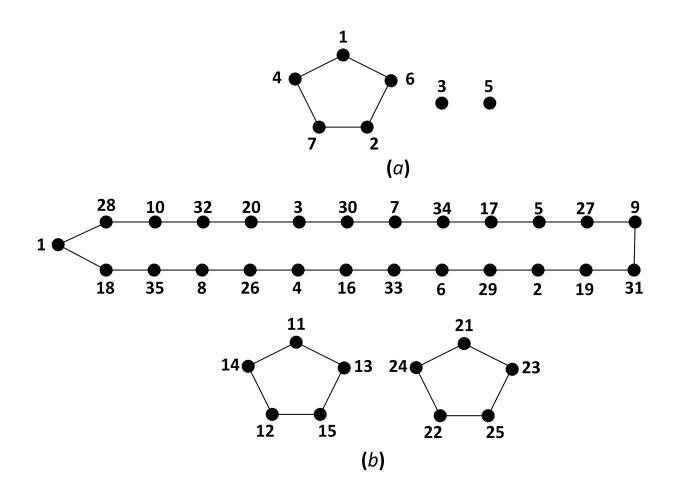
Figure 3. (a). A PSEML of C5 ∪ 2K1. (b). A SEMTL of C25 ∪ 2C5 which is obtained by applying Theorem 3.1 to C5 ∪ 2K1.
Corollary 3.3. Let m, r ≥ 1, l ≥ 2, and n ≥ 4 be positive integers such that m is odd and l ≡ 2 (mod 4). Then all the following graphs have zero SEMD.
- a) m[Cn(2r+1) ∪ C2r+1], if n ≡ 0 (mod 2).
- b) m[Cn(2r+1) ∪ 2C2r+1], if n ≡ 1 (mod 2).
- c) m[C4(2r+1) ∪ Cn(2r+1) ∪ C2r+1], if n ≡ 0 (mod 4).
- d) m[C4(2r+1) ∪ Cn(2r+1) ∪ C2r+1], if n ∈ {6, 10, 14, 18, 22, 26}.
- e) lC4(2r+1) ∪ m[Cn(2r+1) ∪ C2r+1], if n ≡ 8, 12 (mod 16).
Acknowledgement
The authors express their gratitude to the referee for his/her insightful comments. The first author has been supported by "Hibah Kompetensi 2018", 019/SP2H/K2/KM/2018, from the Directorate General of Higher Education, Indonesia.
References
- [1] A. Ahmad, I. Javaid and M.F. Nadeem, Further results on super edge-magic deficiency of unicyclic graphs, Ars Combin. 99 (2011), 129–138.
- [2] S. Cichacz-Przenioslo, D. Froncek, and I. Singgih, Vertex magic total labelings of 2-regular graphs, Discrete Math., 340 (1) (2017), 3117–3124. DOI: 10.1016/j.disc.2016.06.022
- [3] H. Enomoto, A. Llado, T. Nakamigawa, and G. Ringel, Super edge magic graphs, SUT J. Math., 34 (1998), 105–109.
- [4] R.M. Figueroa-Centeno, R. Ichishima, and F.A. Muntaner-Batle, The place of super edgemagic labelings among other classes of labelings, Discrete Math., 231 (2001), 153–168.
- [5] R.M. Figueroa-Centeno, R. Ichishima, and F.A. Muntaner-Batle, On the super edge-magic deficiency of graphs, Ars Combin., 78 (2002), 33–45.
- [6] R.M. Figueroa-Centeno, R. Ichishima, and F.A. Muntaner-Batle, On edge-magic labelings of certain disjoint unions of graphs, Australas J. Combin. 32 (2005), 225–242.
- [7] J.A. Gallian, A dinamic survey of graph labelings, Electron. J. Combin. 16 (2024) # DS6.
- [8] J. Holden, D. McQuillan and J.M. McQuillan, A conjecture on strong magic labelings of 2-regular graphs, Discrete Math. 309 (2009), 4130–4136.
- [9] R. Ichishima, F.A. Muntaner-Batle and A. Oshima, Enlarging the classes of super edge-magic 2-regular graphs, AKCE Int. J. Graphs Comb. 10 (2) (2013), 129–146.
- [10] R. Ichishima and A. Oshima, On the super edge-magic deficiency and α-valuation of graphs, J. Indones. Math. Soc. Special Edition (2011), 59–69.
- [11] R. Ichishima and A. Oshima, On the super edge-magic deficiency of 2-regular graphs with two components, Ars Combin. 129 (2016), 437–447.
- [12] A. Kotzig and A. Rosa, Magic valuation of finite graphs, Canad. Math. Bull. 13 (4) (1970), 451–461.
- [13] V.H. Krisnawati, A.A.G. Ngurah, N. Hidayat, and A.R. Alghofari, On the super edge-magic deficiency of some graphs, Heliyon 6 (2020), 1–10.
- [14] A.A.G. Ngurah, On super edge-magic deficiency of chain graphs, J. Combin. Math. Combin. Comput. 103 (2017), 225–236.
- [15] A.A.G. Ngurah and Adiwijaya, New results on the (super) edge-magic deficiency of chain graphs, International Journal of Mathematics and Mathematical Sciences, Vol. 2017, Article ID 5156974, 6 pages, https://doi.org/10.1155/2017/5156974.
- [16] A.A.G. Ngurah, E.T. Baskoro, and R. Simanjuntak, On super edge-magic deficiency of graphs, Australas. J. Combin. 40 (2008), 3–14.
- [17] A.A.G. Ngurah and R. Simanjuntak, Super edge-magic labelings: deficiency and maximality, Electron. J. Graph Theory Appl. 5 (2) (2017), 212–220.
- [18] A.A.G. Ngurah and R. Simanjuntak, Super edge-magic deficiency of join-product graphs, Util. Math. 105 (2017), 279 -– 289.
- [19] A.A.G. Ngurah and R. Simanjuntak, On the super edge-magic deficiency of join product and chain graphs, Electron. J. Graph Theory Appl. 7 (1) (2019), 157–167.