Risma Yulina Wulandaria , Rinovia Simanjuntak ∗,b,c, Suhadi Wido Saputrob,c
aDoctoral Program in Mathematics, Faculty of Mathematics and Natural Sciences, Institut Teknologi Bandung, Jalan Ganesa 10 Bandung, Indonesia bCombinatorial Mathematics Research Group, Faculty of Mathematics and Natural Sciences, Institut Teknologi Bandung, Jalan Ganesa 10 Bandung, Indonesia cCentre for Research Collaboration in Graph Theory and Combinatorics, Indonesia
rismayulina2107@gmail.com, rino@itb.ac.id, suhadi@itb.ac.id
Let D be a non-empty subset of the distance set {0, 1, . . . , diam(G)}. A graph G is D-antimagic if there exists a bijection f : V (G) → {1, 2, . . . , |V (G)|} such that for every pair of distinct vertices x and y, wD(x) ̸= wD(y), where wD(x) = P z∈ND(x) f(z) is the D-weight of x and ND(x) = {z|d(x, z) ∈ D} is the D-neighbourhood of x. It was conjectured that a graph G is Dantimagic if and only if each vertex in G has a distinct D-neighborhood. A completely separating system (CSS) in the finite set {1, 2, . . . , n} is a collection C of subsets of {1, 2, . . . , n} in which for each pair a ̸= b ∈ {1, 2, . . . , n}, there exist A, B ∈ C such that a ∈ A − B and b ∈ B − A.
In this paper, we provide evidence to support the conjecture mentioned earlier by using Roberts' completely separating systems to define D-antimagic labelings for certain graphs. In particular, we show that if G and H are D-antimagic graphs with labelings constructed from Roberts' CSS, then the vertex-deleted subgraph, G − {v} and the vertex amalgamation of G and H are also Dantimagic. Additionally, we partially answer an open problem of Simanjuntak et al. (2021) by constructing {1}-antimagic labelings for some disjoint unions of paths.
Keywords: antimagic labeling, D-antimagic labeling, completely separating system, vertex amalgamation, union Mathematics Subject Classification: 05C12, 05C78 DOI: 10.5614/ejgta.2025.13.2.2
Received: 3 October 2024, Revised: 3 June 2025, Accepted: 15 June 2025.
∗ corresponding author
1. Introduction
Let G = G(V, E) be a simple, finite, undirected graph with vertex set V (G) and edge set E(G). An antimagic labeling of G is a bijection from E(G) to the set of integers {1, 2, . . . , |E(G)|} such that all vertex weights are pairwise distinct, where the vertex weight is the sum of labels of all edges incident with the vertex under consideration. A graph is antimagic if it admits an antimagic labeling. The notion of antimagic labeling was introduced in 1990 by Hartsfield and Ringel [12], where it was conjectured that
Conjecture 1.1. [12] Every connected graph except P2 is antimagic.
In more than three decades, many papers have been published supporting Conjecture 1.1, which utilized wide-ranging methods. Using a probabilistic method, Alon et al. [1] proved the conjecture for graphs with a minimum degree of at least C log |V |, for some constant C. Eccles [10] improved this result by proving the conjecture for graphs with an average degree of at least some constant d0. Hefetz, Saluz, and Tran [13] utilized the Combinatorial Nullstellensatz to prove that if a graph on p k vertices, where p is an odd prime and k is a positive integer, admits a Cp-factor, then it is antimagic. A series of articles by Cranston, Liang, and Zhu [7], Berczi, Bern ´ ath, and Vizer [3], ´ and Chang et al. [4] showed that for k ≥ 2, every k-regular graph is antimagic. Lozano et. al. [17] proved that caterpillars are antimagic using an O(n log n) algorithm. Separately, Phanalasy et. al. [19] provided evidence that some families of regular graphs are antimagic by using completely separating systems.
In 2013, Kamatchi and Arumugam [14] introduced a variation of antimagic labeling, where vertices are labeled, and the weight of each vertex is the sum of its neighbors' labels. A graph G is said to be distance antimagic if there is a bijection f : V (G) → {1, 2, . . . , v} such that for every pair of distinct vertices x and y holds that w(x) ̸= w(y), where w(x) = P u∈N(x) f(u) and N(x) = {u|ux ∈ E(G)}. An obvious necessary condition for a graph to be distance antimagic is that it does not contain two vertices with the same neighborhood. Kamatchi and Arumugam then conjectured that the necessary condition is also sufficient.
Conjecture 1.2. [14] A graph G is distance antimagic if and only if G does not have two vertices with the same neighborhood.
The families of graphs supporting the truth of Conjecture 1.2 are, among others, the path Pn with n ̸= 3, the cycle Cn with n ̸= 4, the wheel Wn with n ̸= 4 [14], the hypercube Qn with n ≥ 3 [15], some circulant graphs [25], and some Kneser graphs [2]. In 2016, Llado and Miller [16] utilized the Combinatorial Nullstellensatz to prove that a tree with ℓ leaves and 2ℓ vertices is distance antimagic. Additionally, some graphs resulting from the following products: Cartesian, direct, strong, join, lexicographic, and corona have been proved to be distance antimagic [23, 22, 26].
Notice that Conjecture 1.2 applies to all graphs, while Conjecture 1.1 only covers connected graphs. It is not difficult to see that the union of two three-paths is not antimagic. In fact, it has
been shown that for any antimagic graph G, there exists a sufficiently large t such that G ∪ tP3 is not antimagic [5].
In 2021, Simanjuntak, et. al. [24] generalized the concept of the antimagic distance graph to the D-antimagic graph, considering the D-neighborhood instead of the neighborhood.
Definition 1.1. [24] Let G be a graph with diameter diam(G) and D be a non-empty subset of {0, 1, 2, . . . , d}. A D-antimagic labeling on G is a bijection f : V (G) → {1, 2, . . . , |V (G)|} such that wD(x) = P y∈ND(x) f(y) is distinct for every vertex x, where ND(x) = {y ∈ V (G)|d(x, y) ∈ D} is the D-neigbourhood of x. If G admits a D-antimagic labeling, then G is called Dantimagic.
Naturally, Conjecture 1.2 is also generalized to the following.
Conjecture 1.3. [24] A graph G is D-antimagic if and only if ND(x) ̸= ND(y), for every x, y ∈ V (G).
Let r be a positive integer and G be a simple graph. G is said to be a (D, r)-regular graph if |ND(x)| = r for every x ∈ V (G). Recall that the disjoint union of G and H, denoted by G ∪ H, is the graph with V (G ∪ H) = V (G)∪V (H) and E(G ∪ H) = E(G)∪ E(H). It is clear that if G and H do not have two vertices with the same D-neighborhood, then so does G ∪ H. One of the general results supporting Conjecture 1.3 is that the disjoint union preserves the antimagicness of (D, r)-regular graphs, a direct consequence of the following theorem.
Theorem 1.1. [24] Let D ⊂ {0, 1, . . . , d}. If G and H are D-antimagic, H is (D, r)-regular, and |ND(x)| ≤ r, for every x ∈ V (G), then G S H is D-antimagic.
For example, it was proved that disjoint copies of the shadow graphs of a cycle are {2} antimagic [18]. In general, closedness under union is unknown for the set of non-regular Dantimagic graphs. Even for paths and D = {1}, although it is known that Pm ∪ Pn (m, n > 3) and mPn (n ̸= 3) are distance antimagic [24], there is still no proof that the disjoint union of arbitrary paths is distance antimagic.
Problem 1.1. [24] Show that ∪ k i=1Pni , where ni ̸= 3, 1 ≤ i ≤ k, is distance antimagic.
In this paper, we partially answer Problem 1.1 (Section 4) by utilizing modifications of completely separating systems (Section 2). Additionally, we use completely separating systems to construct D-antimagic labelings for amalgamated graphs (Section 3). All these results provide evidence to support Conjecture 1.3.
2. Modification of Completely Separating System (CSS)
In 1961, Renyi [20] raised the problem of finding minimal separating systems in the context of solving certain problems in information theory. Dickson [9] then introduced the completely separating system in 1969.
Definition 2.1. [9] Let n, d, k be integers. A completely separating system on \([n] = \{1, 2, ..., n\}\), denoted by (n)-CSS, is a collection C of subsets [n] in which for each distinct pair \(a, b \in [n]\), there exist \(A, B \in C\) such that \(a \in A - B\) and \(b \in B - A\). A d-element in [n] is an element that occurs in exactly d sets in C. An (n)-CSS is called an (n,k)-CSS if |A| = k, for every \(A \in C\). R(n,k) is defined as the minimum of |C| among all (n,k)-CSS C and an (n,k)-CSS with |C| = R(n,k) is said to be minimal.
Roberts [21] designed a construction to obtain a class of minimal (n,k)-CSS, as described in the following.
Definition 2.2. (Roberts Construction) [21] Let \(k \geq 2\), \(n \geq {k+1 \choose 2}\), k|2n, and \(R = R(n,k) = \frac{2n}{k}\). Construct an \((R \times k)\)-array L as follows: Let \(e_{ij}\) denote the element of L in the \(i^{th}\) row and the \(j^{th}\) column. Initialize all elements of L to zero. For e from I to n, in order, include e in the two positions of L defined by
\[\min_{j} \min_{i} \{ e_{ij} : e_{ij} = 0 \}\] \[\min_{i} \min_{j} \{ e_{ij} : e_{ij} = 0 \}.\]
The \((R \times k)\)-array L is referred to as a Roberts array. Each row of L forms a subset of [n] and the R rows of L form an (n,k)-CSS from Robert's construction.
Example 2.1. The (n,2)-CSS from the Roberts' construction is the set of rows of the following \((n \times 2)\)-array L.
\[L = \begin{pmatrix} 1 & 2 \\ 1 & 3 \\ 2 & 4 \\ 3 & 5 \\ \dots & \dots \\ n-2 & n \\ n-1 & n \end{pmatrix}\]
For \(n=\frac{k(k+1)}{2}\), the \((\frac{k(k+1)}{2},k)\)-CSS from the Roberts construction is described in the following example.
Example 2.2. The \((\frac{k(k+1)}{2}, k)\)-CSS from the Roberts' Construction is the set of rows of the following \(((k+1) \times k)\)-array L.
\[L = \begin{pmatrix} 1 & 2 & 3 & 4 & \dots & k \\ 1 & k+1 & k+2 & k+3 & \dots & 2k-1 \\ 2 & k+1 & 2k & 2k+1 & \dots & 3k-3 \\ 3 & k+2 & 2k & 3k-2 & \dots & 4k-6 \\ \vdots & \vdots & \ddots & \vdots & \ddots & \vdots \\ k-1 & 2k-2 & 3k-4 & 4k-7 & \dots & \frac{k(k+1)}{2} \\ k & 2k-1 & 3k-3 & 4k-6 & \dots & \frac{k(k+1)}{2} \end{pmatrix}\]
We can rewrite the Roberts array L in Example 2.2 as follows.
Observation 2.1. Let k ≥ 3. A (k + 1) × k array L in Definition 2.2 can be written iteratively as follows:
\[\begin{split} L_{1,1} &= 1, \\ L_{i,j} &= L_{i,j-1} + 1, \ \textit{for} \ i \geq 1 \ \textit{and} \ i < j \leq k, \\ L_{i,i} &= L_{i-1,k} + 1, \ \textit{for} \ 2 \leq i \leq k, \\ L_{i,j} &= L_{j,i-1}, \ \textit{for} \ i \geq 2 \ \textit{and} \ 1 \leq j < i. \end{split}\]
In [19], it was shown that a special case of (n)-CSS defines a simple graph, as described below.
Theorem 2.1. [19] Let V = {v1, v2, . . . , vp} be a collection of subsets of [q]. If V is a (q) − CSS in which each element of [q] appears in exactly two vis and E is the set of all unordered pairs {vi , vj} where vi ∩vj ̸= ∅, then G = (V, E) is a simple graph, where |V (G)| = p and |E(G)| = q.
We shall show that some (n)-CSS from Roberts' Construction not only define simple graphs but also provide D-antimagic labelings of them. In such a case, we use the following notion for the graph under consideration.
Definition 2.3. Let n be a positive integer, A be an (n)-CSS from Roberts' Construction, and G be a graph with n vertices. G is said to be D-antimagic over A, if a D-antimagic labeling of G can be constructed from A.
Examples of graphs that are D-antimagic over an (n)-CSS from the Roberts' Construction can be seen in Theorems 2.2 and 2.3.
Theorem 2.2. Let A be the (n, 2)-CSS from Roberts' Construction. For odd n, Cn is distance antimagic over A.
Proof. Let V (Cn) = {v1, v2, . . . , vn}, E(Cn) = {v1v2, v2v3, . . . , vn−1vn, vnv1}, and L be the n×2 array corresponding to A. We can define a bijection g such that the labels of the neighbours of the vertices of the Cn coincide with the rows of the array L. Define a bijection
\[g: V(C_n) \longrightarrow \{L_{a,b} | 1 \le a \le n \text{ and } 1 \le b \le 2\}\]
by Algorithm 1.
Since La,b is an array corresponding to an (n, 2)-CSS A, we can always find two distinct rows with the same entry. This ensures that we can always find a /∈ I as required by Algorithm 1. Furthermore, through the previous algorithm, the weight of a vertex is the sum of the entries in a row. Then, it is clear that
\[\{w(x)|x \in C_n\} = \{1+2\} \cup \{1+3, 2+4, ..., 2n-2\} \cup \{2n-1\}.\]
Algorithm 1 Distance antimagic labeling for Cn
Require: n ≥ 3 odd
  I ← {1}
  g(v1) ← L1,1
  g(v3) ← L1,2
  t ← L1,2
  i ← 1
  j ← 5
  while i ≤ n − 2 do
      Find a ∈ {1, 2, . . . , n}\I and b such that La,b = t
      g(vj ) ← La,3−b
      t ← La,3−b
      Add a to I
      j ← j + 2 mod n
      i ← i + 1
  end while
An example of a cycle that is distance antimagic over a (n)-CSS from Roberts' Construction can be found in Figure 1.
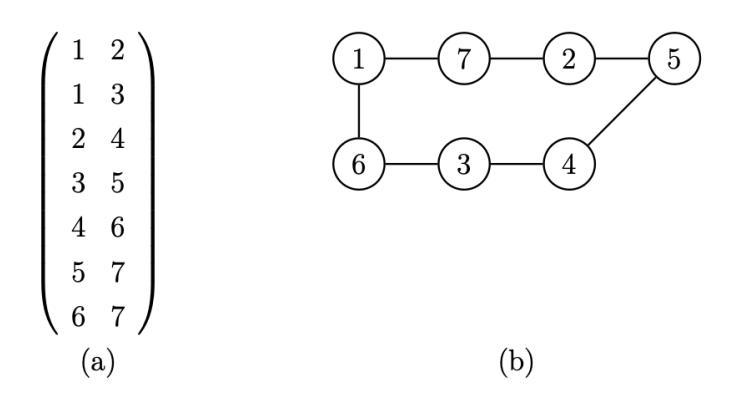
Figure 1: (a) A (7, 2)-CSS A from Roberts' Construction. (b) The cycle C7 that is distance antimagic over A.
Note that Algorithm 1 can only be used to provide the distance antimagic labeling for odd cycles. Since for even n, the iteration for j only produces odd numbers, meaning there are no labels for vj with even j.
Previously, Kamatchi and Arumugam [14] constructed a distance antimagic labeling for odd cycles with a labeling f(vi) = i. Our Algorithm 1 provides an alternative distance antimagic labeling for odd cycles.
For the second example for Definition 2.3, first we define a new (k + 1) × (k + 1) array S from the array L in Example 2.2 as follows: for each i > j, Si,j = x iff x = Li,a and x = Lj,b with
\(1 \le a, b \le k\). Another way to define the array S is described in the following observation.
Observation 2.2. Let \(k \ge 3\). The \((k+1) \times (k+1)\) array S can be written iteratively as follows:
\[S_{1,2} = 1,\] \[S_{i,j} = S_{i,j-1} + 1, \text{ for } i + 2 < j \le k + 1,\] \[S_{i,i+1} = S_{i-1,k} + 1, \text{ for } 1 < i \le k + 1,\] \[S_{i,j} = 0, \text{ for } 1 \le j \le i.\]
Example 2.3. For k = 4, the arrays L and S are as follows:
\[L = \begin{bmatrix} 1 & 2 & 3 & 4 \\ 1 & 5 & 6 & 7 \\ 2 & 5 & 8 & 9 \\ 3 & 6 & 8 & 10 \\ 4 & 7 & 9 & 10 \end{bmatrix} S = \begin{bmatrix} 0 & 1 & 2 & 3 & 4 \\ 0 & 0 & 5 & 6 & 7 \\ 0 & 0 & 0 & 8 & 9 \\ 0 & 0 & 0 & 0 & 10 \\ 0 & 0 & 0 & 0 & 0 \end{bmatrix}.\]
The following shows that we can construct a set of cardinality \(\frac{k(k+1)}{2}\), whose elements are the sum of two rows of the array L.
Proposition 2.1. Let \(k \geq 3\) and \(b(L(i)) = \sum_{j=1}^{k} L_{i,j}\). If \(\mathcal{G} = \{b(L(i)) + b(L(j)) - S_{i,j} | 1 \leq i < j \leq k+1 \}\) then \(|\mathcal{G}| = \frac{k(k+1)}{2}\).
Proof. It is clear that \(b(L(1)) = \frac{k}{2}(k+1) = \frac{k^2+k}{2}\). For \(r \geq 2\),
\[b(L(r)) = (r-1) + (r+k-2) + \dots + ((r-1) + (r-2)((k-1) - (\frac{r-3}{2}))) + \frac{k-r+1}{2} (2((r-1) + (r-2)((k-1) - (\frac{r-3}{2}) + k + 2 - r) + k - r)\] \[= (r-1)^2 + \frac{(k)(r^2 - 3r + 2)}{2} - \frac{2r^3 - 6r^2 + 4r}{12} + \frac{k-r+1}{2} (2k(r-1) - r^2 + 2r + k).\]
Thus b(L(x)) < b(L(y)) for every x < y, and
\[(b(L(i)) + b(L(j)) - S_{i,j}) \neq (b(L(x)) + b(L(y)) - S_{x,y}).\]
Then, \[|\mathcal{G}| = \frac{k(k+1)}{2}\] for \(k \geq 3\).
Now we are ready to construct the second example for Definition 2.3. For \(k \geq 3\), let \(\mathcal{R}_k\) be a graph with vertex-set \(V(\mathcal{R}_k) = \{1, 2, \dots, \frac{k(k+1)}{2}\}\) and (x, y) be an edge in \(\mathcal{R}_k\) if and only if there exists i \((1 \leq i \leq k+1)\) such that x, y are entries in the \(i^{th}\) column of \((k+1) \times k\) array L from Roberts' Construction in Example 2.2. Now, consider that A is the \((\frac{k(k+1)}{2}, k)\)-CSS corresponding to L, then the following holds.
Theorem 2.3. \(\mathcal{R}_k\) is (2k-2)-regular and \(\{0,1\}\)-antimagic over A.
Proof. Since L is a (k + 1) × k array, each vertex has 2(k − 1) neighbors, and Rk is a (2k − 2) regular graph. Furthermore, since each x is located in two different rows in L, and S contains k(k+1) 2 distinct natural numbers starting from 1, there exist a, b such that x = Sa,b. Clearly, if x = Sa,b, then x is located in row a and row b in L.
Thus, w{0,1}(x) = b(L(a)) + b(L(b)) − Sa,b for every x ∈ V (Rk). And due to Proposition 2.1, Rk is {0, 1}-antimagic.
An example of a 6-regular graph R4 that is {0, 1}-antimagic over a (10, 4)-CSS from Robert's Construction can be found in Figure 2.
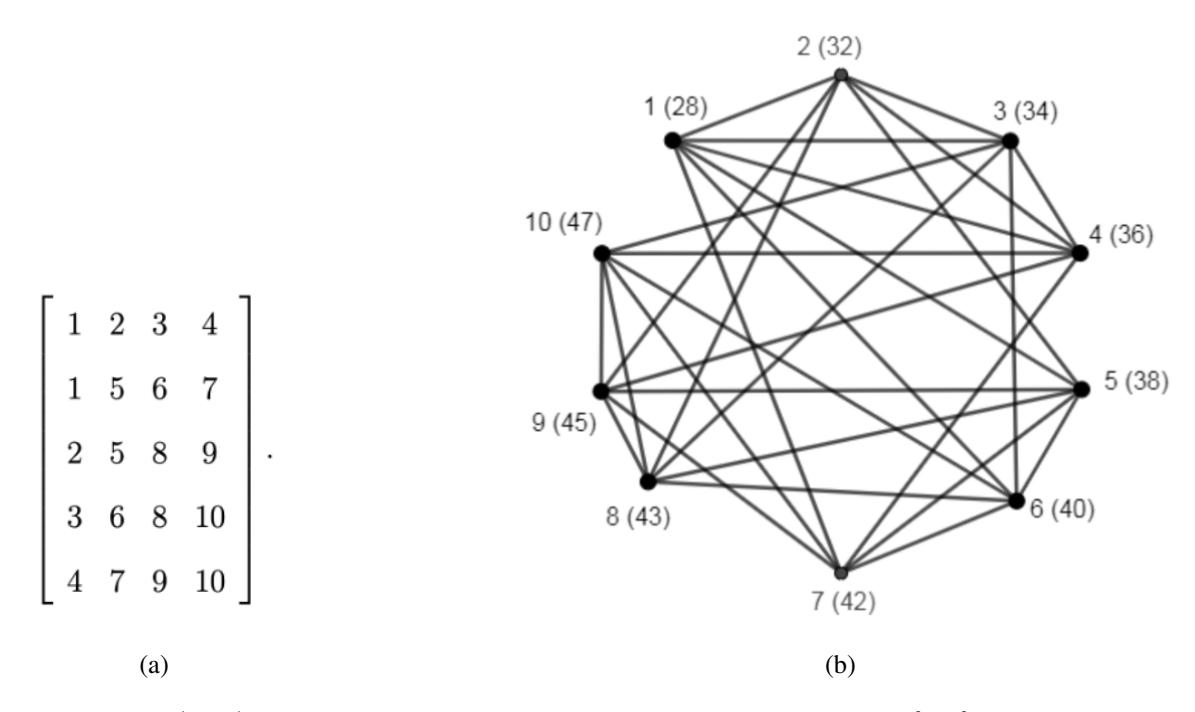
Figure 2: (a) A (10, 4)-CSS A from Robert's Construction. (b) The graph R4 that is {0, 1}-antimagic over A.
Now, we will define our modification of (n, 2)-CSS from Roberts' Construction and use the corresponding array to provide an alternative construction of distance antimagic labelings of 2 regular graphs. Recall that a 2-regular graph is known to be distance antimagic since it is a disjoint union of a cycle that is regular and distance antimagic [14, 24].
Definition 2.4. Let k, n1, n2, . . . , nk, be integers with 3 ≤ n1 ≤ n2 ≤ . . . ≤ nk, ni ̸= 4, ∀i, and
\[a_1 = 0\], \(a_i = \sum_{j=1}^{i-1} n_j\), for \(i \geq 2\). Define \(C(n_1, n_2, ..., n_k) = \{M_1, M_2, ..., M_k\}\) with
\[\text{[rumus tidak dapat ditampilkan dengan baik — lihat PDF asli]}\]
\[M_{i} = \left(\begin{array}{c|c} \frac{(\frac{n_{i}}{2}, 2)\text{-}CSS}{a_{i}} \\ \hline \\ (\frac{n_{i}}{2}, 2)\text{-}CSS \end{array}\right) + \left[\begin{array}{c|c} a_{i} & a_{i} \\ \hline \\ a_{i} & a_{i} \\ \hline \\ a_{i} & a_{i} \\ \hline \\ a_{i} + \frac{n_{i}}{2} & a_{i} + \frac{n_{i}}{2} \\ \hline \\ a_{i} + \frac{n_{i}}{2} & a_{i} + \frac{n_{i}}{2} \\ \hline \\ \vdots & \vdots & \vdots \\ a_{i} + \frac{n_{i}}{2} & a_{i} + \frac{n_{i}}{2} \\ \hline \\ \vdots & \vdots & \vdots \\ a_{i} + \frac{n_{i}}{2} & a_{i} + \frac{n_{i}}{2} \\ \hline \end{array}\right], \ \textit{for even } n_{i}.\]
For \(M_i \in C(n_1, n_2, \dots, n_k)\). Denote the sum of the \(r^{th}\) row of \(M_i\) by \(b(M_i(r)) = M_i(r, 1) + M_i(r, 2)\). We shall show that the sum for each row is distinct. For \(a, b \in \mathbb{N}\), with b - a an even positive integer, \([a, b]_2 = \{a, a + 2, a + 4, \dots, b\}\).
Proposition 2.2. Let \(k, n_1, n_2, ..., n_k\) be integers with \(3 \le n_1 \le n_2 \le ... \le n_k\) and \(n_i \ne 4\), for all i. Let \(C = \{b(M_i(r)) | 1 \le i \le k, 1 \le r \le n_i\}\) for \(C(n_1, n_2, ..., n_k)\), then \(|C| = n_1 + n_2 + ... + n_k\).
Proof. Let \[C = A_1 \cup A_2 \cup \ldots \cup A_k\] with \(A_i = \{b(M_i(r)) | 1 \le r \le n_i\}\), then
\[\text{[rumus tidak dapat ditampilkan dengan baik — lihat PDF asli]}\]
\[A_i = \{2a_i + 3\} \cup [2a_i + 4, 2a_i + n_i - 2]_2 \cup \{2a_i + n_i - 1\}\]
\[\cup \{2a_i + n_i + 3\} \cup [2a_i + n_i + 4, 2a_i + 2n_i - 2]_2 \cup \{2a_i + 2n_i - 1\}, \text{ for even } n_i.\]
By counting the members of \(A_i\), it is clear that \(|A_i| = n_i\). Furthermore, since
\[\max\{A_i\} = 2a_i + 2n_i - 1 < 2(a_i + n_i) + 3 = 2a_{i+1} + 3 = \min\{A_{i+1}\},\\]
then \[A_i \cap A_j = \emptyset\], for \(i \neq j\). Thus, \(|\mathcal{C}| = n_1 + n_2 + \ldots + n_k\).
We then modify the array in Definition 2.4 to two arrays that will be used to construct distance antimagic labelings for the disjoint union of some odd paths (Definition 2.5) and some even paths (Definition 2.6). Recall that the existence of distance antimagic labelings for the disjoint union of paths is generally open. (See Problem 1.1.)
Definition 2.5. Let k be a positive integer, and \(n_1, n_2, \ldots, n_k\) be positive odd integers, where \(n_i \neq \sum_{j=1}^{i-1} n_j\), \(\forall i\) and \(n_{i+1} \geq n_i\). If \(a_1 = 0\) and \(a_i = \sum_{j=1}^{i-1} n_j\), define
\[PO(n_1, n_2, \dots, n_k) = \{N_1, N_2, \dots, N_k\},\\]
where for odd \(a_i\),
\[N_i(a,b) = \begin{cases} 0, & \text{for } (a,b) = (1,1) \text{ and } (a,b) = (n_i,2) \\ M_i(a,b), & \text{otherwise,} \end{cases}\]
and for even \(a_i\),
\[N_i(a,b) = \begin{cases} 0, & \text{for } (a,b) = (1,2) \text{ and } (a,b) = (n_i - 1,2) \\ M_i(a,b), & \text{otherwise.} \end{cases}\]
Next, we show that the sum of each row in the array PO is distinct.
Proposition 2.3. For \(PO(n_1, n_2, ..., n_k)\), let \(PO = \{b(N_i(r)) | 1 \le i \le k, 1 \le r \le n_i\}\). Then \(|PO| = n_1 + n_2 + ... + n_k\).
Proof. Let \(\mathcal{PO} = A_1 \cup A_2 \cup \ldots \cup A_k\) with \(A_i = \{b(N_i(r)) | 1 \le r \le n_i\}\). It will be proved that \(|\mathcal{PO}| = n_1 + n_2 + \ldots + n_k\) by showing that \(|A_i \cup A_{i+1}| = n_i + n_{i+1}\), for every \(i \in \{1, 2, \ldots, k-1\}\). Case 1. For even \(a_i\), \(A_i = \{a_i + 1\} \cup [2a_i + 4, 2a_i + 2n_i - 4]_2 \cup \{a_i + n_i - 2\} \cup \{2a_i + 2n_i - 1\}\) and \(A_{i+1} = \{a_i + n_i + 2\} \cup [2a_i + 2n_i + 4, 2a_i + 2n_i + 2n_{i+1} - 2]_2 \cup \{a_i + n_i + n_{i+1} - 1\}\). Note that \(a_i + 1, a_i + n_i - 2, a_i + n_i + 2, 2a_i + 2n_i - 1, a_i + n_i + n_{i+1} - 1\) are odd, with \(a_i + 1 < a_i + n_i - 2 < a_i + n_i + 2 < 2a_i + 2n_i - 1/a_i + n_i + n_{i+1} - 1\) and \(2a_i + 2n_i - 1 \ne a_i + n_i + n_{i+1} - 1\). It is clear that \(|A_i \cup A_{i+1}| = n_i + n_{i+1}\).
Case 2. For odd \(a_i\), \(A_i = \{a_i + 2\} \cup [2a_i + 4, 2a_i + 2n_i - 2]_2 \cup \{a_i + n_i - 1\}\) and \(A_{i+1} = \{a_i + n_i + 1\} \cup [2a_i + 2n_i + 4, 2a_i + 2n_i + 2n_{i+1} - 4]_2 \cup \{a_i + n_i + n_{i+1} - 2\} \cup \{2a_i + 2n_i + 2n_{i+1} - 1\}\). Note that \(a_i + 2, a_i + n_i - 1, a_i + n_i + 1, a_i + n_i + n_{i+1} - 2, 2a_i + 2n_i + 2n_{i+1} - 1\) are odd, with \(a_i + 2 < a_i + n_i - 1 < a_i + n_i + 1 < a_i + n_i + n_{i+1} - 2 < 2a_i + 2n_i + 2n_{i+1} - 1\). Based on the previous fact, it follows that \(|A_i \cup A_{i+1}| = n_i + n_{i+1}\).
Since \(A_{i+2} = \{2(n_i + n_{i+1}) + b(N_i(r)|r \neq 1, n_i\} \cup \{(n_i + n_{i+1}) + b(N_i(r)|r = 1, n_i\} \text{ for odd } a_i \text{ and } A_{i+2} = \{2(n_i + n_{i+1}) + b(N_i(r)|r \neq 1, n_i - 1\} \cup \{(n_i + n_{i+1}) + b(N_i(r)|r = 1, n_i - 1\} \text{ for even } a_i, \text{ then } \max\{x|x \in A_i\} < \min\{x|x \in A_{i+2}\}.\)
Thus \[|\mathcal{PO}| = n_1 + n_2 + \ldots + n_k\]
Definition 2.6. Let \(k, \beta\) be positive integers and \(n_1, n_2, \ldots, n_k\) be even positive integers. Suppose that \(a_1 = \beta\) and \(a_i = \beta + \sum_{j=1}^{i-1} n_j\), \(i \in [2, k]\), such that for \(j \in [2, k]\), satisfy
- \(n_j \neq 2(a_i + 4 \sum_{l=i+1}^{j-1} n_l)\) and \(n_j \neq a_i + 3 \sum_{l=i+1}^{j-1} n_l\), for i < j, \(a_j\) odd, and \(n_j \equiv 2 \pmod{4}\),
- \(n_j \neq 2(a_i + 5 \sum_{l=i+1}^{j-1} n_l)\) and \(n_j \neq a_i + 3 \sum_{l=i+1}^{j-1} n_l\), for i < j, \(a_j\) odd, and \(n_j \equiv 0 \pmod{4}\),
- \(n_j \neq 2(a_{i+1} 2 n_{j-1})\), for i + 1 < j, \(a_j\) even, and \(n_j \equiv 2 \pmod{4}\),
- \(n_j \neq 2(a_{i+1} 3 \sum_{l=i+1}^{j-1} n_l)\), for i + 1 < j, \(a_j\) even, and \(n_j \equiv 0 \pmod{4}\).
Define \(PE(\beta; n_1, n_2, ..., n_k) = \{L_1, L_2, ..., L_k\}\), where for odd \(a_i\) and \(n_i \equiv 0 \pmod{4}\),
\[L_i(a,b) = \begin{cases} 0, & \text{for } (a,b) = (\frac{n_i}{2} - 1, 2) \text{ and } (a,b) = (n_i - 1, 1), \\ \beta + M_i(a,b), & \text{for the other } (a,b), \end{cases}\]
for odd \(a_i\) and \(n_i \equiv 2 \pmod{4}\),
\[L_{i}(a,b) = \begin{cases} 0, \text{ for } (a,b) = (\frac{n_{i}}{2},2) \text{ and } (a,b) = (n_{i},1), \\ \beta + M_{i}(a,b), \text{ for the other } (a,b), \end{cases}\]
for even \(a_i\) and \(n_i \equiv 0 \pmod{4}\),
\[L_i(a,b) = \begin{cases} 0, & \text{for } (a,b) = (2,1) \text{ and } (a,b) = (\frac{n_i}{2} + 2, 2), \\ \beta + M_i(a,b), & \text{for the other } (a,b), \end{cases}\]
and for even \(a_i\) and \(n_i \equiv 2 \pmod{4}\).
\[L_i(a,b) = \begin{cases} 0, & \text{for } (a,b) = (1,2) \text{ and } (a,b) = (\frac{n_i}{2} + 1,1) \\ \beta + M_i(a,b), & \text{for the other } (a,b). \end{cases}\]
As with the previous arrays, we shall show that the sum of each row in the array PE is distinct.
Proposition 2.4. For \(PE(\beta; n_1, n_2, ..., n_k)\), let \(P\mathcal{E} = \{b(L_i(r)) | 1 \le i \le k, 1 \le r \le n_i\}\). Then \(|P\mathcal{E}| = n_1 + n_2 + ... + n_k\).
Proof. Let \(\mathcal{PE} = A_i \cup A_2 \cup \ldots \cup A_k\) with \(A_i = \{b(L_i(r))|1 \leq r \leq n_i\}\). We will prove that \(|A_i \cup A_j| = n_i + n_j\). Without loss of generality, let i < j. We give the proof for odd \(\beta\), whereas for even \(\beta\) the proof is similar.
Case 1. For \(n_i \equiv 2 \pmod{4}\), we have \(A_i = \{2a_i + 3\} \cup [2a_i + 4, 2a_i + n_i - 2]_2 \cup \{a_i + \frac{n_i}{2} - 1, 2a_i + n_i + 3\} \cup [2a_i + n_i + 4, 2a_i + 2n_i - 2]_2 \cup \{a_i + n_i\}.\)
Case 1.1. For \(n_j \equiv 0 \pmod{4}\): Note that \(2a_i + 3\), \(a_i + \frac{n_i}{2} - 1\), \(2a_i + n_i + 3\), \(a_i + n_i\), \(2a_j + 3\), \(a_j + \frac{n_j}{2} - 2\), \(2a_j + n_j - 12a_j + n_j + 3\), \(a_j + n_j\), \(2a_j + 2n_j - 1\), with \(a_j = a_i + n_i + n_{i+1} + \ldots + n_{j-1}\) are distinct odd numbers. Since the other elements of \(A_i \cup A_j\) are even, based on Proposition 2.2, we have \(|A_i \cup A_j| = n_i + n_j\).
Case 1.2. For \(n_j \equiv 2 \pmod{4}\): Note that \(2a_i + 3\), \(a_i + \frac{n_i}{2} - 1\), \(2a_i + n_i + 3\), \(a_i + n_i\), \(2a_j + 3\), \(a_j + 3\)
\(\text{[rumus tidak dapat ditampilkan dengan baik — lihat PDF asli]}\)
Based on Proposition 2.3 and Proposition 2.4, it is clear that the following proposition is true.
Proposition 2.5. Let \(j, k \in \mathbb{N}\), with \(1 \le j \le k\). For \(PO(n_1, n_2, ..., n_j)\) and \(PE(\beta; n_{j+1}, n_{j+2}, ..., n_k)\) with \(a_{j+1} = \beta\), let \(\mathcal{F} = \{b(N_i(r)) | 1 \le i \le j, 1 \le r \le n_i\} \cup \{b(L_i(r)) | j+1 \le i \le k, 1 \le r \le n_i\}\). Then \(|\mathcal{F}| = n_1 + n_2 + ... + n_k\).
3. D-antimagic Labelings of Product Graphs
In this section, we construct D-antimagic labels for some amalgamated graphs as defined in the following definition.
Definition 3.1. [11] For \(t \in \mathbb{N}\), let \(\{G_i | 1 \le i \le t\}\) be a finite collection of graphs, each of which has a distinguished vertex \(v_{0_i}\) called a terminal. The amalgamation of \(\{G_i | 1 \le i \le t\}\), denoted by \(\mathrm{Amal}(G_i; v_{0_i})\), is the graph formed by taking all \(G_i\)s and identifying their terminals.
Theorem 3.1. Let \(n, m \in \mathbb{N}\), A be an n-CSS and B an m-CSS from Roberts' Construction. Let G and H be graphs with n and m vertices, with terminals \(u_n\) (which corresponds to the nth row of A) and \(v_1\) (which corresponds to the 1st row of B), respectively. If G and H are D-antimagic over n-CSS A and m-CSS B, respectively, then \(Amal(G, H; u_n, v_1)\) is D-antimagic.
Proof. Assume that \(\Delta_D(G) \leq \delta_D(H)\). We construct a D-antimagic labeling for \(\mathrm{Amal}(G, H; u_n, v_1)\) by adding n-1 to each entry in B. Since G and H are both D-antimagic and \(w_D(u_n) = w_D^G(u_n) + w_D^H(v_1)\), then the weights of all vertices in \(\mathrm{Amal}(G, H; u_n, v_1)\) are pairwise distinct. \(\square\)
Combining Theorems 3.1 and 2.2, we have the following corollary.
Corollary 3.1. If m, n are odd positive integers, then \(Amal(C_n, C_m)\) is distance antimagic.
To conclude this section, we provide a D-antimagic labeling for G minus a vertex with the smallest label, where G is already D-antimagic.
Theorem 3.2. Let \(n \in \mathbb{N}\) and A be an (n)-CSS from Roberts' Construction. If G is a D-antimagic graph over n-CSS A and v is a vertex with label 1, then G - v is D-antimagic.
Proof. We can construct a D-antimagic labeling for G-v by considering an array B whose entries are the result of subtracting 1 from each entry in A. It is easy to prove that G-v is D-antimagic over B.
As an example of the previous theorem, consider the following distance antimagic labeling for a path, obtained from a distance antimagic labeling for a cycle.
Example 3.1. From Theorem 2.2, the cycle \(C_5\) is distance antimagic over (5)-CSS A with
\[A = \begin{pmatrix} 1 & 2 \\ 1 & 3 \\ 2 & 4 \\ 3 & 5 \\ 4 & 5 \end{pmatrix}.\]
Define B by subtracting 1 from each entry of A,
\[B = \begin{pmatrix} 0 & 1 \\ 0 & 2 \\ 1 & 3 \\ 2 & 4 \\ 3 & 4 \end{pmatrix},\]
then we obtain the path \(P_4 = C_5 - v\) that is distance antimagic over B.
4. Distance Antimagic Labelings of Disjoint Union of Paths and Cycles
In this last section, we utilize the modifications of CSS from Roberts' construction in Section 2, in particular in Definitions 2.4, 2.5, and 2.6 to construct distance antimagic labelings of the disjoint union of some cycles, disjoint union of some paths, and disjoint union of some paths and some cycles. We start with a distance antimagic labeling of the disjoint union of some cycles.
Theorem 4.1. Let \(k, n_1, n_2, \ldots, n_k\) be integers with \(3 \le n_1 \le n_2 \le \ldots \le n_k\), and \(n_i \ne 4, \forall i\). Then \(\bigcup_{i=1}^k C_{n_i}\) is distance antimagic.
Proof. Let \(G = \bigcup_{i=1}^k C_{n_i}\), with \(V(C_{n_i}) = \{v_{i,j}|j=1,2,\ldots,n_i\}\) and \(E(C_{n_i}) = \{v_{i,j}v_{i,j+1}|j=1,2,\ldots,n_{i-1}\} \cup \{v_{i,1}v_{i,n_i}\}\). Define a mapping
\[g: V(G) \longrightarrow [1, \sum_{i=1}^{k} n_i],\]
where, for \(1 \le i \le k\),
\[g: V(C_{n_i}) \longrightarrow \{M_i(a,b) | M_i \in C(n_1, n_2, \dots, n_k) 1 \le a \le n_i \text{ and } 1 \le b \le 2\}\]
according to Algorithm 2.
It is clear that g is a bijection. Thus, we only need to prove that the algorithm produces a different weight for each vertex. From Algorithm 2, the labels of the neighbours of each vertex are the entries of a particular row of \(C(n_1, n_2, \ldots, n_k)\). Based on Proposition 2.2, we conclude that \(w(x) \neq w(y)\) for every \(x, y \in V(G)\) with \(x \neq y\).
Algorithm 2 A distance antimagic algorithm for \(C_{n_i}\), \(1 \le i \le k\)
Require: n_i \geq 3
    if n_i odd then
          I \leftarrow \{1\}, p \leftarrow 1, j \leftarrow 5
          q(v_{i,1}) \leftarrow M_i(1,1)
          g(v_{i,3}) \leftarrow M_i(1,2)
          t \leftarrow M_i(1,2)
          while p \le n_i - 2 do
                Find a \in \{1, 2, \dots, n_i\} \setminus I and b such that M_i(a, b) = t
                 g(v_{i,j}) \leftarrow M_i(a, 3-b)
                t \leftarrow M_i(a, 3-b)
                Add a to I
                j \leftarrow j + 2 \mod n_i
                p \leftarrow p + 1
          end while
    else
           I \leftarrow \{1\}, p \leftarrow 1, j_1 \leftarrow 5, j_2 \leftarrow 6
          g(v_{i,1}) \leftarrow M_i(1,1), g(v_{i,2}) \leftarrow M_i(\frac{n_i}{2} + 1, 1)
g(v_{i,3}) \leftarrow M_i(1,2), g(v_{i,4}) \leftarrow M_i(\frac{n_i}{2} + 1, 2)
t_1 \leftarrow M_i(1,2), t_2 \leftarrow M_i(\frac{n_i}{2} + 1, 2)
          while p \leq \frac{n_i}{2} - 2 do
                Find a_1, a_2 \in \{1, 2, \dots, n_i\} \setminus I and b_1, b_2 such that M_i(a_1, b_1) = t_1 and M_i(a_2, b_2) = t_2
                g(v_{i,j_1}) \leftarrow M_i(a_1, 3 - b_1), g(v_{i,j_2}) \leftarrow M_i(a_2, 3 - b_2)
                t_1 \leftarrow M_i(a_1, 3 - b_1), t_2 \leftarrow M_i(a_2, 3 - b_2)
                Add a_1, a_2 to I
                j_1 \leftarrow j_1 + 2 \mod n, j_2 \leftarrow j_2 + 2 \mod n,
                p \leftarrow p + 1
          end while
    end if
As an example of Theorem 4.1, consider the following CSS:
\[C(6,7,11,12) = \left\{ \begin{bmatrix} 1 & 2 \\ 1 & 3 \\ 2 & 3 \\ 4 & 5 \\ 4 & 6 \\ 5 & 6 \end{bmatrix}, \begin{bmatrix} 7 & 8 \\ 7 & 9 \\ 8 & 10 \\ 9 & 11 \\ 10 & 12 \\ 11 & 13 \\ 12 & 13 \end{bmatrix}, \begin{bmatrix} 14 & 15 \\ 14 & 16 \\ 15 & 17 \\ 16 & 18 \\ 17 & 19 \\ 18 & 20 \\ 19 & 21 \\ 20 & 22 \\ 21 & 23 \\ 22 & 24 \\ 23 & 24 \end{bmatrix}, \begin{bmatrix} 25 & 26 \\ 25 & 27 \\ 26 & 28 \\ 27 & 29 \\ 28 & 30 \\ 29 & 30 \\ 31 & 32 \\ 31 & 33 \\ 32 & 34 \\ 33 & 35 \\ 34 & 36 \\ 35 & 36 \end{bmatrix} \right\},\]
that can be used to label \(C_6 \cup C_7 \cup C_{11} \cup C_{12}\) as presented in the following figure:
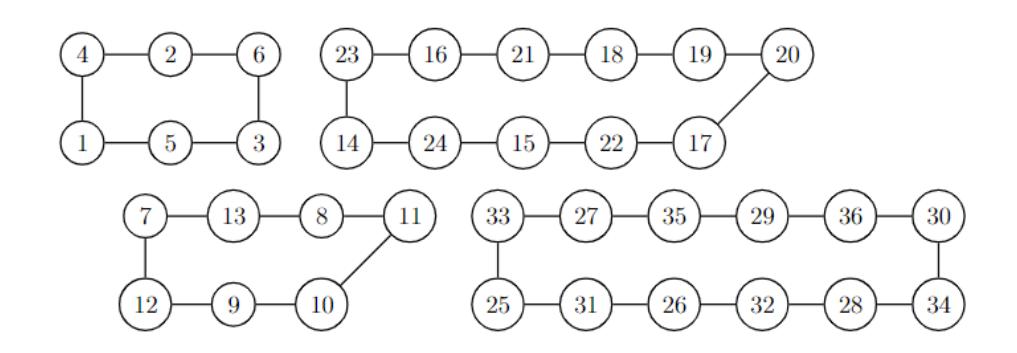
Figure 3: Distance antimagic labeling on \(C_6 \cup C_7 \cup C_{11} \cup C_{12}\)
In the following theorem, we provide distance antimagic labeling for a disjoint union of some paths, which provides a partial answer to Problem 1.1.
Theorem 4.2. Let k be a positive integer and \(n_1, n_2, \dots, n_k\) be positive integers such that for \(t \in [1, k]\) satisfy
- \(5 \le n_1 \le n_2 \le \cdots \le n_j\) are odd, for \(1 \le j \le k\), with \(n_t \ne a_t, \forall t\),
- \(6 \le n_{j+1} \le n_{j+2} \le \ldots \le n_k\) are even, with
- \(n_t \neq 2(a_i + 4 \sum_{l=i+1}^{t-1} n_l), n_t \neq a_i + 3 \sum_{l=i+1}^{t-1} n_l \text{ for } 1 \leq i < t, \text{ odd } \beta \text{ and } n_t \equiv 2 \pmod{4}\),
- \(n_t \neq 2(a_i + 5 \sum_{l=i+1}^{t-1} n_l), n_t \neq a_i + 3 \sum_{l=i+1}^{t-1} n_l \text{ for } 1 \leq i < t, \text{ odd } \beta \text{ and } n_t \equiv 0 \pmod{4},\)
- \(n_t \neq 2(a_{i+1} 2 n_{t-1})\) for \(2 \leq i + 1 < t\), even \(\beta\) and \(n_t \equiv 2 \pmod{4}\),
- \(n_t \neq 2(a_{i+1} 3 \sum_{l=i+1}^{t-1} n_l)\) for \(2 \leq i+1 < t\), even \(\beta\) and \(n_t \equiv 0 \pmod{4}\),
where \(a_i = \sum_{l=1}^{i-1} n_l\) and \(\beta = \sum_{l=1}^{j} n_l\).
Then \(\bigcup_{i=1}^k P_{n_i}\) is distance antimagic.
Proof. Let \(G = \bigcup_{i=1}^k P_{n_i}\), with \(V(P_{n_i}) = \{v_{i,j} | j=1,2,\ldots,n_i\}\) and \(E(P_{n_i}) = \{v_{i,j}v_{i,j+1} | j=1,2,\ldots,n_{i-1}\}\). Define \(f:V(G) \longrightarrow [1,\sum_{i=1}^k n_i]\) with
\[\text{[rumus tidak dapat ditampilkan dengan baik — lihat PDF asli]}\]
\[f: V(P_{n_i}) \longrightarrow \{L_i(a,b) | 1 \le a \le n_i \text{ and } 1 \le b \le 2\}, \text{ for } i = j+1, j+2, \dots, k,\]
according to the following algorithm: construct a distance antimagic labeling for \(\bigcup_{i=1}^k P_{n_i}\) by utilizing steps in Algorithm 2, replacing \(M_i\) with \(N_i\) (from Definition 2.5), for \(1 \leq i \leq j\), and with \(L_i\) (from Definition 2.6), for \(j+1 \leq i \leq k\). Thus, \(\{w(x)|x \in V(G)\} = \mathcal{F}\) and, based on Proposition 2.5, \(|\{w(x)|x \in V(G)\}| = |\mathcal{F}| = n_1 + n_2 + \ldots + n_k\). This concludes the proof. \(\square\)
We give an example for Theorem 4.2 as follows.
\[PO(7,11) \cup PE(18;6,12) = \left\{ \begin{bmatrix} 1 & 0 \\ 1 & 3 \\ 2 & 4 \\ 3 & 5 \\ 4 & 6 \\ 5 & 0 \\ 6 & 7 \end{bmatrix}, \begin{bmatrix} 0 & 9 \\ 8 & 10 \\ 9 & 11 \\ 10 & 12 \\ 11 & 13 \\ 12 & 14 \\ 13 & 15 \\ 14 & 16 \\ 15 & 17 \\ 16 & 18 \\ 17 & 0 \end{bmatrix}, \begin{bmatrix} 19 & 0 \\ 19 & 20 \\ 20 & 21 \\ 0 & 23 \\ 22 & 24 \\ 23 & 24 \end{bmatrix}, \begin{bmatrix} 25 & 26 \\ 0 & 27 \\ 26 & 28 \\ 27 & 29 \\ 28 & 30 \\ 29 & 30 \\ 31 & 32 \\ 31 & 0 \\ 32 & 34 \\ 33 & 35 \\ 34 & 36 \\ 35 & 36 \end{bmatrix} \right\},\]
and the distance antimagic labeling of \(P_7 \cup P_{11} \cup P_6 \cup P_{12}\) obtained from \(PO(7,11) \cup PE(18;6,12)\) can be viewed in Figure 4.
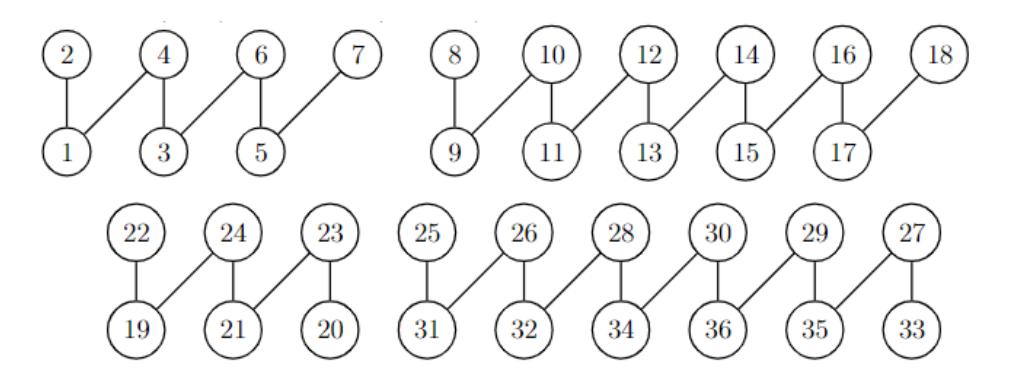
Figure 4: A distance antimagic labeling of \(P_7 \cup P_{11} \cup P_6 \cup P_{12}\).
Lastly, from Propositions 2.2 and 2.5, we have the following corollary.
Corollary 4.1. Let j, k, m be positive integers, where \(1 \le j \le k \le m\), and \(n_1, n_2, \ldots, n_m\) be positive integers. Suppose that \(a_i = \sum_{l=1}^{i-1} n_l\) such that, for \(t \in [1, k]\), satisfy
- \(5 \le n_1 \le n_2 \le \ldots \le n_j\) are odd, with \(n_t \ne a_t, \forall t\),
- \(6 \le n_{j+1} \le n_{j+2} \le \ldots \le n_k\) are even, with
- \(n_t \neq 2(a_i + 4 \sum_{l=i+1}^{t-1} n_l), n_t \neq a_i + 3 \sum_{l=i+1}^{t-1} n_l, \text{ for } 1 \leq i < t, \text{ odd } \beta, \text{ and } n_t \equiv 2 \pmod{4},\)
- \(n_t \neq 2(a_i + 5 \sum_{l=i+1}^{t-1} n_l), n_t \neq a_i + 3 \sum_{l=i+1}^{t-1} n_l, \text{ for } 1 \leq i < t, \text{ odd } \beta, \text{ and } n_t \equiv 0 \pmod{4},\)
- \(n_t \neq 2(a_{i+1} 2 n_{t-1})\), for \(2 \leq i + 1 < t\), even \(\beta\), and \(n_t \equiv 2 \pmod{4}\),
- \[n_t \neq 2(a_{i+1} - 3 - \sum_{l=i+1}^{t-1} n_l)\], for \(2 \leq i+1 < t\), even \(\beta\), and \(n_t \equiv 0 \pmod{4}\),
• nk+1 ≤ nk+2 ≤ . . . ≤ nm are positive integers with nt ̸= 4, ∀t,
where \[a_i = \sum_{l=1}^{i-1} n_l\] and \(\beta = \sum_{l=1}^{j} n_l\). Then \(\bigcup_{i=1}^k P_{n_i} \cup \bigcup_{i=k+1}^m C_{n_i}\) is distance antimagic.
Our results in Theorem 4.2 constructed distance antimagic labelings of the disjoint union of paths with certain conditions. Although it has covered an infinite family of disjoint unions of paths, the existence of distance antimagic labelings for many disjoint unions of paths is still unknown. So we conclude this paper by proposing the following.
Problem 4.1. Find a distance antimagic labeling for the disjoint union of paths that is not covered in Theorem 4.2.
Acknowledgements
This research is supported by Riset Unggulan ITB 2023 ( Number 308/IT1.B07.1/TA.00/2023). The first author is supported by the LPDP Scholarship (the Indonesian Endowment Fund for Education Agency, the Ministry of Finance of Indonesia).
References
- [1] N. Alon, G. Kaplan, A. Lev, Y. Roditty, and R. Yuster, Dense graphs are antimagic, J. Graph Theory 47 (2004), 297–309.
- [2] Y. Anjali and S. Minirani, A computer-aided algorithm to determine distance antimagic labeling of some graphs, Eng. Lett. 32 (2024), 269–275.
- [3] K. Berczi, A. Bern ´ ath, and M. Vizer, Regular graphs are antimagic, ´ Electron. J. Comb. 22 (2015), P3.34.
- [4] F. Chang, Y. Liang, Z. Pan, and X. Zhu, Antimagic labeling of regular graphs, J. Graph Theory 82 (2015), 338–249.
- [5] A. Chavez, P. Le, D. Lin, D. Liu, and M. Shurman, Antimagic labeling for unions of graphs with many three-paths, Discrete Math. 346 (2023), 113356.
- [6] Y. Cheng, A new class of antimagic cartesian product graphs, Discrete Math. 308 (2008), 6441–6448.
- [7] D. Cranston, Regular bipartite graphs are antimagic. J. Graph Theory 60 (2009), 173–182.
- [8] K. Deng and Y. Li, Caterpillars with maximum degree 3 are antimagic, Discrete Math. 342 (2019), 1799–1801.
- [9] T. Dickson, On a problem concerning separating systems of a finite set, J. Comb. Theory Ser. A 7 (1969), 191–196.
- [10] T. Eccles, Graphs of large linear size are antimagic, J. Graph Theory 81 (2014), 162–176.
- [11] D. Fitriani and M. Salman, Rainbow connection number of amalgamation of some graphs, AKCE Int. J. Graphs Comb. 13 (2016), 90–99.
- [12] N. Hartsfield and G. Ringel, Pearls in Graph Theory, A Comprehensive Introduction. Academic Press Inc., Boston (1990)
- [13] D. Hefetz, A. Saluz, and T. Tran, An application of the combinatorial nullstellensatz to a graph labeling problem, J. Graph Theory 65 (2009), 70–82.
- [14] N. Kamatchi and S. Arumugam, Distance antimagic graphs, J. Combin. Math. Combin. Comput. 64 (2013), 61–67.
- [15] N. Kamatchi, G. Vijayakumar, A. Ramalakshmi, S. Nilavarasi, and S. Arumugam, Distance antimagic labelings of graphs, Theor. Comput. Sci. and Discret. Math. 10398 (2017), 113– 118.
- [16] A. Llado and M. Miller, Approximate results for rainbow labeling, ´ Period. Math. Hung. 74 (2016), 1–11.
- [17] A. Lozano, M. Mora, C. Seara, and J. Tey, Caterpillars are antimagic, Mediterr. J. Math. 39 (2021).
- [18] A.A.G. Ngurah, N. Inayah, and M.I.S. Musti, On d-distance (anti)magic labelings of shadow graph of some graphs, Electron. J. Graph Theory Appl. 12 (1) (2024), 25–34.
- [19] O. Phanalasy, M. Miller, L. Rylands, and P. Lieby, On a relationship between completely separating system and antimagic labeling of regular graphs, IWOCA 2010 LNCS 6460 (2011), 238–241
- [20] A. Renyi, On random generating elements of a finite boolean algebra, Acta. Sci. Math. 22 (1961), 75–81.
- [21] I. Roberts, Extremal Problems and Designs on Finite Sets, Ph.D. thesis, Curtin University of Technology (1999).
- [22] N. Shrimali and Y. Parmar, Distance Magic and Distance Antimagic Labeling of Some Product Graphs, Recent Advancements in Graph Theory, CRC Press, (2020), 181–191.
- [23] R. Simanjuntak and A. Tritama, Distance antimagic product graphs, Symmetry 14 (2022), 1411.
- [24] R. Simanjuntak, T. Nadeak, F. Yasin, K. Wijaya, Nurdin, and K. Sugeng, Another antimagic conjecture, Symmetry 13 (2021), 2071.
- [25] S. Syafrizal, R. Simanjuntak, T. Nadeak, K. Sugeng, and T. Tulus, Distance antimagic labeling of circulant graphs, AIMS Mathematics 9 (2024), 21177–21188.
[26] R. Wulandari and R. Simanjuntak, Distance antimagic of product graphs, Electron. J. Graph Theory Appl. 11 (1) (2023), 111–123.