
Odd order C4 -face-magic projective grid graphs
Stephen J. Currana
aDepartment of Mathematics University of Pittsburgh at Johnstown Johnstown, PA, USA 15904
sjcurran@pitt.edu
For a graph G = (V, E) embedded in the projective plane, let F(G) denote the set of faces of G. Then, G is called a Cn-face-magic projective graph if there exists a bijection f : V (G) → {1, 2, . . . , |V (G)|} such that for any F ∈ F(G) with F ∼= Cn, the sum of all the vertex labels around Cn is a constant S. We consider the m × n grid graph, denoted by Pm,n, embedded in the projective plane in the natural way.
Let m ⩾ 3 and n ⩾ 3 be odd integers. It is known that the C4-face-magic value of a C4 face-magic labeling on Pm,n is either 2mn + 1, 2mn + 2, or 2mn + 3. The characterization of C4-face-magic labelings on Pm,n having C4-face-magic value 2mn + 2 is known. In this paper, we determine a category of C4-face-magic labelings on Pm,n for which the C4-face-magic value is either 2mn + 1 or 2mn + 3. It is conjectured that these are the only C4-face-magic labelings on Pm,n having C4-face-magic value 2mn + 1 or 2mn + 3.
Keywords: C4-face-magic graphs, polyomino, projective grid graphs
2010 Mathematics Subject Classification : 05C78
DOI: 10.5614/ejgta.2026.14.1.10
1. Introduction
Kotzig and Rosa introduced graph labelings [14] in 1970. Graph labelings have a number of interesting applications such as radar pulse code designs, communication network models, X-ray
Received: 28 June 2021, Revised: 13 September 2025, Accepted: 20 January 2026.
crystallography, and graph decomposition problems. We direct readers to J. A. Gallian's dynamic survey on graph labelings [11] for further inquiry.
Readers should consult Chartrand, Lesniak, and Zhang [5] for concepts and notation not explicitly defined in this paper. We investigate C4-face-magic labelings on the projective grid graph in this paper. Let G = (V, E) be a planar (toroidal, Klein bottle, projective) graph, and let F(G) denote the set of faces of G. Then, G is called a Cn-face-magic planar (toroidal, Klein bottle, projective) graph if there exists a bijection f : V (G) → {1, 2, . . . , |V (G)|} such that for any F ∈ F(G) with F ∼= Cn, the sum of all the vertex labels around Cn is a constant S. We call the constant S a Cn-face-magic value of G. More generally, Cn-face-magic planar graph labelings are a special case of (a, b, c)-magic labelings introduced by Lih [15]. For a, b, c ∈ {0, 1}, an (a, b, c) magic labeling is a bijective assignment of the elements of the set {1, 2, ..., a|V | + b|E| + c|F|} to the vertices, edges, and faces of G = (V, E, F) that assigns a labels to each vertex, b labels to each edge, and c labels to each face such that the sum of labels for each face (including vertices, edges, and the face itself) is constant. For assorted values of a, b and c, Baca and others [1, 2, 3, 12, 13, 15] have analyzed the problem for various classes of graphs. Wang [16] showed that the toroidal grid graphs Cm × Cn are antimagic for all integers m, n ⩾ 3. Recall that an antimagic labeling is a bijective assignment of the set {1, 2, . . . , |E|} onto the edges of G such that, for every vertex, the sum of the labels on edges incident to the vertex is unique. Butt et al. [4] investigated face antimagic labelings on toroidal and Klein bottle grid graphs; they found bijective assignments of the elements from the set {1, 2, . . . , |V | + |E| + |F|} onto V ∪ E ∪ F such that the induced face labels, formed by the sum of the labels on all vertices and edges incident to the face and the label on the face itself, produce arithmetic sequences with various common differences.
Curran, Low and Locke [6, 7] examined C4-face-magic toroidal labelings on an m ×n toroidal grid graph. They showed that Cm × Cn admits a C4-face-magic toroidal labeling if and only if either m = 2, or n = 2, or both m and n are even. Curran, Low and Locke [8] also investigated C4-face-magic Klein bottle labelings on an m × n Klein bottle grid graph. They showed that an m×n Klein bottle grid graph admits a C4-face-magic Klein bottle labeling if and only if n is even.
Curran [9] showed that an m × n projective grid graph admits a C4-face-magic projective labeling if and only if either both m and n are even, or both m and n are odd. On one hand, when m and n are even, the C4-face-magic value of a C4-face-magic labeling on an m × n projective grid graph is 2mn + 2. On the other hand, when m and n are odd, the C4-face-magic value of a C4-face-magic labeling on an m×n projective grid graph is either 2mn+ 1, 2mn+ 2, or 2mn+ 3. When m and n are odd, the C4-face-magic projective labelings on Pm,n having C4-face-magic value 2mn + 2 were characterized in [9]. In this paper, we determine a category of the C4-facemagic labelings on Pm,n, for m and n odd, having C4-face-magic value 2mn + 1 or 2mn + 3. We conjecture that these are the only C4-face-magic labelings on Pm,n, for m and n odd, having C4-face-magic value 2mn + 1 or 2mn + 3.
2. Preliminaries
In this section we introduce definitions and known results about C4-face-magic projective labelings on an m × n projective grid graph.
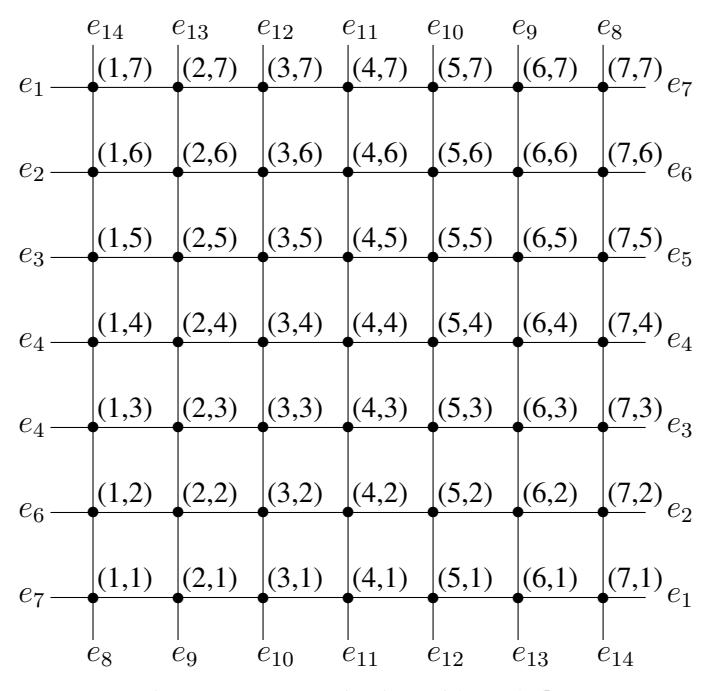
Figure 1. \(7 \times 7\) projective grid graph \(\mathcal{P}_{7,7}\).
Definition 2.1. Suppose m and n are integers such that \(m, n \ge 2\). The \(m \times n\) projective grid graph, denoted by \(\mathcal{P}_{m,n}\), is the graph with vertex set given by
\[V\left(\mathcal{P}_{m,n}\right) = \left\{ (i,j) : 1 \leqslant i \leqslant m, 1 \leqslant j \leqslant n \right\},\,\]
and with edge set consisting of the following edges:
- there is an edge from (i, j) to (i + 1, j), for \(1 \le i \le m 1\) and \(1 \le j \le n\),
- there is an edge from (m, j) to (1, n + 1 j), for \(1 \le j \le n\),
- there is an edge from (i, j) to (i, j + 1), for \(1 \le i \le m\) and \(1 \le j \le n 1\), and
- there is an edge from (i, n) to (m + 1 i, 1), for \(1 \le i \le m\).
The graph \(\mathcal{P}_{m,n}\) has a natural embedding in the projective plane. Since there are double edges on the vertex sets \(\{(1,1),(m,n)\}\) and \(\{(m,1),(1,n)\}\), \(\mathcal{P}_{m,n}\) is a multigraph.
Example 2.1. The \(7 \times 7\) projective grid graph \(\mathcal{P}_{7,7}\) is illustrated in Figure 1. Due to the orientation of the vertices in \(\mathcal{P}_{m,n}\), we refer to the vertices \(\{(i,j): 1 \leqslant j \leqslant n\}\) as column i of \(V(\mathcal{P}_{m,n})\) and \(\{(i,j): 1 \leqslant i \leqslant m\}\) as row j of \(V(\mathcal{P}_{m,n})\).
The following result determines when \(\mathcal{P}_{m,n}\) admits a \(C_4\)-face-magic projective labeling.
Lemma 2.1 ([9], Lemma 2.4). Suppose m and n are integers such that \(m, n \ge 2\). Then \(\mathcal{P}_{m,n}\) admits a \(C_4\)-face-magic projective labeling if and only if m and n have the same parity.
Furthermore, one can determine the possible \(C_4\)-face-magic values of a \(C_4\)-face-magic projective labeling on \(\mathcal{P}_{m,n}\). The next lemma determines the \(C_4\)-face-magic value of a \(C_4\)-face-magic projective labeling on \(\mathcal{P}_{m,n}\) when m and n are even integers.
Lemma 2.2 ([9], Lemma 2.5). Suppose \(m \ge 2\) and \(n \ge 2\) are even integers. Let \(\{x_{i,j} : (i,j) \in V(\mathcal{P}_{m,n})\}\) be a \(C_4\)-face-magic projective labeling on \(\mathcal{P}_{m,n}\) with \(C_4\)-face-magic value S. Then S = 2mn + 2.
In fact, when odd integers m and n, one can determine the digon face sum values on the digon vertex sets \(\{(1,1),(m,n)\}\) and \(\{(m1),(1,n)\}\) of \(\mathcal{P}_{m,n}\).
Lemma 2.3 ([9], Lemma 2.6). Suppose \(m \ge 3\) and \(n \ge 3\) are odd integers. Let \(\{x_{i,j} : (i,j) \in V(\mathcal{P}_{m,n})\}\) be a \(C_4\)-face-magic projective labeling on \(\mathcal{P}_{m,n}\) with \(C_4\)-face-magic value S. Let \(D_1 = x_{1,1} + x_{m,n}\) and \(D_2 = x_{m,1} + x_{1,n}\) be the face sums of the two digons constructed from the pair of vertices at opposite corners of \(\mathcal{P}_{m,n}\). Then either
- 1. S = 2mn + 1 and \(D_1 = D_2 = \frac{3}{2}mn + \frac{1}{2}\),
- 2. S = 2mn + 2 and \(D_1 = D_2 = mn + 1\), or
- 3. S = 2mn + 3 and \(D_1 = D_2 = \frac{1}{2}mn + \frac{3}{2}\).
Example 2.2. Figure 2 illustrates a \(C_4\)-face-magic projective labeling on the \(7 \times 7\) projective grid graph \(\mathcal{P}_{7,7}\) such that the \(C_4\)-face-magic value is 101 and the digon face sum is \(D_1 = D_2 = 26\).
For odd integers \(m \geqslant 3\) and \(n \geqslant 3\), the \(C_4\)-face-magic projective labelings on \(\mathcal{P}_{m,n}\) having \(C_4\)-face-magic value 2mn+2 were characterized in [9]. The statement of this characterization involves several technical definitions. So, we refer the reader to [9] for the details of this characterization. However, it is relatively easy to count the number of distinct \(C_4\)-face-magic projective labelings on \(\mathcal{P}_{m,n}\) having \(C_4\)-face-magic value 2mn+2. We need the following definition in order to state this result.
Definition 2.2. Suppose there exists a positive integer k such that one of the two following conditions hold.
- 1. There are factorizations of \(m=m_1m_2...m_k\) and \(n=n_1n_2...n_k\), where \(m_i>1\) and \(n_i>1\) for all \(1 \le i \le k\).
- 2. There are factorizations of \(m = m'_1 m'_2 \dots m'_k m'_{k+1}\) and \(n = n'_1 n'_2 \dots n'_k\), where \(m'_i > 1\) for all \(1 \le i \le k+1\), and \(n'_i > 1\) for all \(1 \le i \le k\).
We say that \((m_1, n_1, m_2, n_2, \ldots, m_k, n_k)\) is an (m, n)-projective factorization sequence of length 2k. Also, we say \((m'_1, n'_1, m'_2, n'_2, \ldots, m'_k, n'_k, m'_{k+1})\) is an (m, n)-projective factorization sequence of length 2k+1. For convenience, we let \(n'_{k+1}=1\) and refer to \((m'_1, n'_1, m'_2, n'_2, \ldots, m'_{k+1}, n'_{k+1})\) as an (m, n)-projective factorization sequence of length 2k+1. In addition, we say that \((m_1, n_1, m_2, n_2, \ldots, m_k, n_k)\) and \((m'_1, n'_1, m'_2, n'_2, \ldots, m'_{k+1}, n'_{k+1})\) are (m, n)-projective factorization sequences.
Furthermore, we let \(\tau(m,n)\) denote the number of distinct (m,n)-projective factorization sequences.
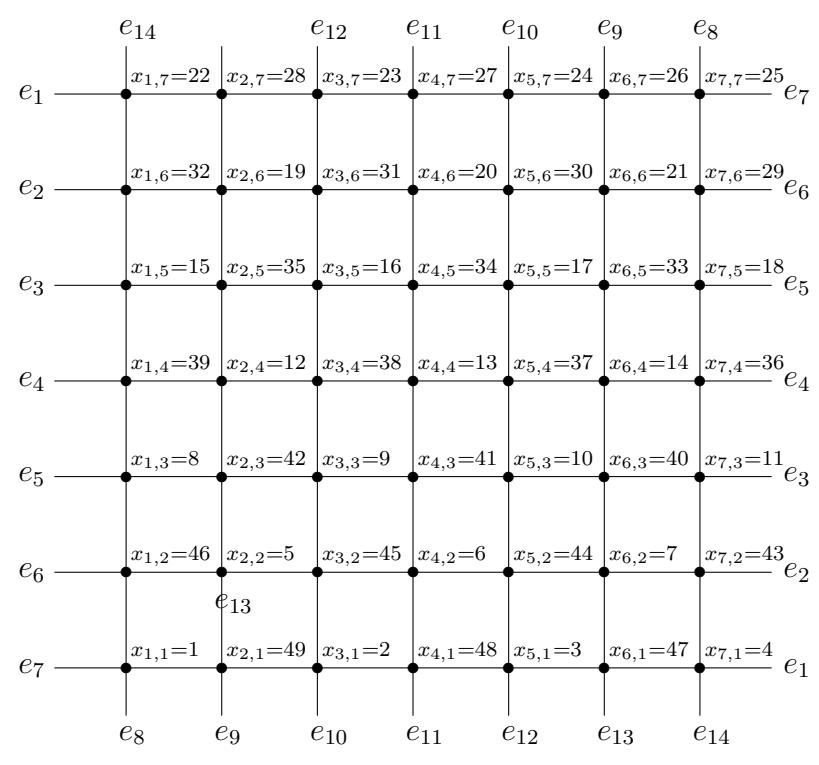
Figure 2. \(C_4\)-face-magic projective labeling on \(\mathcal{P}_{7,7}\) having \(C_4\)-face-magic value 101.
The next result provides the number of distinct \(C_4\)-face-magic projective labelings on \(\mathcal{P}_{m,n}\)having \(C_4\)-face-magic value 2mn + 2 for distinct odd integers m and n.
Theorem 2.1 ([9], Theorem 3.40). Let \(m \ge 3\) and \(n \ge 3\) be distinct odd integers. Then the number of distinct \(C_4\)-face-magic projective labelings on \(\mathcal{P}_{m,n}\) having \(C_4\)-face-magic value 2mn+2 (up to symmetries on the projective plane) is
\[(\tau(m,n) + \tau(n,m)) 2^{m/2+n/2-3} (\frac{m-1}{2})! (\frac{n-1}{2})!.\]
The number of distinct \(C_4\)-face-magic projective labelings on \(\mathcal{P}_{m,m}\) having \(C_4\)-face-magic value \(2m^2 + 2\) for an odd integer m is stated below.
Theorem 2.2 ([9], Theorem 3.41). Let \(m \ge 3\) be an odd integer. Then the number of distinct \(C_4\)face-magic projective labelings on \(\mathcal{P}_{m,m}\) having \(C_4\)-face-magic value \(2m^2+2\) (up to symmetries on the projective plane) is
\[\tau(m,m) 2^{m-3} \left( \left( \frac{m-1}{2} \right)! \right)^2\].
We now direct our attention to \(C_4\)-face-magic labelings on \(\mathcal{P}_{m,n}\) with \(C_4\)-face-magic value 2mn + 1 or 2mn + 3.
Definition 2.3. Let \(X = \{x_{i,j} : (i,j) \in V(\mathcal{P}_{m,n})\}\) be a \(C_4\)-face-magic projective labeling on \(\mathcal{P}_{m,n}\). We define a labeling Y on \(\mathcal{P}_{m,n}\) given by
\[y_{i,j} = mn + 1 - x_{i,j}\] for all \((i, j) \in V(\mathcal{P}_{m,n})\).
We say that Y is the order plus one complement of X labeling on \(\mathcal{P}_{m,n}\). We call the transformation \(\mathcal{C}(X) = Y\) the order plus one complement labeling transformation.
Proposition 2.1. Let \(X = \{x_{i,j} : (i,j) \in V(\mathcal{P}_{m,n})\}\) be a \(C_4\)-face-magic projective labeling on \(\mathcal{P}_{m,n}\) with \(C_4\)-face-magic value S. Then the order plus one complement of X labeling \(Y = \mathcal{C}(X)\) on \(\mathcal{P}_{m,n}\) is a \(C_4\)-face-magic projective labeling on \(\mathcal{P}_{m,n}\) with \(C_4\)-face-magic value 4mn + 4 - S.
Proof. Let \((i_1, j_1)\), \((i_2, j_2)\), \((i_3, j_3)\), and \((i_4, j_4)\) be the vertices of any \(C_4\)-face on \(\mathcal{P}_{m,n}\). Then
\[\sum_{k=1}^{4} x_{i_k, j_k} = S.\]
Thus, the order plus one complement of X labeling \(Y = \mathcal{C}(X)\) satisfies
\[\sum_{k=1}^{4} y_{i_k, j_k} = \sum_{k=1}^{4} (mn + 1 - x_{i_k, j_k}) = 4mn + 4 - S.\]
Since \(h: \{1, 2, ..., mn\} \rightarrow \{1, 2, ..., mn\}\) defined by h(x) = mn + 1 - x is a bijection, so is \(f: V(P_m \times P_n) \rightarrow \{1, 2, ..., mn\}\) defined by \(f(i, j) = h(x_{i,j})\).
Remark 2.1. We observe that \(\mathcal{C}(\mathcal{C}(X)) = X\) for all \(C_4\)-face-magic projective labelings X on \(\mathcal{P}_{m,n}\). Thus, \(\mathcal{C}\) is a one-to-one correspondence between \(C_4\)-face-magic projective labelings on \(\mathcal{P}_{m,n}\) with \(C_4\)-face-magic value S and \(S_4\)-face-magic projective labelings on \(S_4\)-face-magic value \(S_4\)-face-magic value \(S_4\)-face-magic projective labelings on \(S_4\)-face-magic value \(S_4\)-face-magic value \(S_4\)-face-magic projective labelings on \(S_4\)-face-magic value \(S_4\)-face-magic value \(S_4\)-face-magic projective labelings on \(S_4\)-face-magic value \(S_4\)-face-magic value \(S_4\)-face-magic projective labelings on \(S_4\)-face-magic value \(S_4\)-face-magic value \(S_4\)-face-magic projective labelings on \(S_4\)-face-magic value \(S_4\)-face-magic value \(S_4\)-face-magic projective labelings on \(S_4\)-face-magic value \(S_4\)-face-magic value \(S_4\)-face-magic projective labelings on \(S_4\)-face-magic value \(S_4\)-face-magic value \(S_4\)-face-magic projective labelings on \(S_4\)-face-magic value \(S_4\)-face-magic value \(S_4\)-face-magic projective labelings on \(S_4\)-face-magic value \(S_4\)-face-magic value \(S_4\)-face-magic projective labelings on \(S_4\)-face-magic value \(S_4\)-face-magic value \(S_4\)-face-magic projective labelings on \(S_4\)-face-magic value \(S_4\)-face-magic value \(S_4\)-face-magic projective labelings on \(S_4\)-face-magic value \(S_4\)-face-magic value \(S_4\)-face-magic value \(S_4\)-face-magic value \(S_4\)-face-magic value \(S_4\)-face-magic value \(S_4\)-face-magic value \(S_4\)-face-magic value \(S_4\)-face-magic value \(S_4\)-face-magic value \(S_4\)-face-magic value \(S_4\)-face-magic value \(S_4\)-face-magic value \(S_4\)-face-magic value \(S_4\)-face-magic value \(S_4\)-face-magic value \(S_4\)-face-magic value \(S_4\)-face-magic value \(S_4\)-face-magic value \(S_4\)-face-magic value \(S_4\)-face-magic value \(S_4\)-face-magic value \(S_4\)-face-magic value \(S_4\)-face-magic value \(S_4\)-face-magic value \(S_4\)-face-magic value \(S_4\)-face-magic value \(S_4\)-face-magic value \(S_4\)-face-magic value \(S_4\)-face-magic value \(S_4\)-face-ma
Hence, for odd integers \(m \geqslant 3\) and \(n \geqslant 3\), C is a one-to-one correspondence between \(C_4\)-face-magic projective labelings on \(\mathcal{P}_{m,n}\) with \(C_4\)-face-magic value 2mn+1 and those with \(C_4\)-face-magic value 2mn+3.
3. Bicentrally Balanced \(C_4\)-face-magic Labelings on \(\mathcal{P}_{m,n}\)
Notation 3.1. Throughout this section, we assume that both \(m \geqslant 3\) and \(n \geqslant 3\) are odd integers. We write \(m = 2m_0 + 1\) and \(n = 2n_0 + 1\) for positive integers \(m_0\) and \(n_0\). For any positive integer N, we let \(N^+ = N + 1\). In particular, we have \(m_0^+ = m_0 + 1\) and \(n_0^+ = n_0 + 1\).
Notation 3.2. We refer to the vertex \((\frac{1}{2}(m+1), \frac{1}{2}(n+1)) = (m_0^+, n_0^+)\) as the center of the projective grid graph \(\mathcal{P}_{m,n}\). The graph automorphisms of \(\mathcal{P}_{m,n}\) that are induced by a homeomorphism of the projective plane are described in relation to the center of \(\mathcal{P}_{m,n}\). We let \(R_{\theta}\) denote the rotation by \(\theta\) degrees in the counter-clockwise direction about the center. The symmetry H(V) is the reflection about the center row (column). Since the corner vertices of \(\mathcal{P}_{m,n}\) are the only vertices incident to a double edge, a symmetry of \(\mathcal{P}_{m,n}\) sends each corner vertex to another corner vertex. Thus, for distinct integers m and n, the set of symmetries on \(\mathcal{P}_{m,n}\) is \(\{R_0, R_{180}, H, V\}\). We let \(D_+(D_-)\) denote the reflection about the diagonal with positive (negative) slope passing through the center. When m=n, the set of symmetries on \(\mathcal{P}_{m,m}\) is \(D_0\) is \(D_0\) and \(D_0\) is \(D_0\) and \(D_0\) is \(D_0\) and \(D_0\) is \(D_0\).
Definition 3.1. Let \(X = \{x_{i,j} : (i,j) \in V(\mathcal{P}_{m,n})\}\) be a \(C_4\)-face-magic projective labeling on \(\mathcal{P}_{m,n}\) with \(C_4\)-face value S = 2mn + 3. For all \((i,j) \in V(\mathcal{P}_{m,n})\), let
\[S(i,j)=\frac{1}{2}mn+\frac{3}{2}\] if \(i+j\) is even, and \(S(i,j)=\frac{3}{2}mn+\frac{3}{2}\) if \(i+j\) is odd.
We say that X is bicentrally balanced if, for all \((i, j) \in V(\mathcal{P}_{m,n})\),
\[x_{i,j} + x_{m+1-i,n+1-j} = S(i,j).\]
Remark 3.1. Suppose \(X = \{x_{i,j} : (i,j) \in V(\mathcal{P}_{m,n})\}\) is a \(C_4\)-face-magic labeling on \(\mathcal{P}_{m,n}\) that is bicentrally balanced. Then the \(C_4\)-face-magic value S of X is
\[S = x_{1,1} + x_{m,n} + x_{2,1} + x_{m-1,n} = S(1,1) + S(2,1) = 2mn + 3.\]
We observe that the \(C_4\)-face-magic projective labeling on \(\mathcal{P}_{5,5}\) in Figure 2 is bicentrally balanced.
Lemma 3.1. Suppose \(m \geqslant 3\) and \(n \geqslant 3\) are odd integers. Let \(X = \{x_{i,j} : (i,j) \in V(\mathcal{P}_{m,n})\}\) be a \(C_4\)-face-magic projective labeling on \(\mathcal{P}_{m,n}\) with \(C_4\)-face-magic value S = 2mn + 3. Then X is bicentrally balanced. Furthermore, we have \(x_{m_0^+,n_0^+} = \frac{1}{2}S(m_0^+,n_0^+)\). Thus, \(x_{m_0^+,n_0^+} = \frac{1}{4}mn + \frac{3}{4}\) if \(m_0^+ + n_0^+\) is even, or \(x_{m_0^+,n_0^+} = \frac{3}{4}mn + \frac{3}{4}\) if \(m_0^+ + n_0^+\) is odd.
Proof. By Lemma 2.3, the digons formed by the vertex sets \(\{(1,1),(m,n)\}\) and \(\{(m,1),(1,n)\}\) have face values
\[D_1=x_{1,1}+x_{m,n}=\frac{1}{2}mn+\frac{3}{2}\] and \(D_2=x_{m,1}+x_{1,n}=\frac{1}{2}mn+\frac{3}{2},\) respectively.
Suppose that for some integer \(1 \le i < m\),
\[x_{i,1} + x_{m+1-i,n} = S(i,1).\]
See Definition 3.1 for the definition of S(i, j). Since
\[x_{i,1} + x_{i+1,1} + x_{m+1-i,n} + x_{m-i,n} = S,\]
we have
\[x_{i+1,1} + x_{m-i,n} = S - S(i,1) = S(i+1,1).\]
Hence,
\[x_{i,1} + x_{m+1-i,n} = S(i,1)\]
for all \(1 \le i \le m\). A similar argument shows that
\[x_{1,j} + x_{m,n+1-j} = S(1,j)\]
for all \(1 \leqslant j \leqslant n\).
We use induction to show that \(x_{i,j} + x_{m+1-i,n+1-j} = S(i,j)\) for all \((i,j) \in V\mathcal{P}_{m,n}\)). Suppose there exist integers 1 < i < m and 1 < j < n such that
1. for all \[1 \le i' < i\] and \(1 \le j' \le n\), \(x_{i',j'} + x_{m+1-i',n+1-j'} = S(i',j')\), and
2. for all \[1 \le j' < j\], \(x_{i,j'} + x_{m+1-i,n+1-j'} = S(i,j')\).
We need to show that xi,j + xm+1−i,n+1−j = S(i, j). When we add the two C4-face-values
\[x_{i-1,j-1}+x_{i-1,j}+x_{i,j-1}+x_{i,j}=S \text{ and }\] \[x_{m+2-i,n+2-j}+x_{m+2-i,n+1-j}+x_{m+1-i,n+2-j}+x_{m+1-i,n+1-j}=S,\]
we obtain
\[(x_{i-1,j-1} + x_{m+2-i,n+2-j}) + (x_{i-1,j} + x_{m+2-i,n+1-j}) + (x_{i,j-1} + x_{m+1-i,n+2-j}) + (x_{i,j} + x_{m+1-i,n+1-j}) = 2S.\]
Since
\[\begin{split} x_{i-1,j-1} + x_{m+2-i,n+2-j} &= S(i-1,j-1), \\ x_{i-1,j} + x_{m+2-i,n+1-j} &= S(i-1,j), \text{ and} \\ x_{i,j-1} + x_{m+1-i,n+2-j} &= S(i,j-1), \end{split}\]
we have
\[S(i-1,j-1) + S(i-1,j) + S(i,j-1) + (x_{i,j} + x_{m+1-i,n+1-j}) = 2S.\]
Thus
\[x_{i,j} + x_{m+1-i,n+1-j} = S(i,j).\]
Since
\[2x_{m_0^+,n_0^+} = x_{m_0^+,n_0^+} + x_{m+1-m_0^+,n+1-n_0^+} = S(m_0^+,n_0^+),\]
we have
\[x_{m_0^+,n_0^+} = \frac{1}{2}S(m_0^+,n_0^+).\]
Thus, xm+ 0 ,n + 0 = 1 4mn + 3 4 if m+ 0 + n + 0 is even, or xm+ 0 ,n + 0 = 3 4mn + 3 4 if m+ 0 + n + 0 is odd.
3.1. Structure of a Bicentrally Balanced C4-face-magic Labeling
Lemma 3.2. Let X = {xi,j : (i, j) ∈ V (Pm,n)} be a bicentrally balanced C4-face-magic projective labeling on Pm,n. For 1 ⩽ j ⩽ n0, let aj = x1,j + x1,j+1. Then,
1. for all 1 ⩽ i ⩽ m0 where i is odd, and 1 ⩽ j ⩽ n0, we have
\[x_{i,j}+x_{i,j+1}=a_j, \qquad x_{i,n+1-j}+x_{i,n-j}=S-a_j, \ x_{m+1-i,j}+x_{m+1-i,j+1}=a_j, \ and \qquad x_{m+1-i,n+1-j}+x_{m+1-i,n-j}=S-a_j, \ and\]
2. for all 1 ⩽ i ⩽ m0 where i is even, and 1 ⩽ j ⩽ n0, we have
\[\begin{split} x_{i,j} + x_{i,j+1} &= S - a_j, & x_{i,n+1-j} + x_{i,n-j} &= a_j, \\ x_{m+1-i,j} + x_{m+1-i,j+1} &= S - a_j, \text{and} & x_{m+1-i,n+1-j} + x_{m+1-i,n-j} &= a_j. \end{split}\]
Proof. When we equate the two C4-face sums
\[x_{i,j} + x_{i,j+1} + x_{i+1,j} + x_{i+1,j+1} = S \text{ and }\]
\[x_{i+1,j} + x_{i+1,j+1} + x_{i+2,j} + x_{i+2,j+1} = S,\]
we obtain
\[x_{i,j} + x_{i,j+1} = x_{i+2,j} + x_{i+2,j+1}. (1)\]
By (1), for all 1 ⩽ i ⩽ m0 where i is odd, and 1 ⩽ j ⩽ n0, we have
\[x_{i,j} + x_{i,j+1} = a_j\] and \(x_{m+1-i,j} + x_{m+1-i,j+1} = a_j\).
Since
\[a_j + x_{2,j} + x_{2,j+1} = x_{1,j} + x_{1,j+1} + x_{2,j} + x_{2,j+1} = S,\]
we have
\[x_{2,j} + x_{2,j+1} = S - a_j\]
for all 1 ⩽ j ⩽ n0. Also by (1), for all 1 ⩽ i ⩽ m0 where i is even, and 1 ⩽ j ⩽ n0, we have
\[x_{i,j} + x_{i,j+1} = S - a_j\] and \(x_{m+1-i,j} + x_{m+1-i,j+1} = S - a_j\).
Since
\[a_j + x_{1,n+1-j} + x_{1,n-j} = x_{m,j} + x_{m,j+1} + x_{1,n+1-j} + x_{1,n-j} = S,\]
we have
\[x_{1,n+1-j} + x_{1,n-j} = S - a_j\]
for all 1 ⩽ j ⩽ n0. Thus, by (1), for all 1 ⩽ i ⩽ m0 where i is odd, and 1 ⩽ j ⩽ n0, we have
\[x_{i,n+1-j} + x_{i,n-j} = S - a_j\] and \(x_{m+1-i,n+1-j} + x_{m+1-i,n-j} = S - a_j\)
Since
\[(S - a_j) + x_{2,n+1-j} + x_{2,n-j} = x_{1,n+1-j} + x_{1,n-j} + x_{2,n+1-j} + x_{2,n-j} = S,\]
we have
\[x_{2,n+1-j} + x_{2,n-j} = a_j\]
for all 1 ⩽ j ⩽ n0. Hence, by (1), for all 1 ⩽ i ⩽ m0 where i is even, and 1 ⩽ j ⩽ n0, we have
\[x_{i,n+1-j} + x_{i,n-j} = a_j\] and \(x_{m+1-i,n+1-j} + x_{m+1-i,n-j} = a_j\).
.
3.2. Row and Column Permutations on a Bicentrally Balanced Labeling
Definition 3.2. Let \(X = \{x_{i,j} : (i,j) \in V(\mathcal{P}_{m,n})\}\) be a bicentrally balanced \(C_4\)-face-magic projective labeling on \(\mathcal{P}_{m,n}\). Let \(\eta\) be a permutation on the set \(\{1,2,\ldots,m_0\}\) such that \(\eta(i) \equiv i \pmod{2}\) for all \(1 \leqslant i \leqslant m_0\). We define a labeling on \(\mathcal{P}_{m,n}\), \(Z = \{z_{i,j} : (i,j) \in V(\mathcal{P}_{m,n})\}\), such that for all \(1 \leqslant i \leqslant m_0\) and \(1 \leqslant j \leqslant n\), we have
\[\begin{split} z_{i,j} &= x_{\eta(i),j}, \\ z_{m_0^+,j} &= x_{m_0^+,j}, \text{ and } \\ z_{m+1-i,j} &= x_{m+1-\eta(i),j}. \end{split}\]
We let \(\mathcal{E}_{\eta}\) denote the labeling operation given by \(\mathcal{E}_{\eta}(X) = Z\).
Lemma 3.3. Let \(X = \{x_{i,j} : (i,j) \in V(\mathcal{P}_{m,n})\}\) be a bicentrally balanced \(C_4\)-face-magic projective labeling on \(\mathcal{P}_{m,n}\), and let \(\eta\) be a permutation on the set \(\{1,2,\ldots,m_0\}\) such that \(\eta(i) \equiv i \pmod{2}\) for all \(1 \leq i \leq m_0\). Let \(\mathcal{E}_{\eta}\) be the labeling operation defined in Definition 3.2. Then the labeling \(Z = \mathcal{E}_{\eta}(X)\) is a bicentrally balanced \(C_4\)-face-magic projective labeling on \(\mathcal{P}_{m,n}\).
Proof. We first verify that Z is bicentrally balanced. Suppose that \(1 \le i \le m_0\) and \(1 \le j \le n\). Since \(\eta(i) - i\) is even, we have
\[z_{i,j} + z_{m+1-i,n+1-j} = x_{\eta(i),j} + x_{m+1-\eta(i),n+1-j} = S(i,j).\]
Furthermore, we have
\[z_{m_0^+,j} + z_{m+1-m_0^+,n+1-j} = x_{m_0^+,j} + x_{m+1-m_0^+,n+1-j} = S(m_0^+,j).\]
Next, we show that Z is a \(C_4\)-face-magic projective labeling on \(\mathcal{P}_{m,n}\). For all \(1 \leq i < m\) and \(1 \leq j < n\), by Lemma 3.2, we have
\[z_{i,j} + z_{i,j+1} = x_{i,j} + x_{i,j+1}\] and \(z_{i+1,j} + z_{i+1,j+1} = x_{i+1,j} + x_{i+1,j+1}\).
Thus
\[z_{i,j} + z_{i,j+1} + z_{i+1,j} + z_{i+1,j+1} = x_{i,j} + x_{i,j+1} + x_{i+1,j} + x_{i+1,j+1} = S.\]
Since Z is bicentrally balanced, for \(1 \le i < m\), we have
\[z_{i,n} + z_{m+1-i,1} + z_{i+1,n} + z_{m-i,1} = S(i,n) + S(i+1,n) = S.\]
Also, since Z is bicentrally balanced, for \(1 \le j < n\), we have
\[z_{m,j} + z_{1,n+1-j} + z_{m,j+1} + z_{1,n-j} = S(m,j) + S(m,j+1) = S.\]
Definition 3.3. Let \(X = \{x_{i,j} : (i,j) \in V(\mathcal{P}_{m,n})\}\) be a bicentrally balanced \(C_4\)-face-magic projective labeling on \(\mathcal{P}_{m,n}\). Let \(\kappa\) be a permutation on the set \(\{1,2,\ldots,n_0\}\) such that \(\kappa(j) \equiv j \pmod{2}\) for all \(1 \leqslant j \leqslant n_0\). We define a labeling on \(\mathcal{P}_{m,n}\), \(Z = \{z_{i,j} : (i,j) \in V(\mathcal{P}_{m,n})\}\), such that for all \(1 \leqslant i \leqslant m\) and \(1 \leqslant j \leqslant n_0\), we have
\[z_{i,j} = x_{i,\kappa(j)},\] \(z_{i,n_0^+} = x_{i,n_0^+}, \ and\) \(z_{i,n+1-j} = x_{i,n+1-\kappa(j)}.\)
We let \(\mathcal{E}_{\kappa}\) denote the labeling operation given by \(\mathcal{E}_{\kappa}(X) = Z\).
Lemma 3.4. Let \(X = \{x_{i,j} : (i,j) \in V(\mathcal{P}_{m,n})\}\) be a bicentrally balanced \(C_4\)-face-magic projective labeling on \(\mathcal{P}_{m,n}\), and let \(\kappa\) be a permutation on the set \(\{1,2,\ldots,n_0\}\) such that \(\kappa(j) \equiv j \pmod{2}\) for all \(1 \leqslant j \leqslant n_0\). Let \(\mathcal{E}_{\kappa}\) be the labeling operation defined in Definition 3.3. Then the labeling \(Z = \mathcal{E}_{\kappa}(X)\) is a bicentrally balanced \(C_4\)-face-magic projective labeling on \(\mathcal{P}_{m,n}\).
The proof of Lemma 3.4 is similar to the proof of Lemma 3.3.
Definition 3.4. Let \(X = \{x_{i,j} : (i,j) \in V(\mathcal{P}_{m,n})\}\) be a bicentrally balanced \(C_4\)-face-magic projective labeling on \(\mathcal{P}_{m,n}\). Let \(\alpha : \{1,2,\ldots,m_0\} \to \{0,1\}\). We define a labeling on \(\mathcal{P}_{m,n}\), \(Z = \{z_{i,j} : (i,j) \in V(\mathcal{P}_{m,n})\}\), such that for all \(1 \le i \le m_0\) and \(1 \le j \le n\), we have
\[z_{i,j} = x_{(1-\alpha(i))i+\alpha(i)(m+1-i),j}, \quad and\] \(z_{m+1-i,j} = x_{\alpha(i)i+(1-\alpha(i))(m+1-i),j}.\)
We let \(\mathcal{E}_{\alpha}\) denote the labeling operation given by \(\mathcal{E}_{\alpha}(X) = Z\). The labeling operation \(\mathcal{E}_{\alpha}\) has the effect of keeping the labelings on the vertices of columns i and m+1-i the same if \(\alpha(i)=0\) and swapping the labelings on the vertices of column i with those of column m+1-i if \(\alpha(i)=1\).
Lemma 3.5. Let \(X = \{x_{i,j} : (i,j) \in V(\mathcal{P}_{m,n})\}\) be a bicentrally balanced \(C_4\)-face-magic projective labeling on \(\mathcal{P}_{m,n}\), and let \(\alpha : \{1,2,\ldots,m_0\} \to \{0,1\}\). Let \(\mathcal{E}_{\alpha}\) be the labeling operation defined in Definition 3.4. Then the labeling \(Z = \mathcal{E}_{\alpha}(X)\) is a bicentrally balanced \(C_4\)-face-magic projective labeling on \(\mathcal{P}_{m,n}\).
Proof. First, we show that Z is bicentrally balanced. Suppose \(\alpha(i) = 0\). Then
\[z_{i,j} = x_{i,j}\] and \(z_{m+1-i,j} = x_{m+1-i,j}\).
Thus
\[z_{i,j} + z_{m+1-i,n+1-j} = x_{i,j} + x_{m+1-i,n+1-j} = S(i,j).\]
Suppose \(\alpha(i) = 1\). Then
\[z_{i,j} = x_{m+1-i,j}\] and \(z_{m+1-i,j} = x_{i,j}\).
Thus
\[z_{i,j} + z_{m+1-i,n+1-j} = x_{m+1-i,j} + x_{i,n+1-j} = S(m+1-i,j) = S(i,j)\]
since \(m+1-i \equiv i \pmod{2}\). The proof that Z is a \(C_4\)-face-magic projective labeling on \(\mathcal{P}_{m,n}\) with \(C_4\)-face-magic value 2mn+3 is similar to that in the proof of Lemma 3.3.
Definition 3.5. Let X = {xi,j : (i, j) ∈ V (Pm,n)} be a bicentrally balanced C4-face-magic projective labeling on Pm,n. Let δ : {1, 2, . . . , n0} → {0, 1}. We define a labeling on Pm,n, Z = {zi,j : (i, j) ∈ V (Pm,n)}, such that for all 1 ⩽ i ⩽ m and 1 ⩽ j ⩽ n0, we have
\[z_{i,j} = x_{i,(1-\delta(j))j+\delta(j)(n+1-j)},\] and \(z_{i,n+1-j} = x_{i,\delta(j)j+(1-\delta(j))(n+1-j)}.\)
We let Eδ denote the labeling operation given by Eδ(X) = Z. The labeling operation Eδ has the effect of keeping the labelings on the vertices of rows j and n + 1 − j the same if δ(j) = 0 and swapping the labelings on the vertices of row j with those of row n + 1 − j if δ(j) = 1.
Lemma 3.6. Let X = {xi,j : (i, j) ∈ V (Pm,n)} be a bicentrally balanced C4-face-magic projective labeling on Pm,n, and let δ : {1, 2, . . . , n0} → {0, 1}. Let Eδ be the labeling operation defined in Definition 3.5. Then the labeling Z = Eδ(X) is a bicentrally balanced C4-face-magic projective labeling on Pm,n.
The proof of Lemma 3.6 is similar to the proof of Lemma 3.5.
Definition 3.6. We call each of the labeling operations Eη in Definition 3.2, Eκ in Definition 3.3, Eα in Definition 3.4, and Eδ in Definition 3.5 an elementary projective labeling operation.
Definition 3.7. We say that two bicentrally balanced C4-face-magic labelings on Pm,n are projective labeling equivalent if one labeling can be obtained from the other by applying a sequence of elementary projective labeling operations to it.
3.3. Standard Bicentrally Balanced Labeling
Given a bicentrally balanced C4-face-magic projective labeling X on Pm,n, the next theorem identifies a canonical bicentrally balanced C4-face-magic projective labeling on Pm,n that is projective labeling equivalent to X.
Theorem 3.1. Let X = {xi,j : (i, j) ∈ V (Pm,n)} be a bicentrally balanced C4-face-magic projective labeling on Pm,n. Then there is a unique bicentrally balanced C4-face-magic projective labeling Z = {zi,j : (i, j) ∈ V (Pm,n)} on Pm,n that is projective labeling equivalent to X such that
- zi,n+ 0 < zi+2,n + 0 for all 1 ⩽ i ⩽ m − 2 and i + n + 0 is even,
- zi,n+ 0 > zi+2,n + 0 for all 1 ⩽ i ⩽ m − 2 and i + n + 0 is odd,
- zm+ 0 ,j < zm+ 0 ,j+2 for all 1 ⩽ j ⩽ n − 2 and m+ 0 + j is even, and
- zm+ 0 ,j > zm+ 0 ,j+2 for all 1 ⩽ j ⩽ n − 2 and m+ 0 + j is odd.
Proof. By Lemma 3.1, we have \(x_{m_0^+,n_0^+} = \frac{1}{2}S(m_0^+,n_0^+)\). It is easy to check that this value remains the same regardless of the elementary projective labeling operation that we apply to X. Since X is bicentrally balanced, for all \(1 \le i \le m_0\), we have
\[x_{i,n_0^+} + x_{m+1-i,n_0^+} = S(i, n_0^+).\]
Thus, either \(x_{i,n_0^+} < \frac{1}{2}S(i,n_0^+)\) or \(x_{m+1-i,n_0^+} < \frac{1}{2}S(i,n_0^+)\). We define a function \(\alpha:\{1,2,\ldots,m_0\} \to \{0,1\}\) as follows. For each \(1 \leqslant i \leqslant m_0\), let
\[\text{[rumus tidak dapat ditampilkan dengan baik — lihat PDF asli]}\]
By Lemma 3.5, \(\mathcal{E}_{\alpha}(X)\) is a bicentrally balanced \(C_4\)-face-magic projective labeling on \(\mathcal{P}_{m,n}\). Replace X with \(\mathcal{E}_{\alpha}(X)\). Then X satisfies, for all \(1 \leq i \leq m_0\),
\[\begin{split} x_{i,n_0^+} &< \tfrac{1}{2} S(i,n_0^+) \text{ and } x_{m+1-i,n_0^+} > \tfrac{1}{2} S(i,n_0^+) \text{ if } i + n_0^+ \text{ is even, and} \\ x_{i,n_0^+} &> \tfrac{1}{2} S(i,n_0^+) \text{ and } x_{m+1-i,n_0^+} < \tfrac{1}{2} S(i,n_0^+) \text{ if } i + n_0^+ \text{ is odd.} \end{split}\]
Choose a permutation \(\eta\) of \(\{1, 2, ..., m_0\}\) with \(\eta(i) \equiv i \pmod 2\) for all \(1 \leqslant i \leqslant m_0\) such that for all \(1 \leqslant i \leqslant m_0 - 2\),
\[x_{\eta(i),n_0^+} < x_{\eta(i+2),n_0^+} \text{ if } i+n_0^+ \text{ is even, and}\] \(x_{\eta(i),n_0^+} > x_{\eta(i+2),n_0^+} \text{ if } i+n_0^+ \text{ is odd.}\)
By Lemma 3.3, \(\mathcal{E}_{\eta}(X)\) is a bicentrally balanced \(C_4\)-face-magic projective labeling on \(\mathcal{P}_{m,n}\). Replace X with \(\mathcal{E}_{\eta}(X)\). Then X satisfies, for all \(1 \leq i \leq m-2\),
\[\begin{split} x_{i,n_0^+} &< x_{i+2,n_0^+} \ \text{ if } i+n_0^+ \text{ is even, and} \\ x_{i,n_0^+} &> x_{i+2,n_0^+} \ \text{ if } i+n_0^+ \text{ is odd.} \end{split}\]
A similar argument allows us to choose a function \(\delta:\{1,2,\ldots,n_0\}\to\{0,1\}\) and a permutation \(\kappa\) on \(\{1,2,\ldots,n_0\}\) with \(\kappa(j)\equiv j\pmod 2\) for all \(1\leqslant j\leqslant n_0\) such that \(Z=\mathcal{E}_\kappa(\mathcal{E}_\delta(X))\) is a bicentrally balanced \(C_4\)-face-magic projective labeling on \(\mathcal{P}_{m,n}\) and
\[\begin{split} &z_{i,n_0^+} < z_{i+2,n_0^+} \ \text{ for all } 1 \leqslant i \leqslant m-2 \text{ and } i+n_0^+ \text{ is even,} \\ &z_{i,n_0^+} > z_{i+2,n_0^+} \ \text{ for all } 1 \leqslant i \leqslant m-2 \text{ and } i+n_0^+ \text{ is odd,} \\ &z_{m_0^+,j} < z_{m_0^+,j+2} \ \text{ for all } 1 \leqslant j \leqslant n-2 \text{ and } m_0^++j \text{ is even, and} \\ &z_{m_0^+,j} > z_{m_0^+,j+2} \ \text{ for all } 1 \leqslant j \leqslant n-2 \text{ and } m_0^++j \text{ is odd.} \end{split}\]
Definition 3.8. We refer to the bicentrally balanced \(C_4\)-face-magic projective labeling Z in Theorem 3.1 as the standard projective labeling associated with X. We say that Z is a standard bicentrally balanced \(C_4\)-face-magic projective labeling on \(\mathcal{P}_{m,n}\).
As a result of Theorem 3.1, we only need to find the standard bicentrally balanced \(C_4\)-face-magic projective labelings on \(\mathcal{P}_{m,n}\).
Example 3.1. Table 1 illustrates a standard bicentrally balanced \(C_4\)-face-magic projective labeling on \(\mathcal{P}_{9,9}\). For convenience, we display the \(9 \times 9\) projective grid graph as a \(9 \times 9\) checkerboard where each square cell represents a vertex and square cells that share an edge are adjacent.
| 11 | The parameter \(\mathcal{O}_4\)-race-magne projective habening on \(\mathcal{P}_{9,9}\) | ||||||||||
|---|---|---|---|---|---|---|---|---|---|---|---|
| 31 | 51 | 32 | 47 | 36 | 46 | 40 | 42 | 41 | |||
| 53 | 30 | 52 | 34 | 48 | 35 | 44 | 39 | 43 | |||
| 28 | 54 | 29 | 50 | 33 | 49 | 37 | 45 | 38 | |||
| 65 | 18 | 64 | 22 | 60 | 23 | 56 | 27 | 55 | |||
| 16 | 66 | 17 | 62 | 21 | 61 | 25 | 57 | 26 | |||
| 68 | 15 | 67 | 19 | 63 | 20 | 59 | 24 | 58 | |||
| 4 | 78 | 5 | 74 | 9 | 73 | 13 | 69 | 14 | |||
| 80 | 3 | 79 | 7 | 75 | 8 | 71 | 12 | 70 | |||
| 1 | 81 | 2 | 77 | 6 | 76 | 10 | 72 | 11 | |||
Table 1. A standard bicentrally balanced \(C_4\)-face-magic projective labeling on \(\mathcal{P}_{9,9}\) with \(C_4\)-face-magic value 165.
3.4. Partial Bicentrally Balanced Labeling
We need to introduce labelings on subgrids of \(\mathcal{P}_{m,n}\) in order to determine a category of standard bicentrally balanced \(C_4\)-face-magic labelings on \(\mathcal{P}_{m,n}\).
Definition 3.9. Let \(m \geqslant 3\) and \(n \geqslant 3\) be odd integers, and let \(M \geqslant m\) and \(N \geqslant n\) be odd integers. Let \(Grid(m,n) = \{(i,j) : 1 \leqslant i \leqslant m \text{ and } 1 \leqslant j \leqslant n\}\) be the \(m \times n\) subgrid of \(\mathcal{P}_{M,N}\). Let \(P_m \times P_n\) represent the \(m \times n\) planar grid subgraph of \(\mathcal{P}_{M,N}\) on Grid(m,n). Let \(X = \{x_{i,j} : (i,j) \in Grid(m,n)\}\) be a labeling on \(P_m \times P_n\) We say X is a partial bicentrally balanced \(C_4\)-face-magic labeling on the \(m \times n\) subgrid of \(\mathcal{P}_{M,N}\) if
- 1. the sum of the labels on the vertices of each \(C_4\)-face of \(P_m \times P_n\) is 2MN + 3,
- 2. \(\{x_{i,j}: (i,j) \in Grid(m,n) \text{ and } i+j \text{ is even}\} = \{1,2,\ldots,\frac{1}{2}mn+\frac{1}{2}\},\\)
- 3. \(\{x_{i,j}: (i,j) \in Grid(m,n) \text{ and } i+j \text{ is odd}\} = \{MN \frac{1}{2}mn + \frac{3}{2}, MN \frac{1}{2}mn + \frac{5}{2}, \dots, MN\},\\)
- 4. \(x_{i,j} + x_{m+1-i,n+1-j} = \frac{1}{2}mn + \frac{3}{2}\) if \((i,j) \in Grid(m,n)\) and i+j is even,
- 5. \(x_{i,j} + x_{m+1-i,n+1-j} = 2MN \frac{1}{2}mn + \frac{3}{2}if(i,j) \in Grid(m,n)\) and i + j is odd, and
6. X satisfies
\[\begin{split} x_{i,n_0^+} < x_{i+2,n_0^+} \ \ for \ all \ 1 \leqslant i \leqslant m-2 \ and \ i+n_0^+ \ is \ even, \\ x_{i,n_0^+} > x_{i+2,n_0^+} \ \ for \ all \ 1 \leqslant i \leqslant m-2 \ and \ i+n_0^+ \ is \ odd, \\ x_{m_0^+,j} < x_{m_0^+,j+2} \ \ for \ all \ 1 \leqslant j \leqslant n-2 \ and \ m_0^+ + j \ is \ even, \ and \\ x_{m_0^+,j} > x_{m_0^+,j+2} \ \ for \ all \ 1 \leqslant j \leqslant n-2 \ and \ m_0^+ + j \ is \ odd. \end{split}\]
3.5. Partial Alternating Lexicographic Labeling
We introduce two partial bicentrally balanced \(C_4\)-face-magic labelings on an \(m \times n\) subgrid of \(\mathcal{P}_{M,N}\).
Definition 3.10. Let \(m \ge 3\) and \(n \ge 3\) be odd integers, and let \(M \ge m\) and \(N \ge n\) be odd integers. The partial horizontal alternating lexicographic labeling on the \(m \times n\) subgrid of \(\mathcal{P}_{M,N}\), denoted by \(\mathrm{HALL}_{M,N}(m,n)\), is the labeling \(\mathrm{HALL}_{M,N}(m,n) = \{x_{i,j} : (i,j) \in \mathrm{Grid}(m,n)\}\) given by
- \(x_{2i-1,2j-1} = m(j-1) + i\), for all \(1 \le i \le m_0^+\) and \(1 \le j \le n_0^+\),
- \(x_{2i,2j} = m(j-1) + m_0^+ + i\), for all \(1 \le i \le m_0\) and \(1 \le j \le n_0\),
- \(x_{2i,2j-1} = MN + m(1-j) + 1 i\), for all \(1 \le i \le m_0\) and \(1 \le j \le n_0^+\), and
- \(x_{2i-1,2j} = MN mj + m_0^+ + 1 i\), for all \(1 \le i \le m_0^+\) and \(1 \le j \le n_0\).
Similarly, the partial vertical alternating lexicographic labeling on the \(m \times n\) subgrid of \(\mathcal{P}_{M,N}\), denoted by \(\mathrm{VALL}_{M,N}(m,n)\), is the labeling \(\mathrm{VALL}_{M,N}(m,n) = \{y_{i,j} : (i,j) \in \mathrm{Grid}(m,n)\}\) given by
- \(y_{2i-1,2j-1} = n(i-1) + j\), for all \(1 \le i \le m_0^+\) and \(1 \le j \le n_0^+\),
- \(y_{2i,2j} = n(i-1) + n_0^+ + j\), for all \(1 \le i \le m_0\) and \(1 \le j \le n_0\),
- \(y_{2i,2j-1} = MN ni + n_0^+ + 1 j\), for all \(1 \le i \le m_0\) and \(1 \le j \le n_0^+\), and
- \(y_{2i-1,2j} = MN + n(1-i) + 1 j\), for all \(1 \le i \le m_0^+\) and \(1 \le j \le n_0\).
Example 3.2. The labeling in Figure 3 is the partial vertical alternating lexicographic labeling on the \(5 \times 5\) subgrid of \(\mathcal{P}_{15,5}\) denoted by VALL<sub>15,5</sub>(5,5).
Theorem 3.2. Let \(m \ge 3\) and \(n \ge 3\) be odd integers, and let \(M \ge m\) and \(N \ge n\) be odd integers. The horizontal alternating lexicographic labeling \(\mathrm{HALL}_{M,N}(m,n)\) and the vertical alternating lexicographic labeling \(\mathrm{VALL}_{M,N}(m,n)\) are partial bicentrally balanced \(C_4\)-face-magic labelings on the \(m \times n\) subgrid of \(\mathcal{P}_{M,N}\).
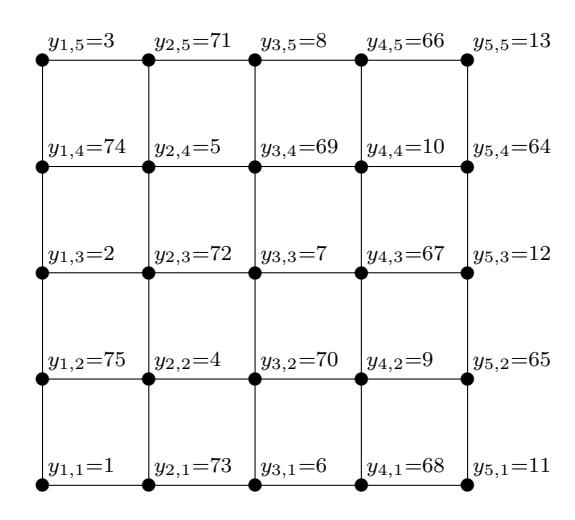
Figure 3. The partial bicentrally balanced \(C_4\)-face-magic projective labeling VALL<sub>15.5</sub>(5,5).
Proof. We show that \(VALL_{M,N}(m,n)\) is a partial bicentrally balanced \(C_4\)-face-magic labelings on the \(m \times n\) subgrid of \(\mathcal{P}_{M,N}\). The proof that \(HALL_{M,N}(m,n)\) is a partial bicentrally balanced \(C_4\)-face-magic labelings on the \(m \times n\) subgrid of \(\mathcal{P}_{M,N}\) is similar.
We observe that for the vertices (i,j) where i+j even, we assign the labels \(1,2,\ldots,\frac{1}{2}mn+\frac{1}{2}\) in lexicographic order; however, for the vertices (i,j) where i+j odd, we assign the labels \(MN-(\frac{1}{2}mn-\frac{3}{2}),MN-(\frac{1}{2}mn-\frac{5}{2}),\ldots,MN\) in reverse lexicographic order.
We have \(y_{2i-1,2j-1} + y_{2i-1,2j} = MN + 1\) for \(1 \le i \le m_0 + 1\) and \(1 \le j \le n_0\). Also, we have \(y_{2i,2j-1} + y_{2i,2j} = MN + 2\) for \(1 \le i \le m_0\) and \(1 \le j \le n_0\). Thus, for \(1 \le i \le m - 1\) and \(1 \le j \le n_0\), we have
\[y_{i,2i-1} + y_{i,2i} + y_{i+1,2i-1} + y_{i+1,2i} = 2MN + 3.\]
Next, we have \(y_{2i-1,2j}+y_{2i-1,2j+1}=MN+2\) for \(1\leqslant i\leqslant m_0+1\) and \(1\leqslant j\leqslant n_0\). Also, we have \(y_{2i,2j}+y_{2i,2j+1}=MN+1\) for \(1\leqslant i\leqslant m_0\) and \(1\leqslant j\leqslant n_0\). Thus, for \(1\leqslant i\leqslant m-1\) and \(1\leqslant j\leqslant n_0\), we have
\[y_{i,2j} + y_{i,2j+1} + y_{i+1,2j} + y_{i+1,2j+1} = 2MN + 3.\]
We observe that, for \(1 \leqslant j \leqslant n_0 + 1\), \(y_{1,2j-1} + y_{m,n+2-2j} = \frac{1}{2}mn + \frac{3}{2}\), and, for \(1 \leqslant j \leqslant n_0\), \(y_{1,2j} + y_{m,n+1-2j} = 2MN - \frac{1}{2}mn + \frac{3}{2}\). Thus, for \(1 \leqslant j \leqslant n-1\), we have
\[y_{1,j} + y_{m,n+1-j} + y_{1,j+1} + y_{m,n-j} = 2MN + 3.\]
Similarly, for \(1 \leqslant i \leqslant m_0 + 1\), \(y_{2i-1,1} + y_{m+2-2i,n} = \frac{1}{2}mn + \frac{3}{2}\), and, for \(1 \leqslant i \leqslant m_0\), \(y_{2i,1} + y_{m+1-2i,n} = 2MN - \frac{1}{2}mn + \frac{3}{2}\). Thus, for \(1 \leqslant i \leqslant m-1\), we have
\[y_{i,1} + y_{m+1-i,n} + y_{i+1,1} + y_{m-i,n} = 2MN + 3.\]
For all \(1 \leqslant i \leqslant m_0^+\) and \(1 \leqslant j \leqslant n_0^+\),
\[y_{2i-1,2j-1} + y_{m+2-2i,n+2-2j} = \frac{1}{2}mn + \frac{3}{2}.\]
Also, for all 1 ⩽ i ⩽ m0 and 1 ⩽ j ⩽ n0,
\[y_{2i,2j} + y_{m+1-2i,n+1-2j} = \frac{1}{2}mn + \frac{3}{2}.\]
We observe that, for all 1 ⩽ i ⩽ m+ 0 and 1 ⩽ j ⩽ n0,
\[y_{2i-1,2j} + y_{m+2-2i,n+1-2j} = 2MN - \frac{1}{2}mn + \frac{3}{2}.\]
Similarly, for all 1 ⩽ i ⩽ m0 and 1 ⩽ j ⩽ n + 0 ,
\[y_{2i,2j-1} + y_{m+1-2i,n+2-2j} = 2MN - \frac{1}{2}mn + \frac{3}{2}.\]
Suppose n ≡ 1 (mod 4). Then n + 0 is odd, and we let n ′ 0 be the positive integer such that n + 0 = 2n ′ 0 − 1. Thus
\[y_{2i-1,2n_0'-1} = n(i-1) + n_0'\] for all \(1 \le i \le m_0^+\), and \(y_{2i,2n_0'-1} = MN - ni + n_0'\) for all \(1 \le i \le m_0\).
Hence,
\[y_{i,n_0^+} < y_{i+2,n_0^+}\] for all \(1 \le i \le m-2\) and \(i+n_0^+\) is even, and (2)
\[y_{i,n_0^+} > y_{i+2,n_0^+}\] for all \(1 \le i \le m-2\) and \(i+n_0^+\) is odd. (3)
A similar argument shows that (2) and (3) hold when n ≡ 3 (mod 4). Also, a similar argument shows that
\[\begin{split} y_{m_0^+,j} < y_{m_0^+,j+2} \ \text{ for all } 1 \leqslant j \leqslant n-2 \text{ and } m_0^++j \text{ is even, and} \\ y_{m_0^+,j} > y_{m_0^+,j+2} \ \text{ for all } 1 \leqslant j \leqslant n-2 \text{ and } m_0^++j \text{ is odd.} \end{split}\]
3.6. Alternating Connected Sums
Definition 3.11. Let r ⩾ 3 be an odd integer and let r0 be the positive integer such that r = 2r0+1. Let X be a partial bicentrally balanced C4-face-magic labeling on the m × n subgrid of PM,N . Suppose r ⩽ M/m. The r-horizontal alternating connected sum of X, denoted by HASCr (X), is the labeling Y = {yi,j : (i, j) ∈ Grid(mr, n)} on Grid(mr, n) given by, for all (i, j) ∈ Grid(m, n) and for all integers 0 ⩽ k ⩽ r0,
- y(2k−1)m+i,j = MN − xi,j + (k − 1 2 )(mn) + 3 2 if 1 ⩽ k ⩽ r0 and i + j is odd,
- y(2k−1)m+i,j = MN − xi,j − (k − 1 2 )(mn) + 3 2 if 1 ⩽ k ⩽ r0 and i + j is even,
- y(2k)m+i,j = xi,j − k(mn) if 0 ⩽ k ⩽ r0 and i + j is odd, and
- y(2k)m+i,j = xi,j + k(mn) if 0 ⩽ k ⩽ r0 and i + j is even.
Suppose \(r \leq N/n\). The r-vertical alternating connected sum of X, denoted by VASC<sup>r</sup>(X), is the labeling \(Y = \{y_{i,j} : (i,j) \in Grid(m,nr)\}\) on Grid(m,nr) given by, for all \((i,j) \in Grid(m,n)\) and for all integers \(0 \leq k \leq r_0\),
- \(y_{i,(2k-1)n+j} = MN x_{i,j} + (k \frac{1}{2})(mn) + \frac{3}{2}\) if \(1 \le k \le r_0\) and i + j is odd,
- \(y_{i,(2k-1)n+j} = MN x_{i,j} (k \frac{1}{2})(mn) + \frac{3}{2}\) if \(1 \le k \le r_0\) and i + j is even,
- \(y_{i,(2k)n+j} = x_{i,j} k(mn)\) if \(0 \le k \le r_0\) and i+j is odd, and
- \(y_{i,(2k)n+j} = x_{i,j} + k(mn)\) if \(0 \le k \le r_0\) and i + j is even.
Example 3.3. The 3-horizontal alternating connected sum of \(HALL_{15,5}(5,5)\) is given in Table 2. For convenience, we display the \(15 \times 5\) projective grid graph as a \(15 \times 5\) checkerboard.
| 11 | 65 | 12 | 64 | 13 | 53 | 24 | 52 | 25 | 51 | 36 | 40 | 37 | 39 | 38 |
| 68 | 9 | 67 | 10 | 66 | 21 | 55 | 22 | 54 | 23 | 43 | 34 | 42 | 35 | 41 |
| 6 | 70 | 7 | 69 | 8 | 58 | 19 | 57 | 20 | 56 | 31 | 45 | 32 | 44 | 33 |
| 73 | 4 | 72 | 5 | 71 | 16 | 60 | 17 | 59 | 18 | 48 | 29 | 47 | 30 | 46 |
| 1 | 75 | 2 | 74 | 3 | 63 | 14 | 62 | 15 | 61 | 26 | 50 | 27 | 49 | 28 |
Table 2. A 3-horizontal alternating connected sum of \(HALL_{15.5}(5,5)\) on \(\mathcal{P}_{15.5}\) with \(C_4\)-face-magic value 153.
Theorem 3.3. Suppose X is a partial bicentrally balanced \(C_4\)-face-magic labeling on the \(m \times n\) subgrid of \(\mathcal{P}_{M,N}\). If r is an odd positive integer such that \(mr \leqslant M\), then the r-horizontal alternating connected sum of X, \(HASC^r(X)\), is a partial bicentrally balanced \(C_4\)-face-magic labeling on the \(mr \times n\) subgrid of \(\mathcal{P}_{M,N}\). Similarly, if r is an odd positive integer such that \(nr \leqslant N\), then the r-vertical alternating connected sum of X, \(VASC^r(X)\), is a partial bicentrally balanced \(C_4\)-face-magic labeling on the \(m \times nr\) subgrid of \(\mathcal{P}_{M,N}\).
Proof. We show that \(HASC^r(X)\), is a partial bicentrally balanced \(C_4\)-face-magic labeling on the \(mr \times n\) subgrid of \(\mathcal{P}_{M,N}\). The proof that \(VASC^r(X)\), is a partial bicentrally balanced \(C_4\)-face-magic labeling on the \(m \times nr\) subgrid of \(\mathcal{P}_{M,N}\) is similar.
First, when \(1 \le k \le r_0\), we have
\[y_{(2k-1)m+2i-1,j} + y_{(2k-1)m+2i-1,j+1} = 2MN + 3 - (x_{2i-1,j} + x_{2i-1,j+1}) \text{ and }\]\[y_{(2k-1)m+2i,j} + y_{(2k-1)m+2i,j+1} = 2MN + 3 - (x_{2i,j} + x_{2i,j+1}).\]
Thus, for all \(1 \le i \le m-1\), \(1 \le j \le n-1\), and \(1 \le k \le r_0\), we have
\[y_{(2k-1)m+i,j} + y_{(2k-1)m+i,j+1} + y_{(2k-1)m+i+1,j} + y_{(2k-1)m+i+1,j+1} = 2MN + 3.\]
Second, when \(0 \le k \le r_0\), we have
\[y_{(2k)m+2i-1,j}+y_{(2k)m+2i-1,j+1}=x_{2i-1,j}+x_{2i-1,j+1}\] and \[y_{(2k)m+2i,j}+y_{(2k)m+2i,j+1}=x_{2i,j}+x_{2i,j+1}.\]
Thus, for all 1 ⩽ i ⩽ m − 1, 1 ⩽ j ⩽ n − 1, and 0 ⩽ k ⩽ r0, we have
\[y_{(2k)m+i,j} + y_{(2k)m+i,j+1} + y_{(2k)m+i+1,j} + y_{(2k)m+i+1,j+1} = 2MN + 3.\]
When we set the C4-face sums below equal,
\[x_{i,j} + x_{i,j+1} + x_{i+1,j} + x_{i+1,j+1} = x_{i+1,j} + x_{i+1,j+1} + x_{i+2,j} + x_{i+2,j+1},\]
we obtain
\[x_{i,j} + x_{i,j+1} = x_{i+2,j} + x_{i+2,j+1}.\]
Thus, for all 1 ⩽ j ⩽ n − 1, we have
\[x_{1,j} + x_{1,j+1} = x_{m,j} + x_{m,j+1}. (4)\]
Third, for all 1 ⩽ j ⩽ n − 1 and 1 ⩽ k ⩽ r0, we have
\[y_{(2k)m,j} + y_{(2k)m,j+1} = 2MN + 3 - (x_{m,j} + x_{m,j+1}).\]
Similarly, we have
\[y_{(2k)m+1,j} + y_{(2k)m+1,j+1} = x_{1,j} + x_{1,j+1}.\]
By (4), we have
\[y_{(2k)m,j} + y_{(2k)m,j+1} + y_{(2k)m+1,j} + y_{(2k)m+1,j+1} = 2MN + 3.\]
A similar argument shows that, for all 1 ⩽ j ⩽ n − 1 and 1 ⩽ k ⩽ r0, we have
\[y_{(2k-1)m,j} + y_{(2k-1)m,j+1} + y_{(2k-1)m+1,j} + y_{(2k-1)m+1,j+1} = 2MN + 3.\]
From the construction of Y , we have
\[\begin{aligned} \{y_{i,j}: (i,j) \in \operatorname{Grid}(mr,n) \text{ and } i+j \text{ is even}\} &= \{1,2,\ldots, \frac{1}{2}mnr + \frac{1}{2}\}, \text{ and } \\ \{y_{i,j}: (i,j) \in \operatorname{Grid}(mr,n) \text{ and } i+j \text{ is odd}\} &= \{MN - \frac{1}{2}mnr + \frac{3}{2}, \\ MN - \frac{1}{2}mnr + \frac{5}{2},\ldots, MN\}. \end{aligned}\]
If i + j is even, we have
\[y_{(2k-1)m+i,j} + y_{(2(r_0-k+1)-1)m+(m+1-i),n+1-j} = 2MN - \frac{1}{2}mnr + \frac{3}{2}, \text{ and } y_{(2k)m+i,j} + y_{2(r_0-k)m+(m+1-i),n+1-j} = \frac{1}{2}mnr + \frac{3}{2}.\]
If i + j is odd, we have
\[y_{(2k-1)m+i,j} + y_{(2(r_0-k+1)-1)m+(m+1-i),n+1-j} = \frac{1}{2}mnr + \frac{3}{2}, \text{ and}\] \[y_{(2k)m+i,j} + y_{2(r_0-k)m+(m+1-i),n+1-j} = 2MN - \frac{1}{2}mnr + \frac{3}{2}.\]
Thus, for all \(1 \le i \le mr\) and \(1 \le j \le n\),
\[y_{i,j} + y_{mr+1-i,n+1-j} = \frac{1}{2}mnr + \frac{3}{2}\], if \(i+j\) is even, and \(y_{i,j} + y_{mr+1-i,n+1-j} = 2MN - \frac{1}{2}mnr + \frac{3}{2}\), if \(i+j\) is odd.
We have, for all \(1 \le i \le m\) and \(0 \le k \le r_0\),
\[\begin{split} y_{(2k-1)m+i,n_0^+} &= MN - x_{i,n_0^+} + (k-\tfrac12)(mn) + \tfrac32 \ \text{ if } i + n_0^+ \text{ is odd and} \\ y_{(2k)m+i,n_0^+} &= x_{i,n_0^+} + k(mn) \ \text{ if } i + n_0^+ \text{ is even.} \end{split}\]
Since, for all \(1 \le i \le m-2\),
\[\begin{split} x_{i,n_0^+} < x_{i+2,n_0^+} &\text{ if } i+n_0^+ \text{ is even and} \\ x_{i,n_0^+} > x_{i+2,n_0^+} &\text{ if } i+n_0^+ \text{ is odd,} \end{split}\]
we have
\[\begin{split} y_{(2k-1)m+i,n_0^+} &< y_{(2k-1)m+i+2,n_0^+} \ \text{if} \ (2k-1)m+i+n_0^+ \ \text{is even and} \\ y_{(2k)m+i,n_0^+} &< y_{(2k)m+i+2,n_0^+} \ \text{if} \ (2k)m+i+n_0^+ \ \text{is even}. \end{split}\]
In addition, we have
\[\begin{split} (k-1)(mn) + \tfrac{1}{2}mn + \tfrac{3}{2} &\leqslant y_{(2k-1)m+i,n_0^+} \leqslant k(mn) \\ & \text{if } (2k-1)m + i + n_0^+ \text{ is even and} \\ k(mn) + 1 &\leqslant y_{(2k)m+i,n_0^+} \leqslant k(mn) + \tfrac{1}{2}mn + \tfrac{1}{2} \\ & \text{if } (2k)m + i + n_0^+ \text{ is even.} \end{split}\]
Hence, for all \(1 \le i \le mr - 2\),
\[y_{i,n_0^+} < y_{i+2,n_0^+}\] if \(i + n_0^+\) is even.
A similar argument shows that, for all \(1 \le i \le mr - 2\),
\[y_{i,n_0^+} > y_{i+2,n_0^+}\] if \(i + n_0^+\) is odd.
Let \(M_0^+\) be the positive integer such that \(mr = 2M_0^+ - 1\). Then \(M_0^+ = mr_0 + m_0^+\). Suppose \(r_0\) is odd. Let \(r_0'\) be the positive integer such that \(r_0 = 2r_0' - 1\). For all \(1 \le j \le n\), we have
\[\begin{split} y_{(2r_0'-1)m+m_0^+,j} &= MN - x_{m_0^+,j} + (r_0'-\tfrac{1}{2})(mn) + \tfrac{3}{2} \ \text{if} \ m_0^+ + j \text{ is odd and} \\ y_{(2r_0'-1)m+m_0^+,j} &= MN - x_{m_0^+,j} - (r_0'-\tfrac{1}{2})(mn) + \tfrac{3}{2} \ \text{if} \ m_0^+ + j \text{ is even.} \end{split}\]
Since, for all \(1 \leqslant j \leqslant n-2\),
\[x_{m_0^+,j} < x_{m_0^+,j+2}\] if \(m_0^+ + j\) is even and \(x_{m_0^+,j} > x_{m_0^+,j+2}\) if \(m_0^+ + j\) is odd,
we have
\[\begin{split} y_{(2r_0'-1)m+m_0^+,j} &< y_{(2r_0'-1)m+m_0^+,j+2} \ \text{ if } (2r_0'-1)m+m_0^++j \text{ is even and} \\ y_{(2r_0'-1)m+m_0^+,j} &> y_{(2r_0'-1)m+m_0^+,j+2} \ \text{ if } (2r_0'-1)m+m_0^++j \text{ is odd.} \end{split}\]
Thus, for all \(1 \le j \le n-2\), we have
\[y_{M_0^+,j} < y_{M_0^+,j+2} \text{ if } M_0^+ + j \text{ is even and}\] (5)
\[y_{M_0^+,j} > y_{M_0^+,j+2}\] if \(M_0^+ + j\) is odd. (6)
A similar argument shows that (5) and (6) hold when \(r_0\) is even.
3.7. Labelings Associated with a Projective Factorization Sequence
Definition 3.12. Let \(m \ge 3\) and \(n \ge 3\) be odd integers.
- 1. Let \(F = (m_i, n_i : 1 \le i \le k)\) be an (m, n)-projective factorization sequence. See Definition 2.2. Let \(X_1 = \mathrm{HALL}(m_1, n_1)\). For \(2 \le i \le k\), let \(Y_i = \mathrm{HACS}^{m_i}(X_{i-1})\) and \(X_i = \mathrm{VACS}^{n_i}(Y_i)\). The horizontal bicentrally balanced labeling associated with F is denoted by \(\mathrm{HBBL}(F) = X_k\).
- 2. Let \(F' = (n'_i, m'_i : 1 \le i \le k)\) be an (n, m)-projective factorization sequence. Let \(X'_1 = \text{VALL}(m'_1, n'_1)\). For \(2 \le i \le k\), let \(Y'_i = \text{VACS}^{n'_i}(X'_{i-1})\) and \(X'_i = \text{HACS}^{m'_i}(Y'_i)\). The vertical bicentrally balanced labeling associated with F' is denoted by \(\text{VBBL}(F') = X'_k\).
Theorem 3.4. Let \(m \ge 3\) and \(n \ge 3\) be odd integers. Suppose X is constructed in one of the following two ways.
- 1. Suppose X = HBBL(F) for some (m, n)-projective factorization sequence \(F = (m_1, n_1, m_2, n_2, \ldots, m_k, n_k)\).
- 2. Suppose X = VBBL(F') for some (n, m)-projective factorization sequence \(F' = (n'_1, m'_1, n'_2, m'_2, \dots, n'_k, m'_k)\).
Then X is a standard bicentrally balanced \(C_4\)-face-magic projective labeling on \(\mathcal{P}_{m,n}\).
Furthermore, distinct (m,n)-projective factorization sequences \(F_1\) and \(F_2\) give rise to distinct standard bicentrally balanced \(C_4\)-face-magic projective labelings \(\mathrm{HBBL}(F_1)\) and \(\mathrm{HBBL}(F_2)\) on \(\mathcal{P}_{m,n}\). Similarly, distinct (n,m)-projective factorization sequences \(F_1'\) and \(F_2'\) give rise to distinct standard bicentrally balanced \(C_4\)-face-magic projective labelings \(\mathrm{VBBL}(F_1')\) and \(\mathrm{VBBL}(F_2')\) on \(\mathcal{P}_{m,n}\).
Proof. We first show that \(\mathrm{HBBL}(F)\) is a standard bicentrally balanced \(C_4\)-face-magic projective labeling on \(\mathcal{P}_{m,n}\). By Theorem 3.2, \(X_1 = \mathrm{HALL}_{m,n}(m_1,n_1)\) is a partial bicentrally balanced \(C_4\)-face-magic labeling on the \(m_1 \times n_1\) subgrid of \(\mathcal{P}_{m,n}\). For \(1 \leq i \leq k\), let
\[M_i = m_1 m_2 \cdots m_i\] and \(N_i = n_1 n_2 \cdots n_i\).
For some integer \(2 \leqslant i \leqslant k\), suppose \(X_{i-1}\) is a partial bicentrally balanced \(C_4\)-face-magic labeling on the \(M_{i-1} \times N_{i-1}\) subgrid of \(\mathcal{P}_{m,n}\). By Theorem 3.3, \(Y_i = \mathrm{HACS}^{m_i}(X_{i-1})\) is a partial bicentrally balanced \(C_4\)-face-magic labeling on the \(M_i \times N_{i-1}\) subgrid of \(\mathcal{P}_{m,n}\) and \(X_i = \mathrm{VACS}^{n_i}(Y_i)\) is a partial bicentrally balanced \(C_4\)-face-magic labeling on the \(M_i \times N_i\) subgrid of \(\mathcal{P}_{m,n}\). Thus \(X_k = \mathrm{HBBL}(F)\) is a partial bicentrally balanced \(C_4\)-face-magic labeling on the \(m \times n\) subgrid of \(\mathcal{P}_{m,n}\). Hence, \(\mathrm{HBBL}(F)\) is a standard bicentrally balanced \(C_4\)-face-magic projective labeling on \(\mathcal{P}_{m,n}\).
A similar argument shows that, for an (n, m)-projective factorization sequence F', VBBL(F') is a standard bicentrally balanced \(C_4\)-face-magic projective labeling on \(\mathcal{P}_{m,n}\).
Let \(F_i = (m_{i,j}, n_{i,j} : 1 \le j \le k_i)\), for i = 1, 2, be distinct (m, n)-projective factorization sequences. We need to show that \(\mathrm{HBBL}(F_1)\) and \(\mathrm{HBBL}(F_2)\) are distinct standard bicentrally balanced \(C_4\)-face-magic projective labelings on \(\mathcal{P}_{m,n}\). Suppose \(m_{1,j'}\) and \(m_{2,j'}\) are the first entries in \(F_1\) and \(F_2\), respectively, such that \(m_{1,j'} \ne m_{2,j'}\).
First, assume j'=1. Without loss of generality, we may assume \(m_{1,1} < m_{2,1}\). Then the labels on \(\mathrm{HBBL}(F_1)\) and \(\mathrm{HBBL}(F_2)\) are the same on the \(m_{1,1} \times 1\) subgrid of \(\mathcal{P}_{m,n}\). Let \(Z=\{y_{i,1}: 1\leqslant i\leqslant m_{1,1}\}\) be the common labels of \(\mathrm{HBBL}(F_1)\) and \(\mathrm{HBBL}(F_2)\) on the \(m_{1,1}\times 1\) subgrid of \(\mathcal{P}_{m,n}\). Let z be the smallest positive integer such that \(z\in\mathrm{Label}_Z(\mathrm{Grid}(m_{1,1},1))\) and \(z+1\notin\mathrm{Label}_Z(\mathrm{Grid}(m_{1,1},1))\). Let \(m'=m_{1,1}\). Then \(z=y_{m',1}=\frac{1}{2}(m'+1)\). In \(\mathrm{HBBL}(F_1)\) we have \(y_{2,2}=z+1\), and in \(\mathrm{HBBL}(F_2)\) we have \(y_{m'+2,1}=z+1\). Thus \(\mathrm{HBBL}(F_1)\) and \(\mathrm{HBBL}(F_2)\) are distinct standard bicentrally balanced \(C_4\)-face-magic projective labelings on \(\mathcal{P}_{m,n}\).
Suppose j'>1. Without loss of generality, we may assume \(m_{1,j'}< m_{2,j'}\). Let \(m'=m_{1,j'}M_{j'-1}\) and \(n'=N_{j'-1}\). Let \(Z=\{y_{i,j}:(i,j)\in\operatorname{Grid}(m',n')\}\) be the common labels of \(\operatorname{HBBL}(F_1)\) and \(\operatorname{HBBL}(F_2)\) on the \(m'\times n'\) subgrid of \(\mathcal{P}_{m,n}\). Let z be the smallest positive integer such that \(z\in\operatorname{Label}_Z(\operatorname{Grid}(m',n'))\) and \(z+1\notin\operatorname{Label}_Z(\operatorname{Grid}(m',n'))\). Then \(z=y_{m',n'}=\frac{1}{2}(m'n'+1)\). In \(\operatorname{HBBL}(F_1)\) we have \(y_{2,n'+1}=z+1\), and in \(\operatorname{HBBL}(F_2)\) we have \(y_{m'+2,1}=z+1\). Thus \(\operatorname{HBBL}(F_1)\) and \(\operatorname{HBBL}(F_2)\) are distinct standard bicentrally balanced \(C_4\)-face-magic projective labelings on \(\mathcal{P}_{m,n}\).
Suppose \(n_{1,j'}\) and \(n_{2,j'}\) are the first entries in \(F_1\) and \(F_2\), respectively, such that \(n_{1,j'} \neq n_{2,j'}\). A similar argument to the one above shows that \(\mathrm{HBBL}(F_1)\) and \(\mathrm{HBBL}(F_2)\) are distinct standard bicentrally balanced \(C_4\)-face-magic projective labelings on \(\mathcal{P}_{m,n}\).
Similarly, we can show that distinct (n, m)-projective factorization sequences \(F'_1\) and \(F'_2\) give rise to distinct standard bicentrally balanced \(C_4\)-face-magic projective labelings VBBL\((F'_1)\) and VBBL\((F'_2)\) on \(\mathcal{P}_{m,n}\).
4. Enumerating Bicentrally Balanced Labelings
We will enumerate the minimum number of distinct \(C_4\)-face-magic projective labelings on \(\mathcal{P}_{m,n}\).
Notation 4.1. Let \(m \ge 3\) be an odd integer. We define the function \(\beta\) given by
\[\beta(m) = \begin{cases} \left( \left( \frac{m-1}{4} \right)! \right)^2, & \text{if } m \equiv 1 \pmod{4}, \\ \left( \frac{m-3}{4} \right)! \left( \frac{m+1}{4} \right)!, & \text{if } m \equiv 3 \pmod{4}. \end{cases}\]
The following theorem gives us a lower bound on the number of distinct \(C_4\)-face-magic projective labelings on \(\mathcal{P}_{m,n}\) having \(C_4\)-face-magic value 2mn+1 (or 2mn+3) for distinct odd integers m and n.
Theorem 4.1. Let \(m \ge 3\) and \(n \ge 3\) be distinct odd integers. Then the number of distinct \(C_4\)-face-magic projective labelings on \(\mathcal{P}_{m,n}\) having \(C_4\)-face-magic value 2mn + 1 (or 2mn + 3) (up to symmetries on the projective plane) is at least
\[(\tau(m,n) + \tau(n,m))2^{m/2+n/2-3}\beta(m)\beta(n),\]
where \(\tau(m,n)\) is the number of distinct (m,n)-projective factorization sequences. See Definition 2.2.
Proof. Let X be a standard bicentrally balanced \(C_4\)-face-magic projective labeling on \(\mathcal{P}_{m,n}\). Let \(\eta\)be a permutation on \(\{1,2,\ldots,m_0\}\) such that \(\eta(i)\equiv i\pmod 2\) for all \(1\leqslant i\leqslant m_0\) and \(\mathcal{E}_\eta(X)\) be the labeling given in Definition 3.2. By Lemma 3.3, there are \(\beta(m)\) distinct bicentrally balanced \(C_4\)-face-magic projective labelings of type \(\mathcal{E}_n(X)\) on \(\mathcal{P}_{m,n}\). Let \(\alpha:\{1,2,\ldots,m_0\}\to\{0,1\}\) and \(\mathcal{E}_{\alpha}(X)\) be the labeling given in Definition 3.4. By Lemma 3.5, there are \(2^{m_0}\) distinct bicentrally balanced \(C_4\)-face-magic projective labelings of type \(\mathcal{E}_{\alpha}(X)\) on \(\mathcal{P}_{m,n}\). Similarly, by Lemma 3.4, there are \(\beta(n)\) distinct bicentrally balanced \(C_4\)-face-magic projective labelings on \(\mathcal{P}_{m,n}\) associated with the elementary projective labeling operation given in Definition 3.3. Also, by Lemma 3.6, there are \(2^{n_0}\) distinct bicentrally balanced \(C_4\)-face-magic projective labelings on \(\mathcal{P}_{m,n}\) associated with the elementary projective labeling operation given in Definition 3.5. Thus, there are \(\beta(m)2^{m_0}\beta(n)2^{n_0}\) distinct bicentrally balanced \(C_4\)-face-magic projective labelings on \(\mathcal{P}_{m,n}\) that are projective labeling equivalent to X. For each of these labelings, there are four labelings that are projective labeling equivalent by one of the symmetries \(R_0\), \(R_{180}\), H, or V of the projective plane. Hence, there are \(\frac{1}{4}\beta(m)2^{m_0}\beta(n)2^{n_0}=2^{m/2+n/2-3}\beta(m)\beta(n)\) distinct bicentrally balanced \(C_4\)-facemagic projective labelings on \(\mathcal{P}_{m,n}\) that are projective labeling equivalent to X up to symmetries of the projective plane. By Remark 3.1 and Lemma 3.1, a \(C_4\)-face-magic projective labeling on \(\mathcal{P}_{m,n}\) is bicentrally balanced if and only if its \(C_4\)-face-magic value is 2mn + 3. Therefore, there are \(2^{m/2+n/2-3}\beta(m)\beta(n)\) distinct \(C_4\)-face-magic projective labelings on \(\mathcal{P}_{m,n}\) with \(C_4\)-face-magic value 2mn+3 that are projective labeling equivalent to X up to symmetries of the projective plane.
By Theorem 3.4, each (m,n)-projective factorization sequence F and each (n,m)-projective factorization sequence F' are associated with unique standard bicentrally balanced \(C_4\)-face-magic projective labelings on \(\mathcal{P}_{m,n}\) given by \(\mathrm{HBBL}(F)\) and \(\mathrm{VBBL}(F')\), respectively. Therefore, there are at least
\[(\tau(m,n) + \tau(n,m))2^{m/2+n/2-3}\beta(m)\beta(n)\]
distinct \(C_4\)-face-magic projective labelings on \(\mathcal{P}_{m,n}\) (up to symmetries on the projective plane) that have \(C_4\)-face-magic value 2mn+3.
By Remark 2.1, there are at least
\[(\tau(m,n) + \tau(n,m))2^{m/2+n/2-3}\beta(m)\beta(n)\]
distinct \(C_4\)-face-magic projective labelings on \(\mathcal{P}_{m,n}\) (up to symmetries on the projective plane) that have \(C_4\)-face-magic value 2mn + 1.
The next proposition gives us a lower bound on the number of distinct C4-face-magic projective labelings on Pm,m having C4-face-magic value 2m2 + 1 (or 2m2 + 3).
Theorem 4.2. Let m ⩾ 3 be an odd integer. Then the number of distinct C4-face-magic projective labelings on Pm,m having C4-face-magic value 2m2 + 1 (or 2m2 + 3) (up to symmetries on the projective plane) is at least
\[\tau(m,m)2^{m-3}(\beta(m))^2.\]
The proof of Theorem 4.2 is similar to that of Theorem 4.1.
Theorem 4.3. Let m ⩾ 3 and n ⩾ 3 be distinct odd integers. Then the number of distinct C4-facemagic projective labelings on Pm,n (up to symmetries on the projective plane) is at least
\[(\tau(m,n) + \tau(n,m))2^{m/2+n/2-3}((\frac{m-1}{2})!(\frac{n-1}{2})! + 2\beta(m)\beta(n)).\]
Proof. By Lemma 2.3, the C4-face-magic value of a C4-face-magic projective labeling on Pm,n is either 2mn + 1, 2mn + 2, or 2mn + 3. By Theorem 2.1, there are exactly
\[(\tau(m,n) + \tau(n,m))2^{m/2+n/2-3}(\frac{m-1}{2})!(\frac{n-1}{2})!\]
distinct C4-face-magic projective labelings on Pm,n (up to symmetries on the projective plane) with C4-face-magic value 2mn + 2. By Theorem 4.1, there are at least
\[(\tau(m,n) + \tau(n,m))2^{m/2+n/2-3}\beta(m)\beta(n)\]
distinct C4-face-magic projective labelings on Pm,n (up to symmetries on the projective plane) with C4-face-magic value 2mn + 1 (or 2mn + 3). The result follows.
Theorem 4.4. Let m ⩾ 3 be an odd integer. Then the number of distinct C4-face-magic projective labelings on Pm,m (up to symmetries on the projective plane) is at least
\[\tau(m,m)2^{m-3}(((\frac{m-1}{2})!)^2+2(\beta(m))^2).\]
The proof Theorem 4.4 is similar to that of Theorem 4.3.
5. Open Problems
We conjecture that the labelings given in Theorem 3.4 are the only standard bicentrally balanced C4-face-magic projective labelings on Pm,n.
Conjecture 1. Let m ⩾ 3 and n ⩾ 3 be odd integers. Suppose X is a standard bicentrally balanced C4-face-magic projective labeling on Pm,n. Then either
- 1. there exists an (m, n)-projective factorization sequence F such that X = HBBL(F) or
- 2. there exists an (n, m)-projective factorization sequence F ′ such that X = VBBL(F ′ ).
Suppose m ⩾ 3 and n ⩾ 3 are odd integers. The characterization of C4-face-magic projective labelings on Pm,n with C4-face-magic value 2mn + 2 is given in [9]. It is natural to ask if there is a characterization of C4-face-magic projective labelings on Pm,n when m ⩾ 2 and n ⩾ 2 are even integers. By Lemma 2.2, the C4-face-magic value of such a labeling is 2mn + 2.
Problem 1. Let m ⩾ 2 and n ⩾ 2 be even integers. Find a characterization of the C4-face-magic projective labelings on Pm,n.
Curran and Locke [10] have characterized the C4-face-magic projective labelings on the 4 × 4 projective grid graph P4,4. They show that there are 144 C4-face-magic projective labelings on P4,4 up to symmetries on the projective plane.
References
- [1] M. Baca, On magic labelings of Mobius ladders. J. Franklin Inst. 326 (1989), 885–888. doi. org/10.1016/0016-0032(89)90010-0
- [2] M. Baca, On magic labelings of honeycomb. Discrete Math. 105 (1992), 305–311. doi. org/10.1016/0012-365X(92)90153-7
- [3] M. Baca, On magic labelings of grid graphs. Ars Combin. 33 (1992), 295–299.
- [4] S.I. Butt, M. Numan, S. Ali, and A. Semanicová-Fe ˇ nov ˇ cíková, Face antimagic labelings ˇ of toroidal and Klein bottle grid graphs. AKCE Int. J. Graphs Comb. 17 (2020), 109–117. doi.org/10.1016/j.akcej.2018.09.005
- [5] G. Chartrand, L. Lesniak, and P. Zhang, Graphs & Digraphs, 6th ed., CRC Press, Boca Raton, (2016).
- [6] S.J. Curran and R.M. Low, C4-face-magic torus labelings on C4 × C4, Cong. Numer. 233 (2019), 79–94.
- [7] S.J. Curran, R.M. Low, and S.C. Locke, C4-face-magic toroidal labelings on Cm × Cn, Art Discrete Appl. Math. 4 (2021), #P1.04, 33 pp. doi.org/10.26493/2590-9770. 1368.f37
- [8] S.J. Curran, R M. Low and S.C. Locke, Equatorially balanced C4-face-magic labelings on Klein bottle grid graphs, arXiv:2206.02028 [math.CO]. doi.org/10.48550/arXiv. 2206.02028
- [9] S.J. Curran, C4-face-magic labelings on odd order projective grid graphs, Australas. J. Combin. 83(3) (2022), 361–396. https://ajc.maths.uq.edu.au/pdf/83/ajc_v83_ p361.pdf
- [10] S.J. Curran and S.C. Locke, C4-face-magic labelings on even order projective grid graphs. In: F. Hoffman, S. Holliday, Z. Rosen, F. Shahrokhi, J., Wierman (eds) Combinatorics, Graph Theory and Computing. SEICCGTC 2021. Springer Proceedings in Mathematics & Statistics, vol 448. Springer, Cham. (2024), 177–201. doi.org/10.1007/ 978-3-031-52969-6_17
- [11] J.A. Gallian, A dynamic survey of graph labeling. Electron. J. Combin. 24 (2021), #DS6. doi.org/10.37236/27
- [12] A. Kasif, H. Muhammad, A. Ali, and M. Miller, Magic labeling of type (a, b, c) of families of wheels. Mathematics in Computer Science. 7 (2013), 315–319. doi.org/10.1007/ s11786-013-0162-9
- [13] K. Kathiresan and S. Gokulakrishnan, On magic labelings of type (1, 1, 1) for the special classes of plane graphs. Util. Math. 63 (2003), 25–32.
- [14] A. Kotzig, and A. Rosa, Magic valuations of finite graphs. Canad. Math. Bull. 13 (1970), 451–461. doi.org/10.4153/CMB-1970-084-1
- [15] K.W. Lih, On magic and consecutive labelings of plane graphs. Util. Math. 24 (1983), 165– 197.
- [16] T.M. Wang, Toroidal grids are anti-magic. In: Wang L. (eds) Computing and Combinatorics. COCOON 2005. Lecture Notes in Computer Science, vol 3595. Springer, Berlin, Heidelberg, (2005), 671–679. doi.org/10.1007/11533719_68