
Electronic Journal of Graph Theory and Applications
Abdilla Nurul Azisah Mna, Hasmawatib, Budi Nurwahyub, Nurdin Hindingb
abdillaazisah26@gmail.com, hasmawati@unhas.ac.id, budinurwahyu@unhas.ac.id, nurdin1701@unhas.ac.id
Correspondence author: hasmawati@unhas.ac.id (Hasmawati)
In this paper, we determine the edge metric dimension of the comb product of a cycle graph and a simple graph containing a dominant vertex. This result generalizes previous findings on the edge metric dimension of the comb product of a cycle and a complete graph. We show that the edge metric dimension of \(C_n > D\), where D is a simple graph with a dominant vertex, equals the product of the order of \(C_n\) and the order of D reduced by two.
Keywords: edge metric dimension, comb product graph, dominant vertex, cycle graph, simple graph Mathematics Subject Classification: 05C12, 05C40, 05C76, 05C85
1. Introduction
Kelenc et al. introduced the edge metric dimension concept to answer the question of the inability of metric dimension to distinguish the edges of a connected graph. Kelenc et al. [2] showed that for every connected graph G, exactly one of the relations \(\beta(G) > \beta_e(G), \beta(G) < \beta_e(G)\), or \(\beta(G) = \beta_e(G)\) holds, where \(\beta(G)\) denotes the metric dimension of graph G while \(\beta_e(G)\) denotes the edge metric dimension.
Received: 27 September 2024, Revised: 2 October 2025, Accepted: 9 November 2025.
<sup>a</sup>Magister Mathematics Program, Hasanuddin University, Makassar - Indonesia
<sup>b</sup>Departments of Mathematics, Hasanuddin University, Makassar - Indonesia
Let G be a connected simple graph and let \(x,y \in V(G)\). The distance of vertex x and y or d(x,y) denotes the length of a shortest path between x and y [9]. Now, assume graph G is connected and \(a,b,v \in V(G)\) in which \(e=ab \in E(G)\). The distance between an edge e=ab and a vertex v is defined as \(s(e,v)=\min\{d(a,v),d(v,b)\}\) [2]. The distance between an edge and a vertex is used to determine the edge metric generator of the graph.
Suppose a connected graph G. Choose an ordered k-tuple of vertices.
\[\Psi = (w_1, w_2, w_3, \dots, w_k), w_i \in V(G).\]
The representation of edge \(e \in E(G)\) to the \(\Psi\) is
\[r(e|\Psi) = (s(e, w_1), s(e, w_2), s(e, w_3), \dots, s(e, w_k)).\]
If \(\forall e_i, e_j \in E(G)\), \(r(e_i|\Psi) \neq (e_j|\Psi)\), then \(W = \{w_i|1 \leq i \leq k\}\) is an edge metric generator of graph G. The edge basis of a graph is the edge metric generator with minimum cardinality [3]. The edge basis cardinality is the edge metric dimension of the graph [2], denoted by \(\beta_e(G)\).
Over time, the edge metric dimension of various graphs was studied, such as in [2,4,7,8]. Kelenc et al. [2] established the edge metric dimension of unique graphs such as complete, cycle, and wheel graphs. Meanwhile, Nasir et al. [4] discussed the edge metric dimension of n-sunlet and prism family graphs. Zubrilina [8] characterized n-order graphs with the edge metric dimension n-1, whereas Wei et al. [7] discussed graphs with edge metric dimension n-2 on bipartite graphs.
In 2021, Singh et al. [6] established the edge metric dimension of French cycle windmill graph. French cycle windmill graph is a comb product cycle graph to the complete one. In this case, the comb product \((\triangleright)\) is defined as an operation between two graphs, for example, a graph G and H so that graph \(G \triangleright H\) is a graph consisting of one copy of graph G and |V(G)| copy of graph H, which then a vertex on graph i-th H copy is attached to the i-th vertex on graph G. Interestingly, in Singh et al. [6], the complete graph as graph H causes the fixed vertex on graph i-th H copy attached to the i-th vertex on the graph G to be the dominant vertex. A vertex \(x \in V(G)\) is called the dominant vertex on the graph G if d(x,v) = 1 for every \(v \in V(G) \setminus \{x\}\) [5].
There is an interesting problem about edge metric dimension of graph resulting comb product of cycle to the graph with a dominant vertex. In this paper, we expand that finding by replacing a complete graph with any simple graph that has a dominant vertex. This study aims to determine the edge metric dimension of the comb product \(C_n \triangleright D\), where D is any simple graph containing a dominant vertex. The finding about the French cycle windmill of Singh et al. [6] is a particular case of this study. Therefore, the novelty of this research is to generate the edge metric dimension of a graph resulting from the comb product of a cycle graph to the simple graph with a dominant vertex which resulted the generalization of previous research findings by Singh et al. [6].
The approach to explaining graph D is to change it into the form graph \(K_1 + G\), which implies G is a simple graph. Therefore, we compute the edge metric dimension of the comb product of the cycle to the graph \(K_1 + G\) in which G is the simple graph. In addition, we also compute the edge metric dimension of graph \(C_n \rhd W_{1,m}\) in which \(W_{1,m}\) is a wheel graph that has order m+1. Wheel graph \(W_{1,m}\) is a graph obtained from cycle graph order m and given an additional vertex in which every cycle vertex is adjacent to that additional vertex. Therefore, this graph also has a dominant vertex, the additional vertex.
2. Main Result and Discussion
To get the main result, we use our finding definitions and propositions. Therefore, we will start with the definition and propositions. As Hasmawati et al. [1] posed a definition of equivalent vertices in determining the graph partition dimension, we also pose a new definition, namely equivalent edges of a graph. The equivalent edges of a graph are essential in determining the edge metric generator.
Definition 2.1. Let G be a connected graph and let e1, e2 ∈ E(G). The edges e1 and e2 are called equivalent if (1) they share a common endpoint, and (2) for every vertex v ∈ V (G) distinct from the endpoints of e1 and e2, we have s(e1, v) = s(e2, v).
For example, suppose a cycle graph C4 with V (C4) = {ui |1 ≤ i ≤ 4} and E(C4) = {uiui+1|1 ≤ i ≤ 3} ∪ {u1u4}. Suppose e1 = u1u2 and e2 = u2u3. Condition (1) is fulfilled because u2 was incident on both edges. Then, s(e1, v) and s(e2, v) will be checked for any v ∈ V (C4) \ {u1, u3}.
For s(e1, v), ∀v ∈ V (C4) \ {u1, u3}, then
\[s(e_1, u_2) = \min\{d(u_1, u_2), d(u_2, u_2)\} = \min\{1, 0\} = 0\] (1)
\[s(e_1, u_4) = \min\{d(u_1, u_4), d(u_4, u_2)\} = \min\{1, 2\} = 1\] (2)
And for s(e2, v), ∀v ∈ V (C4) \ {u1, u3}, we get
\[s(e_2, u_2) = \min\{d(u_2, u_2), d(u_2, u_3)\} = \min\{0, 1\} = 0\] (3)
\[s(e_2, u_4) = \min\{d(u_2, u_4), d(u_4, u_3)\} = \min\{2, 1\} = 1\] (4)
Based on (2.1), (2.2), (2.3), (2.4), we obtain s(e1, v) = s(e2, v)∀v ∈ V (C4) \ {u1, u3}. Thus, the condition (2) in Definition 2.1 is also fulfilled. Therefore, there are equivalent edges of graph C4.
The following proposition describes the relationship between equivalent edges of a graph and its edge metric generator.
Proposition 2.1. If two edges e1 = ua and e2 = ub of graph G are equivalent and W ⊆ V (G) is an edge metric generator, then either a ∈ W or b ∈ W.
Proof. Suppose that W ⊆ V (G) and there are two equivalent edges of graph G, e1 = ua and e2 = ub. Since e1 and e2 are equivalent and share a common vertex u, we have s(e1, x) = s(e2, x) for all x ∈ V (G) \ {a, b}. By using contraposition, we will show that if a, b /∈ W, then W is not the edge metric generator.
Assume W = {vi |1 ≤ i ≤ k} ∈ V (G) and a, b /∈ W. Construct Ψ = (v1, v2, . . . , vk), vi ∈ W, then
\[r(e_1|\Psi) = (s(e_1, v_1), s(e_1, v_2), \dots, s(e_1, v_k))\]
= \((se_2, v_1), s(e_2, v_2), \dots, s(e_2, v_k)\); because of \(e_1\) and \(e_2\) are equivalent = \(r(e_2|\Psi)\)
Therefore, r(e1|Ψ) = r(e2|Ψ). There are two edges, e1, e2, with the same representation as the Ψ, so W is not an edge metric generator. Hence, we obtain that if W is the edge metric generator, then a ∈ W or b ∈ W. Thus, the proof is complete.
Proposition 2.1 shows that identifying equivalent edges in a graph helps determine its edge metric generator. In addition, equivalent edges also relate to graph K1 + G in this paper. This is presented in Theorem 2.1.
Theorem 2.1. If graph G is a simple graph of order n, then graph K1+G has at least n equivalent edges.
Proof. Assume graph G is a simple graph of n-order. Thus, graph K1 + G has a dominant vertex because the vertex of graph K1 is adjacent to all of the vertices of graph G.
Suppose that V (K1) = {u} and V (G) = {vi |1 ≤ i ≤ n}, we get V (K1 +G) = {u, v1, v2, . . . , vn} and E(K1 + G) = E(G) ∪ {uv1, uv2, . . . , uvn}. Therefore, E(K1 + G) is the union of two sets, E(G) and {uv1, uv2, . . . , uvn}.
For the set {uv1, uv2, . . . , uvn}, take any two edges, uva and uvb, 1 ≤ a, b ≤ n, a ̸= b. Suppose ea = uva and eb = uvb, ∀x ∈ V (K1 + G) \ {va, vb}. Because of x ̸= va ̸= vb, so d(va, x) ≥ 1 and d(vb, x) ≥ 1. Thus, we obtain
\[s(e_a, x) = \min\{d(u, x), d(v_a, x)\} = \min\{1, d(v_a, x)\} = 1\] (5)
\[s(e_b, x) = \min\{d(u, x), d(v_b, x)\} = \min\{1, d(v_b, x)\} = 1\] (6)
By using (2.5) and (2.6), we obtain s(ea, x) = s(eb, x). According to Definition 2.1., the edges ea and eb are equivalent. Because 1 ≤ a, b ≤ n, then e1, e2, . . . , en are equivalent edges. Therefore, there are n equivalent edges of this set.
There are two cases of E(G), they are E(G) = ∅ and E(G) ̸= ∅.
Case 1. If = ∅ then E(K1+G) = {uv1, uv2, . . . , uvn}. It has been shown that uv1, uv2, . . . , uvn are equivalent edges so that there are n exactly equivalent edges in the graph K1 + G.
Case 2. If E(G) ̸= ∅, then it can be assumed that |E(G)| = k, k > 0 so that |E(K1 + G)| = n + k. Thus, E(K1 + G) > n. Therefore, graph K1 + G has more than n equivalent edges because graph G is an arbitrarily simple graph.
Based on Case 1 and Case 2, we obtain graph K1 + G has at least n equivalent edges. Thus, the proof is complete.
In the following, we present propositions regarding the distance of a vertex to another and the distance of an edge to a vertex on graph K1 + G as the material used in determining the edge representation to find the edge metric dimension.
Proposition 2.2. Suppose that u, v ∈ V (K1 + G). If u, v are not adjacent, then d(u, v) = 2.
Proof. Suppose graph G is a simple graph and u, v ∈ V (K1+G). If u, v are not adjacent, then there must be a w ∈ V (K1 + G) as the dominant vertex in which d(x, w) = 1, ∀x ∈ V (K1 + G) \ {w} so that d(u, v) = d(u, w) + d(w, v) = 1 + 1 = 2. Thus, the proof is complete.
Proposition 2.3. Assume u, v, w ∈ V (K1 + G). If e = uv, then s(e, w) ≤ 2.
Proof. Assume a simple graph G and u, v, w ∈ V (K1 + G). If e = uv, then we get the following cases.
Case 1. If u = w or v = w, then
Subcase 1. For u = w, we obtain
\[s(e, w) = min\{d(u, w), d(v, w)\} = min\{d(w, w), d(v, w)\} = min\{0, d(v, w)\} = 0.\]
Subcase 2. For v = w, we obtain
\[s(e, w) = \min\{d(u, w), d(v, w)\} = \min\{d(u, w), d(w, w)\} = \min\{d(u, w), 0\} = 0.\]
Based on Subcase 1 and Subcase 2, s(e, w) = 0.
Case 2. If u ̸= v ̸= w and the vertex u or v is adjacent to w, then
Subcase 1. For u adjacent to w, d(u, w) = 1 and d(v, w) ≥ 1,
\[s(e, w) = min\{d(u, w), d(v, w)\} = min\{1, d(v, w)\} = 1.\]
Subcase 2. For v adjacent to w, d(v, w) = 1 and d(u, w) ≥ 1,
\[s(e, w) = min\{d(u, w), d(v, w)\} = min\{d(u, w), 1\} = 1.\]
Based on Subcase 1 dan 2, we get s(e, w) = 1.
Case 3. If u ̸= v ̸= w and both u and v are not adjacent to the w, then according to Proposition 2.2. s(e, w) = min{d(u, w), d(v, w)} = min{2, 2} = 2.
From Case 1, 2, and 3, we obtain \[s(e, w) \leq 2\]. Thus, the proof is complete.
Next, we will determine the edge metric dimension of the graph resulting from the comb product of a cycle graph to the graph with a dominant vertex. Singh et al. [6] have found the edge metric dimension of a graph resulting from the comb product of a cycle to the complete graph with a dominant vertex. Before the main results, we determine the edge metric dimension of the comb product graph of the cycle to the wheel graph because the wheel graph has a dominant vertex, but the edge metric dimension has not been found. As the approach used, the wheel graph W1,m is changed to the form K1 + G. It is found that graph G is Cm for graph W1,m. Thus, W1,m = K1 + Cm. Here is the theorem and its proof.
Theorem 2.2. \[\beta_e(C_n \rhd (K_1 + C_m)) = n(m-1), n \geq 3, m \geq 2.\]
Proof. Suppose that V (Cn) = {ui |1 ≤ i ≤ n} and E(Cn) = {ei = uiu(i+1) (mod n) |1 ≤ i ≤ n} also V (Cm) = {vj |1 ≤ j ≤ m} and E(Cm) = {fj = vjv(j+1) (mod m) |1 ≤ j ≤ m}. Assume V (K1) = {w}, we obtain:
\[V(K_1 + C_m) = V(K_1) \cup V(C_m) = \{w, v_1, v_2, \dots, v_m\}\] \[E(K_1 + C_m) = E(C_m) \cup \{wv_j | 1 \le j \le m\}\] \[= \{f_j = v_j v_{(j+1) \pmod{m}} | 1 \le j \le m\} \cup \{wv_j | 1 \le j \le m\}.\]
Write \(K_1 + C_m\) as \(W_{1,m}\). On the \(C_n \rhd W_{1,m}\), the fixed vertex of \(W_{1,m}\) is dominant, and it is w from graph \(K_1\) according to the scope of the problem. The vertex and edge set of graph \(C_n \rhd W_{1,m}\) are defined as follows.
\[V(C_n \rhd W_{1,m}) = V(C_n) \cup \left(\bigcup_{i=1}^n V((C_m)_i)\right)\] \[= \{u_i | 1 \le i \le n\} \cup \{v_j^i | 1 \le i \le n, 1 \le j \le m\}\] \[E(C_n \rhd W_{1,m}) = E(C_n) \cup \left(\bigcup_{i=1}^n E((C_m)_i)\right) \cup \{u_i v_j^i | 1 \le i \le n, 1 \le j \le m\}\] \[= \{e_i = u_i u_{(i+1) \pmod{n}} | 1 \le i \le n\}\] \[\cup \{f_j^i = v_j v_{(j+1) \pmod{m}} | 1 \le j \le m\} \cup \{u_i v_j^i | 1 \le i \le n, 1 \le j \le m\}\]
Graph \(C_n > W_{1,m}\) in the figure as follows.
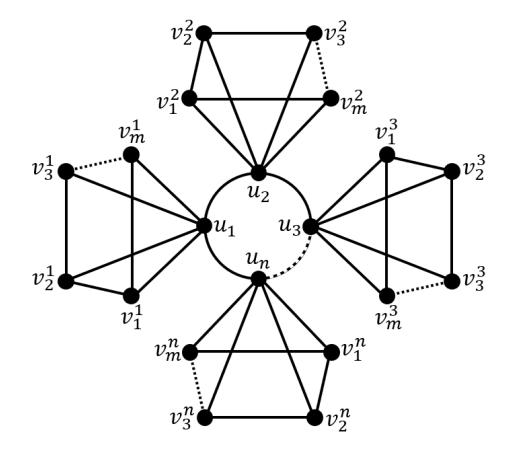
Figure 1. Graph \(C_n > W_{1,m}\)
Then, we find the upper and lower bound of the edge metric dimension of a graph \(C_n > W_{1,m}\).
The upper bound of the edge metric dimension:
Choose \(\Psi = (v_1^1, v_2^1, \dots, v_{m-1}^1, v_1^2, v_2^2, \dots, v_{m-1}^2, \dots, v_1^n, v_2^n, \dots, v_{m-1}^n), v_j^i \in C_n \rhd W_{1,m}\). Two cases are given when the order of \(C_n\) is odd or even.
Case 1. If \[n\] is odd, then \(\text{[rumus tidak dapat ditampilkan dengan baik — lihat PDF asli]}\)
\[\text{[rumus tidak dapat ditampilkan dengan baik — lihat PDF asli]}\]
25
\[\text{[rumus tidak dapat ditampilkan dengan baik — lihat PDF asli]}\]
generator of size n(m-1). Therefore, \(\beta_e(C_n > W_{1,m}) \leq n(m-1)\).
The lower bound of the edge metric dimension:
It will be shown that there is no edge metric generator with a cardinality smaller than n(m-1) in a graph \(C_n > W_{1,m}\).
Assume there is \(W' \subseteq V(C_n \rhd W_{1,m})\) edge metric generator and |W'| < n(m-1).
Note that the edges \(e_i^i = u_i v_i^i \in E(W' \subseteq V(C_n \rhd W_{1,m}))\) for certain i with \(1 \leq j \leq m\) are equivalent edges. Therefore, the number of equivalent edges is m for certain \(i \in (1, 2, ..., n)\). If
W' is the edge metric generator, by using Proposition 2.1., then \(\forall i \in (1, 2, \dots, n)\), there is at most one j such that \(v_j^i \notin W'\). Thus,
\[|W'| \ge |V(C_n)||V(C_m)| - \left(\sum_{i=1}^n |V(C_m)_i| - |V(C_{m-1})_i\right)\] \[= |V(C_n)||V(C_m)| - \sum_{i=1}^n |V(C_m)_i| - (|V(C_m)_i| - 1)\] \[= nm - \sum_{i=1}^n 1\] \[= nm - n\] \[= n(m-1)\]
It is obtained that \(|W'| \ge n(m-1)\) and contradicted by |W'| < n(m-1). Thus, there is no edge metric generator with a cardinality smaller than n(m-1) for this graph. Hence, we obtain \(\beta_e V(C_n \rhd W_{1,m}) \ge n(m-1)\). The proof is complete.
The edge metric dimension of the comb product of the cycle to the wheel graph in Theorem 2.2. is equal to the edge metric dimension of the French cycle windmill found by [6] if the order of the graph was the same. The main finding is that the complete [6] and the wheel graph will be replaced by a generally simple graph with a dominant vertex. Thus, this theorem establishes the edge metric dimension of the graph resulting from the comb product of the cycle graph to the simple graph with a dominant vertex.
Theorem 2.3. If graph G is a simple graph, then \(\beta_e(C_n \rhd (K_1 + G)) = n(|V(G)| - 1), n \ge 3, |V(G)| \ge 2.\)
Proof. Assume \(V(C_n) = \{u_i | 1 \le i \le n\}\) with \(E(C_n) = \{e_i = u_i u_{(i+1) \pmod n} | 1 \le i \le n\}\) also the order of simple graph G is m and \(V(G) = \{v_j | 1 \le j \le m\}\). Suppose that \(V(K_1) = \{w\}\), it is concluded:
\[V(K_1 + G) = V(K_1) \cup V(G) E(K_1 + G) = E(G) \cup \{wv_j | 1 \le j \le m\}.\]
Assume \(K_1 + G = \hat{G}\). On graph \(C_n \rhd \hat{G}\), the fixed vertex of \(\hat{G}\) is the dominant vertex w from graph \(K_1\) by the scope. The vertex and edge set of graph \(C_n \rhd \hat{G}\) are defined as follows.
\[\begin{split} V(C_n \rhd \hat{G}) &= V(C_n) \cup \left( \bigcup_{i=1}^n V(G_i) \right) \\ &= \{u_i | 1 \leq i \leq n\} \cup \{v_j^i | 1 \leq i \leq n, 1 \leq j \leq m\} \\ E(C_n \rhd \hat{G}) &= E(C_n) \cup \left( \bigcup_{i=1}^n E(G_i) \right) \cup \{u_i v_j^i | 1 \leq i \leq n, 1 \leq j \leq m\} \\ &= \{e_i = u_i u_{(i+1) \pmod n} | 1 \leq i \leq n\} \\ &\cup \{e_{jk}^i = v_j^i v_k^i | \text{ for a certain } j, k \ \} \cup \{e_j^i = u_i v_j^i | 1 \leq i \leq n, 1 \leq j \leq m\} \text{ in which} \end{split}\]
\[i \in (1, 2, ..., n)\] and \(j \in (1, 2, ..., m)\).
Following is the figure of graph \(C_n \rhd \hat{G}\).
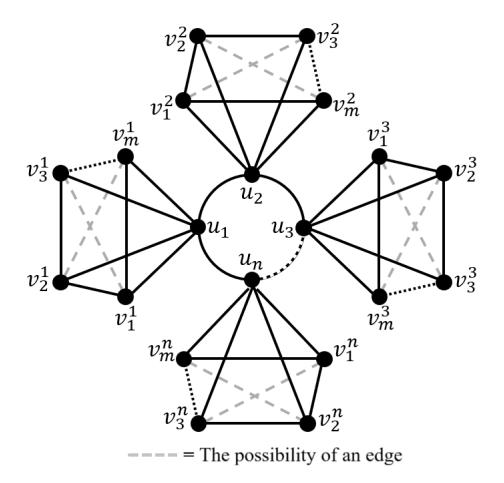
Figure 2. Graph \(C_n \triangleright \hat{G}\)
Now, we find the upper and lower bound of the edge metric dimension of a graph \(C_n \triangleright \hat{G}\). The upper bound of the edge metric dimension:
Choose \(\Psi = (v_1^1, v_2^1, \dots, v_{m-1}^1, v_1^2, v_2^2, \dots, v_{m-1}^2, \dots, v_1^n, v_2^n, \dots, v_{m-1}^n), v_j^i \in C_n \rhd \hat{G}\). In two cases, the order of \(C_n\) is odd or even.
Case 1. If \[n\] is odd, then
\[\text{[rumus tidak dapat ditampilkan dengan baik — lihat PDF asli]}\]
\[r(e_{jk}^i|\Psi) = \begin{cases} \left(\lceil \frac{n}{2} \rceil + 1, \lceil \frac{n}{2} \rceil + 1, \dots, \lceil \frac{n}{2} \rceil + 1, \dots, 3, 3, \dots, 3, \\ x_{i1}, x_{i2}, \dots, \underbrace{0}_{j^{th}}, \dots, x_{i(m-2)}, 3, 3, \dots, 3, \dots, \lceil \frac{n}{2} \rceil + 1, \lceil \frac{n}{2} \rceil + 1, \\ \dots, \lceil \frac{n}{2} \rceil + 1 \right), \text{ if } j \neq k \neq m. \end{cases}\] \[\text{[rumus tidak dapat ditampilkan dengan baik — lihat PDF asli]}\]
\[r(e_{jk}^{i}|\Psi) = \begin{cases} \left( \left\lceil \frac{n}{2} \right\rceil + 1, \left\lceil \frac{n}{2} \right\rceil + 1, \dots, \left\lceil \frac{n}{2} \right\rceil + 1, \dots, 3, 3, \dots, 3, \\ x_{i1}, x_{i2}, \dots, \underbrace{0}_{j^{th}}, \dots, \underbrace{0}_{k^{th}}, \dots, x_{i(m-2)}, 3, 3, \dots, 3, \dots, \left\lceil \frac{n}{2} \right\rceil, \left\lceil \frac{n}{2} \right\rceil, \\ \dots, \left\lceil \frac{n}{2} \right\rceil \right), \text{ if } j \neq k \neq m. \\ \left( \left\lceil \frac{n}{2} \right\rceil + 1, \left\lceil \frac{n}{2} \right\rceil + 1, \dots, \left\lceil \frac{n}{2} \right\rceil + 1, \dots, 3, 3, \dots, 3, \\ x_{i1}, x_{i2}, \dots, \underbrace{0}_{j^{th}}, \dots, x_{i(m-2)}, 3, 3, \dots, 3, \dots, \left\lceil \frac{n}{2} \right\rceil, \left\lceil \frac{n}{2} \right\rceil, \dots, \left\lceil \frac{n}{2} \right\rceil \right), \\ \text{if } k = m. \end{cases}\] Note: \(0 < x_{in} < 2\) (According to Proposition 2.3)
Note: \(0 < x_{ip} \le 2\) (According to Proposition 2.3)
The edge representation differ in all cases, hence the constructed set forms an edge metric generator of size n(m-1). Therefore, \(\beta_e(C_n \rhd (K_1+G)) \leq n(m-1)\).
The lower bound of the edge metric dimension:
Now, we will prove that there is no edge metric generator that has cardinality smaller than n(m-1) on a graph \(C_n > (K_1 + G)\), in which G is a simple graph that has order m.
Assume there is an edge metric generator \(W' \subseteq V(C_n \rhd (K_1 + G))\) in which |W'| < n(m-1).
Remember that the edges \(e_i^i = u_i v_i^i \in E(C_n \rhd (K_1 + G))\) for a certain i also \(1 \leq j \leq m\) are equivalent. In other words, the number of equivalent edges is m for a certain \(i \in (1, 2, ..., n)\). W' is the edge metric generator so that \(\forall i \in (1, 2, ..., n)\), there is at most one j such that \(v_i^i \notin W'\)according to Proposition 2.1.
Assume \(a_i = |V(G_i)| - 1\), we obtain
\[|W'| \ge |V(C_n)||V(G)| - \left(\sum_{i=1}^n |V(G_i)| - a_i\right)\] \[= |V(C_n)||V(G)| - \sum_{i=1}^n |V(G_i)| - (|V(G_i)| - 1)\] \[= nm - \sum_{i=1}^n 1\] \[= nm - n\] \[= n(m-1)\]
Thus, |W'| > n(m-1). The contradiction happens because of |W'| < n(m-1). Therefore, none of the edge metric generators has a cardinality smaller than n(m-1). We conclude \(\beta_e(C_n \triangleright\)\((K_1 + G) \ge n(m-1).\)
According to the upper and lower bound of the edge metric dimension, we conclude that \(\beta_e(C_n \triangleright\)\((K_1 + G) = n(m-1)\). Since |V(G)| = m, we obtain \(\beta_e(C_n \triangleright (K_1 + G)) = n(|V(G)| - 1)\). Thus, the proof is complete.
The finding of Singh et al. [6] can be obtained from Theorem 2.3. The graph used by Singh et al. [6] is graph \(C_m \rhd (K_1+G)\) with \(G=K_{n-1}\) so that \(\beta_e\) \((C_m \rhd (K_1+K_{n-1}))=m(V(K_{n-1})-1)=m((n-1)-1)=m(n-2)\). This also applies to other special graphs that have a dominant vertex, such as star \(S_{1,m}\), wheel \(W_{1,m}\), and fan graph \(F_{1,m}\). \(\beta_e(C_n \rhd S_{1,m})=\beta_e(C_n \rhd F_{1,m})=\beta_e(C_n \rhd W_{1,m})=n(m-1)\) because \(S_{1,m}=K_1+mK_1\), \(F_{1,m}=K_1+P_m\), and \(W_{1,m}=K_1+C_m\). If \(K_1+G=\hat{G}\) for the simple graph G, then we know that graph G is a simple graph that has a dominant vertex and we get \(\beta_e(C_n \rhd \hat{G})=n((|V(\hat{G})|-1)-1)=n(|V(\hat{G})|-2)\). So, the edge metric dimension of a graph resulting from the comb product of a cycle graph to the graph with a dominant vertex is the product of the cardinality of the cycle graph and the cardinality of a graph with a dominant vertex that has been reduced by 2.
3. Conclusion
The edge metric dimension of a graph resulting from the comb product of a cycle graph to the graph with a dominant vertex is the product of the cycle graph cardinality, and the cardinality of a graph with a dominant vertex is reduced by 2. This result generalizes and includes the result of Singh et al. [6] as a special case. Future research could explore comb products where the second factor lacks a dominant vertex, or analogous results for vertex metric dimensions.
Acknowledgement
The authors are very grateful to all referees and our colleagues who have provided beneficial comments in completing this article.
References
- [1] Hasmawati, N. Hinding, B. Nurwahyu, A.S. Daming, and A.K. Amir, The partition dimension of the vertex amalgamation of some cycles, Heliyon, 8 (2022), 1–7.
- [2] A. Kelenc, N. Tratnik, and I.G. Yero, Uniquely identifying the edges of a graph: the edge metric dimension, Discrete Appl. Math., 251 (2018), 204–220.
- [3] M. Tavakoli, M. Korivand, A. Erfanian, G. Abrishami, and E.T. Baskoro, The dominant edge metric dimension of graphs, Electron. J. Graph Theory Appl., 11 (2023), 197–208.
- [4] R. Nasir, S. Zafa, and Z. Zahid, Edge metric dimension of a graph, Ars Combin., 147 (2018), 143–156.
- [5] N.M. Rosyidah and Rinurwati, Edge metric dimension of neighborhood corona graph containing dominant vertices, Journal of Physics: Conference Series, 1821 (2021), 1–8.
- [6] P. Singh, S. Sharma, S.K. Sharma, and V.K. Bhat, Metric dimension and edge metric dimension of windmill graphs, AIMS Mathematics, 6 (2021), 9138–9153.
- [7] M. Wei and J. Yue, On the edge metric dimension of graphs, AIMS Mathematics, 5 (2020), 4459–4466.
- [8] Zubrilina, On the edge metric dimension of a graph, Discrete Math., 341 (2018), 2083–2088.
- [9] S. Akhter and R. Farooq, Metric dimension of fullerene graphs, Electron. J. Graph Theory Appl., 7 (2019), 91–103.