

Introduction
The three-layer system of bituminous pavement in general consists of bituminous layer at the top placed over a granular layer that rests on the subgrade soil with infinite thickness. The thickness of each layer is governed by the modulus of the material, where the thicknesses are computed using two critical strains, i.e., the tensile strain (horizontal principal strain) at the interface of the bottom of the subgrade layer and the compressive strain (vertical principal stress) at the top of the subgrade layer. These two critical strains are key parameters for investigating the fatigue and rutting distress in the pavement, respectively, which eventually cause the pavement to fail. Fatigue and rutting are the main causes of asphalt pavement structure failure, leading to deterioration in service life and performance [1]. For the conventional method of pavement design, all three layers are considered to exhibit linear behavior and the stresses and strains are computed using linear elastic theory.
The bituminous layer typically at the top of the pavement structure exhibits linear viscoelastic behavior under lower strain levels [2]. While the Mechanistic Empirical Design Guide [3] provides the viscoelastic nature of the bituminous layer, it simplifies the analysis by using a dynamic modulus at a certain frequency and temperature to represent the equivalent elastic modulus in the multilayer linear elastic analysis. The granular layer is built using natural materials like gravel or crushed rock, or artificial materials such as crushed slag or clinker, obtained as by-products of certain industrial processes [4]. Various studies have revealed that unbound granular materials show resilient behavior when subjected to traffic loading. This resilient behavior is a desirable characteristic for pavement materials, as it enables them to withstand repeated loading and maintain their structural integrity [5].
Copyright ©2024 Published by IRCS - ITB J. Eng. Technol. Sci. Vol. 56, No. 4, 2024, 499-509 ISSN: 2337-5779 DOI: 10.5614/j.eng.technol.sci.2024.56.4.6
Unbound granular materials exhibit behavior that is non-linear and stress-dependent when subjected to loading. They do not follow a linear stress-strain relationship and the material's stiffness changes with an increase in confinement pressure [6]. Principal stress/strain and unit weight vary with depth as a result of variations in confinement pressure within the pavement, which can be caused by changes in the bituminous layer's thickness or modulus. Thus, changes in the thickness and modulus of the bituminous layer result in variations in the modulus of the granular layer. The design characterizes the granular layer using the resilient modulus of the material. It is recognized that the resilient modulus of the granular layer is influenced by deviatoric stress and confinement pressure. Various models describing the resilient behavior of granular materials under deviatoric stress have emerged from laboratory simulation studies. Commonly available models are given in Table 1.
| Equations | Models for resilient modulus | References | Remarks |
|---|---|---|---|
| (1) | 𝑘2 𝑀𝑅 = 𝑘1𝜎3 | Monismith et.al., (1971) [9] | |
| (2) | 𝑘2 𝑀𝑅 = 𝑘1𝜃 | Hicks et.al., (1971) [10] | MR - Resilient modulus |
| (3) | 𝑘2𝜎3 𝑘3 𝑀𝑅 = 𝑘1𝜃 | Uzan (1985) [11] | θ - first stress invariant |
| (4) | 𝑘2 𝑘3 𝜃 𝜎𝑑 𝑀𝑅 = 𝑘1𝑃𝑎 ( ) ( ) 𝑃𝑎 𝑃𝑎 | Uzan (1985) [12] | σ3 - minor principal stress Pa - reference stress τoct - octahedral shear stress |
| (5) | 𝑘2 𝑘3 𝜃 𝜏𝑜𝑐𝑡 𝑀𝑅 = 𝑘1𝑃𝑎 ( ) ( ) 𝑃𝑎 𝑃𝑎 | Uzan (1993) [13] | k1, k2, k3 - constants |
Table 1 Models depicting non-linear behavior of granular materials [7, 8]
The modulus of the granular layer for the design purpose was computed based on the depth of the supporting layer. For instance, Eq. (1) suggests that the modulus of the granular layer relies on the resilient modulus of the subgrade soil upon which it is situated, along with the thickness of the granular layer [13].
\[M_{RG} = 0.2 (h)^{0.45} M_{S_7}\] (1)
where MRG signifies the modulus of the granular layer, MS denotes the modulus of the subgrade soil, and h represents the thickness of the granular layer. With deviatoric stress and confinement pressure influencing the resilient modulus, it is anticipated that the resilient modulus of the granular layers is more influenced by the bituminous layer and the self-weight of the material above it. To confirm the extent of influence of each layer on the modulus of granular layer, it is essential to explore the impact of changes in the thickness of the granular layer and the modulus of the subgrade soil on the non-linear behavior of the material within the granular layer.
Understanding and characterizing the non-linear, stress-dependent, and resilient behavior of unbound granular materials is crucial for designing durable and long-lasting pavements [14-16]. This investigation is crucial for optimizing the pavement design, assessing pavement performance, implementing effective maintenance and rehabilitation strategies.
In this investigation, the impact of the thickness and modulus of the bituminous layer on the modulus of the granular layer was explored through the utilization of the KENLAYER software. This study also evaluates the effect of different moduli values of bituminous layer and subgrade soil layer. KENLAYER is a finite element software package that uses the layered linear elastic theory to predict the behavior of pavement structures [17]. The program takes into account the layer thicknesses, moduli, and Poisson's ratio of each layer to ascertain the overall stiffness of the pavement section [18]. The details related to the input for the computation of the modulus are discussed in the following section.
Input Data
In this analytical work, three-layered nonlinear stress-strain analysis was carried out using the KENPAVE software [17]. The schematic of the three-layered structure used for the analysis is shown in Figure 1. All the materials were assumed to be homogeneous and the thickness of the subgrade infinite. The structure consisted of a granular layer above the subgrade soil and a bituminous concrete layer above the granular layer. For the analysis, the granular layer was subdivided into 10 sub-layers, as illustrated in Figure 1. The mid-depth of each sub-layer was taken into consideration for the evaluation of the modulus of the granular layer.
Schematic diagram of layered structure for non-linear analysis.
The stress-strain analysis was conducted for various thicknesses of the bituminous layer and the granular layer. The details regarding the thickness used for the analysis are listed in Table 2. In this analysis, the bituminous concrete layer and the subgrade soil were assumed to be linear elastic layers. Since the modulus of the granular layer is largely pressure-dependent, it is considered a non-linear layer. To investigate the influence of layer thickness (bituminous concrete layer and granular layer) and the modulus of the bituminous concrete layer and the soil layer on the modulus of the granular layer, analyses were carried out for different thicknesses and moduli, as outlined in Table 2. For all cases, the modulus of granular layers at different depths was determined and for this purpose, an initial-guess modulus of 500 MPa was assumed for the granular layer. In all analyses, the self-weight of the material was included. The unit weight of all materials and their respective Poisson's ratios are also presented in Table 2.
Table 2 Layer properties.
| Parameters | Bituminous layer | Granular layer | Subgrade soil |
|---|---|---|---|
| Thickness (cm) | 5, 15, 25 | 25, 35, 45 | Infinite |
| Elastic modulus (MPa) | 1,500, 3,000, 4,500 | 500 (Initial guess) | 30, 60, 100 |
| Unit weight of the material (kN / m3 ) | 22.3 | 20 | 17 |
| Poisson's ratio | 0.35 | 0.35 | 0.35 |
The three-layered structure was subjected to a dual wheel load (as shown in Figure 1), with a circular contact area. The details of the wheel load are listed in Table 3. The modulus of the granular layer and strains were determined at three radial coordinates and at two critical depths, as listed in Table 3.
Table 3 Wheel load details and points considered in the analysis.
| Layer Inputs | Options | Input data |
|---|---|---|
| Type of material | ||
| • Bituminous concrete layer | Linear elastic | |
| • Granular layer | Nonlinear | |
| • Subgrade soil layer | Linear elastic | |
| Number of periods per year | 1 | |
| Contact radius (CR) = 11.68 cm | ||
| 1 | Contact pressure (CP) = 467 kPa | |
| Number of load group | Center to center distance between two wheels (YW) = | |
| 29.2 cm | ||
| Radial coordinates | 3 | (0,0), (0,11.68), (0,14.6) |
| Number of Z (depth coordinates) for | 2 | 1. At bottom of bituminous layer |
| analysis | 2. At top of subgrade layer |
The modulus of the granular layer was considered to change based on the stress invariant as expressed in Eq. (2):
\[E = k_1 \theta^{k_2} \tag{2}\] where θ is the stress invariant, which is given by sum of the three principal stresses and earth pressure at any given point. The value of θ can be computed from θ = σ1+σ2+σ3+γz(1+2k0). Here, σ1, σ2, σ3 represent the principal stresses, while k0, k1 and k2 are constants. The values employed for the analysis are detailed in Table 4. The results of the analysis are discussed in the following sections.
| Parameters | Description | Data considered |
|---|---|---|
| Number of sub-layers | For granular layer | 10 |
| Non-linear exponent for granular material | k2 | 0.5 |
| Co-efficient of earth pressure | k0 | 0.6 |
| Angle of internal friction of granular material | φ | 0 |
| Non-linear co-efficient of granular layer | k1 | 10000 |
| Relaxation co-efficient | - | 0.5 |
Table 4 Non-linear parameters for granular layer.
Results and Discussion
The stress at any point in the granular layer is dependent on the thickness of the layers and their modulus values. Given the stress-dependent characteristic behavior of the modulus of the granular layer, this study further delved into the influence of the modulus of the bituminous concrete layer and the sub-layer on the modulus of the granular layer. Similarly, the analysis also examined the impact of the thickness of the bituminous concrete layer on the modulus of the granular layer.
Influence of Bituminous Layer Modulus (E1)
Figure 2 captures the granular layer modulus for different bituminous layer moduli. The modulus in Figure 2(a) corresponds to a bituminous layer thickness of 5 cm. The modulus converged using Eq. (2) was expected to increase with an increasing the stress invariant. The stress invariant is governed by two factors: one is the principal stresses at any given point and the other is the earth pressure.
The principal stress is expected to decrease with the increase in the depth of the layer and the earth pressure is expected to increase with the depth. As the principal stresses decrease, the subbase layer's modulus decreases with an increase in the layer thickness. For a constant bituminous layer thickness, introducing a stiffer material (with a higher modulus) slightly decreases the modulus of the sub-layers within the granular layer. Conversely, when the bituminous layer thickness is increased, as depicted in Figures 2(b) and (c), the modulus of the granular layer significantly decreases, exhibiting only a slight decrease in modulus with depth.
The modulus of the granular layer, which has a 25-cm thick bituminous layer above it (Figure 2(c)), for a depth greater than 6 cm is almost independent of depth. To conclude, the modulus of the granular layer is more influenced by the thickness of the bituminous layer when compared to the increase of its stiffness (modulus). A granular layer with a thin surface layer exhibited a stress-dependent modulus. The stress dependency of the granular layer ceased with the increase in thickness of the surface layer.
Figures 3 and 4 capture the variation of the critical strains that govern the pavement thickness. These analyses were performed by considering the granular layer as a nonlinear layer. For the pavement with a thin bituminous layer (h1 = 5 cm), the horizontal tensile strain at the periphery was found to be maximum. In the case of a thicker pavement, the highest tensile strain was observed at the center of the dual wheel load. An increase in thickness from 5 cm to 15 cm for a modulus of 1500 MPa increased the critical tensile strain. However, this case was observed only for the material with a lower modulus of 1500 MPa. In general, an increase in the thickness and the modulus of the bituminous layer, reduces the critical strain.
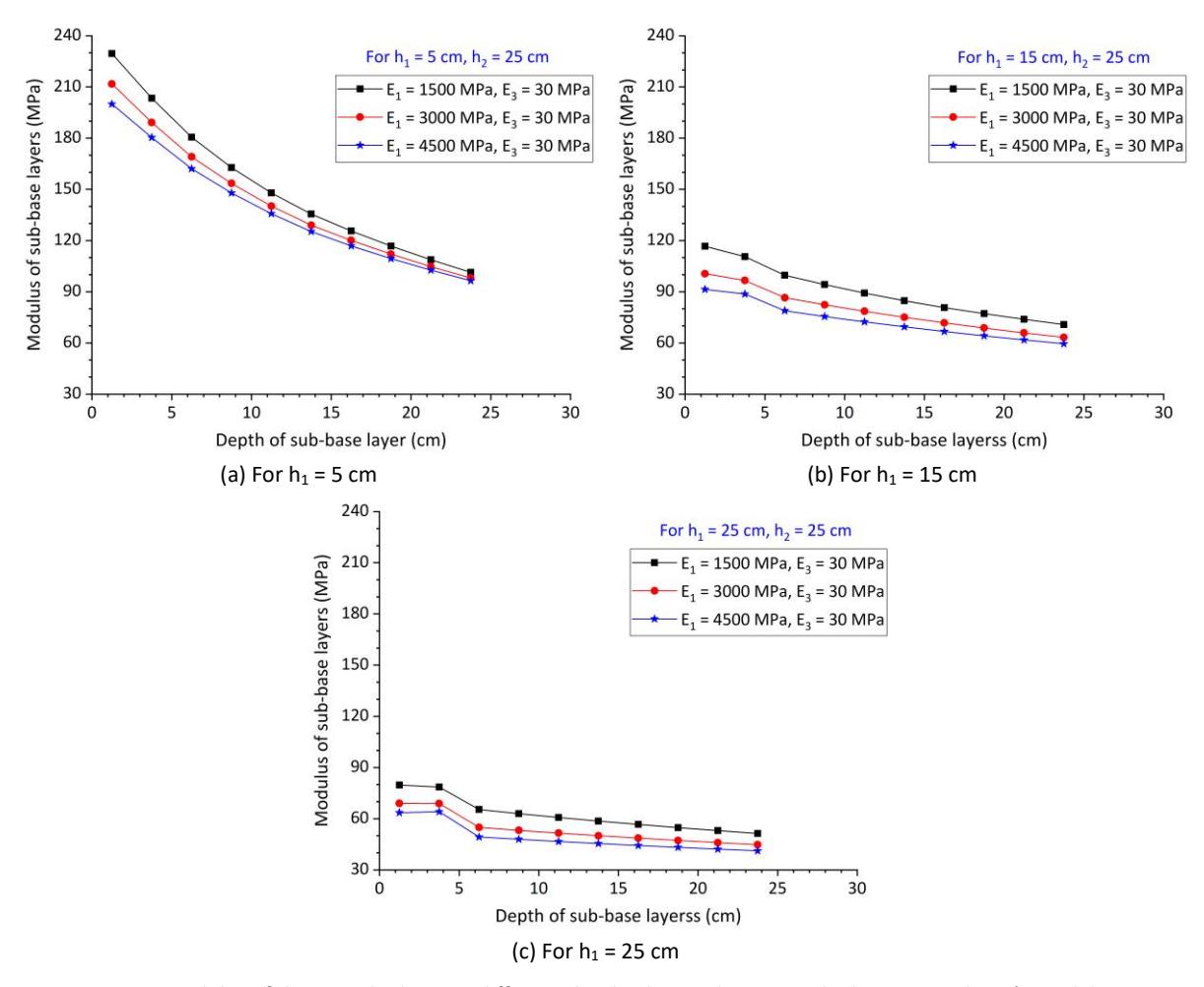
Modulus of the granular layer at different depths due to changes in the bituminous layer's modulus.
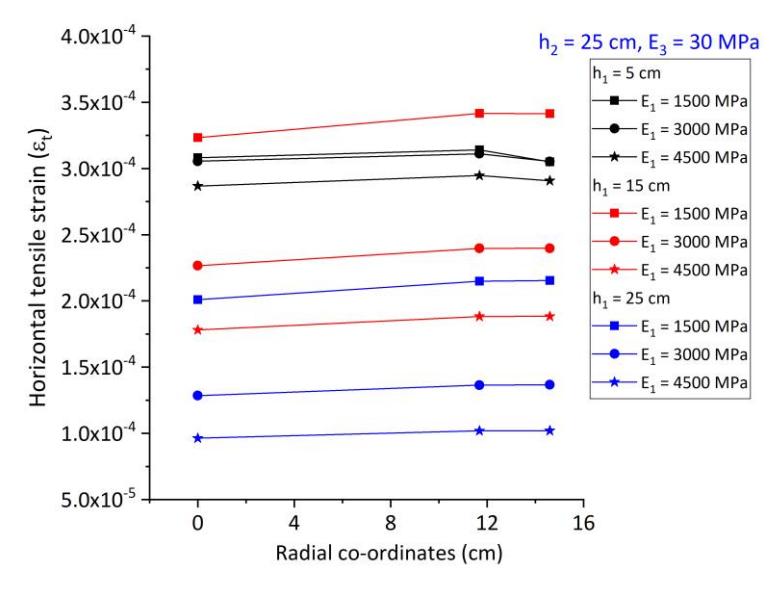
The horizontal tensile strain at the interface of the bottom of the bituminous layer.
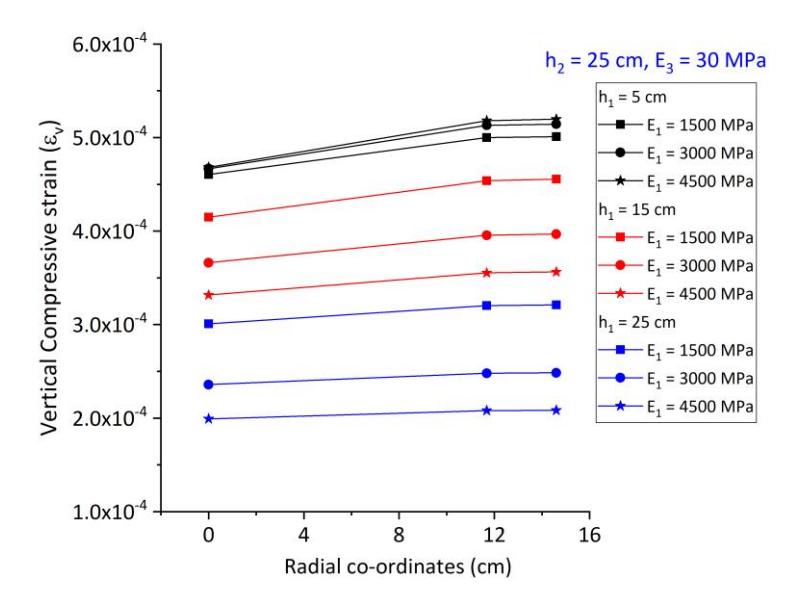
The vertical compressive strain at the interface of the top of the subgrade soil.
Influence of Thickness of Bituminous Layer (h1)
Figure 5 demonstrates that an increase in the thickness of the bituminous layer leads to a reduction in the modulus of the granular layer. As the bituminous layer thickness increases, the principal stresses at any point on the subgrade decrease. Due to this, the confinement pressure offered the principal stresses is reduced and hence the modulus is lower. An increase in bituminous layer thickness by 10 cm reduced the modulus of the granular layer by 10 MPa on average. The bituminous layer modulus also slightly influenced this decrease in modulus but only in a thin bituminous layer.
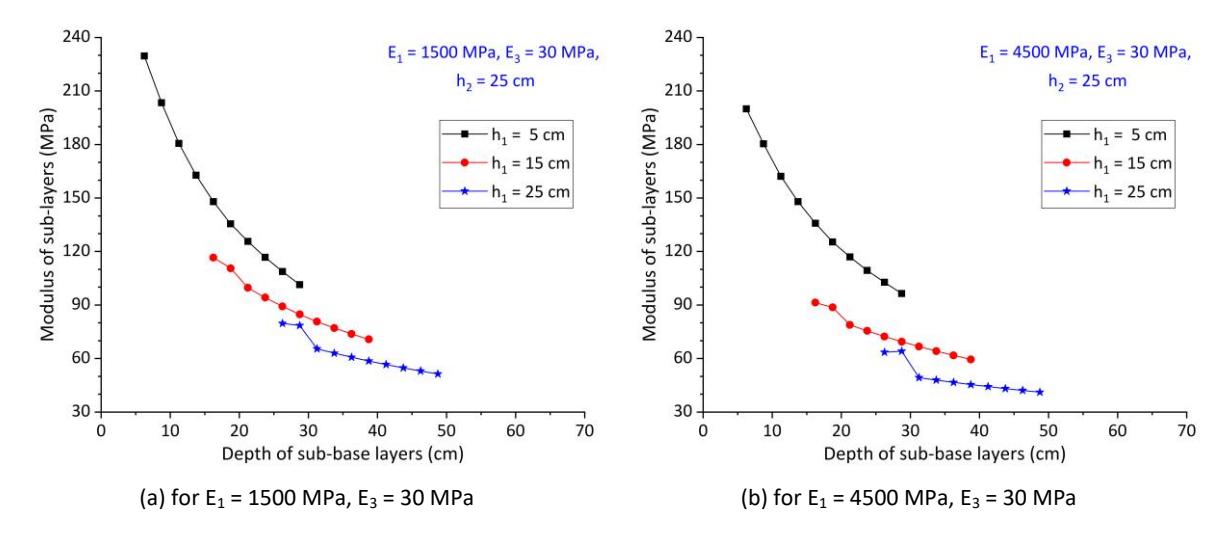
Modulus of sub-base layers at various depths for different thicknesses of the bituminous layer.
Figure 6 depicts the variation in critical strains at the bottom of the bituminous layer as a function of layer thickness. An increase in tensile strain was observed for thicknesses ranging from 5 to 15 cm, followed by a reduction at a thickness of 25 cm, considering the modulus of the bituminous layer as 1500 MPa. On the other hand, for a higher modulus of the bituminous layer, say 4500 MPa, the strain decreases with an increase in the thickness of the bituminous layer. Figure 7 displays the impact of varying bituminous layer thicknesses on the vertical compressive strain at the top of the subgrade soil. On both the modulus of 1500 and 4500 MPa considered, an increase in thickness resulted in a decrease in compressive strain. It can be observed that the 5cm thick layer showed a very low difference in strain between the modulus considered when compared to the higher thickness.
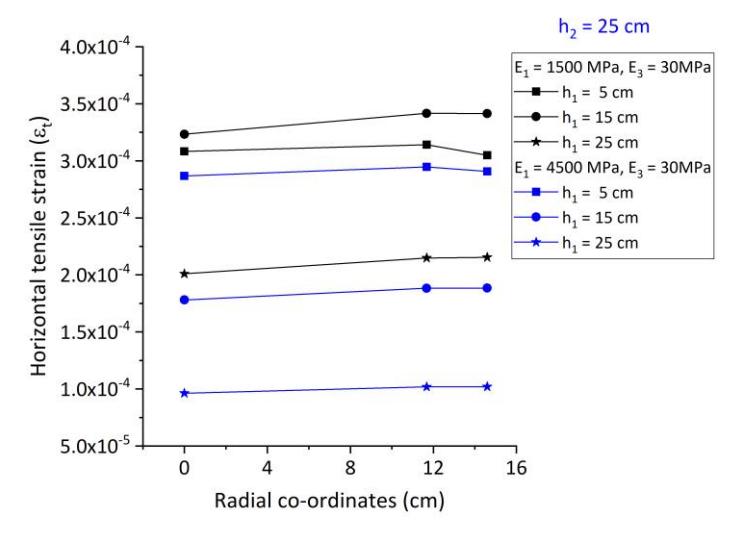
Horizontal tensile strain at the interface of the bottom of the bituminous layer for various thicknesses of the bituminous layer.
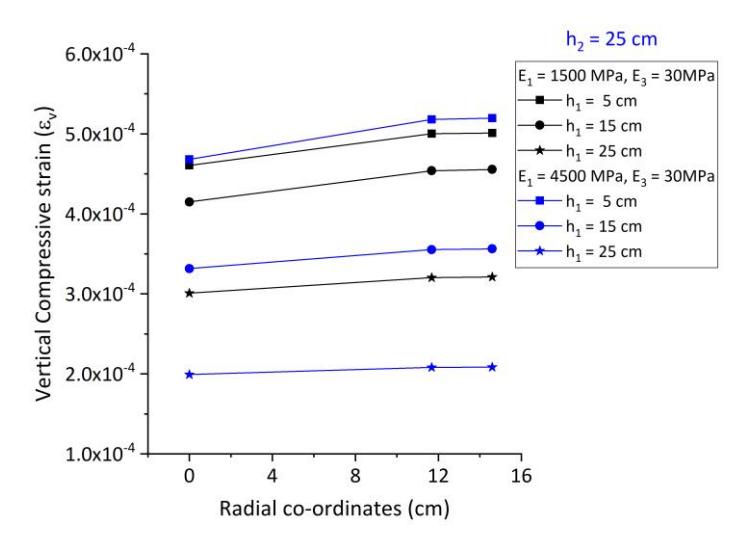
Vertical compressive strain at the interface of top of the bituminous layer for various thicknesses of bituminous layer.
Influence of Modulus of Subgrade Soil (E3)
The modulus of the granular layer was determined for different moduli of the subgrade soil, as shown in Figure 8. There was a reduction in the modulus of the granular layer as the depth increased. The initial reduction of the modulus was observed to be high up to a depth of 18 cm beneath the bituminous surface, after which it decreased. The modulus and its rate of reduction was found to be the same for all three values of E3 in Figures 8a and 8b. This infers that there is no influence of the modulus of the subgrade soil on the modulus of the granular layer. The critical strains at three radial coordinates are shown in Figure 9 for different values of the subgrade modulus. It can be stated that the strain at the interface of the bottom of the bituminous layer remains independent of the subgrade modulus.
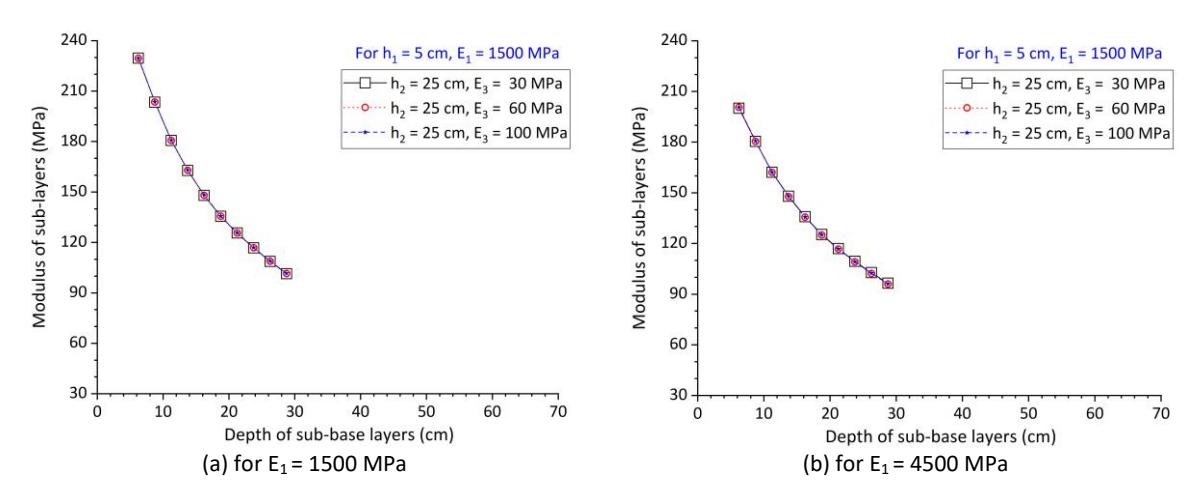
Modulus of the sub-base layer at various depths due to variation of the modulus of the subgrade layer.
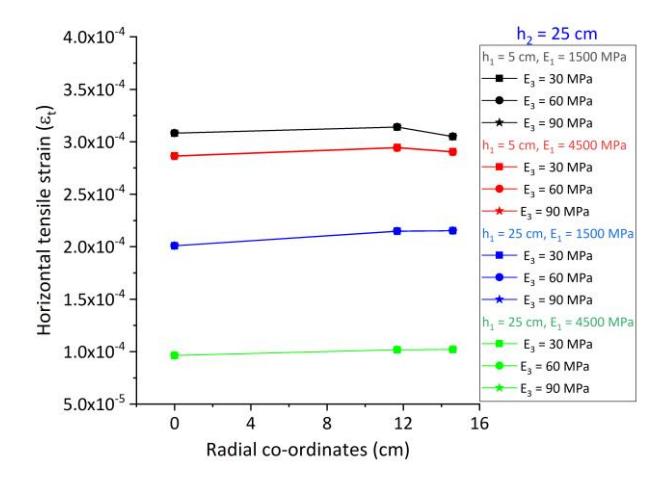
Influence of changes in the modulus of the subgrade layer on the horizontal tensile strain at the bottom of the bituminous layer.
Influence of Thickness of Granular Layer (h2)
Figure 10 illustrates that increasing the thickness of the sub-base layer has no influence on the modulus of the layer.
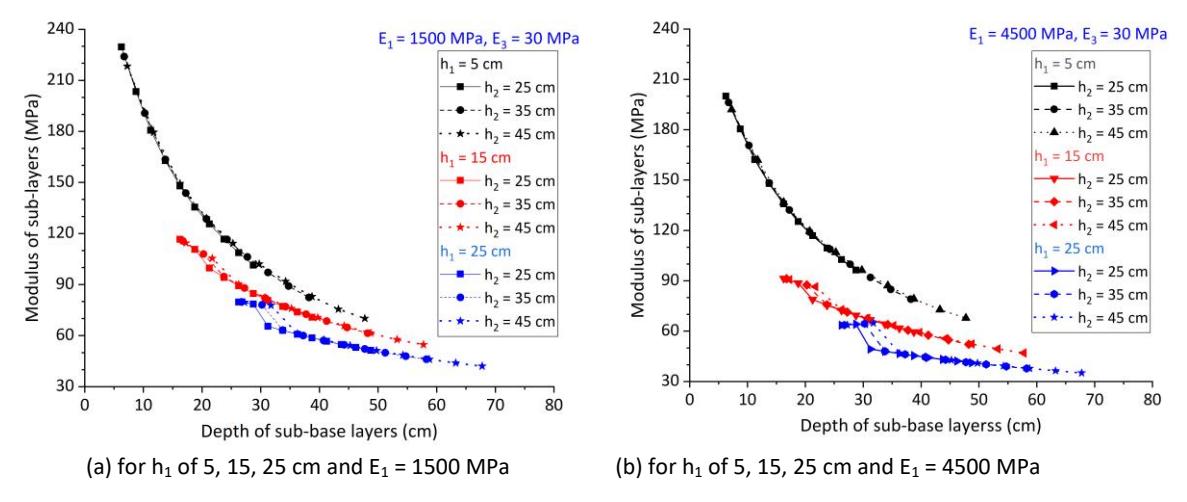
Modulus of the sub-base layer for various thicknesses of the sub-base layer.
From Figure 11, the tensile strain increased with increasing thickness of a granular layer with a thin bituminous layer of 5 cm, whereas with a thicker bituminous layer of 15 and 25 cm, it remained the same for an increased granular layer thickness. This holds true for any modulus of bituminous layer, as depicted in Figure 11a and 11b. The vertical compressive strain decreases as the thickness of the granular layer increases, as shown in Figure 12a and 12b. The extent of reduction in compressive strain at any radial point beneath the load reduces with the increase of the bituminous layer's thickness.
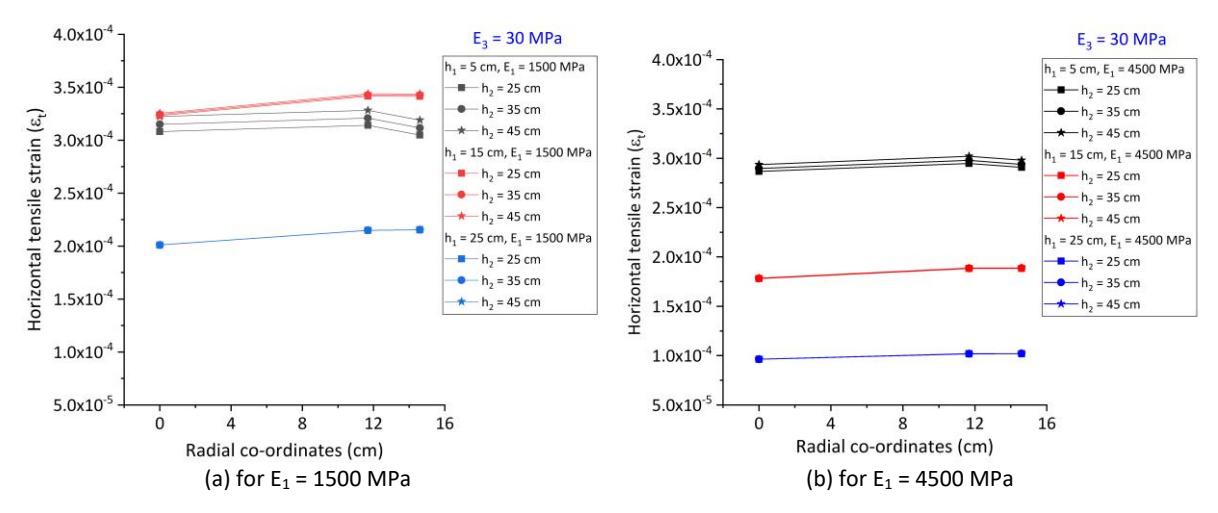
Horizontal tensile strain at the interface of the bottom of the bituminous layer for varying values of h2.
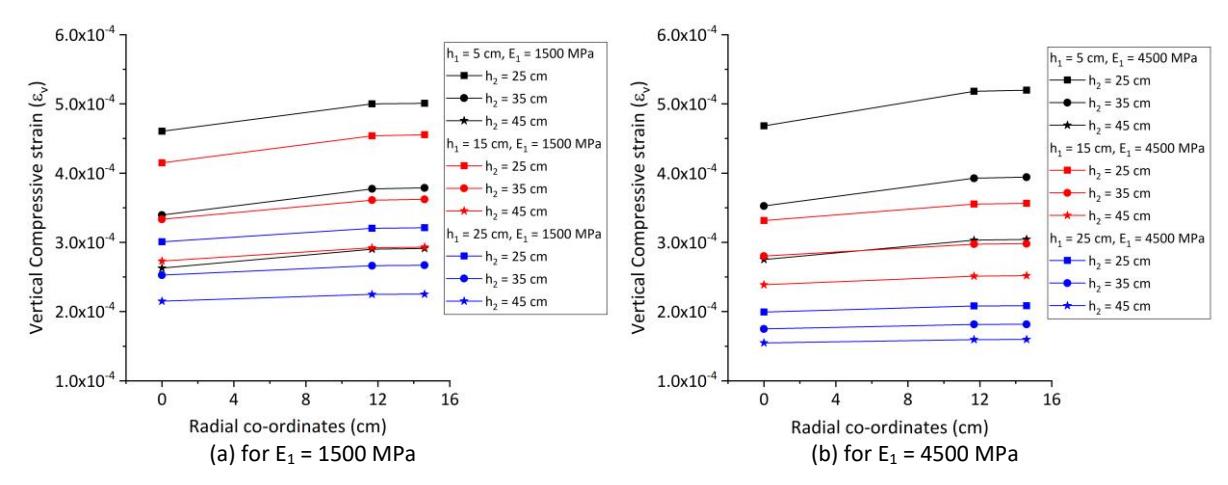
Vertical compressive strain at the interface of the top of the bituminous layer for varying values of h2.
Conclusion
The modulus of the granular layer stands as a critical parameter in the design of flexible pavement structures. The granular layer provides a stable base for the bituminous layer and distributes traffic loads to the subgrade soil. The thickness of the granular layer and that of the bituminous layer both play a pivotal role in determining the overall performance of the pavement system. The KENLAYER software is a valuable tool for predicting the behavior of pavement structures. The program was used in thus study to investigate the effect of varying bituminous and granular layer thicknesses and different moduli values on the modulus of the granular layer.
It can be concluded that increasing the modulus of the bituminous layer results in a reduction of the modulus of the granular layer. This reduction increases with the layer depth when it is placed beneath the thin bituminous layer. The granular layer, particularly with a thin surface layer, exhibits a stress-dependent modulus. A 10-cm increase in the thickness of the bituminous layer leads to a corresponding 10-MPa reduction in the modulus of the granular layer. The tensile strain increased for bituminous layer thicknesses of 5 and 15 cm but decreased for a thickness of 25 cm when the modulus of the bituminous layer was set at 1500 MPa. As the thickness of the bituminous layer increased, the compressive strain at the interface of the top of the subgrade soil decreased. Increasing the thickness of the granular layer resulted in a reduction in the modulus of the granular layer, correlating with an increase in tensile strain at the bottom of the thin bituminous layer. Changes in the modulus of the subgrade soil did not affect the modulus of the granular layer, and the subgrade modulus had no impact on the critical strain at the bottom of the bituminous layer.
Compliance with ethics guidelines
The authors declare that they have no conflict of interest or financial conflicts to disclose.
This article does not contain any studies of human or animal subjects performed by any of the authors.