

Introduction
In recent years, there has been a significant research emphasis on the utilization of industrial and agricultural waste materials within the field of civil engineering. Various waste materials, including fly ash, steel slag, blast furnace slag, rice husk ash (RHA), wood ash, and bagasse ash, have garnered considerable attention. These materials have been explored for potential application in diverse civil engineering practices. One research indicated rice husk as a byproduct of the rice milling process, which is classified as agricultural waste [1].
RHA can improve soil due to silica in the RHA reacting with lime and cement calcium hydroxide to form cementitious compounds that strengthen the soil [2]. RHA is a low-cost, sustainable, and eco-friendly material that can be used for soil stabilization, leading to a decrease in building expenses [3,4]. This ash is about 75% of the rice husk weight and contains a large amount of organic matter. Also, amorphous silica makes up between 85% and 90% of the rice husk ash, contributing to the increased silica content, which contributes to its pozzolanic properties [5].
Incorporating 6% of RHA into the mix reduces soil swelling by reducing the gaps between soil grains. This leads to improved mechanical properties and enhanced soil indexes of the SM soil type when subjected to high loads, but decreased soil improvement and increased mineral soil pollution at an RHA ratio of more than 6% [6]. However, the utilization of commercially produced soil-enhancing substances such as cement and lime has experienced a surge in costs and poses environmental challenges. In response to this, RHA has emerged as a viable substitute with notable pozzolanic properties, capable of combining with lime or cement to effectively solidify soil [7]. Also, powdered rice husk ash strengthens cement [8].
In Roslan's research it was shown that RHA still produces pozzolanic activity even though its burning did not take place at a controlled temperature. It was also found that mixing 10–15% of RHA with 6–8% cement enhanced
Copyright ©2024 Published by IRCS - ITB J. Eng. Technol. Sci. Vol. 56, No. 4, 2024, 450-462 ISSN: 2337-5779 DOI: 10.5614/j.eng.technol.sci.2024.56.4.2 the pozzolanic and cementitious properties of the mixture. This was evident from the reduction in the plasticity index. Moreover, there was an increase in the optimum moisture content of the soil types of kaolinite and bentonite [9].
In a study conducted by Ayininuola and Olaosebikan [10], it was observed that the coefficient of permeability (k) of soil (CL, MH, and SM-SC) exhibited a decrease as the content of rice husk ash (RHA) increased. This decrease can be attributed to the exchangeable behavior of cations, specifically Al3+ and Ca2+, that are present in the ash. These cations form strong bonds with other monovalent ions, thereby impeding the movement of water through the soil.
The findings of Mohamed et al. [11] indicated a high level of effectiveness in enhancing the qualities of swelling soil with the current approach. Furthermore, the optimal proportion of additional residual heat processing (residual heat processing) for the swelling soil was determined to be 15%.
In 2023, Salimzadehshooiili [12] observed that there is a positive correlation between the amount of rice husk ash and the shear modulus in Anzali sand in Iran, indicating that an increase in RHA leads to a rise in the shear modulus. The findings also demonstrated the beneficial impact of partially substituting cement with RHA. Hung et al. focused on sustainable concrete utilizing agro-industrial by-products, particularly rice husk ash. The study showcased accurate forecasts (exceeding 95%) for various concrete characteristics using artificial neural networks (ANN), emphasizing the potential of environmentally friendly and high-performance materials [13].
In studying lateritic soil engineering, Domphoeun et al. noted that using rice husk ash and lime as soil reinforcing materials benefits dams and road sections under high tensile loads [14]. Also, Suvvari et al. [15] studied the stabilization of soil with cement, RHA, and plastic trash. They used the Grey-Taguchi analysis, which showed that the approach enhanced the soil's characteristics.
This study is consistent with previous research on increasing the effectiveness of rice husk ash addition by mixing in a small percentage of cement, which in turn improves the cementitious and pozzolanic properties of the soil in terms of cohesion, liquid limits, plasticity, activity, strength, and cohesion. The novelty of this study lies in applying the cumulative load over the foundation model and testing the bearing strength of the foundation during and after treatment of the soil with a mixture of RHA (optimal ratio) and cement.
The optimal ratio was chosen according to laboratory tests with different RHA ratios, and predictive mathematical equations that contribute to deducing the calculation of the bearing strength of the foundation through the properties of the soil treated with the additives. Another novelty of this study is the behavioral treatment of soil exposed to groundwater.
Methodology
Previous research has demonstrated that rice husk ash possesses pozzolanic qualities, indicating its potential to enhance the mechanical characteristics of soil according to this property, which was used in this study to develop four foundation models. The first model was processed under untreated soil, while the other three models varied the treatment period (7 days, 14 days, and 28 days). These models enable the prediction of mathematical equations that establish a relationship between soil properties and foundation strength when the soil is treated.
Figure 1 illustrates the sequential stages of the methodology employed in this study.
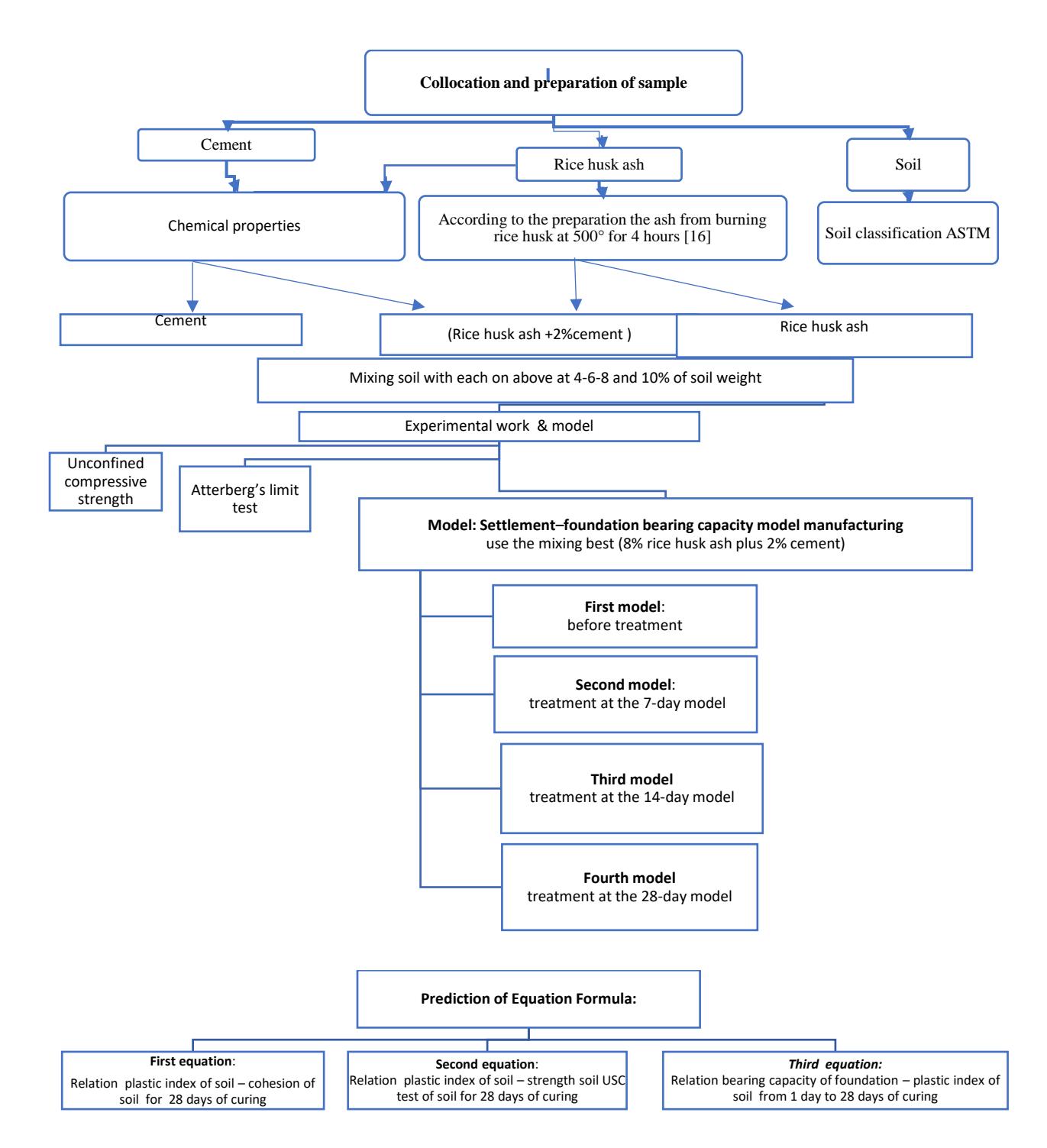
Figure 1 Illustration methodology steps.
Sample Collection and Preparing
The soil samples were taken from Al-Hilla city in Iraq and brought to the lab for examination. Rice husks and cement were purchased from a local market. According to additive preparation, there were three types of mixes. The first additive was rice husk ash at 4%, 6%, 8%, and 10% of soil weight plus a constant percentage of 2% cement. The second additive was rice husk ash at 4%, 6%, 8%, and 10% of soil weight. The third additive was cement at 4%, 6%, 8%, and 10% of soil weight. Figure 2 illustrates the preparation of rise husk ash.
Preparation of rise husk ash.
Chemical Properties of Additives
The chemical analysis shown in Table 1 of the properties of the three additives (rice husk ash + 2% cement of rise husk ash weight, rice husk ash, and cement). The results reached were consistent with the results of previous studies. Also, the data from the laboratory tests aligned closely with the results in the sources mentioned: Taylor (1990) for reference [17] and Pushpakumara and Mendis (2022) for reference [18]. Pozzolanic materials are compounds of silica, aluminium oxide, and iron oxides [19]. The chemical properties of rice husk ash include a total quantity of 93% silica, aluminium oxide, and iron oxides. Rice husk ash can affect the curing of clay soil. In terms of soil stabilization, RHA is a highly preferred industrial byproduct over slag silica or fly ash due to its significant pozzolanic activity, which substantially enhances the soil's strength and durability [20].
Table 1 Chemical properties of additives.
| The Chemical | (RHA+) 2% C | RHA | C |
|---|---|---|---|
| CaO | 7.7 | 1.5 | 62 |
| SiO2 | 74.5 | 72.3 | 22 |
| Al2O3 | 4.9 | 4.4 | 5 |
| Fe2O3 | 1.6 | 1.2 | 4 |
| MgO | 1.1 | 1 | 1 |
| K2O +Na2O | 4.3 | 4.3 | – |
Soil Classification
The soil of Al-Hilla city in Iraq was classified as clay soil (low plastic clay) (cl) according to ASTM. Table 2 shows the laboratory test results conducted on raw, unsuitable soil [21].
Table 2 Soil properties
| Natural Moisture Content | 8.95 | ASTM - number | ||
|---|---|---|---|---|
| Gs | 2.72 | [22] | ||
| % of gravel | 2.1 | |||
| % of sand | 469 | |||
| % of silt | 12 | ASTM: D 1140–2000 | ||
| % of clay | 44 | [23] | ||
| Soil Classification | cl | |||
| LL | 74 % | |||
| PL | 35 % | ASTM D 4318–2000 | ||
| PI | 39 % | |||
| A | 0.98 | [24] | ||
| W% | 15% | |||
| Dry density | 1.65 | ASTM D4254–2000 | [25] | |
| Strength – UCS | 65 | |||
| Cu | 21 | ASTM D2166−16, 2016 | [26,27] | |
Settlement–Foundation Bearing Capacity Model Manufacturing
Sample Preparation and Testing Methodologies
The model consisted of various components, including:
- 1. A steel container of 400 mm in length, 550 mm in width, and 350 mm in height. Joining 6 mm-thick steel plates with welding improved the structural integrity of the container. The steel loading system was a custom-made structure designed to deliver static loads to the model footing, which was submerged in water (groundwater). Objects that do not have any buoyancy or ability to float, as defined by the ASTM D 1194 [28] standard.
- 2. Two dial gauges, each with a precision of 0.01 mm/division, were affixed to the model footing to measure the settlement reading during the loading.
- 3. The model footing consisted of a square foundation that was fitted with a 50-mm rigid steel plate that was specifically built for testing purposes.
- 4. The subterranean water drainage system situated in the lower section of the container accurately imitated the characteristics of groundwater.
- 5. A reservoir with a length of 1.5 m was connected to the network. The tank released water through faucets into the water drainage system.
Water was gradually added to the container holding the filter material until it reached the surface, simulating the process of exposing clay soil and altering the distribution of grain sizes to accurately portray the attributes of the soil. An innovative method was devised for creating soil filter beds to efficiently address the problems of groundwater elevation and saturation caused by precipitation events [29]. Uniform and thorough saturation of all specimens was ensured by this specific procedure, resulting in equal and intense wetting.
The methodology was carried out in the following stages: Enhanced water dissipation was observed due to the presence of a gravel layer at the base of the container. Water could ascend and flow steadily thanks to the perforated hollow plastic tubes. A fly mesh layer placed above hollow plastic tubes effectively blocked soil particles from passing through the openings, thus preventing them from infiltrating the underlying gravel layer. An unoccupied filter layer was the result of this configuration. Two layers, each measuring 50 mm, were compacted to create a soil filter with a density of 1.65. To prevent the intermingling of filter and soil particles, a fly mesh layer was added.
This study focused on analyzing how the curing period affects the foundation performance when soil is strengthened with a particular mix of RHA and cement to resist the effects of underground water. Figure 3 shows a detailed schematic of the experimental setup.
Preparation of Blended Soil and Testing Procedure
Four model tests were established. The clay's height was divided into sub-layers of 50 mm, with each one being compacted to achieve a level surface until the entire depth of the soil bed was reached. Then, the model footing was placed directly on the surface at the center of the container. Then water from the tank was allowed to flow into the bottom of the model. To compute the loads to be applied, the model footing underwent testing by ASTM D 1194 [14]. Figure 3 illustrates the model test set-up. The sample was loaded in equal increments using dead weights, gradually increasing the load up to one-tenth of its ultimate capacity until failure occurred. Once the settlement reading approached nearly 10% of the footing diameter, the load at failure could be calculated. The model footing retained each increment of the applied load for a period of 4 to 15 minutes, during which settlement readings were recorded simultaneously. Settlement was measured by placing two 0.01-mm dial gauges on opposite corners of the footing. In the experimental set-up, the settlement was measured using standard weights until the point of failure was reached.
1. The first model tested a foundation on the soil before treatment. The depth of the soil's downward movement was measured cumulatively when a load was applied to it.
- 2. The second model, which was tested after a 7-day recovery period, involved treating the foundation soil by mixing 8% RHA (rice husk ash) and 2% C (cement) based on the soil weight. The same work style was followed as with the first model but the mixed soil was extended to a depth of 1B. For the third model, the same method was used as for the first model, but testing began after a 14-day recovery period. In this period, material containing 8% RHA (rice husk ash) and 2% C (cement) by weight of the soil was mixed with the soil. Later, the soil mixture was spread to a depth that matched the width of the foundation, with B representing the foundation's width. The impact of the curing period on the foundation performance was studied with this model, specifically when soil was reinforced using a specific blend of RHA and cement.
- 3. In addition to the fourth model, testing of the third model began after a 14-day recovery period, using the same method as for the first model. The soil was mixed with a combination of 8% RHA (rice husk ash) and 2% C (cement) by weight of the soil at that moment. The soil mixture was later spread to a depth equivalent to 1B, with B representing the width of the foundation.
Model test set-up.
Experimental Test
Atterberg's Limit
Atterberg's limit was determined for maximum plasticity and subsequently applied to study the clay soil characteristics known as the activity and plasticity index. ASTM D 4318-2000 [24] is universally recognized and applied worldwide. This study conducted a comparison of the effects of three additives at 4%, 6%, 8%, and 10%, which included cement, rice husk ash, and a mixture of rice husk ash with a constant 2% cement content.
Unconfined Compressive Strength
According to the instructions outlined in ASTM D2166-16 (2016), as referenced in [26]. Unconfined Compressive Strength was tested on three additives at 4%, 6%, 8%, and 10%, which included cement, rice husk ash, and a mixture of rice husk ash with a constant 2% cement content to improve the unconfined compressive strength and cohesive strength of the soil. After 28 days of curing, the mixing procedure commenced to reach the maximum unconfined compressive strength attainable, shown by assessing the stress-strain parameters that were automatically displayed.
Result and Discussion
The Atterberg Limit
Figure 4 describes the lower liquid limit from 74 at RHA to 55 and 56 at 8% RHA + 2% C and 8% RHA, respectively, while increasing the liquid limit at 8%C to 80. Figure 5 shows an increase in the plastic limit before mixing to 35, and after mixing to 70, 46, and 45 at (8%C, 8% RHA + 2% C, and 8% RHA), respectively. Also from Figure 6, it can be seen that the percentage of soil plasticity (pI) was 39%, which is considered highly plastic. A change occurs when the soil is treated to reduce it to (9, 10, and 11), indicating that the soil's plasticity became (low plastic, low plastic, and medium plastic) at (8% C, 8% RHA + 2% C, and 8% RHA), respectively, based on the soil plasticity classification [30]. The plastic index was reduced after mixing the soil with RHA, which is attributed to RHA absorption of the moisture from the soil.
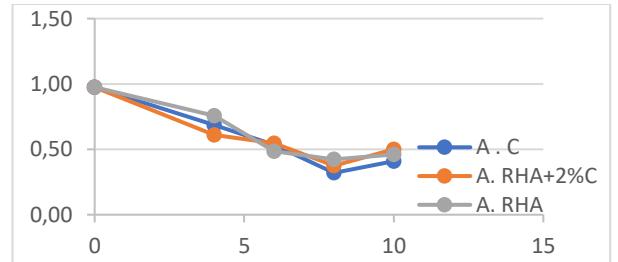
The findings demonstrate a reduction in the level of soil activity, as shown by Figure 7, ranging from normal activity of the soil with a value of 0.98 to an inactive state with a value of 0.31 at a cement content of 8%. Similarly, in the mixture of 8% RHA with 2% cement, the soil activity decreased to 0.30, suggesting a condition of inactivity. According to the soil activity categorization, the soil activity can be considered inactive with a value of 0.42, at 8% RHA.
The level of soil activity is a critical determinant that can greatly influence a project's stability and safety. This parameter measures the soil's ability to increase and contract in response to changes in moisture content. Soils with high activity values tend to experience more volume changes, which can lead to settlement and structural damage, whereas soils with low activity values are more stable and less likely to settle. The study by Prabodh Kumar and Dayakar Babu from 2022 revealed an improvement in the physical behavior of soil after mixing with RHA [31].
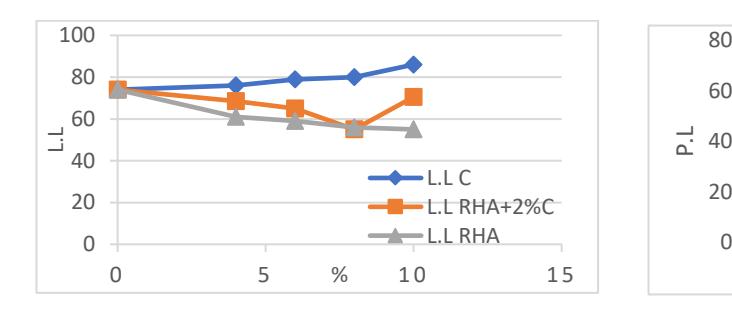
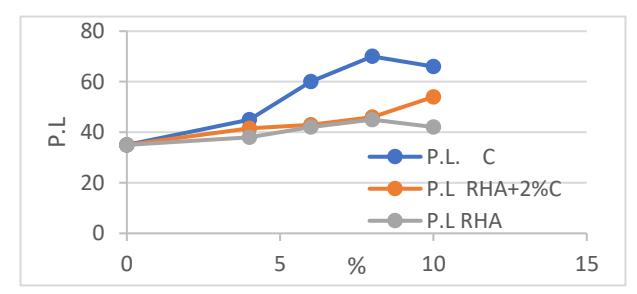
Liquid limit – soil mixture. Plastic limit – soil mixture.
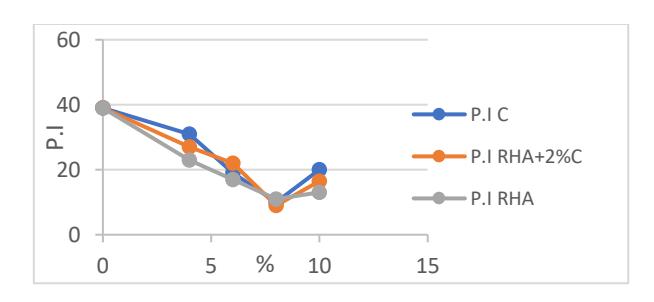
Plastic index – soil mixture. Activity – soil mixture.
After studying the effects of three additives mixed with soil for 28 days and evaluating their influence on cohesive soil and liquidity, the best treatment was to use a mixture of 8% rice husk ash and 2% cement. This mixture led to an improvement in soil cohesiveness. The study looked at how the mixture changes over time by checking the soil's ability to hold water, its pores, and its overall effectiveness at 1, 7, 14, and up to 28 days. Table 3 illustrates the effect of 8% rice husk ash mixed with 2% cement over time.
| Curing time | L.L | P.L | P.I | A% |
|---|---|---|---|---|
| 1 day | 74 | 35 | 39 | 0.98 |
| 7 day | 66 | 39 | 27 | 0.6 |
| 14 day | 59 | 45 | 14 | 0.4 |
| 28 day | 55 | 46 | 9 | 0.3 |
Unconfined Compressive Strength
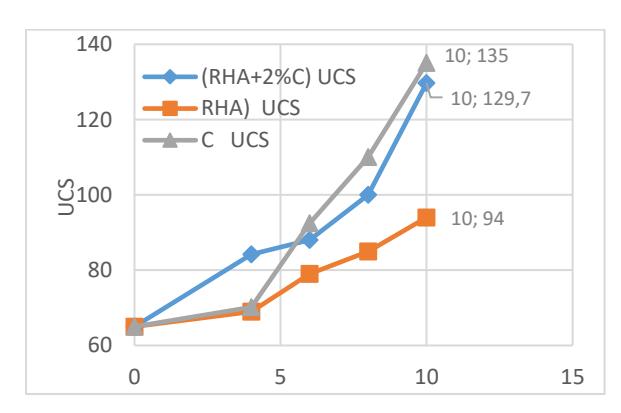
The results of unconfined compressive strength are shown in Figure 8. The experimental result indicates that the soil strength before treatment was equal to 65 KN/m², while after treatment with 8% cement at a curing
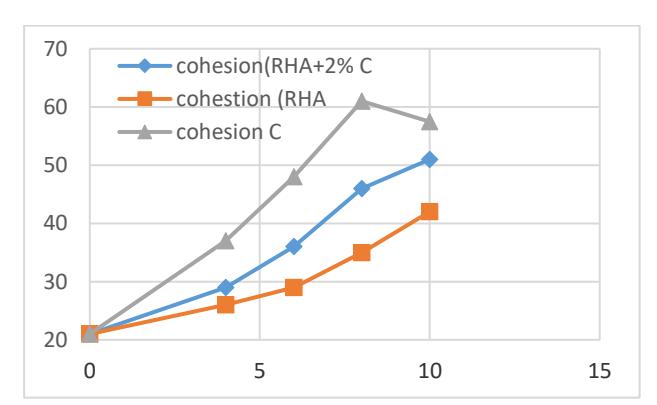
period of 28 days, the soil strength was 135 KN/m². Similarly, for the soil mixed with 8% rice husk ash and a curing period of 28 days, the soil strength reached 94 KN/m². Furthermore, for the soil mixed with 8% rice husk ash and 2% cement and a curing period of 28 days, the soil strength was found to be 129.5 KN/m². The results of soil cohesiveness are shown in Figure 9. The experimental outcomes demonstrate that the soil cohesiveness before the curing process reached 21 KN/m²
Following a curing time of 28 days, the addition of 8% cement to the soil resulted in a notable increase in cohesion, specifically by 57.5 KN/m². In a similar vein, the soil cohesiveness was determined to be 42 KN/m² when the soil was mixed with an 8% concentration of rice husk ash. Furthermore, the addition of 8% rice husk ash and 2% cement to the soil resulted in a notable enhancement of soil cohesiveness, with the value reaching 51 KN/m². Therefore, it can be noted that the mixing of rice husk ash into clay soil leads to an improvement in soil properties and an increase in soil strength and cohesion. Additionally, when a constant 2% cement content was mixed with rice husk ash, a further enhancement in soil performance was observed, which closely resembles the behavior exhibited by clay soil treated with 8% cement.
This study noted that the best additive percentage was 8% RHA + 2% C. After curing for 28 days, the results agreed with Oktavia et al. (2019) [32], who found that the unconfined compressive strength increased to 105 KN for 7 days at an additive percentage of 6% RHA. Pushpakumara & Mendis (2022) [34] noted that the unconfined compressive strength increased to 121.7 when using a mixing percentage of 10% RHA and 20% lime during a curing period of 28 days. This study showed that RHA can be successfully recycled as a soil stabilizer, to avoid environmental pollution produced by open dumping of RHA. Moreover, using RHA as soil stabilizer would reduce the CO2 emissions from other soil stabilizers like cement because of the CO2 emissions due to the use of cement [35], also reducing the cost of using cement.
UCS – soil mixture after 28 days of curing.
Cohesion – soil-mixture after 28 day of curing.
Model Test
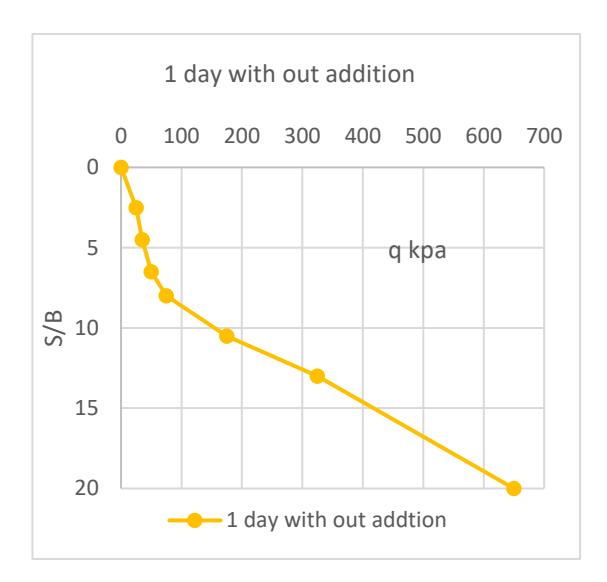
Figure 10 illustrates the relationship between bearing capacity, measured in kilopascals (kPa), and settlement per foundation width, denoted as S/B, in the first model. The soil's ultimate bearing capacity (q) in its completely saturated condition without any additional substances was measured to be 49 Kpa.
Figure 11 shows the relationship between settlement per foundation width (S/B) and bearing capacity (q Kpa). The soil's ultimate bearing capacity (q) in its completely saturated condition equaled 115 Kpa for the second model using a soil mixture with 8% rice husk ash and 2% cement at a vertical distance under the foundation equal to the foundation width. The model underwent 7 days of complete water saturation. Figure 12 shows the relationship between settlement per foundation width (S/B) and bearing capacity (q Kpa). The third model shows the use of a soil mixture with 8% rice husk ash and 2% cement after 14 days at a vertical distance under the foundation equal to the foundation width. The soil's bearing capacity at failure (q) in its completely saturated condition equaled 275 Kpa.
Figure 13 presents the relationship between settlement per foundation width (S/B) and bearing capacity (q Kpa) for the fourth model. The soil's ultimate bearing capacity (q) reached 460 Kpa, for a soil mixture with 8% rice husk ash and 2% cement at a vertical distance under the foundation equal to the foundation width. The duration of this scenario was 28 days. The criterion for failure utilized in all model experiments was the one proposed by Terzaghi et al. (1996) [37], which defines the load required to produce a settlement per width of foundation (S/B) equal to 10% of the footing's width to find the bearing capacity at failure. In general, three types of shallow foundation failure exist: punching failure, general shear failure, and local failure. The failure type is determined by comparing the ratio of the clay to the foundation's depth and width, as previously noted in [36].
Figures 10 to 13 explain the results for the fourth model from the load-bearing capacity tests in its completely saturated condition. After 7, 14, and 28 days of curing, the load-bearing capacity of the model foundation on submerged clay soil increased from 49 KPa for untreated soil to 115, 275, and 460 KPa for cured soil, respectively. This increase in bearing capacity of the soil with the addition of 8% RHA and 2% cement (C) to a depth equal to the foundation width was a result of the similarity of the pozzolanic properties of rice husk ash with the chemical properties of cement.
S/B–q – first model after 1 day of treatment.
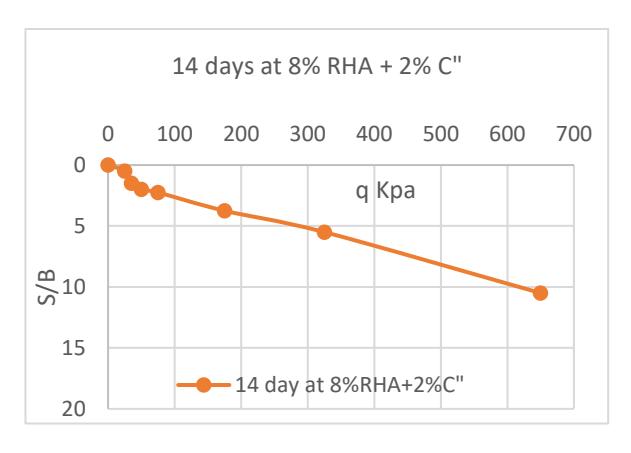
S/B–q – third model after 14 days of treatment.
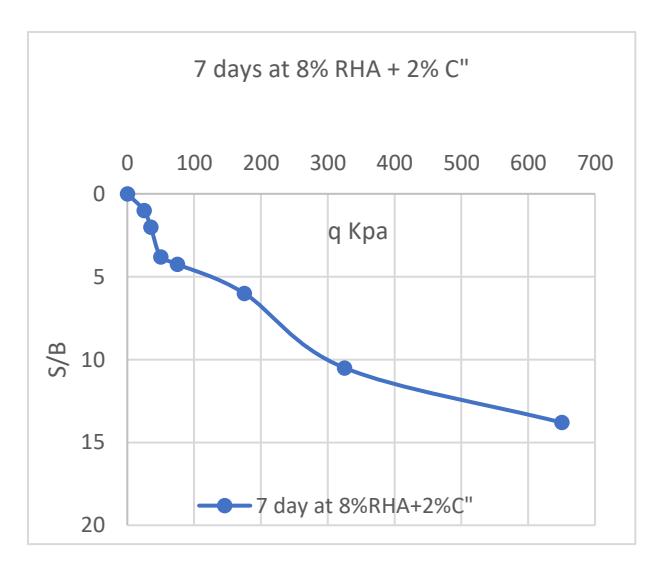
S/B–q – second model after 7 days of treatment.
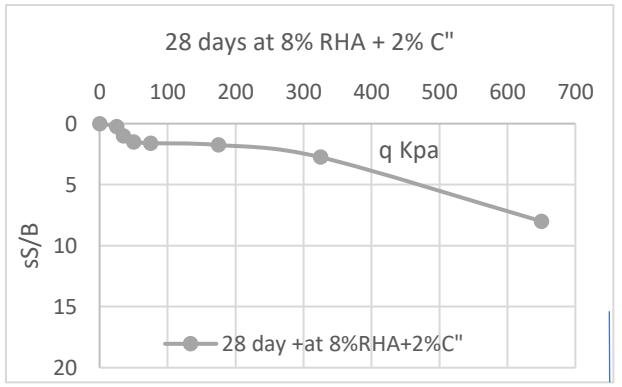
S/B–q – fourth model after 28 days of treatment.
Prediction of Equation Formula
This study aimed to reduce cost and labor requirements in model creation by providing a detailed representation of soil behavior throughout the treatment process. In addition, to establish a thorough connection between the dynamic behavior of soil parameters and the underlying bearing capacity which involves cumulative loading. The equations shown below were derived from the graphical representations.
Considering the background mentioned above, the first equation, depicted in Figure 14 and backed by Figures 6 and 9, showcases a deliberate effort to enhance operational effectiveness in terms of cost and time. A precise correlation between the plasticity index (PI) and the cohesive properties of soil during a 28-day treatment period was established by formulating a mathematical equation to accomplish this objective.
The second equation is depicted in Figure 15 and backed by Figures 6 and 8. A mathematical equation was formulated to establish a direct relationship between the coefficient of plasticity (PI) and soil strength, particularly with the unconfined compressive strength (USC), with a 28-day treatment regimen.
An analysis was performed using data extracted from Table 4 and summarized in Figure 16. The third equation, shown in Figure 16 and explained in Table 4, incorporates information from Figures 10, 11, 12, and 13. This part of the research aimed to develop a comprehensive mathematical equation that underlies the connection between relevant soil factors and the point at which foundation failure occurs. The study was conducted using a therapy regimen lasting from 1 day to 28 days in completely saturated conditions to emulate underground water. Cost and labor efficiency in model construction can be optimized by providing a comprehensive depiction of soil behavior during the treatment process, also to showcase significant correlations between soil property behaviors and its capacity to endure cumulative loading. Attaining these aims is crucially dependent on the development of relevant equations, which are based on graphical analyses.
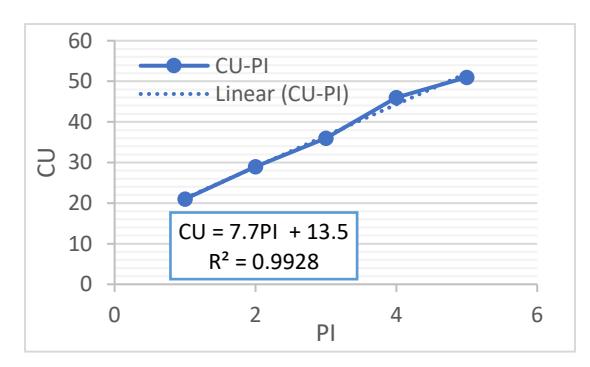
Figure 14 PI-q during 28 days of curing.
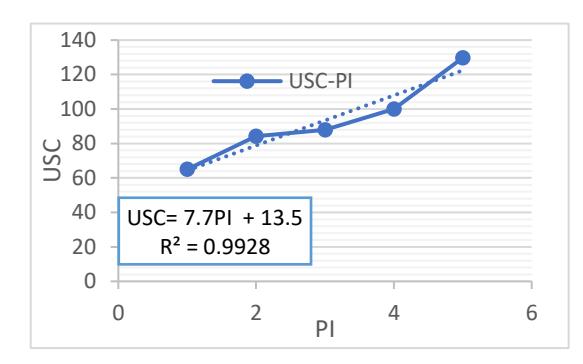
Figure 15 PI-q during 28 days of curing.
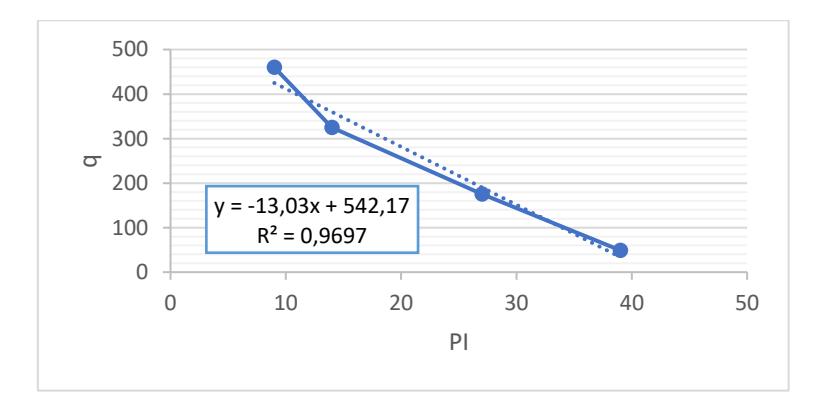
Figure 16 PI-q with the curing time at (1, 7, 14, and 28) days.
Information Formula True factor First equation: Relation of plastic index of soil – cohesion of soil for 28 days of curing CU = 7.7PI + 13.5 R² = 0.99 Second equation: Relation plastic index of soil – strength soil USC test of soil for 28 days of curing USC= 7.7PI + 13.5 R² = 0.99 Third equation: Relation of bearing capacity of foundation – plastic index of soil from 1 day to 28 days of curing q = - 13.03 PI + 542.17 R² = 0.969
Table 4 Prediction of equation formula.
Conclusion
This study revealed that the addition of rice husk ash (RHA) to clay soil (CL) leads to a substantial enhancement in soil parameters, particularly when combined with a small amount of cement. This improvement results in increased soil quality and resilience. The inclusion of RHA, either by itself or in combination with a fixed cement content of 2% resulted in a noteworthy decrease in the amount of soil required and the activity index. It improved the soil's stability and reduced its vulnerability to volumetric fluctuations. The unconfined pressure strength and cohesiveness of the soil showed a substantial increase when combined with 8% RHA and 2% cement, particularly after a treatment period of 28 days. The study created four foundation models to evaluate the effects of CL soil treatment and groundwater exposure using RHA and cement, with the goal of improving the foundation's resistance. The results indicated that the soil's initial ability improved from 49 kPa in its untreated state to 115, 275, and 460 kPa in the treated soil with 8% RHA and 2% cement after 7, 14, and 28 days of treatment, respectively. The study established three mathematical equations that correlate the plastic index with soil cohesiveness, unconfined pressure strength, and foundation resistance. These equations can be utilized to forecast the behavior of treated soil. RHA's use as a soil stabilizer has both environmental and economic benefits. It has the potential to decrease CO2 emissions and lower expenses in comparison to conventional stabilizers like cement, thereby presenting a more sustainable alternative.
Nomenclature
C Cement UCS Unconfined compressive strength (kN/m2 ) RHA + 2%C Rice husk ash + 2% cement RHA Rice husk ash LL Liquid limit PL Plastic limit PI Plastic index A Activity Cu Cohesion (kN/m2 ) Gs Specific gravity W% Optimum moisture content D Diameter (mm) q Bearing capacity at failure
Greek Symbols
Ds Density (kg/m3 )
Acknowledgements
The main author would like to extend her thanks and gratitude to the staff of the Civil Department laboratories for their assistance in completing this work and to everyone who contributed, from its preparation to the publication of the manuscript.
Compliance with ethics guidelines
The authors declare that they have no conflict of interest or financial conflicts to disclose.
This article does not contain any studies with human or animal subjects performed by any of the authors.