

Introduction
Agricultural remains and wastes (peels, bones, damaged or low quality fruits and vegetables) whose elimination has a negative impact on the environment and the economy, since no policies exist for the proper management and disposal and most of the time these wastes are discarded and disposed in open air waste disposal lands without any control (Difonzo et al., 2022; Martinez et al., 2012). One of the ways to reduce the negative impact of the construction sector on the environment is to use waste materials, which is an attractive alternative to disposal in that cost and pollution problems (Colangelo et al., 2021). In the search of alternatives, natural fiber reinforced concrete used to be obtained from abundant renewable sources, resources, which allows for continuous supply and substantial cost savings for composite sectors (Asyraf et al., 2022). Fibers are rope-like materials that can be used for different purposes, provided by plants (vegetables, leaves and wood) (Ahamed et al., 2021). Some of the most used fibers in concrete are coconut (Aslam et al., 2023; Ahmad et al., 2022; Ali et al., 2022), sugarcane bagasse (Perez et al., 2022; Ahmed et al., 2022), plantain (Elbehiry et al., 2020; Akinyemi and Dai, 2020), among others. However, in recent decades, new studies of natural fibrous alternative materials from agro-industrial waste have been analyzed that contain specific characteristics, which improve their mechanical properties and resistance to fracture (Luhar et al., 2020).
Plant production industries generate a large amount of waste such as stems, leaves or fruits (Mejías-Brizuela et al., 2016). According to the Food and Agriculture Organization of the United Nations (FAO) (2021), Mango (Mangifera indica L.) is the most predominant tropical fruit in the world, with a production of 41 million tons in 2020 where Mexico is one of the main producers with 2 million tons (SIAP, 2021). Depending on the mango variety, 33-85% is pulp, 7-24% is peel, and 9-40% is seeds (García-Mehecha et al., 2023). The mango industry is based on the processing and use of the edible part of the fruit, mainly to obtain the pulp, juice and nectar. According to a study of the Mango agro-food chain, approximately 40% of the raw material is wasted in Mexico (Pacheco-Jiménez et al., 2022).
Likewise, the guano palm is a genus of palms distributed in the southwest of the United States, Mexico, the Antilles, and northern Colombia and Venezuela (Escalante, 2018). The adult leaves are used for thatching rural houses and the
immature leaves are used for various crafts such as making brooms, hats, furniture, house roofs, mats, and bows. The manufacture of these crafts generates volumes of waste estimated at 1,540 tons nationwide, mainly in the central and southern regions of Mexico, since there is no process for their use, they end up in landfills or are incinerated (Sustaita Rivera, 2009).
Therefore, these materials may be used as reinforcement through fibers for the production of concrete, these fibers are generally added to the cement paste in low volumes (frequently less than 1%) showing control over cracking, and spawling due to temperature contraction effects, increasing its resistance, ductility, and tenacity (Ede and Agbede, 2015).
The optimum fiber dosage is important as a higher dosage causes a decrease in the mechanical and durability performances of concrete due to lack of flowability (Ahmad et al., 2022). Parameters describing fiber characteristics are length, diameter, and appearance or slenderness, that is the consequence of the existing ratio of the length to the diameter, as well as the constitution by a complex association of polymeric substances and the chemical composition varying as a function of type and origin of these fibers (García and Salcedo, 2006). Hasan et al. (2022) analyzed two types of ramie and abaca fibers incorporated in concrete at 0.15%, 0.3% and 0.45%, and based on their results, the addition of low volumes of these fibers in concrete mixes improved the compression and flexural mechanical properties.
Lumingkewas et al. (2017) studied the effect of 20 and 40 mm length coconut fiber additions in concrete demonstrating the decrease in tensile strength. Juarez et al. (2003) studied the addition of lettuce fibers in cement compounds, obtaining good results in the flexural strength, and concluded that the reduction in the alkaline matrix effect and the fibers hydrophilic quality is to isolate fibers with different chemical compounds. In another investigation, Herrera and Quispe (2019), found that use of agave natural fibers in small quantities of 0.1% increased the compressive strength, reflecting less permeability in the paste treated. In studies by Jimenez and Torres (2020), additions of sugar cane bagasse produced an inversely proportional reaction in the concrete compression resistance, that is for a greater fiber quantity the resistance diminishes, being the optimal percent between 0.5 to 2.5%. Mansour et al. (2017) in their study concluded that 1% alpha fiber added in concrete improves fracture toughness better than 2% fiber reinforcement.
Marroquín and Lopez (2019) analyzed concrete mechanical properties using bejuco fibers, concluding that the mixture with concrete produced a less malleable mixture due to the absorption capacity of fibers, recommending 0.3% of fibers within the total weight of the mixture. Trabelsi and Kammoun ( 2020), studied the use of nopal mucilage fibers to develop structural elements, observing that fibers increased the concrete tenacity and delivering higher velocity impact resistance.
Based on the above, the purpose of this work is to study the use of natural palm and mango fibers as reinforcement in concrete, with different percentages and dimensions on the compressive and flexural strength properties of concrete.
Methodology
Concrete material samples preparation to be tested included fine sand and coarse gravel, cement, tap water, and natural fibers. Portland compound cement CPC 30 R, according to ASTM C-150 (2020) standard, was used. Crushed stone sand from river Mezcala in the south of the country, with an aggregate particle size average of 4.75 mm and a maximum size of 19mm, were obtained. Aggregate physical properties are presented in Table 1.
| Property | Coarse aggregate (gravel) | Fine aggregate (sand) | Cement |
|---|---|---|---|
| Density (g/cm3 ) | 2.70 | 2.47 | 3.01 |
| Water Absorption (%) | 0.39 | 2.13 | - |
| Compacted volumetric weight (kg/m3 ) | 1573.99 | 1649.36 | - |
| Loose volumetric weight (kg/m3 ) | 1477.09 | 1546.06 | - |
| Fineness Modulus | - | 2.33 | - |
| Nominal maximum aggregate (mm) | 19.00 | 4.75 | - |
Table 1 Physical properties of aggregates and cement.

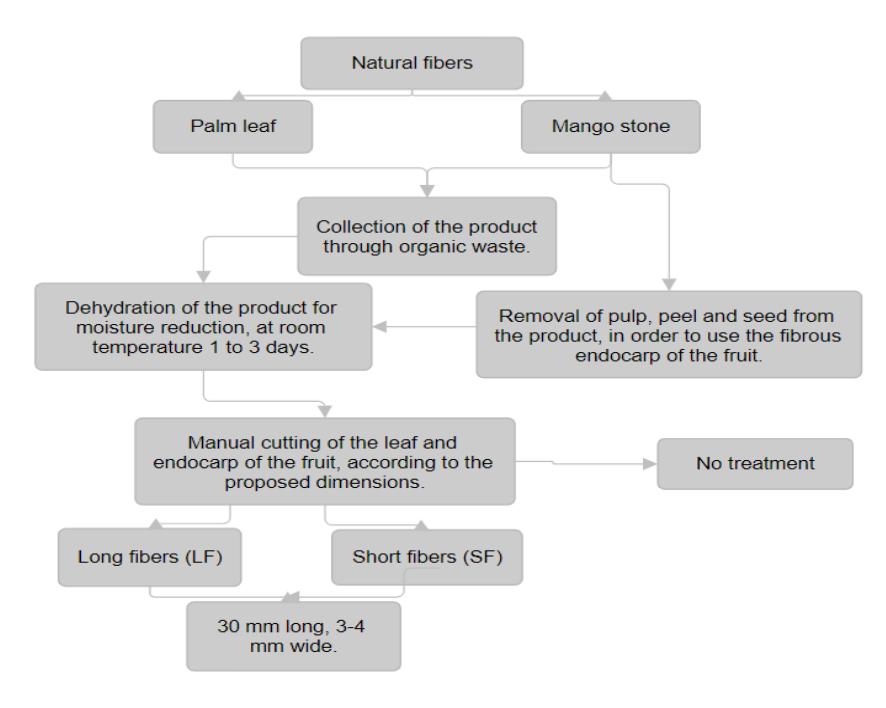
Flowchart, recycling natural fiber procedure.
The provisions of different types of natural fibers were through the recollection of organic wastes, for the case of mango fruits, the pulp, peel and seed were removed, and the stone material (endocarp) was obtained as the final step of the procedure. Previously cleaning and dehydration procedures to the natural materials were performed, as observed in Figures 2 (a) and (b).
(a) Cleaning of mango stone and (b) Dehydration of palm leaves.
Long natural fibers were cut manually with dimensions of 30 mm long, and 3-4 mm wide as observed, while short fibers were 10 mm long, as observed in Figures 3 a) and b). The proposal of these lengths seeks to obtain a relationship between the dimension of the fiber and the mechanical properties of the cement paste.
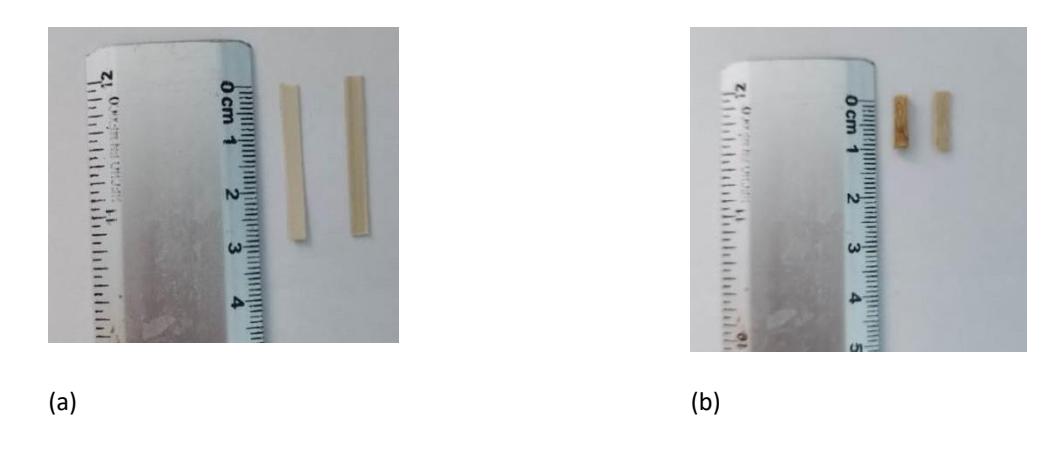
(a) Palm long fibers (b) Mango short fibers.
Characterization Physical Mechanics of Fibers
The water content of plant fibers depends on temperature, physical properties, and especially relative humidity (Bouasker et al., 2014). The moisture content of the fibers was determined at room temperature by the weight difference method (Sumesh et al., 2022; Saha et al., 2021). The dry weight of a sample of 30 bundles of mango and palm fibers was determined at room temperature, on a Denver Instrument electronic scale with an accuracy of 0.0001 gr. The fiber drying process was carried out at 70 °C in an oven for one hour, and finally it was weighed again to determine its dry weight. The percentage of moisture content was calculated from the following expression (Tamanna et al., 2021), where: %H is the percentage of moisture, wh is the ambient dry weight and wo is the dry weight at 70 ℃.
\[\%H = \left(\frac{wh - wo}{wh}\right) * 100\tag{1}\]
Water absorption is the main factor affecting the mechanical properties of natural fiber reinforced concrete (Shah et al., 2022). Three measurements were performed, where each sample contained 30 pieces of mango and palm fibers, which were saturated in distilled water for 24 hours, then dried on an absorbent cloth removing excess water from the material until a superficial drying is obtained. Finally, the superficially dry sample was weighed and dried at 70 °C for one hour, and the sample was weighed again. The percent absorption content was determined from Eq. (2), where W is water absorption percentage, m0, and m1 are the weight of the specimen before and after immersion, respectively (Sekar et al., 2022).
\[(W) = \left(\frac{m1 - m0}{m0}\right) * 100 \tag{2}\]
To determine the density, the volume displacement method or Archimedes' principle was used, 30 bundles of fibers saturated in distilled water were taken for 24 hours, and weighed on the electronic scale, and the samples were placed in 50 ml test tubes, adding distilled water to a 30 ml afore. The fibers were completely immersed in distilled water and the volume displacement was obtained according to:
\[\rho = \left(\frac{m}{\nu}\right) \tag{3}\]
The ratio of mass (m) to volume (v) determines the density of the fiber (Saha et al., 2021). Mechanical tensile testing of mango and palm fibers was performed according to the parameters of ASTM D638 (2022), and type IV specimen was used as shown in Figure 4 (a). For the strength test, an MTS model 3156 universal press was used, with a maximum load of 2000 kN (Figure 4 (b)).
(a) Specimen dimensions; (b) tensile test of natural fibers.
Physical and Mechanical Tests on Natural Fibers
Table 2 shows a comparison of the physical properties of the best known natural fibers used in the manufacture of reinforced concrete. Palm and mango fibers are in the same range of ambient moisture content with the values of 4.12 % and 4.00 %. High moisture content is detrimental to the performance of the material because it causes an internal accumulation of water, which is responsible for weakening the composite (de Azevedo et al., 2020).
Palm fibers have the highest absorption percentage compared to mango fibers with a value of 56.91%. The high water absorption is related to the porosity of the fiber, that is, natural fibers are hollow in nature and therefore diffuse more in water in the composites (Yorseng et al., 2020), which may result in a loss of adhesion between the fibers and the cementitious matrix. It can be observed that the studied mango and palm fibers present low density values in comparison with the known fibers. These values represent a decrease in the weight of the composite compared to the matrix, which gives an added value to the composite with a slightly lower weight (Hidalgo et al., 2012).
| Table 2 | Comparison of the physical characteristics of natural mango and palm fibers with other fibers in the | ||||
|---|---|---|---|---|---|
| literature. |
| Fiber type | Moisture content (%) | Density (g/cm3 ) | Absorption (%) | Reference |
|---|---|---|---|---|
| Coir | 1.1-1.6 | 93.8 | (Chauhan et al., 2022; | |
| Galicia-Aldama et al., 2019) | ||||
| Heneque | 1.4 | (Castillo-Lara et al., 2020) | ||
| Jute | 12-13.7 | 1.3-1.5 | 62.0 | (Yun et al., 2022; Hussain |
| and Ali, 2019) | ||||
| Flax | 7-12 | 1.4-1.5 | (Korniejenko et al., 2020) | |
| Hemp | 3.5-8.0 | 1.4 | 107.6 | (Ziane et al., 2020) |
| Banana | 1.37 | 170 | (Saad et al., 2022) | |
| Fan palm | 0.5-0.8 | 100-200 | (Machaka et al., 2014) | |
| Sisal | 11 | 1.2-1.5 | 110-239 | (Balreddy et al., 2023) |
| Palm leaf | 1.15 | 70 | (Poletto et al., 2014) | |
| Palm sabal leaf | 4.12 | 1.21 | 56.91 | This study |
| Mexicana | ||||
| Mango | 4.0 | 1.09 | 39.34 | This study |
Figure 5 shows the stress-strain curves for natural fibers subjected to direct tension, and the specific values of the mechanical properties are shown in Table 3. The maximum breaking strength of mango fibers with an average value of 18.98 MPa, and palm fibers with a value of 17.53 MPa. These results are lower than those reported by some researchers on the literature of some natural fibers in the range of 70-300 MPa (Machaka et al., 2014; Marvila et al., 2021; Silva et al., 2020), but these results are also similar to those reported by other researchers (Armas-Ruiz et al., 2016; Ramakrishna
et al., 2005). As demonstrated, the mechanical properties of natural fibers can vary depending on the fiber composition dimensions, thickness, area, etc. (Arséne et al., 2003).
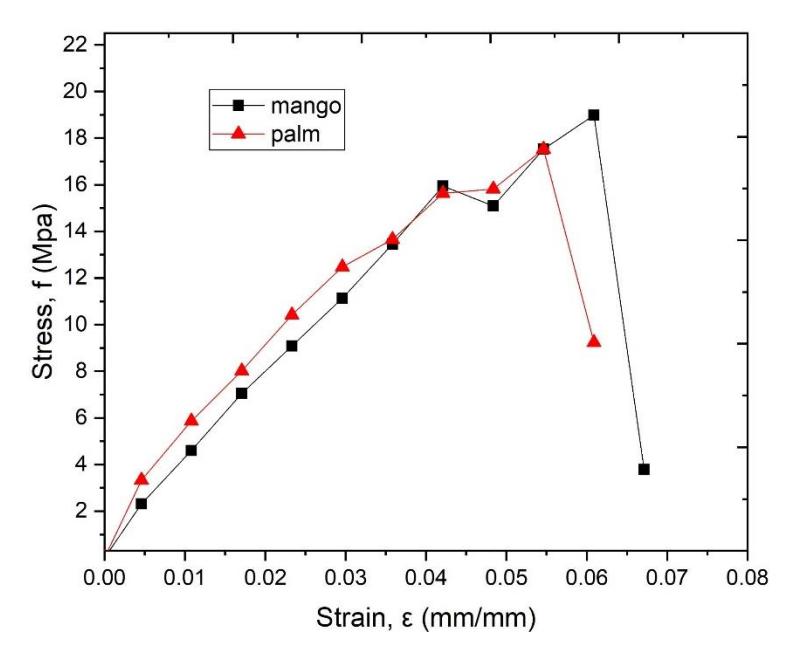
Figure 5 Stress-strain curves of natural fibers from mango bone and palm leaf.
Table 3 Mechanical properties of natural fibers.
| Properties | Units (%)) | Mango | Palm |
|---|---|---|---|
| Tensile strength | MPa | 18.98 | 17.53 |
| Modulus of elasticity | MPa | 385 | 457 |
| Toughness | N.mm | 0.73 | 0.67 |
Mixture Concrete
For the elaboration of concrete a theoretical 300 kg/cm2 control sample mixture was considered according to ACI 211 method (2009), adding up 0.2% or 0.4% mango and palm fibers with respect to the fine aggregate weight, to find an optimal percentage less than 1%, according to studies by Ede and Agbede (2015), low volumes are added (frequently less than 1%). The water/cement ratio of 0.54, as observed in Table 4. Paste additives were not used, and there was no further treatment to natural fibers, and water quantity, cement, and gravel were not changed.
Table 4 Concrete mix design for 1 m<sup>3</sup>.
| Cement (kg/m³) | Coarse aggregate (kg/m³) | Fine aggregate (kg/m³) | Water (kg/m³) | Water/cement A/C | Fiber (%) | Fiber (kg/m³) |
|---|---|---|---|---|---|---|
| 366.07 | 1047.65 | 650.63 | 197.65 | 0.54 | 0 | |
| 366.07 | 1047.65 | 650.63 | 197.65 | 0.54 | 0.2 | 1.30 |
| 366.07 | 1047.65 | 650.63 | 197.65 | 0.54 | 0.4 | 2.60 |
The fiber paste was prepared as follows: first, coarse aggregate was mixed, then water and the fine aggregate was added, and cement was added. All these materials were mixed about 4 minutes in time until a homogeneous paste was obtained. Afterward, the paste stood still for 2 minutes, and with a rod, we proceeded to detach part of the concrete in the small areas of the container, and finally, the natural fibers were incorporated, distributed evenly all around the paste at random. Afterward, it was poured in big molds to perform physical tests according to ASTM C- 143 (2020), and C-231 (2022) standards, on the fresh concrete for obtaining slump, air concrete mixture content. The porosity of the concrete is obtained from the data of the air content test, and is calculated according to the following equation.
\[P = \frac{\left(\frac{a}{c}\right) - 0.36h + \left(\frac{A}{c}\right)}{0.317 + \left(\frac{1}{n_f}\right)\left(\frac{Af}{c}\right) + \left(\frac{1}{n_f}\right)\left(\frac{Ag}{c}\right) + \left(\frac{A}{c}\right)} \tag{4}\] where (A) is the air content, and the value of 0.7 was taken for the hydration of the cement (h), with the materials physical properties as fine (Af), coarse aggregates (Ag), cement (c), water /cement ratio (a/c), sand specific weight (pf) and gravel (pg).
Likewise, the constants 0.36 and 0.317 correspond to the percentages present in the cement of C4AF (tetracalcium aluminate ferrite) and C3A (tricalcium aluminate) (Mei et al., 2021). These were performed to provide a better quality control in the consistency of cement paste. Nomenclature for compressive and flexural strength are shown in Table 5.
| Sample control | Fiber type | Porcentage (%) | Dimension | Nomenclature |
|---|---|---|---|---|
| Concrete (C) | 0 | C-00 | ||
| Mango (M) | 0.2 | Long (L) | LM-02 | |
| Mango (M) | 0.4 | Long (L) | LM-04 | |
| Mango (M) | 0.2 | Short (S) | SM-02 | |
| Mango (M) | 0.4 | Short (S) | SM-04 | |
| Palm (P) | 0.2 | Long (L) | LP-02 | |
| Palm (P) | 0.4 | Long (L) | LP-04 | |
| Palm (P) | 0.2 | Short (S) | SP-02 | |
| Palm (P) | 0.4 | Short (S) | SP-04 |
Table 5 Nomenclature used for mechanical tests.
Preparation of Specimens
Mechanical compression test parameters are determined by uniaxial compression on cube or cylindrical sample specimens (Jurowski et al., 2018). Twelve cylinders were fabricated for each design with 150 mm diameter and 300 mm height standard dimensions referred to ASTM C-31 (2022), subsequently, the specimens were cured in water for 28 days. Compression tests were performed during the initial and final curing period of 7 and 28 days respectively as shown in Figure 6.
Compressive strength test.
For concrete mechanical flexural tests, 6 standard rectangular beams per sample were elaborated, using steel molds with dimensions: 500 mm long, 150 mm wide, and 150 mm high according to ASTM C-31 Standard [64]. These beams were made with the same concrete mixture, as the compressive strength samples. A 120-ton maximum loading universal press was used. The bending resistance was determined using the ASTM C78 (2022) standard procedure (loading at third points) as seen in Figure 7.
Flexural strength test.
Under loading at the third point, two possibilities exist, being the first, is fractures occurring within the mid third, where flexural strength is calculated (Meisuh et al., 2018).
\[fr = \left(\frac{pl}{bd^2}\right) \tag{5}\] where fr is the flexural strength, pl is the loading applied multiplying the distance between the supporting points; b is the sample average width, and finally d is the height of the specimen. Secondly, for fractures outside the clear mid third, it is no more than 5% of its length, and the resistance is calculated (Jamshaid et al., 2022).
\[fr = \left(\frac{3pa}{bd^2}\right) \tag{6}\] where a is the average distance between the fracture line and the closest support in the beam surface in millimeters.
Results
Concrete Workability
The concrete mixture was planned for a 12 ± 2 cm slump, for the purpose of better consistency in the concrete paste and easier specimen molds. Different mixture slumps with natural fibers can be observed, as seen in Figure 8. Short fibers with volume contents higher than 0.4% showed less workability and consistency, with values around 11-12 cm in the cement mix due to water absorption, weight, type, and uniform fiber distribution (Yun et al., 2022).
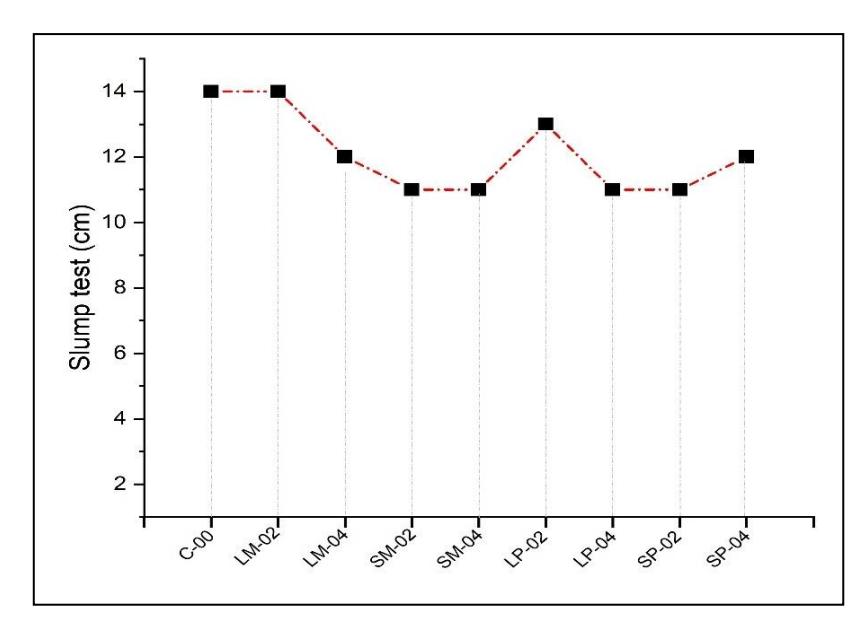
Concrete slump test results.
Air Content
In Figure 9 the fresh concrete air content results are presented, and this physical property is fundamental to evaluate air voids trapped in the paste and, thus concrete durability. That is, when the void content in the paste is higher, the permeability increases, affecting the final performance in the product mechanical properties (Nicolás et al., 2024). It can be observed that with less natural fibers added, the air content diminishes with respect to the control mixture, due to the contact area between the matrix and the reinforcement decreases as a function of percent fibers (de Azevedo et al., 2021). Also, the reinforcement modifies internally the structure and less quantity fibers distribute better within the concrete paste, covering the pores left over by the coarse aggregate.
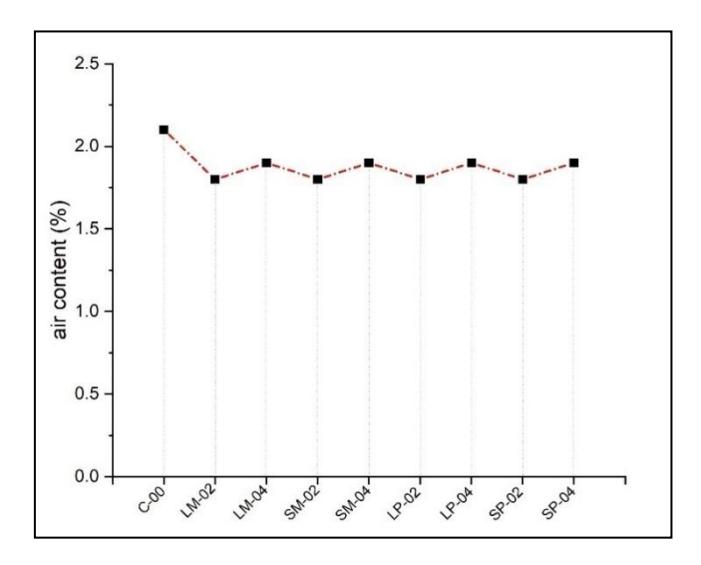
Percentage voids in concrete.
Porosity of the Concrete Paste
In Table 6 the calculated percent porosity results are presented. In general, it can be appreciated that the control sample shows a 19.68% with a 0.54 a/c relation analogous to other results reported (Flores-Nicolás et al., 2021), with a 22% and a 0.59 a/c relation. When the water-cement relation increases, the cement matrix structure will present high porosity and permeability. For the samples with low natural palm and mango fibers at reinforcement content of 0.2%, the content of voids and pores diminishes by approximately by 1% with respect to the control sample. This is maybe due to the fact that LM02, SM02, LP02 and SP02 fibers present better distributions within the paste as indicated by the air content results obtained.
| Sample | a/c | Porosity (%) |
|---|---|---|
| C-00 | 0.54 | 19.68 |
| LM-02 | 0.54 | 18.89 |
| LM-04 | 0.54 | 19.17 |
| SM-02 | 0.54 | 18.89 |
| SM-04 | 0.54 | 19.17 |
| LP-02 | 0.54 | 18.89 |
| LP-04 | 0.54 | 19.17 |
| SP-02 | 0.54 | 18.89 |
| SP-04 | 0.54 | 19.17 |
Table 6 Porosities of the concrete paste.
Compressive Strength Test Results
A compressive strength test was performed at 7, 14 and 28 days after samples preparation, with cylinder samples, containing natural fiber reinforcement and compared with the cylinder concrete control sample. The control specimen
presented very few cracks before rupture, the cracks starting at the lower part, and continuing to grow at the cylinder border as shown in Figure 10 a). In general, the rupture in the control sample was generated in the cylinder extremes, with the main crack advancing and cutting in a vertical or diagonal way.
For the mango fiber specimen, the formation of several cracks in different sizes distributed along the whole cylinder before rupture can be observed, including a columnar type of failure as seen in Figure 10 b). For the palm fibers reinforcement cylinders various small size cracks diagonally crossed along, with a failure in the middle part of the cylinder, as observed in Figure 10 c). Both samples showed greater ductility over the course of the experiment. The cracking tendencies observed in the fiber reinforced cylinders were observed for the seven and twenty-eight day elapsed tests, indicating well distributed fibers, retarding the specimens` failure.
(b)
(c)
Figure 10 Compressive strength at 28 days, samples a) C-00 b) SM-04 c) SP-02.
Compressive results are presented in Table 7, where the cylinders' average F'c, as well as the standard deviation and the variability coefficient, are also included. The control sample C-00 in the experimental test showed a final resistance at 28 days of 330.7 kg/cm² which represents 100%, exceeding the proposed theoretical design of 300 kg/cm². Samples of SM-04 and SP-02 increase their compressive strength with values of 372.3 and 373.6 kg/cm² compared to the control sample, this increase indicates 112.5% and 112.9% as observed in Figure 11. This behavior shows better adherence, less volume of voids, and improved distribution between the cement matrix and reinforcement with low natural fibers quantities.
Sample LP-02 presents the lowest F´c at 28 days of curing, with 274.9 kg/cm², that is, it obtained a decrease of 16.9% in its mechanical properties compared to the control sample. The porosity values in this design present low permeability, but including the compression results this may indicate fibers are subject to a degradation process from concrete for the high alkalinity and greater area of long fibers.
Table 7 Average values of compressive strength after 28 days.
| Sample | Compressive strength (F'c) | ||||
|---|---|---|---|---|---|
| Mean (kg/cm2) | St. dev. (kg/cm²) | CofV (%) | |||
| C-00 | 330.7 | 4.31 | 1.3 | ||
| LM-02 | 329.2 | 3.82 | 1.1 | ||
| LM-04 | 331.1 | 2.09 | 0.6 | ||
| SM-02 | 324.9 | 3.12 | 1.0 | ||
| SM-04 | 372.3 | 5.04 | 1.4 | ||
| LP-02 | 274.9 | 4.42 | 1.6 | ||
| LP-04 | 300.1 | 3.74 | 1.2 | ||
| SP-02 | 373.6 | 1.59 | 0.4 | ||
| SP-04 | 318.5 | 5.03 | 1.6 | ||
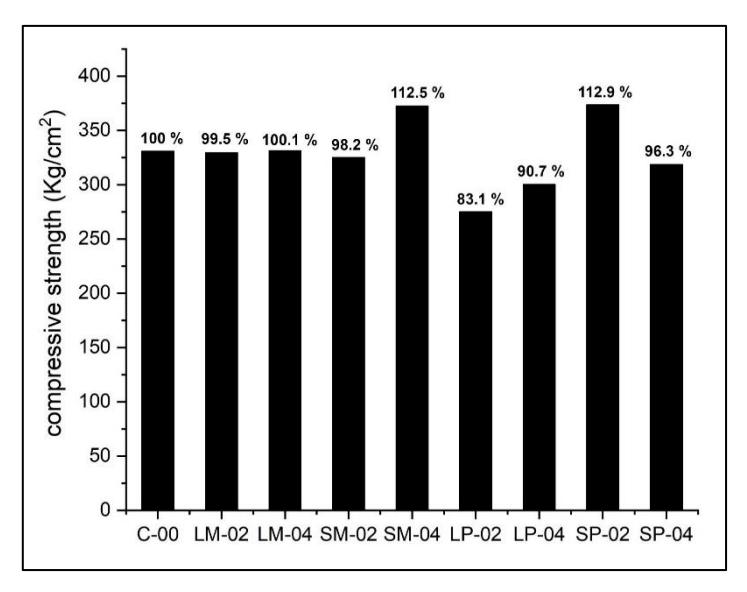
Compressive strength graph of concrete, cured at 28 days.
Flexural strength test results
Flexural strength average values for concrete (F'f) were obtained and are presented in Table 8. It can be observed for samples LM-02, LM-04, and LP-04 that F'f increased by 4% to 5%, as seen in Figure 12. This fact indicates that the length of fibers helps to retard and control beam cracks, having a greater area with short fibers. These results are comparable to studies using kenaf fibers (Elsaid et al., 2011). Furthermore, the addition of short fibers to SP-02 and SP-04 to the samples, diminished considerably the F'f values by 15% to 18%, may be due to different factors, such as fiber dimension, area, adherence in the fiber and matrix interface, etc.
Correlations between the mechanical properties F'f and F'c are in a range 11% to 16% of compression resistance, and the results are comparable with parameters studied in the literature (Moreno et al., 2016).
Table 8 Average values of flexural strengths for 28 days of curing time.
| Sample | Flexural Strength (F´f) | ||
|---|---|---|---|
| Tensile strength | Mean (kg/cm2 ) | F´f/F´c (%) | |
| C-00 | 45.33 | 14 | |
| LM-02 | 47.51 | 14 | |
| LM-04 | 46.88 | 14 | |
| SM-02 | 40.08 | 12 | |
| SM-04 | 42.90 | 12 | |
| LP-02 | 44.07 | 16 | |
| LP-04 | 47.73 | 16 | |
| SP-02 | 37.36 | 11 | |
| SP-04 | 38.59 | 12 | |
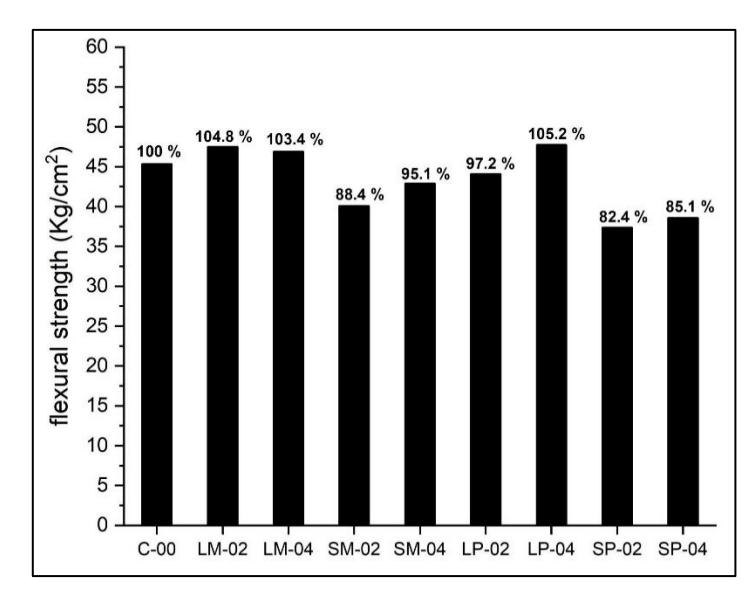
Percentage flexural strength.
Microstrusture
After cylinder compression and flexural strength tests reached rupture and failure, the microscopic images of the fractured specimens are presented in Figure 13. Material palm fibers, either short and long, present a good and random distribution as well as a considerable degradation in size, and a change in color due to the effect of concrete paste alkalinity. Most of the fibers are broken after mechanical tests, and fibers are not anchored in the cement paste meaning the interaction and adherence in the fiber/cement matrix is weak, as seen in Figures 13 (a) and (b). For mango fibers shown in Figure 13 (c) and (d) it is noticed that cement paste penetrates in the fiber pores besides being anchored in the cement matrix, existing a strong union and adherence from the reinforcing material, and providing evidence suggesting the increase in the material´s mechanical properties.
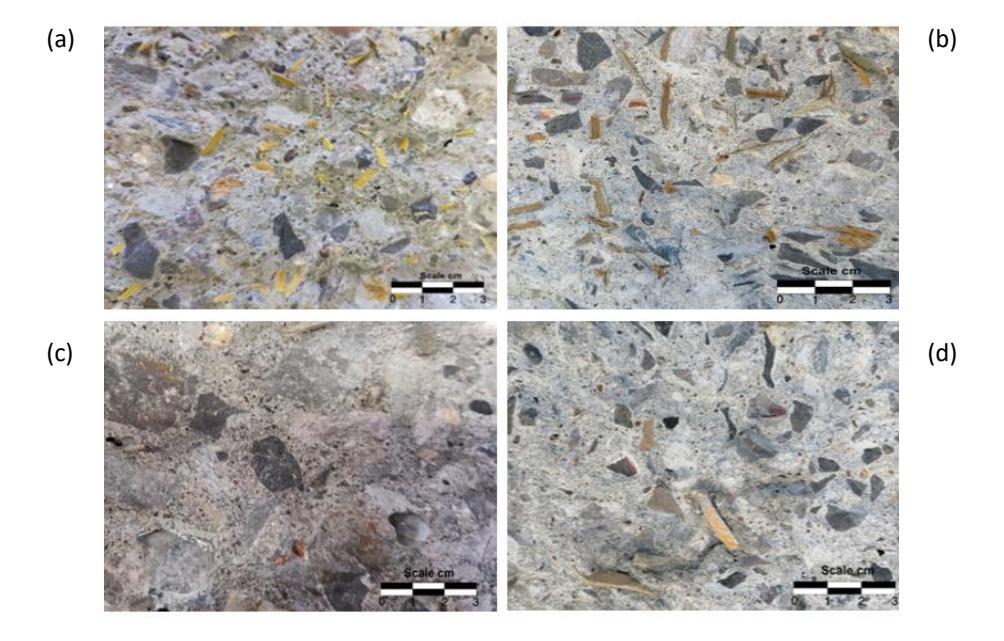
Microscopic images of concrete a) SP-04 b) LP-02, c) SM-02 d) LM-04.
Figure 14 shows the natural mango and palm fibers after one year in the cement paste reinforcement. The mango fiber, as shown in Figure 14 (a), shows deterioration in the upper part caused by the fracture of the specimen, however, there is a slight degradation in its dimensions. In contrast, palm fiber suffers greater deterioration in its physical structure.
The yellow line as seen in Figure 14 (b) indicates the original dimension of the fiber, consequently, its dimensions were reduced by approximately 40% after one year.
Microscopic images of the fibers a) mango and b) palm.
Discussion
Physical and mechanical properties of concrete
The use of natural fibers added to concrete has been used in developing countries, Figure 8 shows the effect of natural palm and mango fibers as reinforcement in concrete, which modifies its physical properties such as slump, air content and porosity. It was shown that the workability of the concrete paste decreased by adding different volumes and dimensions of fiber compared to the control sample. This event is due to the absorption of water by natural fibers of any type, these effects are comparable with other authors (Jamshaid et al., 2022; Krishna et al., 2018; Shah et al., 2022).
Figure 9 shows the different values of air content in fresh concrete with and without natural fibers. It is observed that by adding a lower percentage of fiber at 0.2% the amount of voids decreases, meaning that there are fewer bubbles within the interfacial zone of the aggregate and the paste. This event indicates that the fibers have a better distribution in the cementing structure.
Porosity is an important parameter because it is directly proportional to the mechanical strength of concrete (de Souza Rodrigues et al., 2006). In Table 6 it can be observed that the lower content of natural palm and mango fibers decreases the porosity of the concrete paste, consequently, the material is less permeable compared to the samples with higher fiber content. These results are consistent with previous research by Achour et al. (2017).
The compressive failure of the cylinders occurred at 28 days of curing and can be observed in Figure 10, the cracks occurred due to the axial load of the experiment. Cracks typically form in the interfacial transition zone, generally the weakest part of most hardened concrete, and influence the mechanical properties of the concrete (Afroughsabet et al., 2016). The increased crack formation can be noticed in the cylinders with natural fibers compared to the control sample because the fiber enhanced the bond strength, adding more cement products to the fiber surface (Wei et al., 2016), meaning that more energy is needed to break the samples.
The compressive strength (F´c) is shown in Figure 11, the samples with short mango fibers in an amount of 0.4% and short palm fibers in a smaller amount of 0.2% improved the mechanical properties of the concrete by an increase of 12% greater than the control sample. The reduced area of short fibres and the lower number of pores in this sample result in better distribution and strong cohesion of the structure and reinforcement. These results are comparable to other authors who have reported a decrease in F´c when fiber volume increases (Trabelsi and Kammoun et al., 2020; Elsaid et al., 2011; Flores Nicolás et al., 2024).
The flexural strength is observed in Figure 12, it can be noted that the long fibers have a better behavior in the samples with handle in different percentages, and palm fibers in a percentage of 0.4%. This behavior indicates that the long fiber dimension supports a greater load than the concrete supported until cracking due to the interfacial bond between the fibers and the matrix (Afroughsabet et al., 2016). It has been shown that the short fiber dimension helps to better propagate the cracks of the compressive forces and the long fiber dimension, on the contrary, the flexural forces, this finding indicates a direct relationship of the fiber dimension with the mechanical properties of the concrete.
Microstructure
Figure 13 shows the interfacial transition zone of the concrete paste, aggregate and natural fibers. The Zone (ITZ) is commonly considered to be the weakest element of concrete. An improvement of the ITZ properties is positively influenced by the added material. In this phase, the first cracks in the material begin and the process of destruction of the composite material begins (Golewski, 2018). The properties of ITZ are affected by the characteristics of the aggregate and the cementitious matrix. A good distribution of all the fiber-reinforced samples can be observed over the surface of the concrete matrix. However, a weak adhesion of the palm fibers and their degradation are shown, as a result of the high water absorption, as observed in Figure 13 b).
Figure 14 a) shows the microscopic images of the ITZ zone, where it can be seen that the surface of the fiber shows degradation due to the paste medium. The alkaline medium mainly degrades the lignin present in plant fibers, making it soluble, causing the separation of the cellulose fibrils (defibrillation) that until then were linked by the lignin (Camargo et al., 2020). This event also reduces the resistance of the palm fiber, causing poor adhesion and internal cracks in the concrete, weakening the material, as can be seen in Figure 14 b).
This is why, for possible future research, the authors recommend suggesting some chemical treatment to protect the durability of natural fibers in alkaline environments. It is important to apply other geometries of natural fibers other than those analyzed in this research, i.e. square fibers, or fibers with shorter dimensions for use in reinforced concrete.
Conclusions
The conclusions from this work can be drawn as follows.
The physical and mechanical characteristics of natural fibers depend on the type of fibers, shape, and dimensions, and there is also a variety in the results, but it is excellent information for the study of new natural elements incorporated as reinforcement in concrete. The workability of concrete decreases with the addition of natural fibers depending on the absorption, shape and length of the fibers. Also, concrete porosity diminishes with material reinforcement in low quantities, indicating a better distribution within the paste filling up voids left over by the coarse aggregates.
The use of palm or mango natural fibers as cement reinforcements is possible in the construction industry, at low contents. For short mango fibers an optimal content of 0.4% increases the compression resistance by 12%, retarding and controlling cracks produced by mechanical stress. Although flexural strength diminished slightly, mango long fibers did not modify the mechanical compression resistance, but an increase in the concrete F'f compared favorably with the control sample. Palm fibers did not show balance in the mechanical properties, but it is recommended a 0.2% content with respect to the sand weight due to the 12% increase in the compression mechanical properties.
Fibers must be protected using some surface chemical treatment avoiding properties losses and maintaining fibers' durability being in contact with the concrete's alkaline medium, without affecting its use and commercial application. At the microstructure fiber/cement interface, mango fibers present better adherence with good distribution over the cement paste, provoking a better response on the mechanical properties, as observed.
Acknowledgment
The authors are grateful for the support of the Secretaria de Ciencia, Humanidades, Tecnología e Innovación (Secihti) for this research.
Conflict of Interest Statement
The authors declare that the research was conducted without any financial or commercial relationships that could be construed as a potential conflict of interest.