

Introduction
The revolution in nanomaterials science and engineering has been rapidly expanding in diverse fields, including, but not limited to, intelligent textiles, portable electronics, and the Internet of Things. Such advanced applications require improved energy storage devices, such as supercapacitors, with excellent performance, high mechanical flexibility, and cost-effective fabrication (S. Y. Liu et al., 2024; Shaheen et al., 2024; Shalini, Naveen, Durgalakshmi, Balakumar, & Rakkesh, 2024). It has been found that many transition metal oxides/hydroxides and their nanocomposites could be utilized for supercapacitor electrodes (Asghar et al., 2024; Luo, San, Wang, Meng, & Tao, 2024; Malavekar, Pujari, Jang, Bachankar, & Kim, 2024; Meena, Sivasubramaniam, David, & Santhakumar, 2024). Among them, cobalt-based nanomaterials have been considered promising electrode candidates due to their excellent electrochemical properties (Hu, Wang, Wu, & Li, 2021; Pore, Fulari, Shejwal, Fulari, & Lohar, 2021; R. Z. Wu, Sun, Xu, & Chen, 2021; Xu, Yan, Wang, Wang, & Cheng, 2021). They can be synthesized using various methods with functional properties for various applications (Patel, Sereda, & Banerjee, 2021; Yu et al., 2024; Yun et al., 2024; Zhang, Xue, Yan, Gao, & Gao, 2023). However, the most commonly used synthesis methods require high temperatures, long reaction times, and expensive equipment. For example, M. Mansournia and N. Rakhshan prepared Co2(OH)3Cl nanoparticles in hydrothermal reaction times of 24 h, 6 h, and 1 h at 100℃ using dichlorobis(thiourea)cobalt(II) ethanolic solution (Co(TU)2Cl2) as a precursor (Mansournia & Rakhshan, 2017). Stick-like and bud-like morphologies of Co2(OH)3Cl were obtained by S. Ganguli et al. in 6 hours at 120oC using cobalt(II) chloride hexahydrate in 5:1 of ethanol:water mixture (Ganguli, Koppisetti, Ghosh, Biswas, & Mahalingam, 2019). At the exact temperature of 120℃, nanorods of cobalt hydroxide carbonate were hydrothermally formed in 12 h, 9 h, 6 h, and 3 h by T. Masikhwa and co-researchers (Masikhwa et al., 2016). In another example, the alternating voltage-induced electrochemical method was applied by M. Jing et al. (Jing et al., 2015) to synthesize Co2MnO4/Co2(OH)3Cl nanocomposite with drying for 12 h at 50℃. This produces a specific capacitance of 779 F/g at 1 A/g in 2 M of a potassium hydroxide (KOH) electrolyte.
In all the cases mentioned above, the precipitated materials are powder; hence, a binder is required to fabricate electrodes with current collector substrates. Notably, a nickel foam substrate was straightforwardly coated by nanowires of cobalt chloride carbonate hydroxide deposited in 6 h at 95oC in a water-based solution including CoCl2 and CO(NH2)2. That binder-free electrode delivers an areal capacitance of 3.48 F/cm2 at 2.5 mA/cm2 (1737 F/g at 1.25 A/g) in 1 M KOH, as reported by D. Wu et al. (D. Wu et al., 2016).
Instead of using nickel foam or stainless steel substrates, carbon cloth has attracted attention as a current collector for supercapacitors (X. Q. Liu et al., 2020; Mishra, Shetti, Basu, Reddy, & Aminabhavi, 2019). Carbon cloth microfibers were conformally coated by Ni(OH)2 and Ni-Co-OH nanoflakes using chemical bath deposition for 1-2 h at room temperature, as described in our previous works (Alhebshi & Alshareef, 2015; Alhebshi, Rakhi, & Alshareef, 2013). In the present work, Co2(OH)3Cl nanoflakes have been directly deposited on carbon cloth microfibers by chemical bath deposition in only one hour at room temperature. Moreover, the correlation between the material properties and the supercapacitor performance has been investigated.
Experiments
Electrodes Synthesis
Our cobalt-based electrodes were prepared by a simple, fast, and economical chemical bath deposition method directly on a flexible carbon substrate (carbon cloth 7302003, 99% carbon content and 11.5 mg/cm2 , Fuel Cell Store, USA). First, several pieces of the carbon were weighed and vertically attached in two Pyrex beakers. Second, 1.0 M of cobalt(II) chloride hexahydrate (CoCl2.6H2O) was dissolved in deionized (DI) water in the beakers. Third, 1.56 mL of ammonium hydroxide solution (NH4OH, 30%-33% NH3 in H2O) was drop-by-drop added to the dissolved cobalt salt with stirring at room temperature. An area of 1.0 cm2 of each carbon piece was immersed into the mixture. After 10 min, the coated carbon substrates were removed from one beaker, and the solution was filtered to collect the residue, while the substrates in the other beaker remained until 60 min. Finally, both sample types, hereafter denoted S-10 min and S-60 min, were washed with DI water and dried in air overnight at room temperature. The mass difference before and after the deposition is considered the mass loading of the active electrode material. It was found between 0.25 mg and 0.50 mg in our samples using a microbalance (XP26 Model, METTLER TOLEDO, USA). In our experiments, the grade of the used chemicals is analytical with no additional purification (Sigma-Aldrich, USA).
Structural Characterization
The molecular formula and the crystal structure of the prepared samples were determined using an X-ray diffraction (XRD) system equipped with a source of CuK, as its wavelength λ is 0.15406 nm (D8 Advance Model, Bruker Corporation, USA). To identify the elements of the electrode materials, energy-dispersive X-ray spectroscopy (EDAX) was applied along with a scanning electron microscope (SEM, Nova Nano 360 Model, FEI Company, USA). Using secondary electron detectors of SEM, which are called Everhart-Thornley detectors (ETD) and through-the-lens detectors (TLD), the morphology of the electrodes was magnified in nanometer and micrometer scales using an electron beam voltage of 5 kV.
Electrochemical Measurements
In a standard three-electrode configuration of the electrochemical workstation (CHI 660D Model, CH Instruments Incorporation USA), our prepared samples were set up as working electrodes, with a reference electrode of saturated calomel electrode (SCE) and a counter electrode of platinum wire. An aqueous electrolyte of 1 M KOH was utilized at room temperature for the following electrochemical tests. Cyclic voltammetry (CV) and galvanostatic charge-discharge (GCD) were conducted to investigate the charge storage mechanism and to calculate the specific (gravimetric) capacitance of the electrodes according to the Eq. (1) (Taberna & Simon, 2013):
\[C_{\rm S} = (I \Delta t) / (m \Delta V) \tag{1}\] where I is the applied current of GCD in ampere (A), ∆t is the discharge time in second (s), m is the mass loading of the electrode active materials in gram (g), and ∆V is the discharge potential in volt (V). In addition, equivalent series resistance (ESR), charge transfer resistance (RCT), and electrolyte diffusion were pointed out from Nyquist plots of electrochemical impedance spectroscopy (EIS).
Results and Discussion
The XRD spectra of the as-obtained S-10 min and S-60 min powder are analyzed in Figure 1(a). The prominent peaks of our both samples are centered at angels of 16.2o , 32.1o , 39.3o , 50.0o , and 53.6o , which are respectively well-matched with the atomic planes of (101), (113), (024), (033), and (220) in the standard data of rhombohedral crystal Co2(OH)3Cl (JCPDS card number of 73-2134) (Ma et al., 2014). The presence of chloride in the resultant instead of pure cobalt hydroxide or oxide is expected since CoCl2.6H2O reacts with the OHions at room temperature without an additional oxidizer or post-treatment. It is seen that the diffraction peaks of S-60 min are sharper than those of S-10 min, indicating that the nucleation and growth of Co2(OH)3Cl in 60 min produce an improved crystallization. Figure 1 (b) shows the elemental spectrum of the deposited S-60 min thin film, including carbon from the substrate, oxygen, cobalt, chlorine, and negligible aluminum (< 1.0 %). The element weight (Wt%) and corresponding atomic weight (At%) percentages confirm the purity of the sample without foreign elements from the precursors used in the chemical bath deposition.
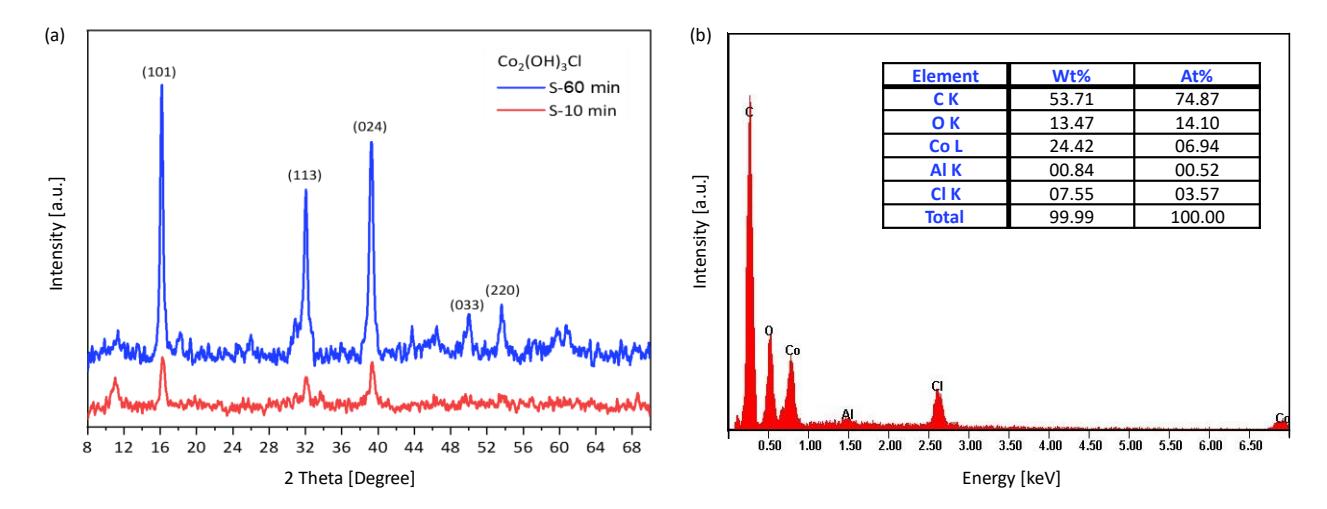
(a) XRD spectra of the as-obtained S-10 min and S-60 min powder, and (b) EDAX spectrum of S-60 min thin film on carbon substrate with its element weight and atomic weight percentages.
The nucleation and growth of Co2(OH)3Cl are further monitored using SEM after 10 min and 60 min of the chemical bath deposition. Figure 2 (a-c) displays initial nanoparticles distributed on the microfibers of the carbon substrate. The nanoparticles evolve to vertical nanoflakes in 60 min, as seen in Figure 2 (d-f). The plausible growth mechanisms are initially based on the hydrolyzation of CoCl2.6H2O with NH4OH to produce monomers of cobalt hydroxide hydrate. Then, the monomers precipitate as nuclei that grow up by decomposition of NH4OH. Increasing the synthesis reaction time can allow further decomposition of NH4OH, hance building more layers of cobalt hydroxide hydrate. Similar growth mechanisms of nanostructures are reported for carbonated cobalt chloride hydroxide hydrate prepared at different times using a hydrothermal method by Mahmood N. et. al. (Mahmood et al., 2015). The Co2(OH)3Cl nanostructures are conformally deposited on each carbon microfiber in both samples. This industrial substrate offers flexible 3-dimensional woven fabric that facilitates the passage of the supercapacitor electrolyte through the electrode active materials instead of the 2-dimensional flat substrates such as stainless steel sheets. It is noteworthy that the as-prepared electrodes are binder-free thin films opposite the traditional bulky electrodes that use additional binders to attach the active material powder to the substrates.
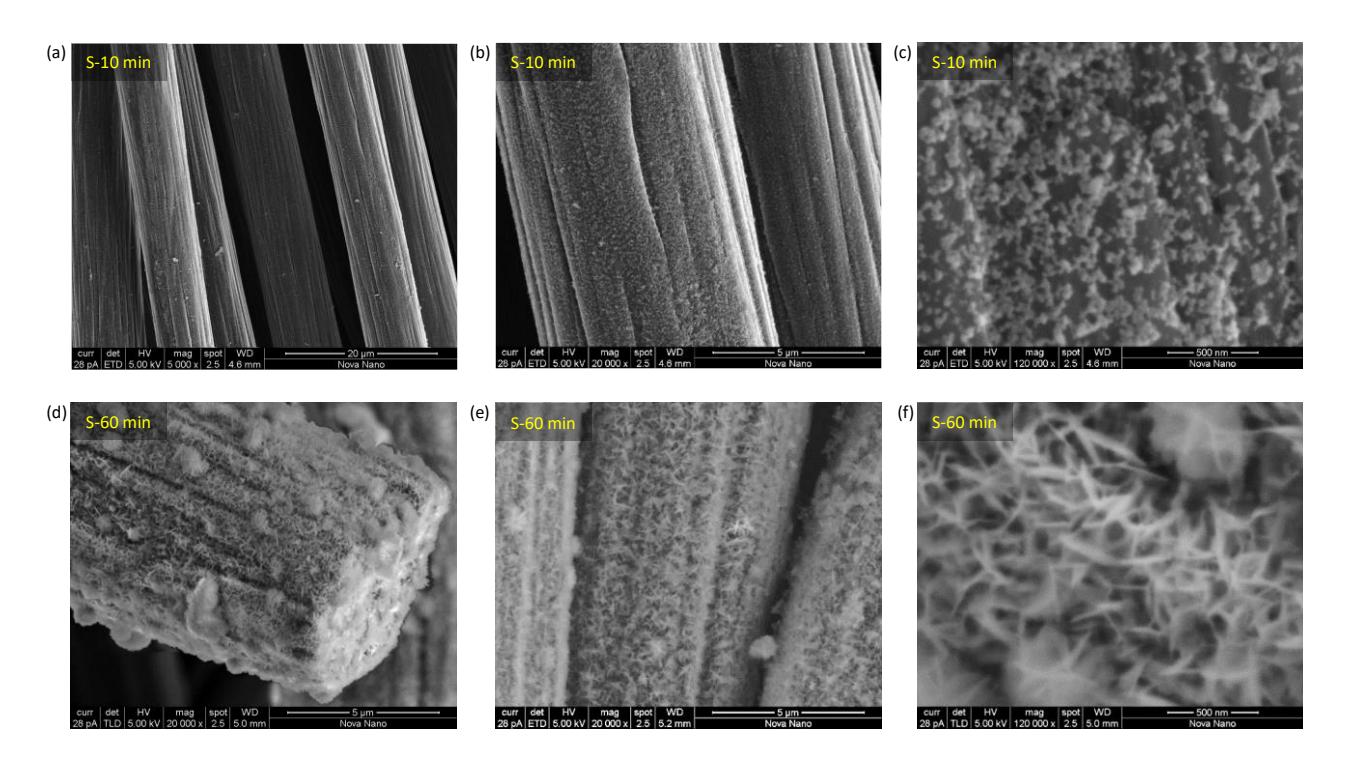
Figure 2 SEM images of \(Co_2(OH)_3CI\) in (a-c) S-10 min nanoparticles and (d-f) S-60 min nanoflakes on carbon microfibers at different magnifications.
Figure 3 (a and b) demonstrate the CV curves of S-60 min and S-10 min electrodes, respectively, in KOH electrolyte at potential scan rates between 100 mV/s and 10 mV/s. The limits of the potential windows are optimized to avoid any oxygen and hydrogen evolution reactions from the aqueous electrolyte. To clarify the current density peaks at 10 mV/s of both samples, the curves are compared in Figure 3 (c). As expected, there are two anodic peaks in the positive current range and two cathodic peaks in the opposing current range, respectively, resulting from the quasi-reversible oxidation and reduction reactions with KOH (Cao, Xu, Liang, & Li, 2004). At 10 mV/s, the peaks in S-60 min at 44 mV and 150 mV are separated by 106 mV, which is a shorter potential distance than 160 mV in S-10 min between 23 mV and 183 mV, pointing out that the redox reactions in S-60 min have better reversibility. At higher scan rates, the potential separations are increased in both samples, and S-60 min still exhibits better reversibility.
The kinetics of the charge-storage mechanism can be qualitatively described based on the exponent value (b) of the power-law Eq. (2):
\[i(v) = a v^b (2)\] where i is the peak current, v is the scan rate, a is a constant, and b is the exponent that can be determined by the slope of the linear relation between log(i) and log(v). If the b value equals 0.5, the mechanism is controlled by the semi-infinite linear diffusion of electrolyte ions into the electrode's layers. In another case, the surface-controlled mechanism occurs when the b value equals 1 (Y. Liu, Jiang, & Shao, 2020). As calculated from Figure 3 (d) and represented in the fitting Eqs. (3) and (4), the slops for S-60 min and S-30 min are 0.72 and 0.68, respectively. Such values indicate a combination of slow diffusion and surface-controlled processes.
\[i = 0.72 v + 0.25\] (S-60 min) (3)
\[i = 0.68 v + 0.21\] (S-10 min) (4)
In Figure 3 (e) and Eqs. (5) and (6), it is found that i is linearly proportional to \(v^{0.5}\) in both samples. The slope in S-60 min is slightly higher than in S-10 min, indicating a better diffusion in S-60 min.
\[i = 1.44 v^{0.5} + 0.25\] (S-60 min) (5)
\[i = 1.37 \text{ v}^{0.5} + 0.21\] (S-10 min)
The Nyquist plot's slope, nearly 45°, can also confirm the electrolyte ions' diffusion into the electrode at the low-frequency range, as Figure 3 (f) illustrates. At the high-frequency range, the impedance curve approaches the x-axis at 9.6 ohm for S-60 min and 11.9 ohm for S-10 min. These equivalent series resistance (ESR) values include the electrode, substrate, and solution resistances. Besides, the semicircle diameter represents the charge transfer resistance (RCT). The RCT of S-60 min seems to be 2.0 ohm, while no semicircle is found for S-10 min. The reason could be that the increased growth of nanoflakes provides more active sites for charge transfer by the redox reactions in S-60 min. The partially uncoated carbon fibers in S-10 min could decrease the redox contribution of the distributed nanoparticles. It has been reported that such commercial carbon cloth has a low specific capacitance of around 1-2 F/g when used as electrodes without treatment or coating (Chen et al., 2024).
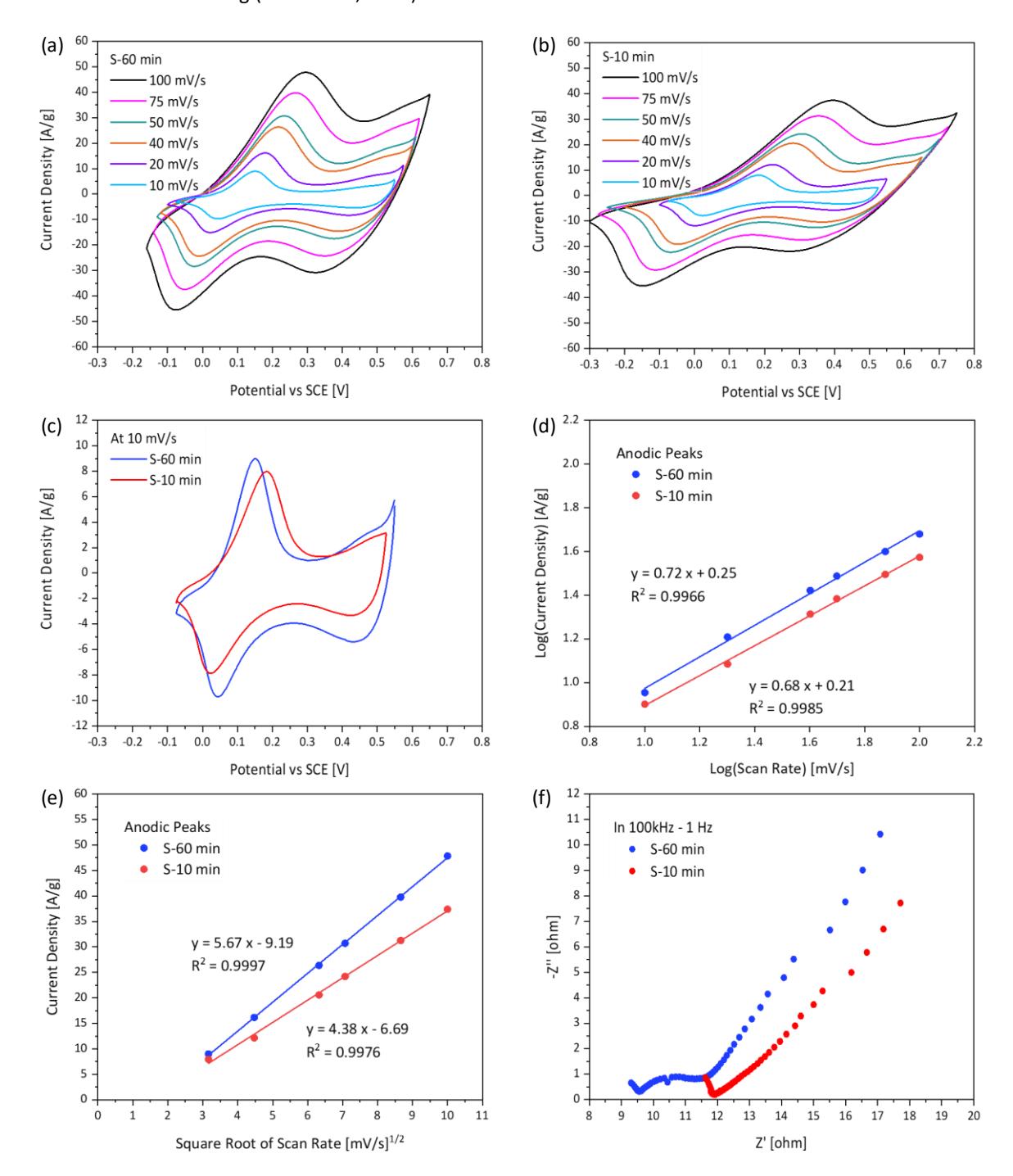
(a and b) CV curves of S-60 min and S-10 min in 1 M KOH, respectively, (c) CV curves of both samples at a scan rate of 10 mV/s, (d and e) the current density of anodic peaks as functions of scan rate and the square root of scan rate, respectively, with linear fitting equations, and (f) Nyquist plot of EIS.
By applying constant anodic and cathodic current densities on the electrodes, the electrical charges are stored and then released in pre-set limits of the potential window, as demonstrated in the GCD curves of Figure 4 (a-e). In analogy with the CV peaks mentioned above, the GCD reveals two plateaus in all charge curves and other corresponding plateaus in the discharge curves of both \(Co_2(OH)_3CI\) electrodes. It is well-known that supercapacitors are charged and discharged faster by applying high current densities, such as 12 A/g, than low values, such as 1 A/g. Nevertheless, the specific capacitance values, also called gravimetric capacitance, are calculated within a wide range of current density using equation (1), as evaluated in Figure 4 (f). The S-60 min electrode exhibits longer discharge times, hence higher specific capacitances than the S-10 min electrode at all current densities.
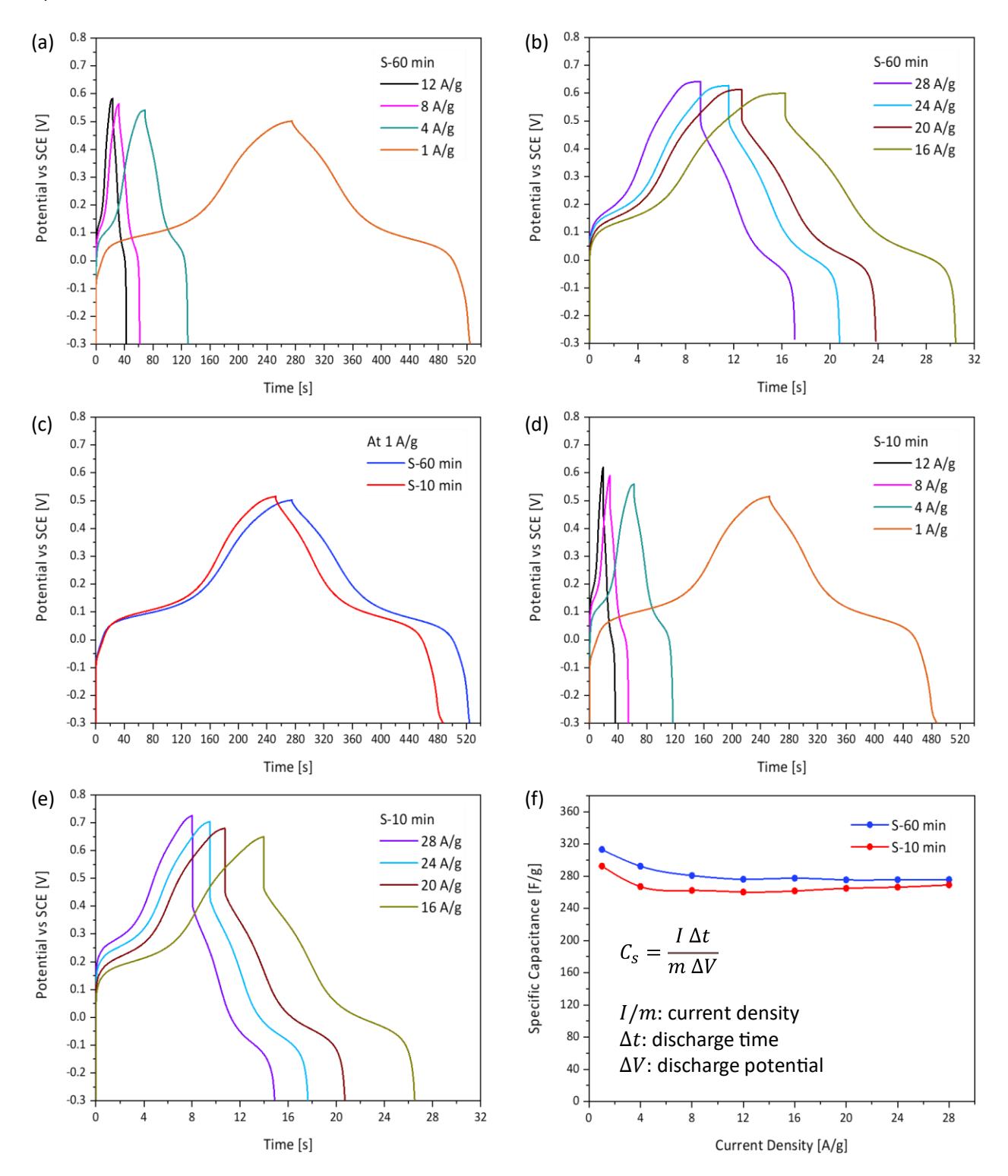
Figure 4 (a and b) GCD curves of S-60 min at low and high current densities, respectively, (c) GCD curves of both samples at a current density of 1 A/g, (d and e) GCD curves of S-10 min at low and high current densities, respectively, and (f) specific capacitance functions of both samples.
An increase in specific capacitance with increasing the synthesis time has been reported in the work of T. Masikhwa and co-researchers (Masikhwa et al., 2016). They concluded that the specific capacitance at 1 A/g of cobalt hydroxide carbonate nanorods in 6 M KOH increases from 208 F/g to 466 F/g by increasing the growth time from 3 h to 12 h. Those long hours led to an increase in the specific surface area of the nanorods. Table 1 lists a comparison of the synthesis time and supercapacitor performance for cobalt-based nanostructured electrodes. Our results of 293 F/g for S-10 min and 313 F/g for S-60 min at 1 A/g are achieved in shorter times than the reported values. The good supercapacitor performance in our work is attributed to many factors, including the growth of nanoflake morphology, which seems to provide a more extensive electrode-electrolyte interface than the nanoparticles of S-10 min. In addition, the better crystallization of Co2(OH)3Cl in S-60 min than in S-10 min could support the reversibility of the redox reactions. Both samples' overall electrochemical performance can be ascribed to the conformal coating and firm Co2(OH)3Cl attachment on each carbon fiber by the chemical bath deposition. Our binder-free cobalt-based electrodes on fabric substrates have proved promising for flexible supercapacitors. They could find applications as energy storage components in intelligent textiles, portable electronics, and the Internet of Things.
Table 1 A comparison of the synthesis time and supercapacitor performance for cobalt-based nanostructured electrodes.
| Electrode | Synthesis Time and Method | Electrolyte | Specific Capacitance at 1 A/g | Reference |
|---|---|---|---|---|
| Cobalt hydroxide chloride | 60 minutes in chemical bath | 1 M KOH | 313 F/g | This research |
| nanosheets | deposition | aqueous | ||
| Cobalt hydroxide chloride | 10 minutes in chemical bath | 1 M KOH | 293 F/g | This research |
| nanoparticles | deposition | aqueous | ||
| Cobalt hydroxide carbonate | 12 hours in hydrothermal | 6 M KOH | 466 F/g | (Masikhwa et al., |
| nanorods | method | aqueous | 2016) | |
| Cobalt hydroxide carbonate | 3 hours in hydrothermal | 6 M KOH | 208 F/g | (Masikhwa et al., |
| nanorods | method | aqueous | 2016) | |
| Chlorine-doped carbonated cobalt | 12 hours in hydrothermal | 1 M KOH | 8808 F/g | (Mahmood et al., |
| hydroxide nanorods | method | aqueous | 2015). |
Conclusion
A simple, fast, and economical chemical bath deposition method has been optimized to produce a conformal Co2(OH)3Cl nanostructured coating on carbon microfibers. Interestingly, Co2(OH)3Cl nanoparticles appear in only 10 minutes of the deposition time; then, the nanoflakes are grown in 60 minutes. In both cases, the as-prepared Co2(OH)3Cl has a rhombohedral crystal structure without a significant atomic weight percentage of impurities. The CV and GCD curves prove that the electrochemical energy storage mechanism of Co2(OH)3Cl electrodes in KOH electrolyte depends on semireversible redox reactions at the surface and the semi-infinite diffusion process. As a result, the S-60 min exhibits a specific capacitance of 313 F/g at a current density of 1 A/g, higher than 293 F/g at 1 A/g for the S-10 min. The improved performance is achieved because the better crystallinity of S-60 min with nanoflake morphology enables electrolyte ions to penetrate the electrode more efficiently than the nanoparticles. Our optimized synthesis of cobalt hydroxide chloride nanostructures on woven substrates offers binder-free electrodes for flexible supercapacitor applications. It is recommended that further development be made in terms of mechanical flexibility, cyclic stability, and electrical conductivity.
Acknowledgment
The author thanks King Abdullah University of Science and Technology (KAUST) in Saudi Arabia for its laboratory services and Taibah University in Saudi Arabia.
Compliance with ethics guidelines
The authors declare that they have no conflict of interest or financial conflicts to disclose.
This article does not contain any studies with human or animal subjects performed by any of the authors.