

Introduction
Asphalt has long been one of the most prevalent composite materials used in pavement construction worldwide (Ruiz-Riancho et al., 2021; Wu et al., 2022; Yang et al., 2021). With growing emphasis on sustainability in construction, innovations in asphalt technology are being implemented to align with green construction goals, meet diverse functional demands, and adapt to global price fluctuations (C. Yang et al., 2022; Yousif et al., 2022). Conventionally, asphalt functions as an insulating material with high electrical resistance, making it non-conductive by nature (Notani et al., 2019). However, traditional pavements can be transformed into smart, multifunctional systems by incorporating specific additives into asphalt mixes, enabling the creation of advanced asphalt concrete with enhanced properties (Zadri et al., 2022). These additives not only improve the electrical properties of asphalt but also preserve its core mechanical load-bearing capabilities (Rew et al., 2017; Arsalaan Khan Yousafzai, Muslich Hartadi Sutanto, Muhammad Imran Khan, et al., 2024).
Copyright ©2025 Published by IRCS - ITB ISSN: 2337-5779
<sup>1</sup>Department of Civil and Environmental Engineering, Universiti Teknologi PETRONAS, Seri Iskandar 32610, Malaysia <sup>2</sup>Department of Civil Engineering, University of Engineering & Technology Peshawar, 25120 Khyber Pakhtunkhwa, Pakistan
<sup>3</sup>Department of Civil and Construction Engineering, College of Engineering, A'Sharqiyah University, 400 Ibra, Oman <sup>4</sup>Center of Urban Resource Sustainability, Institute of Smart and Sustainable Living, Universiti Teknologi PETRONAS, Seri Iskandar 32610, Perak, Malaysia
<sup>5</sup>Department of Civil Engineering, College of Engineering, Imam Mohammad Ibn Saud Islamic University (IMSIU), Riyadh 11432, Saudi Arabia
A significant innovation is piezoresistive asphalt, which enables the real-time tracking of loads and pavement defects. Recent studies have emphasized the wide range of applications and advantages of electrically conductive asphalt and concrete mixtures (ECAM/ECAC). These include detecting early damage through strain sensing, monitoring traffic, aiding autonomous vehicle navigation, assessing pavement damage, supporting truck weigh-in-motion systems, monitoring structural health, enabling non-destructive testing, promoting self-healing of microcracks, facilitating deicing for winter maintenance, enabling rapid pothole repairs, reducing noise, and harnessing energy via piezoelectric mechanisms (Abdualla et al., 2017). These advancements underscore the potential for further exploration and innovation in this field (Rizvi et al., 2016).
The selection of suitable additives to impart conductivity to asphalt is a critical consideration (Li et al., 2022). Asphalt's conductivity depends on the formation of a conductive network within the mix, which is influenced by the additive's geometry, composition, and concentration. Recycling industrial and household waste materials offers a dual advantage of improving the electrical properties of asphalt while addressing environmental sustainability challenges in pavement engineering (Ruidong et al., 2021). Researchers have employed various additives—fibre-based, binder-based, and granule-based, as well as their combinations—to enhance electrical conductivity and enable self-healing capabilities in asphalt mixes. Additives can also be classified by material type (carbon-based or metallic) (Hasan et al., 2021), size (nano, micro, or macro) (H. Yang et al., 2022), or form (powders, fibres, or solid particles) as noted by Chen et al. (Chen et al., 2019). Another categorization divides modifiers into polymer modifiers, chemical modifiers, adhesion/anti-stripping agents, and fibre additives. Commonly used conductive additives include carbon fibre, steel fibre, aluminium fibre, steel wool (Karimi et al., 2020), carbon nanotubes (Y. Liu et al., 2021), graphene (H. Yang et al., 2022), graphite powder, carbon black, nickel powder, iron tailings (Ullah et al., 2021), copper slag (Fakhri et al., 2020), coke (Rizvi et al., 2016), and metallic shavings (Fakhri et al., 2020; Karimi et al., 2021; Messaoud et al., 2022; Ullah et al., 2021; A. K. Yousafzai et al., 2024).
This study investigates the effects of incorporating waste tyre metal fibre (WTMF) as a modifier in asphalt mixtures. Fibre proportions (0.375%, 0.75%, 1.125%, and 1.5%) and bitumen contents (4%, 4.5%, 5%, 5.5%, and 6%) were systematically varied, guided by prior research from Luana et al. (Schuster et al., 2023), Hanwen et al. (H. Yang et al., 2022), Ying-Yuan et al. (Y.-Y. Wang et al., 2022), Lusheng Wang et al. (L. Wang et al., 2022), Shafi Ullah et al. (Ullah et al., 2022), Messaoud et al. (Messaoud et al., 2022), Zhenxia Li et al. (Li et al., 2022), Jia-Liang Le et al. (Le et al., 2022), Cahit Gürer et al. (Gürer, Fidan, et al., 2022) and (Gürer, Düşmez, et al., 2022), Zejiao Dong et al. (Dong et al., 2022), and Liping Cao et al. (Cao et al., 2022). The goal was to develop a computational model capable of predicting Marshall mix design parameters using data from 75 laboratory-tested Marshall specimens with varying fibre and bitumen contents. The study leverages a decision tree (DT) algorithm with input variables including fibre and bitumen content, porosity, and aggregate percentage. Model performance was assessed using statistical tools such as the coefficient of determination (R²), adjusted R² (R̅²), and mean absolute error (MAE). The results indicate that adding metal fibres to asphalt could greatly improve pavement performance and provide high piezoresistivity, opening the door to potential self-sensing applications in future smart infrastructure.
Literature Review
Metallic Additives in Asphalt
Various metallic additives, including steel fibre, iron tailings, and metal shavings, have been explored for asphalt modification. These materials include steel, iron tailing, magnetite, carbonyl iron powder, copper wire, aluminium metal fibres, and steel slag (Chen & Balieu, 2020; Shishegaran et al., 2020; A. K. Yousafzai et al., 2024). Additives in this category have been found to retain electro-mechanical damage sensing abilities even after the initial cracking (within the linear elastic range). Steel fibre is one of the most commonly used additives in asphalt. A single steel fibre has a tensile strength of approximately 502 MPa, significantly surpassing that of asphalt concrete. Its electrical conductivity is quite high at 7.0x10⁻⁵ Ω-m, though its potential for conductivity improvement is lower compared to carbon-based materials (Chen & Balieu, 2020). Additionally, it is reported that this additive undergoes uneven heating, leading to asphalt with reduced durability (Chen et al., 2019). Metal fibres derived from waste tires have also been found to increase the air voids (AV) content and lower the bulk density of asphalt mixtures. Additionally, they are prone to oxidation (i.e., less corrosionresistant) and are chemically incompatible with asphalt materials (L. Liu et al., 2021). These drawbacks make metallic materials less desirable compared to carbon-based additives. Steel-based conductive additives come in different sizes, with lengths ranging from 1 to 9 mm and diameters between 6 and 20 mm (Chen & Balieu, 2020). One common form of steel wool fibre (SWF), made from virgin materials, is used to improve the electrical conductivity of asphalt and enhance its crack-healing properties (Karimi et al., 2020). Conversely, metal shavings, a waste product from metal
industries, can be used as a substitute for SWF (González et al., 2018). A research study found that the use of centimetrelevel SWF resulted in lower mechanical performance with localized electrical conductivity. However, in contrast, Hanwen et al. (H. Yang et al., 2022) reported that SWF-modified asphalt mixtures exhibited good electrical conductivity, thereby demonstrating self-healing capabilities. Heopeng et al. (Wang et al., 2016) observed significant improvements in Marshall Stability (MS), tensile strength, and rutting resistance in asphalt specimens modified with SWF. This enhancement was attributed to the even distribution of steel fibres, which create a complex 3D structure that allows the asphalt to transfer more stress. Iron tailings, a commonly underused byproduct of the iron ore extraction process, are produced during beneficiation.
Earlier studies have mainly concentrated on enhancing the piezoresistive properties of asphalt mixtures while preserving the essential mechanical performance parameters. However, predicting these properties is more difficult due to the complex interactions between Marshall parameters, asphalt components, and various additives. With advancements in high-tech computing, machine learning algorithms have become increasingly reliable and robust, capable of accurately predicting outcomes. These algorithms can be especially valuable when applied to the development of sustainable, smart asphalt manufacturing. Therefore, this study explores the use of machine learning algorithms to predict the Marshall parameters of modified asphalt mixes containing varying contents of optimized bitumen, aggregates, and waste tyre metal fibre in different mix ratios.
Machine Learning in Pavement Engineering
Machine learning methods have revolutionized predictive modelling in civil engineering. Techniques such as artificial neural networks, support vector machines, and decision trees enable accurate predictions of asphalt performance metrics. A study by Leon et al. (Leon & Gay, 2019) assessed the impact of aggregate angularity on the permanent deformation of asphalt mixtures using GEP. The researchers prepared a total of 98 samples in the laboratory, incorporating different percentages of angular, sub-angular, rounded, and sub-rounded aggregates. Awan et al. (Awan et al., 2022) used multi-expression programming to evaluate the MS and MF parameters, utilizing datasets consisting of 253 samples for asphaltic base course and 343 samples for asphaltic wearing course, respectively. Khan et al. (Khan et al., 2023) developed the relationship between the water-cement ratio, superplasticizer, flow, 1-day, and 7-days compressive strength to predict the 28-days compressive strength of semi flexible pavement using artificial neural network (ANN). Upadhya et al. (Upadhya et al., 2022) adopted ANN, random tree (RT), RF, and adaptive neuro-fuzzy inference system (ANFIS) for predicting MS of glass fibre-modified asphalt concrete. ANN and least square support vector machine (LS-SVM) were adopted by Khuntia et al. (Khuntia et al., 2014) to predict the Air Voids (AV), MS and MF of waste polyethylene (PE)-modified bituminous mixtures. Nyirandayisabye et al. (Nyirandayisabye et al., 2022) used SVR, linear regression (LR), KNN, RF, Light Gradient Boosted Machine (LGBM), Gradient Boosting Regressor (GBR), DT regressor, and stacking regressor to access the pavement damage and distress quality. Ridge regression, lasso regression, LR, SVR, KNN, ANN, DT, RF, AdaBoost, voting regressor, XGBoost, gradient boost and cat-boost were adopted by Pal et al. (Pal et al., 2023) to predict the compressive strength of rubber and recycled aggregate modified fibrereinforced concrete.
DT regression, known for its simplicity and interpretability, is particularly effective for mapping relationships between variables and identifying influential factors in material performance. DTs are primarily composed of leaves, branches, and roots (Nitsche et al., 2014). The decision tree model is simple to understand, interpret, and visualize, and it is one of the simplest methods for determining linkages between variables and the most essential variable (Zhao & Zhang, 2008). It is important to note that Decision Tree Regressors (DTRs) come in various types, including basic, thorny, and intermediate trees. The key difference between them lies in the size of the smallest leaf. A decision tree consists of branches, nodes, leaves, and other components. The tree divides the nodes into sub-nodes based on various factors and selects the split that results in the most homogeneous sub-nodes. The prediction outcome is derived from the leaf at the end of the path. DTRs have been successfully utilized by researchers across a wide range of applications (Karbassi et al., 2014).
Materials and Methodology
The aim of this research was to apply the decision tree machine learning algorithm to evaluate the Marshall performance parameters of waste tyre metal fibre (WTMF) modified asphalt mixes. The experimental process was divided into several stages, each focused on achieving a specific goal. The first stage involved determining the Optimum Bitumen Content (OBC) for both control samples and each modified mixture with a specified WTMF content. The input parameters included fibre content, bitumen content, aggregate percentage, and porosity. The next step was to develop an algorithm
capable of optimizing the mix parameters. Finally, various statistical tools were used to evaluate the performance of the developed models.
Materials and Specimens Preparation
The research was conducted using locally available construction materials from Perak, Malaysia. Aggregates were sourced from Sunway Quarry Industries Sdn Bhd, and the bitumen chosen was 60/70 penetration grade, based on its widespread use in Malaysia. Waste Tyre Metal Fibre (WTMF), shown in Figure 1, was used as the primary electrically conductive additive in this study. The WTMF had dimensions ranging from 3 to 9 mm in length and a diameter of 0.1 mm. The metal fibre content was selected to align with previous research studies while also addressing issues such as agglomeration and improper mixing and compaction that can occur at higher fibre contents. Additionally, the Marshall mix design used in this research follows the standard specifications set by JKR (Public Works Department of Malaysia) (Standard Specification for Road Works - Section 4: Flexible Pavement, 2008). Asphaltic concrete with a maximum nominal aggregate size of 14 mm (AC-14) was used for aggregate gradation and the preparation of asphalt mixture samples, representing the wearing course of the pavement. The aggregates were initially sieved through the required sizes to achieve the appropriate combinations based on particle size.
Waste tyre metal fibre used in this research.
The Marshall mix design procedure was used to determine the optimum mix proportions for this study. The first step was to determine the optimum bitumen content (OBC), which is aimed at optimizing the amount of bitumen for a specific type of mix to achieve a durable composition. The OBC was determined for both the controlled mix and the WTMF-modified mixes according to the procedure outlined by the Asphalt Institute. It is important to note that the OBC for each mix series varied due to different WTMF contents in each series. Marshall specimens, 100 mm in diameter and 65 mm in height, were produced following ASTM D6926-20. A total of 1200 gm of blended aggregates were added to the bitumen mixture, along with the selected amount of WTMF additive, to prepare each Marshall specimen. Each mixture was composed of 44% coarse aggregates, 50% fine aggregates, and 6% mineral filler. The aggregates were first heated in an oven at 140-160°C to eliminate all moisture. For uniform blending, the fibres were gradually added during the dry mixing of the oven-dried aggregates with the pre-determined optimum bitumen content. The mixture was then transferred into pre-heated specimen moulds with a 100 mm diameter and 63.5 mm height to maintain the temperature. The inside of the moulds was greased, and paper filters were placed on both the top and bottom surfaces to prevent the compacted mix from adhering to the mould. The filled moulds were placed in a Marshall compactor, where 75 blows were applied to each face of the specimen for compaction. After compaction, the specimens were extruded from the moulds and left to cool at room temperature overnight. These samples were then tested for Marshall stability, flow, and volumetric properties.
Experimental Design
Marshall Stability and Flow are essential tests for evaluating the resistance of bituminous mixtures to deformation and their ability to withstand continuous traffic loads. Marshall stability reflects the tensile strength of the asphalt mixture, indicating its capacity to resist rutting at high service temperatures. In contrast, flow measures the rutting resistance by showing the permanent strain that occurs at failure during the test. A total of 75 Marshall samples were prepared, including both control and WTMF-modified series (from Series A to Series D). These samples were made by mixing JKR graded aggregate with 60/70 penetration grade bitumen and the desired WTM fibre content. The fibre was incorporated directly into the aggregate-bitumen mixture during dry mixing. For compaction, all samples received 75 blows per diametrical face using the standard Marshall compaction hammer. The equipment used in this study is shown in Figure 2 (a and b), with testing conducted at a continuous loading/deformation rate of 50.8 mm/min at 60 °C. The maximum load at failure was recorded as Marshall stability (kN). The specimens were conditioned in a water bath at 60 °C for 25-30 minutes to simulate service temperatures.
(b)
Figure 2 (a) Positioning of the sample in the digital Marshall testing machine. (b) Close-up view of the installed sample.
Model development
Machine learning now plays a crucial role in automating simulations, helping researchers reduce the need for extensive laboratory testing. Several methods are available to map the relationship between inputs and predict target outputs based on real-world data. This study utilizes a Decision Tree (DT) regressor implemented in Python programming to predict the Marshall Stability (MS) and Marshall Flow (MF) of fibre-modified asphalt mixes prepared in the laboratory. The performance of the model was evaluated using various statistical tools, with the best-performing model being selected. This model was also used to assess the importance of each input variable in predicting the output variables. Additionally, the model will be employed to evaluate outcomes based on combinations that were not directly tested in the laboratory.
MS and MF models were developed using 75 datapoints, with 80% allocated for training and 20% for testing. A decision tree regressor was applied to create the model, using input variables such as aggregate percentage, asphalt content, fibre content, and porosity. The model's performance was evaluated using R-Square, Adjusted R-Square, and Mean Absolute Error (MAE) (Eqs. (1) to (3)). The best-performing model based on training data was selected for determining the optimal combination of input variables and assessing the importance of each variable in output prediction. A detailed performance summary of the model can be found in Table 1.
\[R^{2} = 1 - \frac{\sum_{i=1}^{n} (\hat{Y}_{i} - \bar{Y})}{\sum_{i=1}^{n} (y_{i} - \bar{y})}\] (1)
\[Adj.R^{2} = 1 - \left(\frac{\left(1 - \frac{\sum_{i=1}^{n} (\bar{Y}_{i} - \bar{Y})}{\sum_{i=1}^{n} (y_{i} - \bar{y})}\right)(n-1)}{(n-p-1)}\right)\](2)
\[MAE = \frac{1}{n} \sum_{i=1}^{n} \left| y_{i-} \widehat{Y}_{i} \right|\] (3)
In the above equations, \(y_i\), \(\hat{Y}_i\) are the actual and predicted output, \(\bar{y}\), \(\bar{Y}\) are the mean values of actual and predicted outputs and, n and p, are the number of observation and input variables, respectively.
| Decision Tree Model | |||||
|---|---|---|---|---|---|
| Training | Testing | ||||
| MAE | 0.421 | 0.259 | |||
| R-Square | 0.901 | 0.937 | |||
| Adj. R-Square | 0.897 | 0.927 | |||
Table 1 Model's performance in training and testing phases.
Results
Based on the experimental data, bitumen content, aggregate percentage, fibre content, and porosity were selected as input variables, while MS and MF were chosen as output variables, with the decision tree regressor applied using Python programming. To ensure the dataset had no missing values, k-nearest neighbours was used to fill any missing values by substituting them with the closest values from the five nearest neighbours on either side. Figures 3 and 4 display the distribution of MS and MF in relation to fibre content, with five different percentages of fibre content (including the control) being investigated in this study. Each subplot in these figures represents a specific proportion of fibre content, showing the mean, first quartile, third quartile, and lower and upper limits for both MS and MF. The data points are evenly distributed around the mean value for each fibre content percentage. To confirm normality, an outlier check was performed, which identified two MS data points above the upper limit, leading to their removal from the dataset. Details of the outlier check can be found in Table 2 and Figure 5.
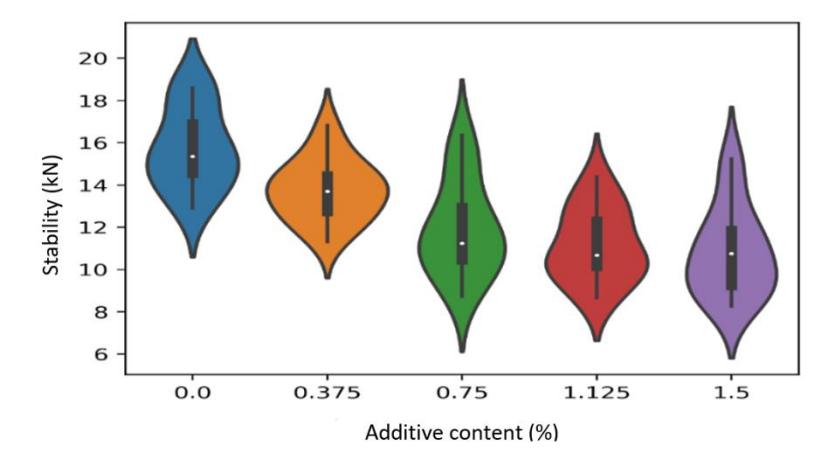
Marshall stability distribution against additive content.
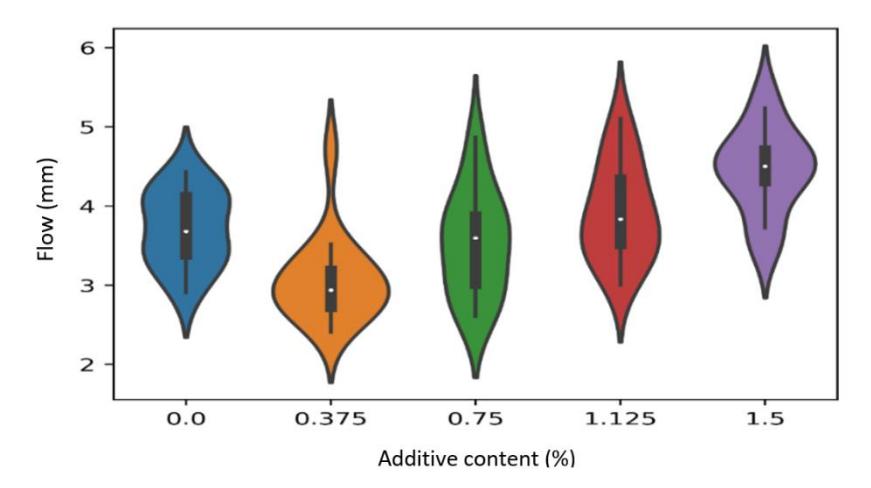
Marshall flow distribution against additive content.
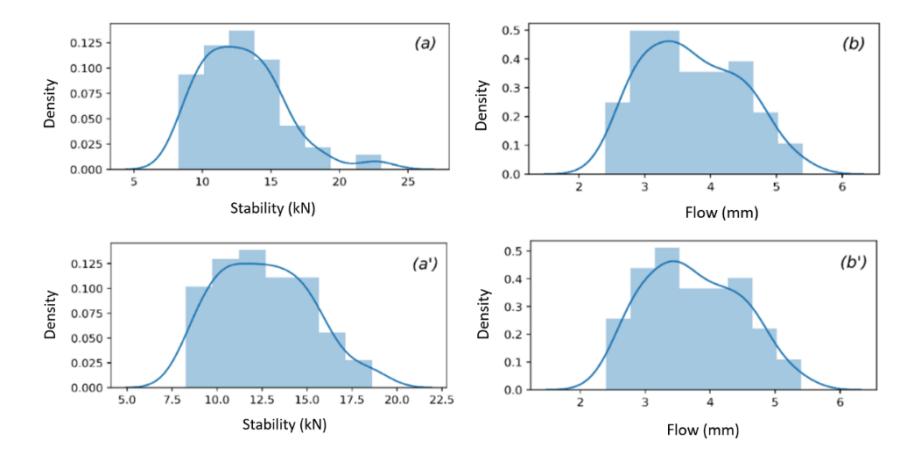
(a & b) Marshall stability and flow distribution before outlier check. (a' & b') Marshall stability and flow distribution after performing the outlier check.
Table 2 Outlier check.
| Q1* | Q2* | Q3* | IQR** | Lower limit | Upper Limit | Outliers | |
|---|---|---|---|---|---|---|---|
| MS (kN) | 10.609 | 12.525 | 14.535 | 3.925 | 4.721 | 20.423 | 23.044, 22.190 |
| MF (mm) | 3.134 | 3.637 | 4.301 | 1.167 | 1.383 | 6.052 | None |
| *Q1, Q2 & Q3 = 1st, 2nd, and 3rd quartile. | |||||||
**IQR = inter quartile range
After this, Pearson correlation coefficient was computed between the input and output variables using equation 4. From Table 3, skewness for all the variables falls within the range of normal distribution (-0.5 to 0.5) except for stability which is 0.95 which means the values of MS are slightly positively skewed. Based on kurtosis, it can be concluded that all the variables have significant peaks which are close to normal distribution. Details of the data distribution and correlation can be seen in Table 3 and Figure 6. In the figure, intense colours represent strong correlation, whether positive or negative, whereas lighter colours represent weak correlation.
Table 3 Descriptive statistics of the dataset (Arsalaan Khan Yousafzai, Muslich Hartadi Sutanto, Nasir Khan, et al., 2024).
| Parameter | Additive Content (%) | Aggregate (%) | Binder Content (%) | Porosity (%) | Stability (kN) | Flow (mm) |
|---|---|---|---|---|---|---|
| Count | 75 | 75 | 75 | 75 | 75 | 75 |
| Mean | 0.75 | 95.00 | 5.00 | 4.29 | 12.86 | 3.72 |
| St. Dev. | 0.53 | 0.71 | 0.71 | 1.63 | 3.03 | 0.73 |
| Min. | 0.00 | 94.00 | 4.00 | 0.63 | 8.25 | 2.40 |
| Max. | 1.50 | 96.00 | 6.00 | 7.99 | 23.04 | 5.40 |
| Skewness | 0.00 | 0.00 | 0.00 | -0.32 | 0.95 | 0.29 |
| Kurtosis | -1.31 | -1.31 | -1.31 | -0.32 | 1.36 | -0.83 |
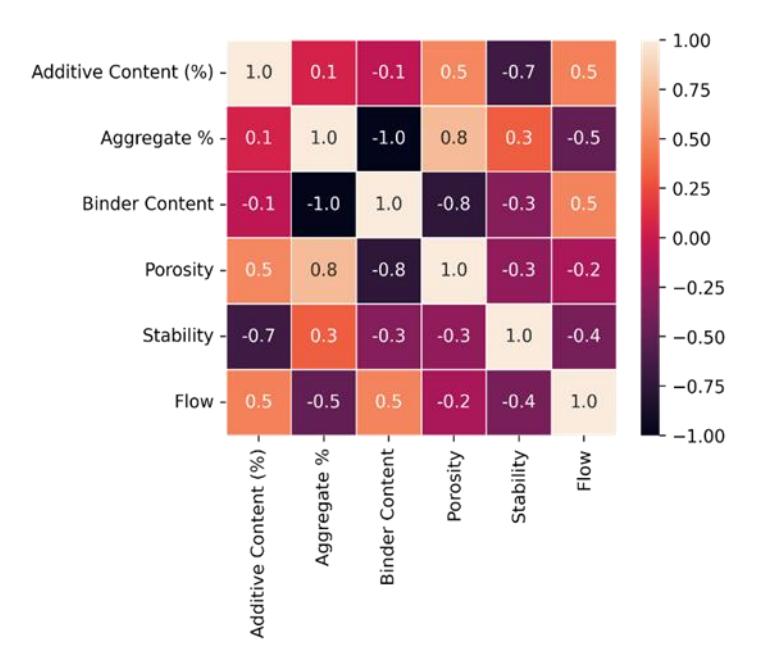
Variable's correlation matrix.
\[C_{J-K} = \frac{\Sigma(J_i - \bar{J})(K_i - \bar{K})}{\sqrt{\Sigma(J_i - \bar{J})^2} \sqrt{\Sigma(K_i - \bar{K})^2}}\](4)
In this equation, CJ-K is the correlation of variable J with variable K, Ji, Ki is the ith entry of variables J and K, and J ̅, K̅ are the mean values of variables J and K.
These results align with the study's objective to evaluate the impact of varying WTMF and bitumen contents on the mechanical performance of asphalt mixes. The reduction in stability indicates a trade-off between enhanced conductivity and mechanical durability, emphasizing the importance of balance in mix design. Conversely, the increase in flow suggests improved flexibility and potential deformation resistance, which are desirable traits in certain applications. By quantifying these effects, the decision tree model provides actionable insights into optimizing WTMFmodified asphalt compositions.
Discussion
The Decision Tree (DT) model was employed to map various input variable values to evaluate the Marshall Stability (MS) and Marshall Flow (MF). The direct laboratory results for MS and MF in this study were limited to specific combinations. The machine learning model was utilized to predict values that were not directly estimated in the laboratory. Specifically, MS and MF values were predicted for fibre contents of 0.5%, 1%, and 1.75%, with bitumen content ranging from 4% to 6%. The analysis revealed that MS decreases with increasing fibre and bitumen content, while MF increases with both variables. The sensitivity of MS to changes in fibre and bitumen content remained nearly constant. However, MF demonstrated different reactions to variations in these inputs. The influence of bitumen content on MF was less pronounced at lower fibre content levels but became more significant as fibre content increased. Detailed predictions of the model can be seen in Figures 7 and 8, where it can be observed that the MS decreases with increases in both WTMF and bitumen content, while the flow increases with increase in WTMF and bitumen content. Additionally, it was found that the impact of binder content on flow was less pronounced with lower WTMF content, whereas the effect became more significant as the WTMF content increased. According to the prediction model, there is a 17% reduction in MS when the WTMF content is increased from 0.375% to 1.75% at 4% binder content. Similarly, there is 24% reduction in MS when the WTMF content is increased from 0.375% to 1.75% at 6% binder content. For flow predictions, there is 11% increase when WTMF content is increased from 0.375% to 1.75% at 4% binder content, 32% increase when WTMF content is increased from 0.375% to 1.75% at 6% binder content.
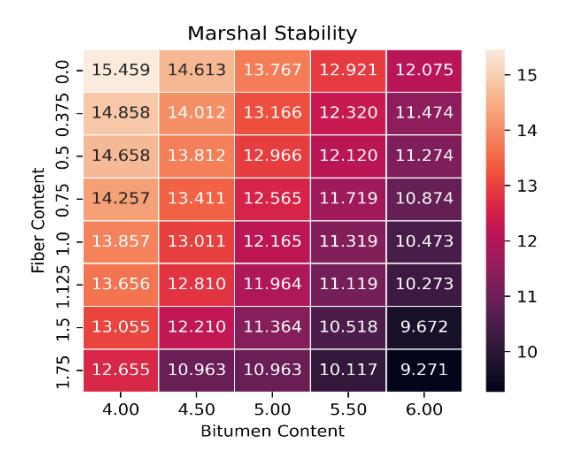
Effect of fibre content and bitumen content on Stability.
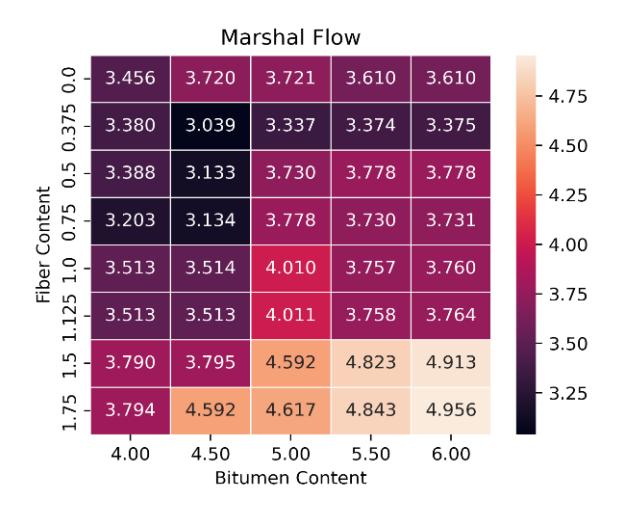
Effect of fibre content and bitumen content on flow.
These outcomes underscore the importance of systematically analysing the interplay between material components to meet performance requirements while supporting sustainability goals. The study's methodology and results contribute to the growing body of knowledge on machine learning applications in civil engineering, showcasing the practical utility of predictive models in material optimization.
Conclusions
The study explores the use of decision tree algorithm for developing a relationship between the four input variables (i.e., fibre content, bitumen content, aggregate percentage, and porosity) to predict the MS and MF based on a dataset consisting of results of 75 experiments performed in laboratory. Mapping the relationship between input variables using DT regressors was successfully performed. The predictive power of the model was assessed by R-Square, Adjusted R-Square, and MAE. R2 recorded for the model was 0.937 for testing data. The established correlation underscores the possibility of using this machine learning model for successfully predicting the performance parameters for the modified mixes. Based on the model's predictions, it was also concluded that the effect of bitumen content on flow values is stronger at higher percentages of fibre content as compared to lesser fibre content. In conclusion, this research work investigates an alternative state-of-art method to assess and predict the MS and MF of the WTMF-modified mixes. Such modified mixes can also contribute to recycling and reuse of waste material to reduce the environmental impact. This study confirms the effectiveness of decision tree regression for predicting the performance of WTMF-modified asphalt mixes. Incorporating WTMF not only improves functionality but also supports environmental sustainability. Future research should explore additional machine learning techniques and larger datasets to further validate these findings. Further research and validation can be done in the future to refine and expand the findings that would ultimately advance the machine learning predictive practices in the pavement industry.
Acknowledgments
The authors appreciate and acknowledge the support received from Universiti Teknologi PETRONAS, Malaysia, and the Higher Education Commission, Pakistan, in the development of this study.
Compliance with ethics guidelines
The authors declare they have no conflict of interest or financial conflicts to disclose.
This article contains no studies with human or animal subjects performed by authors.