

Introduction
Farmers in rural areas of Thailand engage in both agriculture and livestock farming to produce food for self-consumption and generate income. However, the price uncertainty of farm produce and market volatility has become a major challenge to economic security. Additionally, farmers often lack the time to seek alternative sources of income due to labor intensive nature of agriculture and animal husbandry (Boonraksa et al., 2022). In shrimp farming, feeding plays a crucial role in ensuring healthy growth and optimal yield. Efficient and consistent feeding is necessary to promote uniform shrimp growth, improve feed utilization, and reduce waste. Traditional hand-feeding methods often result in uneven feed distribution, leading to distorted growth patterns, increased waste, water quality deterioration, and health problems in shrimp. An automatic feeder, especially one integrated with Internet of Things (IoT) technology, can provide a more reliable and even feed distribution. By automating the feeding process, farmers can better control the amount and timing of feed, resulting in even shrimp growth, feed cost reduction. Additionally, it also enables former to customize feeding schedule depending on growth stage and size of shrimp (Arditya et al., 2021; Silalahi et al., 2023).
Currently, research is actively exploring the application of various technologies in agriculture to enhance productivity. One such development is an automatic water management system powered by solar energy, designed specifically for bio floc production. This prototype is built using an Internet of Things (IoT) framework and includes a mobile application that enables comprehensive management of fish and shrimp farming systems. The system supports water quality
monitoring, automatic feeding, and manual control functions. By automating key processes, the feeders significantly reduce the labor required in aquaculture operations (Blancaflor et al., 2021; Rethwan Faiz et al., 2022; Deepthi et al., 2023). Management of water quality feeding schedule is the most important aspect of shrimp farming practice. To solve the issue, mobile applications have emerged as powerful tools for supporting automated feeding systems. These applications allow farmers to control and monitor their ponds remotely, optimizing the shrimp's feed distribution and environmental conditions. One example is the use of the Blynk application, which can control an automatic feeder and display important data, like the pH levels of the pond, via notifications on platforms like Line. This setup typically employs an Arduino microcontroller and an ESP8266 Wi-Fi module to create a system that can be operated through a smartphone, giving farmers real-time control and monitoring capabilities from a distance. The design involves integrating IoT technologies to automate and streamline the feeding process, ensuring that shrimp receive adequate and consistent feed without the need for manual intervention. The system not only reduces labor but also helps maintain optimal water conditions by tracking metrics such as pH, temperature, and dissolved oxygen levels, leading to improved shrimp health and growth as well as efficient and sustainable aquaculture practices (Suksawad et al., 2020; Wayangkau et al., 2023; Wardhany et al., 2020). The fish feeding system has been further enhanced to operate at the edge of the pond, utilizing a blower mechanism to distribute feed effectively over the water surface. An Arduino based feeding mechanism, powered by 12V battery and capable of IoT based real time control system is developed in (Thepsena et al., 2022).
Solar energy, a renewable and sustainable energy source, offers a promising alternative to traditional energy resources, especially in addressing the global energy crisis. Leveraging solar energy in aquaculture, particularly in automated shrimp feeding systems, is a recent development aimed at enhancing energy efficiency and reducing dependency on conventional power sources. Solar-powered feeders not only provide an environmentally friendly solution but also lower operational costs, making them appealing to farmers looking to improve sustainability in their practices. An automatic shrimp feeder powered by solar energy allows for reliable feeding schedules even in remote locations without access to grid electricity. This system enables consistent feeding, promoting optimal shrimp growth while reducing the carbon footprint of aquaculture operations. As such, solar-powered feeding systems are gaining attention and becoming more popular among aquaculture professionals who prioritize both economic and environmental benefits (Dindo et al., 2015). Moreover, solar installation requires comparatively fewer installation of electrical components like wires and control devices than the grid-based power supply, greatly improving the safety aspect of operation in more risky areas like a shrimp farm.
The IoT system can increase efficiency by monitoring data in real time, making feeding more accurate, reducing waste, and helping to analyze data to improve future processes (Huang et al., 2025; Dhanaraju et al., 2022). To demonstrate the advantages and strengths of this research and innovation, a comparison of previous studies is presented in Table 1. Most previous studies incorporate IoT in aquaculture, indicating its importance in modern shrimp farming. However, some studies from Dindo et al. (2023) do not utilize IoT, showing that its adoption is not yet universal. While some studies integrate smartphone control from Ahmed et al. (2024) and Toruan et al. (2023) lack this feature. This suggests that remote accessibility remains an area for improvement. Solar-powered shrimp feeders are rare. Only two prior studies from Silalahi et al. (2023) and Blancaflor et al. (2021) used solar energy, while most rely on traditional power sources. The proposed system stands out by integrating solar power and promoting sustainability. The previous study from Dindo et al. (2023) implemented three feeder speed controls. Our study improves upon this by offering precise feeding control at different speeds.
The previous studies, Wayangkau et al. (2023) and Wardhany et al. (2021) included a shrimp food level sensor. Our study addresses this gap, enhancing automation and efficiency. Water quality measurement is not consistently integrated; some studies incorporate DO, temperature, and pH sensors, but many do not. Our system ensures real-time monitoring, aligning with best aquaculture practices. Economic analysis is often overlooked. Only one previous study from Ahmed et al. (2024) considered economic feasibility. This paper study contributes by evaluating cost-effectiveness, which is crucial for adoption. This paper presents a distinctive integration of three core technologies: solar energy, IoT, and multispeed motor control. The system also features continuous water quality monitoring through the integration of DO, temperature, and pH sensors. Key innovations include a solar-powered animal feeding system that allows flexible scheduling and control via smartphone. Experimental results demonstrate that the system can reduce annual labor cost by up to 83.18% depending on scenarios.
| Reference | Silalahi et al., 2023 | Blancaflor et al., 2021 | Rethwan Faiz et al., 2022 | Wayangkau et al., 2023 | Wardhany et al., 2021 | Dindo et al., 2023 | Ahmed et al., 2024 | Toruan et al., 2023 | This Work |
|---|---|---|---|---|---|---|---|---|---|
| Automatic shrimp feeder | ✗ | ✓ | ✓ | ✓ | ✓ | ✗ | ✓ | ✓ | ✓ |
| Control via smartphone | ✗ | ✓ | ✓ | ✓ | ✓ | ✗ | ✗ | ✗ | ✓ |
| Solar-powered source | ✓ | ✓ | ✗ | ✗ | ✗ | ✗ | ✗ | ✗ | ✓ |
| Internet of things technology | ✓ | ✓ | ✓ | ✓ | ✓ | ✗ | ✓ | ✓ | ✓ |
| Three feeder speed control | ✗ | ✗ | ✗ | ✗ | ✗ | ✓ | ✗ | ✗ | ✓ |
| Shrimp food level sensor | ✗ | ✗ | ✗ | ✓ | ✓ | ✗ | ✗ | ✗ | ✓ |
| Water quality measurement using DO, Temperature, and pH sensor | ✗ | ✓ | ✗ | ✗ | ✓ | ✗ | ✓ | ✓ | ✓ |
| Economic analysis | ✗ | ✗ | ✗ | ✗ | ✗ | ✗ | ✓ | ✗ | ✓ |
Table 1 Previous studies comparison.
Therefore, the objective of this research is to design and develop such a shrimp feeder system which is powered by solar energy and is controllable through IoT system to increase feeding efficiency, reduce waste, and reduce energy costs. The central hypothesis of this research is that the proposed automatic feeding system can deliver precise control over feed quantity, reduce wastage, and enhance shrimp growth rates when compared to conventional feeding methods. The innovation of this work lies in its integration of intelligent control with sustainable energy—utilizing solar power in place of traditional electricity sources. By incorporating IoT technology, the system enables real-time management through a smartphone application, providing users with advanced capabilities such as scheduling feedings, adjusting feeding times on demand, and regulating feed distribution speed. These features align with the evolving needs of modern aquaculture, promoting both efficiency and environmental sustainability.
The principal contributions of this study are as follows:
- 1. This paper focuses on the design of a solar-powered automatic shrimp feeder. Internet of Things technology is applied for controlling the operation via smartphone. A water quality measurement system was applied in this paper with DO, ph and temperature sensors.
- 2. In this work, a charging circuit and a voltage step-down circuit are designed for use in a microcontroller control system, utilizing solar energy for power generation and a battery for energy storage.
- 3. A DC motor control circuit for feeding is conceived and implemented in this study. A smartphone may be used to control the circuit's three motor speed settings with a smartphone and also switch it on and off and specify the working hours.
Smart Farming
Smart Farming is the application of technology and knowledge to develop agriculture, which can ensure the stability and safety of agricultural and food products. Nowadays, the use of technology is increasing, especially information technology and automation systems. Smart farming is the evolution of precision farming with innovative intelligent methods to enable many functions related to remote farm management by managing the farm in real-time. The study explores the role of IoT and sensor technologies in promoting agricultural sustainability by examining market trends, system architectures, practical applications, sensor types, associated benefits, challenges, and potential directions for future research (Morchid et al., 2024; Sahoo et al., 2021). Figure 1 shows the conceptual schematic diagram of smart farming technology. Cloud computing data and event management architecture includes data and event management via Cloud Computing, which represents using the cloud to manage data and events, by connecting data from various sources through intelligent sensors, including automatic data processing within the cloud system.
Smart agriculture is made possible by a new technology called the Internet of Things (IoT), which allows equipment to be connected remotely. Numerous industries, including trade, health, energy, smart cities, smart homes, traffic management, smart agriculture, and more, are beginning to be impacted by IoT technology. IoT technology has advanced dramatically in agriculture, particularly in farm management. With the use of this technology, all agricultural
instruments and equipment may be connected to make informed decisions about fertilizer delivery and irrigation (Said Mohamed et al., 2021; Dhanaraju et al., 2022).
Smart farming technology.
Methodology
This methodology section outlines the research process, beginning with the design of the shrimp feeder's structural framework, followed by the development of the solar power generation system and charging circuit. It also covers the design of the DC motor control circuit and the implementation of remote-control functionality using the Blynk application.
Design of the Structure and the Components of an Automatic Shrimp Feeder
The square stainless-steel tubing was selected to construct the support framework. Since the shrimp feeder must float on water, it must be designed to be lightweight using stainless steel. The feed container is designed using a stainlesssteel tank connected to a conical stainless-steel piece to transfer the feed to the shrimp feeder nozzle. Solar panel, feed tank, control box, floating buoys, conveyor and feeder dispenser, DC motor, and control board are the individual component of the automatic shrimp feeder. Figure 2 show the structure of the shrimp feeder. This research integrated three types of water quality sensors: temperature, pH, and dissolved oxygen (DO) sensors to monitor water conditions in real time, which are very important for shrimp farming because water quality directly affects the health, growth, and survival rate of shrimp. With real-time measurement, farmers can sense and respond to changes in water quality in a timely manner, which will help increase farm management efficiency and reduce risks that may occur in shrimp farming in the long run.
Structure of the solar-powered automatic shrimp feeder.
Design of the Power Supply
This research has applied a 200 watt solar panel to produce electricity and store it in the 12 volts battery through a charging circuit. The monocrystalline solar panel was selected because it has high efficiency, size and weight suitable for shrimp feeder application. The electricity produced by PV module and stored in battery powers both the DC motor as well as control system. A voltage buck circuit is required to lower the 12-volt battery power to 5 volts to power microcontroller and control instruments. The battery charge controller circuit is responsible for generating a constant voltage and supplying current to the LM317T voltage regulator through diode D1. This circuit's LM317T is used as a voltage regulator to manage both voltage and current. A 13.8 V battery may be efficiently charged from a solar cell by adjusting the legs of the LM317T. In order to guarantee correct circuit functioning and protection, the BC548 transistor is also included as a ground-isolating switch (Murtianta, and Rumaksari, 2024; Kumar et al., 2024). Figure 3 shows how this system is configured.
Figure 4 show the buck converter circuit. The voltage from the solar cell through the IC LM317T is reduced from 12 volts to 5 volts and then through the transistor 2N1893 to increase the rate current. The output voltage (Vout) of buck converter circuit can be calculated according to Eq. (1).
\[V_{out} = 1.25 \times (1 + \frac{R_2}{R_1}) \tag{1}\]
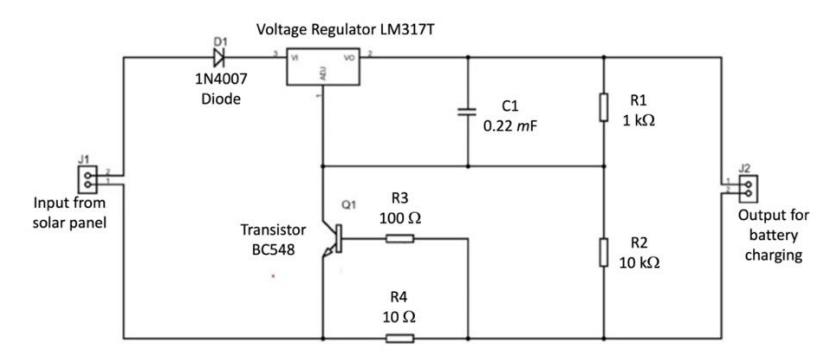
Battery charger circuit.
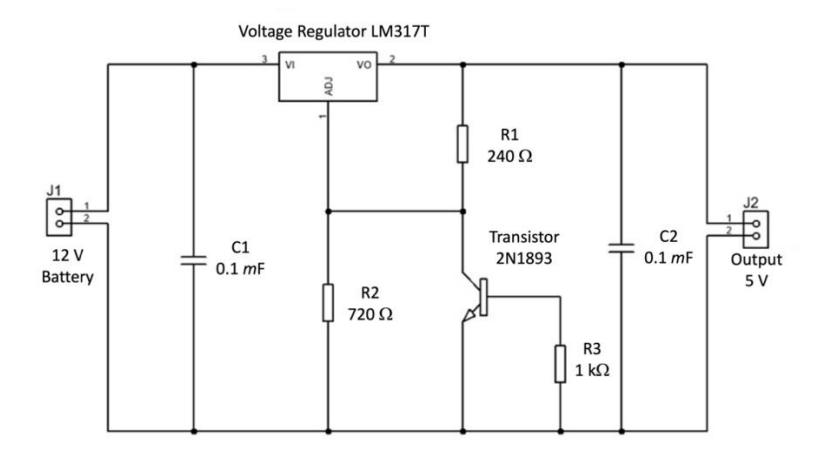
Buck converter circuit for 12V to 5V.
Design of Motor Drive Circuit
The motor drive circuit used in this system is designed to control motor speed based on the principle of Pulse Width Modulation (PWM). This technique is chosen because it allows for precise speed control, improves energy efficiency, and reduces heat generated during operation. Additionally, the circuit features a simple structure, low cost, and high durability, making it well-suited for shrimp feeding systems that rely on battery power or solar energy. The circuit is also compatible with IoT-based control systems and can easily integrate with various sensors. It operates using a 12-volt power supply and is specifically designed for 12-volt DC motors, allowing for straightforward connection and reliable performance in real-world applications.
The generation of a PWM signal to control the operation of a transistor can be done by generating a pulse signal of the IC NE 555, which can determine the frequency by adjusting the values of three parameters: RA, RB and C1. Therefore, the duty cycle can be calculated as Eq. (2) and the system frequency can be found from Eq. (5). The motor control circuit has been specifically designed to offer precise speed regulation. It provides the capability to adjust the motor's speed across three distinct levels. This adjustment is achieved through frequency control, a method that alters the system's operating frequency to achieve the desired speed. Figure 5 and 6 shows the design and implementation of the motor speed control circuit.
\[D = \frac{t(on)}{t(on) + t(off)} \times 100 \tag{2}\]
\[t(on) = 0.693 \times (R_A + R_2) \times C_1 \tag{3}\]
\[t(off) = 0.693 \times (R_1) \times C_1 \tag{4}\]
\[T = t(on) + t(off) (5)\]
\[f = \frac{1}{T} \tag{6}\]
The system's pulse operation is characterized by specific parameters. The operating times of the pulse are divided into two distinct periods:
t(on) – Represents the duration of the pulse rise or the "on-time" when the system is active.
t(off) – Represents the duration of the pulse fall or the "off-time" when the system is inactive.
These durations are essential in calculating the duty cycle (D), which indicates the proportion of time the system remains active within a single cycle. This interplay between t(on), t(off), duty cycle, time period (T), and frequency (f) forms the foundation of the pulse control and modulation in the system.
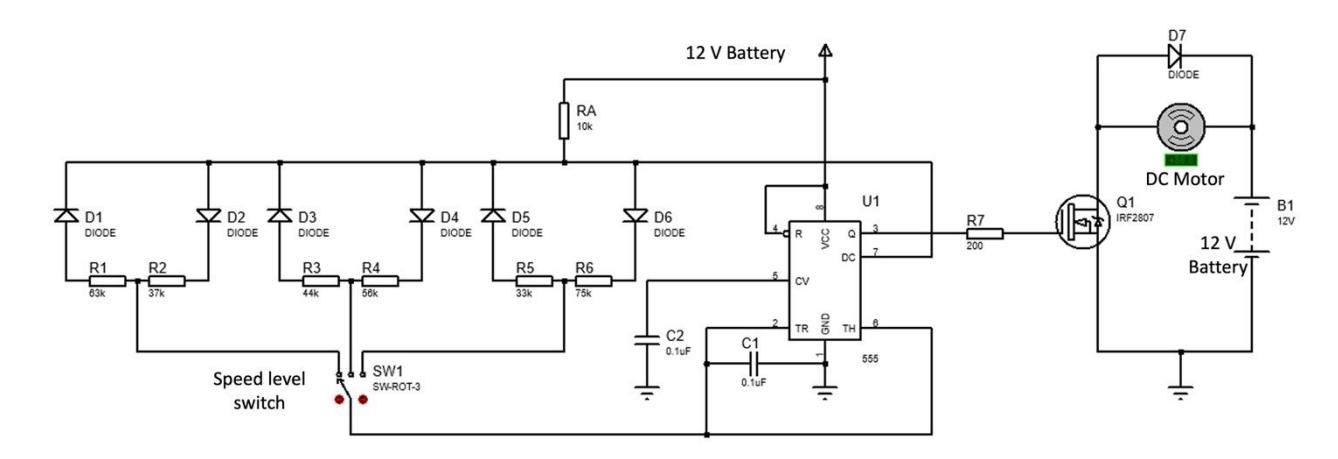
The design of motor control circuit.
The implementation of the motor drive and control circuit.
Design of the Programming for Automatic Shrimp Feeding Machine
The automatic shrimp feeder uses electricity from the battery through a voltage buck circuit to supply power to the Arduino microcontroller, ESP32, and motor control circuit. The ESP32 is applied because it is suitable for an automatic shrimp feeder control system that requires internet connection and control via smartphone, which supports Wi-Fi and can be remotely controlled via IoT system. It is also small, has low power consumption, low cost, high efficiency, and supports connection with various sensors and devices. This research applied the Blynk application in a smartphone to control the on-off and set the time of the microcontroller control unit for controlling the DC motor. The design of the operation system of the automatic shrimp feeder is shown in the diagram in Figure 7. The sensors applied in this research are: the DO sensor, water temperature sensor (DS18B20), pH sensor and Ultrasonic sensor. The ultrasonic sensor in this research is used to identify the food level by comparing the height of the food container, calculating the percentage, and displaying the result on the smartphone (because the farmer may increase the capacity of the food container). For example, in this research, the food container is 80 cm high. If the food container is full, it will be calculated as (80/80)*100 = 100% (Display 100% on the smartphone). The operation of the automatic shrimp feeder can adjust the feeding cycle speed, turn on-off, set the on-off time via a smartphone, and can also display the status of the food via a smartphone.
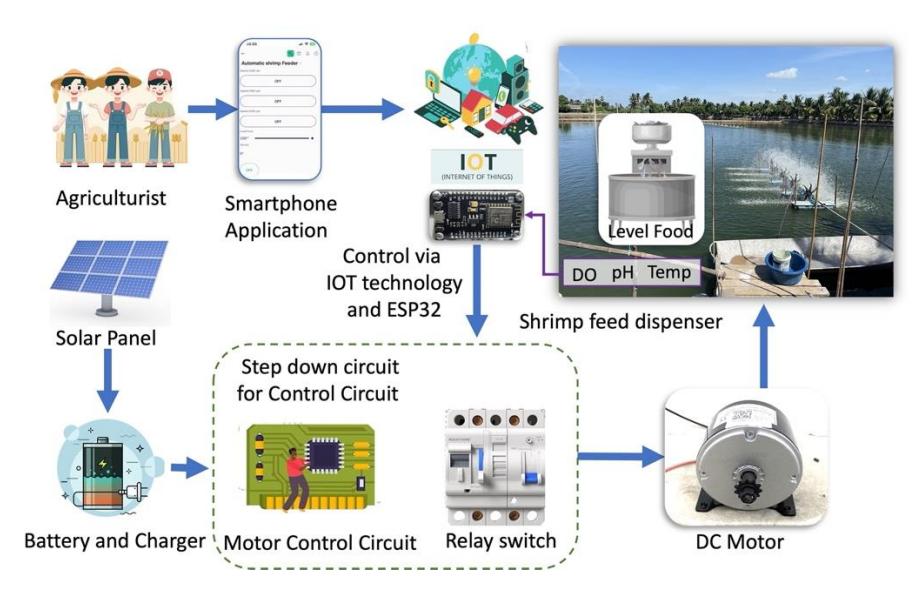
Design diagram of solar-powered automatic shrimp feeder.
- (a) Controlling via the Blynk application
- (b) Shrimp feeder timing setting
Blynk application on a smartphone of shrimp feeder.
The Blynk application display on the smartphone can select the motor speed level according to the switch SW1, SW2, and SW3 at 1,000 rpm, 1,500 rpm, and 2,000 rpm respectively, as shown in Figure 8 (a) Each switch functions to turn on/off the desired speed. The "Level Food" shows the operation of the sensor to measure the distance of food in the tank and the "Volume" shows the amount of food in the tank as a percentage. The shrimp feeder has a feeding timer function, as shown in Figure 8 (b).
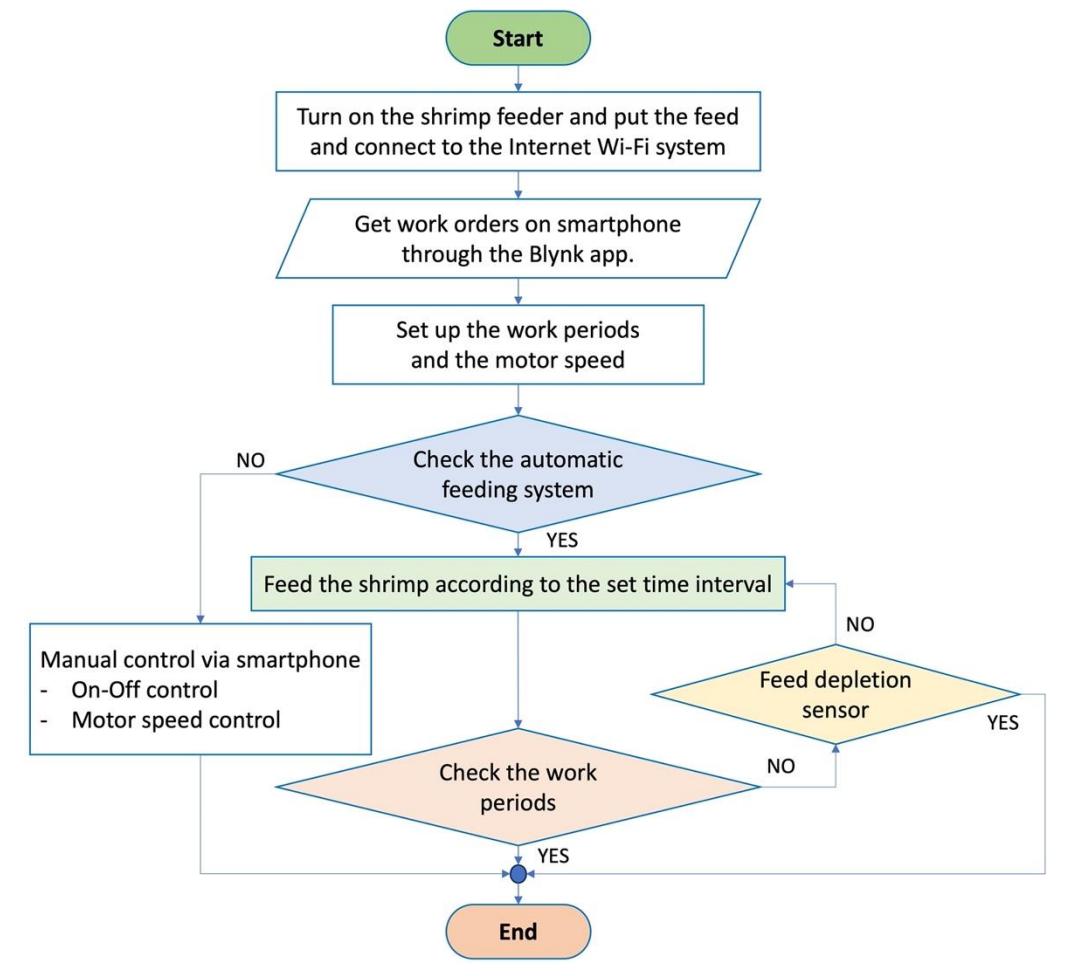
Flowchart of automatic shrimp feeder operation process.
Figure 9 shows the flowchart of automatic shrimp feeder operation process. The operation process of the shrimp feeder starts with the Blynk application on the smartphone controlling the operation of the relay via WIFI connection by reading the distance value from the ultrasonic sensor to measure the amount of food. After that, select the 3-level food dispensing speed level and turn on the operation.
Experimental Results
This section details the testing procedures for the solar-powered automatic shrimp feeder, focusing on key components and performance metrics. The tests conducted are divided into three main areas. In the charging circuit testing, the designed and constructed charging circuit was tested to ensure it could generate a stable voltage and current for effective battery charging. Parameters such as input voltage, charging current, and battery charging rate were recorded. The DC motor drive circuit testing, the DC motor drive circuit, responsible for operating the feeder mechanism, was evaluated to confirm it delivers the required torque and speed for consistent feeding operations. Measurements of voltage, current, and motor speed were taken to assess the efficiency and reliability of the motor drive. In the shrimp feeder operation testing, the complete feeder system was tested to verify the feeding functionality. This involved examining the timing, distribution, and quantity of feed delivered to ensure proper feeding intervals and amounts. For each test, the voltage, current, power, and electrical energy consumption were recorded. These measurements help evaluate the overall performance and efficiency of the solar-powered system, including power consumption and energy efficiency. Figure 10 illustrates the design of the solar-powered automatic shrimp feeder. Table 2 shows the performance test of the solar-powered automatic shrimp feeder. Tested with control via a smartphone (On-Off), automatic time setting (On-Off), feeding speed setting, and stop working with the sensor. This shows that the shrimp feeder is efficient and can perform all functions correctly.
The solar-powered automatic shrimp feeder.
Table 2 Performance test of the solar-powered automatic shrimp feeder.
| Parameters considered | Number of tests | Number of the shrimp feeder works accurately | Accuracy (%) |
|---|---|---|---|
| Controlled via a smartphone (On-Off) | 10 | 10 | 100 |
| Automatic time setting (On-Off) | 10 | 10 | 100 |
| Feeding speed setting | 10 | 10 | 100 |
| Stop working with the sensor | 10 | 10 | 100 |
Battery charging circuit test
The battery charging test commenced at 4:00 a.m. by connecting the charging circuit, a solar panel, and a 12-volt, 20 amp-hour (Ah) battery in a complete setup. This arrangement enabled the solar panel to begin collecting sunlight as soon as it became available, initiating the charging process. The battery charging test results showed that the current was high during 0-80 minutes and decreased as the battery charging time increased. The charging current was rated at 0.7 amps. The charging current decreased as the battery SOC value increased. After 180 minutes, the charging current was only 0.37 amps with the battery voltage at 13.70 volts as shown in Figure 11. Therefore, the designed and constructed charging circuit can be used efficiently, which takes 180 minutes to fully charge (Full battery).
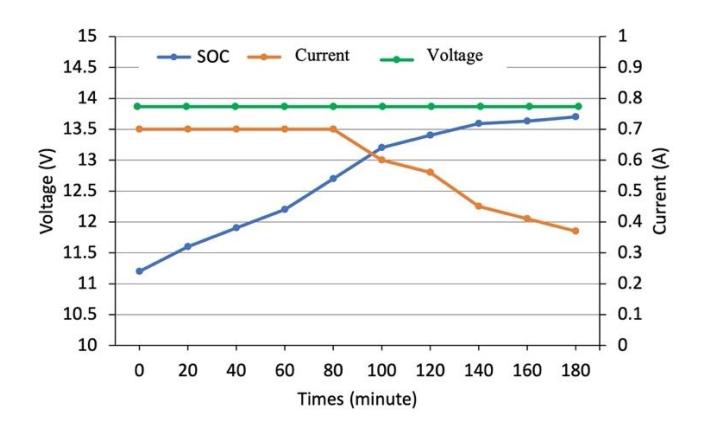
Battery charging circuit testing.
The DC Motor Drive Circuit Test
The testing process for the DC motor drive circuit was carried out systematically. Initially, the motor shaft was securely connected to the shrimp feeder feed dispenser. Following this setup, the motor speed was adjusted precisely to match the rated speed of 2,700 rpm. This configuration ensured the alignment of the motor's performance with the operational requirements of the shrimp feeder. The test aimed to evaluate the efficiency, stability, and reliability of the motor drive circuit under standard operating conditions. The test results of the DC motor drive circuit are shown in Table 3. While the motor without feed dispenser, voltage 11.91 volts, current 5.13 amps, power 61.09 watts, while the motor with feed dispenser, voltage 11.55 volts, current 15.37 amps, power 177.52 watts, the motor power is increased from 61.09 watts to 177.52 watts. When a feed dispenser is connected, it indicates that the motor is working harder during feeding because the feed dispenser puts more load on the motor to feed, which requires more power to rotate.
Table 3 The results of DC motor drive circuit test.
| Motor condition | Voltage (V) | Current (A) | Power (W) |
|---|---|---|---|
| Motor without feed dispenser | 11.91 | 5.13 | 61.09 |
| Motor with feed dispenser | 11.55 | 15.37 | 177.52 |
Figure 12 shows the pulse signal measurements of the IC NE555, focusing on the comparison between leg 3 and leg 6. The signal at leg 3 shows a duty cycle of 74.5% with a frequency of 112.6 Hz for 2,000 rpm, indicating a stable square wave output. In contrast, the signal at leg 6 exhibits a sawtooth waveform, which is characteristic of the capacitor charging and discharging cycle within the NE555 timer circuit. These signal measurements provide insight into the timing and waveform characteristics of the NE555, confirming its proper functioning within the circuit. After that, the pulse signal generated from IC NE555 is used as the input signal for the MOSFET to control the speed of the DC motor.
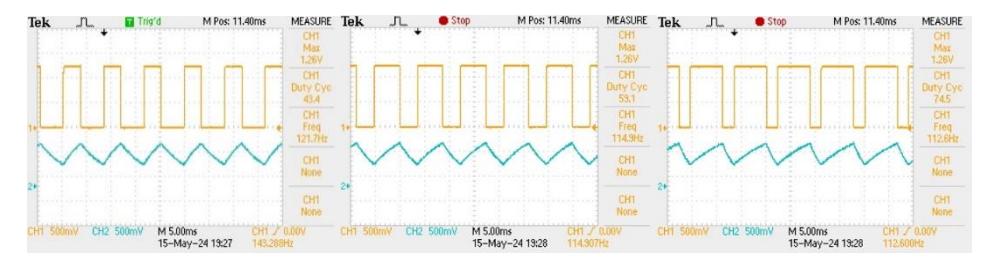
Pulse signal of the IC NE555 for the MOSFET drive at 1,000 rpm, 1,500 rpm, and 2,000 rpm.
Feeding Test of the Shrimp Feeder
Feeding test of the shrimp feeders, in this test, 5 kg of shrimp feed was used for the test. The feeding speed adjustment was tested at 1,000 rpm, 1,500 rpm, and 2,000 rpm. The values of electric current, voltage, power, time for food to run out, and spreading radius of the shrimp feeder were measured. The results of the shrimp feeder feeding test are shown in Table 4. The test results indicate that increasing the motor speed led to a corresponding increase in current draw and power consumption. Specifically, operating the feeder at higher speeds required more electrical power to maintain performance. However, this increase in speed also resulted in a reduction in feeding time. For example, when the motor was set to 2,000 RPM, dispensing 5 kg of feed was reduced to just 54 seconds. This demonstrates a trade-off between energy consumption and efficiency: higher speeds allow for faster feeding but consume more power. These findings
suggest that adjusting the motor speed can effectively balance feeding efficiency with energy usage, depending on the specific operational priorities.
| Table 4 | The feeding test results of the shrimp feeder. |
|---|---|
| Motor speed (rpm) | Voltage (V) | Current (A) | Power (W) | Time (Min.) |
|---|---|---|---|---|
| 1,000 | 10.66 | 5.97 | 63.64 | 01:10 |
| 1,500 | 10.69 | 11.96 | 127.85 | 01:02 |
| 2,000 | 10.72 | 16.69 | 178.92 | 00:54 |
Figure 13 shows the feeding radius of the automatic shrimp feeder. The test results show that when the working speed is increased, the food distribution distance is longer. However, the electricity consumption is also higher. The maximum feeding radius of the automatic shrimp feeder at 2,000 rpm is 4.5 m on average. The experiment helps the shrimp feeder user to estimate the feeding radius by determining the motor speed.
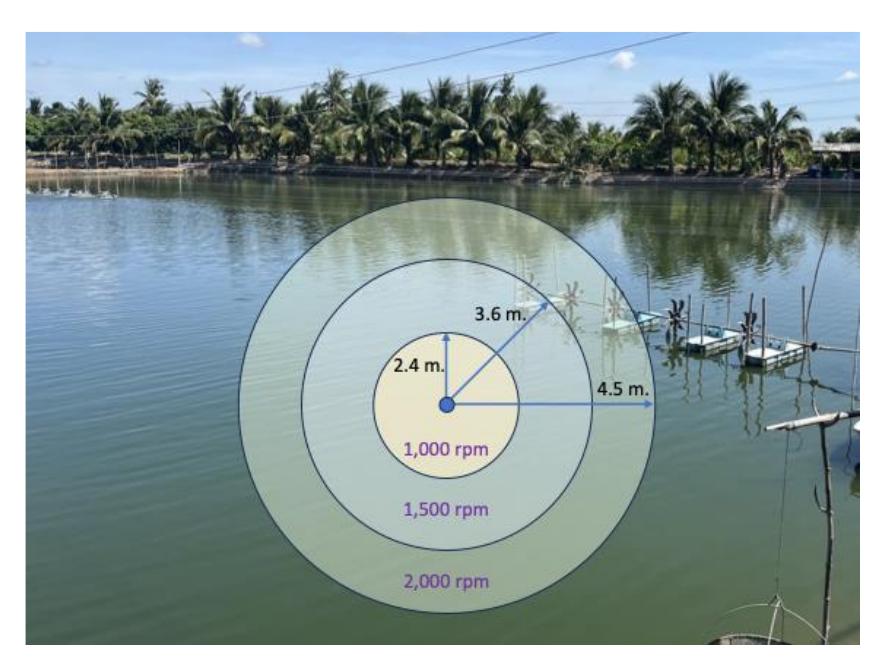
Feeding radius of the automatic shrimp feeder.
Discussions
From the shrimp feeding machine test, in the motor drive circuit test, the motor with feeder has a significantly higher energy requirement compared to the no load case. Although it works as designed, improvements should be considered to increase energy efficiency and reduce unnecessary waste. Increased energy consumption may be an important consideration, especially in systems powered by solar cells, where adequate battery capacity may need to be planned. If a longer feeding range is desired, a higher power motor may be required. Conventional feeding systems may have limitations in dispersal distance, which may result in excessive food waste and lack of feeding range, but this research can provide feeding range up to 4.5 meters and can adjust the amount of food. The integration of IoT with shrimp feeder still has limitations in connecting the feeder to Wi-Fi signal when changing Wi-Fi password and router, and the speed of the internet system also affects the control via smartphone. The efficiency of solar panels depends on weather conditions and geographic location. Areas with consistent sunlight will provide the best efficiency, while areas with cloudiness, dust, or high humidity may reduce efficiency. If solar panels are installed near trees or buildings, they may be partially shaded, reducing the efficiency of energy production. Therefore, the system design must take these factors into account in order for the shrimp feeder to operate efficiently and reduce costs in the long run. Researchers have asked shrimp farmers about their feedback on feeders and found that they want to use feeders to save effort and provide convenience. However, it still takes time to understand how to use feeders via smartphones.
Economic analysis of this research, Although the use of solar panels, IoT systems, DC motors, batteries, and feeding structures may have higher initial cost than traditional feeding systems, it has the potential to pay back faster from energy and feeding cost savings (Kumar et al., 2024; Hendarti et al., 2020). Proper control of food quantity and feeding
time by shrimp feeder can make shrimp grow faster and have higher survival rate. Using IoT-controlled automatic feeding system can increase shrimp production per farming cycle (Ahmed et al., 2024).
| Parameters | Human labor in shrimp farming | Shrimp Feeder without Solar | Shrimp Feeder with Solar-Battery | |
|---|---|---|---|---|
| (Baht) | Battery (Baht) | (Baht) | ||
| Shrimp feeder instillation cost. | - | 18,000 | 22,500 | |
| Electric system instillation cost. (Electric | ||||
| wire costs, electric poles, protection | - | 10,000 | - | |
| equipment, etc) | ||||
| Annual electricity bill. | - | 489 | - | |
| Annual maintenance cost. | - | 450 | ||
| (2% of the Instillation cost per year) | 360 | |||
| Annual Wi-Fi router. | 1,600 | |||
| (Cost per year) | - | 1,600 | ||
| Battery replacement cost. | (4,000 for 10 | |||
| (2,000 Baht per 4 years) | years) | |||
| Annual labor cost. | ||||
| (400 Baht/day) | 146,000 | - | - | |
| Annual total cost | 146,000 | 30,449 | 24,550 | |
| Ten years total cost | 1,460,000 | 52,448 | 47,000 | |
Table 5 Economic analysis of shrimp feeder.
Table 5 shows the economic analysis of shrimp feeder. The cost of human labor in shrimp farming is significantly high. However, by using shrimp feeders with a solar-battery system, the annual cost was reduced by 83.18% compared to traditional human labor. Ten years total cost reduced by 96.78% to 1,460,000 baht. we have assessed the feeder depreciation data at 15% of the Shrimp feeder installation cost because the material is made of stainless steel, so it is expensive. The feeder has a lifespan of 10 years. For the battery, the cost of the battery replacement of 2,000 baht per 4 years. However, the use of shrimp feeders without solar-battery may have higher electricity costs due to the use of higher power motors and higher electricity installation costs if the system is installed at a longer distance. The use of a shrimp feeder with a solar-battery also has the advantage of being environmentally friendly.
However, this research has not yet tested the system in a real shrimp pond environment, which is a major limitation of the study. The reasons are time limitation, budget, availability of field testing site, and the process of requesting ethics approval for animal research according to Thai law, which takes a long time to complete. The researcher plans to conduct field testing in a real shrimp pond in the next research phase. Quantitative data will be collected and the results analyzed using statistics to assess the efficiency, feeding accuracy, effects on shrimp health, growth, and survival rate, as well as data such as food consumption rate.
Application and development of the shrimp feeder. In this paper, the shrimp system was designed with a modular structure for easy installation and maintenance in remote agricultural areas or shrimp farms. Parts such as sensors and motors can be easily changed or calibrated by users with basic technical knowledge. The shrimp feeder uses standard sensors for temperature, pH, and dissolved oxygen, which require periodic calibration. A user manual and instructions are provided. The efficiency of solar panels varies depending on the weather conditions. Therefore, the shrimp feeder is designed with a backup battery to ensure continuous operation even during low sunlight. The shrimp feeder can still operate stably in field tests. Further studies may be conducted in a wider range of environments in the future. The current shrimp feeder system is designed for small to medium-sized farms, but it can be expanded by adding multiple feeders and controlling them via the same application. In the future, a dashboard for managing multiple feeding points in large farms will be developed. In the future, a smartphone application may be developed that is easy to use for farmers in general. There is a user manual and a video tutorial. There are plans to cooperate with agricultural agencies to provide knowledge and training to farmers in the future.
Conclusion
This paper, the design of a solar-powered automatic shrimp feeder based on the Internet of Things technology, focuses on the design and implementation of a DC electric motor drive control system with the control of IoT technology. The control of the motor operation via a smartphone shows convenience and increased efficiency. The agricultural user can control the speed of the motor up to 3 levels. It is also possible to set the working time of the automatic feeder according to the needs. Remote control via Blynk application allows farmers to monitor and adjust the operation of the shrimp feeder remotely anytime, anywhere. This article uses solar panel power generation as a power source for motors and control circuits, which is an approach that effectively reduces energy costs and also reduces environmental impacts. Power generation from this renewable energy is environmentally friendly and reduces carbon dioxide and other pollutants. The application of IoT technology and solar power generation in the design of automatic shrimp feeders not only improves the efficiency of shrimp farm management, but also presents a sustainable and environmentally friendly method that reduces energy costs and preserves the environment. Although the technology of automatic shrimp feeder using solar energy and IoT has helped increase the efficiency of feeding, reduce waste, and reduce energy costs, there are still ways to develop it in the future to improve the efficiency of the system even more, focusing on adding water quality sensors and oxygen replenishment systems in the water. It can also be applied to other animals. Future research will develop intelligent automatic feeding algorithms based on water quality data, shrimp feeding behavior, and feeding time to increase feeding efficiency and reduce waste in the system. In addition, automatic water quality control, such as adding oxygen or adjusting pH when it detects values that exceed the appropriate range, will help elevate the feeding system to a fully intelligent farm management system.
Acknowledgement
Funding was also received from the, Thailand Science Research and Innovation (TSRI) and Fundamental Fund of Rajamangala University of Technology Rattanakosin with funding under contract No. FRB6704/2567/ project code 192850 / Research project "The Design of Automatic Shrimps Feeder with the Internet of Things Technology and Solar Power Supply" (2024). Thank you the Rajamangala University of Technology Rattanakosin and Rajamangala University of Technology Suvarnabhumi, Nonthaburi, Thailand for supporting the financial and facility.
Compliance with ethics guidelines
The authors declare they have no conflict of interest or financial conflicts to disclose.
This article contains no studies with human or animal subjects performed by authors.