

Introduction
Concrete is the most used building material. Concrete durability is crucial for long-term operation in harsh conditions. Concrete contains cement, water and other natural resources. Cement production uses a lot of energy and emits 7% of global greenhouse gases (Nafisa & Rabin, 2020). In recent decades, silica fume, fly ash and slag have been extensively researched to improve concrete durability and sustainability (Milena et al., 2014; Li et al., 2022). Pulverized coal combustion produces fly ash, a pozzolanic byproduct. It provides a denser, less porous result than cement hydration when coupled with Portland cement and water. Class F fly ash is pozzolanic and made from bituminous or anthracite coal (Teixeira et al., 2019). SiO2, Al2O3, and Fe2O3 must surpass 70%. Class C ashes are pozzolanic cementitious materials made from sub-bituminous or lignite coal. A minimum of 50% Fe2O3, Al2O3, and SiO2 must be present in the overall composition, per ASTM specifications. Most FA classes C and F characterization methods focus on metal oxide composition. However, FA containing 20% or more calcium oxide was categorized as class C, whereas FA through less calcium was characterized as class F. In addition, the percentage CaO can be used to differentiate classes C and F, where class C comprises more than 10% CaO and class F comprises less than 10% CaO (Thomas et al., 1999).
The recommended replacement level for fly ash in high strength concrete is 15–25% (ACI Committee 211, 2008). In contrast, for normal concrete strength, fly ash can be utilized as a binder comprising over 50% of the total. GGBFS, or ground granulated blast furnace slag, is an iron byproduct produced in a blast furnace. Its primary components are melted calcium silicate and alumina silicate, both of which required periodic removal from the blast furnace. GGBFS, like fly ash, has physical qualities defined by the cooling procedure used to lower the temperature of the molten components, while its chemical composition depends on the source materials used to make iron (Thomas et al., 1999). The heating of molten material with a high-pressure water jet produces crystalline glassy granules particles, whereas pillarization with an air-water jet rapidly forms spherical glassy pellets of varying diameters.
Following this, particulates smaller than 45μm and with a surface area ranging from 400 to 600 m2 /kg are ground. Hydraulic material GGBFS is capable of undergoing hydration in the presence of water to form a solidified compound. GGBFS's cementitious performance depends on its chemical composition and glass content, which define its reactivity index. ASTM C989 classifies slag by increasing reactivity as Grade 80, Grade 100, or Grade 120, with Grade 120 having the highest index (Rohith Kumar & Reddy Suda, 2021). Micro silica, or silica fume (CAS number 69012-64-2 and EINECS number 273-761-1), is a non-crystalline amorphous polymorph of silica, which is silicon dioxide. The ultrafine powder in question is a by-product obtained during the fabrication of silicon and ferrosilicon alloys. It is composed of spherical particles, with an average diameter of 150 mm. The primary application of this substance is as a pozzolanic component in high performance concrete. The chemical composition of silica fume is predominantly determined by the composition of the primary product produced in the furnace. Furthermore, the composition is subject to the influence of furnace design. In general, silica fume with reduced ignition loss is produced by furnaces equipped with heat recovery systems. Silica fume's SiO2 content depends on the alloy's silica concentration, unlike fly ash. Silica fume from a single source exhibit minimal or no variation in chemical composition over a day (Wang et al., 2019). When high-purity quartz is reduced carbothermically with carbonaceous substances such as coal, coke, or woodchips in electric arc furnaces for the fabrication of silicon and ferrosilicon alloys, silica fume is produced as a byproduct. Supplementary Cementitious Materials (SCMs) are extensively employed in mortar sand concretes in diverse proportions, primarily to decrease the cement content. This results in concrete structures incurring reduced initial and life-cycle expenses (Zhenhai et al., 2023). Most SCMs are byproducts, therefore using them decreases cement and blended mix concrete production waste and energy. In recent years, research on multi-blended concrete (MBC) using pozzolanic ingredients and industrial byproducts has increased. MBCs' better workability, long- term strength, and durability are the main reasons (Halit et al., 2010).
Alternatives to traditional structural concrete with multiple binder combinations are worth considering. Common blending agents include fly ash, rice husk ash, GGBS, silica fume, calcined clay, and metakaolin. Improved rheological and cohesive qualities, lower heat of hydration, decreased permeability, alkali silica reaction regulation, and chemical attack resistance have been demonstrated (Yunchao et al., 2021; Kwabena & Khorami, 2023). Overall, it can be observed that each of these substances exhibit unique characteristics and respond differently when exposed to water, with certain substances exerting opposing effects on the properties of concrete (Wilson et al., 2013). To enhance the properties of concrete, the combination of two or more types of mineral admixtures has emerged as a superior option to that of a single admixture. Presently, ongoing research is focused on enhancing the performance of binary blended cements (containing a single type of pozzolans) and ternary blended cements (containing two types of pozzolans). The majority of MBCs have been developed by combining silica fume with fly ash or GGBS as a supplementary cementitious material. It is widely acknowledged that the incorporation of silica particulate into concrete substantially enhances their mechanical and durability characteristics (Zhang et al., 2022). In general, fly ash results in reduced initial strength but enhanced workability, whereas silica fume, which has a higher specific surface area but greater reactivity than FA and GGBS, reduces workability. The combination of SF, GGBS, and FA resulted in an early strength increase as a consequence of the balancing effect between water demand and reactivity (Mohamed et al., 2023). Consequences of employing this substance in concentrations significantly exceeding 5% include elevated water demand, restricted accessibility, and exorbitant silica fume costs, in addition to challenges associated with construction and dispersion. Fly ash and GGBS, by virtue of their comparatively low water demand, can be utilized in conjunction with silica fumes to circumvent the high water demand associated with binary mixtures that incorporate silica fume. However, the challenges associated with excessive hemorrhaging and poor cohesion that are occasionally ascribed to mixtures comprising fly ash and GGBS can be surmounted by employing silica fume concurrently (Mehta & Deepankar Kumar, 2019).
Recent advancements in their almost high-performance multi-blended cement concrete signify a monumental stride toward transforming concrete into a contemporary material of exceptional performance, characterized by improved attributes and prolonged life span. Additionally, these advancements have contributed to its ecological friendliness by maximizing the use of water, admixtures and aggregates to produce a material with an extended life cycle (Mehta & Gjørv, 1982). Fly ash and GGBS continue to be frequently combined in OPC due to the widespread use of GGBS in high performance concrete. A few studies have been examined the feasibility of using fly ash, GGBS and SF instead of cement (Yusuf et al., 2022).
Supplemental cementitious materials (SCMs) can replace traditional cement in concrete until it is partially replaced, improving material performance and environmental sustainability. Since SCMs like fly ash, slag, and silica fume can be used in concrete compositions, they reduce cement manufacturing-related carbon dioxide emissions. Partial replacement improves concrete workability, durability, chemical resistance and permeability (Mohammed et al., 2020). SCMs often provide a denser microstructure, which strengthens concrete and decreases splitting. Through the use of industrial wastes, these materials may boost the building sector's sustainability and profitability. Partial replacement of concrete components improves sustainability and resilience, which aligns with ecologically responsible building methods (Adam & Aïtcin, 1998) interest in partially replaced concrete has grown due to its enhanced results. A study (Lianfei et al., 2022; Prakash et al., 2021) examined the effects of replacing Portland cement in ultra-high-performance concrete with metakaolin and industrial by products (silica fume, GGBS, and fly ash). With silica fume at 15%, several compositions were tested. Improvementsto15%metakaolin increased in permeability resistance and compressive, flexural, and fracture tensile strengths. Ternary compounds with 25% metakaolin and 50% GGBS had lower chlorideion permeability resistance and mechanical characteristics. Microstructural investigation showed a high-density microstructure in UHPC with industrial detritus and metakaolin (Mehrab & Taghvaee, 2021). The life cycle evaluation showed lower embodied energy, life cycle cost, and carbon footprint. The study found that adding industrial waste and metakaolin to UHPC improves its environmental sustainability without affecting mechanical performance, enabling cleaner construction materials. Also, fiber concrete is considered as another potential replacement to the conventional concrete. An investigation was conducted into the feasibility of utilizing locally accessible waste ashes—Rice Husk Ash (RHA) and Silica Fumes (SF)—as partial cement replacements in concrete to resolve environmental concerns associated with waste ash disposal. Portland cement and ternary mixes of RHA (0–30%), SF (5% and 10%), and SF were tested (Mehta & Gjørv, 1982). X-ray diffraction confirmed RHA and SF's amorphousness, while the petrography study verified aggregate reactivity. In line with ASTM C1260, accelerated mortar bar studies showed 0.13% and 0.18% expansions at 28 daysfor10%SFwith5%RHAand 20% RHA (Yusuf et al., 2022; Rongjin et al., 2022). This study suggests using SF and RHA to reduce alkali-silica interactions and improve concrete durability while resolving waste ash disposal issues.
The study (Mehta & Deepankar Kumar, 2019) examines the ecological impacts of several concrete mixture designs using extensive Environmental Life Cycle Assessment (LCA). The research comprehensively evaluates the environmental effects of various concrete formulations throughout their life cycles, contributing to the sustainable elements of diverse design selections. Meanwhile, the environmental sustainability of ternary mixed cement was examined to improve highperformance self-consolidating concrete's resilience to high temperatures (Mehta & Gjørv, 1982). This study examines the complex interactions in ternary blended cement formulations and how they affect concrete's resistance to high temperatures. The authors argue that their alternative is more resilient and sustainable than existing building approaches due to its ecological benefits.
Recently, (Sonali & Puja, 2023; Babu Padavala et al., 2023; Babu et al., 2023) investigated the performance of ternary blended cement concrete by using granite quarry particles as a partial replacement for natural sand. Quarry dust affects concrete, key study found. The chemical changed concrete's behavior, indicating its practicality. Shamsad et al. (2019) mechanically and durably evaluated quaternary geo-polymer concrete composites. We found that quaternary mixing increased sustainable concrete research. Ahmed et al. (2022) and Ardalan (2017) recommend pumice powder with silica fume for self-compacting concrete. How these compounds affect concrete improved and simplified self-compacting concrete. Recently constructed concrete infrastructure nanoparticles were tested (Zhang et al., 2021; Gutierrez, 2019; Piotr, 2021). Concrete nanoparticles alter conductivity benefits and cons.
Aktham et al. (2022) investigated quarry dust, slag, and silica fume composite mortar, Quarry dust fit ternary mortar. This study explored how these components affect mortar durability and mechanical properties. Container density and slurry film thickness caused metakaolin-silica fume synergy, according to Alateah et al. (2023). Slurry properties varied due to complicated circumstances. This work revealed the intricate connection between silica fume and metakaolin in cement-based systems. Asadollahfardi et al. (2019) advanced algorithm predicts concrete compressive strength using fly ash. Random Forest, MLP, K-Nearest Neighbors Material characterization was shown by regression predicting concrete strength (Hessam et al., 2019). The researchers tested binary nano-modified concrete's temperature dependence. The environmental impact of nano-modified concrete was assessed using temperature sensitivity. Rongjin et al. (2022) studied recyclable plastic fiber cementitious composites. Greener cementitious composites with recycled plastic fiber were studied. In 2020, Cheah et al. examined two- or three-element high-strength concrete. Study better concrete mixes.
As researchers investigated in the year 2006, compressive strength and tensile strength at fracture in 120 MPa concrete specimens (Chen et al., 2020). This study illuminates the practical use of these properties in strength criteria. The reactivity of cement pastes including glass and fine fraction concrete from construction and demolition waste was examined (Choi et al., 2023). Their microstructural research revealed the viability of using discarded materials. The individual has advanced environmental research by establishing predictive analytics-based surface water quality forecasting algorithms (Kang et al., 2020). The study is essential for environmental monitoring and management. The properties of substantial volumes of sustainable high-strength concrete incorporating recycled aggregates, industrial by products and nano-silica were investigated (Chu et al., 2021). This study helps create environmentally friendly concrete combinations.
In a comprehensive study, Dalin et al. (2022) studied how recycled waste glass affects high-performance concrete. The study examined how recycled trash glass affects concrete characteristics and its appropriateness for eco-friendly construction. Reactive powder concrete combined with metakaolin and fly ash in different amounts was tested (Deprizon et al., 2023). The study examined how fly ash and metakaolin affect reactive powder concrete. The results were significant. This increased knowledge about innovative cementitious mixes. Kinematic full-field measurements defined terra cotta ceramics' mechanical behavior (Duan et al., 2023). Research analysed the mechanical performance of terra cotta ceramics using sophisticated measurement techniques. An experimental investigation was carried out by (Erdem & Önder, 2008) on self-compacting concrete incorporating quarry sediment. While specific publication information is absent, it is probable that the research investigated the characteristics and viability of self- compacting concrete that integrated quarry dust as a partial substitute for traditional aggregates (Arıoğlu et al., 2006).
The potential for enhancing concrete characteristics with additional constituents was demonstrated in a study conducted by Frías et al. (2021) that examined the influence of silica fume and pulverized granulated slag from blast furnaces on the engineering specifications of ultra-high-performance concrete. The combined effects of steel fiber and supplementary cementitious materials (silica fume, GGBS, fly ash, and rice husk ash) on the hardened properties of recycled aggregate concrete were investigated and other sustainable ideas with modelling. (Veerendra et al., 2023 & 2024). Their investigation enhances the body of knowledge regarding sustainable concrete mixtures. The compressive strength of ternary blended geo polymer concrete composites in electronic form was investigated by (Hakeem et al., 2023). This substance can replace cement-based concrete sustainably. Self-compacting concrete was tested using fly ash, silica fume, and nano titanium oxide (Hussein et al., 2023).
Innovations boost concrete development by improving its qualities. Hasan et al. (2021) studied reinforced concrete durability and chloride ion penetration. Huon et al. (2007) explored how hybrid fibers affect ternary blend geopolymer concrete durability and performance in various combinations. Rajesh et al. (2013) predicted environmentally friendly geopolymer cement with fumes of silica and natural zeolite compressive strength using an artificial neural network model. This model determines entity efficacy. Marine difficulties are addressed by studying quaternary mixed mortar's mechanical strength, resisting corrosion, and chemical composition (Jumaa et al., 2022). In 2020, Qureshi et al. evaluated GGBS and microsilica to increase concrete tensile characteristics. We learned how extras affect tangible features via this study. Kumutha et al. (2021) projected high-strength ternary concrete mixtures with varying silica levels using machine learning.
Advanced concrete material research benefits from several insightful studies. Raghavender et al. (2021) evaluate fly ash, silica fume, and nano titanium oxide self-compacting concrete for its versatility. Phani Sai et al. (2023) objectively analyzed reinforced concrete structure service life prediction, focusing on chloride-ion penetration, revealing durability. Sathish Kumar et al. (2021) explore how hybrid fibers affect ternary blend geopolymer concrete durability and recommend ways to improve it. Shahmansouri et al. (2021) use modern materials science computational methods to develop an artificial neural network model to predict sustainable geopolymer concrete compressive strength. Quaternary mixed mortar in coastal conditions was tested for mechanical strength, corrosion resistance, and chemical composition by Srinivas et al. (2021). Improve micro-silica and GGBS for concrete strength (Suda & SrinivasaRao, 2020) using practical material recommendations.
Karthik et al. (2021) clarify self-compacting concrete's cementitious properties to better categorization. In conclusion, Vamsi Nagaraju et al. (2023) predict durable ternary blended concrete using machine learning, offering novel concrete composition optimization methods. These works showcase domain developments and concrete material research and application. This study formulates and tests fly ash, GGBS, and silica fume ternary combinations to improve concrete's mechanical properties and durability. This study compares water-to-binder ratios and replacement percentages on compressive strength and water permeability across varied curing durations (Zhang et al., 2022). Multiple industrial byproducts are examined for synergy in this study. This will help develop a sustainable, functional high-performance concrete production strategy. This study promotes sustainability, trash reuse, and building industry environmental issues. Using less cement and more industrial waste can achieve this (Li, 2022). This study determines the best fly ash, GGBS, and silica fume combinations to improve concrete strength, durability, and sustainability. This study attempts to improve concrete performance and lessen its environmental impact. We will do this by studying mix-water-binder ratios and curing time. Reducing Portland cement in construction improves multi-blended concrete performance and is more sustainable Piro et al. (2022). This study is the first to explore the combined impacts of fly ash, GGBS, and silica fume on concrete characteristics in ternary mixes at varying water-to-binder ratios, curing durations, and temperatures.
Previous studies focused on their separate effects. Standardized testing is used to compare it, an uncommon issue in scholarship. The study uses sorptivity and compressive strength testing at various curing intervals to quantify material lifespan. Add silica fume to GGBS and fly ash to study synergistic effects and eco-friendly, high-performance concrete mix compositions. Using SCM combinations to measure long-term strength and permeability fills several data gaps. Many studies have used fly ash, GGBS, and silica fume as partial cement substitutes in concrete. This study examines the synergistic effects of these three components in ternary mixes, which is unusual. It investigates their collective impact on long-term durability, a neglected area. Most research focuses on short-term strength, but this one examines how water-to-binder ratios (w/b) and longer curing times (28, 56, and 90 days) affect concrete compressive strength and water sorptivity. This study examines these factors' interactions over time to improve durability, minimize permeability, and promote sustainable concrete methods using industrial wastes.
Materials and Methods
GGBS, fly ash, and 4% silica fume were used to partially replace the standard mix in ternary blended concrete. Mixed two SCMs form ternary blended concrete as a partial cement replacement. This is additive manufacturing. Incorporating the SCMs allows for the potential compensation of one SCM's shortcomings through the efficacy of the other SCM. To this experiment, three distinct mixtures were chosen, each with a different ratio of water to cement: 0.3, 0.4, and 0.5. The fly ash content varied from 0% to 70% by weight of cement, while the silica fume content of each mixture was maintained at 4% by weight of cement. The durability characteristics, including water sorptivity were examined for these mixtures. In an identical way, the silica fume content is maintained at 4% by weight of cement using a variety of water cement ratios. On the contrary, the GGBS content is varied from 0% to 70% by weight of cement, and the durability qualities are investigated. Because it consumes a significant portion of the waste materials, ternary mixed concrete contributes to the reduction of the negative effects on the environment. It has been found that the durability attributes of concrete are improved when it is blended with ternary components such as fly ash, GGBS, and SF. Due to the reaction between alkali and silica, the concrete that was combined with ternary components, specifically SF and FA (Class C), produced a significant expansion. The early hydration process and the following creation of C-S-H due to pozzolanic reaction were both facilitated by the ternary blended concrete containing GGBS and SF, which ultimately resulted in the lowering of the pores size in the concrete. The two mixes CSFFA and CSFGGS were established for different binder ratios 0.3, 0.4, and 0.5.
Test Conducted
This study tested concrete's mechanical and durability using fly ash, GGBS, and silica fume ternary mixtures. The compressive strength test measured concrete's axial load resistance at 28, 56, and 90 days. Standardly cast and cured 150 mm x 150 mm x 150 mm concrete cubes were tested for compressive strength using a compression testing machine (CTM) as per IS 516:1959. Measured maximum load at failure and computed compressive strength by cross-sectional area. Additionally to compressive strength, the water sorptivity test measured concrete permeability and water resistance. Water sorptivity was examined using the South African durability index testing technique manual. Capillary absorption was tested on 70 mm x 30 mm oven-dried concrete samples. Measurements were done at 28, 56, and 90 days. Water flow was used to measure concrete durability. Concrete strength and permeability were monitored using different water-to-binder ratios, fly ash, GGBS, and silica fume. The test results determined concrete's sorptivity coefficient, which measures water resistance and durability. We repeated the trials using 0.3, 0.4, and 0.5 water-tobinder ratios. The impact of extra cementitious materials on the mechanical and durability characteristics of 34:66 FA to CA concrete was investigated in each batch. CA was used in a 60:40 20mm: 10/12mm aggregate combination. The binder contained 0.5%–0.7% superplasticizer (SP). The mixture of fly ash and GGBS requires 160 kg/m3 of water, but the combinations containing 4% silica fume (SF) and GGBS require 175 kg/m3. This applies to all three w/bs. Table 1 lists blend details.
Table 1 Details of concrete mixes.
| w/b | Supplementary Cementitious Materials (SCM) | Binder Quantity (kg/m3 ) | FA (kg/m3 | ) CA -10/12 mm (kg/m3 | ) CA -20 mm (kg/m3 | ) Sp (kg/m3 ) |
|---|---|---|---|---|---|---|
| 0.30 | 0 | 533.33 | 596.00 | 462.77 | 694.16 | 3.73 |
| Flyash -20% | 426.67 | |||||
| Flyash -30% | 373.33 | |||||
| Flyash -40% | 320.00 | |||||
| Flyash -50% | 266.67 | |||||
| Flyash -60% | 213.33 | |||||
| Flyash -70% | 160.00 | |||||
| 0 | 400.00 | |||||
| Flyash -20% | 320.00 | |||||
| Flyash -30% | 280.00 | |||||
| 0.40 | Flyash -40% | 240.00 | 641.65 | 498.22 | 747.33 | 2.80 |
| Flyash -50% | 200.00 | |||||
| Flyash -60% | 160.00 | |||||
| Flyash -70% | 120.00 | |||||
| 0 | 320.00 | |||||
| Flyash -20% | 256.00 | |||||
| Flyash -30% | 224.00 | |||||
| 0.50 | Flyash -40% | 192.00 | 669.04 | 519.49 | 779.23 | 2.24 |
| Flyash -50% | 160.00 | |||||
| Flyash -60% | 128.00 | |||||
| Flyash -70% | 96.00 | |||||
| GGBS -20% | 426.67 | |||||
| GGBS -30% | 373.33 | |||||
| 0.30 | GGBS -40% | 320.00 | 596.00 | 462.77 | 694.16 | 3.73 |
| GGBS -50% | 266.67 | |||||
| GGBS -60% | 213.33 | |||||
| GGBS -70% | 160.00 | |||||
| GGBS -20% | 320.00 | |||||
| GGBS -30% | 280.00 | |||||
| GGBS -40% | 240.00 | |||||
| 0.40 | GGBS -50% | 200.00 | 641.65 | 498.22 | 747.33 | 2.80 |
| GGBS -60% | 160.00 | |||||
| GGBS -70% | 120.00 | |||||
| GGBS -20% | 256.00 | |||||
| GGBS -30% | 224.00 | |||||
| GGBS -40% | 192.00 | |||||
| 0.50 | GGBS -50% | 160.00 | 669.04 | 519.49 | 779.23 | 2.24 |
| GGBS -60% | 128.00 | |||||
| GGBS -70% | 96.00 | |||||
| Flyash -20% + SF -4% | 443.33 | |||||
| Flyash -30% + SF -4% | 385.00 | |||||
| Flyash -40% + SF -4% | 326.67 | |||||
| 0.30 | Flyash -50% + SF -4% | 268.33 | 574.18 | 445.83 | 668.75 | 2.92 |
| Flyash -60% + SF -4% | 210.00 | |||||
| Flyash -70% + SF -4% | 168.00 | |||||
| Flyash -20% + SF -4% | 332.50 | |||||
| Flyash -30% + SF -4% | 288.75 | |||||
| Flyash -40% + SF -4% | 245.00 | |||||
| 0.40 | Flyash -50% + SF -4% | 201.25 | 624.01 | 484.52 | 726.78 | 2.19 |
| Flyash -60% + SF -4% | 157.50 | |||||
| Flyash -70% + SF -4% | 126.00 | |||||
| Flyash -20% + SF -4% | 266.00 | |||||
| Flyash -30% + SF -4% | 231.00 | |||||
| Flyash -40% + SF -4% | 196.00 | |||||
| 0.50 | Flyash -50% + SF -4% | 161.00 | 653.91 | 507.74 | 761.61 | 1.75 |
| Flyash -60% + SF -4% | 126.00 | |||||
| Flyash -70% + SF -4% | 100.80 | |||||
| GGBS -20% + SF -4% | 443.33 | |||||
| GGBS -30% + SF -4% | 385.00 | |||||
| GGBS -40% + SF -4% | 326.67 | |||||
| 0.30 | GGBS -50% + SF -4% | 268.33 | 574.18 | 445.83 | 668.75 | 2.92 |
| GGBS -60% + SF -4% | 210.00 | |||||
| GGBS -70% + SF -4% | 168.00 | |||||
| GGBS -20% + SF -4% | 332.50 | |||||
| GGBS -30% + SF -4% | 288.75 | |||||
| GGBS -40% + SF -4% | 245.00 | |||||
| 0.40 | GGBS -50% + SF -4% | 201.25 | 624.01 | 484.52 | 726.78 | 2.19 |
| GGBS -60% + SF -4% | 157.50 | |||||
| GGBS -70% + SF -4% | 126.00 | |||||
| GGBS -20% + SF -4% | 266.00 | |||||
| GGBS -30% + SF -4% | 231.00 | |||||
| 196.00 | ||||||
| 0.50 | GGBS -40% + SF -4% | 653.91 | 507.74 | 761.61 | 1.75 | |
| GGBS -50% + SF -4% GGBS -60% + SF -4% | 161.00 126.00 |
Results
Binder Ratio vs Compressive Strength
The outcomes of binary cementitious blends containing 0.3 W/B of FA and GGBS
FA and GGBS data are shown in Figure 1. GGBS in concrete mixtures reveal these additives' long-term behaviour. The FA case illustrates a prevalent pattern observed in pozzolanic materials. An initial decline in compressive strength is noted at the 28-day mark as the percentage of FA replacement increases. The mélange containing 70% FA replacement exhibits the lowest recorded value of 32.89 MPa. For this initial decrease in strength, the pozzolanic reactions between FA and calcium hydroxide initiated gradually. Nevertheless, what renders these findings intriguing is the transformation that takes place as the curing periods advance. The compressive strength not only regains at 56 days and 90 days, but in certain cases exceeds the strengths observed at 28 days for conventional concrete. For instance, the strength of the 70% FA replacement mixture after 90 days is 55.56 MPa.
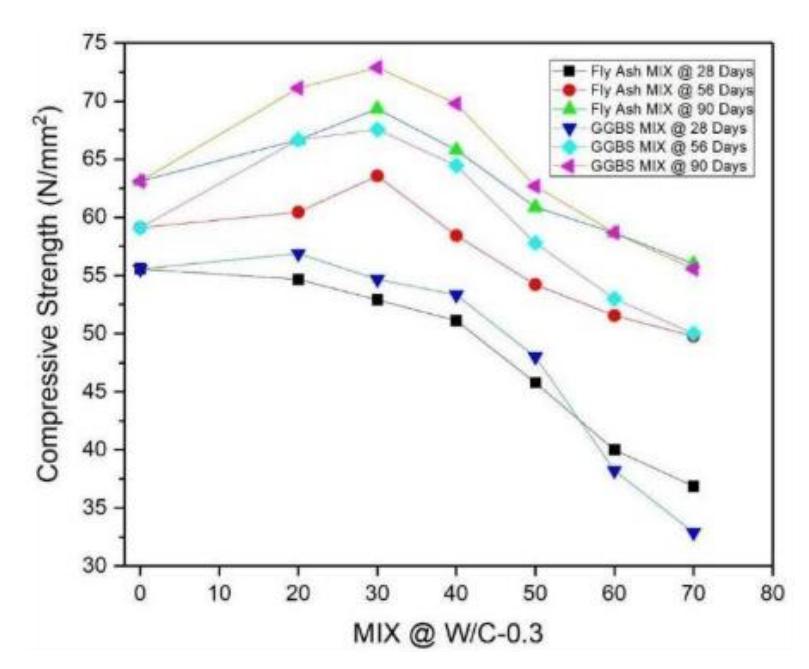
The outcomes of binary cementitious blends containing 0.3 W/B of FA and GGBS
Results of both binary blends of cement concrete with 0.4 W/B ratio of both FA and GGBS
The outcomes of FA and GGBS with a W/B ratio of 0.4 are depicted in Figure 2. The concrete compositions containing FA at a W/B ratio of 0.4 exhibit a noteworthy trend. At 28 days, the mixture with 0% FA replacement exhibits a robust compressive strength of 46.22 MPa, indicating strong early performance. A marginal decline in initial vigor is observed as the proportion of FA replacement rises. The mixture containing 20% FA replacement, for example, possesses a 28 day strength of 44.00 MPa. However, this early strength decline seems to be compensated for as curing progresses. At 56 days, the same 20% FA replacement mixture surpasses its 28-day strength, reaching 54.22 MPa. This trend continues at 90 days, with the 20% FA replacement mixture achieving a 90-day strength of 58.22 MPa.
The observed pattern aligns with increased proportions of FA substitution. For example, the mixture with 70% FA replacement exhibits a 90-day compressive strength of 55.11 MPa, exceeding its 28-day strength of 46.22 MPa. The results for GGBS concrete mixtures at a W/B ratio of 0.4 present a similar trend. At 28 days, the mixture with 20% GGBS replacement demonstrates a strong early compressive strength of 47.11 MPa. As the GGBS replacement percentage increases, there is a reduction in early strength, with the mixture at 70% GGBS replacement showing a 28-day strength of 32.00 MPa. This initial strength decrease is associated with the pozzolanic nature of GGBS, where reactions with calcium hydroxide are time dependent. As with FA, the strength gains are evident as curing periods extend. For example, the 20% GGBS replacement mixture reaches a 56-day strength of 54.67 MPa and a 90-day strength of 60.44 MPa.
Similarly, the 70% GGBS replacement mixture achieves a 90-day compressive strength of 48.56 MPa, surpassing its 28 day strength.
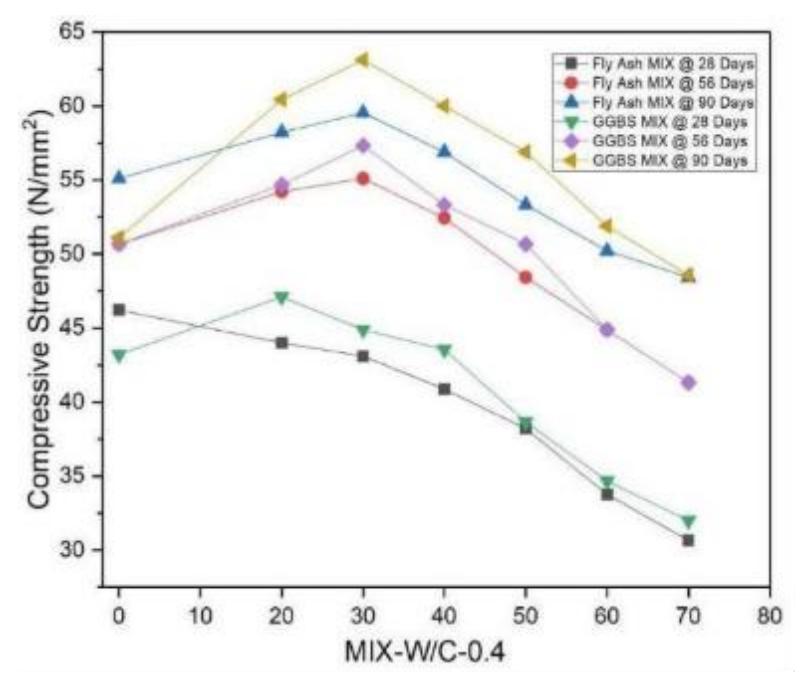
Results of both binary blends of cement concrete with 0.4 W/B ratio of both FA and GGBS
Results of both binary blends of cement concrete with 0.5 W/B ratio of both FA and GGBS
When FA is incorporated at a W/B ratio of 0.5, the data indicates a noteworthy pattern in the compressive strength of the concrete. Figure 3 illustrates the spread of compressive strength of the mix with percentage replacements from 0 to 70. At 0% FA replacement, the 28-day compressive strength is 38.66 MPa, indicating reasonable early strength. But as the proportion of FA replacement rises, an evident decline in early potency becomes apparent. For example, the 20% FA replacement mixture exhibits a 28-day strength of 36.00 MPa, and this trend continues as the replacement percentage increases. At 70% FA replacement, the 28-day strength is 23.11 MPa, the lowest in the series. The initial decline in potency can be ascribed to the protracted pozzolanic reactions that transpire between calcium hydroxide and FA. As the curing process advances, it becomes evident that composites comprising a greater proportion of FA replacement undergo a substantial augmentation in strength. At 56 days, the 20% FA replacement mixture achieves a strength of 42.66 MPa, surpassing its 28-day strength. This pattern continues, with the 70% FA replacement mixture reaching a 56-day strength of 29.33 MPa. At 90 days, the same 20% FA replacement mixture exhibits a remarkable 90 day strength of 46.66 MPa, showing substantial strength development over time.
The results for GGBS concrete mixtures at a W/B ratio of 0.5 also demonstrate a similar pattern, which aligns with the pozzolanic nature of GGBS. At 28 days, the mixture with 20% GGBS replacement exhibits a notable early strength of 40.00 MPa, indicating strong initial performance. However, as the GGBS replacement percentage increases, there is a reduction in early strength, similar to the behaviour observed with FA. As an illustration, the 70% GGBS replacement mixture possesses the lowest 28-day strength in the series at 28.00 MPa. Strength increases with curing time. The 20% GGBS replacement combination reaches 55.56 MPa after 90 days and 44.89 MPa after 56 days. Like 70% GGBS replacement, its strength increases from 28 to 43.44 MPa at 90 days.
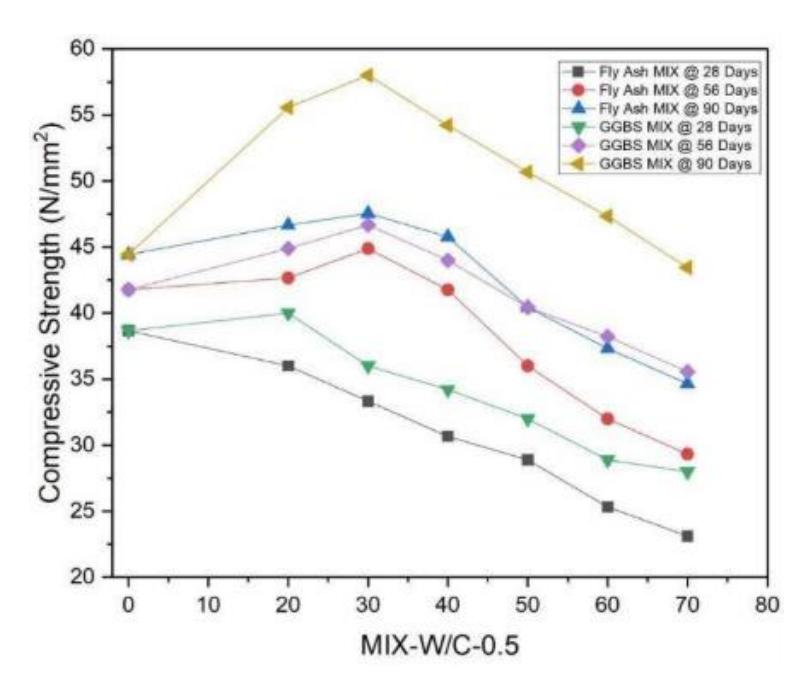
Results of both binary blends of cement concrete with 0.5 W/B ratio of both FA and GGBS
Results of ternary blend of cement concrete fixing 4% SF with 0.3 W/B ratio of both FA and GGBS
FA and GGBS in concrete mixtures with a SF content of 4% and a W/B ratio of 0.3 (Figure 4) provide observations about the effects of these additives on concrete strength. A diminished initial strength is observed in the FA mixtures after 28 days. Substantial strength gains occur as the curative period extends to 56 and 90 days. The 4% SF content increases strength over time.
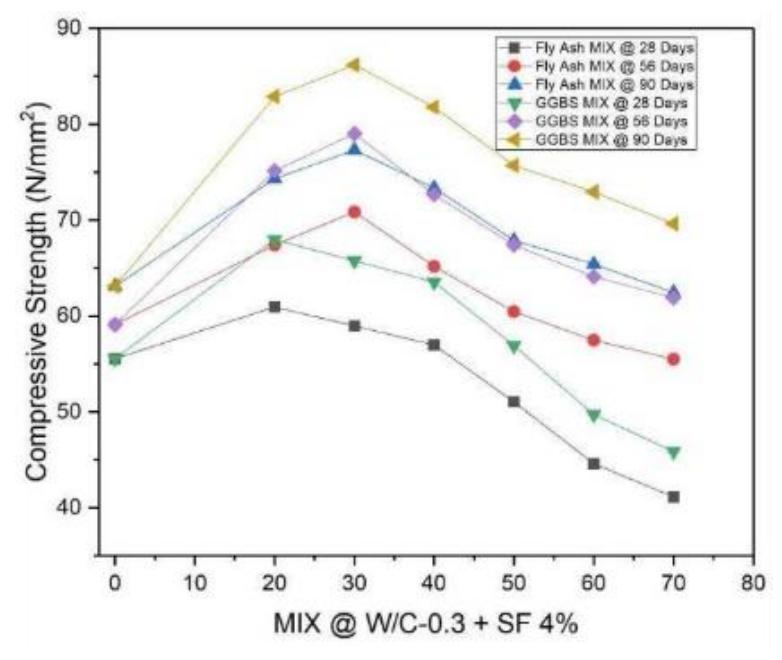
Results of ternary blend of cement concrete fixing 4% SF with 0.3 W/B ratio of both FA and GGBS.
Results of ternary blend of cement concrete fixing 4% SF with 0.4 W/B ratio of both FA and GGBS
Figure 5 shows FA and GGBS concrete with 4% SF and 0.4W/B. At this slightly higher W/B ratio, the early strength growth is greater than with the 0.3 W/B ratio mixes. FA mixes with SF show commendable 28-day strengths, which continue to improve throughout 56 and 90 days of treatment. GGBS compositions with 0.4 W/B also record high initial strengths and maintain them during curing.
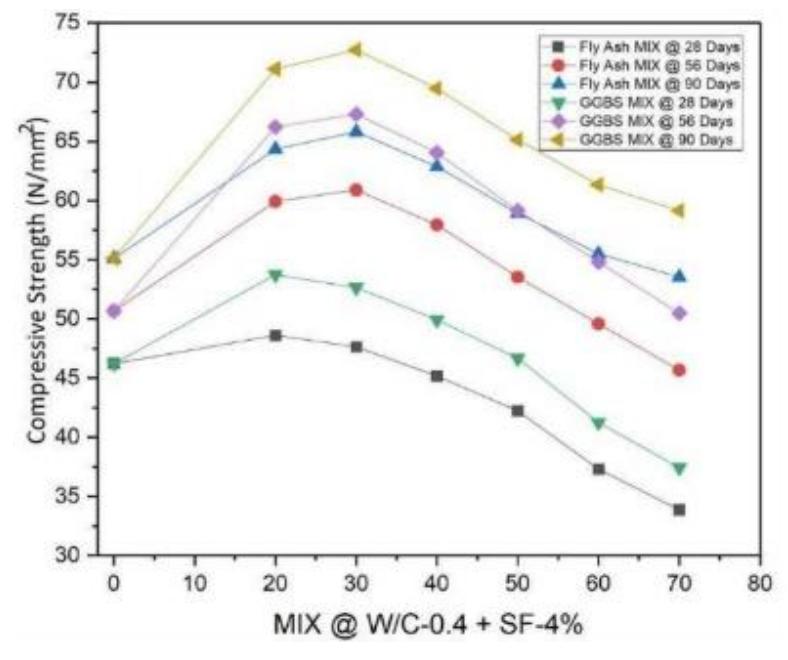
Results of ternary blend of cement concrete fixing 4% SF with 0.4 W/B ratio of both FA and GGBS.
Results of ternary blend of cement concrete fixing 4% SF with 0.5 W/B ratio of both FA and GGBS
Concrete compositions containing FA and GGBS, both with a W/B ratio of 0.5 and a SF level of 4%, demonstrate significant performance trends (Figure 6). FA combinations at this higher W/B ratio show slower early strength improvements compared with 0.4 mixes. However, 28-day strengths are still considerable, and the 56-day and 90-day results confirm long-term strength development. GGBS combinations with 0.5 W/B have slightly lower initial strengths than those with 0.4 W/B, but the strengths after 28, 56, and 90 days show that the 4% SF content improves performance over time.
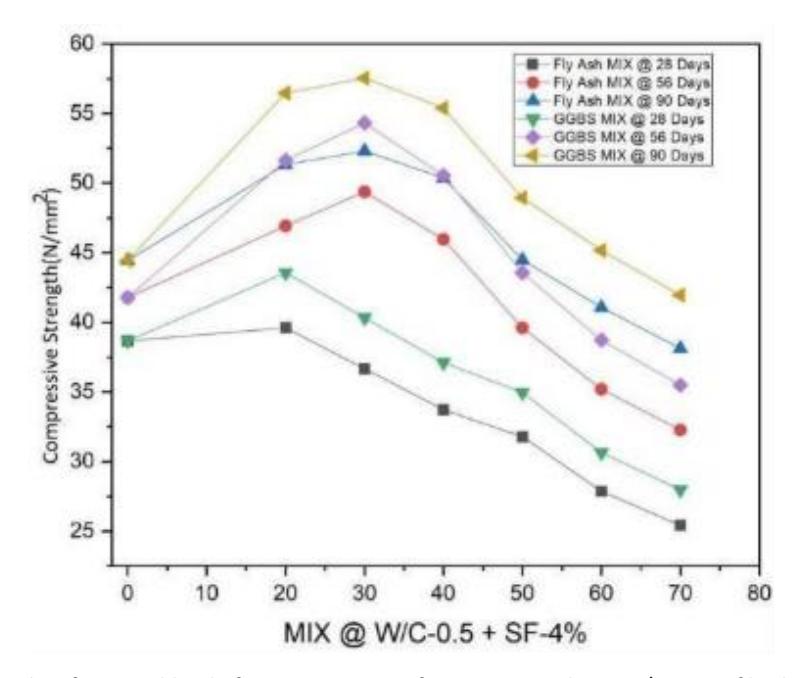
Results of ternary blend of cement concrete fixing 4% SF with 0.5 W/B ratio of both FA and GGBS.
Water Sorptivity Test
Binary and ternary composite concrete with FA and GGBS is tested for its ability to improve concrete's mechanical qualities and durability. These composite concretes' W/B ratios are examined extensively. The impacts of W/B ratios on sorptivity are detailed here, including the effects of adding 4% SF.
Water Sorptivity with W/B ratio 0.3 with FA and GGBS
Over 28, 56, and 90-day curing periods, binary blended concrete mixes with FA and GGBS at varied percentages and W/B ratios show distinct water permeability trends (Figure 7). For the mix without SCMs at a W/B ratio of 0.3, water sorptivity values fall gradually during curing. 20% FA and 20% GGBS reduce water sorptivity values compared with the control. Even at 50% replacement levels, sorptivity continues to decrease. However, at greater SCM percentages (60% and 70%), values increase slightly.
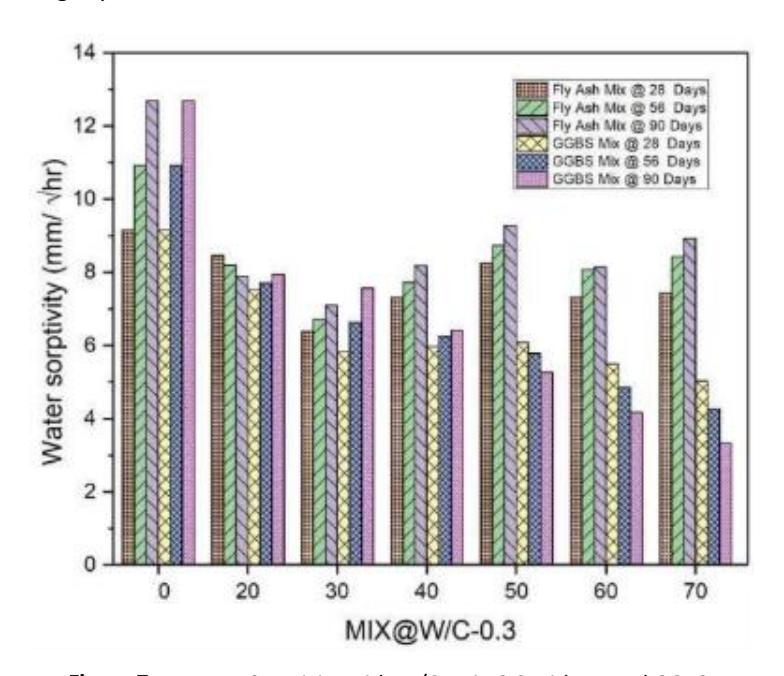
Water Sorptivity with W/C ratio 0.3 with FA and GGBS.
Water Sorptivity with W/B ratio 0.3 with FA and GGBS and 4% SF
FA and GGBS with 4% SF at W/B = 0.3 are shown in Figure 8. Within the FA blend, 4% SF reliably lowers sorptivity values across all curing times. Similarly, GGBS blends with SF record lower sorptivity values across curing periods.
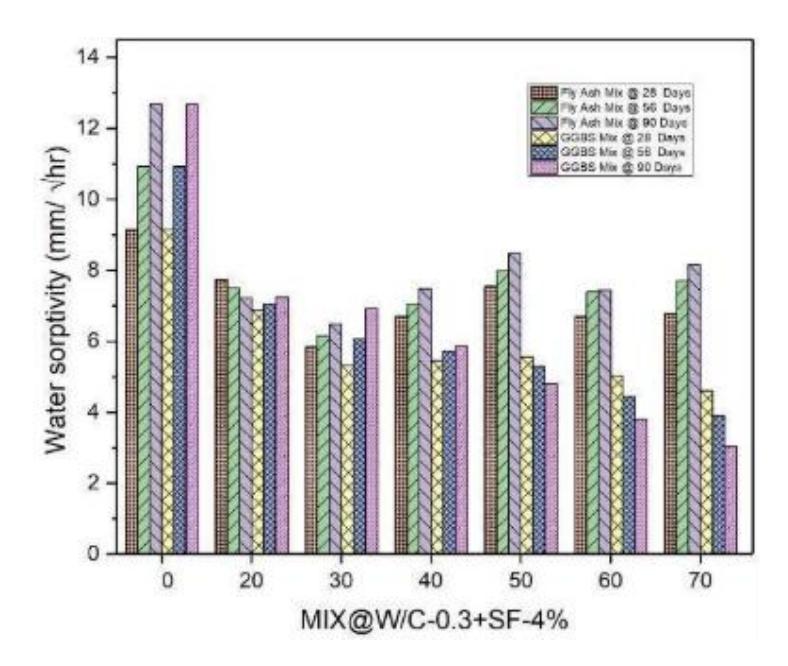
Water Sorptivity with W/C ratio 0.3 with FA and GGBS with 4% SF.
Water Sorptivity with W/B ratio 0.4 with FA and GGBS
Figure 9 displays test results for concrete mixes with FA and GGBS at a W/B ratio of 0.4 and varied curing times. The control mix without SCMs shows a reduction in water sorptivity values from 28 to 90 days. Adding 20% FA and 20% GGBS reduces sorptivity values compared with the control, indicating better durability. FA sometimes records lower sorptivity values than GGBS at the same curing period and SCM percentage.
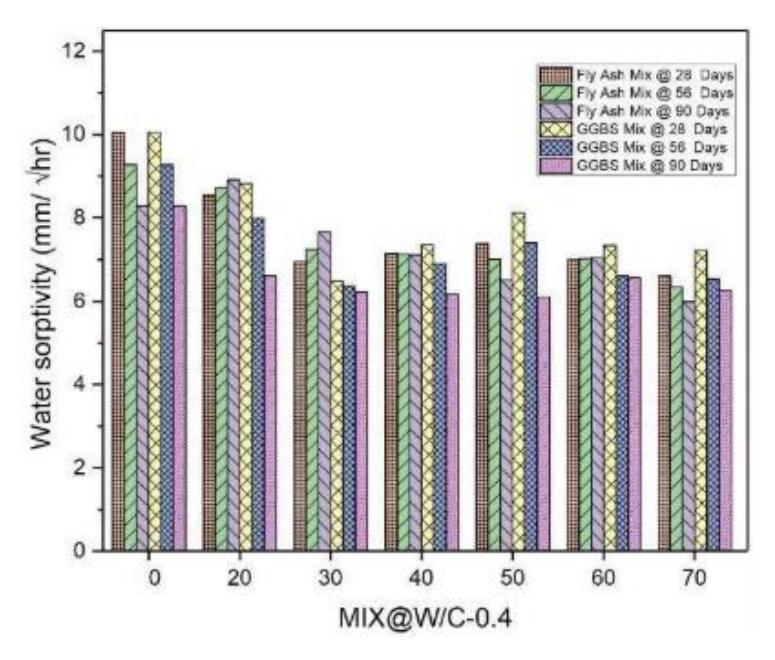
Water Sorptivity with W/C ratio 0.4 with FA and GGBS.
Water Sorptivity with W/B ratio 0.4 with FA and GGBS and 4% SF
Figure 10 shows the sorptivity results for FA + 4% SF and GGBS + 4% SF at a w/b ratio of 0.4 and varying percentages. Sorptivity values decrease significantly compared with the control. As SCM percentages increase, values consistently reduce across all curing durations.
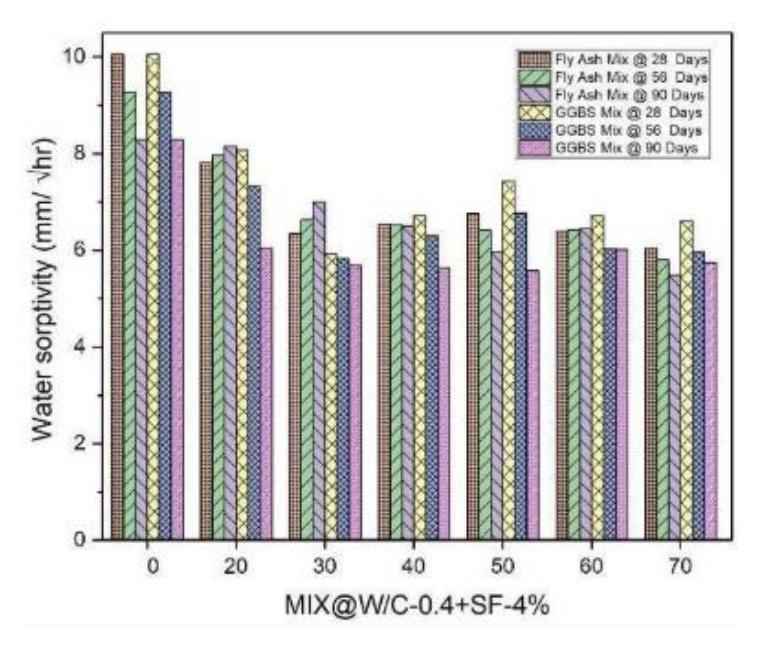
Water Sorptivity with W/C ratio 0.4 with FA and GGBS with 4% SF.
Water Sorptivity with W/B ratio 0.5 with FA and GGBS
The water sorptivity results for concrete mixes with FA and GGBS at a w/b ratio of 0.5 are presented in Figure 11. The control mix shows reductions in sorptivity with curing time, but overall values remain higher than those of lower w/b mixes. FA and GGBS mixes show rising sorptivity values with increasing w/b ratio, reflecting higher porosity.
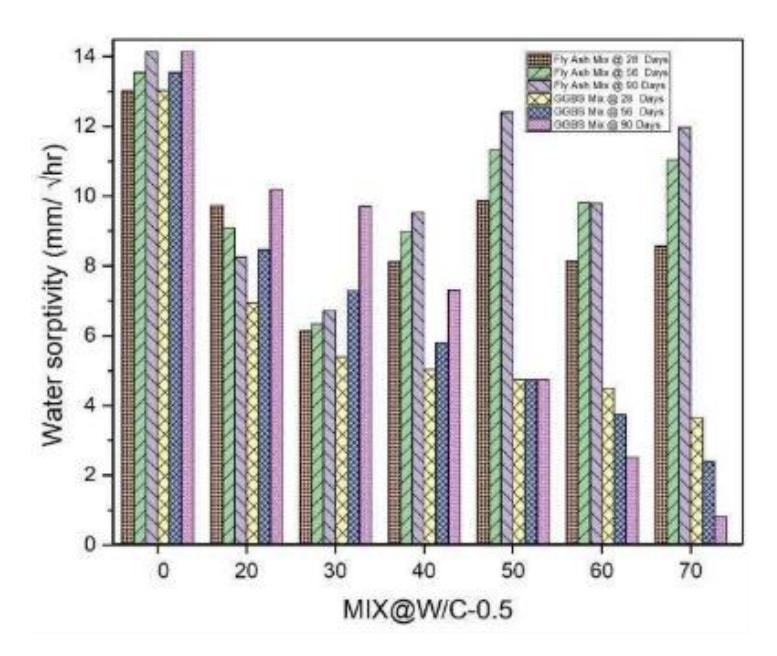
Water Sorptivity with W/C ratio 0.5 with FA and GGBS.
Water Sorptivity with W/B ratio 0.5 with FA and GGBS and 4% SF
Concrete mixes with FA and GGBS plus 4% SF at w/b ratio 0.5 are shown in Figure 12. Sorptivity values are significantly lower compared to the corresponding FA or GGBS mixes without SF.
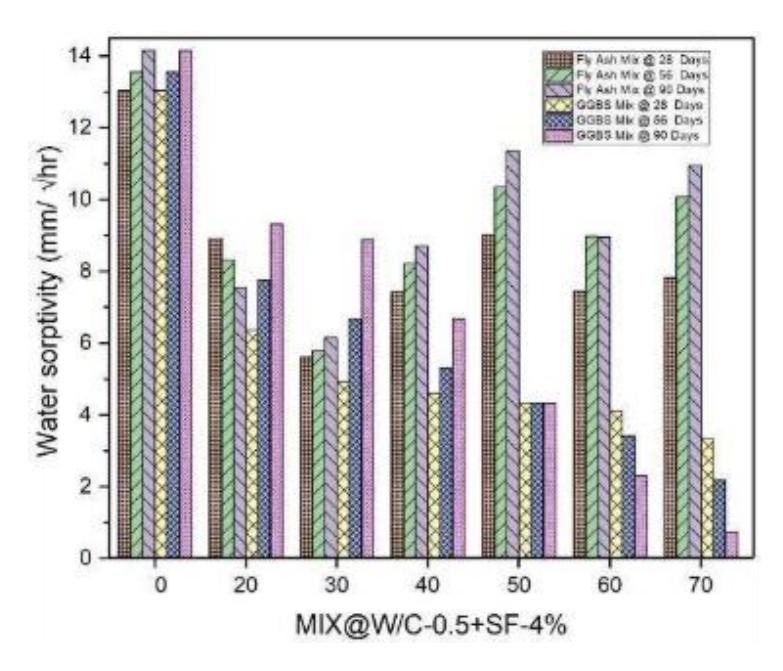
Water Sorptivity with W/C ratio 0.5 with FA and GGBS with 4% SF.
Overall Results
This study reveals the performance of binary and ternary concrete mixtures with FA, GGBS, and SF at different w/b ratios. The compressive strength data show that SCMs generally lower early-age strengths but increase long-term strengths with extended curing. The addition of 4% SF consistently improves strength development across mixes. Water sorptivity results show that lower w/b ratios reduce permeability. The incorporation of FA, GGBS, and SF further decreases sorptivity values, with optimal improvements recorded for mixtures containing both GGBS and SF.
Discussion
Binder Ratio vs Compressive Strength
Binary Cementitious Blends with 0.3 W/B (FA and GGBS)
As shown in Figure 1, the binary blends with a W/B ratio of 0.3 exhibited a clear reduction in compressive strength at 28 days with increasing FA replacement. This reduction can be attributed to the delayed initiation of pozzolanic reactions between FA and calcium hydroxide, which typically progress more slowly in early stages. However, as curing advanced to 56 and 90 days, the compressive strength values not only recovered but in many cases exceeded those of the control mix. The 70% FA replacement mixture, which recorded the lowest strength of 32.89 MPa at 28 days, reached 55.56 MPa at 90 days. This transformation demonstrates the ability of FA to enhance long-term strength development despite initial weaknesses. Such findings reinforce the concept of a trade-off between early strength reduction and longterm durability, which is central to the sustainable application of FA in cementitious systems.
Binary Blends with 0.4 W/B (FA and GGBS)
From Figure 2, it can be observed that mixes incorporating FA at a W/B ratio of 0.4 initially displayed slightly lower strengths compared to the control at 28 days. The 20% FA blend, for example, achieved 44.00 MPa compared to the 0% replacement's 46.22 MPa. However, by 56 and 90 days, the FA blends surpassed their early strengths, reaching 54.22 MPa and 58.22 MPa respectively. This behavior reflects the ongoing pozzolanic activity of FA, which contributes to binder formation and improved matrix densification over time. Similarly, GGBS blends showed an early reduction in compressive strength at higher replacement levels, with the 70% GGBS mixture recording only 32.00 MPa at 28 days. Yet by 90 days, the same mixture increased to 48.56 MPa, while the 20% GGBS blend reached 60.44 MPa. These results highlight the characteristic compromise between early-age performance and long-term gains when using supplementary cementitious materials. The progression from early weakness to later strength emphasizes the importance of curing duration in realizing the benefits of both FA and GGBS.
Binary Blends with 0.5 W/B (FA and GGBS)
The compressive strength results in Figure 3 show that mixtures at a W/B ratio of 0.5 followed a similar but more pronounced pattern. FA blends demonstrated marked reductions in 28-day strength, with the 70% replacement mixture falling to just 23.11 MPa. Nonetheless, by 90 days, this value increased to 43.44 MPa, illustrating significant long-term recovery. For GGBS mixtures, early strengths were higher compared to FA but still displayed reductions at higher replacement levels. The 20% GGBS mixture, for instance, recorded 40.00 MPa at 28 days, but grew to 55.56 MPa at 90 days. The consistent trend of initial weakness followed by long-term improvement reflects the time-dependent pozzolanic and latent hydraulic reactions of these SCMs. The outcomes underline the fact that mixes with higher W/B ratios and greater SCM proportions demand longer curing to achieve desirable performance. They also emphasize the potential of these materials in applications where durability and sustainability are prioritized over rapid early strength.
Ternary Blends with 4% SF
4% SF with 0.3 W/B (FA and GGBS)
As presented in Figure 4, when 4% SF was incorporated alongside FA and GGBS at a W/B ratio of 0.3, the compressive strength behavior revealed important insights. At 28 days, the FA mixtures exhibited reduced initial strength values. This was consistent with the known slower reactivity of FA, which delays strength development. However, significant strength gains were recorded at 56 and 90 days, reflecting the enhanced long-term performance of the ternary blends. The consistent improvement is attributed to the fine particle size and high pozzolanic reactivity of SF, which accelerated the consumption of calcium hydroxide and promoted the formation of additional C–S–H gel. This effect helped densify the matrix and compensate for the slower reactivity of FA. GGBS combinations also benefited from the synergistic role of SF, producing higher strengths at later ages. This demonstrates that ternary mixtures containing SF contribute to both matrix densification and enhanced durability potential, even at lower W/B ratios.
4% SF with 0.4 W/B (FA and GGBS)
From Figure 5, it can be observed that at a W/B ratio of 0.4, ternary blends with SF exhibited commendable strengths at 28 days, which improved further at 56 and 90 days. FA mixtures displayed steady growth across curing durations, showing how SF enhanced the activity of the FA through synergistic pozzolanic reactions. For GGBS blends, the addition of SF boosted the latent hydraulic activity of GGBS by refining the pore structure and accelerating hydration. The effect of SF was evident in the sustained high strengths at later curing stages, which highlighted its value in supporting both immediate and long-term performance. The data confirm that SF effectively enhances the role of both FA and GGBS in ternary systems, enabling mixtures to achieve a balance of strength development and durability at moderate binder ratios.
4% SF with 0.5 W/B (FA and GGBS)
The ternary blends with FA, GGBS, and 4% SF at a W/B ratio of 0.5, as shown in Figure 6, demonstrated moderate 28 day strengths but exhibited clear improvement over curing durations. FA blends with SF displayed delayed early strength but substantial recovery by 90 days. Similarly, GGBS mixtures showed progressive strength development, benefiting from the ongoing contribution of SF to matrix densification. The results underline the role of SF in mitigating the adverse effects of higher W/B ratios. Its ability to refine pore structures and react quickly with calcium hydroxide ensured that even at elevated water content, the blends achieved meaningful strength improvement and durability enhancement. This indicates that SF can be effectively combined with both FA and GGBS at various binder ratios, contributing to sustainable and resilient concrete mixtures.
Water Sorptivity Test
Binary Blends at W/B Ratio 0.3 (FA and GGBS)
As illustrated in Figure 7, the control mix without supplementary materials recorded a gradual decline in water sorptivity values as curing progressed, which reflected improved resistance to moisture ingress. When 20% FA and 20% GGBS were added, water sorptivity values reduced further compared to the control, confirming the beneficial role of these materials in reducing permeability. However, at higher replacement levels of 60% and 70%, sorptivity values began to increase slightly, suggesting a threshold effect. Beyond this level, the pore refinement achieved through pozzolanic
reactions may not fully counterbalance the higher porosity introduced by greater SCM proportions. This highlights the importance of optimizing replacement levels to achieve the best durability outcomes.
Binary Blends with 4% SF at W/B Ratio 0.3
From Figure 8, it can be observed that the addition of 4% SF consistently lowered water sorptivity across all curing ages for both FA and GGBS blends. The fine particle size of SF allowed it to fill voids in the cement matrix, while its rapid pozzolanic activity consumed available calcium hydroxide, leading to greater matrix densification. This synergy between SF and the other SCMs enhanced impermeability, demonstrating how combined use of these materials can substantially improve durability performance. The findings emphasize the effectiveness of ternary blends for applications requiring high resistance to water penetration.
Binary Blends at W/B Ratio 0.4 (FA and GGBS)
As presented in Figure 9, mixtures with a W/B ratio of 0.4 showed a decrease in water sorptivity with curing. Both FA and GGBS replacements improved impermeability compared with the control. Although small differences were noted between FA and GGBS blends at similar replacement levels, both materials demonstrated the ability to refine pore structure and restrict water ingress. These results underline the potential of using SCMs to enhance water resistance in mixes with moderate binder ratios, where durability gains are especially valuable.
Binary Blends with 4% SF at W/B Ratio 0.4
From Figure 10, it is evident that the inclusion of 4% SF further enhanced water resistance in blends with FA and GGBS. Sorptivity values dropped significantly compared with the control, and reductions were consistent across all curing ages. This performance can be attributed to the dual action of SF, which both refined the pore structure through its filler effect and contributed additional cementitious products via pozzolanic reaction. The outcome demonstrates that even at moderate binder ratios, the use of SF in ternary systems produces concrete with superior impermeability.
Binary Blends at W/B Ratio 0.5 (FA and GGBS)
The results shown in Figure 11 indicate that binary blends at a W/B ratio of 0.5 generally displayed higher sorptivity compared with lower binder ratios, which was expected given the greater water content and resulting porosity. Nevertheless, curing reduced sorptivity values over time, highlighting the effect of progressive pozzolanic reactions. FA and GGBS contributed to gradual improvements, but the higher w/b ratio limited the extent of permeability reduction compared to lower ratios. This demonstrates the sensitivity of sorptivity behaviour to water content in mix design.
Binary Blends with 4% SF at W/B Ratio 0.5
As shown in Figure 12, the addition of 4% SF substantially lowered sorptivity values in mixes with a W/B ratio of 0.5, compared with those without SF. This outcome reflects the strong ability of SF to densify the matrix and counteract the negative effects of higher water content. Both FA + SF and GGBS + SF blends recorded marked improvements, demonstrating the synergistic contribution of SF in mitigating permeability issues at elevated w/b ratios. The findings confirm that SF is an effective supplementary material for ensuring durable concrete, even when higher water content is present.
Overall Discussion and Closing Remarks
The study of binary and ternary concrete mixtures incorporating FA, GGBS, and SF has demonstrated clear patterns in both strength development and durability performance. It has been shown that while early compressive strengths may decrease with higher replacement levels of supplementary cementitious materials, significant gains are recorded at later curing ages. These delayed improvements can be attributed to pozzolanic reactions and latent hydraulic activity, which intensify over extended curing durations.
As presented across the different binder ratios, FA and GGBS exhibited the expected compromise between initial performance and long-term durability. The lower early strengths were offset by substantial improvements at 56 and 90 days, reinforcing the importance of adequate curing in the design of sustainable concrete. SF, consistently included at 4%, played a critical role in enhancing matrix densification and accelerating reactivity. Its filler effect, coupled with its high pozzolanic activity, contributed to notable improvements in both compressive strength and impermeability across all binder ratios. Water sorptivity tests further supported the mechanical findings by showing that the inclusion of supplementary cementitious materials reduced permeability, especially when SF was present. At lower w/b ratios, sorptivity values decreased significantly, reflecting dense microstructures with reduced pore connectivity. At higher ratios, SF mitigated the adverse influence of increased porosity, allowing the blends to achieve acceptable durability even under less favorable water contents.
The combined results emphasize the potential of FA, GGBS, and SF in designing durable, eco-friendly concrete mixtures. These materials not only improve long-term performance but also contribute to sustainability by reducing cement demand and utilizing industrial by-products. The balance between early-age performance and later strength development underscores the need for careful mix design and curing considerations. It can therefore be concluded that ternary blends incorporating these supplementary materials provide a viable path toward resilient and environmentally responsible construction practices. By optimizing proportions and ensuring adequate curing, concrete structures can achieve both structural integrity and reduced environmental impact, aligning with global efforts for sustainable development in the construction industry.
Conclusion
This empirical investigation shows how GGBS, concrete performance, and durability are interconnected. Optimization of GGBS in concrete mixtures is supported by empirical evidence, enabling designs that balance structural integrity and sustainability. Sorptivity, slope, water absorption, and porosity indicate concrete durability. Systematic changes show complex relationships between GGBS content and cure time. This study illustrates the intricate link between GGBS incorporation, concrete performance, and durability. Research shows that GGBS incorporation in concrete is beneficial. Designers can balance structural integrity and sustainability. The dataset analyses how GGBS quantities effect concrete properties. The experiment encompasses different GGBS percentages (20%, 30%, 40%, 50%, 60%, 70%), water-to-binder (w/b) ratios (0.3, 0.4, 0.5), and curing periods (28, 56, 90 days). At 28 days, a high GGBS concentration improves compressive strength, hence boosting early-age strength. Compressive strength increases with fly ash at 0.4 and 0.5 w/b ratios. Concrete quality is examined over 28, 56, and 90 days with different fly ash and w/b ratios. Weight, strength at compression, and sorptivity rise with 60% fly ash at 0.3 w/b. More fly ash decreases sorptivity, suggesting durability. Stable 90-day results imply long-term cure. With proper proportions and cure periods, fly ash may reinforce and lengthen concrete. Sorptivity, slope, absorption of water, and permeability indicate concrete durability. Systematic adjustments in these parameters show complex GGBS concentration-curing duration relationships.
According to thorough compressive strength data, fly ash or GGBS in concrete impacts mechanical properties and durability. Fly ash enhances compressive strength best at 60% 0.3 w/b. This requires improving the concrete's weightbearing capacity and performance. Fly ash enhances compressive strength at 0.4 and 0.5 w/b ratios, suggesting a positive relationship with mechanical strength. Increased fly ash decreases sorptivity, strengthening concrete and water resistance. GGBS promotes early-age strength and the integrity of structures via compressive strength. High GGBS concentrationspromoteearly-agecompressivestrengthat28 days. Sorptivity, slope, absorption of water, and porosity indicate concrete durability. Systematic parameter changes show complex connections between GGBS concentration and cure time. This study shows the intricate link between GGBS, concrete performance, and durability. Designing concrete mixtures with the optimum GGBS balances strength and sustainability. The steepness, porousness, and water absorption of concrete determine its durability. These values shift systematically, suggesting complex relationships between GGBS concentration and cure time. This study shows the complex relationship between GGBS incorporation, concrete performance, and durability. Experimental data on GGBS optimization in concrete formulations enhances structural integrity and eco-friendly design. Detailed compressive strength studies reveal that fly ash or GGBS changes concrete's mechanical characteristics and durability. Compressive strength is optimum with 60% 0.3w/b fly ash. Strong, weight-bearing concrete is needed. Mechanically, fly ash strengthens things at 0.4 and 0.5 w/b ratios. Fly ash reduces sorption, strengthening and waterproofing concrete. GGBS' compressive strength makes it stronger and more stable early on. Because sorptivity, slope, water absorption, and porosity change, the GGBS concentration-curing time relationship is difficult to calculate. Correct concrete design is crucial. Real-world data on concrete's interactions with other materials help us improve concrete mixtures for project goals and the environment.
This research shows that ternary blends of fly ash, GGBS, and silica fume can strengthen concrete, especially after long curing. These cementitious components make concrete more durable and water-resistant over time. This makes them an eco-friendlier concrete option. The environment benefits from these mixes' improved construction performance and reduced Portland cement use. The environmental impact of these three-way combinations over time and their efficacy and cost-effectiveness in real-world construction initiatives should be examined using LCA. Certain concrete mixtures may benefit from different curing methods and SCM qualities in different places.
Co-relation of Experimental Results
The relationship between sorptivity and compressive strength in fly ash and GGBS concrete mixtures affects sustainable development, environmental considerations, and life cycle assessment. Reduced water absorption increases durability. Low water-permeability service life is extended by concrete constructions' lower steel reinforcement corrosion rate. Longer lifespans reduce premature repairs and replacements, promoting structural resilience and sustainable growth. The strong correlation between compressive strength and fly ash and GGBS suggests that sustainable concrete compositions can achieve similar or superior mechanical strength. This element helps buildings and infrastructure withstand time and environmental stress. Fly ash and GGBS reduce cement, helping the environment. Carbon dioxide emissions are reduced by using less cement in these sustainable concrete formulae. This reduction supports global efforts to lessen construction's environmental impact and shows how alternative materials might improve green building.
Long-term effects must be considered. The study recommends long curing times for optimal results, which may complicate construction projects. Longer cures and project timelines must be balanced for long-term planning and implementation. To protect the environment, fly ash and GGBS must be mined, treated, and transported appropriately. To maximize their environmental benefits in concrete, these materials must be transported sustainably. The study shows that additional materials reduce emissions and conserve resources. Using less cement reduces carbon dioxide emissions, boosting sustainability. The study employs industrial by-products instead of cement to save resources and lessen environmental effect.
Further Study
The study also suggests in depth investigation of life cycle analysis (LCA), LCA shows these sustainable concrete combinations and environmental benefits. LCA principles were supported by lower embodied carbon, making concrete compositions with added materials greener. Extended curing fits LCA, which assesses a structure's life time environmental impact. Durability and strength improve structure's whole-life performance, making them more sustainable. Finally, fly ash and GGBS concrete combinations, sorptivity and compressive strength correlation implies sustainable, durable, and eco-friendly construction solutions. Optimizing these alternative materials' positive influence on construction requires realizing long-term benefits, addressing logistical challenges, ensuring ethical material procurement, and embracing entire LCA principles.
Compliance with ethics guidelines
The authors declare they have no conflict of interest or financial conflicts to disclose.
This article contains no studies with human or animal subjects performed by authors.