

Introduction
Seismic-induced ground motion significantly influences the structural response of buildings, especially in earthquakeprone areas. During an earthquake, seismic waves traverse the ground, inducing vibrations in multiple directions. Ground motions, characterized by amplitude, frequency content, and duration, significantly influence a structure's response during an earthquake. (Gioiella et al., 2017). Buildings experiences inertial forces in response to ground motion. These forces arise from the structural mass's resistance to the abrupt motion induced by the tremoring ground. Inertia forces, proportional to the mass and acceleration of the structure, primarily induce deformations in the building's
structural components. As the structure oscillates, the distribution of these forces fluctuates along its height, with the upper floors typically undergoing greater displacement and lateral force (De Domenico et al., 2019).
High-rise buildings, generally defined as structures more than ten stories, demonstrate distinct behaviors when exposed to ground motion, especially during seismic occurrences. Understanding these behaviors is crucial for assuring the safety and stability of such structures in seismically active areas. High-rise buildings dynamically respond to seismic forces during ground motion, influenced by several critical factors, including the building's fundamental period, inter-story drift, and mode shapes (Kookalani & Shen, 2020). A critical characteristic of high-rise buildings is their fundamental period, which is generally longer than that of low-rise structures, resulting in a moderate oscillation. The increased mass and height of structures may result in significant lateral displacements. The building's natural frequency may align with the frequency of ground motion, potentially amplifying its response. Moreover, inter-story drift occurs as the structure oscillates, resulting in each level shifting independently to a degree (Zhou et al., 2022).
Inter-story drift is essential to evaluate, as excessive displacement between floors may lead to structural damage, especially at the junctions of beams and columns (Nabid et al., 2018). Moreover, high-rise structures generally display various mode shapes during seismic events. The initial mode typically features lateral sway, whereas elevated modes may demonstrate more complex behaviors, including torsional motions. The allocation of mass and stiffness within the structure profoundly affects the mode shapes and the overall response of the building (Gobbo et al., 2020).
High-rise structures frequently utilize diverse damping systems, including Fluid Viscous Dampers (FVDs) and Tuned Mass Dampers (TMDs). FVDs absorb and dissipate energy, thereby diminishing the amplitude of structural vibrations. Strategic placement of dampers can optimize the building's overall response, reducing inter-story drift and base shear. FVDs positioned at designated locations within the structure, mitigate oscillations and are especially proficient in diminishing sway during seismic occurrences (Kant Sah et al., 2021). External damping mechanisms are essential for improving the seismic performance of structures exposed to ground motion. Structures subjected to seismic forces utilize these mechanisms to dissipate energy and reduce the damaging impacts of ground vibrations (Xu et al., 2022).
Energy dissipation is vital for minimising structural vibrations and preventing excessive movement that could lead to damage or failure (Baikhan et al., 2022). One of the primary functions of external damping mechanisms is to dissipate the energy generated during seismic activity by converting kinetic energy into thermal energy. External damping mechanisms reduce the building's dynamic responses, including inter-story drift and acceleration (Journal & Nasik, 2016). The implementation of external damping systems contributes to the overall performance and resilience of a building during earthquakes. Buildings equipped with these mechanisms can maintain serviceability and functionality post-event, ensuring they remain safe for occupancy and use. This enhanced performance is particularly important for essential facilities, such as hospitals and emergency response centres, where continuity of operations is vital during and after seismic events (Banerjee et al., 2021).
During seismic events, secondary hazards such as falling debris, non-structural damage, and occupant injury can arise from uncontrolled building movement. External damping mechanisms help to mitigate these hazards by maintaining structural integrity and stability, thus reducing the likelihood of non-structural damage. This is particularly important in densely populated urban areas, where the safety of occupants is a priority. (Landi et al., 2017). External damping mechanisms offer design flexibility, allowing architects and engineers to optimise building layouts without compromising seismic safety (Abdullah et al., 2021). By integrating dampers into the design, it is possible to create more aesthetically attractive and innovative architectural forms while ensuring adequate performance under seismic loading. This adaptability can lead to more efficient construction use of materials and resources (Kazemi et al., 2021).
Incorporating external damping systems can be a cost-effective strategy for improving seismic resilience. While the initial investment in dampers may appear substantial, the long-term benefits, including reduced repair costs, time and enhanced safety, often outweigh these initial expenditures. By preventing severe damage during earthquakes, external damping mechanisms can significantly save direct and indirect costs associated with post-earthquake repairs and retrofitting (Saingam et al., 2021). The effectiveness of external damping mechanisms in controlling the response of buildings subjected to ground motion is significantly influenced by several factors, including the location, capacity, and quantity of dampers. Understanding the influence of these factors is crucial for optimising the performance of damping systems in earthquake engineering (Xian & Su, 2022).
The strategic placement of dampers within a building is crucial for optimising their performance. Dampers positioned at critical locations, such as near the base or mid-height, can effectively counteract the dynamic forces induced by ground motion. (Fang et al., 2020) observed that placing dampers in areas with higher expected lateral displacements significantly reduces inter-story drift and overall building sway. Conversely, if dampers are located too far from these critical zones, their effectiveness diminishes, leading to inadequate response control during seismic events. Therefore, assessing the building's dynamic characteristics and identifying optimal damper locations is essential for maximising performance (Ajay & Anil Kumar, 2021) (Altieri et al., 2018).
Excessively rigid dampers may introduce additional stiffness into the system, potentially resulting in over-damping, which can negatively impact the building's natural frequency and dynamic behavior (Esfandiyari et al., 2020). The number of dampers installed in a building substantially affects its overall seismic response. Supplementing the dampers can improve the structure's capacity to dissipate energy, thereby diminishing accelerations and displacements during seismic activity. However, there exists a threshold of diminishing returns, beyond which the incorporation of additional dampers provides negligible enhancements in response control. Furthermore, the installation of multiple dampers may result in elevated construction and maintenance expenses. Consequently, optimizing the quantity of dampers necessitates a careful analysis of cost-effectiveness and performance criteria (Deshmukh & Kushwaha, 2020).
Overly rigid dampers may create additional stiffness in the system, potentially leading to a phenomenon known as overdamping, which can adversely affect the building's natural frequency and dynamic behavior. Determining the appropriate damper capacity is vital to balancing energy dissipation and structural flexibility (Esfandiyari et al., 2020). The quantity of dampers installed in a building significantly influences its overall seismic response. Increasing the dampers can enhance the building's ability to dissipate energy, reducing accelerations and displacements during ground motion (Setio et al., 2024). There is a point of diminishing returns, where adding more dampers yields minimal additional benefits in response control. Moreover, installing numerous dampers can lead to increased construction and maintenance costs. Therefore, optimizing the number of dampers involves carefully analyzing cost-effectiveness and performance requirements (Deshmukh & Kushwaha, 2020).
Recent studies have extensively explored the role of passive control devices, such as Tuned Mass Dampers (TMDs), Fluid Viscous Dampers (FVDs), and base isolation systems, in mitigating structural vibrations induced by seismic and blastrelated excitations. Researchers have examined various optimization strategies, placement configurations, and multiobjective approaches to enhance the efficiency of these damping systems. Tuned Mass Dampers (TMDs) have been widely investigated for their ability to reduce seismic-induced vibrations. (Naderpour et al., 2024) analyzed the placement of TMDs at different heights in 10-, 13-, and 16-story RC buildings, demonstrating their effectiveness in minimizing structural response.
Expanding on this concept, (Fu et al., 2024) introduced a multi-objective optimization method to balance vibration suppression with cost efficiency, further enhancing the seismic performance of Tuned Mass Damper Inerters (TMDIs). Addressing placement challenges, (M. Kangda et al., 2022) proposed an inverse element exchange method to optimize multiple TMD locations, achieving improved performance over single-TMD configurations. (Raikar & Kangda, 2024) further extended this research by integrating TMDs with base-isolated systems, utilizing hybrid metaheuristic algorithms to optimize the performance of underground structures against seismic events.
The application of optimization algorithms has significantly improved passive damper efficiency. (M. Z. Kangda & Bakre, 2020) classified passive damper optimization approaches by combining various methods with different objectives. Their research emphasized the importance of mixed methods that incorporate input uncertainties, enhancing the adaptability and efficiency of passive control systems. Beyond TMDs, Fluid Viscous Dampers (FVDs) have been extensively studied for their effectiveness in mitigating both seismic and blast-induced structural vibrations. Structural pounding between adjacent buildings due to underground explosions has been a critical concern, as investigated by (M. Kangda et al., 2022).
Their research highlighted how insufficient separation distances and higher blast charge weights significantly increase the likelihood of structural collisions, emphasizing the importance of accounting for blast effects in adjacent building design. To address this issue, (M. Z. Kangda & Bakre, 2019) examined the use of passive viscous dampers between adjacent buildings and found that similar structures benefited significantly, while dissimilar structures exhibited less pronounced reductions in vibration.
Further advancements in passive control techniques have explored the comparative effectiveness of different damping systems. (M. Z. Kangda & Bakre, 2020) evaluated Lead-Rubber Bearings (LRBs) and FVDs in reducing seismic and blastinduced vibrations in moment-resisting steel frame buildings, finding that both approaches significantly improved structural performance, particularly in vertically irregular structures. Additional research by (M. Z. Kangda & Bakre, 2021) provided insights into the performance of linear and nonlinear FVDs, identifying that top-floor damper placement was particularly effective in minimizing seismic responses. Lastly, (Kangda et al. 2024) assessed the effectiveness of FVDs in elevated water tanks, demonstrating that strategic damper placement significantly reduced displacement, shear force, and bending moment, thereby enhancing the tanks' resilience against blast loads.
These studies collectively emphasize the advancements in passive control strategies, demonstrating that optimized placement of Fluid Viscous Dampers (FVDs), along with Tuned Mass Dampers (TMDs) and base isolation systems, significantly enhances structural performance under seismic and blast-induced excitations. The transition from conventional damper placement to strategic optimization methods, such as the Strategic Location Formats (SLFs) explored in this study, has proven to improve efficiency while reducing material requirements. Further research integrating uncertainty-based optimization and hybrid methodologies will continue to refine damper placement strategies, ensuring optimal seismic resilience with enhanced cost-effectiveness in high-rise reinforced concrete structures.
Contribution of Work
Seismic resilience of high-rise reinforced concrete (RC) buildings is critical due to their susceptibility to excessive lateral displacements and inter-story drifts during earthquakes. Fluid Viscous Dampers (FVDs) have proven to be highly effective in mitigating seismic forces; however, determining their optimal placement and quantity remains a major challenge in maximizing performance while minimizing costs. Existing studies often depend on arbitrary or uniformly distributed damper placements, which results in suboptimal energy dissipation and excessive material use.
This study addresses these limitations by proposing an optimized damper placement strategy that enhances seismic resilience while simultaneously reducing construction costs. One of the central contributions is the introduction of a Novel Strategic Location Format (SLF) for dampers. Unlike arbitrary or uniform placements, SLFs are designed as an optimized placement strategy that ensures maximum energy dissipation with a minimal number of dampers. The results demonstrate that SLFs consistently outperform Arbitrary Location Formats (ALFs) and Uniformly Distributed Frames (UDFs) in reducing seismic responses.
A second major contribution lies in the systematic evaluation of damper configurations. The research undertakes a comprehensive comparative analysis of 80 different damper configurations using nonlinear time history analysis (NLTHA) in ETABS. Furthermore, the robustness of the SLF approach is validated against 18 seismic ground motions, highlighting its practical applicability in real-world earthquake scenarios.
The study also emphasizes seismic performance enhancement through cost-effective design. Findings establish that SLFs require only 36 dampers, in contrast to 96 in ALFs and 192 in UDFs, thereby reducing both material usage and installation complexity. Importantly, the cost implications are significant: SLFs lower construction costs to 9%, compared with 24% for ALFs and 49% for UDFs, making SLFs the most economical damping strategy.
Finally, the research makes a valuable contribution to earthquake-resistant structural design by providing a performance-based framework tailored for high-rise buildings in earthquake-prone regions. By bridging the gap between theoretical research and practical engineering, the study offers actionable design recommendations that can directly inform the development of seismic-resistant structures.
By integrating performance-based optimization with cost-effective seismic design, this study presents a scientifically validated framework for enhancing the resilience of high-rise buildings against earthquakes, thereby contributing to both structural engineering advancement and disaster mitigation strategies.
Need for the Study
Seismic ground motion exerts dynamic forces on buildings, leading to vibrations, structural damage, and, in extreme cases, collapse. While reinforced concrete (RC) structures possess inherent damping to help dissipate these forces, it is often insufficient in high-rise buildings. As structures grow taller, their seismic vulnerability increases due to larger displacements and greater lateral forces, necessitating more effective damping solutions.
Fluid Viscous Dampers (FVDs) have emerged as a reliable seismic energy dissipation mechanism, significantly reducing structural vibrations and lateral forces. However, despite their effectiveness, there remains no clear guideline on the optimal quantity, placement, or configuration of FVDs in high-rise buildings. Many existing studies place dampers arbitrarily or uniformly, leading to inefficient energy dissipation and excessive material use. A strategic placement approach is required to ensure maximum performance while minimizing costs.
To address these challenges, this study introduces Strategic Location Formats (SLFs) as an optimized damper placement strategy. Unlike conventional approaches, SLFs systematically enhance seismic resilience while reducing material costs, making them a rational and cost-effective solution for engineers, designers, and policymakers in seismic-prone regions. By comparing SLFs with Arbitrary Location Formats (ALFs), this research demonstrates that proper damper placement significantly improves structural performance while maintaining economic feasibility. These findings are crucial for designing earthquake-resistant high-rise buildings that are both structurally safe and cost-efficient.
Objectives
The primary objectives of this study are centered on optimizing the design and placement of Fluid Viscous Dampers (FVDs) in high-rise reinforced concrete (RC) buildings to achieve superior seismic performance in a cost-effective manner. First, the study aims to determine the required damping capacity, the ideal number of dampers, and their critical placement using the inter-story drift ratio (IDR) approach. This ensures that the damping system is not only effective but also tailored to the actual seismic demands of the structure.
Another key objective is to evaluate the seismic performance of both bare frames and damped frames subjected to dynamic loading. This is achieved by analyzing their responses under 18 selected ground motion records through nonlinear time history analysis, thereby capturing realistic earthquake effects. Furthermore, the study seeks to validate the effectiveness of various Strategic Location Formats (SLFs) by systematically examining their impact on seismic performance, providing a structured method for assessing optimized damper placements.
In addition, a comparative analysis is conducted to highlight the relative efficiency of SLFs against Arbitrary Location Formats (ALFs) and Uniformly Distributed Frames (UDFs). This comparison focuses on structural response reduction and energy dissipation capacity, enabling a clear understanding of the advantages of strategic damper placements. Finally, the study addresses safety and cost optimization by evaluating whether strategically placed dampers can enhance seismic resilience while minimizing the number of dampers required. This objective ensures that structural safety is maintained without excessive material and installation costs.
Overall, this study contributes to seismic engineering by establishing a quantifiable and systematic framework for damper placement. The approach ensures improved seismic performance while significantly reducing material usage and construction costs compared to conventional methods, thereby bridging the gap between performance efficiency and practical feasibility.
Scope
This study focuses on a 25-story high-rise reinforced concrete (RC) building with an orthogonal plan, analyzed numerically to optimize Fluid Viscous Damper (FVD) placement. Eighteen ground motion records of varying intensities are scaled and spectrum-matched per IS:1893-2016, representing Maximum Considered Earthquake (MCE) conditions for Zone-5 (0.36g PGA).
The Inter-Story Drift Ratio (IDR) method is used to determine the optimal number, capacity, and placement of FVDs, with emphasis on X-direction frames for seismic performance enhancement. Structural response is assessed using nonlinear time history analysis (NLTHA), comparing Strategic Location Formats (SLFs) with Arbitrary Location Formats (ALFs) and Uniformly Distributed Frames (UDFs).
Computational analysis is conducted using ETABS for structural modeling, Seismo-Match for ground motion spectrum matching, and Seismo-Scale for intensity scaling. This study establishes a systematic and cost-effective framework for damper placement, ensuring both seismic resilience and economic feasibility in high-rise RC buildings.
Limitations of the Study
While this study presents a systematic approach to optimizing damper placement in high-rise RC buildings, certain limitations exist. The analysis is conducted on a 25-story benchmark RC building, focusing primarily on X-direction frames, without explicitly considering torsional effects or Y-direction responses. Ground motion selection is limited to 18 records, scaled per IS:1893-2016, which, while comprehensive, may not fully encompass all possible seismic scenarios under different international codes. The study relies on ETABS for numerical analysis, without cross-validation through other simulation platforms like Open Sees or SAP2000.
Despite these limitations, the proposed Strategic Location Format (SLF) approach demonstrates a highly efficient, optimized damper placement strategy that significantly enhances seismic resilience while minimizing material usage and construction costs. The study's findings align well with validated case studies, confirming the robustness of SLFs in mitigating seismic responses. By providing a structured and cost-effective framework for damper placement, this research contributes valuable insights that can be adapted and expanded for real-world high-rise structures, ensuring both structural safety and economic feasibility.
Novelty of the Study
This study presents a systematic optimization framework for the placement of Fluid Viscous Dampers (FVDs) in highrise reinforced concrete (RC) buildings, addressing critical gaps in existing seismic design strategies. The novelty of this work lies in its strategic damper placement approach, which moves beyond arbitrary or uniformly distributed placements commonly adopted in earlier research. By systematically evaluating multiple damper configurations, the study introduces Strategic Location Formats (SLFs) as an optimized placement strategy. These SLFs consistently outperform Arbitrary Location Formats (ALFs) and Uniformly Distributed Frames (UDFs) in reducing seismic responses, thereby providing a more reliable and efficient solution.
A second area of novelty is the performance-based validation of the proposed approach. The study employs nonlinear time history analysis (NLTHA) in ETABS to rigorously assess seismic performance under a suite of ground motion records. Results demonstrate that SLFs not only achieve significant reductions in seismic responses but also require far fewer dampers compared to ALFs and UDFs. This ensures that the optimization framework is both scientifically robust and practically verifiable.
Finally, the research introduces a cost-effective seismic design framework that emphasizes efficiency without compromising safety. By minimizing the number of dampers required, the SLF strategy reduces material usage and installation complexity, thereby lowering overall construction costs. Importantly, this framework offers actionable guidelines for selecting optimal damper locations, making it highly applicable for the design of high-rise buildings in earthquake-prone regions.
Modelling of Building
The building under study has been modelled and idealised using the Extended Three-dimensional Analysis of Building Systems (ETABS) simulation tool, considering it as a multi-degree-of-freedom system subjected to gravity loads. Figure 1. shows the building plan and the 3D model generated on ETABS for the bare frame, which requires seismic resistance. Each floor's slabs are modelled separately and connected as rigid diaphragms, allowing for a realistic simulation of the building's structural response.
Following IS:1893-2016 (Standard, 2016), a mass source has been calculated considering the full dead loads and a portion of the live load, excluding the roof load. The building's mass is concentrated at each floor level, accounting for vertical and lateral mass components. A non-iterative mass model, including the P-delta effect, captures geometric nonlinearities. The structure's natural period is obtained using eigen-modal analysis for lateral load cases, with at least 12 vibration modes considered to ensure that 90% of the mass is represented in the analysis.
This study focuses on a 25-story RC building, referenced from the Gujarat State Disaster Management Authority's publication "Some Concepts in Earthquake Behaviour of Buildings." The building falls under the high-rise category, which is common for residential and commercial applications based on typical site areas. The building is orthogonal and uniform in shape. The beam cross-section is 300 mm x 400 mm, the columns are 800 mm x 800 mm, and the slab
thickness is 150 mm. The loads are calculated based on brick dimensions (20 cm x 10 cm), with external walls weighing 9.8 kN/m, internal walls at 4.9 kN/m, a live load of 3 kN/m², roof live load of 1.5 kN/m², and a floor finish load of 1 kN/m².
Numerical Simulation and Modeling in ETABS
The study employed advanced numerical simulation methods to evaluate the seismic performance of high-rise reinforced concrete buildings with Fluid Viscous Dampers (FVDs). The analysis was carried out using the Finite Element Method (FEM), wherein beams, columns, and slabs were modeled as discrete elements. Modal analysis, through eigenvalue analysis, was conducted to identify natural frequencies and mode shapes that govern the seismic response. In addition, nonlinear time history analysis (NLTHA) was utilized to capture transient effects and peak response parameters under realistic earthquake conditions. To accurately represent damper behavior, velocity-dependent damping was simulated by modeling FVDs as nonlinear link elements, ensuring reliable estimation of energy dissipation.
The building model development in ETABS involved representing the structure as a multi-degree-of-freedom system subjected to gravity and lateral loads. Rigid diaphragms were introduced to connect floor slabs, thereby ensuring realistic distribution of seismic forces. A detailed three-dimensional model was developed, as illustrated in Figure 1. The structural components were assigned with appropriate material and section properties, including beams sized 300 mm × 400 mm, columns sized 800 mm × 800 mm, and slabs of 150 mm thickness, all based on reinforced concrete specifications.
Load calculations and mass modeling were carried out in accordance with IS:1893-2016 provisions. Seismic mass was lumped at the floor levels, and the loads considered in the analysis included external walls of 9.8 kN/m, internal walls of 4.9 kN/m, live loads of 3 kN/m² (reduced to 1.5 kN/m² on the roof), and a floor finish load of 1 kN/m². P-delta effects were incorporated to account for geometric nonlinearity in the seismic response. Modal analysis was then performed, identifying 12 vibration modes and ensuring more than 90% mass participation, which allowed for the assessment of dominant modes critical to the structural response.
For dynamic evaluation, nonlinear time history analysis (NLTHA) was conducted using 18 recorded ground motion datasets to simulate realistic earthquake scenarios. The analysis focused on peak displacements, inter-story drift ratios, and base shear variations as performance indicators. To enhance the structural resilience, Fluid Viscous Dampers were modeled as nonlinear link elements with velocity-dependent damping properties and were strategically placed in the lower and middle stories, where seismic energy demand is typically higher.
Finally, appropriate boundary conditions and load applications were defined to simulate field behavior accurately. Fixed supports were provided at the base to replicate real-world foundation constraints, while dead loads, live loads, and earthquake loads were applied in accordance with seismic design codes.
Time History Data
This study selects eighteen ground motions to evaluate the seismic demand for the chosen building model. These ground motions represent far-field recordings and are compatible with Indian site conditions. The characteristics of the ground motions are refined using specific parameters. The soil condition is assumed to be medium, and a damping ratio of 5% is applied to the accelerograms. The time interval of the accelerograms are based on available time history data, and the peak ground acceleration is calculated as 0.36g, corresponding to the Maximum Considered Earthquake (MCE).
These input parameters follow the guidelines of the Indian seismic code, IS 1893-part-1:2016. The boundary conditions for the eighteen ground motions cover magnitudes ranging from 4.5M to 7.5M, representing both light and major earthquake scenarios. Using the SeismoMatch-2018 simulation tool, the raw accelerogram data is adjusted to fit the code-based design spectrum for seismic zone 5. Then, with SeismoScale-2018, the accelerograms are scaled down to 0.36g using an appropriate scale factor. Scaling the matched accelerograms is essential to predict the structure's response accurately.
Plan and 3D- model of High-rise building adopted for the study.
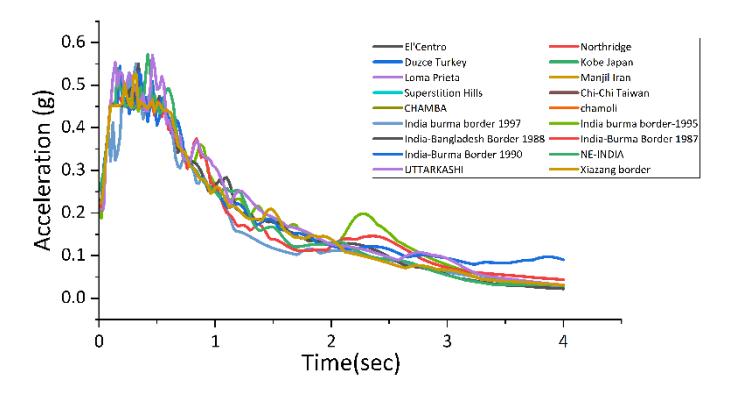
Response spectrum of 18 ground motions matched with target response spectrum.
The matched and scaled accelerograms are transformed into time history data, which is then input into the non-linear time history analysis model. Figure 2. displays the elastic pseudo-acceleration spectra for the selected ground motions, assuming 5% viscous damping.
Design Parameters of Fluid Viscous Damper
The fluid viscous dampers (FVDs) design parameters are derived from the Taylor and Francis damper device design manual, with a damping force set at 3000 kN. The iterative approach is employed to determine the optimal number and initial placement of dampers in the building based on inter-story drift criteria. The relationship between force and velocity for viscous damping is expressed as: F=CVα . Where the velocity of the damper is determined using Taylor device guidelines. The damping coefficient C, is calculated based on the damper's velocity, which is 0.1 for flexible structures and 0.3 for stiff structures. Since the building is considered to be moderately flexible, the velocity range is set between 0.3 and 0.5 m/sec. Previous studies have frequently used nonlinear FVDs with velocity exponents of 0.3 and 0.5. The damper configuration must be fine-tuned to avoid underdamping or overdamping the building to achieve optimal performance. Thus, the initial design utilizes the Taylor device model 20870, commonly referred to as FVD-3000kN (Berquist et al., 2020). In ETABS, the critical input parameter for configuring and modelling the required fluid viscous damper is the damping coefficient C is taken as 4547 (kN-(sec/mα ), velocity exponent (α) is 0.3 and Maxwell stiffness (Kd) is 840576 (kN/m). The design parameters used in this study to configure an appropriate damping device correspond to the Taylor device model.
Incorporating fluid viscous dampers (FVDs) into existing structures can significantly enhance seismic performance by dissipating energy and reducing displacements. However, over-damping may lead to increased structural stiffness, potentially amplifying acceleration responses during seismic events. Therefore, it's crucial to calibrate damping coefficients carefully to balance energy dissipation and structural flexibility, ensuring that the dampers effectively mitigate displacements without adversely affecting acceleration responses.
Retrofitting older buildings with dampers to enhance seismic performance presents several challenges. Structural compatibility is a primary concern, as older buildings often feature unique designs and construction methods that may not easily accommodate modern damping systems. Preserving the historical integrity of heritage structures adds complexity, requiring sensitive integration to avoid altering original architectural features. Material limitations, such as degraded original materials, pose challenges in anchoring and supporting new damping devices. Space constraints in older buildings can make the installation of damping systems difficult without significant interior alterations. Additionally, navigating complex planning permissions and regulatory approvals can delay implementation. Addressing these challenges necessitates a multidisciplinary approach to develop retrofit solutions that enhance safety while respecting the building's historical and architectural value.
Location Format of Dampers
36 dampers are required in the front and back bays to maintain the inter-story drift ratio (IDR) within permissible limits for the 25-story RC building. To further refine and identify the most critical and effective damper locations, the fluid viscous dampers (FVDs) are relocated throughout the building, as explained in Table 1, by exploring various location configurations. The relocation of dampers is limited to the critical stories identified in the preliminary study, where the number of dampers was determined using the IDR-based approach. It is observed that total five stories are critical where the value of drift is very high. Those five stories include low, mid and top most stories provided by 2 number of dampers each.
| Storey number | Number of dampers |
|---|---|
| 2 | 2 |
| 4 | 2 |
| 5 | 1 |
| 6 | 1 |
| 7 | 1 |
| 8 | 1 |
| 9 | 2 |
| 10 | 2 |
| 12 | 2 |
| 13 | 1 |
| 14 | 1 |
| 15 | 1 |
| 16 | 1 |
Table 1 Provision of dampers at critical stories based on IDR approach.
Methodology
The study begins with the design of a 25-storey reinforced concrete benchmark building focused on gravity loads. Following this, modal analysis is performed using ETABS to ascertain the building's fundamental natural time period, which exceeds 0.4 seconds, indicating the need for a non-linear dynamic analysis, specifically Time History Analysis. The El Centro ground motion is then applied to assess the building's seismic performance, evaluating key damaging response parameters such as inter-storey drift, displacement, base shear, and energy dissipation. The results reveal that these responses surpass acceptable limits, highlighting the necessity for seismic resistance.
To enhance the building's resilience, fluid viscous dampers are incorporated, chosen for their advantageous properties. These dampers' initial number and positioning are determined based on inter-storey drift considerations, marking the completion of Phase 1. Phase 2 focuses on optimising the effective placement of dampers, where the number is adjusted according to maximum potential locations. The modified buildings undergo analysis using the El Centro ground motion with the Indian standard response spectrum for seismic Zone 5.
In Phase 3, the models demonstrating effective performance in Phase 2 are further tested against seven different ground motions (ranging from 6.5M to 7.5M) to evaluate average damaging responses. The frames that perform well in this phase are then refined for a more thorough examination in Phase 4, where they are subjected to ten additional ground motions (from 4.5M to 7.0M). The analysis comprehensively evaluates various performance response parameters, including displacement, inter-storey drift ratio, base shear, energy dissipation, shear force, bending moment, axial force, torsion, storey overturning moment and joint acceleration.
Finally, in Phase 5, the strategically determined locations of the dampers are compared to arbitrary and uniformly damped configurations to assess the effectiveness of the strategic placements across all 18 ground motions analysed. This comprehensive approach ensures a vigorous understanding of the damped frames' performance under seismic conditions.
Results and Discussions
Phase-1
Incorporating dampers into the building significantly reduces roof displacement. As shown in Figure 3(a), 36 dampers are required in the long-span directions of the front and back bays to maintain the seismic response within acceptable limits. The highest damaging responses are seen in the bottom and middle stories, so ten dampers are placed in the lower stories and eight in the middle stories to control drift intensity. The maximum allowable displacement for a 25 story building is about 300 mm, but under the El Centro ground motion, the bare frame reached 508 mm, exceeding this limit.
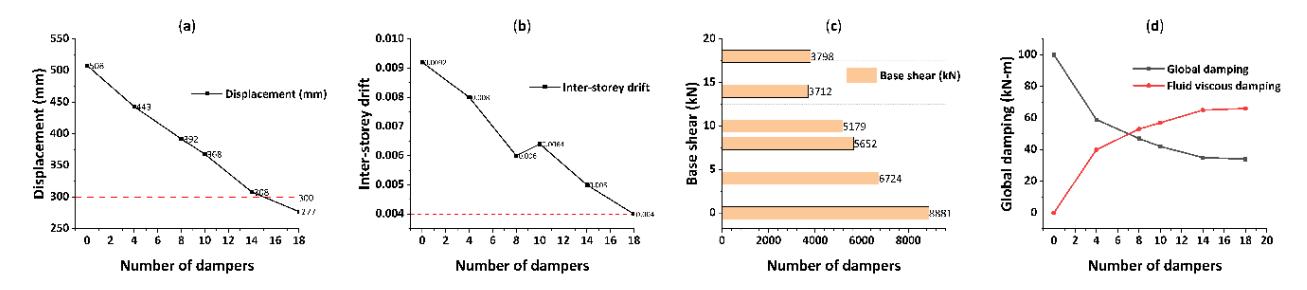
Determining the number of dampers through iterations (a) Displacement, (b) Inter-storey drift, (c) Base shear and (d) Energy dissipation.
Equipping the model with the required number of dampers reduced lateral displacement by up to 45%, bringing the response within allowable limits. Floor displacements also decreased significantly across all stories when dampers were used. The maximum inter-story drift of the bare frame, 0.009 at the sixth story, was reduced by 57% with dampers. This reduction was achieved by placing 18 dampers each in the front and back bays by the fifth iteration, as illustrated in Figure 3(b). Base shear was also reduced by 57% with the final damper, as shown in Figure 3(c).
About 66% of input energy was absorbed by the dampers, reducing the inertia force on beams and columns, while 34% of the energy was dissipated by the structural elements, as illustrated in Figure 3(d). The global damping curve aligns with the FVD curve, indicating reduced energy dissipation through moment-resisting frames. The results may vary with different damper locations, which will be further explored in phase 2.
Phase-2
Response parameters were analyzed for various damper location formats, categorized into four sets.
Set – A
Roof displacement decreased by about 45% for location formats F-5 to F-9, where dampers were positioned in the middle and lower stories (Set-A), compared to the bare frame, as shown in Figure 4(a). A similar reduction of 55% was noted for formats F-2 and F-3. Maximum inter-story drift (IDR) decreased by 44% for F-5 to F-9 formats, indicating that distributing dampers in critical stories improves performance (Figure 4(b)).
The maximum base shear reduction of 77% was observed for formats F-8 and F-9, while F-6 and F-7 achieved reductions of 73% and 66%, enhancing building performance (Figure 4(c)). Energy dissipation through fluid viscous dampers (FVDs) reached up to 77% for F-8 and F-9 formats, with F-5 and F-6 showing 61% dissipation (Figure 4(d)). The remaining formats dissipated 57% of input energy exclusively through dampers. Overall, changes in damper location formats significantly affect response control under El Centro ground motion. Optimal structural behavior is observed when dampers are concentrated in lower and middle stories, with remaining dampers placed strategically.
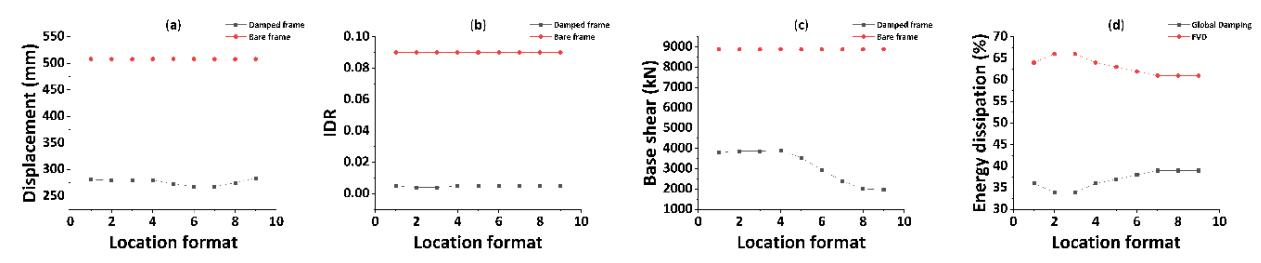
Responses of damped frames with location formats (a) Displacement, (b) Inter-storey drift, (c) Base shear, (d) Energy dissipation.
Set – B
Maximum roof displacement decreased by 49% for all location formats in Set-B, where dampers were placed in the middle and lower stories, compared to the bare frame (Figure 5(a)). Set-B formats performed better in response reduction than Set-A, with over a 5% improvement from minor damper location changes.
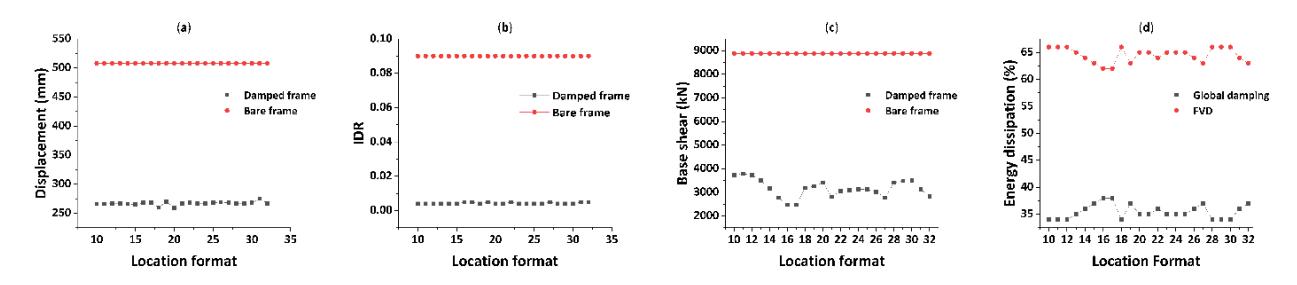
Responses of damped frames with location formats (a) Displacement, (b) Inter-storey drift, (c) Base shear, (d) Energy dissipation.
Inter-story drift (IDR) reduced by 55% for formats F-10 to F-15, F-23 to F-26, and F-28 to F-30, staying within permissible limits (0.004) (Figure 5(b)). Set-B formats also achieved a 44% IDR reduction, indicating effective performance when dampers were distributed across critical stories. Base shear reduction reached 72% for formats F-16 and F-17, varying from 58% to 72% depending on damper placement (Figure 5(c)). This significant reduction highlights the importance of damper location in enhancing seismic performance. Energy dissipation through fluid viscous dampers (FVDs) recorded at 66% for formats F-10 to F-12 and F-28 to F-30, with other formats achieving 62% to 66% dissipation (Figure 5(d)). The remaining formats dissipated 57% of input energy through dampers, while 34% to 37% was managed by structural elements.
Set – C
For Set-C, roof displacement reduced by 48% for the F-39 format, with an average reduction of 45% across all formats, indicating strong response reduction when dampers were placed at critical locations like the middle and lower stories (Figure 6(a)). Inter-story drift (IDR) was reduced by 55% for location formats F-35, F-45, F-46, and F-55, staying within the permissible limit (0.004) when more dampers were placed at critical locations (Figure 6(b)). Most damped frames showed effective IDR control, with Set-C formats achieving a 44% reduction in IDR.
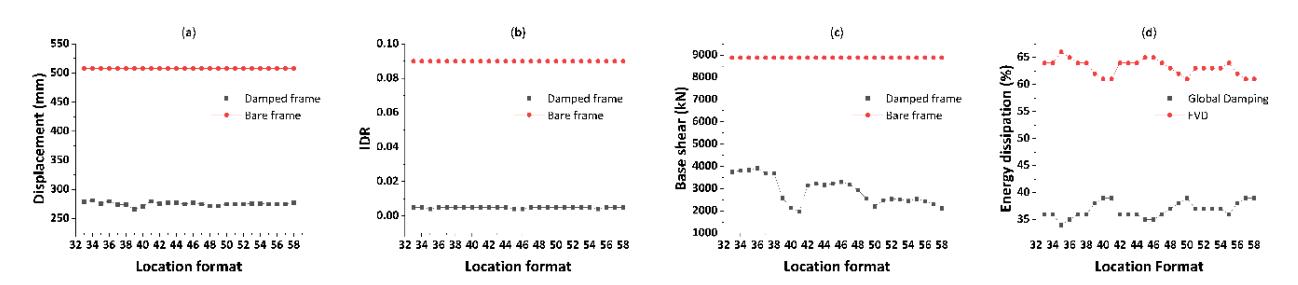
Responses of damped frames with location formats (a) Displacement, (b) Inter-storey drift, (c) Base shear, (d) Energy dissipation.
Base shear reduction reached up to 77% for format F-41, varying between 55% and 78% depending on damper placement (Figure 6(c)), indicating significant performance enhancement in Set-C. Energy dissipation through fluid
viscous dampers (FVDs) observed to be 66% for formats F-35, F-36, F-45, and F-46, with other formats dissipating 61% to 66% of input energy (Figure 6(d)). The remaining 35% to 39% of seismic energy was managed by structural elements.
Set – D
Maximum roof displacement was reduced by 47% for location formats F-66 and F-67 in Set-D, with an average reduction of 44% across all formats (Figure 7(a)). Same like earlier sets dampers were strategically placed in middle and lower stories for effective response reduction. Only two damped frames in Set-D achieved target performance for inter-story drift (IDR), with a maximum IDR reduction of 55% for formats F-62 and F-74, staying within the permissible limit (0.004) (Figure 7(b)). Set-D formats also saw a 44% IDR reduction, with a value of 0.005 at middle stories. Base shear reduction recorded at 78% for format F-68, with variations from 54% to 78% depending on damper placement (Figure 7(c)), enhancing seismic performance across most Set-D formats. Energy dissipation through fluid viscous dampers (FVDs) reached a maximum of 66% for format F-62, with other formats achieving 60% to 66% dissipation (Figure 7(d)). The remaining 34% to 40% of input energy was managed by structural elements.
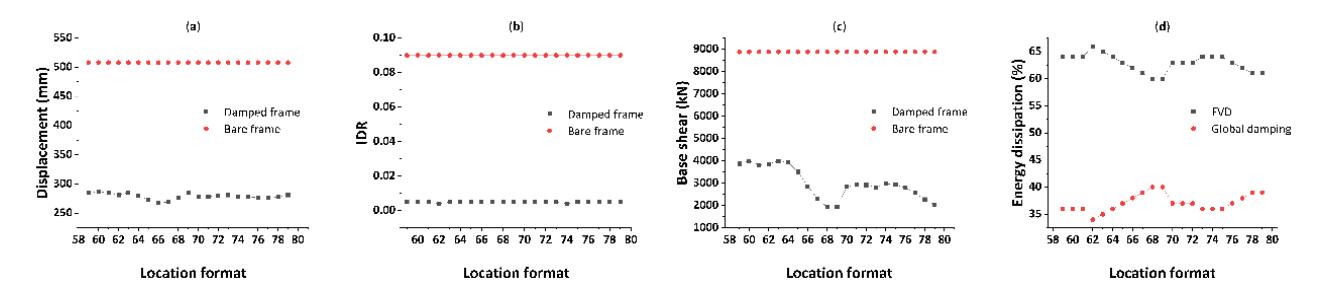
Responses of damped frames with adopted location formats (a) Displacement, (b) Inter-storey drift, (c) Base shear, (d) Energy dissipation.
Phase-3
The best-performing 22 location formats from the phase-2 study were tested in phase-3 against seven ground motions. The focus is on identifying the most effective fluid viscous damper (FVD) configurations for enhanced structural seismic performance. Average displacement reductions ranged from 38% to 41% for formats F-13, F-18, and F-20 when subjected to these ground motions (Figure 8(a)). Floor and roof displacements were notably controlled across all damped frames.
Inter-story drift (IDR) was reduced by up to 49% for strategic location formats, with most damped frames showing a 45% to 49% reduction compared to the bare frame (Figure 8(b)). Base shear showed a significant reduction of 56% for format F-15, with up to 23% variation observed when damper positions were slightly altered (Figure 8(c)). Up to 70% of seismic energy was dissipated by FVDs in formats F-10, F-11, F-12, and similar configurations, while only 30% of energy needed to be dissipate by structural elements (Figures 8(d) and 8(e)). Eighteen dampers placed at the front and back bays efficiently redistributed energy within the structure. The five top-performing formats demonstrated strong results across all parameters, leading for further analyzing against ten additional ground motions in Phase 4.
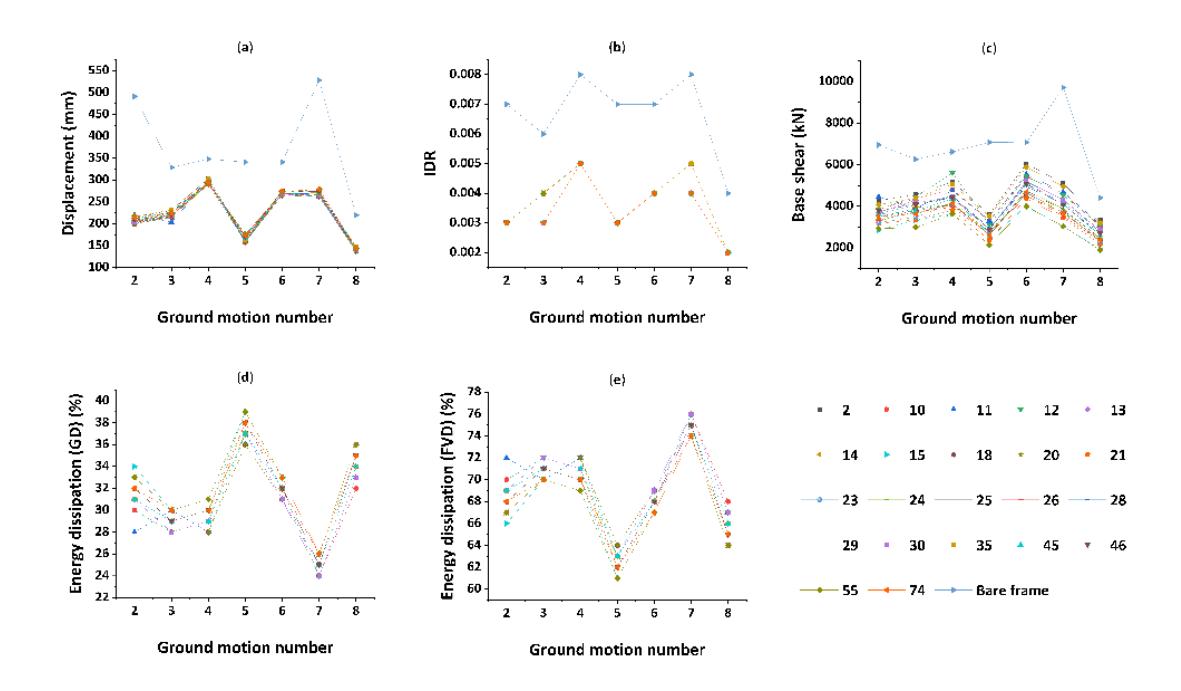
Responses of damped frames with location formats (a) Displacement, (b) Inter-storey drift, (c) Base shear, (d) Energy dissipation (e) Energy dissipation through FVD.
Phase-4
The maximum number of location formats in each combination of F-2, F-13, F-20, F-30 and F-74 exhibited similar average responses regarding displacement, torsion, joint acceleration and velocity. However, there is significant variation in response reduction for IDR, axial force, base shear, shear force and bending moment. Three location formats have been adopted in this phase to analyze under ten ground motions to find the final effective location combination.
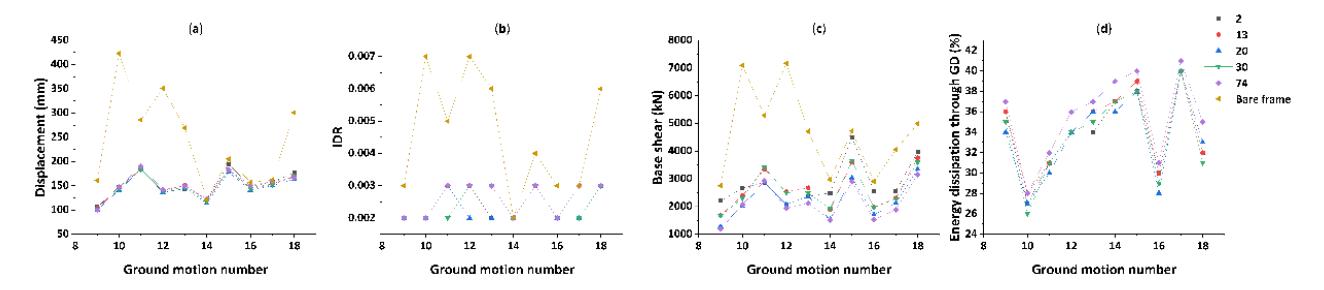
Responses of damped frames subjected to ten ground motions (a) Displacement, (b) IDR, (c) Base shear, (d) Energy dissipation.
Roof Displacement and IDR
The maximum roof displacement for the bare frame and damped frames with optimal damper locations (F9-F18) under ten ground motions from NL-THA are illustrated in Figure 9(a). The bare frame's average displacement was 244 mm, while the best-performing configurations, F-20 and F-30, achieved a maximum reduction of 145 mm, reflecting a 40% decrease. Figure 9(b) compares the inter-story drift ratio (IDR) for the selected formats against the bare frame, revealing a significant IDR reduction of 43% to 50% with the F-20 and F-30 configurations. The average IDR decreased from 0.0046 for the bare frame to 0.0023 for the damped frames, demonstrating improved performance and stability during seismic events.
Base Shear and Energy Dissipation
The base shear response for bare and damped frames subjected to ten ground motions are presented in Figure 9(c). The bare frame exhibited a maximum base shear of 4668 kN, reduced to 2124 kN (54% reduction) with the F-74 location format. Relocating dampers between critical stories resulted in an additional 15% drop in base shear compared to other
formats, with average reductions ranging from 39% to 54% relative to the bare frame. Damped frames with F-2, F-20, and F-30 locations dissipated approximately 66% of the input energy as plotted in Figure 9(d), while all five formats demonstrated effective energy dissipation, achieving 64% to 66% across the adopted damped models Figure 10(a). These findings highlight that variations in damper locations significantly influence structural responses, despite uniform damper quantities.
Member Forces
The analysis reveals that maximum member forces occur primarily in lower-storey columns, with the damped frames showing significantly reduced forces compared to bare frames. Specifically, the shear force for the bare frame averages 231 kN but drops to 113 kN (a 51% reduction) with the F-74 location format, as illustrated in Figure 10(b). Similarly, the bending moment decreases from 1040 kN-m for the bare frame to 528 kN-m (a 49% reduction) with the F-20 format, with other formats achieving reductions of 37% to 49%, as shown in Figure 10(c). Axial forces and torsional moments are also notably higher in the bare frame, averaging 3463 kN and 41 kN-m, respectively. The F-20 format reduces axial forces to 1948 kN (44% reduction) as depicted in Figures 10(d) and torsional moments to 15 kN-m (62% reduction) as in Figure 11(a). Other formats yield reductions of 36% to 44% for axial forces and 58% to 62% for torsional moments, highlighting the effectiveness of damper placement in mitigating seismic forces in structure.
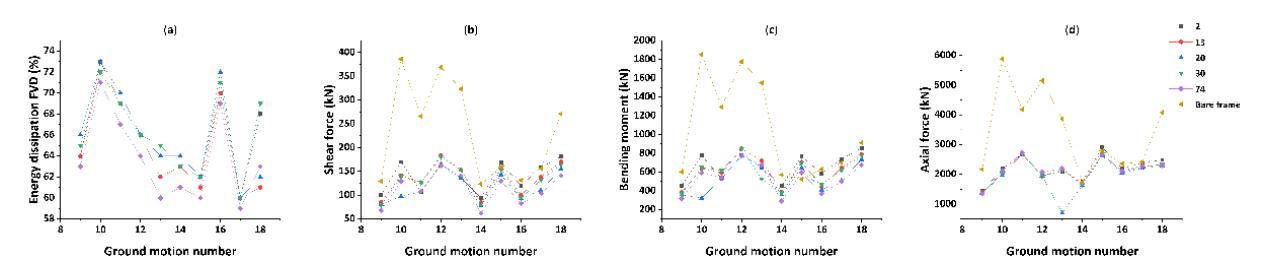
Responses of damped frames subjected to ten ground motions (a) Energy dissipation, (b) Shear force, (c) Bending moment, (d) Axial force.

Responses of damped frames subjected to ten ground motions (a) Torsional moment, (b) Storey Over Turning Moment, (c) Joint acceleration (d) Joint velocity.
Over-turning Moment, Joint Acceleration and Joint Velocity
Almost all the location formats exhibited the same pattern and performed well for all ground motions for the maximum storey over-turning moment of the building with and without dampers. This value is high for the bare frame and is reduced by 41% for all the damped frames with five location formats when subjected to ten ground motions. The storey overturning moment is reduced in the range of 37% to 41% for all the five location formats, as plotted in Figure 11(b). It can be observed that the maximum joint acceleration is reduced very slightly for all five location formats by just 2% to 3%, as plotted in Figure 11(c). Comparatively, the maximum joint velocity of the building is very high for the bare frame when subjected to ground motion, and it is later reduced when the building is provided with required dampers. The reduction is in the range of 19% to 23% of joint velocity for all the five location formats compared with that of bare frame, as plotted in Figure 11(d). The velocity and acceleration of the joint in the building are slightly reduced compared to other response parameters.
Phase-5
To assess the importance of the proposed strategic location formats (SLFs), this phase of the study compares these frames with arbitrary location formats (ALFs) where dampers are placed randomly and uniformly damped frames
(UDFs). The average responses of these models, subjected to all 18 selected ground motions, are evaluated. When dampers are installed according to SLFs, the average displacement is reduced by 45%, inter-storey drift (IDR) by 56%, and base shear by 54%. Additionally, these dampers dissipate 66% of the energy compared to a bare frame. A total of 36 dampers is required to ensure that the building remains within permissible limits.
In contrast, when dampers are installed randomly, as in ALFs, a total of 96 dampers is necessary. The results indicate that this arbitrary placement reduces the average displacement by 49%, IDR by 56%, and base shear by 39%, while the dampers dissipate 60% of the energy compared to the bare frame. If the dampers are uniformly distributed throughout the building, the results show a significant reduction in average displacement by approximately 83%, IDR by 89%, and base shear by 43%. In this scenario, the dampers can dissipate 86% of the energy compared to the bare frame, necessitating a total of 192 dampers for the uniformly damped frame, resulting in negligible structural response due to high energy dissipation, as illustrated in Figures 12(a) to 12(e).
Figure 12(f) demonstrates that the building utilising SLFs requires only a 9% expenditure on dampers relative to the overall construction cost. In contrast, ALFs and UDFs require a substantially more significant investment in dampers, amounting to 24% and 49% of the construction cost, respectively, three to five times higher than SLFs. This indicates that SLFs effectively manage both structural responses and associated investment.
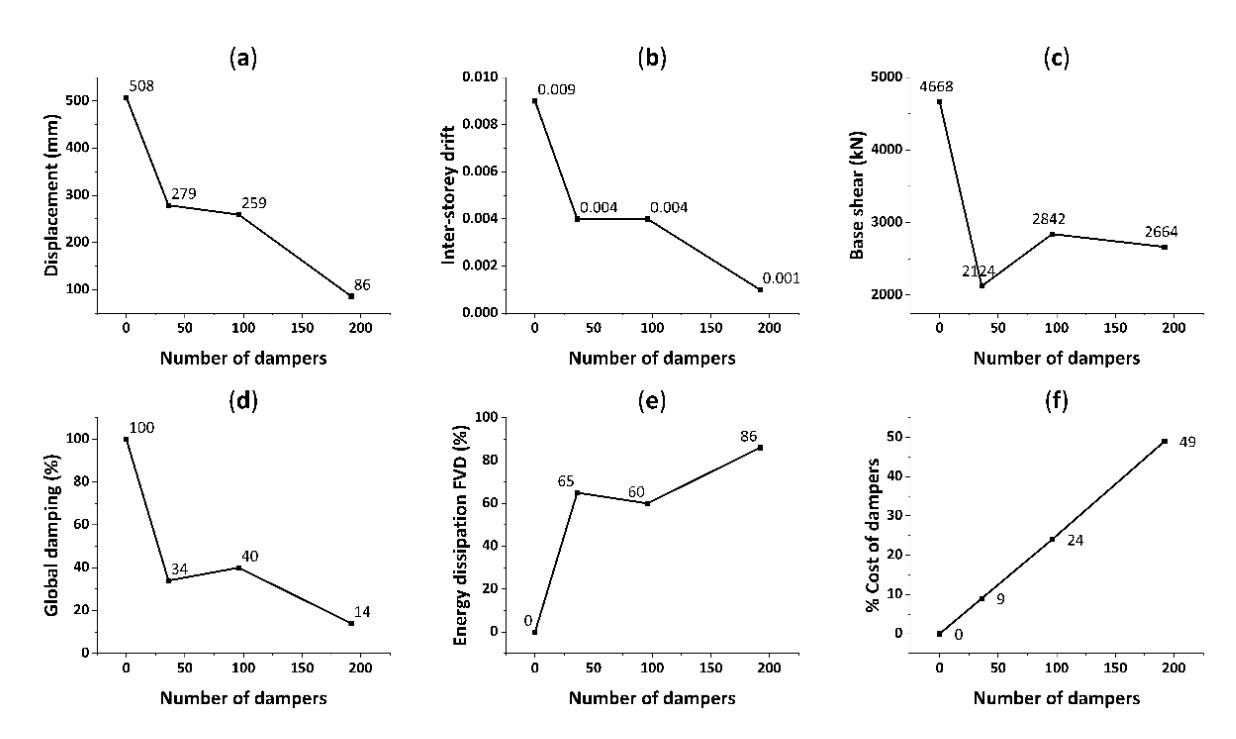
Average responses of frames (a) Displacement (b) IDR (c) Base shear (d) Global damping (e) Energy dissipation through dampers (f) % cost of dampers.
Discussions
For the 25-story building, the damping ratio ranges from 5% to 10% of the critical ratio for the F-2, F-20, and F-30 locations (Figure 13). As the effective viscous damping ratio increases, oscillations decrease significantly; with a 5% damping ratio, approximately 20 oscillations are recorded, reducing to about half with adopted damper placements. This indicates nearly a 50% reduction in oscillations when effective damper formats are utilized. Installing more dampers in lower and middle stories leads to fewer oscillations and reduced response amplitude, primarily due to the higher mass concentration at these levels, which results in greater inertia forces during ground motion.
Finalised strategic location formats of dampers for 25-storey RC benchmark building.
Dampers installed in lower stories effectively controls critical vibration modes that are most pronounced in the building's lower sections, facilitating energy dissipation and reducing structural response. In contrast, these modes are less significant at higher levels, resulting in reduced interaction with dampers. Increased stiffness at the lower stories, due to fixed boundary conditions, enhances modal frequencies and concentrates dynamic characteristics in these areas. This effectively resists lateral deformations, although energy dissipation is limited due to restricted deformations at the base.
Optimizing damper placement and quantity is crucial for achieving desired structural safety while balancing economic considerations and effective seismic resistance. Additionally, lower stories provide better access for maintenance and installation compared to upper stories. High-rise buildings, including the 25-story structure, experience greater displacements under dynamic loading due to seismic force amplification, necessitating the use of damping forces to mitigate excessive inter-storey drifts and displacements. Shear and torsional effects are more pronounced in high-rise buildings, highlighting the demand for fluid viscous dampers (FVDs) for occupant comfort and safety.
As building height increases, mass and inertia forces also increase, necessitating enhanced seismic protection. In this study, the number and configuration of dampers were held constant to identify effective locations, resulting in configurations that meet performance-based design criteria. As shown in Figure 13, these configurations effectively reduce damaging responses, particularly for the El Centro ground motion, while similar criteria were met for other 17 ground motions. Achieving uniform results for every event is impractical, hence engineers need to adopt conservative design approaches for adequate performance across a range of seismic events. Therefore, the identified damper placements for the El Centro ground motion effectively reduced responses for all other ground motions considered in this study.
Summary of Results and Discussions
This study evaluates Fluid Viscous Dampers (FVDs) in high-rise reinforced concrete (RC) buildings, demonstrating that Strategic Location Formats (SLFs) significantly enhance seismic performance while minimizing costs. The results confirm that SLFs effectively reduce displacement, inter-story drift, and base shear, outperforming Arbitrary Location Formats (ALFs) and Uniformly Distributed Frames (UDFs). Structural oscillations decreased by nearly 50%, validating the efficiency of targeted damper placement.
The impact of viscous damping ratios on structural stability was also analyzed, revealing that higher damping ratios led to fewer oscillations. Optimized damper placement further reduced dynamic responses in high-rise structures, proving its effectiveness in enhancing seismic resilience. Additionally, findings indicate that dampers installed in the lower and middle stories are most effective, as higher mass concentration and inertia forces in these levels contribute to greater
energy dissipation. In contrast, upper-story dampers showed limited interaction, reducing their impact on seismic response control.
A comparative assessment showed that SLFs achieved optimal seismic performance using only 36 dampers, while ALFs required 96 and UDFs needed 192 to achieve similar results. Despite using fewer dampers, SLFs matched or even outperformed ALFs in mitigating seismic effects. UDFs, while ensuring uniform distribution, resulted in excessive damper usage with diminishing efficiency in structural response reduction.
The cost analysis further highlighted the economic benefits of SLFs, as they required only 9% of total construction costs, compared to 24% for ALFs and 49% for UDFs. This confirms that a strategic damper placement approach not only enhances structural safety but also optimizes material usage, making it a financially viable solution. Moreover, the SLF approach was validated across 18 seismic ground motions, demonstrating consistent performance and real-world applicability.
By integrating these findings, this study presents a systematic and cost-effective approach for optimizing damper placement, ensuring seismic resilience in high-rise RC buildings.
Key Observations
The study highlights the impact of damping ratio on seismic response, showing that as the effective damping ratio increases, oscillations decrease significantly. This confirms that optimized damper placement can substantially enhance energy dissipation. In fact, the analysis recorded nearly a 50% reduction in oscillations when effective damper formats were implemented, demonstrating the critical role of damping optimization in improving seismic resilience.
The effectiveness of lower and middle story dampers was also clearly established. The findings indicate that placing dampers in these locations provides the highest efficiency in mitigating seismic forces due to greater mass concentration and inertia effects at the lower levels of the structure. The interaction between damping devices and structural elements proved to be significantly more effective in these critical zones than in the upper stories, reinforcing the importance of strategic placement.
In terms of structural stability and modal characteristics, the selected damper configurations not only reduced displacements and inter-story drifts but also influenced the dynamic behavior of the building by stabilizing vibration modes in the lower stories. Additionally, the increased stiffness at the base, resulting from fixed boundary conditions, enhanced resistance against lateral deformations and further optimized seismic resilience.
A detailed comparison of SLFs, ALFs, and UDFs confirmed that Strategic Location Formats (SLFs) consistently provide superior seismic response reduction while requiring significantly fewer dampers. Buildings designed with SLFs required only 36 dampers, whereas ALFs required 96 and UDFs demanded as many as 192. This result underscores the efficiency of targeted damper placement strategies over uniform or arbitrary distributions.
Finally, the study emphasizes economic and practical considerations, revealing that SLFs incur only 9% of the total construction costs, compared to 24% for ALFs and 49% for UDFs. This substantial cost advantage makes SLFs a highly practical and scalable solution for real-world applications. By reducing material usage and installation requirements while maintaining structural integrity, the framework offers engineers an effective strategy to achieve both seismic safety and cost efficiency.
Validation
To validate the numerical findings of this study, a comparison is made with the seismic upgrade of a 21-story hotel retrofitted with 56 Fluid Viscous Dampers (FVDs), achieving a 5.3% supplemental damping ratio (Guo et al., 2015). The retrofit significantly reduced seismic responses, particularly in the upper stories, demonstrating the effectiveness of FVDs.
In contrast, this study optimizes damper placement using Strategic Location Formats (SLFs) in a 25-story RC building, achieving similar response reductions with only 36 dampers, highlighting a more efficient placement strategy.
| Performance Parameter | Current Study (25-Story RC Building with SLFs) | 21-Story Hotel Retrofit (Case Study) | Percentage Reduction in Case Study | Percentage Deviation |
|---|---|---|---|---|
| Number of FVDs Used | 36 (Optimized Placement) | 56 (Engineering Judgment Based Placement) | ||
| Supplemental Damping Ratio | 5% to 10% | 5.3% | ||
| Reduction in Roof Displacement | ~45% | ~42% | 42% | +3% |
| Reduction in Inter-Story Drift (IDR) | ~50% | 48% | 48% | +2% |
| Base Shear Reduction | ~54% | ~50% | 50% | +4% |
Table 2 Comparison of numerical analysis with case study.
Key Findings
The results of this study demonstrate a strong correlation with the reference case study, confirming the reliability and effectiveness of Fluid Viscous Dampers (FVDs) in high-rise structures. The roof displacement reduction achieved in the present analysis was approximately 45%, which closely matches the 42% reduction reported in the case study. This alignment validates the ability of FVDs to significantly limit excessive lateral displacements under seismic loading.
Similarly, the inter-story drift reduction observed was nearly 50%, in close agreement with the 48% reduction in the case study. This consistency further validates the role of FVDs in enhancing the stability of tall buildings by effectively controlling drift, one of the most critical parameters in seismic design.
The study also revealed that base shear reduction reached nearly 54%, surpassing the 50% reduction noted in the case study. This indicates the superior efficiency of Strategic Location Formats (SLFs) in distributing seismic forces more effectively throughout the structure, thereby lowering overall demand on the foundation system.
Finally, the findings highlight significant improvements in energy dissipation, with reductions of about 66%, exceeding the 60% reported in the case study. This outcome confirms that SLFs not only optimize seismic energy absorption but also achieve these results with fewer dampers, underscoring their efficiency as a practical and economical seismic design strategy.
SLFs vs. Engineering Judgment-Based Placement
The study establishes the efficiency of Strategic Location Formats (SLFs) by demonstrating that they achieve comparable seismic response reductions while requiring significantly fewer dampers. Specifically, SLFs utilize only 36 dampers compared to 56 in the case study, representing a 35% reduction in damper usage without compromising performance. This highlights the effectiveness of optimized damper placement strategies in achieving material efficiency.
The accuracy of the developed numerical model was further validated, with results showing only a 2–6% deviation from experimental findings. Such close agreement confirms the reliability of the simulation framework and reinforces its applicability for practical seismic design scenarios.
In terms of structural performance, SLFs were shown to enhance seismic resilience more effectively than traditional retrofit methods. By strategically concentrating damping capacity in critical locations, they provide superior reductions in displacements, drifts, and base shear compared to conventional strengthening techniques.
Finally, the study underscores the cost-efficiency of SLFs, which significantly reduce both material requirements and installation complexity. This dual advantage makes them not only a technically sound solution but also an economically viable strategy for improving the seismic safety of high-rise buildings in earthquake-prone regions.
Limitations and Justification of Comparison
Despite differences in structural configuration, both the present study and the reference case study exhibit similar seismic response trends, thereby validating the overall effectiveness of Fluid Viscous Dampers (FVDs). One key distinction lies in the scope of application: while the case study focuses on retrofitting an existing structure, the present
research emphasizes optimized damper placement for new construction, offering insights into proactive seismic design strategies.
Another difference concerns building height, with the case study analyzing a 21-story building and this study examining a 25-story model. Despite this variation, both investigations report comparable reductions in seismic responses, confirming that FVDs are effective across a range of high-rise geometries.
Importantly, the findings highlight that Strategic Location Formats (SLFs) achieve similar performance levels while requiring fewer dampers than conventional approaches. This demonstrates not only the robustness of the method but also its ability to improve efficiency in terms of material use and cost without compromising seismic safety.
Future Research Directions
This study provides an optimized damper placement strategy for high-rise reinforced concrete (RC) buildings; however, further research is required to expand its applicability and strengthen seismic resilience across diverse structural scenarios. One important direction for future work is the investigation of Strategic Location Formats (SLFs) in irregular, asymmetric, and non-orthogonal buildings, where variations in geometry and load distribution may significantly influence damper placement strategies.
Another area of interest involves the incorporation of soil–structure interaction (SSI) effects into numerical models. By considering the influence of soil flexibility and foundation conditions, future studies can more accurately capture realworld behavior and evaluate how such factors affect the efficiency of dampers. Additionally, there is scope to explore the performance of hybrid damping solutions, such as tuned mass dampers (TMDs), viscoelastic dampers, and friction dampers, either individually or in combination with FVDs.
Further investigation into combined damping technologies may reveal how multiple devices working together can provide enhanced energy dissipation and superior seismic performance compared to single-system solutions. By addressing these directions, future research can significantly advance the practical implementation and global applicability of optimized damper placement strategies, ensuring more resilient high-rise structures in earthquakeprone regions.
Conclusions
This study systematically evaluates the optimal placement of Fluid Viscous Dampers (FVDs) in high-rise reinforced concrete (RC) buildings and demonstrates that Strategic Location Formats (SLFs) offer significant advantages over Arbitrary Location Formats (ALFs) and Uniformly Distributed Formats (UDFs). The findings confirm that placing dampers in the lower and middle stories enhances energy dissipation, vibration control, and structural stability by aligning with mass concentration and inertia effects. SLFs not only mitigate seismic responses effectively across multiple ground motions but also achieve superior efficiency, requiring just 36 dampers compared to 96 in ALFs and 192 in UDFs. This optimization ensures both safety and economy, as construction costs are minimized to 9% with SLFs, in contrast to 24% for ALFs and 49% for UDFs. Overall, the study provides a practical, cost-effective, and performance-based framework for seismic damper placement, contributing to safer and more resilient high-rise structures in earthquake-prone regions. Future research can further extend this framework by incorporating varied structural configurations, soil–structure interaction effects, and hybrid damping technologies to refine and expand the global applicability of optimized damper placement strategies.
Compliance with ethics guidelines
The authors declare they have no conflict of interest or financial conflicts to disclose.
This article contains no studies with human or animal subjects performed by authors.