

Introduction
Polymers are highly compatible with cement-based materials, offering numerous benefits, such as improved flexibility, excellent resistance to acid and alkali corrosion, and the ability to withstand elastic deformation without cracking. Consequently, they have become a widely adopted solution for enhancing the mechanical performance, deformation capacity, and long-term durability of cement-based materials in various construction applications (Ohama 1995; Sakai et al. 1995; Park et al. 2009; Mirza et al. 2002; Assaad 2018). Owing to these advantages, polymers are commonly utilized in the repair and rehabilitation of roads, bridges, reservoirs, dams, and other critical infrastructure, as well as for bonding, facing, and protective coatings for building materials (Shaker et al., 1997; Almeida et al., 2006).
In recent decades, significant research has been devoted to exploring the incorporation of agricultural, industrial, and thermoelectric plant residues as partial substitutes for cement in concrete production (Cheerarot et al., 2011; Cheerarot et al., 2004; Rashad et al. 2014; Shukla et al. 2011). The use of such supplementary cementitious materials not only contributes to resource conservation and waste management but also helps reduce the environmental footprint of the construction industry. The inclusion of various cementitious byproducts, such as condensed silica fume, fly ash, ground granulated blast furnace slag (GGBS), rice husk ash (RHA), palm oil fuel ash, and sugarcane bagasse ash, has played a crucial role in the advancement of high-strength mortar and concrete technologies (Karim et al., 2014; Le et al., 2015; Van Tuan et al., 2011). These industrial and agricultural byproducts, commonly known as pozzolans, possess a unique capability to react with cement or its hydration products, forming additional cementitious compounds that enhance the microstructure and performance of concrete (Chindaprasirt et al. 2014; Jamil et al. 2013). Their addition not only improves the mechanical properties and durability of concrete but also offers significant potential to reduce the overall
production costs and energy consumption associated with cement manufacturing, thereby supporting more sustainable construction practices (Antiohos et al., 2013; Agarwal et al., 2006).
This study aims to investigate the impact of partially replacing cement with Ground Granulated Blast Furnace Slag (GGBS), Fly Ash (FA), and Polyvinyl Alcohol (PVA) solution on the key mechanical and microstructural properties of cement mortar, including compressive strength, tensile strength, flexural strength, hardness, and SEM. This study not only quantified the effect of each material but also examined their combined influence to determine the optimal replacement and dosage levels. While previous studies have explored the individual effects of supplementary cementitious materials or polymer modifiers on mortar performance, limited research has examined the combined influence of GGBS, FA, and PVA in a single mix design. This study uniquely investigates the synergistic impact of these additives on both mechanical and hardness properties, identifying optimal replacement and dosage levels. By integrating microstructural observations with quantitative performance data, this study provides new insights into how moderate PVA addition enhances the benefits of GGBS, offering a practical approach for producing high-strength, crackresistant mortars.
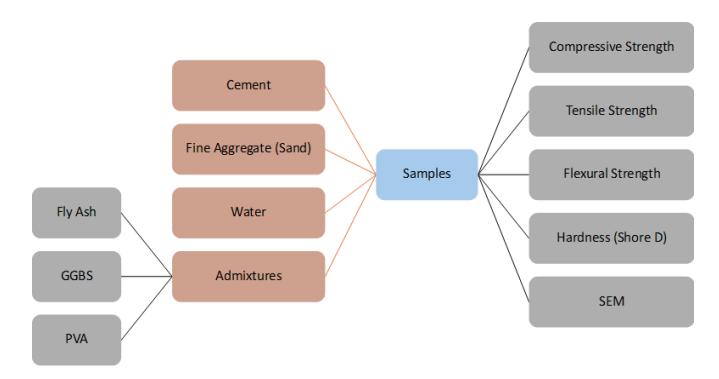
Flowchart of the experimental work.
Materials and Methods
Figure 1 presents a schematic flow diagram summarizing the materials used and tests performed. Ordinary Portland Cement (Type I) conforming to ASTM C150, fly ash meeting ASTM C618 (Class F), and ground granulated blast-furnace slag (GGBS) complying with ASTM C989 (Grade 100) were procured from SIKA Company, Iraq. Their chemical compositions were verified using X-Ray Fluorescence (XRF) analysis at the Materials Construction Laboratory, Mustansiriyah University, as shown in Table 1. The physical properties of these materials are presented in Table 2. Ottawa sand obtained from the Geological Survey in Baghdad, Iraq, was used as a fine aggregate in accordance with ASTM C778, and its grading was confirmed by sieve analysis conducted in the same laboratory, as indicated in Table 3. Polyvinyl alcohol (PVA), a water-soluble thermoplastic polymer with an off-white powdery texture, was sourced from SIKA, Iraq. To prepare the PVA adhesive, 200 g of PVA powder was dissolved in 1000 ml of pure water by heating without boiling and stirring for approximately 30 min (Budavari et al., 1996). The properties of PVA are summarized in Table 4. Tap water was used during the mixing and curing processes. The mix design proportions used in this study are presented in Table 5.
| Chemical Content | Cement | FA | GGBS |
|---|---|---|---|
| SiO2 | 19.1 | 42.3 | 35 |
| Al2O3 | 6 | 27.2 | 10.1 |
| Fe2O3 | 4 | 7.1 | 9 |
| SO3 | 3.4 | 0.87 | 0.1 |
| CaO | 64.1 | 12.8 | 38 |
| K2O | 0.5 | 0.6 | 0.32 |
| Na2O | 0.2 | 0.9 | 0.7 |
| TiO2 | 0.2 | 0.8 | 0.62 |
| MnO | - | - | 0.54 |
| MgO | 1.6 | 6.4 | 5.9 |
| P2O5 | 0.9 | 0.5 | 0.02 |
| Loss on ignition | 3.03 | 1.9 | 0.2 |
Table 1 Chemical composition of FA, GGBS, and cement.
Table 2 Physical properties of FA, GGBS, Cement.
| Physical properties | Cement | FA | GGBS |
|---|---|---|---|
| Color | Grey-light white | Grey | Off-white |
| Nature of material | powder | powder | powder |
| Specific Surface Area m2/kg | 360 | 610 | 418 |
| Specific gravity g/cm3 | 3.12 | 2.39 | 2.9 |
| The moisture content % | 3.3 | 0.81 | 0.1 |
Table 3 Sand sieving.
| Sieve Size (U.S. Standard No.) | Sieve Opening (µm) | Individual Percent Retained (%) | Cumulative Percent Retained (%) | Cumulative Percent Passing (%) |
|---|---|---|---|---|
| No. 16 | 1180 | 0 | 0 | 100 |
| No. 20 | 850 | 1.5 | 1.5 | 98.5 |
| No. 30 | 600 | 3 | 4.5 | 95.5 |
| No. 40 | 425 | 28 | 32.5 | 67.5 |
| No. 50 | 300 | 38 | 70.5 | 29.5 |
| No. 100 | 150 | 25 | 95.5 | 4.5 |
| Pan | - | 4.5 | 100 | 0 |
Table 4 PVA properties.
| Properties | Results |
|---|---|
| Grade | 27 - 96 |
| Volatile matter % | 5 |
| pH | 7-May |
| Sodium acetate % | 1 |
| Hydrolysis mol% | 95.5 - 96.5 |
| Viscosity (4%, 20ºC) mPa·s | 24.0 - 30.0 |
| Purity % | 94 |
Table 5 Mix design.
| Mix | OPC g | Sand g | Water g | FA g | GGBS g | PVA g |
|---|---|---|---|---|---|---|
| Ref | 1000 | 3000 | 500 | 0 | 0 | 0 |
| F15 | 850 | 3000 | 500 | 150 | 0 | 0 |
| F20 | 800 | 3000 | 500 | 200 | 0 | 0 |
| F25 | 750 | 3000 | 500 | 250 | 0 | 0 |
| F30 | 700 | 3000 | 500 | 300 | 0 | 0 |
| G15 | 650 | 3000 | 500 | 200 | 150 | 0 |
| G20 | 600 | 3000 | 500 | 200 | 200 | 0 |
| G25 | 550 | 3000 | 500 | 200 | 250 | 0 |
| G30 | 500 | 3000 | 500 | 200 | 300 | 0 |
| P1 | 550 | 3000 | 500 | 200 | 250 | 10 |
| P2 | 550 | 3000 | 500 | 200 | 250 | 20 |
| P3 | 550 | 3000 | 500 | 200 | 250 | 30 |
| P4 | 550 | 3000 | 500 | 200 | 250 | 40 |
The compressive strength of the hydraulic cement mortars was tested at both 7 and 28 days according to ASTM C109/C109M-05, using 50 mm cube specimens in a 300 KN universal compressive machine. The tensile strength was evaluated at 28 d following ASTM C190, with a briquette-shaped sample subjected to tensile force until fracture, and the strength was calculated by dividing the maximum load by the cross-sectional area. The flexural strength was also tested at 28 days in accordance with ASTM C348-08, using a prism (40 mm × 40 mm × 160 mm) placed on two supports and loaded at the center. Hardness was measured at 28 days using a Quality Hardness tester in accordance with ASTM D2240-03, taking seven readings from the sides of the cube and using Shore D hardness. Microstructural evaluation was performed using Scanning Electron Microscopy (SEM) to correlate the observed morphology with the mechanical performance. The tests were conducted at the Engineering College of Mustansiriyah University.
Results
The compressive strength results (Shown in Table 6 and in Figure 2) demonstrated that the inclusion of FA, GGBS, and PVA noticeably affected the mortar performance. Over 28 days, the reference mix reached 27.43 MPa, whereas FA
replacement improved strength up to 20% FA (30.02 MPa) before slightly declining at higher levels. In comparison, the GGBS mortars achieved superior performance, with G25 recording the highest compressive strength of 34.12 MPa. The PVA-modified mixes outperformed both the FA and GGBS series, with P1 (10 g PVA) achieving 36.76 MPa, representing a 34% increase over the reference, although excessive PVA (P4:34.65 MPa) resulted in a slight reduction in strength.
| Average Compressive | Average Tensile | Average Flexural | The Shore D | ||
|---|---|---|---|---|---|
| Mix | Strength | Strength | Strength | Hardness | |
| 7 days | 28 days | 28 days | 28 days | 28 days | |
| Ref | 18.24 | 27.43 | 1.47 | 3.21 | 92.72 |
| F15 | 21.26 | 29.12 | 1.69 | 3.41 | 93.21 |
| F20 | 21.52 | 30.02 | 1.72 | 3.49 | 93.42 |
| F25 | 21.32 | 29.52 | 1.73 | 3.51 | 93.53 |
| F30 | 21.13 | 29.15 | 1.73 | 3.52 | 93.61 |
| G15 | 22.41 | 31.73 | 1.97 | 3.92 | 93.85 |
| G20 | 23.96 | 32.62 | 2.09 | 4.37 | 93.92 |
| G25 | 26.12 | 34.12 | 2.24 | 4.55 | 94 |
| G30 | 25.68 | 33.89 | 2.26 | 4.57 | 94.11 |
| P1 | 27.76 | 36.76 | 2.76 | 5.43 | 93.73 |
| P2 | 27.54 | 35.89 | 2.68 | 5.26 | 93.45 |
| P3 | 26.43 | 35.21 | 2.57 | 5.07 | 93.26 |
| P4 | 25.34 | 34.65 | 2.52 | 4.81 | 93.01 |
Table 6 Average test results.
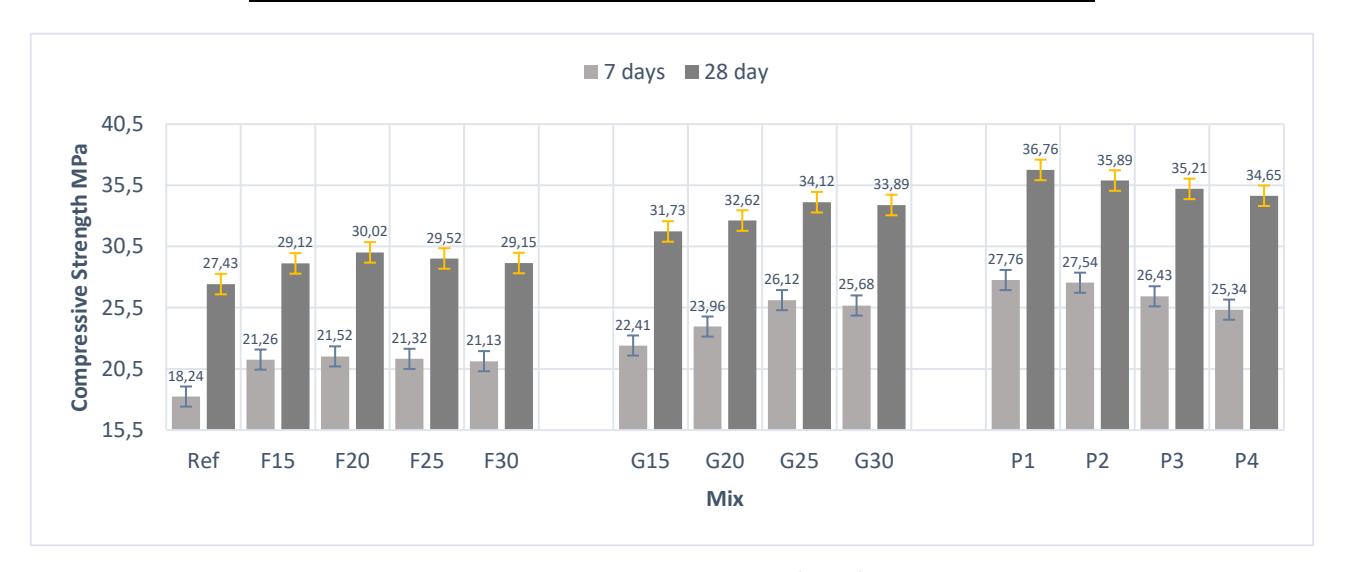
Average compressive strength results.
For the tensile strength results shown in Table 6 and Figure 3, GGBS-based mortars surpassed FA mortars, with G30 reaching 2.26 MPa compared to 1.73 MPa for F30, whereas P1 achieved the maximum value of 2.76 MPa. A similar trend was observed in the flexural strength (as shown in Table 6 and Figure 4), where P1 again outperformed all other mixes with 5.43 MPa, followed by G25 at 4.55 MPa and F25 at 3.51 MPa.
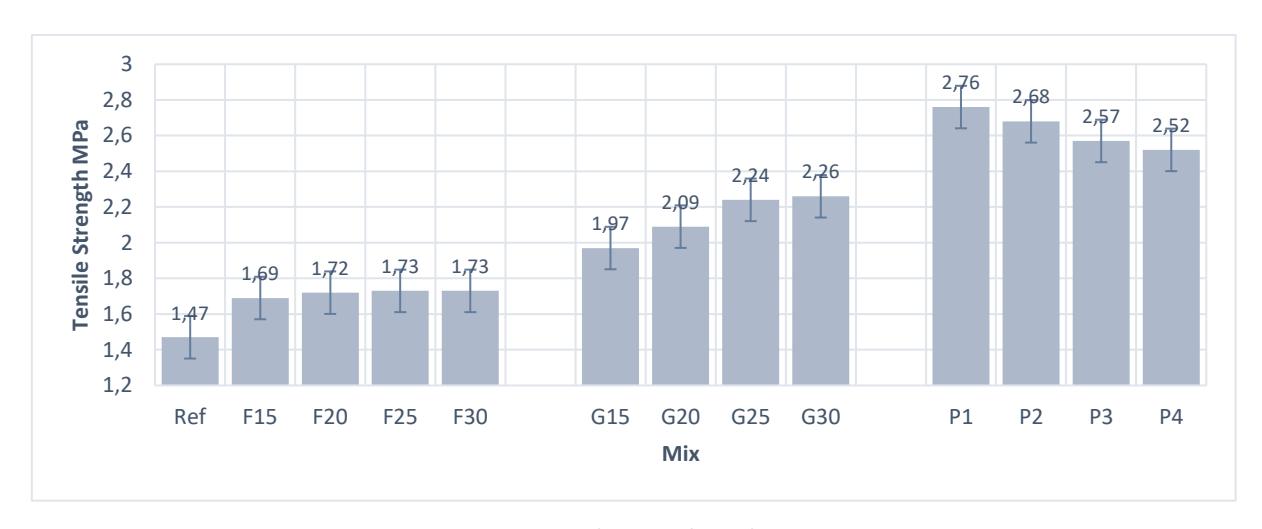
Tensile strength results.
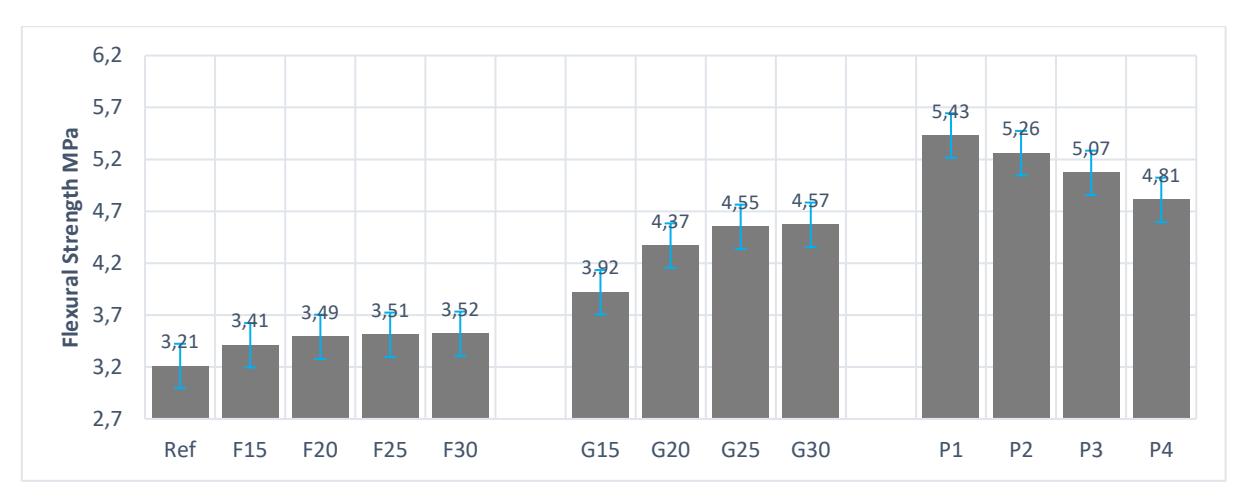
Flexural strength results.
The hardness values, as shown in Table 6 and Figure 5, also improved across all modified mortars, with the reference recording 92.72 and the highest values observed for G30 (94.11) and P1 (93.73), while excessive PVA slightly reduced the hardness to 93.01 in P4.
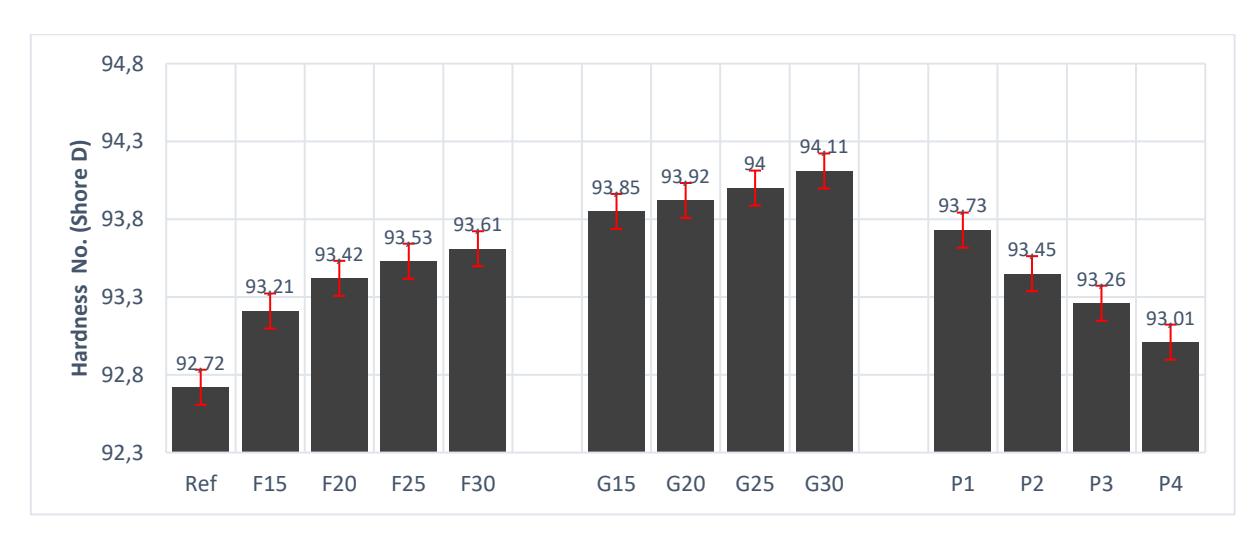
The hardness (Shore D) test results.
SEM imaging (Figure 6) further confirmed these results, with the reference sample showing many voids and low density, while P1 exhibited a denser and smoother microstructure with fewer voids. In contrast, P4 exhibited voids and needlelike CH crystals, indicating reduced structural compactness.
SEM Image Results (a) Reference Sample, (b) P1 Mixture, (c) P4 Mixture.
Discussion
Figure 2 and Table 6 present the average compressive strength values obtained from three specimens of the different mortar series, showing that partial replacement of cement with 15–30% fly ash (FA) (F-series) generally improved the 28-day strength compared to the reference mix (Ref: 27.43 MPa), with an observed optimum at 20% FA (F20:30.02 MPa) before a slight decline at 30% (F30:29.15 MPa). This aligns with studies indicating FA's long-term pozzolanic benefits of FA, but the potential for reduced early strength due to slower hydration (Shubbar et al., 2019; Agnihotri et al., 2022). In contrast, ground granulated blast furnace slag (GGBS) replacements (G-Series) at 15–30% significantly outperformed the FA mixes, with 25% GGBS (G25:34.12 MPa) achieving the highest 28-day strength. This is attributed to GGBS's calcium-rich composition of GGBS, which promotes faster hydration and a denser microstructure with enhanced C-S-H gel formation (Agnihotri et al., 2022; Mohammed Zidan Sameer et al., 2024). Furthermore, the incorporation of PVA (Pseries) led to an additional increase in compressive strength, with P1 demonstrating a notable 34% improvement over the Ref mix by achieving 36.76 MPa, primarily because of PVA's ability to bridge microcracks and improve load distribution. However, excessive PVA content, as seen in P4 (34.65 MPa), resulted in reduced strength consistent with findings on polymer overloading negatively impacting cement hydration (Fan et al., 2019).
Figure 3 and Table 6 present the average tensile strength results obtained from three specimens, indicating that GGBS mixes exhibited superior tensile strength, with G30 reaching 2.26 MPa compared to 1.73 MPa for F30 (FA-based mortar) and 1.47 MPa for the reference mix. This is attributed to the high calcium oxide content in GGBS, which promotes stronger interfacial bonding between the aggregates and the matrix (Ahmed et al., 2023; Ahmed et al., 2022). Furthermore, PVA-modified mortars demonstrated the highest tensile strength, with P1 achieving 2.76 MPa, because PVA effectively restricts crack propagation through its elastic deformation properties (Fan et al., 2019; Abbas et al. 2020; Abbas et al. 2018).
Figure 4 and Table 6 presents the average flexural strength values obtained from three specimens, showing a similar trend in strength development, with the PVA-modified mortar P1 achieving the highest value at 5.43 MPa, significantly outperforming G25 (4.55 MPa) and F25 (3.51 MPa); this superior performance is attributed to the ductility provided by PVA's polymer network, which enhances energy absorption under bending stresses, a characteristic well-documented in studies on polymer-modified mortars (Agnihotri et al., 2022; Fan et al., 2019; Abbas et al. 2020).
Figure 5 and Table 6 presents the average shore D hardness results obtained from three specimens, revealing that all modified mortars exhibited higher hardness values compared to the reference mix (92.72), with peak values observed for G30 (94.11) and P1 (93.73). This increase in hardness is attributed to the densification effect provided by supplementary cementitious materials such as FA and GGBS, which leads to reduced porosity and the formation of a surface-hardening film by PVA (Abbas et al. 2020). The elevated SiO₂ and Al₂O₃ levels in the mixes (known for their inherent hardness) may also contribute to this improvement. Conversely, excessive PVA content, as observed in P4 (93.01), resulted in a slight reduction in hardness, which is consistent with the findings on how high polymer dosages can interfere with complete cement hydration (Agnihotri et al., 2022; Fan et al., 2019).
In Figure (6a), the SEM imaging captures the microstructure of the reference sample, highlighting the significant presence of voids and a relatively low density. In contrast this, Figure (6b) presents the microstructure of P1, showcasing a notably reduced number of voids and a comparatively smooth surface, suggesting a compact and dense nature. Moving on to Figure (6c), the CH needle-like crystal is observed, revealing a decent amount of voids and a semi-smooth surface.
Conclusion
This study confirmed that the incorporation of GGBS, FA, and PVA substantially improved the mechanical and microstructural properties of cement mortar. The P1 mix (25% GGBS + 10 g PVA) achieved optimal performance, attaining 28-day compressive, tensile, and flexural strengths of 36.76 MPa, 2.76 MPa, and 5.43 MPa, respectively, thereby surpassing the FA-based, GGBS-only, and reference mortars. Among the supplementary cementitious materials, GGBS was more effective than FA, with 25% replacement (G25) producing the best compressive and flexural strengths, and 30% replacement (G30) yielding the highest tensile strength and hardness. FA contributed positively to strength development up to 20% replacement, but higher proportions diminished performance owing to slower hydration. PVA addition further enhanced crack-bridging and load transfer; however, excessive dosages (≥30 g) reduced both strength and hardness by interfering with hydration. All modified mixes exhibited higher Shore D hardness than the reference, which was attributed to densification from supplementary cementitious materials and the surface film formation of PVA. Microstructural observations supported these findings, with SEM images showing that the optimal PVA and GGBS minimized voids and promoted denser and smoother morphologies, correlating directly with the mechanical improvements.
While these findings highlight the benefits of combining GGBS and moderate PVA dosages to produce high-strength, crack-resistant mortars, the scope of this study was limited to short-term properties. Future research should focus on the long-term durability aspects, such as shrinkage behavior, permeability, freeze–thaw resistance, and performance under aggressive environmental conditions. Further investigations into optimizing workability, assessing life-cycle performance, and exploring hybrid combinations of polymers and supplementary cementitious materials will provide a more comprehensive understanding and support the development of next-generation sustainable and durable construction materials.
Acknowledgement
The authors sincerely acknowledge the support and facilities provided by the Materials Construction Laboratory at Mustansiriyah University.
Nomenclature
ASTM = American Society for Testing and Materials
FA = Fly Ash
GGBS = Ground Granulated Blast Furnace Slag
OPC = Ordinary Portland Cement
PVA = Polyvinyl Alcohol RHA = Rice Husk Ash
SEM = Scanning Electron Microscopy
XRF = X-Ray Fluorescence
Compliance with ethics guidelines
The authors declare they have no conflict of interest or financial conflicts to disclose.
This article contains no studies with human or animal subjects performed by the authors.