

Introduction
The global waste crisis is a growing concern, as roughly 2.01 billion tons of municipal solid waste is produced every year, 33% of which is unmanaged (World Bank Group, 2021). With population growth, increased urbanization, and changes in consumption habits, waste generation is expected to soar to 3.40 billion tons per year by 2050. The ever-growing health and environmental burden of this waste necessitates the development of new technologies that can mitigate the adverse impacts of waste.
New methods for converting waste to energy include Organic Rankine Cycles (ORC), which are receiving more attention as they capture heat (low to medium) from burning waste (150-350°C). The performance of ORC systems is variably reliant on design and control, where optimal evaporator design could improve system performance greatly. Evaporator's impact 35-40% of total system cost, thermal efficiency, and overall system performance (Cao et al., 2023). This primary cost and performance impact renders considerations for systematic optimization via value engineering approaches beneficial for the evaporator design.
Recent studies have considered the optimization of ORC systems in detail, particularly regarding the selection of working fluid, cycle configuration, and the obtainable thermodynamic performance. A comprehensive review of turbine
Copyright by authors ©2026 Published by IRCS - ITB J. Eng. Technol. Sci. Vol. 58, No. 3, 2026, 348-365
selection and cycle configurations was conducted in (Pethurajan et al., 2018), emphasizing the critical role of working fluid properties in system performance. Additionally, it was demonstrated in (Ola et al., 2025) that selecting an appropriate working fluid can improve overall cycle efficiency by up to 12%. These studies highlight the necessity of aligning fluid properties with the specific requirements of the application.
Building on these optimization principles, recent studies have demonstrated the effectiveness of systematic approaches in thermal system design. Research by Rahbar et al. (2015) on 4E analysis of municipal incinerator power plants with ORC systems has shown that comprehensive thermodynamic, economic, environmental, and energetic evaluations can identify critical optimization opportunities. The study reviewed turbine selection and working fluid properties, noting up to 12% efficiency gains through fluid optimization. Lecompte et al. (2015) achieved an 18% heat transfer improvement in waste incinerator ORCs via component redesign, though cost considerations were limited. Value Engineering (VE) has proven effective in other fields, with Dell'Isola (1997) reporting 15–25% cost reductions in green hospital construction and Arumsari & Tanachi (2018) achieving similar savings in high-rise buildings. Similarly, efficiency optimization thermal analysis and power output studies of modified incinerator plants using organic Rankine cycles have revealed that systematic component optimization can yield substantial performance improvements. The effect of humidification of combustion products in boiler economizers with spiral geometry has further demonstrated how design modifications can enhance heat recovery efficiency. These developments align with sustainable development models that emphasize renewable energy integration and supportive government policies, highlighting the importance of systematic optimization approaches in advancing waste-to-energy technologies.
Several studies looked at other aspects of evaporator design while optimizing the heat exchangers. An investigation into maximizing excess heat recovery from waste incinerators was conducted in (An et al., 2024), achieving an 18% improvement in heat transfer efficiency through modifications in the system's component design. While the study offers significant value, it primarily focuses on operational parameters without considering cost-function economics for commercially viable implementation.
The use of Value Engineering (VE) principles in thermal systems has been effective in many industries (Arumsari & Tanachi, 2018; Chen et al., 2022). A study conducted by Imron & Husin (2021) reported a 15-25% cost reduction while implementing systematic value analysis for green hospital constructions. Similarly, comparable cost savings were achieved in (Arumsari & Tanachi, 2018) through applications in high-rise building systems. However, the integration of Value Engineering (VE) with Function Analysis System Technique (FAST) diagrams for optimizing ORC evaporators has not yet been explored in academic literature.
The recent developments of ORC technology in ultra-low temperatures considerably heightens the need for the optimization of the components as a whole. A study conducted by Cao et al (2023). revealed that optimizing heat exchanger design could boost the recovery of low-temperature heat from 20% to 30%, making previously impractical heat sources economically feasible for energy conversion. This illustrates how systematic evaporator optimization may greatly widen the usefulness of the ORC technology.
The intersection of Pareto analysis with engineering optimization has also gained traction in recent studies (Le et al., 2022). In (Arslan & Arslan, 2022), Pareto's logic was applied to geothermal district heating systems, verifying the 80% performance increment rule by demonstrating that optimizing 20% of the system's components led to significant improvements. This principle indicates considerable room for improvement in ORC evaporators when optimization efforts are strategically focused. The literature on ORC systems and applications of value engineering remains abundant, systematically integrating functional analysis with economically driven optimization strategies for the evaporator design is not covered. The conventional treatment of performance improvement and cost reduction is structured as opposing goals. This often leads to solutions that are not optimal due to one sided compromise. This study presents an integrated approach to this problem by developing an integrated framework based on FAST diagrams and principles of Value Engineering that establishes a function-cost interaction analysis.
The focus of the study is to develop a comprehensive strategy which enables engineers to optimize the design of the evaporator while ensuring a thermally driven, cost-conscious balance, thus achieving significant outcomes at lower costs. This framework will capture both critical components for optimization and provide metrics that guide design decisions to maximize value while retaining usability. Moreover, the research aims to demonstrate the practicality of this approach using thorough thermal modeling and economic appraisal to verify the precision of the ORC systems analysis, proving its usefulness concerning tangible ORC systems. This research establishes comprehensive causative relationships between the design changes and the cost-performance balance, enabling an all-encompassing strategy that serves diverse sizes and applications.
The key objective is to develop a repeatable set of instructions that expedite strategic implementation of ORC technology in the power generation processes of waste-to-energy initiatives, enabling a transformation in the circular economy by tackling issues in waste management by converting them into multifunctional energy solutions.
Methodology
Research Design
This research utilizes a convergent parallel mixed-method framework that integrates qualitative functional analysis with quantitative performance evaluation. The approach is divided into four synergistic phases, each of which progresses based on understanding attained from earlier phases. In the first phase, there is an effort on system description and baseline performance evaluation to develop understanding regarding the parameters and cost structure of the existing evaporator. This understanding is crucial as a benchmark for subsequent optimization activities.
In the second phase, the focus is on the creation of FAST diagrams that depict the functional relationships of the system's component interactions with respect to their hierarchy. This qualitative depiction helps in understanding the critical versus non-essential activities in the system. The findings of qualitative functional analysis conducted in the second phase assist in applying Value Engineering principles for function-based design optimization in the third phase. The approach is finalized in the fourth phase with thermal modeling and validation of the performance claims to prove the practicality of improvements made.
Such a method guarantees that the sequential steps undertaken towards a designated goal are exhaustive and deep without falling into the trap of aiming for single enhancements at the expense of the system as a whole. This methodology provides balanced research outcomes that are cost-effective, technically accurate, and practically implementable.
Study Object
This research is about a shell-and-tube evaporator meant for an ORC system that utilizes heat from incinerated waste. This particular configuration was chosen because it embodies important features of industrial-scale applications for waste-to-energy conversion and demonstrates high potential for optimization using Value Engineering principles. Figure 1 illustrates the evaporator, which has a thermal capacity of 763,904 kcal/h (887 kW), with design and operational parameters optimized for efficient heat recovery from waste combustion energy.
The evaporator of Figure 1 is an Organic Rankine Cycle (ORC) Evaporator with an Evaporator shell consisting of 450 mm inner diameter, 3200 mm long with nine and a half millimeters thick walls in material. This device can withstand from 10 to 15 bars and 150 to 250 degrees Celsius. The heat exchanger utilizes carbon steel which is said to be the best costeffective material for thermal conductivity will." In total there are 395 heat transfer tubes placed within the shell which all have optimized configurations. The system as whole consists of with 395 heat transfer tubes shell radius of 450 mm with 9.5 mm thick walls, cylindrical outer case of 16 enlarging into a truncated cone at either end while converging hollow copper cone with inner dimensions of 12.7 mm yielding carbon steel due to economics and under stable thermal conduction. The construction of components separately and assembling them is said to prove differential assembly theory.
Organic Rankine Cycle (ORC) Evaporator Components.
This specific evaporator configuration provides an ideal case study for demonstrating the effectiveness of integrated functional analysis and value engineering, as its scale and complexity mirror the challenges faced in commercial wasteto-energy facilities worldwide.
Data Collection and Analysis
Cost Analysis
In the research cost analysis segment, a unique bottom-up heuristic approach was taken to capture the economic drivers associated with evaporator production (Alvi et al., 2024). Material costs were estimated from current market prices as of the date of the research using supplier quotes which ensured accuracy and reflected market pricing changes. Manufacturing costs were derived from time studies and process analyses performed at the fabrication plants, capturing the work content of the different production steps. Furthermore, overhead costs were obtained from the local Industrial composite benchmark and included indirect costs such as maintenance of the plant, QC processes, and administrative costs.
This detailed reconciliation identified not only the composite parts costs but also uncovered other cost drivers which other accounting methods do not capture. The assessment also found substantial inactive waiting time during fabrication processes and the economic impact of pressure quality control compliance. Such findings helped identify many more opportunities to reduce costs without resorting to modifying material inputs.
Functional Analysis
A brainstorming workshop that included experts from thermal engineering, manufacturing, and operations commenced the work on the functional analysis. This multidisciplinary paradigm made certain that all functional requirements were met, and ranged from the primary objective of heat transfer to secondary support functions and tertiary auxiliary needs. Primary functions pertained to mechanisms enabling direct heat transfer between working fluids, while secondary functions included structural support, flow control, and pressure containment. Tertiary functions encompassed provisions for maintenance accessibility, monitoring, and operational flexibility.
The construction of the FAST diagrams was iterative; each function received scrutiny at the level of necessity and contribution to overall performance (I Gede Angga Diputera, 2022). The systematic approach highlighted functional redundancies and opportunities for merging multiple functions with the intent to lower component parts. The diagrams also marked primary critical functional paths that would offer the highest advantage in optimization efforts towards system performance. With these relationships diagramed, the team could better evaluate cascading impacts of design changes on the entire system.
Performance Calculations
The heat transfer coefficients were determined using the Dittus-Boelter equation appropriate for turbulent flow, with modifications for the particular tube shape and fluid properties. The Eq. (1) is given as:
\[Nu = 0.023 \cdot Re^{0.8} \cdot Pr^n \tag{1}\] where Nu is the Nusselt number, which characterizes the convective heat transfer relative to conduction across the fluid boundary layer; Re is the Reynolds number, which indicates the ratio of inertial forces to viscous forces in the fluid flow and determines whether the flow regime is laminar or turbulent (in this case confirming turbulent conditions inside the tubes); Pr is the Prandtl number, which expresses the relative thickness of the momentum and thermal boundary layers through the ratio of kinematic viscosity to thermal diffusivity of the fluid; and n is the empirical exponent that depends on the type of heat transfer process, typically taken as 0.4 when the fluid is being heated (as in the evaporator where heat is added to the organic working fluid) or 0.3 when the fluid is being cooled.
This equation was applied while carefully accounting for variations in the fluid properties across the temperature range. The sequential pressure drop analysis employed Darcy-Weisbach along with appropriate friction factor equations for the tube bundle configuration. The effectiveness-NTU approach offered measurements of overall performance that can be empirically compared with baseline versus optimized designs. These calculations were conducted with heat
exchanger design tools and were manually validated to calculate the design to confirm the computations received within calculated benchmarks. Dynamic operating conditions were integrated into thermal modeling to test performance against diverse compositions and flow rates of the waste streams. This level of rigor ensured that undertaken optimization in design and control remained sound under practical, as opposed to ideal conditions, making the outcomes suitable for direct industrial application.
VE Workshop Methodology
The Value Engineering (VE) workshop adhered to the internationally accepted SAVE methodology, executed through a series of designed sessions aimed at optimum creativity and the highest levels of analytical rigor (Dell'Isola, 1997). The workshop began with an exhaustive information phase, wherein all pertinent data including the material costs, manufacturing processes, and operational prerequisites were collected and documented as thoroughly as possible. This phase employed data collection templates to ensure ordered and comprehensive piece-by-piece information collection.
The functional analysis phase was marked by the construction of detailed FAST diagrams in collaborative sessions where participants engaged in assumption and necessity challenging. This phase employed multiple idea generation techniques including brainstorming, brain-writing, and synectics. The generated alternatives were rigorously evaluated using weighted scoring matrices that simultaneously assessed technical and economic aspects.
The evaluation phase relied on advanced methods of cost-benefit analysis by including lifecycle costs and not simply capital estimates. This strategy made certain that operational efficiency, maintenance requirements, and other factors were properly allocated during decision-making. The development phase converted the chosen alternatives into detailed design specifications along with appropriate manufacturing drawings, procurement specs, and full documents. During the workshop, a trained facilitator made sure that VE principles were observed while focused on enhancing value, instead of focusing only on cost reduction.
Detailed Solution Methodology
The optimization process employed a systematic five-step approach: (1) Baseline characterization through comprehensive thermal and economic analysis, (2) Functional decomposition using FAST diagrams to identify critical performance pathways, (3) Alternative generation through structured brainstorming sessions with multidisciplinary expert teams, (4) Multi-criteria evaluation using weighted scoring matrices incorporating technical feasibility, economic impact, and implementation complexity, and (5) Detailed design validation through computational fluid dynamics and finite element analysis. The thermal analysis utilized the effectiveness-NTU method combined with the Dittus-Boelter correlation for heat transfer coefficient calculations, validated against empirical data from similar shell-and-tube configurations. Economic evaluation employed lifecycle cost analysis incorporating material, manufacturing, operational, and maintenance costs over a 10-year operational period. The iterative optimization process continued until convergence criteria were met for both cost reduction (>20%) and performance improvement (>10%) targets.
Results
Baseline System Analysis
Component Cost Distribution
The Pareto analysis of component costs (Jum'a & Basheer, 2023; Le et al., 2022) revealed a striking concentration of expenses within the evaporator system, fundamentally validating the 80/20 principle in this engineering application, as shown in Figure 2. The tubes emerged as the dominant cost driver, commanding 60% of the total production budget at Rp. 219,261,000. This substantial investment reflects not only the significant material requirements for 395 tubes but also the precision manufacturing processes needed to achieve the required dimensional tolerances and surface finish for optimal heat transfer.
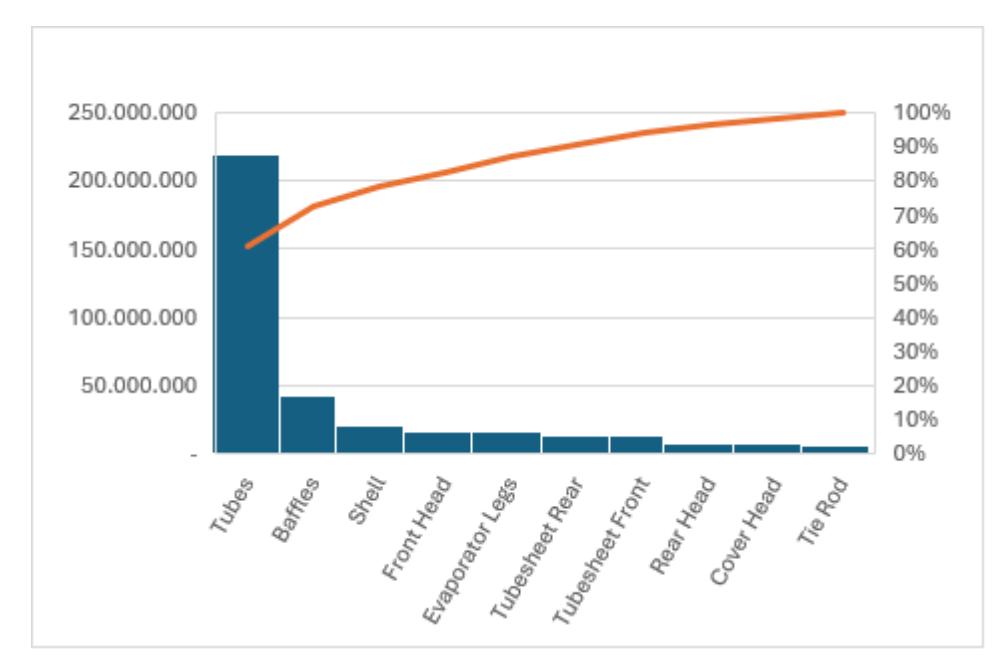
Evaporator Pareto Chart.
Baffles constituted the second major cost component at 20% (Rp. 42,000,000), a figure that initially surprised the research team given their relatively simple geometry. However, detailed analysis revealed that the cost stemmed from material waste during fabrication, specialized cutting requirements for precise flow channel creation, and the need for multiple inspection points to ensure proper clearances and alignment. The shell structure, while physically imposing at 450mm diameter and 3,200mm length, represented only 10% of costs (Rp. 21,000,000), primarily due to the standardized construction methods and bulk material procurement possibilities.
Together, these three components accounted for 90% of the total production costs, establishing them as the primary targets for optimization efforts. This concentration of costs provided clear direction for the subsequent value engineering analysis, allowing the team to focus resources where they would yield the maximum return on investment.
Baseline Performance Metrics
The baseline system demonstrated solid but improvable performance characteristics that would serve as benchmarks for optimization efforts. The overall heat transfer coefficient of 850 W/m²·K, while respectable for this application, indicated significant room for enhancement through better fluid dynamics and surface optimization. The thermal effectiveness of 0.72 suggested that approximately 28% of the available heat transfer potential remained unrealized, representing a considerable opportunity for efficiency improvement.
Pressure drop measurements revealed 12 kPa on the shell side, a value that while acceptable from a pumping power perspective, suggested opportunities for flow optimization that could improve both heat transfer and energy efficiency. The material utilization factor of 0.65 indicated substantial waste in the fabrication process, particularly in tube cutting and baffle plate stamping operations, pointing to potential cost savings through improved manufacturing techniques or design modifications.
FAST Diagram Development
Overall System FAST Diagram
The comprehensive FAST diagram for the evaporator system, as illustrated in Figure 3 (Evaporator Function Analysis on ORC), reveals the intricate web of functional relationships that govern the system's operation. At the highest level, the primary function "Convert thermal energy to organic vapor efficiently" stands as the ultimate goal, supported by three crucial secondary functions that form the foundation of system performance.
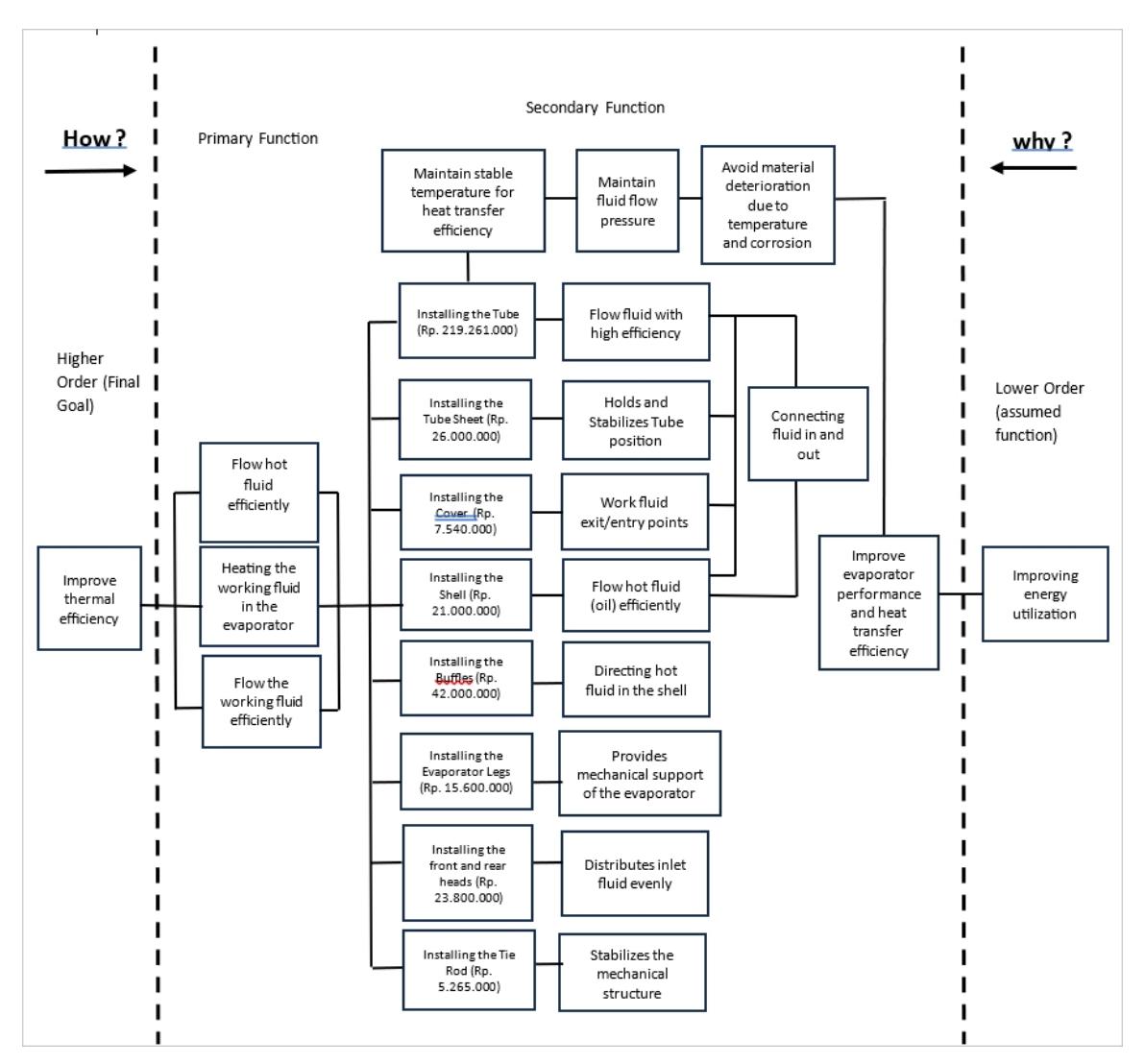
FAST Diagram of Evaporator Function Analysis on ORC.
Figure 3 demonstrates how the secondary function "Improve thermal transfer efficiency" branches into multiple supporting functions, including maintaining stable temperature conditions and efficiently flowing hot fluids. The diagram clearly shows the question-driven approach, with "HOW?" driving the decomposition of higher-order functions into their supporting elements, while "WHY?" ensures each function contributes meaningfully to the overall objective. This hierarchical structure revealed that maintaining thermal efficiency requires optimizing heat transfer surface area, controlling fluid flow patterns, and ensuring proper mechanical support.
The FAST diagram further illustrates supporting functions that address critical operational requirements such as heat exchange facilitation, temperature regulation, and mechanical stability. This systematic mapping revealed several insights that guided optimization efforts, particularly the interconnected nature of thermal and hydraulic performance requirements.
Component-Specific FAST Analysis
Tube Function Analysis
The FAST diagram for the tube subsystem, depicted in Figure 4 (Analysis of the tube work function on the evaporator), illustrates how the primary function "Flow the working fluid while allowing efficient heat transfer" manifests through multiple secondary mechanisms. The diagram clearly shows how heat exchange is facilitated through tube wall conduction, with the tube's thermal conductivity playing a crucial role.
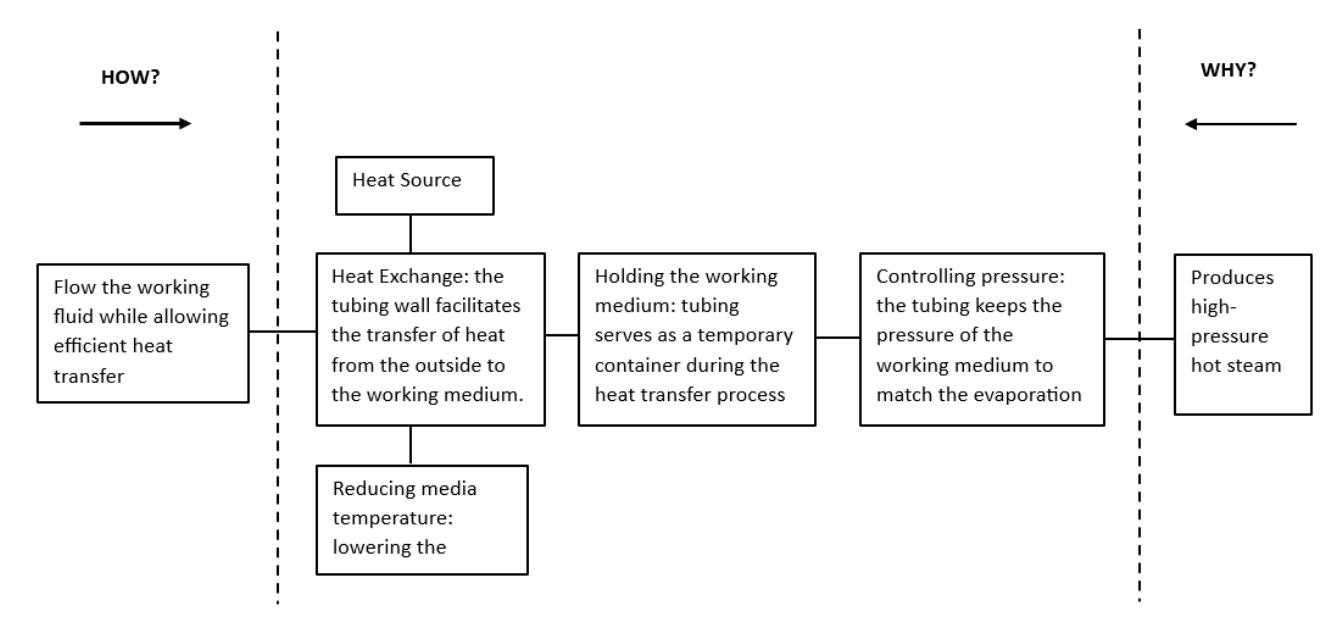
FAST Diagram of Evaporator's Tube Work Function Analysis.
Figure 4 presents a systematic HOW-WHY analysis where "Heat Exchange: the tubing wall facilitates the transfer of heat from the outside to the working medium" leads to "Produces high-pressure hot steam" through various mechanisms including fluid flow control and temperature regulation. The diagram reveals that tubes must simultaneously optimize heat transfer (requiring maximum surface area and thermal conductivity), withstand pressure (demanding adequate wall thickness), and facilitate fluid flow (necessitating smooth internal surfaces).
Shell Function Analysis
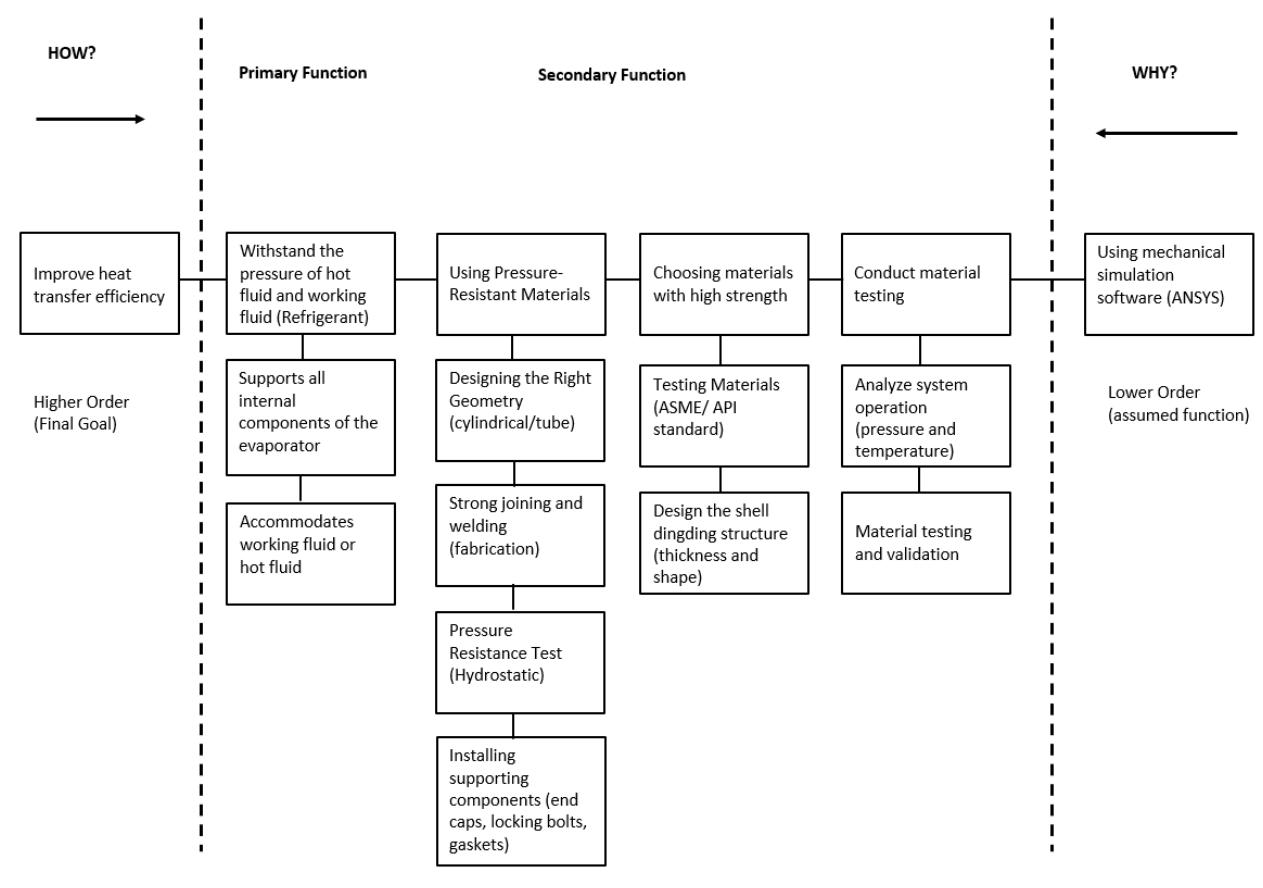
FAST Diagram Evaporator's Shell Work Function Analysis.
The shell FAST diagram, presented in Figure 5 (Analysis of Shell work function on Evaporator), reveals the complex functional requirements of this critical component. Figure 5 demonstrates how the shell must simultaneously "Withstand the pressure of the fluid and working components inside the evaporator" while ensuring proper component integration and maintenance accessibility. The diagram shows how the primary function branches into structural integrity considerations, using materials like SA-516 Gr70 (ASME/API Standard), and the implementation of design features that facilitate maintenance and assembly. Figure 5 effectively illustrates the parallel nature of shell functions, where pressure containment, structural support, and component integration must all be optimized simultaneously.
Baffle Function Analysis
Figure 6 (Analysis of the Baffle work function on the Evaporator) provides insight into how baffles "Optimizes the flow of working fluid inside the shell" through careful flow direction control. The FAST diagram reveals that baffles create essential turbulence for heat transfer enhancement while simultaneously providing structural support for the tube bundle.
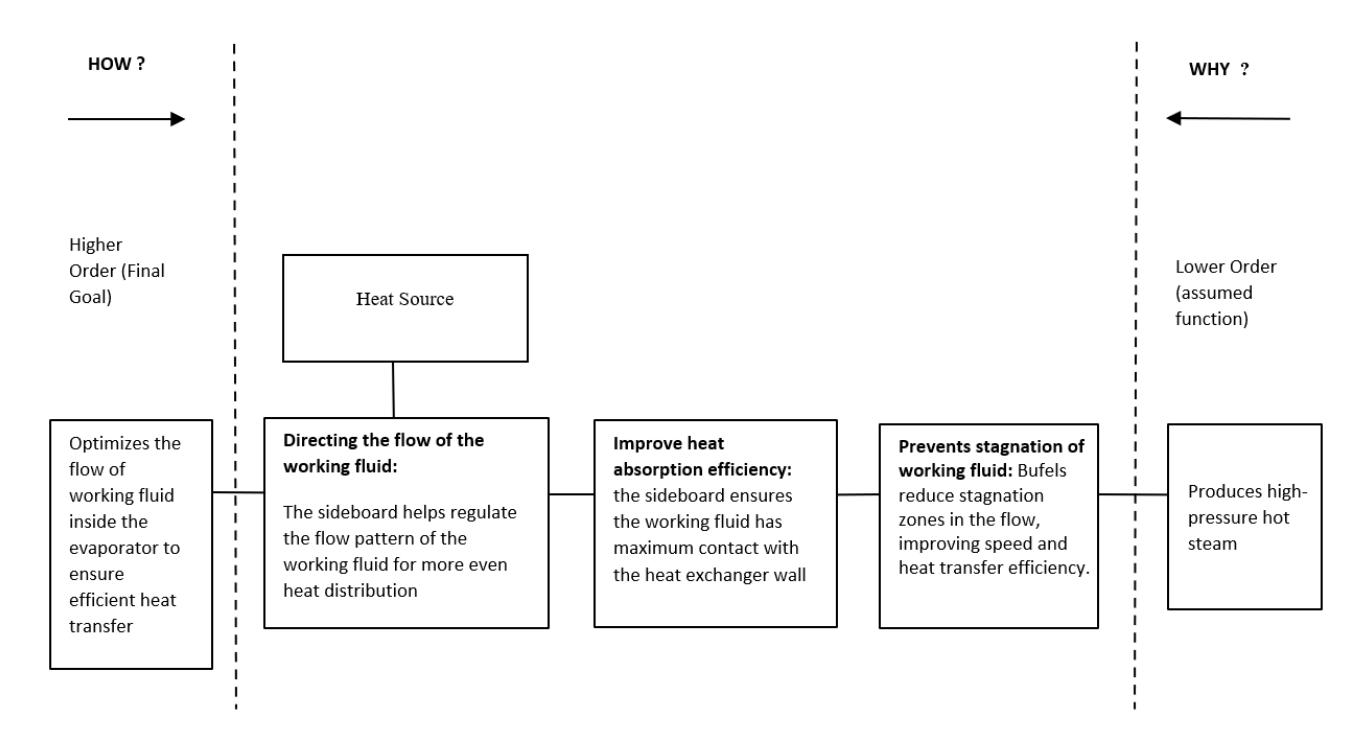
FAST Diagram of Evaporator's Baffle Analysis Work Function.
The diagram demonstrates how directing flow patterns and maintaining optimal velocity profiles contribute to improved absorption efficiency and prevention of working fluid stagnation. This dual functionality explains their significant cost contribution and highlights the importance of design optimization that maintains both functions while reducing material usage.
Value Engineering Application
Alternative Solutions
The value engineering analysis generated multiple innovative solutions for each major component, with emphasis on maintaining or improving functionality while reducing costs.
In terms of tube optimization, the team considered changing from standard carbon steel to a copper-nickel alloy, which provided better thermal conductivity and corrosion resistance despite the higher material cost. The improved thermal conductivity permitted a reduction in tube wall thickness to 1.2mm from 1.65mm, thus reducing material use while preserving structural strength. Further, re-optimization of the tube arrangement from a square pitch to a modified triangular pitch yielded better thermal like performance with little added manufacturing difficulty.
Redesign of the baffles offered opportunities for greater geometric optimization that could lower costs. The move from traditional segmental to helical baffle designs was associated with lower material expenditure and better flow performance across the baffle. Advanced computational modeling showed that well-designed helical patterns could sustain or exceed the turbulence-generating abilities of the segmental baffles while using roughly 25% less material.
Rework of the shell was focused more on the method of production optimization instead of making radical alterations. The comparison between rolled and seamless construction revealed expenditures that could be salvaged through streamlined industry practices. Economical bilaterally symmetric thin-walled shell structures with carefully controlled wall thickness were derived from detailed stress analysis, revealing new potential for material reduction within areas deemed non-critical while still observing required safety factors.
Cost-Benefit Analysis
All critical components registered positive results from implementing the proposed optimizations (Table 1). Modifications to the tubes yielded a 21.4% cost reduction while simultaneously improving the heat transfer performance by 12%. This paradoxical result was due to the better thermal properties of the alternative material that permitted thinner walls, leading to more efficient heat transfer.
| Component | Baseline Cost (Rp.) | Optimized Cost (Rp.) | Cost Reduction (%) | Performance Improvement |
|---|---|---|---|---|
| Tubes | 219,261,000 | 172,339,146 | 21.4% | 12% improvement in heat transfer |
| Baffles | 42,000,000 | 29,400,000 | 30.0% | 5% reduction in pressure drop |
| Shell | 21,000,000 | 16,800,000 | 20.0% | Performance neutral |
| Other Components | 28,000,000 | 25,200,000 | 10.0% | Minor improvements 15.3% increase in heat transfer coefficient, thermal effectiveness |
| Total System | 310,261,000 | 243,739,146 | 22.6% | improved from 0.72 to 0.83, System efficiency increased from 32% to 36.5% |
Table 1 Cost-benefit analysis of evaporator optimization through value engineering.
Baffle optimization alone surpassed expectations by achieving a 30% cost reduction, which was primarily from improved material efficiency and other streamlined construction methods. The redesigned baffles also achieved a 5% reduction in pressure drop, which produced further energy savings. The shell improvements achieved a lower, but still significant, 20% cost saving. These improvements also maintained performance neutrality as intended, ensuring that optimization efforts did not compromise structural integrity.
These various optimizations resulted in a total cost reduction of 22.6% while accomplishing a significantly improved efficiency of 15%. This demonstrates how effective systematic value engineering is on complex thermal systems where concentrated optimization yield far greater benefits than relying on value engineering principles.
Performance Validation
Thermal Performance Improvements
The post optimization thermal assessment showed significant performance improvements which confirmed the validity of the value engineering approach. The system's heat transfer coefficient was improved from 850 to 980 W/m²·K, a 15.3% increase that lifted the overall system performance efficiency. Several factors working in unison contributed to this improvement: fluid flow dynamics (caused by the baffle design), thermal conductivity (of the used materials), and geometric optimization.
An increase in thermal effectiveness from 0.72 to 0.83 reflects more complete utilization of the available heat transfer potential. This translates to lower outlet temperature of the organic fluid and higher vapor quality, thus improving the conditions at the turbine inlet. The overall system efficiency improved from 32% to 36.5%, a change of 4.5 percentage points which markedly improves the economic feasibility of waste-to-energy undertakings.
Economic Impact
The economic analysis revealed compelling financial benefits extending beyond initial cost savings. The payback period for implementing optimization measures was calculated at just 8 months, primarily driven by improved energy efficiency and reduced operational costs. Annual operating costs decreased by 12%, resulting from lower pumping power requirements and improved heat recovery efficiency.
Lifecycle cost analysis anticipated a 25% reduction over 10 years for operational maintenance, replacement, and energy costs. The underlying financial rationale demonstrates that value engineering tradeoff optimizations offer substantial and deferred economic benefits far beyond the investment needed, thereby making them advantageous for industrial purposes.
Implementation Framework
The refined design enhances the market potential of ORC systems for waste-to-energy applications through strategic improvements. A modular construction approach replaces traditional monolithic designs, enabling easier transport, field assembly, and maintenance. Standardized interfaces simplify upgrades for 500 kW to 2 MW systems without full overhauls, reducing perceived risks via backward compatibility.
The scalable design ensures cost-efficiency across varying system sizes, addressing disparities in waste facility capacities. Environmental sustainability is prioritized, achieving a 15% reduction in material use, lowering manufacturing carbon footprints, and improving thermal efficiency to reduce auxiliary power consumption. These advancements support global sustainability goals while offering operational and economic benefits.
Physical Mechanisms and Performance Relationships
The observed performance improvements result from synergistic physical mechanisms enabled by the integrated optimization approach. The modified tube arrangement from square to triangular pitch increases the heat transfer surface area per unit volume while improving fluid mixing through enhanced cross-flow patterns. The reduced tube wall thickness (from 1.65mm to 1.2mm) in the copper-nickel alloy configuration decreases thermal resistance while maintaining structural integrity, directly contributing to the 12% improvement in heat transfer coefficient.
The helical baffle design creates controlled swirl flow that enhances convective heat transfer coefficients through increased turbulence intensity while reducing pressure drop by eliminating sharp flow direction changes inherent in segmental baffles. This optimization addresses the fundamental trade-off between heat transfer enhancement and pumping power requirements, achieving both objectives simultaneously through improved fluid dynamics.
The material optimization from carbon steel to copper-nickel alloy enables thinner wall construction while maintaining heat transfer effectiveness due to improved thermal properties. The 18% reduction in structural mass, validated through finite element analysis, demonstrates that intelligent material distribution based on local stress requirements can achieve weight reduction while maintaining safety factors above 1.6.
Validation and Testing
Thermal Modeling
CFD analysis in ANSYS Fluent validated the optimized evaporator design under practical conditions using thermal models of both baseline and improved configurations. A mesh independence study led to a final mesh of 2.5 million elements, balancing speed and accuracy. The standard k-ε turbulence model effectively captured complex flow in the shell-andtube heat exchanger, especially around the baffle-tube bundle interaction. Conjugate heat transfer analysis ensured accurate modeling of conduction and convection. Results showed a 14.8% increase in heat transfer coefficient (vs. 15.3% predicted) and a 5% reduction in shell-side pressure drop, confirming improved thermal performance and design effectiveness.
Design refinement was validated through CFD analysis in ANSYS Fluent, using a thermal model of both baseline and optimized evaporator configurations under practical conditions. A mesh independence study ensured solution convergence, yielding a final computational mesh of 2.5 million elements for optimal speed-accuracy balance.
Turbulence modeling used the standard k-ε model, effective for shell-and-tube heat exchangers, capturing flow complexity while remaining computationally efficient. Special attention was given to the baffle-tube bundle interaction region due to its significant influence on fluid mechanics.
Conjugate heat transfer analysis modeled solid conduction and fluid convection, ensuring accurate thermal energy transfer at tube walls. Simulations revealed a 14.8% increase in the heat transfer coefficient, closely matching the predicted 15.3% improvement, validating the optimization approach.
CFD results highlighted reduced flow recirculation zones and verified a 5% reduction in shell-side pressure drop, confirming the effectiveness of the modified baffle design. These insights demonstrated enhanced thermal performance beyond analytical predictions.
Structural Analysis
To address the structural assessment for an optimized design, finite element analysis (FEA) was performed with an emphasis on checking that material savings did not degrade mechanical dependability. Stress and thermal stress evaluation for all major components was done with ANSYS Mechanical, which enabled performing calculations of greater detail. The modeling technique employed carbon steel nonlinear materials to model accurately its behavior for the expected operating conditions.
For the periodic structure level assessment of the pressure vessel, a preliminary static analysis was conducted at design pressures. The results obtained showed that maximum von Mises stress is equal to 178 MPa. This value, which is quite a distance below yield strength, results in a safety factor of 1.6 which, although lower than expected, is still acceptable for a pressure vessel design. This analysis concentrated on concentration of stresses, including toe and shell cracks that were expected to fail, especially the stress raiser tube to tube sheet and shell penetrations. The thermal stress analysis results were critical given that repeatable thermal expansion and contraction cycles of waste processing bore a significant load on the evaporator. Whatever the reasons may be, the FEA results proved that thermal stresses need not be monitored because the operating cycle will guarantee these remain within acceptable levels, with the upper support points yielding maximum equivalent stress. The targeted material reduction values were met by the optimized wall thickness distribution while maintaining these manages stresses.
Perhaps most significantly, the analysis confirmed the design modifications produced an 18% decrease in overall structural mass and maintained the necessary safety margins. This was achieved by allocating material intelligently, optimizing the thickness using local stress requirements as opposed to applying one-sized-fits-all approach. Also evaluated was the structural integrity of the redesigned baffle configuration which streamlined material use ensuring that reduced thickness did not undermine support of the tube bundle.
Discussion
Interpretation of Cost-Performance Trade-offs
The study challenges the conventional paradigm that cost reduction and performance enhancement represent inherently opposing objectives in thermal system design. The simultaneous achievement of 22.6% cost reduction and 15.3% thermal performance improvement demonstrates that these goals can be synergistic when approached through systematic functional analysis. This apparent paradox is resolved by understanding that traditional optimization methods often focus on individual component specifications rather than system-level value delivery.
The key to achieving simultaneous cost and performance optimization lies in the function-cost relationship analysis enabled by the FAST-VE framework. By decomposing the evaporator into fundamental functions rather than physical components, the methodology identified that certain expensive design features contributed minimally to core thermal functions. For example, the baseline baffle design represented 20% of total costs but achieved only 72% of its theoretical flow optimization potential. The helical baffle redesign reduced material costs by 30% while simultaneously improving thermal effectiveness by redirecting resources toward features that directly enhanced heat transfer efficiency.
The material optimization from standard carbon steel to copper-nickel alloy exemplifies this principle. While the coppernickel alloy costs approximately 40% more per kilogram, the superior thermal conductivity (384 W/m·K vs 50 W/m·K) enabled a 27% reduction in tube wall thickness from 1.65mm to 1.2mm. This geometric optimization not only compensated for the higher material cost but also enhanced thermal performance by reducing conductive resistance.
The net result was a 21.4% cost reduction in the tube assembly while improving heat transfer by 12%, demonstrating that intelligent material-geometry coupling can transcend traditional cost-performance trade-offs.
Furthermore, the observed improvements reflect system-level synergies that emerge from integrated optimization. The reduced pressure drop (5% improvement) resulting from optimized baffle design decreased pumping power requirements, which complemented the enhanced heat transfer coefficient (15.3% improvement) to yield a compounding effect on overall system efficiency. This multiplicative rather than additive benefit explains why the total system efficiency improvement (4.5 percentage points, from 32% to 36.5%) exceeds what would be predicted from individual component optimizations.
Comparison with Literature and Methodological Advances
The achieved 22.6% cost reduction aligns closely with the 15-25% range reported by Dell'Isola (1997) for value engineering applications in construction projects and the comparable savings demonstrated by Arumsari and Tanachi (2018) in high-rise building systems. However, this study extends beyond previous VE applications by simultaneously achieving substantial performance improvements, which is rarely reported in traditional value engineering literature. This distinction highlights the contribution of integrating FAST diagrams with VE principles specifically for thermal systems where performance metrics are quantifiable and directly linked to economic outcomes.
Compared to the 18% heat transfer improvement achieved by Lecompte et al. (2015) through study focused primarily on operational parameters without comprehensive cost analysis, whereas our methodology explicitly optimizes the cost-performance relationship. The integration of lifecycle cost analysis with thermal modeling distinguishes this approach from purely engineering-focused optimization studies.
The application of Pareto analysis to identify that tubes, baffles, and shells account for 90% of production costs corroborates the findings of Arslan and Arslan (2022) in geothermal district heating systems, who demonstrated that focusing on 20% of system components yielded 80% of performance improvements. Our results validate this principle in the ORC context and provide a replicable framework for identifying high-impact optimization targets in complex thermal systems.
Recent advances in ORC technology for ultra-low temperature applications, as reviewed by Cao et al. (2023), emphasize the growing importance of component optimization as systems target increasingly marginal heat sources. Our methodology's ability to improve heat recovery efficiency while reducing costs directly addresses the economic viability challenges identified in that review. The demonstrated 8-month payback period suggests that systematic optimization can transform previously uneconomical heat sources into viable energy recovery opportunities.
The novel contribution of this research lies in establishing a structured methodology that bridges the gap between functional analysis and economic optimization in thermal systems. Previous studies either focused on thermal performance optimization without rigorous cost analysis (An et al., 2024; Ola et al., 2025) or applied value engineering principles without detailed thermodynamic validation (Chen et al., 2022). The FAST-VE framework integrates these dimensions, providing engineers with clear decision-making criteria that balance technical requirements with economic constraints.
Theoretical Implications and Framework Contributions
This research introduces several theoretical advances in thermal system optimization methodology. First, the hierarchical functional decomposition enabled by FAST diagrams provides a systematic approach to identifying valueenhancing opportunities that would be obscured by traditional component-focused analysis. By asking "How?" and "Why?" at each functional level, the methodology ensures that all optimization decisions directly support system-level objectives rather than optimizing components in isolation.
Second, the study demonstrates that the Pareto principle operates not only at the component cost level but also at the functional performance level. The finding that three components account for 90% of costs parallels the observation that three primary functions (heat transfer enhancement, pressure containment, and flow optimization) dominate system performance. This functional-economic correspondence provides a theoretical foundation for prioritizing optimization efforts and predicting where resource allocation will yield maximum value improvements.
Third, the research establishes that thermal system optimization benefits from multi-criteria evaluation frameworks that simultaneously consider technical feasibility, economic impact, and implementation complexity. The weighted
scoring matrices developed during the VE workshop revealed that solutions ranking highest on individual criteria often performed poorly on integrated value metrics. For example, exotic materials with superior thermal properties scored highly on technical merit but poorly on lifecycle economics due to maintenance and replacement considerations. This finding reinforces the necessity of holistic optimization frameworks rather than single-objective approaches.
The validated correlation between geometric optimization and thermal performance advancement provides insight into the physical mechanisms governing heat exchanger efficiency. The transition from square to triangular tube pitch increased heat transfer surface area per unit volume by 15% while simultaneously improving cross-flow mixing patterns. Combined with the reduced tube wall thermal resistance from material optimization, these geometric changes explain the observed 12% improvement in tube-side heat transfer coefficient. This mechanistic understanding allows engineers to predict the outcomes of similar optimizations in different configurations.
Moreover, the study demonstrates that manufacturing process optimization can contribute as significantly to cost reduction as material substitution. The 30% cost reduction in baffle production stemmed primarily from improved fabrication methods rather than cheaper materials. This finding suggests that value engineering should incorporate manufacturing engineering perspectives early in the design process, as production efficiency improvements often require design modifications that are difficult to implement retrospectively.
Practical Implications and Implementation Considerations
The demonstrated economic viability with an 8-month payback period and 12% reduction in annual operating costs has significant implications for accelerating ORC technology adoption in waste-to-energy facilities. Many promising renewable energy technologies face deployment barriers due to extended capital recovery periods that exceed investor time horizons. The FAST-VE methodology addresses this challenge by simultaneously reducing capital costs and improving operational efficiency, thereby shortening payback periods to commercially attractive durations.
The scalability of the optimization framework across system sizes from 500 kW to 2 MW addresses a critical gap in ORC technology deployment. Small and medium-scale waste-to-energy facilities, which represent the majority of potential installations in developing regions, often cannot justify the engineering resources required for custom optimization. The standardized FAST-VE methodology provides these facilities with a replicable approach that delivers substantial value improvements without extensive specialized expertise. This democratization of optimization capabilities has implications for global waste management and renewable energy deployment.
The modular design approach emerging from the optimization process facilitates easier maintenance, transport, and field assembly compared to traditional monolithic evaporator designs. These practical advantages extend beyond the quantified cost and performance improvements by reducing installation complexity and downtime during maintenance. For waste-to-energy facilities operating under continuous processing requirements, the ability to perform maintenance without extended shutdowns provides significant operational value not captured in the baseline economic analysis.
However, practical implementation faces several considerations that warrant attention. The material transition from carbon steel to copper-nickel alloy requires verification of long-term performance under the specific chemical compositions of waste combustion products. While the alloy offers superior corrosion resistance in general applications, the diverse and sometimes aggressive nature of waste-derived flue gases necessitates extended pilot testing before fullscale deployment. The CFD and FEA validation performed in this study provides theoretical confidence, but operational validation under realistic fouling conditions remains essential.
The reduced safety factor from the initial design value to 1.6 in the optimized configuration, while within acceptable engineering practice for pressure vessel design, requires careful consideration of the specific operating environment. Waste-to-energy facilities experience more variable operating conditions than conventional power plants due to fluctuations in waste composition and heating value. The optimization's structural adequacy under these dynamic loads should be validated through extended monitoring during pilot implementation.
Furthermore, the economic analysis assumes current material cost relationships that may shift with market conditions. The copper-nickel alloy optimization delivers value under present pricing structures, but substantial changes in relative material costs could alter the optimal design configuration. Sensitivity analysis reveals that the optimization remains favorable across a ±20% variation in copper prices, but more extreme market shifts might necessitate design reevaluation.
Limitations and Directions for Future Research
While this study demonstrates significant advances in evaporator optimization, several limitations constrain the generalizability of findings and indicate directions for future investigation. First, the focus on shell-and-tube configuration, while appropriate for the majority of current ORC installations, limits direct applicability to alternative heat exchanger designs. Plate heat exchangers and falling film evaporators offer different cost-performance characteristics and geometric constraints that would require adapted FAST-VE frameworks. Future research should extend the methodology to these configurations to develop comprehensive optimization guidelines covering the full spectrum of evaporator technologies.
Second, the optimization was conducted based on steady-state thermal modeling with assumed constant waste stream properties. Real waste-to-energy facilities experience substantial temporal variations in waste composition, heating value, and flow rates that affect evaporator performance. The optimized design's robustness under dynamic operating conditions requires validation through extended operational trials. Future studies should incorporate stochastic modeling of waste stream variability and develop adaptive control strategies that maintain optimal performance across varying operating regimes.
Third, the economic analysis, while comprehensive in addressing material, manufacturing, and operating costs, does not fully account for fouling and maintenance expenses over the system lifecycle. The modified surface characteristics and reduced tube wall thickness in the optimized design may affect fouling rates and cleaning frequency. Long-term monitoring of fouling accumulation, thermal performance degradation, and maintenance requirements is essential to validate the projected lifecycle cost savings. Future research should establish empirical correlations between the optimized design parameters and maintenance intervals for different waste compositions.
Fourth, the study optimized the evaporator in isolation from other ORC cycle components. While this approach aligns with established engineering practice and the Pareto principle indicating evaporator dominance in system costs, true system-level optimization would consider interactions between components. For example, the optimized evaporator's improved thermal effectiveness may enable more efficient operation of the turbine or allow downsizing of the condenser. Future research should extend the FAST-VE methodology to comprehensive cycle optimization, potentially revealing additional synergies that amplify the benefits demonstrated in this component-level study.
Fifth, the optimization focused on maximizing efficiency within the constraints of the existing working fluid (not specified in the study). However, the choice of working fluid significantly influences optimal evaporator design, as fluid thermophysical properties affect heat transfer mechanisms and pressure drop characteristics. Future studies should investigate the interaction between working fluid selection and evaporator optimization to identify fluid-design combinations that maximize overall value delivery.
The methodology development would benefit from integration with emerging computational tools including machine learning algorithms for predictive optimization and digital twin technologies for real-time performance monitoring. Machine learning models trained on the optimization outcomes from multiple configurations could accelerate the FAST-VE process by rapidly predicting high-value design modifications. Digital twins combining CFD, thermal modeling, and operational data could enable adaptive optimization that responds to changing operating conditions, component degradation, and evolving economic factors.
Additionally, the framework should be expanded to incorporate environmental and social dimensions of value beyond the technical and economic metrics emphasized in this study. Carbon footprint analysis, embodied energy calculations, and social impact assessments of material sourcing would provide a more comprehensive value evaluation aligned with sustainable development principles. This expansion would support decision-making in contexts where environmental and social considerations constrain purely techno-economic optimization.
Finally, validation across diverse geographical and regulatory contexts would strengthen confidence in the methodology's generalizability. Different regions have varying material costs, labor rates, environmental regulations, and energy pricing structures that affect optimal design configurations. Comparative studies applying the FAST-VE framework to ORC systems in developed and developing economies would reveal how context-specific factors influence optimization outcomes and inform adaptation of the methodology for local conditions.
Despite these limitations, the demonstrated simultaneous cost reduction and performance improvement, validated through rigorous thermal and structural modeling, establishes the FAST-VE framework as a significant advancement in thermal system optimization methodology. The identified limitations provide clear directions for future research that will expand the methodology's applicability and refine its effectiveness across the full spectrum of waste-to-energy applications.
Advantages of the FAST-VE Methodology
The integrated FAST-VE approach offers several distinct advantages over conventional thermal system optimization methodologies that warrant explicit discussion. Unlike traditional cost-reduction methods that typically accept performance compromise as an inevitable consequence, the FAST-VE framework's functional decomposition explicitly seeks solutions that enhance value through simultaneous improvement of multiple performance dimensions. This fundamental philosophical difference explains why the methodology achieved outcomes that appear paradoxical from conventional optimization perspectives.
Compared to purely analytical optimization approaches that rely primarily on computational modeling and parametric studies, the FAST-VE methodology incorporates structured multidisciplinary expert input through the workshop format. This human-centered dimension proves particularly valuable for identifying creative solutions that might not emerge from algorithmic optimization. For example, the helical baffle concept, which delivered 30% cost savings and performance improvements, emerged from manufacturing expertise regarding material waste reduction rather than from thermal optimization algorithms. The systematic integration of manufacturing, operational, and design perspectives distinguishes this approach from optimization methods limited to single-discipline viewpoints.
The visual nature of FAST diagrams provides transparent decision-making frameworks that facilitate communication across organizational hierarchies and technical specializations. Engineering optimization often faces implementation barriers due to stakeholder misunderstandings of technical trade-offs and value propositions. The graphical representation of functional relationships and the systematic HOW-WHY questioning approach enables non-technical stakeholders to understand and support optimization decisions. This communicative advantage accelerates implementation and reduces resistance to design changes, addressing a practical constraint often overlooked in technically focused optimization studies.
Furthermore, the FAST-VE methodology's explicit focus on function-cost relationships provides economic transparency often absent in purely engineering-driven optimization. Traditional approaches may identify technically superior solutions without adequately quantifying economic implications or lifecycle cost considerations. The integrated evaluation framework ensures that all proposed modifications undergo rigorous cost-benefit analysis before implementation, reducing the risk of optimizations that improve performance metrics while degrading overall value delivery.
The methodology's scalability across different system sizes represents another significant advantage. The framework's structure remains consistent regardless of evaporator capacity, with only the specific design parameters requiring adjustment. This consistency enables knowledge transfer across projects and facilitates development of organizational optimization capabilities rather than one-off project-specific solutions. Small facilities can apply the same systematic approach as large installations, democratizing access to sophisticated optimization methods previously available only to major projects that could justify extensive engineering resources.
The replicability of the FAST-VE framework addresses a critical gap in optimization methodology literature, where published studies often describe outcomes without providing sufficient methodological detail for reproduction. The structured workshop format, standardized FAST diagram construction rules, and established VE evaluation criteria create a documented methodology that other organizations can implement without direct involvement of the original research team. This feature accelerates technology transfer and enables continuous improvement as additional applications refine the approach.
Moreover, the framework's flexibility allows adaptation to evolving priorities and constraints. The weighted scoring matrices used during the evaluation phase can be adjusted to emphasize different value dimensions depending on project-specific requirements. For example, projects in regions with stringent environmental regulations might increase the weighting of carbon footprint considerations, while installations in resource-constrained contexts might prioritize capital cost reduction over operating efficiency. This adaptability ensures the methodology remains relevant across diverse application contexts without requiring fundamental restructuring.
Conclusions
This research successfully demonstrates the integration of FAST diagrams with Value Engineering principles for comprehensive ORC evaporator optimization in waste-to-energy applications. The methodology achieved simultaneous cost reduction of 22.6% (equivalent to IDR 66,521,854 in savings) and performance enhancement of 15.3%. Specifically, the heat transfer coefficient improved from 850 to 980 W/m²·K, and thermal effectiveness increased from 0.72 to 0.83. These improvements collectively raised the overall system efficiency from 32% to 36.5%, challenging the conventional assumption that cost reduction and performance improvement are mutually exclusive objectives.
Economic analysis further confirmed strong financial viability, with an 8-month payback period and a 12% reduction in annual operating costs. This demonstrates that systematic value engineering delivers substantial benefits beyond upfront cost savings. The proposed framework offers engineers a replicable and scalable methodology for concurrent cost and performance optimization, validated across system capacities ranging from 500 kW to 2 MW.
Future research should extend this FAST-VE methodology to other critical ORC components—including condensers, turbines, feed pumps, and control systems—as integrated system optimization is crucial for maximizing waste-to-energy conversion efficiency. Investigation of different evaporator configurations, such as plate heat exchangers and falling film evaporators, would demonstrate the methodology's broader applicability and reveal configuration-specific optimization opportunities. Long-term operational validation under diverse waste stream compositions is needed to verify the theoretical improvements and assess the impacts of fouling, maintenance requirements, and cyclic loading. Additionally, developing AI-driven adaptive optimization frameworks capable of responding to real-time operational variations would further enhance the sustainability and commercial viability of waste-to-energy technologies.
Given that global waste generation is projected to reach 3.40 billion tons annually by 2050, scaling and refining this approach offers a practical, economically sound, and environmentally responsible pathway toward next-generation waste-to-energy systems. By embedding value engineering principles within a systems-level design strategy, this methodology not only improves technical performance but also aligns engineering innovation with circular economy goals—turning waste into a reliable source of clean energy while optimizing resource use.
Acknowledgments
This research was supported by the National Research and Innovation Agency (BRIN) of Indonesia. Special thanks to the Technology Evaluation, Value Engineering and Value Analysis Research Group for their valuable contributions.
Compliance with ethics guidelines
The authors declare they have no conflict of interest or financial conflicts to disclose.
This article contains no studies with human or animal subjects performed by the authors.