

Introduction
In recent decades, polyoxometalates have attained significant attention due to their wide structural and chemical versatility. Polyoxometalates (POMs), formerly known as heteropolyanions, are large clusters of inorganic molecular anions consisting of high oxidation state metals coordinated by oxo ligands. These complexes consist of pseudooctahedral metal-oxo building blocks linked by their corner- and edge-sharing oxygens (Breibeck et al., 2022). In general, polyoxometalates can be determined as either isopolyoxometalates [MmOy]n- or heteropolyoxometalates [XxMmOy]n- (A. Gao et al., 2025). POMs can be formed by the expansion of the tetrahedral monomeric metal oxide [MO4]n- to pseudo-octahedral oxoanion {MO6} in conjunction with the formation of a double-bonded pπ-dπ interaction between the transition metal and terminal oxo-ligand due to the existence of vacant transition metal d-orbitals (Kai Walters, 2022).
POMs have been known to have several dominant and common POM structural classes (POM platforms), i.e., Anderson-Evans, Lindqvist, and Dawson. Figure 1 shows the vast structural diversity of POMs that have been developed from foundational types such as the Anderson type to highly intricate assemblies such as the nona-cobalt architecture. This type of evolutionary developed structure resulted from the existence of a highly modifiable metal-oxo cluster surrounding central atoms, typically phosphate or silicate. Nowadays, the majority of widely used hetero-POMs have
1Chemical Engineering Department, Institut Teknologi Bandung, Jalan Ganesa No. 10, Bandung 40132, Indonesia
4Research Center for Nanosciences and Nanotechnology, Institut Teknologi Bandung, the Keggin structure as their primary structure, due to their thermal stability (Mir et al., 2020). Interestingly, other POM types, such as Wells-Dawsons [X2M18O62] n- or the X2M18 structure, originate from two lacunary Keggin units [XM9O31] n- , each of them lacking an {M3O13} triad and connected by corner-sharing oxygens (Long et al., 2010). Thus, the Keggin structure is frequently considered as a POM building block. Especially for the catalysis aspect, by modifying the structure of POMs, one can tune their acid-base, redox, and even electron mobility (Iftikhar et al., 2024). The importance of structure modification of POMs has been addressed in many previous reviews. This structure modification, when harnessed carefully, will lead to variation of the physical and chemical properties of the POMs and eventually optimized catalytic properties (T. Wang et al., 2025). Therefore, the discussion of POM usage, structure modification, and their comparison with other more conventional catalysts for bio-product valorization is the goal of this mini review.
There are various known electron-rich polyoxometalate (POM) structures (Ahmad et al., 2024), such as: a) the Anderson POM structure; b) the Co2Mo10 structure; c) the Dexter-Silverton structure; d) the sandwich-POM structure; e) the sandwich-type POM with a 'cubane' of four different atoms; f) the sandwich-type polyoxotungstate cluster with a central core of tetra-ruthenium oxide [Ru4O4], [Ru4(µ-O)4(µ-OH)2(H2O)4](γ-SiW10O36)2]10− ; g) the electroactive tetra-cobalt core Co4O4 'cubane', which is usually sandwiched between two oxidatively resistant tri-lacunary units, such as the [PW9O34]9 − , wheelshaped [Mo154] cluster; h) the same but with another electroactive core and different atoms; i) an electroactive [Ru4O4] core stabilized by two units of (γ-SiW10O36)2]10− to make a complete sandwich structure, as shown in (f); j) the nona-cobalt architecture Co9(H2O)6(OH)3(HPO4)2(PW9O34)316− ( = Co9-POM or Co9); k) a [CoxFe4‒x(OH)3 Fe4-x(OH)3 (PO4)]4 core surrounded by four (SiW9O34)4]n− units; l) a central core of Co9, where orange balls represent cobalt atoms, while pink tetrahedrons show phosphorus atoms; m) an active cobalt-iron core of [(Co3Fe(OH)3PO4)4(SiW9O34)4]28− .
Properties and Applications of POMs
Polyoxometalates Properties
POMs are renowned for their remarkable catalytic activities with numerous different properties, such as being capable of conducting protons, having a number of anchored oxygen atoms, and possessing metal-redox centers (Yao Zhang et al., 2024). Their excellent catalytic activities for redox reactions results from their electron-transfer properties, so that these materials can also be utilized as good electron storages (Du et al., 2020). POMs themselves sometimes function as very weak bases, since they can connect Lewis acid centers or donate electrons from their surface oxo ligands to electron acceptors groups. POMs are also capable of acting as Lewis acid due to the existence of metal ions with empty orbitals, so that electrons can be accepted onto their surface. Due to previously mentioned properties, alteration of
POM molecules can be done extensively and by carefully modifying their molecules different catalytic properties can be achieved. Thus, as has been reported by several previous studies, POMs' acid-base and redox properties can easily be altered based on the environmental conditions and this trait makes POMs a flexible materials class when it comes to acid-base and redox reactions (Zhong et al., 2021).
Apart from their modifiability, POMs have also been reported to have stable properties, to be capable of transferring protons, while they are also very active in the UV-near visible spectrum. These traits make them versatile for both electrochemical and photochemical redox reactions (Qian Wang et al., 2025). However, it is imperative to bear in mind that acid-base, redox, and chiral properties are greatly affected by external factors such as solvents used, POM-cation interactions, and covalently bonded organic moieties of POM anions. For example, POMs' acidity can be maintained by the existence of a polar protic solvent. Meanwhile, Lewis acidity and redox activity may change due to electron movement between POM cations and anions or an organic moiety attached to them, or for other reasons (Iftikhar et al., 2024). The nature of cations in POMs has been reported to have a significant impact on the properties and solubility of POM molecules. Cations in POMs are usually inorganic ones, for example H+, Na+, K+, Cs+, NH4+, and Ag+. On the other hand, several currently recognized POMs have organic cations, which can be altered to suit different needs (Soria-Carrera et al., 2023).
Generally, thermal stability of POMs is crucial for supporting catalytic reactions, since various catalytic reactions occur in extreme conditions, and some reactions can produce coke, which leads to catalyst deactivation and loss of active sites. In contrast, POM regeneration or decoking is needed to recover catalytic activity. This process usually requires a high temperature, at which some POM catalysts may lose their active protons. Therefore, POM catalysts require excellent thermal stability to ensure high recyclability. Under high temperatures, POM deactivation typically starts with dehydration, oxygen removal from the supramolecular structure, partial decomposition, and primary structure degradation to form its oxides (Yanmei Zhang et al., 2011). The same work found that the Keggin cubic structure can be preserved at higher temperatures by introducing Cs atoms as its counter-ions. A more recent study had a similar finding for the effect of counter-ion variability towards thermal stability (Misra et al., 2020).
Chemical stability is also found to be an important aspect of utilizing POMs as catalysts. Normally, conventional POMs tend to suffer from leaching in corrosive media (D. Gao et al., 2019; Mialane et al., 2021). Other work has reported that coke formation rapidly deteriorates POM-based catalysts (L. Liu et al., 2023) and, therefore, making catalysts that are less susceptible to coke formation has become an important research focus. In 2001, Kozhevnikov found that Pd-doped POM catalysts can inhibit the formation of polyaromatic coke so that the regeneration temperature decreases (Siddiqui et al., 2000). The chemical stability of POMs, including hydrolytic and oxidative stability, is also crucial for catalytic systems, since water is the commonly used reactant or generated product, and oxidative catalytic requires oxygen-rich systems. In most cases, POMs exhibit remarkable chemical stability due to the non-existence of organic ligands. However, it should be clear that the importance of thermal and chemical stability of POMs relatively depends on the type of catalysis and transformation (Hu et al., 2024; Changzhen Wang et al., 2015).
| Properties | Factors affecting POM catalysts | Factors affecting zeolite catalysts |
|---|---|---|
| BrØnsted | Proton atoms bonded with oxygen in their primary | Bridging hydroxyl groups adjacent to Al atoms |
| acidity | structure (Marcio Jose da Silva et al., 2023) | (Schroeder et al., 2020) |
| Lauria a sistitu. | Transition metal sites in their primary structure | Intra-framework embedded metals (Al, Sn, Zr, Ti |
| Lewis acidity | (Dang et al., 2024) | for example) (Ravi et al., 2020) |
| Daday santar | A central atom within the primary structure | Metal-exchanged atoms within the zeolite |
| Redox center | (R. Wang et al., 2022) | framework (Pietrzyk et al., 2020) |
Table 1 Comparison of known properties that affect catalytic activities of POM-based catalysts and zeolites.
Different active site centers have been investigated thoroughly and used accordingly based on the required reaction (Table 1). Once the metal center has been pinpointed and studied, the catalyst's controllability can be enhanced and optimized as well. Due to the controllability of POMs at the elemental and molecular levels, they have been widely utilized for their appealing applications, particularly in catalysis (Y. Liu et al., 2025; Márcio José da Silva et al., 2025; Vizcaíno-Anaya et al., 2025), medicine and biotechnology (Mbage et al., 2023; Salazar Marcano et al., 2024), electrochemistry (Gusmão et al., 2022), molecular magnetism (Clemente-Juan et al., 2012), as well as photoluminescent (Zheng et al., 2024), photochromic (L. Li et al., 2024), sensing (Veríssimo et al., 2022), energy storage applications (Chen Wang et al., 2023), etc. This mini review presents the latest development on POMs' usage as catalysts, particularly for biomass conversion.
Polyoxometalates as Catalyst
For over two decades, catalytic materials based on polyoxometalates have garnered considerable attention due to their many advantages in catalysis. Due to the versatility of POM properties, POMs can be used for multiple catalysis reactions, including acid-catalyzed reactions, base-catalyzed reactions, and redox-catalytic reactions (S.-S. Wang et al., 2015). POMs with protons as the only counter-cation, also called heteropolyacids (HPAs), are usually used for acidcatalyzed reactions, such as esterification, transesterification, and solvolysis (Kozhevnikov, 2007). Protons present in POMs or HPAs act as Brønsted acids that can be used as promotors of acid-catalyzed reactions (Timofeeva, 2003). In addition, the oxo ligands on the surface of POMs can transfer electrons to electron acceptors, rendering them appropriate for base-catalyzed reactions. Furthermore, metals in POMs can participate in redox catalytic activities and form Lewis acids, which are active sites for acid-catalyzed reactions (Z. Li et al., 2023). Thus, there are at least four reaction groups that are well catalyzed by POMs (Figure 1): C-O bond scission (solvolysis); C-C bond formation (condensation); R-OR bond formation (esterification); and even oxidation of targeted substances. These catalytic schemes are also known to be well catalyzed by zeolite (Table 2).
Schematic of recognized biomass valorization reactions that are well catalyzed by POMs.
Interestingly, as can be seen in Table 2, there are a number of studies that discuss and compare the use of zeolites with POMs. Briefly, when these two material classes are used separately, each of them suffers from each's inherent limitations. It can be noted that by embedding POMs into zeolite, one can harness both of those materials' properties, such as the high Brønsted acidity strength of POMs and the thermal stability of zeolites. Thus, these hybrid materials are noteworthy to be studied.
| Class of Reactions | Conventional Catalysts | POM-based Catalysts | Key finding | Reference |
|---|---|---|---|---|
| Hydroisomerization of hexane | Pt/Hβ zeolite | Pt-PW12/Hβ zeolite | Increased yield of hydroisomerized compounds due to the introduction of POM | (Lefebvre, 2016) |
| Esterification | H-Y zeolite | PW12/HY zeolite | Increased yield of ester compounds due to the introduction of POM | (Patel et al., 2024) |
| Cascade transformation furfural into GVL | Zr-MOF | POM encapsulated within organic framework | Significant increase of GVL yield from 0 to 58% | (M. Ma et al., 2024) |
| Alcohol dehydration | H-mordenite | PW12/SiO2 | Significant coke reduction found for POM-based catalyst compared to zeolite-based catalyst | (Alasmari et al., 2024) |
Table 2 Current exemplary comparative POM performances compared with conventional catalysts.
POMs/HPAs can be utilized as both homogeneous and heterogeneous catalysts. Their high solubility in most polar and organic solvents (depending on the POM counter-cation) makes them appropriate for effective homogeneous catalytic reactions. In some cases, as demonstrated by Ishii's work, POMs/HPAs can act as catalyst precursors (Mizuno et al., 2006). These compounds can undergo decomposition, resulting in the formation of soluble small active species during the reaction. While excellent reaction rates can be achieved with a homogeneous catalytic system, its drawbacks in terms of product separation and catalyst discovery should not be overlooked. Therefore, it is essential to develop POMbased catalysts that are easy to recover and reuse for practical application in industry. Several approaches have been devised to improve the recoverability and recyclability of POM catalysts, including the heterogenization of originally homogenous POM/HPA catalysts. Heterogeneous catalysis is favored due to the benefit of effortless separation between catalyst and product (Aghajani et al., 2023). While the high solubility of Polyoxometalates (POMs) enables their effective use as homogeneous catalysts or active precursors, the industrial requirement for efficient product separation and catalyst recovery has required the development of heterogeneous POM systems that combine high reactivity with the practical benefits of easy recyclability. In Table 3, diverse utilization of POM has been tabulated, and from the work of Ghasemi compared with Malmir, slight change in the cationic POM structure might shift its usage thus making it as a versatile class catalyst "building block" that can be modified easily through cation modification.
Table 3 Types of POM-catalyzed reactions.
| Reaction Type | Reaction | Used POMs | Reference |
|---|---|---|---|
| Alkene Polymerization: Propene oligomerization Styrene polymerization | Ni-POM/SBA-15 H3PW12O40 | (Magazova et al., 2022) (Aouissi et al., 2010) | |
| Dehydration: Fructose to HMF | Silica-PEI-POM | (Pulido-Díaz et al., 2025) | |
| Etherification: Cyclization of (+)-citronellal | Homogenous POMs | (Qiwen Wang et al., 2023) | |
| Cyanosilylation: Aldehydes/ketones compounds to cyanohydrin | TBA-ZrPW11 | (Yekke-Ghasemi et al., 2022) | |
| Acid Catalysis | Aminolysis: Aromatic amines to β-amino alcohols | H3PMo12O40, H3PW12O40 | (T. Li et al., 2018) |
| Condensation: 1,3-dicarbonyl compound condensation with aldehydes and urea | MOF/POM hybrid | (Maru et al., 2022) | |
| Esterification: Acetic acid esterification with selected alcohol and acid | H3PMo12O40/TiO2.ZrO2 | (Viswanadham, 2023) | |
| Transesterification: Long/branched chain triglycerides conversion into biodiesel | H3PMo12O40/SOM-ZIF-8 | (Xie et al., 2024) | |
| Hydrolysis: Hydrolysis of cellulose | H5PMo10V2O40/Silica | (Qi et al., 2025) | |
| Base | Cyanosilylation: Cyanosilylation of carbonyl compounds | TBA-PW11 | (Malmir et al., 2022) |
| Catalysis | Condensation: Knoevenagel condensation | Cu-containing heteropolyoxoniobate | (Zuo et al., 2024) |
| Epoxidation: Oxidation of alkenes to epoxides | Na-subtituted H3PW12O40 | (Fernández et al., 2023) | |
| Carbonylation: Oxidation of styrene to benzaldehyde | Fe-Mo Modified H3PW12O40 | (Yulin Zhang et al., 2022) | |
| Dehydrogenation: Dehydrogenation of alkanes to alkenes | K5[α-1,2-PV2W10O40] (PV2W10) | (Orozco et al., 2020) | |
| Arenes oxidation: Selective oxidation of anthracene to anthraquinone | Supported-POM | (Maksimchuk et al., 2023) | |
| Organosilane oxidation: Oxidation of organosilanes to silanols | [CuΙ3(pz)3{PMo12O40}]·H2O | (X. Ma et al., 2022) | |
| Oxidation | Phenols oxidation: Oxidation of phenols to produce quinone and its derivatives | 2D POM-based coordination polymers | (Chang et al., 2021) |
| Alcohols oxidation: Benzyl alcohol to corresponding aldehydes | Ag-Cu/POM | (Lukato et al., 2021) | |
| Oxidative cleavage of C-C bonds: Lignin depolymerization Glucose, cellulose, and other biogenic feedstocks to formic acid | Pd-doped POM H8[PV5Mo7O40] | (L. Zhao et al., 2025) (Maerten et al., 2020) | |
| Oxidative cleavage of M-C bonds: n-Bu4Sn to 1-butanol | H5V2PMo10O40 | (Khenkin et al., 2013) | |
| Reduction of Organic Compounds Hydrogenation of carbonyl compounds | Ru-POM | (Peng et al., 2022) | |
| Reduction | Photoreduction of CO2 Photoreduction of CO2 to CO | POM-COF | (M. Lu et al., 2022) |
| Photoreduction of Metal Cations Photocatalytic metal recovery | [PW11Si2O40C26H16N2]TBA3 | (Huo et al., 2025) |
Generally, there are two strategies to obtain more heterogeneous POMs catalyst, including solidification and immobilization of catalytically active POMs. Insoluble solids can be obtained by complexing POMs with cations that have a suitable molecule size, anion/cation composition, molecular charge, shape, and apparent polarity. These factors result in a strong ionic interaction between the ionic components. For instance, rather than using pure HPAs, POMs with large inorganic counter-cations (e.g., NH4 + , Cs+ , Na+ , K+ , Ag+ , etc.) or dendritic organic cations are used to achieve lower solubility in polar and organic solvents (Misra et al., 2020). Furthermore, it is possible to solidify POMs through their
immobilization within MOFs (metal-organic frameworks) (Jia et al., 2024), covalent organic frameworks (COFs) (Xue et al., 2023), mesoporous silica (Ortiz-Bustos et al., 2021), porous polymers (Y. Lu et al., 2021), transition metal oxide (Vilà et al., 2024), porous carbon (S. Ma et al., 2022), and so on. The porous supports, aside from providing a large surface for the distribution of highly active sites, also have the potential to affect the catalytic activity via strong support-HPA interactions that alter the active center atoms.
Heterogeneous POM catalysts certainly have good recoverability and recyclability. However, the modified heterogeneous POM catalyst must also maintain good activity and selectivity for the catalytic reaction, such as an adequate pore structure to facilitate substrate diffusion, including distribution of pore opening, total pore volume, and apparent surface area. In addition, POM catalysts must have notable surface properties, such as hydrophilic/hydrophobic properties designed for specific catalytic reaction systems. Furthermore, it is essential to protect active sites from leaching, thermal decomposition, coke formation, and catalyst poisoning to maintain their catalytic activity (Argyle et al., 2015; R. Liu et al., 2021).
Polyoxometalates for Biomass Conversion
Solvolyis Reaction
Solvolysis reactions are among the most well-known polyoxometalate (POM) catalyzed processes, owing to the Brønsted acidic nature of POMs. Particularly, this class of material is also known as heteropolyacid (HPA). The heteropolyacid (HPA) structure's intricate network of solvent-facilitated tunnels enables reactants to access more active sites throughout the framework, enhancing catalytic efficiency compared to surface-based catalysis (Mateos et al., 2023). Often, covalent bond cleavage reactions are well catalyzed by the presence of proton atoms (Costentin et al., 2013). The inherent ability of HPAs to act as solid acid catalysts themselves, providing protons to facilitate bond cleavage, has led to their widespread use in solvolysis reactions for biomass conversion and other applications. The tunable acidity and structural versatility of POMs allow for optimized catalytic performance in various solvolysis processes.
State of POM Solvent Reaction Feed/Temperature Ref H3PW12O40 Water Cellobiose/120-160 oC (Q. Liu et al., 2022) H3PW12O40 Water Cellulose/180 oC (Tian et al., 2010) H5BW12O40 Water Cellulose/60 oC (Ogasawara et al., 2011) HPV1W Ethanol/water Cellulose/180 oC (Jagannivasan et al., 2025) HSiW Ethanol Celluose/200 oC (Y. Wang et al., 2022)
Table 4 Solvolysis catalyzed by homogeneous POMs.
Typically, a certain polysaccharide solvolysis reaction is started with an acidic proton and oxygen that bind two monosaccharide units. This phenomenon is followed by conjugated acid formation and eventually ends with C-O bond cleavage. Continuing from the previous step, the formed cyclic carbocation is then rapidly added with water molecules to form sugar molecules.
Schematic of representative selected cellulose solvolysis catalyzed by POM (Nakamura et al., 2021).
Oxidative Reaction
Oxidation reactions are crucial in modern chemistry and the chemical industry, accounting for approximately 30% of total production processes. Traditionally, oxidation was defined as a reaction involving the interaction of a substance with oxygen. Today, oxidation reactions are performed for various purposes, including environmental catalysis, chemical synthesis, and combustion. These reactions play a key role in producing valuable intermediates, such as alcohols, epoxides, aldehydes, ketones, and organic acids through catalytic oxidation (Niatouri et al., 2023; Qin et al., 2023; T. Zhang et al., 2021).
Oxidation reactions are fundamental to both natural chemical processes and key transformations in organic chemistry. Catalysts play a crucial role in facilitating these reactions and a wide range of catalysts is utilized for oxidative processes. Common catalysts include metal ions, metal complexes, zero-valent metals, metal oxides, and metal-metal oxide composites. Recently, HPA-based catalysts have demonstrated excellent performance in oxidation reactions, as summarized in Table 5. For example, Leng et al. reported the successful oxidation of benzyl alcohol to benzaldehyde using hydrogen peroxide (\(H_2O_2\)) and HPA catalysts (AVIM-DPB-PW and PDIM-DPB-PW). The aforementioned catalysts displayed high activity and selectivity, and can easily be reused after simple separation (Leng et al., 2012). Additionally, cobalt-containing heteropolyanion-based heterogeneous catalysts have been developed for selective aldehyde oxidation in an aerobic condition. Kholdeeva et al. have reported that \(TBA_4[HPW_{11}CoO_{39}]\) and \(TBA_5[PW_{11}CoO_{39}]\) supported on silica demonstrated high activity and selectivity, achieving 90 to 93% conversion and 98% selectivity to isobutyl acetate (IBAc) after 6 hours at room temperature (kholdeeva, 2004).
Table 5 Oxidative reaction catalyzed by POMs.
| Reactant | Catalyst | Temp. (°C) | Time (h) | Product | Conv. (%) | Sel. (%) | Yiel | d (%) | Ref. |
|---|---|---|---|---|---|---|---|---|---|
| 2-decanol with H2O2 | Poly(ethylene oxide- pyridinium) with H3PW12O40 | 80 | 24 | 2-decanone | N/A | N/A | 96 | 5% | (Yamada et al., 2010) |
| 2-hexanol with H2O2 | Poly(ethylene oxide- pyridinium) with H3PW12O40 | 80 | 24 | 2-hexanone | N/A | N/A | 99 | 9% | (Yamada et al., 2010) |
| Benzyl alcohol with H2O2 | AVIM-DPB-PW | 90 | 2 | Benzaldehyde | 92 | 100 | N | /A | (Leng et al., 2012) |
| Benzyl alcohol with H2O2 | PDIM-DPB-PW | 90 | 2 | Benzaldehyde | 90 | 100 | N | /A | (Leng et al., 2012) |
| Benzyl alcohol with H2O2 Solvent: CH3CN | [Cu(Phen)(4,4-bl (H2O)]2[PW12O40]. (4, | 85 | 5 | Benzaldehyde | 85 | 98 | N/A | (Babahydari et al., 2016) | |
| Benzyl alcohol with H2O2 Solvent: CH3CN | [Cu3(4,4-bpy)3 [HSiW12O40] • (C3H | - | 85 | 5 | Benzaldehyde | 59 | 97 | N/A | (Babahydari et al., 2016) |
| Isobutyraldehyde (IBA) with O₂ Solvent: CH₃CN | TBA4HPW11CoO | 39 | 20 | 6 | Isobutylacetate | 94 | N/A | 54 | (Kholdeeva, 2004) |
| Formaldehyde with \(O_2\) Solvent: \(H_2O\) | TBA4HPW11CoO | 39 | 40 | 5 | Acetic acid | 20 | N/A | 5 | (Kholdeeva, 2004) |
| Benzyl alcohol with H2O2 | H6P2W18O62@SBA | -16 | Reflux temp. | 6 | Benzaldehyde | 83 | >99 | N/A | (Masteri- Farahani et al., 2016) |
| Cyclooctane with \(H_2O_2\) | H6P2W18O62 | Reflux temp. | 24 | Epoxycyclooctane | >99 | >99 | N/A | (Masteri- Farahani et al., 2016) | |
| Cellulose in H2O | H8[PV5Mo7O40] | l | 90 | 24 | Formic acid | 76 | 37 | N/A | (Albert et al., 2014) |
| Cellulose in H2O | H5[PV2Mo10O40 | ] | 90 | 24 | Formic acid | 39 | 48 | N/A | (Albert et al., 2014) |
| Lignin in H₂O | H8[PV5Mo7O40] | 90 | 24 | Formic acid | 100 | 32 | N/A | (Albert et al., 2014) | |
| Lignin in H₂O | \(H_5[PV_2Mo_{10}O_{40}\) | ] | 90 | 24 | Formic acid | 95 | 33 | N/A | (Albert et al., 2014) |
| Xylan in H₂O | H8[PV5Mo7O40] | 90 | 24 | Formic acid | 100 | 58 | N/A | (Albert et al., 2014) | |
| Xylan in H₂O | H5[PV2Mo10O40 | ] | 90 | 24 | Formic acid | 97 | 55 | N/A | (Albert et al., 2014) |
| Glucose in H₂O | H5[PV2Mo10O40 | ] | 90 | 26 | Formic acid | >98 | 47 | N/A | (Wölfel et al., 2011) |
| Sorbitol in H2O | H5[PV2Mo10O40 | ] | 90 | 26 | Formic acid | >98 | 56 | N/A | (Wölfel et al., 2011) |
| Cellobiose in H2O | H5[PV2Mo10O40 | ] | 90 | 26 | Formic acid | >98 | 47 | N/A | (Wölfel et al., 2011) |
| Xylose in H₂O | H5[PV2Mo10O40 | ] | 90 | 26 | Formic acid | >98 | 54 | N/A | (Wölfel et al., 2011) |
| Sucrose in H2O | H5[PV2Mo10O40] | 90 | 26 | Formic acid | >98 | 48 | N/A | (Wölfel et al., 2011) |
|---|
Albert et al. have explored various Keggin-type heteropolyanions for the selective oxidation of biomass into formic acid. Among these, the heteropolyanion catalyst H8[PV5Mo7O40] (HPA-5) has demonstrated outstanding catalytic efficiency in converting the primary components of lignocellulosic biomass (Albert et al., 2014). Similarly, Wolfel et al. have reported HPA-5 utilization as a homogeneous catalyst for the direct oxidation of multiple biogenic carbohydrate substrates. This reaction exhibits remarkable selectivity, particularly in the production of formic acid (FA) in the liquid phase (Wölfel et al., 2011).
Typically, oxidation of biomass substance follows the Mars–van Krevelen mechanism. In this case, the metal center that acts as oxygen-rich center binds with hydroxyl bonds from biomass-derived compounds. Following the previous step, the water molecule is released and the metal center becomes oxygen-deficient. Reactivation of this center is done through reoxidation by oxygen or oxidant, so that the metal center becomes reactivated.
Schematic of representative oxidation of glucose to formic acid (Z. He et al., 2023).
Esterification Reaction
The class of reactions between alcohol and organic acid to produce esters is well-known and has been widely studied in organic chemistry. Esterification is a basic reaction in organic synthesis that results in compounds that can be found in both natural and man-made form. Esters are very important for industry and are a major area of study for many industrial chemists. Common ester-based products include biofuels such as biodiesel (Nisar et al., 2021); solvents such as ethyl acetate, methyl acetate (Yansong Zhou et al., 2022), and butyl acetate; and plasticizers like triacetin and dibutyl phthalate (Huang et al., 2021; Johar et al., 2023). Other examples are ester gums, glyptals, and cellulose-based materials such as cellulose nitrate for paints and cellulose acetate for textiles (El Nemr et al., 2021; W. Liu et al., 2022). Esters are also widely used as flavorings (Jaiswal et al., 2022), food preservatives (Novais et al., 2022), perfumes, fragrances (Alemdar et al., 2023), and ingredients in personal care products (Ortega-Requena et al., 2024).
In order to ramp up the production rate of certain esters, the right organic and/or inorganic catalyst needsto be selected appropriately. Because of this, different ester compounds can be obtained from different types of catalysts. Polyoxometalates (POMs), which are molecular metal oxides formed through early transition metal-oxygen anions condensation, have been utilized as catalysts in esterification reactions. In these POMs, metals like W, Mo, and V are often in their highest oxidation states. For instance, Cardoso et al. in 2008 utilized H3PW12O40 as a homogeneous catalyst to accelerate the reaction rate of the esterification of fatty acids. Studies have shown that this HPW catalyst can be used to produce many things, even when the conditions are not very harsh. This is a substantial advantage compared to traditional homogenous acid catalysts like H2SO4 and PTSA. This means that HPW may be an affordable means to make biodiesel, especially if one utilizes oils that have a lot of free fatty acids (Cardoso et al., 2008).
Figure 5 briefly explains a typical esterification of fatty acid with alcohol catalyzed by POM. As the initial step, POM molecules donate their proton atoms to the hydroxyl moiety group to form protonated carboxylic moieties. Subsequently, this step is followed by the formation of a resonance structure. From this step, alcohol molecules and electron-poor carbocation go through an additional reaction, followed by dehydration of the corresponding ester.
Schematic representation of esterification catalyzed by Keggin polyoxometalate (Abu Hassan, 2017; Vilanculo et al., 2020).
Table 6 Esterification reactions catalyzed by POMs.
| Reactant | Catalyst | Temp. (°C) | Time (h) | Product | Conv. (%) | Sel. (%) | Yield (%) | Ref. |
|---|---|---|---|---|---|---|---|---|
| Palmitic acid and ethanol | H3PW12O40 | Reflux temperature | 10 | Ethyl palmitate | 86 | 95 | N/A | (Cardoso et al., 2008) |
| Palmitic acid and methanol | \(Cs_xH_{4-x}SiW_{12}O_{40}\) | 60 | 6 | Methyl palmitate | 94 | 98 | N/A | (Pesaresi et al., 2009) |
| Palmitic acid and methanol | \(Zn_{1.2}H_{0.6}PW_{12}O_{40}\) | 65 | 10 | Methyl palmitate | 96.1 | N/A | 97.2 | (J. Li et al., 2009) |
| Palmitic acid and ethanol | \([MIM-PSH]_xH_{3-}\) \(_xPW_{12}O_{40}\) | 80 | 4 | Ethyl Palmitate | 90.8 | N/A | 91.8 | (Han et al., 2013) |
| Oleic acid and ethanol | H3PW12O40 | Reflux temp. | 10 | Ethyl Oleate | 90 | 95 | N/A | (Cardoso et al., 2008) |
| Oleic acid and PEG | \(Cs_xH_{4-x}SiW_{12}O_{40}\) | 130 | 24 | PEG- Monooleate | 100 | 100 | N/A | (Abdullah et al., 2017) |
| Oleic acid and n- butanol | BiPW | 100 | 4 | Butyl Oleate | 90.1 | N/A | N/A | (J. Wang et al., 2014) |
| Oleic acid and methanol | SWIL/SiO2 | 100 | 4 | Methyl Oleate | 98.5 | N/A | N/A | (Zhen et al., 2012) |
| Stearic acid and ethanol | H3PW12O40 | Reflux temp. | 10 | Ethyl Stearate | 87 | 97 | N/A | (Cardoso et al., 2008) |
| Stearic acid and n- butanol | BiPW | 100 | 4 | Butyl Stearate | 88.3 | N/A | N/A | (J. Wang et al., 2014) |
| Linoleic acid and ethanol | H3PW12O40 | Reflux temp. | 10 | Ethyl Linoleate | 92 | 93 | N/A | (Cardoso et al., 2008) |
| Lauric acid and n- butanol | BiPW | 100 | 4 | Butyl Laurate | 87.7 | N/A | N/A | (J. Wang et al., 2014) |
| Myristic acid and ethanol | H3PW12O40 | Reflux temp. | 10 | Ethyl Myristate | 90 | 97 | N/A | (Cardoso et al., 2008) |
| Myristic acid and n- butanol | BiPW | 100 | 4 | Butyl Myristate | 88.1 | N/A | N/A | (J. Wang et al., 2014) |
| 2-keto-L-gulonic acid and methanol | K2.2H0.8PW12O40 | 65 | 5 | Methyl 2- keto-L- gulonate | N/A | N/A | 96 | (Vu et al., 2013) |
| Glycerol and acetic acid | PDVC- H3PW12O40 | 100 | 3 | TAG | >99 | 73 | N/A | (Betiha et al., 2016) |
From Table 6, it can be seen that most reaction conditions of the esterification reaction do not exceed the reflux temperature. This can be attributed to the substantially low activation energy of POM protonation (Ling et al., 2024). Wang et al. used polyoxometalates (POMs) as heterogeneous catalysts to produce fatty acid esters. The BiPW catalyst was also designed to esterify different alcohols with different fatty acids, which is a large improvement compared to traditional homogeneous catalysts. In addition, these different types of catalysts can be easily recovered and used again (J. Wang et al., 2014). The Cs HPA (Cesium heteropolyacid) is another example, which is a strong Brønsted acid catalyst that works very well in making PEG-monooleate ester. When oleic acid and PEG-600 were used at a 1:4 molar ratio, the catalyst achieved 100% selectivity for PEG-monooleate without producing any byproducts (Abdullah et al., 2017). Table 4 shows a summary of other POM-based catalysts that are used in esterification reactions to make different ester products.
Condensation Reaction
Condensation reactions provide a facile route to synthesize larger products with desirable properties and functionalities that can be utilized for selected biofuels and specialty chemicals production. These reactions can be conducted in more benign conditions with the use of homogeneous or heterogeneous acid, base, or amphoteric catalysts. Heteropolyacid catalysts have been recognized as suitable catalysts for condensation reactions. Based on Julian's work (Sánchez-Velandia et al., 2022), HPA, especially phosphotungstic acid, can catalyze the condensation reaction of monoterpenes and aldehydes, resulting in heterocyclic products of various types, such as 3-oxabicyclo [3,3,1] nonane, that can be used as biological precursors. Furthermore, Ferreira (Ferreira et al., 2010) has demonstrated that heteropolyacid can be used for the utilization of glycerol, which is the byproduct of biodiesel production by transesterification of triglyceride with methanol or ethanol. Glycerol can be converted to solketal through a condensation reaction with acetone (conversion >99% and selectivity 97%). Solketal is known as an additive in fatty acid methyl ester fuel production, improving its cold flow properties.
\[\text{[rumus tidak dapat ditampilkan dengan baik — lihat PDF asli]}\]
Schematic of representative aldol condensation catalyzed by Keggin polyoxometalate (Guo et al., 2008).
Figure 6 briefly describes the aldol condensation mechanism. The reaction is always started with the protonation of aldehyde substance to form electron-poor carbocation moiety groups. This step is followed by C-C bond formation from electron rich moiety groups such as hydroxyl and aromatic ones. Subsequently, by another addition of proton atoms from the POM followed by the release of H2O molecules, an aldol product (adduct) is formed. Formaldehyde and methyl formate, which are produced in significant quantities from coal and natural gas derivatization, can also be utilized as more valuable chemical intermediates through condensation reactions. He et al. demonstrated formaldehyde condensation with methyl formate to obtain methyl glycolate and methyl methoxy acetate, which are important for chemical intermediate medicine production. Furthermore, Rahaman et al. conducted the synthesis of diphenolic acid (DPA) via a condensation reaction of levulinic acid and phenols using an H3PW12O40 catalyst. Diphenolic acid is already
known as a potential renewable alternative for toxic bisphenol A (BPA) in water bottles, containers, and dental sealants. Other uses of heteropolyacid catalysts for condensation reactions are summarized in Table 5.
| Reactant | Catalyst | Temp. (°C) | Time (h) | Product | Conv. (%) | Sel. (%) | Yield (%) | Reference |
|---|---|---|---|---|---|---|---|---|
| Limonene and benzaldehydes | H3PW12O40 | 50 | 5 | 3-oxabicyclo [3,3,1] nonane | >99 | 80 | N/A | (Sánchez- Velandia et al., 2022) |
| Glycerol and acetone | H3PW12O40 | 70 | 6 | (2,2 dimethyl-[1,3]di oxan-4-yl)-methanol (solketal) | >99 | 97 | N/A | (Ferreira et al., 2010) |
| Formaldehyde and methyl formate | H3PW12O40 | 160 | 5 | Methyl glycolate and methyl methoxy acetate | N/A | N/A | 16 mmol/g- cat | (D. He et al., 1999) |
| Benzene and formaldehyde | H3PW12O40 | 160 | 2 | Diphenylmethane | 93.2 | 37.9 | 35.3 | (Hou et al., 2003) |
| Benzaldehyde and ethyl cyanoacetate | Na8H[PW9O34] | 25 | 6 | Ethyl 2-cyano-3- phenylacrylate | N/A | N/A | 83 | (Yu Zhou et al., 2014) |
| Levulinic acid and phenols | H3PW12O40 | 100 | 6 | Diphenolic acid | 87 | 98 | N/A | (Rahaman et al., 2021) |
| O-methoxy benzaldehyde and phenols | H3PW12O40/Si- MCM-41 | 100 | 3 | 4-[(4-hydroxyphenyl) (phenyl)methyl]phenol | N/A | N/A | 73.8 | (Udayakumar et al., 2006) |
Table 7 TCondensation reactions catalyzed by POMs.
POM Catalyst Regenerability
Typically, POM catalysts cost more than conventional mineral/organic acids, thus making them reusable is important for their practical utilization. Since POMs can be utilized as either homogeneous or heterogeneous catalysts, regeneration methods and strategies for POM catalysts may vary depending on the reaction system, catalyst stability, and other issues to be considered, such as the potential for structural degradation, leaching, aggregation, and catalyst poisoning (Schwiedrzik et al., 2023). For example, in homogeneous catalysis systems, the primary challenge lies in the difficulty of separating the product from the catalyst. In contrast, in heterogeneous catalysis systems, the main issue is the loss of active sites (Darekar et al., 2025). As tabulated in Table 8, conventional regeneration methods employ standard physical unit operations, such as precipitation, solvent extraction, and membrane filtration, to isolate catalysts based on distinct physicochemical differences. More comprehensive design strategies focus on modifying the catalyst architecture with ionic liquids or responsive surfactants to engineer intrinsic, tunable phase-separation behaviors, and the second approach has been attracting numbers of researchers lately.
| Strategies/Methods | Descriptions | Ref |
|---|---|---|
| Regeneration Methods | ||
| Precipitation | HPA can be recovered from polar organic solutions without neutralization by precipitating with a hydrocarbon solvent | (Nlate et al., 2007; Schmid et al., 2022) |
| Decantation | Removing the liquid layer at the top from the layer of solid or liquid below | (Zhu et al., 2013) |
| Solvent extraction | HPA can be extracted from an acidified aqueous solution of its salt with a polar organic solvent | (Yunfei Zhang et al., 2024) |
| Solvent evaporation | HPA in ethanol or water can be recovered by evaporation of the solvent | (Heravi et al., 2018) |
| Membrane filtration | Separation through nanofiltration | (Esser et al., 2022) |
| Biphasic system | Certain system that separates catalyst and reaction mixture into two phases | (Schmid et al., 2022) |
| Regeneration Strategies | ||
| Ionic liquid-POM | Incorporation of room temperature ionic liquid to tune POM solubility | (H. Wang et al., 2024) |
| Surfactant type | Catalysts that have surfactant properties and mostly have automatic | |
| catalyst | behavior, sensitive to temperature, chemical, or light | (J. Zhao et al., 2023) |
Table 8 Regeneration methods/strategies for homogeneous POM catalysis systems.
Only a limited number of homogeneous reactions facilitate straightforward POM catalyst recycling, such as olefin hydration (Y. Ma et al., 2022). Moreover, in some cases, POM catalysts can also decompose to small active species during the reaction, which could make it more challenging to recover and recycle the catalyst, requiring additional
purification steps. Homogeneous POM catalysts can be separated and reused through various methods, such as precipitation (Nlate et al., 2007), decantation (Zhu et al., 2013), solvent extraction (H. Zhang et al., 2024), solvent evaporation (Heravi et al., 2018), and membrane filtration (Esser et al., 2022). One more viable strategy to overcome the separation problem is the utilization of a biphasic catalytic system (Schmid et al., 2022; Wan et al., 2023) and surfactant-type modified catalyst (J. Zhao et al., 2023). A certain homogeneous catalytic reaction with a biphasic system allows easier separation, since the reaction system can be separated into two liquid phases during the reaction. The biphasic system consists of two immiscible liquid phases: the catalyst phase and the product phase. The catalyst phase is usually in the heavier first layer, insisting on a solution of POM with a polar solvent. The higher phase, on the other hand, allows for the transfer of the organic product with its less polar solvent (Schmid et al., 2022). Furthermore, some POM catalysts can be modified with cationic surfactants, which can be applied for the homogenization of catalysts with non-polar organic solvents (Leng et al., 2009). For easier separation, a cationic surfactant with a dendritic type is preferable, since it can make the catalyst easily recover precipitation from organic solvents of low polarity (Nlate et al., 2007).
The regeneration methods and strategies of heterogeneous POM catalysts are quite different from those of homogeneous ones. In heterogeneous catalysis, the main regeneration problem is the deactivation of active sites through decomposition, leaching, poisoning, aggregation, dehydration, and especially coke formation in organic catalytic reactions (Ni et al., 2025). To understand optimum coke removal, one needs to consider the nature of coke formation. Soft coke, which can be considered as an oligomer of hydrocarbon, tends to form at lower temperatures (Al-Shathr et al., 2023). Along with catalytic reaction progression, highly polymerized hydrocarbon is steadily formed to produce hard coke (Verdeş et al., 2022). Conventional heterogeneous catalyst regeneration through a decoking process or aerobic oxidation in 450 to 550 °C is not suitable for POM catalysts, because their thermal stability is insufficient. For instance, the temperature at which Keggin HPAs lose all their acidic protons decreases in the following order: H3PW12O40 (465 °C) > H4SiW12O40 (445 °C) > H3PMo12O40 (375 °C) > H4SiMo12O40 (350 °C) (Kozhevnikov et al., 2001). At higher temperatures, the Keggin structure may undergo decomposition to form the constituent oxides but follow the same order: 610, 540, 495 and 375 °C, respectively (Pandey, 1994). Thus, it is important to select viable regeneration methods, enhance the catalyst's thermal stability, and inhibit coke formation during the reaction.
Other regeneration methods have also been attempted to make up for the drawbacks of the conventional methods, such as solvent extraction and ozone treatment. Soluble coke can be removed from the recovered catalyst through solvent extraction using suitable solvents such as CCl4 and CH2Cl2 due to similar coke-solvent polarity. Moreover, the coke removal process can also be conducted using SO2 or CO2 through supercritical extraction (Steven A. Bradley et al., 1989). However, this method cannot be used to remove insoluble coke (mostly hard coke), resulting in lower catalytic activity of the recycled catalyst. It can have the potential to dismember the catalyst network through leaching (Dashtian et al., 2024). Furthermore, ozone treatment can also be used to regenerate heavily coked HPA catalysts by oxidizing them at a temperature as low as 150 °C. Thus, this method can prevent the destruction and loss of active sites of HPA catalysts in contrast to conventional oxygen regeneration (Srour et al., 2019). However, these two methods are not practical on a large scale due to their inefficiency and high costs.
Based on the aforementioned regenerability issues, some researchers have focused on modifying and developing solid HPA catalysts with high thermal stability to enhance their regenerability. It is known that anchoring HPA to metal oxide surfaces renders the catalyst more thermally stable. Previous studies have reported that by modifying the structure of POMs, their recyclability can also be improved (Devassy et al., 2006; Okumura et al., 2007). However, lower acidity results from this recycling activity, which means their activity as acid catalyst are impaired compared to fresh catalyst. Researchers have also made HPA bonded with ferromagnetic nanoparticles such as Fe3O4 to make it separable by magnetic field (Ayati et al., 2016).
Other methods to regenerate catalysts include doping addition and coke inhibitors utilization. The addition of platinum group metals (PGM) such as Pd and Pt to HPA catalysts has been reported as a good strategy for coke inhibition (Alhanash et al., 2010). These metal additives assist the bifunctional metal-acid mechanism of alkane conversion and make the catalyst more stable against coking (Kozhevnikov et al., 2001). This metal doping can prevent polyaromatic as the precursor of hard coke from forming, which lowers the temperature needed for regeneration (Alhanash et al., 2010). However, it is important to take into account that PGM doping may also lead to the occurrence of side reactions, which could make the process less selective. In aqueous solvent cases, for acid-catalyzed processes that can handle water, adding nucleophilic molecules like water, methanol, and acetic acid can help in preventing coke from forming. These nucleophilic molecules can react with the carbenium ion intermediate, which is the coke precursor, to make oxygenates. This can automatically lower the amount of coke that forms (Alhanash et al., 2010).
Putting it into a more simplified explanation, Figure 7 shows typical POM catalyst recycling and regeneration strategies, which commonly involve either a modified or unmodified structure. For any strategy that includes structure modification, certain POM molecules can be separated from the reaction mixture easily, either utilizing different polarity or ferromagnetism properties. More practical approaches such as physical separation, solvent extraction, and usage of ozone usually do not require tedious structure modification, but the risk of activity loss during regeneration still has to be mitigated carefully.
| Definition | ||
|---|---|---|
| Strategies/Methods | Regeneration Methods | Ref |
| Coke removal with ozone acts as the oxidant and provides a lower | (Kozhevnikov et al., 2001; | |
| Ozone treatment | regeneration temperature | Srour et al., 2019) |
| Solvent extraction | Coke removal using a solvent | (Yunfei Zhang et al., 2024) |
| Aerobic oxidation | Conventional coke removal using oxygen at high temperatures has the potential to cause HPA catalyst decomposition | (Kozhevnikov et al., 2001) |
| Regeneration Strategies | ||
| Trapping or coating HPA in metal oxide composites to enhance catalyst | (Alhanash et al., 2010; | |
| Immobilization | thermal stability | Devassy et al., 2006) |
| Doping | Use of metal additives to improve catalyst stability against coking | (Ji et al., 2025) |
| Coke inhibitor | Addition of nucleophilic molecules to reduce coke formation | (Alhanash et al., 2010) |
Table 9 Regeneration methods/strategies for heterogeneous POM catalysis systems.
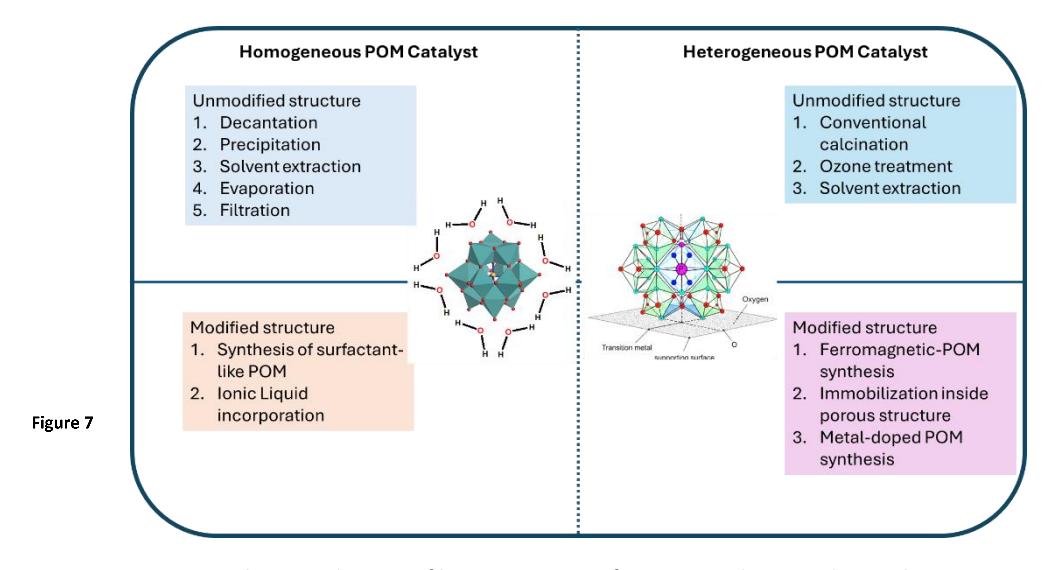
Schematic drawing of known strategies for POM catalyst recycling and regeneration.
Industrial Utilization of POM Catalysts
In the end, industrial applications of POM catalysts are the aspect that is required for sustainable utilization of POMs in biomass valorization. In the field of biomass valorization through conventional thermal catalytic schemes, the use of POMs is still hindered by their deactivation through rapid coke formation and catalyst leaching (Jiang et al., 2025; Xiao et al., 2023). Thus, the use of POMs in biomass valorization through photo/electrocatalysis needs to be developed (Shah et al., 2024). Remarkable inherent proton conductivity, tunable redox properties, and modifiability of POMs are versatile options for multiple catalytic reactions, thus making them viable for any chemical industry as a more sustainable approach in the future (Yu Zhang et al., 2019). Remaining challenges in improving the structural stability of POMs during catalyst regeneration is pivotal for their application in future industrial-scale application.
Conclusion
Polyoxometalates (POMs) have emerged as versatile and effective catalysts for biomass conversion due to their tunable acidic and redox properties. This review comprehensively discussed the properties, preparation methods, and applications of POMs in catalytic processes, with a focus on their use in biomass valorization. POMs demonstrate
excellent performance in various reactions, including oxidation, esterification, and condensation. Their ability to function as both homogeneous and heterogeneous catalysts offers flexibility in their application. However, the challenge of catalyst recovery and recycling, particularly for homogeneous systems, has led to the development of heterogeneous POM catalysts through solidification and immobilization techniques.
The reusability aspect of POM catalysts is crucial for their practical application. Different regeneration strategies have been explored for both homogeneous and heterogeneous systems, addressing issues such as product separation, catalyst deactivation, and thermal stability. These activities include the usage of biphasic solvent systems, surfactant modifications, doping addition, and the development of more thermally stable solid POM catalysts.
Future research in this field should be directed to further enhance the thermal and chemical stability of POM catalysts, improving their regenerability and developing a more benign heterogeneous catalytic system that allows lowertemperature usage. Thus, by developing more benign conditions and also more thermally stable POM catalysts, their usage in biomass valorization for producing biofuels and chemicals can contribute to the development of sustainable green chemistry and chemical engineering. In conclusion, POMs have been shown to have great potential as catalysts for biomass conversion, offering a combination of high activity, selectivity, and potential for regeneration. Continued research and development in this area may significantly contribute to the advancement of sustainable chemical processes and the utilization of renewable resources.
Acknowledgement
Dian H. Wahyudi acknowledges the Ministry of Education, Culture, Research, and Technology of the Republic of Indonesia for the PMDSU (Program Magister menuju Doktor untuk Sarjana Unggul) Batch VI scholarship.
Compliance with ethics guidelines
The authors declare they have no conflict of interest or financial conflicts to disclose.
This article contains no studies with human or animal subjects performed by the authors.