Ever wondered how sheet metal gets its precise bends? It's not just about pressing and folding! Scientists are exploring how small grooves, or 'V-grooves,' cut into the metal before bending can dramatically influence the final shape. This research uses computer simulations to understand how different groove designs affect the bend's sharpness and how much the metal springs back after bending. The goal is to find the perfect groove to achieve the most accurate and desired metal forms.
The art of shaping metal, especially sheet metal, often involves bending it into specific forms. A common technique is V-bending, where a punch presses a sheet into a V-shaped die. However, achieving a perfectly controlled bend, with a precise radius and minimal 'springback' (the tendency of metal to return to its original shape after bending), can be tricky. This study investigates a novel approach: introducing V-grooves into the metal sheet *before* bending.
Using sophisticated computer simulations (finite element analysis in ANSYS LS-DYNA), researchers have explored how the geometry of these V-grooves impacts the outcome of the V-bending process. Think of these grooves as pre-designed stress points that guide the metal's deformation.
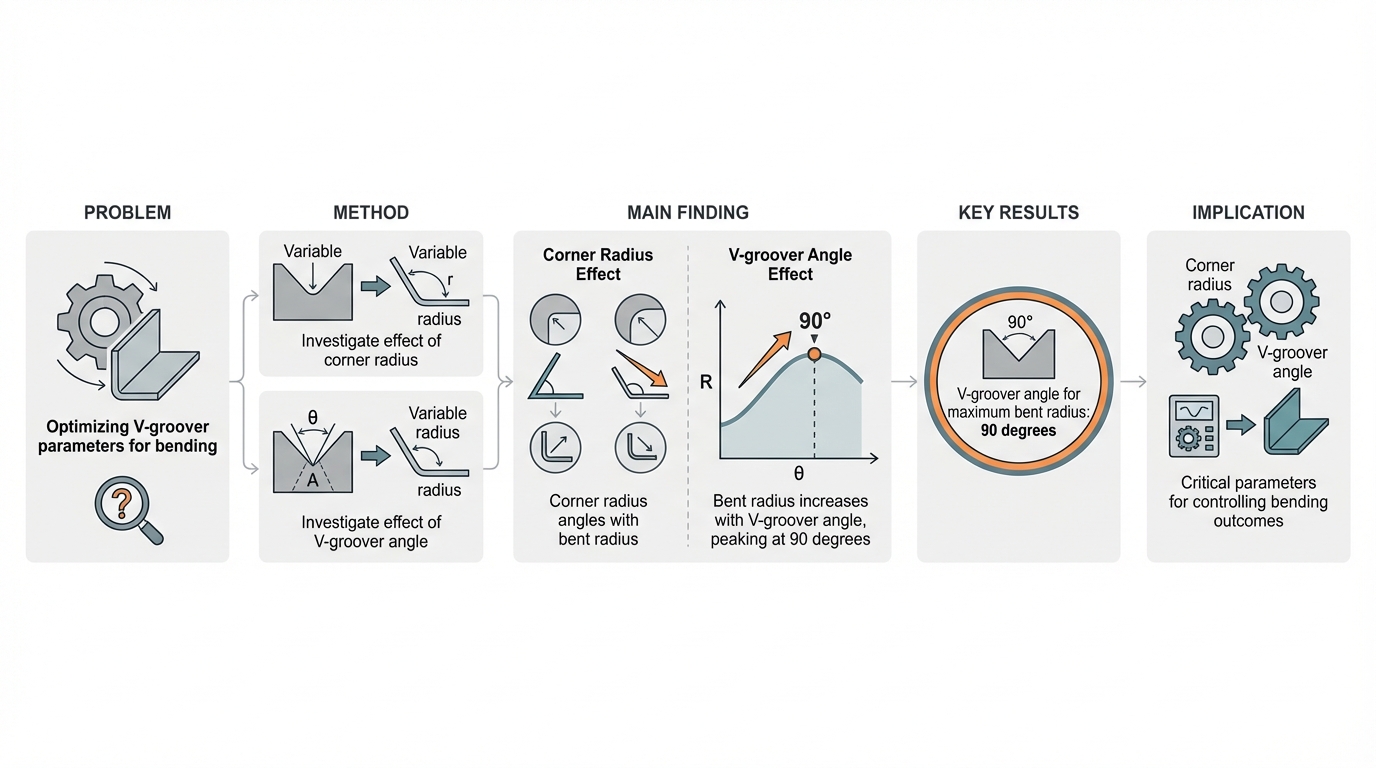
One key finding is the significant role of the groove's corner radius. When the material is removed to create a larger corner radius in the V-groove, it effectively weakens the bending resistance in that area. This leads to a more pronounced bend, resulting in both a smaller final bent angle and a tighter bent radius. It's like scoring a piece of paper before folding it – the score makes the fold easier and more defined.
The overall shape of the V-groove also plays a crucial part. Different groove designs, even if they remove the same amount of material, can lead to variations in the final bent angle and radius. This highlights the sensitivity of the bending process to the precise geometry of the pre-cut grooves.
Interestingly, when the amount of material removed (the cutting cross-sectional area) is kept the same, the bent angle doesn't change much. However, the bent radius is more sensitive. As the angle of the V-groove itself increases, the bent radius also tends to increase, reaching its largest value when the V-groove angle is 90 degrees. This suggests that the angle of the groove is a critical factor in controlling the sharpness of the final bend.
In essence, by carefully designing these V-grooves, manufacturers could gain finer control over the V-bending process, leading to more accurate and predictable metal parts with reduced material waste and improved quality. This research opens up new possibilities for optimizing metal forming techniques through subtle geometric modifications.