
Introduction
Research in the field of automobile-pedestrian accidents is primarily dedicated to developing vehicle safety countermeasures to the response of the human knee joint. Experimental studies of human body behavior have been conducted using cadaveric dissection. All of them attempted to investigate the mechanisms of injury, the injury criterion in relation to the injury status and thus the safety performance of the automobile. When a collision occurs, pedestrians will suffer the most harm and the part that will be in first contact with the vehicle are the lower limbs, even though the severity is lower than when the head is hit, as illustrated in Figure 1 [1]. The lower extremities are the most common encountered injury area in pedestrian collisions (accounting for 37% of moderate injuries), followed by the head (35%). In short, the lower extremities are an area where injuries often occur in car crashes.
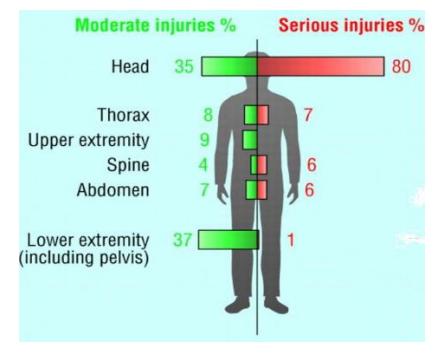
Figure 1 Frequency of injuries and severity of each area of the body when a traffic collision occurs [1].
Copyright ©2024 Published by IRCS - ITB ISSN: 2337-5779
In addition, at relatively low impact speeds (25 km/h to 50 km/h) most crashes occur in urban areas and can result in serious injury or death [2]. Thus, this study focused on impact speeds from 20 km/h to 50 km/h in relation to lower extremity injuries. Behavior of vehicle-pedestrian collision was analyzed in kinematic and dynamic terms by using a finite element (FE) simulation.
In 2010, Daisuke Nakane et al. [3] used a multibody pedestrian model to evaluate injury risk. The injury risk prediction for various standard sizes of the THUMS was studied. However, lower extremity injury criteria were only considered for the 50th-percentile adult male (AM50) model related to bending moment. In addition, bone fractures were not simulated.
Another research to evaluate the influence of gait stance of pedestrians on lower extremity injuries was conducted by Guiling Li et al. [4] in 2015. A limitation of this study was that fractures/failures in the pedestrian model were not simulated. However, the presence of bone fractures and ligament ruptures may affect the subsequent kinematics in the simulation and the magnitude of the predicted injury parameters. In addition, only one pedestrian size was modeled, while the influence of the pedestrian's horizontal velocity was not considered.
To convince that a THUMS HBM can be used to predict pedestrian injuries well in real-world crashes, ten realworld crashes involving pedestrians were reconstructed using numerical simulation by Pushpender Panday et al. [5] in 2021. Injuries estimated from FE simulations were compared with the victim's clinical profile. The study examined the suitability of a THUMS HBM in predicting injuries occurring in real-world automobile-pedestrian collision scenarios. It was found that the THUMS HBM simulation could successfully reproduce the pedestrian kinematics.
In addition, a review study of injury criteria for vehicle safety assessment using a HBM by Filippo Germanetti et al. [6] in 2022 noted that injuries occurring in the lower limbs caused by vehicle impact are generally related to the knee, femur, and tibiae. The use of a HBM allows analyzing lower extremity injuries in detail, examining the stresses on the bones; additionally, for knee ligaments, an assessment of their strain can be calculated.
To represent a typical Vietnamese anthropometry, by scaling down from the THUMS AM50, a V-THUMS was created. It was also adjusted to obtain the NCAP position. For evaluation of lower extremity injuries, multipleobjective comparative research on injuries of different lower extremities has been conducted by Fei Lei et al. [7] in 2021, which was presented in support of the design of front-end structures subject to sedan-pedestrian collision. The experimental models used were FlexPLI (Flexible Pedestrian Legform Impactor) and FlexPLI-UBM (Flexible Pedestrian Legform Impactor with Upper Body Mass). The experimental results of this research were used to validate the V-THUMS in the study of Nguyen et al. [8] in 2023.
Following these previous studies, the present study focused on the influence of impact speed along with pedestrian posture on lower extremity injuries caused by a pickup truck for a typical Vietnamese male. Seven impact angles (0 o , 30o , 60o , 90o , -30o , -60o , -90o ) were investigated under pickup truck-pedestrian impact, with the speed ranging from 20 km/h to 50 km/h. The pedestrians facing towards the vehicle had an impact angle of 30o , 60o , and 90o , while the pedestrians facing away from the vehicle had an impact angle of -30o , -60o , and -90o ). In addition, simulations of lower extremity fractures and knee ligament ruptures were performed to obtain an overview of the extent of the injuries.
Methodology
A Chevrolet C2500 model 1994 pickup truck obtained from the FHWA/NHTSA National Crash Analysis Center [9] was used in this research. The vehicle model was simplified compared to the original one by using the approach presented in Anh et al. 2021 [10] to save computational resources. This method has also previously been used by Kongsakul et al. [11] and was validated with experimental data on frontal impacts. The HBM used was V-THUMS with NCAP posture [8]. V-THUMS was created by scaling THUMS AM50 version 4 created by the Toyota Motor Corporation [12]. The kinematics and dynamics of V-THUMS were analyzed and the results were evaluated based on the lower extremity injury criteria for Vietnam. The geometries of THUMS AM50 and V-THUMS are described in Figure 2. The geometry scaling algorithm published by Untaroiu [13] was used to create V-THUMS from THUMS. Furthermore, V-THUMS was qualitatively verified in Nguyen et al. (2023) [8] by using experimentally tested data (FlexPLI and FlexPLI-UBM models) from the study of Lei et al. (2021) [7].
Geometry comparison of THUMS AM50th and V-THUMS [8].
Reconstruction Finite Element model of Pickup Truck
In this study, only the front shape of the pickup truck struck the pedestrian. Thus, the front structure of the vehicle was necessary for the simulation while the other parts could be eliminated to reduce the number of elements in the model and the simulation time needed. The simplified (new) model should have similar performance in terms of kinematics compared to the original model. The procedure is summarized as follows:
- 1. Delete unnecessary parts.
- 2. Preserve the lost weight and redefine the center of gravity of the vehicle.
- 3. Assign the lost mass to the center of gravity just found to balance the vehicle the same as the original.
- 4. Add boundary conditions to ignore the change in moment of inertia and external forces.
The original and modified C2500 pickup truck models are illustrated in Figure 3. The verification results of the modified model were similar to those in Anh et al. (2021) [8]. A comparison of the technical specifications of the original and modified models is presented in Table 1. The total number of elements in the modified model was reduced by 34% and the mass and location of the center of gravity of the modified vehicle model were kept unchanged compared to the original vehicle model.
Model of Chevrolet C2500 year 1994 pickup truck: (a) original model, (b) modified model.
Table 1 Comparison of the original and modified pickup model.
| Original model | Modified model | Difference | ||
|---|---|---|---|---|
| Number of nodes | 66,586 | 51,525 | 22.62% | |
| Number of elements | 58,404 | 38,700 | 33.74% | |
| Weight (kg) | 2,013 | 2,013 | 0 | |
| x | 2,219.64 | 2,219.64 | 0 | |
| Location of C.G | y | -2.90134 | -2.90134 | 0 |
| z | 664.751 | 664.751 | 0 |
Lower Extremity Injury Criteria
The lower extremities are the most vulnerable area after the head when a traffic accident occurs and the injury level of lower limbs, femur, tibia, fibula, and ligaments also varies. Some studies regarding lower extremity injuries have been published, such as Yasuki and Yamamae (2010) [14], Yasuki (2015) [15], Kerrigan et al. (2003), (2004) [16, 17], Ivarsson et al. (2004) [18], and Bose et al. (2007) [19]. The present study focused on two of the lower extremity injury criteria, i.e., stress (for femur, tibia, and fibula) and strain (for knee ligaments).
Threshold of Stress for Lower Extremity Bones
In the simulation of traffic accident injuries, the Von Mises stress is often used to assess injuries in many areas of the human body such as the head, thorax, lower extremities, etc. In Arnoux et al. 2005 [20], in the shearing tests, the Von Mises stress of bones was higher than in the bending tests and had value of 130 MPa at 10 m/s. In addition, tibia fracture was also found. In another experiment, by Arnoux et al. 2006 [21], the AM50 model stood in front of the Euro NCAP Supermini car model. Braking was applied to the vehicle model with an initial speed of 10.88 m/s and a constant deceleration of 5.58 m/s2 according to the data recorded during experiments. As was done during the experiment, the pedestrian model and more specifically the impacted leg were placed in a slightly flexed position at the same height of the knee joint in front of the vehicle bumper. The analysis in this study focused only on lower extremity behavior during the first phase of pedestrian impact until the first injury appeared on the leg. Based on this, the stress thresholds of the knee ligament used in the present research are described in Table 2 below.
| Bones | Ultimate stress | |
|---|---|---|
| Femur | 125 MPa | |
| Metaphysis | 130 MPa | |
| Tibia | Epiphysis | 110 MPa |
| Head | 125 MPa | |
| Fibula | Diaphysis | 100 MPa |
Table 2 Threshold of stress for lower extremities [21].
Strain Criteria for Ligaments
There are four ligaments in the knee, namely the collateral ligament on the side of the knee (the medial collateral ligament – MCL, and the lateral collateral ligament – LCL) and the cruciate ligament in the center of the knee (anterior cruciate ligament – LCL, and posterior cruciate ligament – PCL). The knee ligament of a real right leg is shown in Figure 4(a), while the knee ligament of a right leg modeled with FEM is shown in Figure 4(b). Several studies about the strain threshold for knee ligaments are available. The model used in Arnoux et al. (2005) [20] was validated by various impact situations to serve as a complete model of the lower extremities and is expected to be functional in different scenarios such as sports traumatology and frontal pedestrian impact. The experimental data of knee ligament injuries were summarized from some sources to conduct a simulation focused on strain criteria. The resulting strain threshold for knee ligaments is presented in Table 3.
Knee ligament detail of the right leg: (a) real joint structure (Knee Pain Explained, n.d.[22]); (b) FEM model of the knee joint structure.
Table 3 Strain threshold for knee ligaments.
| Knee ligament strain | Threshold |
|---|---|
| MCL | 28% |
| LCL | 28% |
| ACL | 22% |
| PCL | 22% |
Result and Discussion
The analyzed impact speed was varied from 20, 30, 40 to 50 km/h. The impact position of the pedestrian was considered at the center of the vehicle front with various impact angles (0°, 30°, -30°, 60°, -60°, 90°, -90°) as illustrated in Table 4. Therefore, a total of 28 cases were studied. In addition, due to the posture of V-THUMS, both knees did not impact each other and the left leg or right leg was hit first depending on the impact angle. Hence, both the left and right legs were focused on in this study.
Table 4 Summary of simulation cases.
Lower Extremity Bone Injuries
The kinematic behaviors and lower extremity bone injuries of both legs when V-THUMS was impacted by the pickup truck are represented in Figures 5 and 6 for a typical case of a 0° impact angle at 50 km/h impact speed. The femur of the right leg was impacted first, after several milliseconds of the initial impact. The pedestrian was knocked over and struck the bonnet, while the lower extremity continued to be struck. Therefore, the femur of the right leg fractured while the femur of left leg did not. In addition, the tibia and fibula of both legs also fractured after a few tens of seconds.

Key frames from the simulation in the case of a 0° impact angle at an impact speed of 50 km/h.
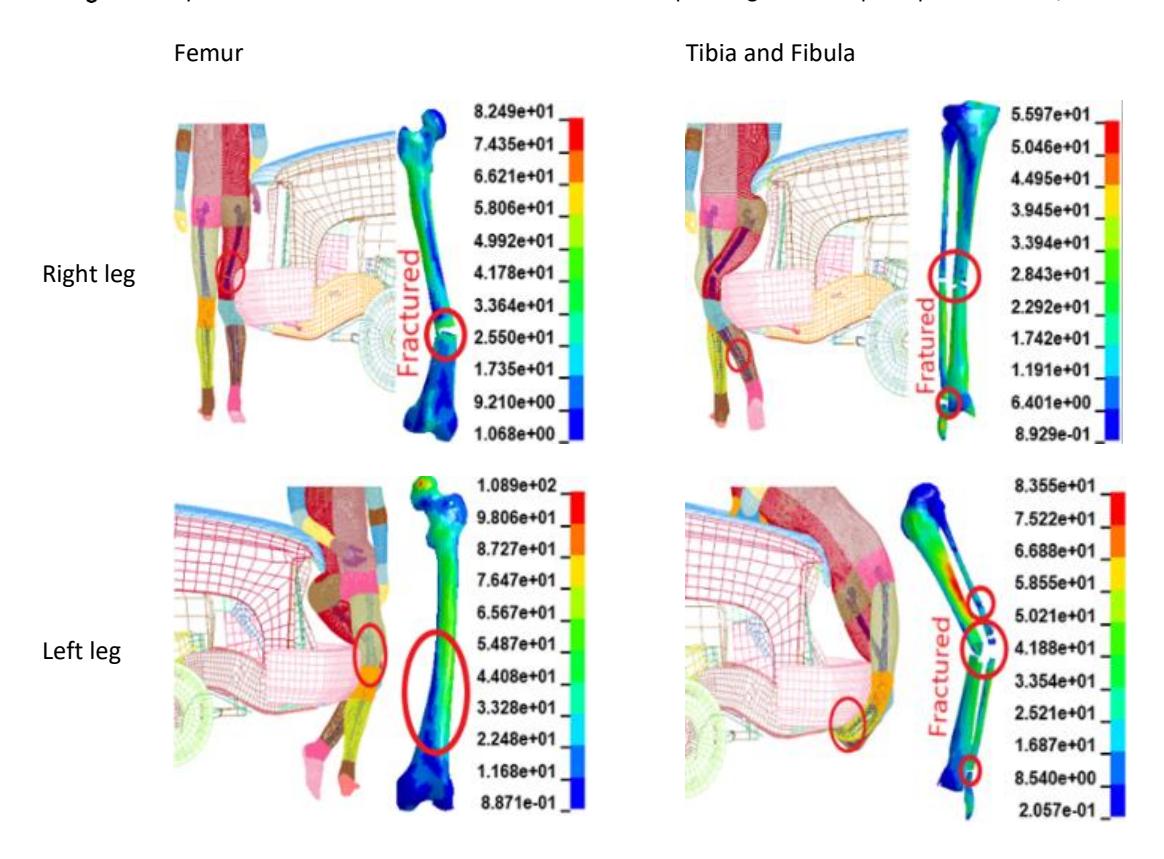
Lower extremity bone injuries of V-THUMS in the case of a 0 o impact angle at 50 km/h impact speed.
The lower extremity bone injuries obtained from all 48 cases are summarized in Tables 5 to 8. It is noted that at an impact velocity of 20 km/h, both legs had no bone fractures regardless of the impact angle. The lower limb bones fractured in general at impact velocity 30 km/h and above, especially the tibia and fibula, and when the impact velocity was higher than 40 km/h, the femur, tibia, and fibula of both the right and the left leg fractured. The injuries of the tibia and fibula were more serious than those of the femur. Because the first impact area is located at the femur of the right leg – except for the case of a -90° impact angle – there were some cases where the femur of the left leg did not fracture until 50 km/h, in particular the cases of a 0° and 30° impact angle.
| Table 5 Summary of lower extremity bone injuries in the case of a 0 | o impact angle. |
|---|
| Impact speed | Leg | Femur | Tibia | Fibula |
|---|---|---|---|---|
| Right leg | - | - | - | |
| 20 km/h | Left leg | - | - | - |
| Right leg | - | Fractured | Fractured | |
| 30 km/h | Left leg Right leg | - | Fractured | Fractured |
| Fractured | Fractured | Fractured | ||
| 40 km/h | Left leg | - | Fractured | Fractured |
| Right leg | Fractured | Fractured | Fractured | |
| 50 km/h | Left leg - | Fractured | Fractured |
| Table 6 Summary of lower extremity bone injuries in the case of 30° and -30° impact angles. |
|---|
| Femur | Tibia | Fibula | |||||
|---|---|---|---|---|---|---|---|
| Impact speed | Leg | 30° | -30° | 30° | -30° | 30° | -30° |
| 20 km/h | Right leg | - | - | - | - | - | - |
| Left leg | - | - | - | - | - | - | |
| 30 km/h | Right leg | Fractured | - | - | Fractured | Fractured | Fractured |
| Left leg | - | - | Fractured | - | Fractured | - | |
| Right leg | Fractured | Fractured | Fractured | Fractured | Fractured | Fractured | |
| 40 km/h | Left leg | - | - | Fractured | Fractured | Fractured | Fractured |
| Right leg | Fractured | Fractured | Fractured | Fractured | Fractured | Fractured | |
| 50 km/h | Left leg | - | - | Fractured | Fractured | Fractured | Fractured |
Table 7 Summary of lower extremity bone injuries in the case of 60° and -60° impact angles.
| Tibia | Fibula | ||||||
|---|---|---|---|---|---|---|---|
| Impact speed | Leg | 60° | -60° | 60° | -60° | 60° | -60° |
| Right leg | - | - | - | - | - | - | |
| 20 km/h | Left leg | - | - | - | - | - | - |
| 30 km/h | Right leg | Fractured | - | - | Fractured | - | Fractured |
| Left leg | - | - | Fractured | Fractured | Fractured | Fractured | |
| Right leg | Fractured | Fractured | Fractured | Fractured | Fractured | Fractured | |
| 40 km/h | Left leg | Femur Fractured - Fractured Fractured | Fractured | Fractured | Fractured | Fractured | |
| Right leg | Fractured | Fractured | Fractured | Fractured | Fractured | ||
| 50 km/h | Left leg | Fractured | Fractured | Fractured | Fractured | Fractured | |
Table 8 Summary of lower extremity bone injuries in the case of 90° and -90° impact angles.
| Femur | Tibia | Fibula | ||||||
|---|---|---|---|---|---|---|---|---|
| Impact speed | Leg | 90° | -90° | 90° | -90° | 90° | -90° | |
| 20 km/h | Right leg | - | - | - | - | - | - | |
| Left leg | - | - | - | - | - | - | ||
| 30 km/h | Right leg | - | - | Fractured | Fractured | Fractured | Fractured | |
| Left leg | - | - | - | Fractured | - | Fractured | ||
| Right leg | Fractured | Fractured | Fractured | Fractured | Fractured | Fractured | ||
| 40 km/h | Left leg | - | Fractured | Fractured | Fractured | Fractured | Fractured | |
| Right leg | Fractured | Fractured | Fractured | Fractured | Fractured | Fractured | ||
| 50 km/h | Left leg | Fractured | Fractured | Fractured | Fractured | Fractured | Fractured | |
Ligament Injuries
The knee ligament injuries of V-THUMS are represented in Figure 7 for a typical case of a 0° impact angle at 50 km/h impact speed. It was found that the ACL and PCL ligaments are more susceptible to rupture in this case, which can also be understood in view of the elasticity of the two ligaments being lower than that of the other two. The results obtained for all cases are presented in Tables 9 to 12. Pedestrians in a walking posture who faced away from the vehicle had fewer ligament injuries than those who faced towards the vehicle. In particular, the two legs had the least ligament injuries at a -90° impact angle. For example, at speeds of 20 km/h to 40 km/h, there were no ruptured ligaments. When the speed reached 50 km/h, the ACL and LCL in the right leg ruptured, while only the ACL in the left leg ruptured. This is the case when the ligaments were the least injured.
In general, among the four types of ligaments, the MCL was less injured compared to the other three ligaments, LCL, ACL, and PCL. In addition, both legs suffered easily ruptured ligaments at impact angles of 60° and 90°. In particular, ACL and PCL almost ruptured even at an impact speed of 20 km/h. Another remark is that in most cases, the LCL and ACL ruptured in the knee at the same time and the left knee was most likely to rupture. This is explained by the fact that the right leg is first impacted in the upper part of the lower extremity, so the possibility of fracture is very high. When the bone is broken, the strain appearing on the ligaments will be reduced and as a result it is less likely to be ruptured than the left leg, which is subsequently impacted without fracture of bones.
Knee ligament injuries in the case of a 0 o impact angle at 50 km/h impact speed.
Table 9 Ligaments' injury in case of 0° impact angle.
| Impact speed | Legs | MCL | LCL | ACL | PCL |
|---|---|---|---|---|---|
| Right leg | - | - | - | - | |
| 20 km/h | Left leg | - | Ruptured | Ruptured | - |
| Right leg | - | - | - | - | |
| 30 km/h | Left leg | - | Ruptured | Ruptured | - |
| Right leg | - | - | - | - | |
| 40 km/h | Left leg | - Ruptured Ruptured - - Ruptured - Ruptured Ruptured | - | ||
| Right leg | - | ||||
| 50 km/h | Left leg | Ruptured |
Table 10 Ligament injuries in the case of 30o and -30o impact angles.
| Impact | MCL | LCL | ACL | PCL | |||||
|---|---|---|---|---|---|---|---|---|---|
| speed | Legs | 30° | -30° | 30° | -30° | 30° | -30° | 30° | -30° |
| Right leg | Ruptured | - | - | - | 0 | - | - | - | |
| 20 km/h | Left leg | - | - | Ruptured | - | Ruptured | - | - | - |
| Right leg | - | - | - | - | - | - | - | - | |
| 30 km/h | Left leg | - | - | Ruptured | Ruptured | Ruptured | Ruptured | Ruptured | - |
| Right leg | - | - | - | - | - | Ruptured | - | - | |
| 40 km/h | Left leg | - | - | Ruptured | Ruptured | Ruptured | Ruptured | Ruptured | - |
| Right leg | Ruptured | - | Ruptured | - | Ruptured | Ruptured | Ruptured | - | |
| 50 km/h | Left leg | - | - | Ruptured | Ruptured | Ruptured | Ruptured | Ruptured | - |
Table 11 Ligament injuries in the case of 60o and -60o impact angles.
| Impact | MCL | LCL | ACL | PCL | |||||
|---|---|---|---|---|---|---|---|---|---|
| speed | Legs | 60° | -60° | 60° | -60° | 60° | -60° | 60° | -60° |
| 20 | Right leg | Ruptured | - | - | - | Ruptured | - | Ruptured | - |
| km/h | Left leg | - | - | Ruptured | - | Ruptured | - | Ruptured | - |
| 30 | Right leg | - | - | - | - | 0 | - | - | - |
| km/h | Left leg | - | - | Ruptured | - | Ruptured | - | Ruptured | - |
| 40 | Right leg | - | - | - | - | Ruptured | - | - | - |
| km/h | Left leg | - | - | Ruptured | - | Ruptured | Ruptured | Ruptured | - |
| 50 | Right leg | Ruptured | - | Ruptured | Ruptured | Ruptured | Ruptured | Ruptured | - |
| km/h | Left leg | Ruptured | Ruptured | Ruptured | - | Ruptured | Ruptured | Ruptured | - |
Table 12 Ligament injuries in the case of 90°and -90° impact angles.
| MCL | LCL | ACL | PCL | ||||||
|---|---|---|---|---|---|---|---|---|---|
| Impact speed | Legs | 90° | -90° | 90° | -90° | 90° | -90° | 90° | -90° |
| 20 km/h | Right leg | - | - | - | - | Ruptured | - | Ruptured | - |
| Left leg | - | - | Ruptured | - | Ruptured | - | Ruptured | - | |
| 30 km/h | Right leg | - | - | Ruptured | - | Ruptured | - | Ruptured | - |
| Left leg | Ruptured | - | Ruptured | - | Ruptured | - | Ruptured | - | |
| Right leg | - | - | - | - | Ruptured | - | Ruptured | - | |
| 40 km/h | Left leg | Ruptured | - | Ruptured | - | Ruptured | - | Ruptured | - |
| Right leg | - | - | Ruptured | Ruptured | Ruptured | Ruptured | Ruptured | - | |
| 50 km/h | Left leg | Ruptured | - | Ruptured | - | Ruptured | Ruptured | Ruptured | - |
Influence of Bone Fractures on Ligament Ruptures
When the femur of the right leg is fractured, the ligament is less stretched, thus resulting in the ligament not rupturing. Three cases were analyzed in this study. All these cases occurred when the pedestrian faced toward the vehicle (at impact angles of 30°, 60°, 90°) at a certain impact speed, as shown in Table 13.
Table 13 Behavior of bone fractures and ligament ruptures of the right leg at 30°, 60°, 90° impact angles.
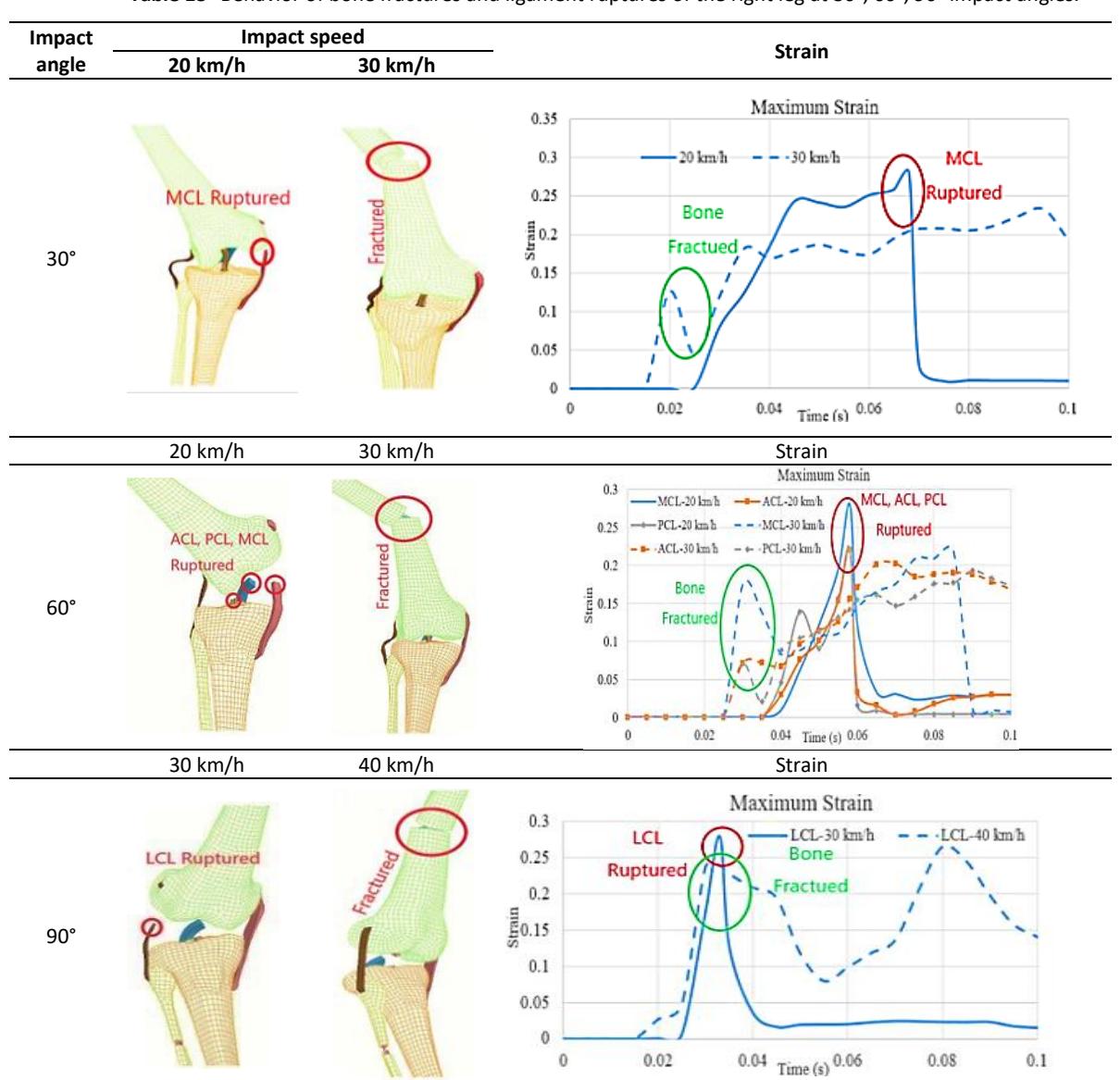
If the impact speed is higher than this value, the kinetic energy is too high to cause both bones to fracture and the ligaments of the right leg to rupture. In particular for the case of a 30o impact angle, when the impact speed was 20 km/h, the MCL ruptured at a strain threshold of 28% between 0.06 s and 0.07 s. When the impact speed was increased to 30 km/h, between 0.02 s and 0.03 s, the strain of the MCL tended to increase to 13% but suddenly dropped to 5% because during this time the femur began to fracture. After that, the strain in the MCL still increased but did not reach the threshold for rupturing. The other two cases had a similar response and can be explained in the same way as the case of a 30° impact angle.
Furthermore, for an explicit demonstration of the influence of bones fractures on ligaments rupture, a simulation study of the effect of bone fractures was conducted for the case of a 60o impact angle and 30 km/h impact speed. The results are shown in Figure 8. When a threshold for lower limb fracture was not applied in the model, the three ligaments MCL, ACL, PCL ruptured (Figure 8(a1)) at 0.04 s to 0.05 s and the maximum strain in the LCL was about 24% at 0.04 s to 0.05 s, as shown in Figure 8(b). In contrast, when the model was set up with a threshold for lower limb fracture (Figure 8a2), only the ACL ruptured, at about 0.07 s. The maximum strain for MCL, PCL, LCL was 21%, 19% and 7%, respectively, as shown in Figure 8(b).
Therefore, it can be remarked that bone fractures significantly affect ligament rupture at a certain low impact speed when the pedestrian faces toward the vehicle, in other words, a fractured bone will reduce the stretching level of the ligament.
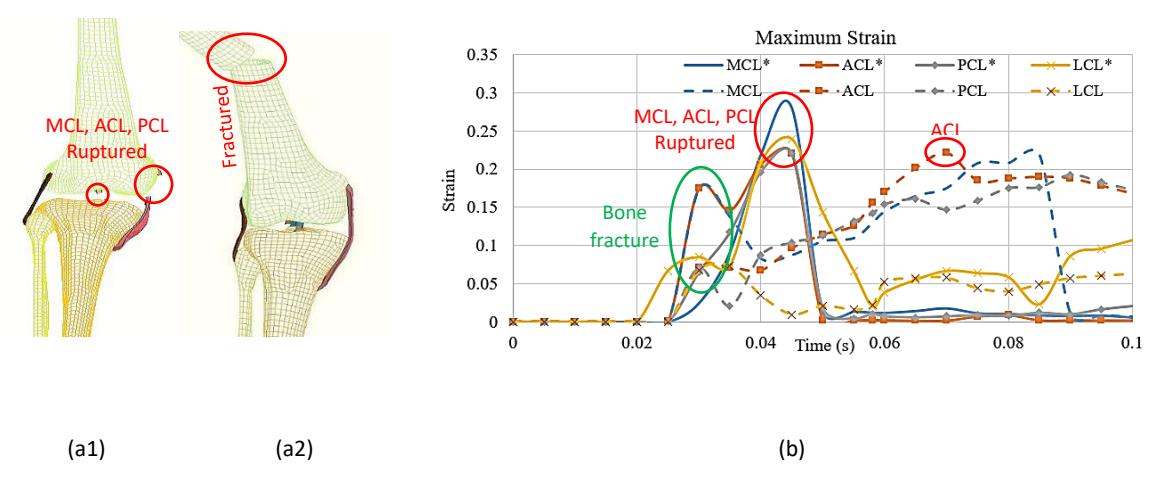
Behavior of ligaments with the effect of bone fracture: (a1) response of ligaments without bone fracture; (a2) response of ligaments with bone fracture; (b) maximum strain in the ligaments (solid lines depict the case without bone fracture; dash lines depict the case with bone fracture).
Conclusion
This study used V-THUMS, representing a Vietnamese pedestrian in walking posture impacted by a Chevrolet C2500 year 1994 pickup truck to study the effect of impact speed and pedestrian position on lower extremity injuries in traffic accidents. The simulation results revealed that the injuries in both legs of V-THUMS were different when struck by the pickup truck. Some notable conclusions were found:
- 1. Lower extremities are injured more when the pedestrian faces toward a vehicle than when facing away from the vehicle, especially in the case of ligament rupture.
- 2. The femur is harder to fracture than the tibia and fibula even when it is struck first, because the bone of the femur is very hard and thick.
- 3. At a certain impact speed, the injuries in both legs depend on the impact angle. In particular, considering the right leg for the case of 20 km/h impact speed, no ligament injury was found at impact angle 0o ; there was a ruptured MCL ligament at impact angle 30o ; there were three ruptured ligaments (MCL, ACL, and PCL) at collision angle 60o , and there were two ruptured ligaments (ACL and PCL) at impact angle 90o .
- 4. Bone fracture significantly affects ligament rupture at a certain impact speed for every impact angle when the pedestrian faces towards the vehicle. The fractured bone will reduce the stretching level of the ligament.
5. In case of a 20 km/h impact speed, injuries of the lower extremities were the least serious. There was no bone fracture, only several ruptured ligaments were found. Thus, it can be considered as a recommendation for vehicles to move in crowded areas at a speed of less than 20 km/h, thus ensuring less injury when a traffic collision occurs.
Acknowledgements
This research was funded by Vietnam National University Ho Chi Minh City (VNU-HCM) under grant number C2022-20-05. We also acknowledge Ho Chi Minh City University of Technology (HCMUT), VNU-HCM for supporting this study.
Abbreviations
HBM = Human Body Model
THUMS = Total Human Model for Safety
V-THUMS = THUMS with Vietnamese anthropometric characteristics
FE = Finite Element
FlexPLI = Flexible Pedestrian Legform Impactor
FlexPLI-UBM = Flexible Pedestrian Legform Impactor with Upper Body Mass
CG = Center of Gravity
MCL = Medial Collateral Ligaments LCL = Lateral Collateral Ligaments ACL = Anterior Cruciate Ligaments PCL = Posterior Cruciate Ligaments