
Introduction
Considering the increases in global temperatures, climate change, and air pollutants caused by many industries, including the manufacture of asphalt mixes, the approach of warm-mix asphalt (WMA) technology is becoming prominent. Also, many asphalt industry researchers and contractors have made attempts to reduce the temperature of the asphalt mixture during production, the fuel consumption, and the emission of environmental pollutants. This technology can also increase the asphalt carrying distance and minimize the secondary aging of asphalt mixtures [1]. Natural additives, chemical additives, and bitumen additives are three important categories of additives used in this type of asphalt mixture. The bitumen category is divided into water-based and water-containing additives. By reducing bitumen viscosity, natural additives can reduce the mixing temperature, while chemical additives can diminish the temperature of the mixture by lowering the friction level between bitumen and cementitious materials [2].
Numerous studies have demonstrated that the structural and content features, the source of the pure bitumen, and the chemical makeup of the additives all influence the rheological and mechanical attributes of bitumen and asphalt mixes [3],[4]. Because the mixing and compaction temperatures of WMA are lower and aging conditions are less severe, it is generally predicted that asphalt mixtures will have lower rutting and moisture damage resistance than traditional mixtures. Additionally, the type of additives, the amount of moisture in the stone materials, the type and source materials, the rate at which bitumen ages, and the degree of adhesion between bitumen and stone materials are some of the factors that affect how sensitivity to moisture asphalt mixtures are and how easily they rut [3],[5]. The impact of
additives with various bases (Sasobit, Kaowax, Zeolite, and PAWMA) on the mechanistic characteristics of bituminous mixtures with and without reclaimed asphaltic pavement, including rutting, cracking, and moisture susceptibility, were assessed in a study carried out by Yousefi and his coworkers in 2020. The findings of this study demonstrated that the sort of utilized additive can impact the mechanistic properties of asphaltic mixes. Unlike other additives, the utilization of PAWMA has enhanced moisture damage resistance. In addition, the results demonstrated that the use of all additives enhanced the fatigue cracking endurance. On the other hand, this research showed that, except for zeolite, the additives increased the rutting resistance of WMA mixes [1]. Additionally, the Sasobit addition demonstrated improved resistance to moisture susceptibility in the following experiment [6].
Similarly, another study investigated moisture damage, rutting, and fatigue of mixtures modified with coconut powder as an additive. The results of this research should improve the fatigue performance of the asphalt mixture; this may be due to the reduction in production temperature and the reduction in the aging rate of the asphalt mixtures, however; it could also lead to an increase in rutting [7]. Moreover, in another research, the mechanical properties of four types of additives were investigated. The results of this research showed that the utilization of additives decreased the viscosity values of the enhanced bitumen and that by reducing the production temperature, it reduced the amount of energy depletion and the production of air contaminants was reduced as well. In addition, the research showed that mixtures modified with these additives increased the rutting resistance [8]. Furthermore, in research conducted by Abdullah et al. to evaluate the high-temperature characteristics of warm asphaltic mixes containing chemical additives, it was concluded that the modified asphalt mixture showed better rutting and moisture damage resistance compared to the unmodified asphalt mixture [9].
Therefore, according to several previous studies, it can be concluded that the type of additives used and the type of bitumen and stone materials used can have various consequences on the performance of modified asphaltic mixes. In some cases, the researchers reached different conclusions about the effect of these additives on the rutting and moisture susceptibility of the asphalt mixtures. On the other hand, the percentages of these additives play an essential role in the performance of asphalt mixtures, which has not been studied sufficiently to determine the appropriate percentage of these additives according to the environmental and traffic conditions of the region. Consequently, the present research tried to address the gap created in past studies regarding this issue. Therefore, the main goal of this study was to assess the influence of using various percentages of added agents on the mechanical properties and durability of WMA mixes. Also, in this study, a performance interaction diagram (PID) was utilized to determine the appropriate percentage of additives to use.
Materials used and Methodology
Asphaltic Binder
A base asphaltic binder of PG 64-22 (penetrating grade 60/70) was used. Table 1 lists some important characteristics of base asphaltic binders.
| Specification limits | ||||
|---|---|---|---|---|
| Testing | Standard | Min. | Max. | Results |
| Penetration at (25 ℃) (0.1) | ASTM D-5 | 60 | 70 | 62 |
| Softening point (℃) | ASTM D-36 | 46 | 48.5 | |
| Ductility at 25 ℃ (cm) | ASTM D-113 | 100 | 130 | |
| Flashpoint, ℃ | ASTM D-92 | 232 | 290 | |
| Specific gravity | ASTM D-90 | 1.010 | 1.060 | 1.018 |
Table 1 The physical attributes of the base asphaltic binder
WMA Additives
In this study, two sorts of additions were used to modify the base binder: organic additive (Sasobit) and water-based bituminous foam (Zeolite). Sasobit is an aliphatic hydrocarbon with a chain length of 40–115 carbon atoms that is created by polymerization using the Fischer–Tropsch method. Sasobit melts in a range of temperatures between 85 and 115 degrees Celsius [10]. 2%, 4%, and 6% of Sasobit were used as substitute for pure bitumen. Zeolites were hydrated and microporous aluminosilicate minerals with a porous structure. They are composed of silica (SiO) and tetrahedral alumina (AlO), forming a white-to-red powder. Dosages 2%, 4%, and 6% zeolite were added by the mass of the base asphaltic binder. The physical attributes of Sasobit and Zeolite utilized in this research are presented in Table 2.
| Specification | |||
|---|---|---|---|
| Attributes | Sasobit | Zeolite | |
| Components | Alpha-polyethylene hydrocarbons | Amine-based | |
| Physical state | Plastic and Peril | Solid | |
| Color | White | White | |
| Odor | Odorless | Odorless | |
| Solubility in water | Insoluble | Insoluble | |
| Specific gravity | 0.62 gr/cm3 | 3 2.7 gr/cm | |
| Solubility in water | No soluble | No soluble | |
Table 2 Characteristics of sasobit and zeolite.
Mineral Aggregate
In this research, limestone materials with an ultimate nominal size of 12.5 mm were used. Table 3 shows the physical characteristics of the materials utilized in this research. Also, the granulation diagram for different asphalt mixtures is the same, as shown in Figure 1.
Table 3 Mineral aggregate physical characteristics.
| Tests | Standard | Virgin Aggregate | Standard limit |
|---|---|---|---|
| Los Angeles abrasion (%) | ASTM C131 | 23 | ≤ 30 |
| Two fracture faces | ASTM D5821 | 90 | ≤ 93 |
| Fine aggregate specific gravity | ASTM C128 | 2.48 | |
| Coarse aggregate specific gravity | ASTM C127 | 2.58 |
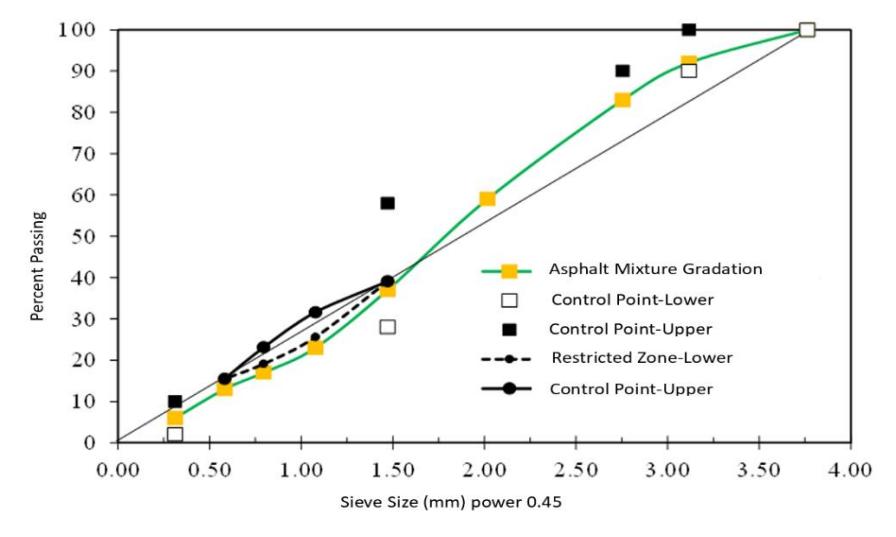
Aggregate gradation and specification limits.
Mixture Design
The basic binder in this research was heated to 125 °C. WMA additives were then added and the mixture was mixed for eighteen minutes to create modified asphalt binders. The Superpave mixing design technique was then used to estimate the ideal proportion of asphalt, with level 1 and heavy traffic (121 gyrations). Strict adherence to all Superpave mix design parameters resulted in the optimal binder content. The volumetric properties are shown in Table 4. Consistent binder content was employed across asphalt mixtures in our study to maintain uniformity in binder percentages. This decision was made to facilitate a comparative evaluation of asphalt mixture performance without the confounding variable of varying optimum binder content.
| Volumetric attributes | Standard | Outcomes | |
|---|---|---|---|
| Air void % | 4% | 4% | |
| VMA % | 13% ≤ | 15.30% | |
| VFA | (65-75)% | 73.44 % | |
| Dust proportion | 0.6-1.2 | 0.91 % | |
| % Gmm @ Ninit=9 | <89% | 87.34% | |
| %Gmm @ Nmax=121 | <98% | 96.90% | |
| OBC (%) | 5.20% | ||
Table 4 Volumetric attributes of the designed asphalt mix
Experimental Plan
This study has evaluated the resistance to rutting, cracking, and moisture sensitivity of modified asphalt mixtures using dynamic creep, semi-circular bending, and indirect tensile strength tests, respectively. The bitumen was separately modified with varying percentages of Sasobit and Zeolite additives, specifically 2%, 4%, and 6% for each additive. Also, in the end, a functional interaction diagram was used to determine the appropriate percentage of the use of the additive. Fig. 2 shows the experimental plan flow chart.
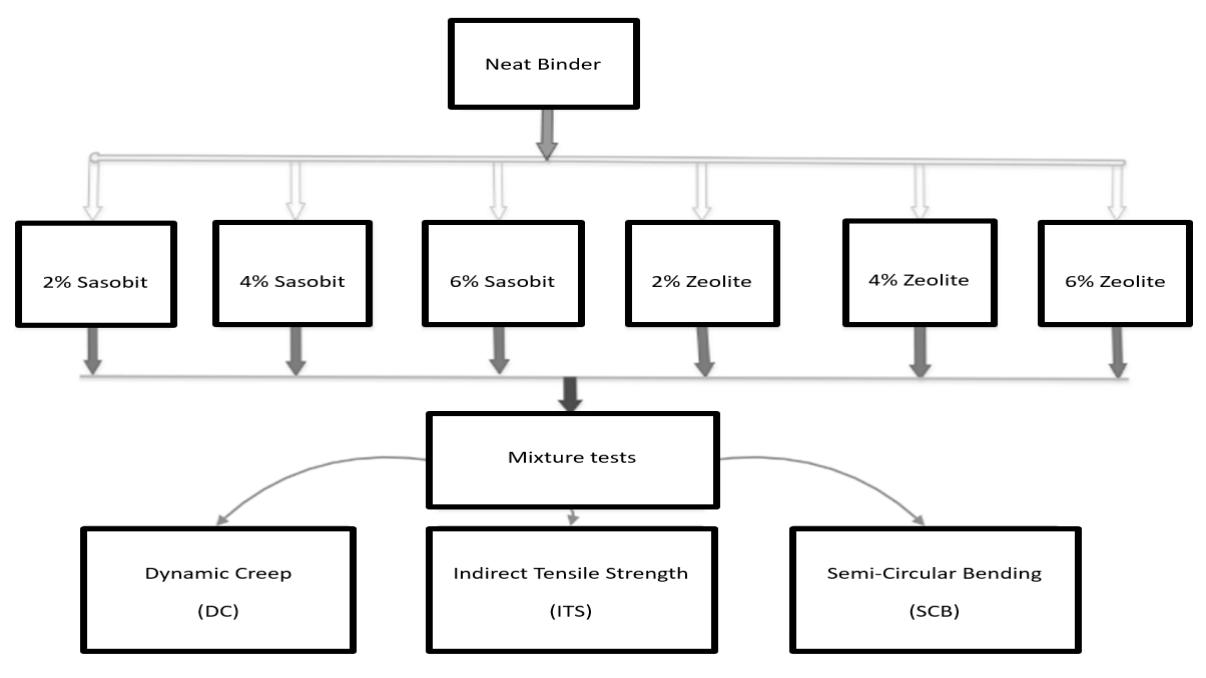
Experimental plan flowchart
Experimental Work
This section provides an overview of the investigational testing conducted to determine how WMA additives affect WMA's mechanical properties and durability.
Dynamic Creep (DC)
Rutting is one of the possible failures in areas with high temperatures and high traffic. The amount of passing traffic, especially heavy vehicles, and the area where the pavement is built in a hot region, the possibility of rutting failure in this area is higher. For this reason, many researchers and contractors in the asphalt industry have been trying to modify pure bitumen and enhance the rutting endurance of asphaltic mixtures [8].
So far, various methods have been utilized to assess the rutting properties of asphaltic mixes. The dynamic creep test is among the easiest and most popular of this kind of test. Flow number and cumulative strain are two important parameters in this type of test, which are utilized to assess the rutting of asphaltic mixes. To perform this test (AASHTO
TP 79–15), a universal testing machine (UTM-5P) was utilized; firstly, the samples were prepared for five hours at 60 \(^{\circ}\)C and then were subjected to sinusoidal loading at 414 kPa with half a second of loading and 1.5 seconds of loading in each cycle. Figure 3 shows an example of the output graph of the dynamic creep test. This graph includes the first, second, and third phases of the test process. The load cycle number at which the graph moves from the second to the third region is introduced as a flow number. The Franklin model was utilized to estimate the flow number of the different asphaltic mixes. This model expresses the relationship between the load cycles (n) and the accumulated strain (\(\epsilon\)p), according to the relationship shown in Eq. (1).
\[\varepsilon_n = An^B + C(e^{Dn} - 1) \tag{1}\]
With the constants A, B, C, and D, both the first and second derivatives can be used to determine the FN, as shown in Eqs. (2) and (3), respectively:
\[\frac{d\varepsilon\rho}{dn} = ABn^{B-1} + Ce^{Dn} \tag{2}\]
\[\frac{d^2\varepsilon\rho}{dn^2} = AB(B-1)n^{B-2} + CD^2e^{Dn} \tag{3}\]
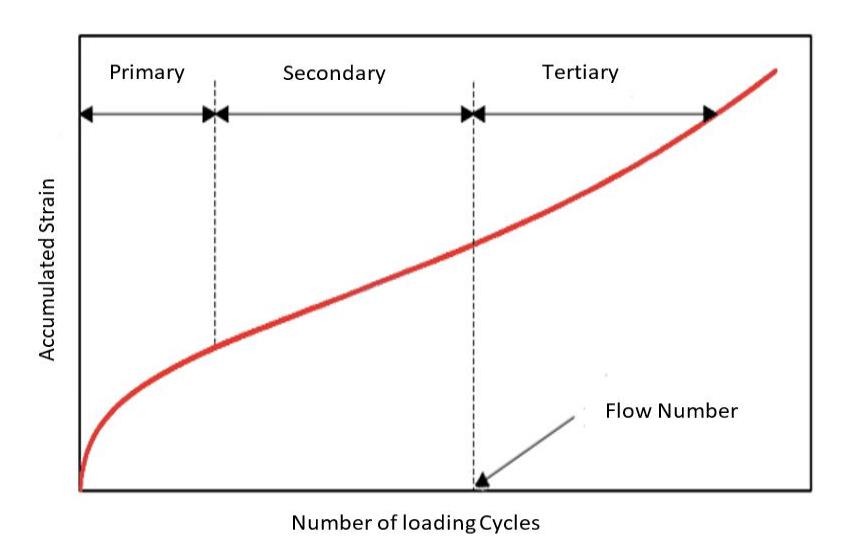
Figure 3 The cyclic loading pattern of a typical asphalt mixture
Moisture Susceptibility (TSR)
Moisture failure is a major pavement failure that causes other pavement failures. The lack of proper cohesion of bitumen components and the lack of proper adhesion between bitumen and stone materials can cause this damage [11-13]. Many studies have shown that during the use of WMA technology, due to the reduction in the fabrication temperature of asphaltic mixes, stone materials may not dry completely and the moisture in it may cause asphalt mixture failure. Therefore, it can be said that WMAs are more susceptible to moisture damage than traditional mixes [1, 11]. In this research, an indirect tensile strength (ITS) test, following the AASHTO T283 specification, was utilized to evaluate the moisture susceptibility of modified asphalt mixtures. To perform this test, six specimens were made with an air void of \(7 \pm 0.5\) percentage, of which three samples were prepared under saturated conditions, and the other three samples were prepared under unsaturated conditions. To prepare the saturated sample, a vacuum pump was used to induce a negative pressure of 70-80%. Next, the saturated samples were put in a freezer for 16 hours at (-18°C), and then the specimens were put in a water bath at 60 °C for 24 hrs. In the final stage, the saturated and unsaturated samples were placed in a water bath at 25 °C.
The ITS values were calculated as in Eq.(4):
\[ITS = \frac{2000P}{\pi D t} \tag{4}\] where P, D, and t stand for the specimen's maximum load (N), diameter (mm), and thickness (mm), respectively.
The tensile stress ratio (TSR) was used to determine if the asphaltic mixes were subjected to moisture sensitivity. As shown in Eq. (5), the TSR was calculated by dividing the average ITS values of conditioned samples by the ITS values of an unconditioned specimen.
\[TSR = \frac{ITS \ con}{ITS \ uncon} \tag{5}\]
Semi-circular Bending Test (SCB)
A semi-circular bending test according to the AASHTO TP 124 standard was used to evaluate the resistance of the asphalt mixtures against cracking. To create semi-circular bending test samples, a cylindrical sample measuring 150 mm in diameter and 170 mm in height was first created. A water jet was then used to cut the sample into 30 mm discs. Next, each of the cut discs was cut in half and a 20 mm length gap was created in the center of the created samples. Figure 4 demonstrates the phases of making SCB samples from cylindrical gyratory samples. To operate this test, the samples were broken under a loading rate of 3 mm/min after being kept at 25℃ for 4 hours, and the parameters of energy required for failure (FE) and flexibility index (FI) were calculated for each of the samples. According to AASHTO TP 79- 15 the flexibility index and the energy required to break semi-circular bending samples for different asphalt mixtures were calculated according to Eqs. (6) and (7).
\[FE = \frac{W_f}{A} = \int (p) \frac{du}{A} \tag{6}\] where A = the area ligament and Wf = the area under the curve.
\[FI_t = 0.01 * \frac{FE}{|m|} \tag{7}\] where t is the average specimen thickness (mm), A is the ligament unit area, m is the load-displacement curve's slope at the inflection point, and Wf is the area under the curve.
SCB specimen preparation and processing [1].
Results and Discussion
Dynamic Creep (DC)
Figure 5 shows the dynamic creep test outcomes for asphalt mixtures enhanced with various percentages of additives. As the figure illustrates, the use of additives increased the flow number of asphaltic mixes and led to an improvement in the strength of modified asphalt mixtures. The increase rate was more noteworthy with the rise in the percentage of these additives. This increase was higher for the mixtures containing Sasobit than for the mixtures modified with Zeolite. The use of 2%, 4%, and 6% of Sasobit increased the flow number by 220, 500, and 790%, respectively, while for 2%, 4%, and 6% of Zeolite the flow number increased by 111, 450, and 558%. The increase in the flow number of the asphalt mixtures is supported by the network structure and the enhanced stiffness of the modified bitumen leading to an increase in the stiffness of the asphalt mixtures and resistance to rutting.
The AASHTO TP 79-15 standards have introduced a minimum flow number of 740 as the quality control limit of asphalt mixtures against rutting of roads with heavy traffic (more than 30 million ESALs). According to this standard, it was observed that the modified mixtures with 2% Sasobit and Zeolite were not yet able to meet the criteria to pass the rutting resistance condition. However, increasing the percentage of additives (4 and 6% of Sasobit and Zeolite) provided the necessary resistance for the modified mixtures. Therefore, it is recommended to use 4% and 6% of Sasobit and
Zeolite addition according to the criterion of resistance against rutting. The amount of accumulated strain for asphalt mixtures at various percentages of Zeolite and Sasobit are illustrated in Figure 9. The results indicated that the use of Zeolite and Sasobit additives resulted in a reduction in accumulated strain, with a more notable decrease observed at higher percentages of these additives. This decrease signifies an increase in resistance to rutting. Comparing equal percentages of Zeolite and Sasobit, the additive Zeolite has shown a greater reduction in accumulated strain. This suggests that, compared to Sasobit, Zeolite has a more significant impact on resistance to rutting.
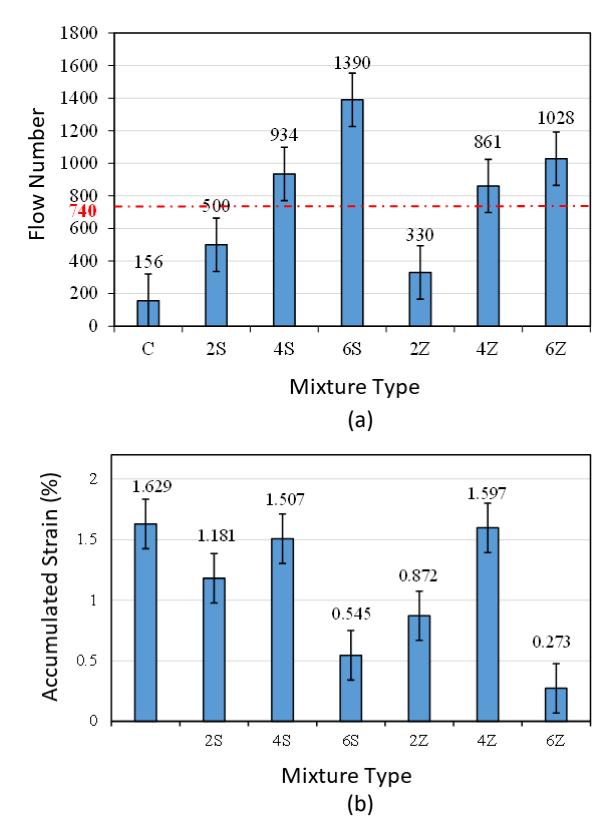
Accumulate strain and flow number results of the different asphalt mixtures.
Indirect Tensile Strength (ITS)
Figure 6 illustrates the indirect tensile strength test results of the modified asphalt mixtures with different percentages of additives. As the results show, using these modifiers increased the value of indirect tensile strength of the modified samples in the wet and dry states. The value of indirect tensile strength of modified asphalt mixtures increased with the increase in the percentage of these additives. Thus, the mixture containing 6% Sasobit had the highest ITS value in a dry state with an increase rate of 69%. Also, the mixture containing 6% Zeolite with a 38% increase had the most ITS increase in a wet state. This increase in the amount of ITS in wet and dry states can be attributed to the structure of the Sasobit network and the increase in stiffness of bitumen modified with additives.
Furthermore, the results of the indirect tensile strength ratio of modified asphalt samples in wet and dry states are shown in Figure 6. According to the figure, it can be noticed that the use of Sasobit reduced the amount of TSR so that the use of 2%, 4%, and 6% of Sasobit reduced the percentage of TSR by 5.5, 14 and 23%, which many other researchers have also concluded. In contrast, the results of the indirect tensile strength test showed that the use of Zeolite increased the resistance of moisture susceptibility and the value of the TSR parameter.
It increased the TSR value by 10%. The AASHTO T283 standard proposes a criterion of 80% for the TSR value to determine whether asphalt mixtures pass or not. Asphalt mixtures with a TSR greater than 80% mean that the mixture has the necessary resistance to moisture damage. Taking this into account, the asphalt mixtures with Zeolite passed the minimum resistance of moisture susceptibility. In contrast, Sasobit's TSR was less than 80%, indicating that, due to the use of aggregate materials with high susceptibility to moisture damage (such as siliceous aggregates), the use of Sasobit in these types of asphalt mixtures should not be recommended.
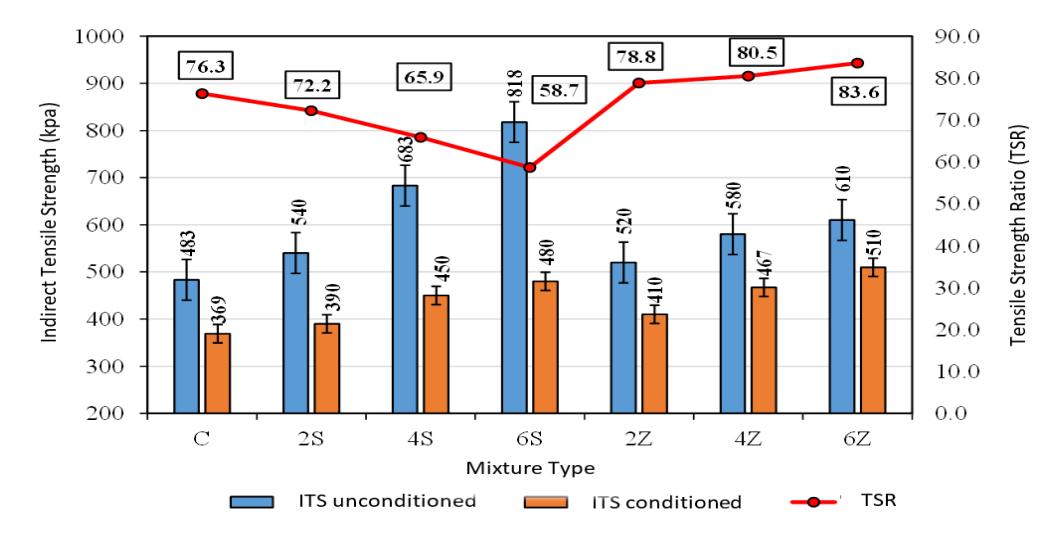
The results of ITS and TSR results for different asphalt mixtures.
Semi-Circular Bending (SCB)
The results of the semi-circular bending test and the value of the fracture energy parameter at a temperature of 25 °C are shown in Figure 7. In general, the results show that the use of additives increased the amount of energy required to break the asphalt mixtures. The mixtures modified with Zeolite additives showed better-cracking resistance than those modified with Sasobit additives. This could be due to reducing bitumen aging during the mixture production, as reported by previous researchers [1, 14-16]. The use of 2%, 4%, and 6% of Sasobit increased the FE by about 23%, 56%, and 86%, respectively. Also, using 2%, 4%, and 6% of Zeolite increased the value of FE by about 30%, 68%, and 89%, respectively.
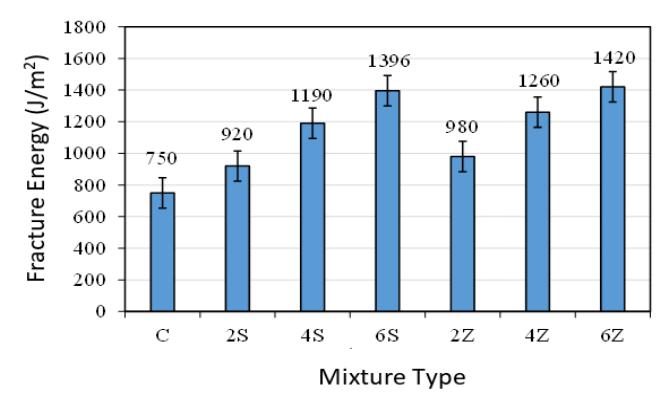
Variations in asphalt mixes' fracture energies.
The value of the FI parameter for different asphalt mixtures at 25 °C is given in Figure 8. According to the figure, it can be seen that the use of 2%, 4%, and 6% of Zeolite generally increased the value of the flexibility index. This increase was the highest for the mixture containing 6% Zeolite with a 79% increase, while for the mixtures modified with 4% of Sasobit increased the flexibility index value by 64%, then reducing the flexibility index by increasing the Sasobit additive to 6%. This could be due to the increase in stiffness and the decrease in flexibility of the modified mixtures due to the network structure created in the bitumens modified with Sasobit. Despite the decrease in the FI value of the mixtures with 6% Sasobit compared to the lower percentages, the flexibility index value of this mixture was still higher than the value for the traditional mixture. Many previous studies used a value of FI equal to 8 as the boundary limit of the functional investigation of cracking using the ductility index. Thus, if a mixture has an FI greater than 8, it indicates an appropriate performance of cracking resistance at medium temperature. The results illustrate that among the different asphalt mixtures, 2% and 4% of Sasobit and mixtures modified with 4% and 6% of Zeolite have an FI value higher than 8 and therefore improved cracking resistance.
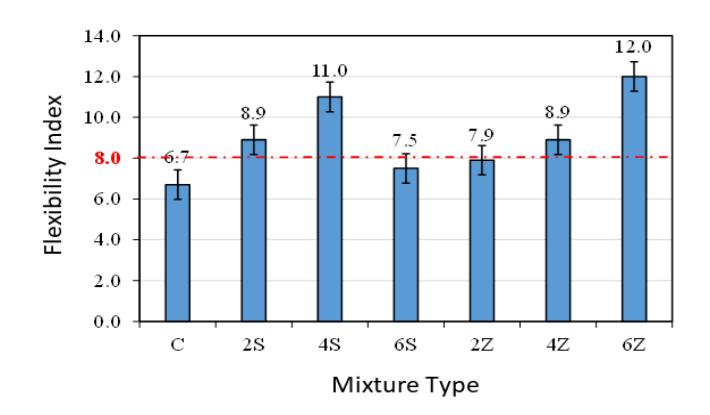
The flexibility index of different asphalt mixtures.
Performance Interaction Diagram (PID)
One of the most important concerns of asphalt industry engineers and contractors is the production of asphalt mixtures that are resistant to major pavement failures and suitable for the environmental and traffic conditions of the region. For example, the asphalt mixture designed for hot sregion should differ from the asphalt type designed for cold regions. For hot regions, rutting failure is one of the most likely types of failure for these weather conditions. For cold regions, cracking, and moisture failure are the main types of pavement failure. Therefore, it is necessary to design the asphalt mixture considering the environmental and traffic conditions and the major damages that occur in that area. The use of a performance interaction diagram is one of the methods of producing suitable asphalt mixtures taking into account the environmental and traffic conditions and major damage to the pavement [17].
The performance interaction diagram of asphalt mixtures modified with 0, 2, 4, and 6% of Sasobit and Zeolite is shown in Figure 9, to distinguish suitable asphalt mixtures in terms of rutting and cracking resistance. The performance interaction diagram is divided into four quadrants:
- 1. The first quarter (Q1): mixtures having a high tendency for rutting yet considerable resilience against cracking (soft and flexible).
- 2. Second quarter (Q2): mixtures that are not prone to rutting and cracking (stiff and flexible). An ideal quadrant is an area inside the green boundary.
- 3. Third quarter (Q3): exceptionally weak resistance to rutting and cracking (soft and unsteady).
- 4. Fourth quarter (Q4): The resistance to rutting is good, while the resistance to cracking is low (brittle and stiff).
To distinguish between asphalt mixes with acceptable performance and those with poor performance, there are established threshold values for both FI and TSR. Several preliminary investigations establish threshold values of 8 for FI (a measure of cracking) and 80 for TSR (an assessment of moisture susceptibility) for asphalt mixes. Furthermore, the AASHTO TP 79-15 suggests using the FN value above 740 as the rutting resistance passing condition for high-traffic volume roads (ESALs > 30 million) [18]. As shown in Figure 9, mixture C, which falls into QIII and had the worst performance in terms of rutting, cracking, and resistance to moisture damage, has a large potential for rutting and low resistance to cracking. The addition of the Sasobit and Zeolite raises the FN and FI values of the asphalt mix. Nevertheless, the altered asphalt mixture is in the QI zone and does not have the required resistance to rutting. The performance of asphalt mixtures has been enhanced by the addition of 4%, 6% of Zeolite, and 4% of Sasobit. As a result, the control mixture has been moved to the second quadrant green section. In light of this, it can be concluded that using 4% and 6% Zeolite and 4% Sasobit will result in an asphalt mixture that is suitable for the area under consideration. Furthermore, the pure mixture moved from the third zone to the fourth zone because of using 6% Sasobit (with a good performance against rutting and weak against cracking).
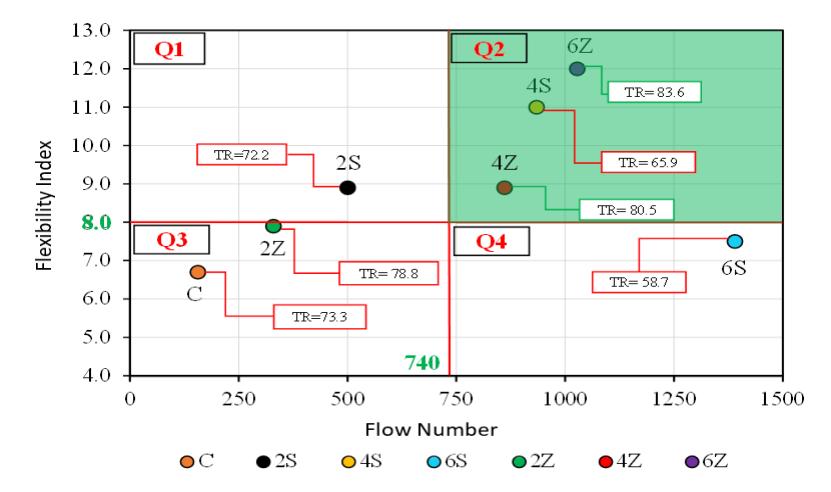
The flexibility index of different asphalt mixtures.
Concluding Remarks
The purpose of this research was to evaluate the effects of various additive percentages on warm-mix asphalt's performance. Two types of additives were used: Sasobit as an organic additive and Zeolite as a water-based additive and bituminous foam. The operation of the asphaltic mixes was assessed using a performance interaction diagram (PID), taking into account the evaluation of rutting and cracking endurance.
The incorporation of WMA additives, such as Sasobit and Zeolite, has shown significant improvement in the performance of the asphalt mixtures, particularly in terms of rutting resistance, as estimated by the flow number (FN). The type of additive used also plays a crucial role in moisture susceptibility, with Zeolite enhancing moisture resistance, while Sasobit had a detrimental effect. Mixtures with Zeolite exhibited a tensile strength ratio (TSR) above 80%, indicating strong moisture resistance at 4% and 6% dosages. Both additives contributed to improving the cracking resilience of asphalt mixes, as evidenced by increased flexibility index (FI) values, except in cases where 6% Sasobit was used. Additionally, modifying asphalt mixtures with these additives increased fracture energy (FE), with Zeolite having a more pronounced effect compared to Sasobit. The increase in FE was generally proportional to the content of the modifier.
According to the performance interaction diagrams (PID), adding 4% of Sasobit and 4% and 6% of Zeolite increased the rutting and cracking resistance. This emphasizes the significance of using a PID approach when designing mixtures.
Acknowledgement
The authors acknowledge the financial support provided by Mustansiriyah University and Al-Kitab University through their respective research funding schemes, which played a crucial role in enhancing the quality of this research.
Compliance with ethics guidelines
The authors declare that they have no conflict of interest or financial conflicts to disclose.
This article does not contain any studies with human or animal subjects performed by any of the authors.