
Introduction
Emerging pollutants such as microplastics (MPs) and "forever chemicals" such as perfluoroalkyl substances (PFAS) are of current concern to environmental scientists globally (Enyoh et al., 2022; Enyoh et al., 2023a). Both pollutants are persistent and bioaccumulated in the environment which has led to their widespread contamination of the environment, including surface water, groundwater, soil, and air, and leading to its bioaccumulation in the food chain (Babut et al., 2017; Cverenkárová et al., 2021; Cunningham et al., 2022). The sources of these pollutants are well established ranging from both domestic and industrial applications such as firefighting foams, stain-resistant fabrics, non-stick cookware, and paper products (Llorca et al., 2018) while MPs mainly from washing synthetic clothes, personal care products, tire wear, paints, and coatings (Campanale et al., 2020).
Perfluorooctanesulfonic acid (PFOS), a prominent member of the PFAS family, is prevalent in the environment and has been linked to adverse effects on human health, including liver damage, developmental problems, immune system suppression, and reproductive issues (Evans et al., 2020). These consequences bear resemblance to those associated with microplastics (MPs) (Campanale et al., 2020). In response to its toxicity and persistence in the environment, several countries, including the United States, Canada, and the European Union, have either banned or imposed restrictions on
School of environmental and chemical engineering, Shanghai University, Shanghai 200444, China
4 Sustainable Materials Laboratory (SusMatLab), Missouri University of Science and Technology, Rolla, MO 65409, USA
PFOS (European Chemical Agency, 2023). Nonetheless, efforts to remediate contaminated areas and prevent further pollution persist due to ongoing PFOS use and its enduring presence in the environment (Bahrami et al., 2024).
Given the wide distribution and longevity of both PFOS and MPs in natural ecosystems, there is potential for detrimental interactions, impacting fish, wildlife, and human populations (Campanale et al., 2020). Scientists are currently investigating this interplay and harnessing MPs for PFAS removal (Enyoh et al., 2022; Campanale et al., 2020; Scott et al., 2021). However, previous research has often relied on one-factor-at-a-time (OFAT) techniques (Bakir et al., 2014; Wang et al., 2015; Comier et al., 2022), limiting the ability to effectively enhance complex sorption processes. Therefore, the development of more comprehensive methodologies is imperative for unraveling and refining these interactions. Sorption effectiveness is known to depend on various factors, including temperature and contaminant concentration (Zhao et al., 2022). Typically, the influence and significance of these parameters and their interactions are only partially explored, as one parameter is usually varied while others are held constant (Enyoh et al., 2023b), making process optimization more challenging.
The application of multivariate statistical techniques can help to understand the relationship between numerous sorption factors, providing information on the efficiency of the operational system (Witek-Krowiak et al., 2014). In sorption research, Response Surface Methodology (RSM) often serves as the foundation for optimization processes (Ovuoraye et al., 2021; Allouss et al., 2019; Ferreira et al., 2023) and thus was applied in study following a designed of experiment based on the Central Composite Design (CCD) to assess and optimize the sorption mechanisms of PFOS on polyethylene microplastics (PE MPs) (a common plastics found in the environment (Erni-Cassola et al., 2019)).
This study was based on simulations involving both a molecular dynamics (MD) and Grand Canonical Monte Carlo (GCMC) simulations. These methodologies are instrumental in acquiring the necessary data to comprehend the sorption processes fully. Through this approach, our study aims not only to investigate the interactions between PFOS and PE MPs but also to optimize these processes for improved efficiency and the applicability of PE MPs as adsorbents.The statistical-mechanical GCMC simulation, which simulates sorption at the molecular level, is particularly good at estimating the number of molecules in the sorbent pores. According to Enyoh and Wang (2022), it is frequently used to mimic adsorption equilibrium. However, the structure, equilibrium, and dynamics of small molecule systems are investigated using MD simulation. Both GCMC and MD simulations have recently been extensively used to investigate the adsorption behavior of MPs for organic pollutants at the microscopic level (Enyoh et al., 2022; Enyoh and Wang, 2023).
This study focuses on the optimization of the PFOS sorption process driven by PE MPs, with an emphasis on three critical response parameters: sorption energy, sorption density, and binding energy. Each of these parameters plays a significant role in elucidating the dynamics and effectiveness of the sorption process (Enyoh and Wang, 2022; Enyoh and Wang, 2023). Sorption energy is a fundamental factor in understanding how PFOS molecules adhere to the surface of PE MPs. It quantifies the energy change associated with the interaction between the sorbate (PFOS) and the sorbent (PE MPs). A higher sorption energy indicates a stronger binding affinity between the molecules, implying a more efficient and stable sorption process. Optimizing sorption energy holds the key to maximizing the sorption capacity of the PE MPs, thus enhancing their ability to capture and remove PFOS contaminants from the environment. Sorption density quantifies the concentration of sorbate (PFOS) adsorbed onto a unit surface area of the sorbent (PE MPs) (Enyoh and Wang, 2023). Maximizing sorption density translates to utilizing the available surface area of the PE MPs to its fullest potential, resulting in higher PFOS removal efficiency. Binding energy encapsulates the overall strength of the interaction between PFOS and PE MPs. It accounts for the potential energy change when PFOS molecules are adsorbed onto the surface of PE MPs. A higher binding energy indicates a more stable and favorable interaction, reflecting the durability of the sorption process (Enyoh and Wang, 2023). Optimizing binding energy ensures that the PFOS molecules are securely attached to the PE MPs, mitigating the risk of re-release into the environment.
By optimizing these response parameters—sorption energy, sorption density, and binding energy—this study not only enhances the understanding of PFOS sorption processes but also paves the way for designing more effective and efficient remediation strategies for mitigating the impact of PFOS contamination in natural habitats.
Methodology
Preparation and optimization of PE MPs and PFOS
To initiate the simulation, we meticulously constructed a solitary 3D isotactic polyethylene (PE) molecular model using the Materials Studio platform. This model consisted of a 2 x 2 chain length, and we generated the surface using the Oblique Crystal System with an initial entry group of 1 p 1. Subsequently, we placed this model within a simulation cell with dimensions (a: 25 Å, b: 25 Å, c: 25 Å) to ensure compatibility with molecular dynamics simulations. To improve the precision and efficiency of the simulation, we performed a crucial step of geometric optimization, specifically energy reduction, for both the PE and perfluorooctane sulfonate (PFAS) molecular models. The initial molecular model for PE, which had an unsatisfactory starting structure, underwent geometry optimization using the FORCITE module coupled with the COMPASS Forcefield. The optimization process was executed using a smart algorithm, with energy and force convergence tolerances set at 0.001 kcal/mol and 0.5 kcal/mol/Å, respectively, encompassing 500 iterations. The resultant molecular configuration post-geometric optimization is visually depicted in results. Similarly, the PFAS molecule was synthesized in silico and subsequently optimized through a similar procedure.
Simulation design and analysis
In order to move away from the OFAT analysis approach, the study's design employed a CCD framework, which encompassed two factors at two levels each (-1 and +1). This design was implemented using RSM (Enyoh et al, 2022b;2023b). This approach effectively captures linear, quadratic, and interaction effects, with the added capability to incorporate a second-order polynomial model, as highlighted in the work by Ovuoraye et al, (2021). Within the CCD framework, an exploration of the response landscape is conducted, allowing for the anticipation of the optimal point. The parameters driving the simulation were Temperature (ranging from 298 K to 313 K) and PFOS loading counts (ranging from 1 to 3), as detailed in Table 1. However, the experimental design space extended its reach to optimize the impact of these factor levels on three distinct responses: sorption energy (measured in kcal/mol), sorption density (measured in g/cm³), and binding energy (measured in kcal/mol). This investigation involved a total of 11 experimental runs, as visualized through the studentized residual plot presented in Figure 1.
Table 1 The research design's simulation conditions and chemical potentials are described in detail in the matrix.
| Factor 1 | Factor 2 | Chemical potential (𝛍) during simulation (J) | |
|---|---|---|---|
| Run | A: Temperature (K) | B: Loading (Counts) | |
| 1 | 316 | 2 | 1.18E-21 |
| 2 | 298 | 3 | 4.68E-22 |
| 3 | 298 | 1 | 1.40E-21 |
| 4 | 305.5 | 2 | 1.14E-21 |
| 5 | 305.5 | 2 | 1.14E-21 |
| 6 | 305.5 | 2 | 1.14E-21 |
| 7 | 305.5 | 1 | 1.44E-21 |
| 8 | 313 | 1 | 1.47E-21 |
| 9 | 295 | 2 | 1.39E-21 |
| 10 | 313 | 3 | 4.91E-22 |
| 11 | 305.5 | 3 | 4.80E-22 |
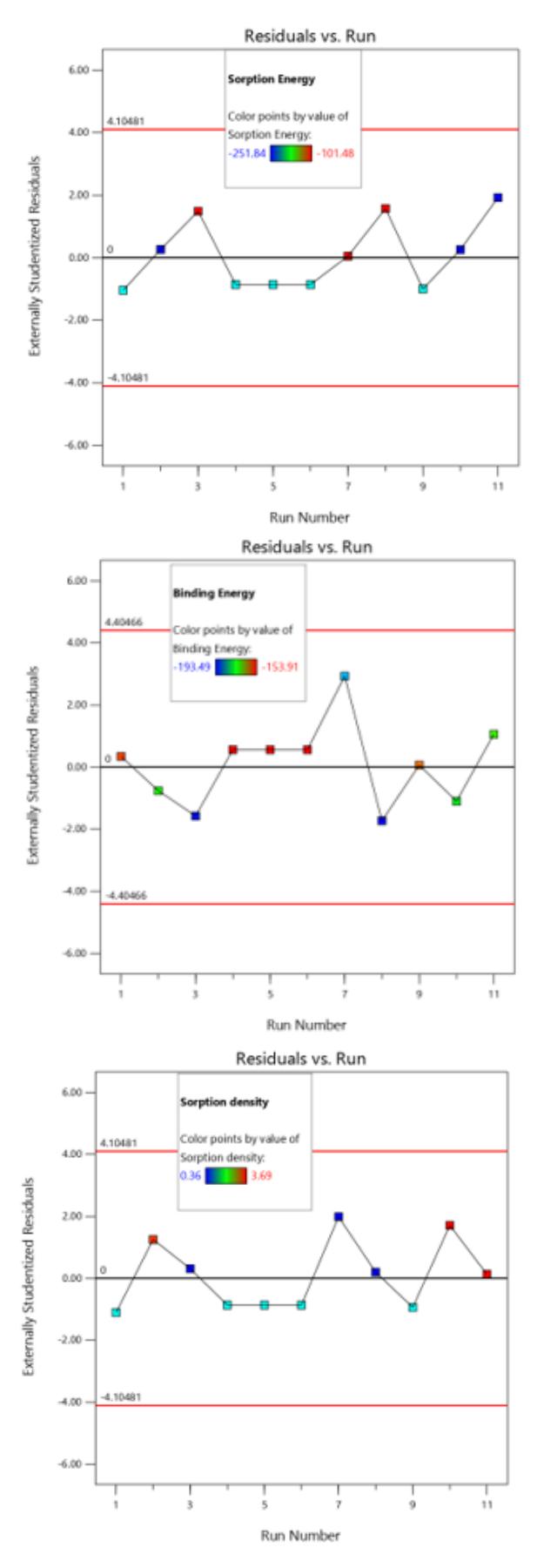
Studentized plot of model runs versus residuals for sorption energy, binding energy and sorption density.
Perfluorooctanesulfonic acid Sorption onto Polyethylene Microplastics: A Simulation-Driven Response Surface Optimization via Central Composite Design 15 DOI: 10.5614/j.eng.technol.sci.2025.57.1.2
Grand Canonical Monte Carlo (GCMC) and MD simulation
The Monte Carlo methodology relies on its ability to generate a substantial number of random variables that adhere to a specific distribution (Enyoh et al, 2022a). In this investigation, the GC-MC simulation was executed utilizing the SORPTION module within the MS software as described previously (Enyoh et al., 2022). The Metropolis algorithm was chosen as the Monte Carlo technique due to its versatile applicability. This simulation entailed utilizing polyethylene microspheres (PE MPs) as the sorbent and perfluorooctane sulfonate (PFOS) molecules as the sorbate. For simulation tasks, fixed loading was employed, encompassing loading and production steps of 100,000 (though single sorption simulations necessitated fewer steps, often less than 500), coupled with equilibration steps of 10,000 and intervals of 50 steps. The CCD framework was employed to systematically manipulate system temperatures.
In this study, MD simulation of the polyethylene (PE) - perfluorooctanesulfonic acid (PFOS) molecular system, which is central to our research, was carried out using the FORCITE module of Materials Studio, following the methodology described by Enyoh et al. (2022a). To calculate forces for substances that share an element, thus serving as a substitute for experiment-based potential energy functions, we utilized the COMPASS ab initio force field. All computations were performed using the COMPASS force field, well-known for its applicability in modeling organic molecules and determining material properties.
The examined PE-PFAS molecular system was modeled as an open system, maintaining constant temperature (controlled via the Berendsen method with a decay constant of 0.10 ps) and a consistent number of molecules. Consequently, the NVT ensemble was adopted for the molecular dynamics simulation. The charge distribution was automated, employing the Ewald approach for electrostatic interactions and the atom-based approach for Van der Waals interactions, each carried out with a precision of 0.001 kcal/mol. Before embarking on the molecular dynamics simulation, an extensive system relaxation phase was conducted utilizing an annealing process. This involved five annealing cycles within the NVT ensemble, commencing at 298 K, followed by temperature escalation and subsequent reduction back to 298 K. The simulation duration was set at 10 ps, spanning 10,000 steps with a time step of 1 fs. This annealing procedure effectively minimized the system's total energy further, establishing a more stable foundation from which to initiate subsequent molecular dynamics simulations.
The chemical potential (μ) during GCMC simulations was calculated using the following Eq. (1):
\[\mu = -kT * ln(P/P0) \tag{1}\] where: μ is the chemical potential; k is the Boltzmann constant, i.e. 1.38064852 × 10⁻²³ J/K; T is the temperature in K; P is the pressure of the system i.e. 0.569, 0.610, and 0.714 GPa for 1, 2 and 3 PFOS loading counts respectively and P0 is the reference pressure (usually taken as the pressure of an ideal gas at the same temperature and volume) = 0.8 GPa. The chemical potentials for the different trials are presented in Table 1.
After the molecular dynamics (MD) simulation, the sorption energy and density metrics are extracted from the output file. Meanwhile, the computation of the binding energy was conducted using the formula provided in equation (Enyoh and Wang, 2022; Enyoh and Wang, 2023).
\[\Delta E = E_{complex} - (E_{CIP} + E_{MPsurface}) \tag{2}\]
\[E_{binding}(kcal/mol) = -\Delta E \tag{3}\]
The binding energy, referred to as Ebinding, is computed by taking the disparity between the individual point energies of PFOS and PE MPs prior to the sorption phase (EPFOS and EPE-MP surface), and the combined energy of the PFOS-PE MP system subsequent to a molecular dynamics (MD) simulation (Ecomplex).
RSM optimization process for PFOS sorption by PE MPs
In this study, we employed a Central Composite Design (CCD) based on Response Surface Methodology (RSM) for the experimental design and optimization of the process parameters. The optimization modeling was carried out using the trial version of Design Expert Software version 13.0, developed by Stat-Ease Inc., headquartered in Minneapolis, USA. The CCD is a robust and widely adopted empirical modeling technique within RSM that allows for the systematic investigation of both individual and interactive effects of multiple independent variables on the response variable. This technique facilitates the generation of a set of experimental runs that include factorial points, axial points, and central points, which are strategically selected to provide sufficient information for model building.
The CCD approach is particularly advantageous because it enables the fitting of experimental data to various model types—linear, quadratic, or cubic—depending on the complexity of the system under study. The method involves the calculation of model coefficients that are critical in understanding the significance of each variable and their interactions. These coefficients are used to identify the optimal levels of the independent variables that maximize or minimize the response variable, depending on the study's objectives (Ovuoraye et al., 2021; Enyoh et al., 2023b). Furthermore, RSM is instrumental in refining the final model equation, which may be factorial, polynomial, or quartic in nature.
The selection of the appropriate model is guided by statistical criteria, such as the coefficient of determination (R²), adjusted R², and lack-of-fit tests, ensuring that the model accurately captures the process dynamics within the explored range of variables (Mohammad et al., 2019). The ultimate model is typically expressed in the form of a predictive equation, as demonstrated in equation 4, which represents the optimal response surface and facilitates the identification of the most favorable operational conditions for the process. This comprehensive approach not only enhances the understanding of the underlying process but also aids in the development of robust and reliable optimization strategies.
\[Y_{i} = \beta_{0} + \sum_{i=1}^{k} \beta_{i} x_{1} + \sum_{i=1}^{k} \beta_{ij} x_{i}^{2} + \sum_{i=1}^{k} \sum_{j=3}^{k} \beta_{ij} x_{i} x_{j}\] \[(4)\]
Within this conceptual framework, the symbol Yi signifies the effectiveness pertaining to PFOS sorption attributes: sorption energy (quantified in kcal/mol), sorption density (expressed in g/cm³), and binding energy (measured in kcal/mol). Meanwhile, the variables Xi and Xj stand as representatives of independent factors, such as temperature and loading counts. Notably, \(\beta\)0 assumes the role of a constant parameter, whereas \(\beta\)i and \(\beta\)j function as coefficients that outline the impact of these independent variables on PFOS sorption characteristics. To gauge the precision of the Response Surface Methodology (RSM) model, an analysis of variance (ANOVA) was employed, applying a significance threshold of p < 0.05. Moreover, the ultimate assessment of numerical optimization was conducted utilizing desirability functions.
Results and Discussion
Optimization and characterization of PE MPs and PFOS
The optimized and characterized prepared polyethylene microspheres (PE MPs) and perfluorooctane sulfonate (PFOS) are illustrated in Figure 2. The process of geometry minimization involves arranging a group of atoms in space so that the overall inter-atomic forces on each atom are nearly zero, and the position on the potential energy surface (PES) becomes a stationary point. This stationary point represents the most stable configuration for the molecule and is likely to be naturally occurring. The objective of geometry optimization is to pinpoint the location where the energy is at its lowest (Enyoh et al., 2022a; Teng et al., 2023). The ultimate optimized total energies were recorded as 4228.15 kcal/mol for PE MPs, a significant reduction from the initial 6076.97 kcal/mol, and -102.701 kcal/mol for PFOS, in contrast to the initial 119627.42 kcal/mol (as seen in Figures 2(a) and 2(b)). These optimally stable forms were employed in the study of PE-MP driven PFOS sorption behavior.
Utilizing the Connolly model (Connolly, 1983), the assessment of surface area and occupied volume was carried out and the cornolly surface area for the PE MPs is elucidated through Figure 2(d). This representation provides insight into the surface characteristics of the PE MPs. Specifically, the surface area of the PE MPs measures 233.54 Ų. In addition to surface area, other spatial parameters are noteworthy: the free volume, which accounts for 898.28 Ų, and the occupied volume, amounting to 281.87 ų. These measurements collectively contribute to a comprehensive understanding of the physical attributes and spatial distribution of the PE MPs. The surface area of an object holds significance as it reveals the extent of space covered by its outer boundary. Notably, enhancing the surface area of a substance often accelerates chemical reactions. Conversely, the assessment of occupied volume gauges the internal capacity of an object.
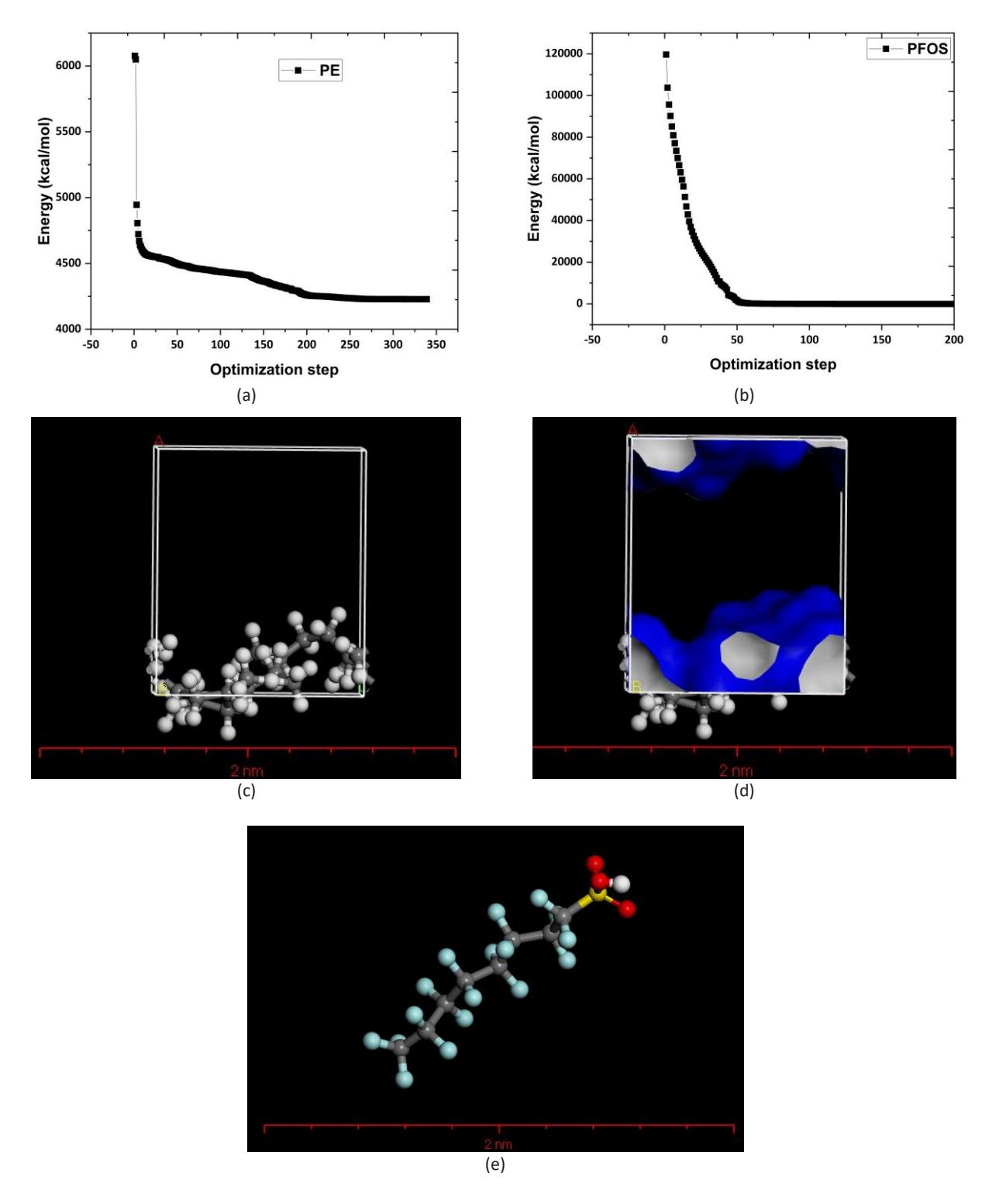
Geometry optimization energies versus optimization steps for (a) PE MPs and (b) PFOS; optimized structure of PE MPs in vacuum slap (c) and cornolly surface plot (d); optimized PFOS structure (e).
RSM modeling and optimization process
Statistical analysis and three-dimensional (3D) variable effect on PE MPs-driven sorption of process
The CCD in Table 1 was followed for the simulation sorption study. A representative distribution and sorption density fields for PFOS molecules on PE MPs are presented in Figure 3 while the results of the PFOS sorption energy (kcal/mol), sorption density (g/cm3), and binding energy (kcal/mol) by the PE MPs adsorbents in various trials are shown in Table 2.
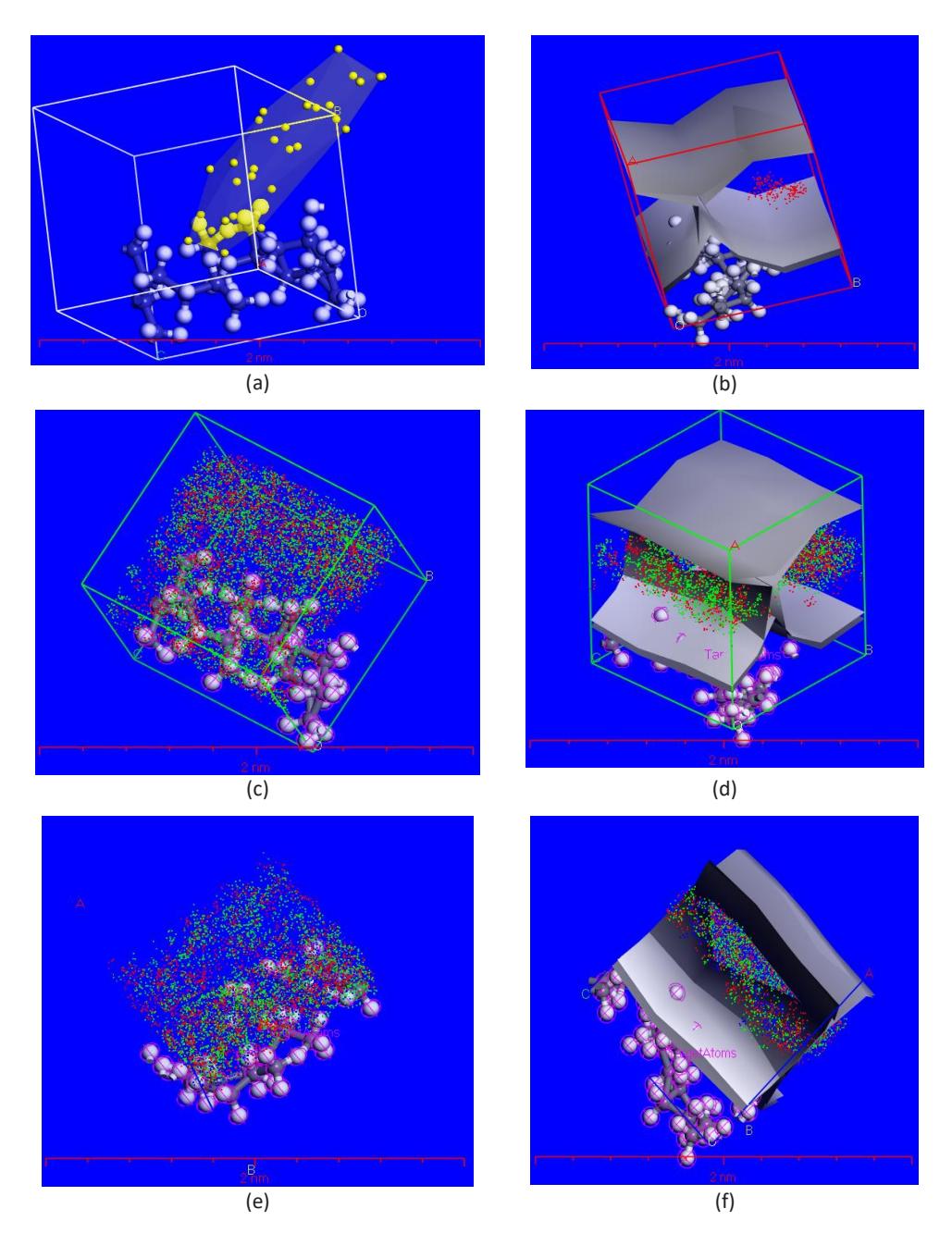
Representative distribution and sorption density fields for PFOS molecules respectively for (a,b) single [trial 3]; (c,d) double [trial 9] and (e,f) triple [trial 2] loading counts. The provided data showcases the distribution and sorption density fields of PFOS molecules under different loading conditions onto polyethylene microplastics (PE MPs). In trial 3, which involves a single loading of PFOS molecules, the representative distribution and sorption density fields are depicted in (a) and (b) respectively. Similarly, for trial 9, involving a double loading of PFOS molecules (represented by two colours: green and red), the corresponding fields are presented in (c) and (d). Lastly, in trial 2, where a triple loading of PFOS molecules (represented by three colours: green, red and blue) is considered, the distribution and sorption density fields are shown in (e) and (f).
| Table 2 | Sorption Energy (kcal/mol), Sorption density (g/cm3) and Binding Energy (kcal/mol) for the sorption of PFOS on PE MP |
|---|
| Response (Actual) | ||||||
|---|---|---|---|---|---|---|
| Run | Sorption Energy (kcal/mol) | Sorption density (g/cm3 ) | Binding Energy (kcal/mol) | Sorption Energy (kcal/mol) | Sorption density (g/cm3 ) | Binding Energy (kcal/mol) |
| 1 | -213.21 | 1.24 | -156.53 | -193.28 | 1.68 | -159.29 |
| 2 | -251.42 | 3.51 | -172.43 | -256.83 | 3.02 | -166.18 |
| 3 | -102.30 | 0.36 | -192.64 | -128.98 | 0.23 | -181.24 |
| 4 | -212.76 | 1.23 | -153.91 | -193.06 | 1.65 | -159.22 |
| 5 | -212.76 | 1.23 | -153.91 | -193.06 | 1.65 | -159.22 |
| 6 | -212.76 | 1.23 | -153.91 | -193.06 | 1.65 | -159.22 |
| 7 | -101.61 | 0.36 | -186.29 | -102.65 | 0.33 | -198.96 |
| 8 | -101.48 | 0.36 | -193.49 | -129.29 | 0.27 | -181.34 |
| 9 | -212.06 | 1.23 | -158.61 | -192.84 | 1.61 | -159.15 |
| 10 | -251.84 | 3.69 | -174.92 | -257.14 | 3.07 | -166.28 |
| 11 | -251.47 | 3.68 | -171.11 | -283.47 | 3.62 | -177.66 |
These visual representations offer valuable insights into how the PFOS molecules are distributed across the surface of the PE MPs and how densely they are adsorbed onto the microplastics. A better comprehension of how different PFOS concentration levels impact the sorption process can be achieved by researchers through the examination of changes in distribution and density patterns during various loading scenarios. This information is crucial for optimizing the sorption process and designing effective removal strategies for PFOS contaminants from the environment.
Tables 3 to 5 present the statistical model interpretation of the optimization of PE MP-driven sorption of PFOS in an aqueous environment. The results indicate that the linear model selected for the optimization analysis of PE MPs-driven sorption of PFOS is statistically significant, with p-values of 0.0002 for sorption energy and sorption density, respectively. The Fisher's statistic yielded model F-values of 29.07 and 31.35, and adequacy of precision values of 14.60 and 15.60, respectively, with corresponding cumulative variance values of 12.28 and 30.09 for temperature and loading rate. These values, being greater than 4.0, confirm the significant adequacy of the signal-to-noise ratio in the optimization modeling of the sorption process (Enyoh et al., 2022a). This implies that the linear model provides a robust framework for understanding the optimization of PFOS sorption on PE MPs without requiring adjustments to the modeled parameters.
The model's predicted, adjusted, and actual R² values of 0.7558, 0.8488, and 0.8791 for sorption energy, and 0.7719, 0.8585, and 0.8868 for sorption density, indicate a strong correlation between the predicted and observed outcomes, suggesting that the model accurately represents the physical sorption process.
The linear model optimization statistics reveal that PFOS loading (p-value = 0.0001) has a significant antagonistic impact on the optimal sorption energy of the PE MP-driven process, while temperature (p-value = 0.9859) does not significantly influence the sorption energy within the 95% confidence interval. Similarly, temperature (p-value = 0.8940) has no significant impact on sorption density, whereas the PFOS loading count (p-value = 0.0001) significantly affects sorption density.
The reduced quadratic model analysis, as shown in Table 6, further elucidates the sorption mechanism by confirming that the second-order effect of loading is significant (p-value = 0.0241) in the sorption energy required for PFOS removal. The ANOVA results demonstrate a model F-value of 5.98 and an adequacy of precision of 6.66, confirming the model's significance for interpreting the sorption energy with minimal noise (Ovuoraye et al., 2021; Enyoh et al., 2022b). The R², adjusted R², and predicted R² values of 0.7195, 0.5992, and 0.310, respectively, further confirm the correlation between the predicted binding energy and the actual data.
Physically, the active sites on the PE MPs responsible for PFOS sorption are likely the hydrophobic regions of the polymer that interact with the hydrophobic tails of PFOS molecules (Dai et al, 2022). The statistical significance of loading count suggests that the availability of these active sites is crucial for the sorption process. At higher PFOS concentrations, more active sites on the PE MPs are engaged, leading to higher sorption energy and density. Conversely, at lower PFOS loading, fewer active sites are occupied, resulting in a decrease in sorption energy.
The reduced impact of temperature on sorption density and energy suggests that the sorption process is primarily driven by hydrophobic interactions rather than temperature-dependent processes like diffusion or molecular movement (Chen et al, 2022). This highlights that the PE MPs' sorption efficiency is more influenced by the concentration of PFOS rather than temperature variations. The "Celine effect" observed in the binding energy could be due to the minimal influence of temperature on the stability of the sorbed PFOS on the PE MPs, reinforcing that optimizing the loading rate and surface area of PE MPs is critical for enhancing sorption capacity.
These findings suggest that in environmental applications, strategies focusing on increasing the concentration and surface area of PE MPs are more effective in enhancing PFOS removal than merely adjusting temperature. The optimization analysis also indicates that maintaining an adequate loading rate is crucial for achieving maximum sorption efficiency, as the availability of active sites on the PE MPs directly impacts the binding energy and overall sorption performance.
Summarily, while temperature has a limited role in influencing the sorption process, the PFOS loading count is a key determinant of sorption efficiency, affecting both the sorption energy and density. The insights gained from this optimization study are vital for developing more effective environmental remediation strategies for PFOS contamination, particularly in designing sorption processes that maximize the use of available active sites on PE MPs.
| Source | Sum of Squares | df | Mean Square | F-value | p-value | |
|---|---|---|---|---|---|---|
| Model | 32693.23 | 2 | 16346.61 | 29.07 | 0.0002 | Significant |
| A-Temperature | 0.1880 | 1 | 0.1880 | 0.0003 | 0.9859 | |
| B-Loading | 32693.04 | 1 | 32693.04 | 58.14 | < 0.0001 | |
| Residual | 4498.15 | 8 | 562.27 | |||
| Lack of Fit | 4498.15 | 6 | 749.69 | |||
| Pure Error | 0.0000 | 2 | 0.0000 | |||
| Cor Total | 37191.38 | 10 | ||||
| Mean = 193.06; Std. Dev. = 23.71; C.V. % | = 12.28; | R² = 0.8791; Adjusted R² = 0.8488; Predicted R² = 0.7558; Adeq |
Precision = 14.6013
Table 3 ANOVA of the Linear model and evaluation metrics of the PE MP performance on sorption energy.
Table 4 ANOVA statistics of the linear model description of PE MP performance on sorption density.
| Source | Sum of Squares | Mean Square | F-value | p-value | ||
|---|---|---|---|---|---|---|
| Model | 15.62 | 2 | 7.81 | 31.35 | 0.0002 | significant |
| A-Temperature | 0.0047 | 1 | 0.0047 | 0.0189 | 0.8940 | |
| B-Loading | 15.61 | 1 | 15.61 | 62.67 | < 0.0001 | |
| Residual | 1.99 | 8 | 0.2491 | |||
| Lack of Fit | 1.99 | 6 | 0.3321 | |||
| Pure Error | 0.0000 | 2 | 0.0000 | |||
| Cor Total | 17.61 | 10 | ||||
Mean = 1.65; Std. Dev. = 0.49; C.V. % = 30.29; R² = 0.8868; Adjusted R² = 0.8585; Predicted R² = 0.7719; Adeq Precision = 15.16
Table 5 ANOVA of the reduced quadratic model description of binding energy PE MP sorption performance
| Source | Sum of Squares | df | Mean Square | F-value | p-value | |
|---|---|---|---|---|---|---|
| Model | 1761.60 | 3 | 587.20 | 5.98 | 0.0241 | significant |
| A-Temperature | 0.0198 | 1 | 0.0198 | 0.0002 | 0.9891 | |
| B-Loading | 453.72 | 1 | 453.72 | 4.62 | 0.0686 | |
| B² | 1307.86 | 1 | 1307.86 | 13.33 | 0.0082 | |
| Residual | 686.83 | 7 | 98.12 | |||
| Lack of Fit | 686.83 | 5 | 137.37 | |||
| Pure Error | 0.0000 | 2 | 0.0000 | |||
| Cor Total | 2448.43 | 10 | ||||
| Mean = -169.80; Std. Dev. = 9.91; C.V. % = 5.83; R² | = 0.7195; Adjusted R² = 0.5992; Predicted R²= |
0.3100; Adeq Precision = 6.66
The response surface modeling of the PE MP-driven sorption of PFOS based on the final equation obtained from the linear model and the reduced quadratic model is repres-ented by Eqs 5-7:
Sorption energy = \[-193.06 - 0.15\] Temperature \(-63.93\) PFOS Loading count (5)
Sorption density = \[1.65 + 0.02\] Temperature + \(1.40\) PFOS Loading count (6)
Binding energy = \[-159.24 - 0.05\] Temperature + \(7.53\)PFOS Loading - \(14.55\) PFOS Loading2 (7)
The optimization result based on the final model interpretation of the PE MP-driven optimal sorption energy, sorption density, and binding energy of PE MP to enhance the removal of PFOS substances from an aqueous environment translates to a temperature of 309.96 K, and PFOS loading count of 1.82 in aqueous environment. The optimized conditions correspond to optimized sorption energy, binding energy, and sorption density of -181.89 Kcal/mol, -161.02 Kcal/mol, and 1.42 g/cm3 respectively, as shown in Table 5. These results were confirmed in the optimization ramp shown in Figure 4. The predicted optimized operating conditions on sorption energy, density, and binding energy translate to a standard deviation of 23.71, 0.49, and 9.91 respectively, from the actual observation practicable.
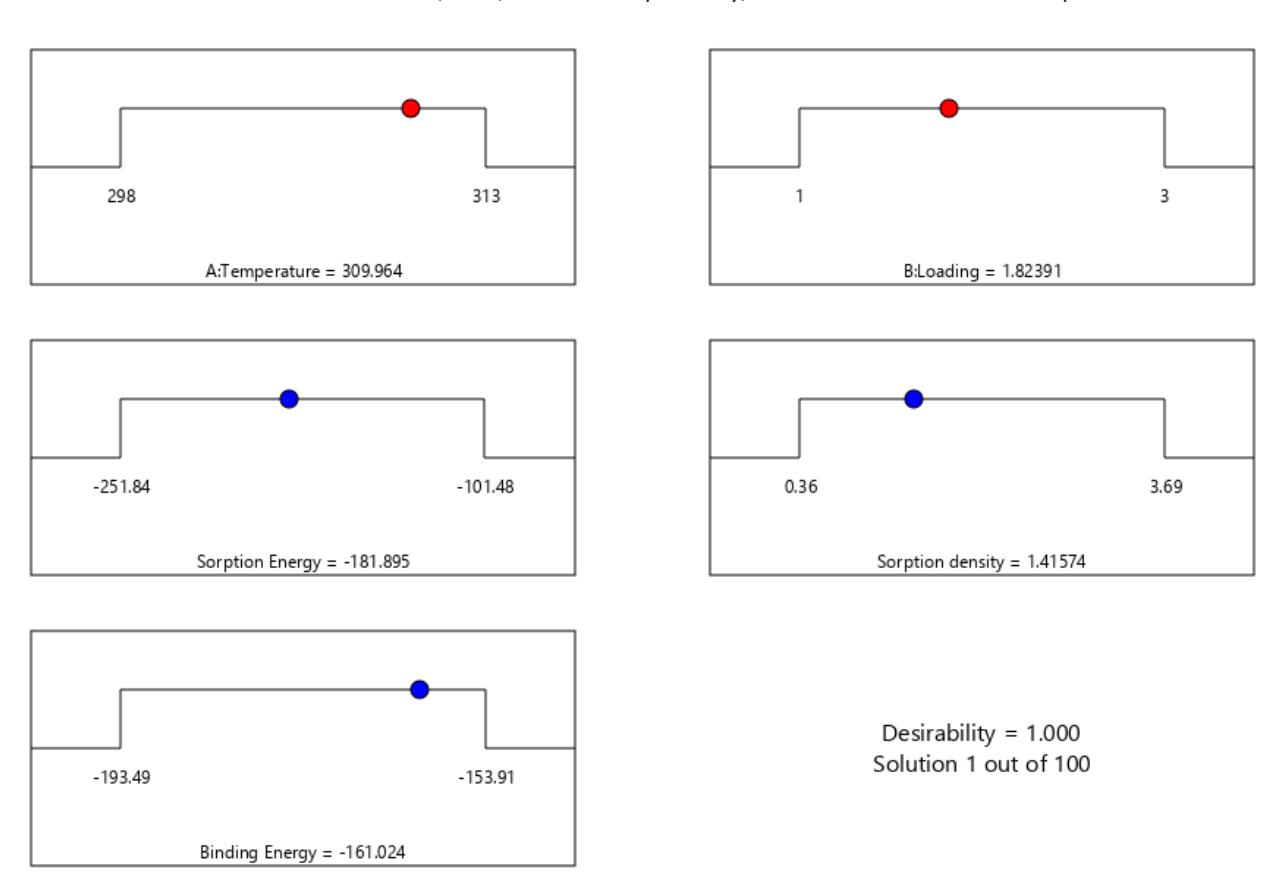
Figure 4 Optimization ramp confirmation of the predicted operating conditions and optimized outputs of the PE MP-driven sorption of PFOS form aqueous environment.
Table 6 Optimization results and evaluation metrics on predicted output and actual value practicable
| Solution 1 of 100 Response | Predicted Mean | Predicted Median | Observed | Std Dev | SE Mean | 95% CI low for Mean | 95% CI high for Mean | 95% TI low for 99% Pop | 95% TI high for 99% Pop |
|---|---|---|---|---|---|---|---|---|---|
| Sorption Energy | -181.90 | -181.90 | -193.06 | 23.71 | 8.84 | -202.29 | -161.50 | -302.85 | -60.95 |
| Sorption density | 1.42 | 1.42 | 1.54 | 0.499 | 0.19 | 0.99 | 1.85 | -1.13 | 3.96 |
| Binding Energy | -161.02 | -161.02 | -169.79 | 9.91 | 4.62 | -171.95 | -150.10 | -215.63 | -106.42 |
Effect of optimal conditions on response variables
The outline of the 3D surface in 5(a) in Figure 5 confirmed the effect of optimum temperature and PFOS loading count on the sorption energy of PE MPs. The gradient of the contour patterns on the base of the surface plot confirmed that temperature has no significant effect on the sorption energy of PE MP for the uptake of per- and polyfluorinated substances from an aqueous medium. The transformation of the blue contour lines towards the predominant green confirmed that the sorption energy of polyethylene MP sorption energy decreased significantly as the PFOS loading count decreased. The result established that as the PFOS loading count decreased from 2.5 to 1.5, the sorption energy of the PE MP decreased from -300 Kcal/mol to -150 Kcal/mol at the optimum temperature of 309.96K. This outcome proved that at low PFOS loading counts, the PE MPs sorption sites are less than enough to absorb the PPFOS at the optimum temperature of the medium (Hakimabadi et al., 2023; Lionetto & Esposito 2021). The findings established that in an aqueous environment, a lower concentration of PE MP does not reduce the presence of PFAS thus decreasing sorption efficiency at elevated temperature.
The findings suggest that when PFOS loading counts are low, the sorption sites present on the PE MPs are probably insufficient to effectively capture and absorb PFOS molecules, especially when operating at the optimum temperature for this system. This result underscores the complicated balance between sorbent concentration and sorption capacity. At lower PFOS loading counts, there are not enough available binding sites on the PE MPs to accommodate a substantial number of PFOS molecules, leading to a decrease in sorption energy. Furthermore, the findings extend to broader implications for environmental remediation strategies in the context of PFOS contamination. They reveal that simply reducing the concentration of PE MPs in an aqueous environment is not an effective means of diminishing the presence of PFOS. This inefficiency becomes even more pronounced when the temperature is elevated. This observation is particularly significant for environmental scientists and engineers seeking to develop efficient and sustainable methods for mitigating PFAS pollution.
The contour gradient on the base of the 3D surface of 5(b) in Figure 5 also confirmed the PFOS loading count significantly impacted the sorption density of PE MP in an aqueous environment irrespective of temperature. The result confirms the linear model assumptions on the antagonistic effect of loading count on the performance of the PE-MP-driven sorption performance in an aqueous medium. The findings proved that at the established optimum temperature of 309.96 K, the sorption density of PE MP increased consistently from 1.0 to 3.5 g/cm3 with an increase in PFOS loading count from 1.5 to 3.0 (Cormier et al., 2022; Agboola & Benson, 2021). This outcome indicates as the PFOS loading counts increased, there was an increase in the tendency of PE MP to absorb PFAS to its active sites at the elevated temperature (Agboola & Benson, 2021; Joo et al., 2021). The simultaneous increase in sorption density and PFOS loading count is a strong indication of an increase in adsorption sites with enhanced sorption characteristics, which tends toward high efficiency of removal.
However, the curvature of the surface plot in 5(c) in Figure 5 was drawn based on the reduced quadratic model assumptions on the significant effect of temperature and PFOS loading count on the binding energy of PE-MP-driven sorption of per- and polyfluorinated substances in a combined system. The gradient of the contour pattern of the surface plot shows that within the range of temperature of 298 – 313K under investigation, an increase in loading count from 1 to 1.75 will increase the binding affinity of per- and polyfluorinated substances onto PE-MP intermittently. At the optimum condition of temperature and PFOS count, the maximum binding energy of the per- and polyfluorinated substances to PE MPs surfaces corresponds to -161.02 Kcal/mol driving the sorption process to reach equilibrium. It can also be inferred from the analysis of the surface plot that at elevated temperatures, a loading count greater than ≥ 1.5 and ≤ 2.7 is required to maintain the maximum sorption performance of the PE MPs (Cheng et al., 2021; Yang et al., 2022).
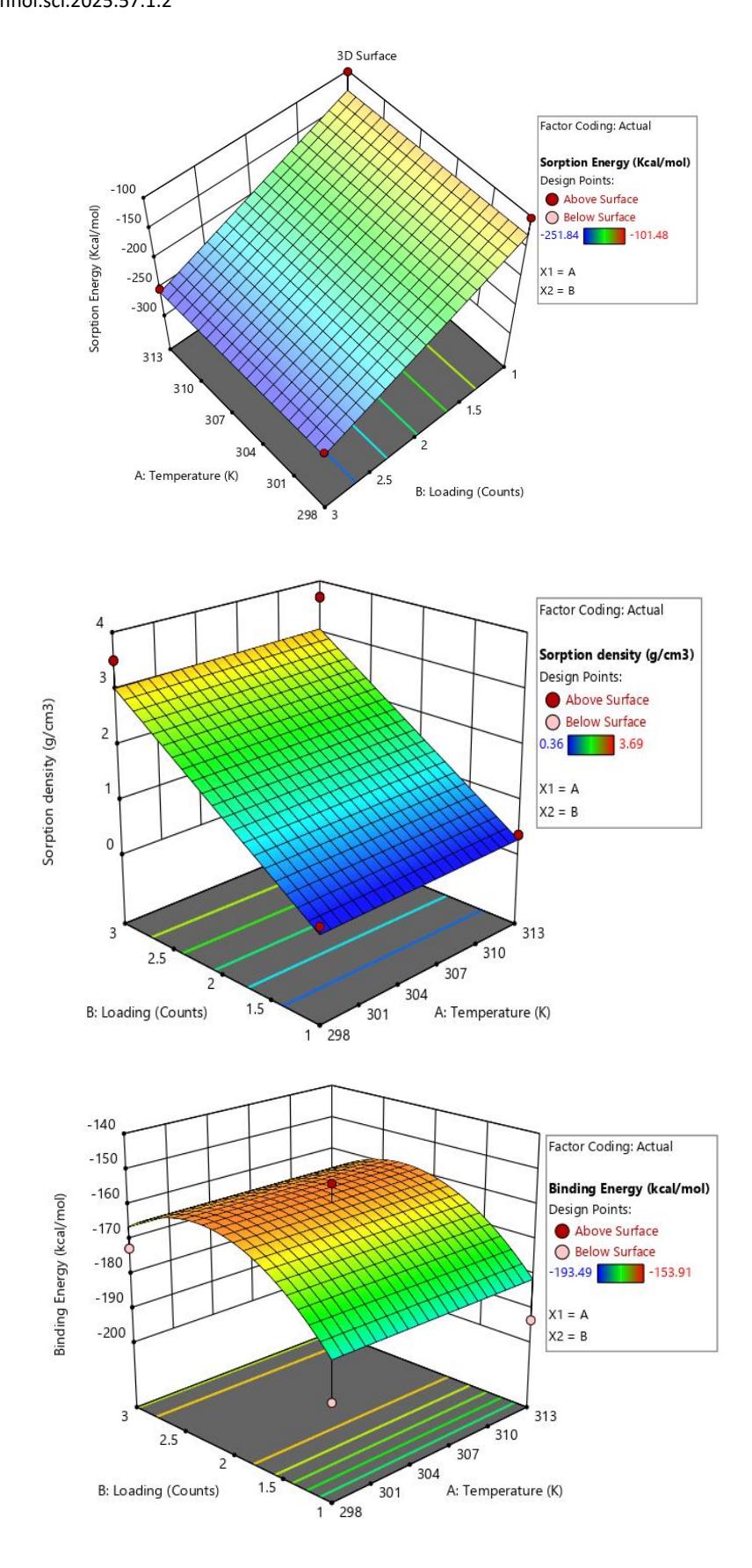
3D-Surface plots showing the effect of optimized conditions on; (a) Sorption energy, (b) Sorption density, and (c) Binding energy of PE MP-driven sorption of PFOS.
The environmental implications of these findings are profound. The observed decrease in sorption efficiency at lower PFOS loading counts, particularly at elevated temperatures, highlights the challenges of using PE MPs as sorbents for PFAS in contaminated water bodies. This inefficiency suggests that under suboptimal conditions, such as lower contaminant concentrations or fluctuating environmental temperatures, the effectiveness of PE MPs in reducing PFAS levels may be significantly compromised. This is particularly concerning for environmental remediation efforts aimed at addressing PFAS contamination in natural water bodies, where conditions are less controlled than in laboratory settings. Moreover, the results suggest that environmental remediation strategies should consider not only the concentration of sorbents but also the environmental conditions, such as temperature, that could impact sorption performance. For instance, in warmer climates or during certain seasons, the reduced sorption efficiency of PE MPs at higher temperatures could limit their effectiveness in PFAS removal. This points to the need for more sophisticated and adaptable remediation strategies that account for environmental variables. The findings also raise questions about the sustainability and long-term effectiveness of using PE MPs for PFAS remediation. If the sorption sites on PE MPs become saturated or less effective at higher temperatures, this could lead to the need for more frequent replacement or regeneration of the sorbents, increasing both the environmental and economic costs of remediation efforts. Additionally, the potential release of adsorbed PFAS back into the environment under suboptimal conditions could pose a secondary contamination risk, further complicating remediation efforts.
Generally, PE MPs show potential as sorbents for PFAS in aqueous environments, their effectiveness is highly dependent on both the PFOS loading count and environmental conditions such as temperature. These findings suggest that a onesize-fits-all approach to PFAS remediation may be insufficient and that more tailored strategies, potentially involving a combination of sorbents or the development of more temperature-resistant materials, may be necessary to effectively address PFAS contamination in diverse environmental settings.
Conclusions
This study undertook a comprehensive investigation into the optimization of the PFOS sorption process driven by polyethylene microspheres (PE MPs). The significance of this research stems from the critical interplay of multiple factors, specifically sorption energy, sorption density, and binding energy, which collectively dictate the efficiency and effectiveness of the sorption process. Through a rigorous series of simulations, the prepared PE MPs and PFOS were meticulously optimized and characterized.
Key findings indicate that optimal sorption conditions are achieved at a temperature of 309.96 K with a PFOS loading count of 1.82. These conditions yield optimal values of -181.89 Kcal/mol for sorption energy, -161.02 Kcal/mol for binding energy, and 1.42 g/cm³ for sorption density. The study revealed that while temperature has minimal impact on sorption energy, PFOS loading count significantly influences both sorption density and binding energy. However, the environmental implications of these findings are limited and highlight potential challenges in real-world applications. The decreased sorption efficiency observed at lower PFOS loading counts and elevated temperatures suggests that the effectiveness of PE MPs as sorbents may be compromised in natural water bodies where conditions are less controlled. This variability in performance underscores the need for more sophisticated remediation strategies that can adapt to diverse environmental conditions. Finally, while this research demonstrates the potential of PE MPs as sorbents for PFOS removal, it also highlights the complexity of environmental remediation efforts. The findings suggest that effective PFOS remediation may require a more tailored approach, potentially involving a combination of sorbents or the development of more environmentally resilient materials. Future research should focus on addressing these challenges to develop more efficient and sustainable solutions for PFAS contamination in diverse aquatic environments.
The optimization process achieved through multivariate statistical techniques and simulations offers a promising avenue for enhancing the efficacy of PFOS removal strategies. By understanding and manipulating these interactions, the potential for more effective environmental remediation becomes tangible, addressing the critical concern of PFOS contamination in aquatic systems.
Compliance with ethics guidelines
The authors declare that they have no conflict of interest or financial conflicts to disclose.
This article does not contain any studies with human or animal subjects performed by any of the authors.
Acknowledgement
This study was partially supported by the Special Funds for Basic Research (B) (No.22H03747, FY2022-FY2024) of Grantin-Aid for Scientific Research of Japanese Ministry of Education, Culture, Sports, Science and Technology (MEXT).