
Introduction
Rapid urbanization has intensified housing and infrastructure demand in Indonesia , the world's fourth-most populous country (Tereshko and Rudskaya, 2021). With an annual population growth rate of 1.1% over the past decade Indonesia is on a trajectory to surpass the United States in total population (Svendsen, 2022). This population boom has fueled an expansive growth in the construction sector, which, while economically vital, has also emerged as a leading source of environmental degradation due to the significant generation of construction and demolition (C&D) waste (Al-Raqeb et al., 2023). Globally, construction and demolition (C&D) activities account for at least 30% of total solid waste, making the sector one of the largest contributors to environmental degradation (Hao et al., 2019; Sembiring, 2018). In Indonesia, the mismanagement of construction waste not only exacerbates environmental problems but also leads to economic inefficiencies—such as increased disposal costs, wastage of raw materials, and missed opportunities for reuse and recycling. The prevailing "take, make, dispose" linear economic model in construction further limits opportunities to recover materials (Jahan et al., 2022; Osmani et al., 2008). Among the primary contributors to this waste are inefficiencies in project design, procurement, and implementation, with design being the most critical phase (Susilowati, et. al., 2022). Ineffective waste management practices and the use of low-recovery materials only deepen the crisis (Waheed et al., 2024).
Despite these challenges, the construction sector holds immense economic promise. A shift to a circular construction model—where resources are reused, recycled, and optimized—could yield IDR 172.5 trillion (USD 12.1 billion), equivalent to 6.3% of the sector's GDP by 2030. Already, the sector contributes 10.79% to Indonesia's GDP (Bappenas RI, 2024). However, current waste management practices lack integration with financial planning across the construction life cycle, leading to systemic inefficiencies. This underscores the urgent need for a circular approach that aligns environmental goals with economic incentives. Circular construction encourages modular design, reuse, and
Copyright ©2025 Published by IRCS - ITB J. Eng. Technol. Sci. Vol. 57, No. 4, 2025, 505-518 ISSN: 2337-5779 DOI: 10.5614/j.eng.technol.sci.2025.57.4.6
recycling throughout a building's life span, thereby reducing material losses and maximizing resource efficiency (Ajayi and Oyedele, 2018). Yet, this transformation demands more than just technical adaptation—it requires a financial framework that supports circularity from design to deconstruction (Hao et al., 2019). Without a comprehensive financing model, circular initiatives remain fragmented and underfunded. Embedding circular economy principles into Indonesia's construction sector therefore calls for strategic financial alignment that can drive systemic change (Bappenas RI, 2024).
To date, there is a lack of detailed, proportional financing frameworks that consider waste management at each stage of the construction process. This study addresses that gap by investigating four critical areas: (1) current practices in managing construction waste in Indonesia, (2) strategies employed across the project life cycle, (3) key financing components of waste management, and (4) the development of a model that maps financial allocations to project phases. These insights are essential for facilitating efficient material recovery and accelerating the transition toward a circular construction economy. In contrast to prior studies that primarily catalog waste types and recycling options, this research presents a cost-based model that integrates financial considerations with the construction life cycle. The model aims to guide more accurate budgeting, inform policy development, and improve strategic planning for waste management. In doing so, it offers a practical pathway to reducing material waste, improving environmental outcomes, and supporting Indonesia's move toward sustainable, circular construction practices.
Materials and Methods
Data in this research were collected through questionnaires, structured interviews, and observations. According to the 'Indonesian Standard Industrial Classification 2021' and 'Construction Statistics 2021', Indonesian construction activities are divided into three main areas: building construction (56.17%), civil construction (35.37%), and specialized construction (8.46%). Samples were randomly selected in proportion based on the classifications. Respondents were required to have at least an intermediate-level qualification, in accordance with Indonesian labor regulations in the construction sector. The questionnaire survey collected 80 responses from a range of construction projects, achieving a completion rate of approximately 30%. A summary of respondent and project profiles is presented in Table 1.
Table 1 Profile of the respondents and projects.
To enhance the validity of the findings, structured interviews were conducted with participants from four randomly selected projects, representing diverse types—building, road, hydro, and others. Furthermore, direct observations were carried out at one of the building projects, reflecting the sector's significance within Indonesia's construction industry, to document observable waste generation and management practices. In the analysis process, construction waste management was categorized by a percentage of recyclable or non-recyclable waste, depending on the waste type in the field and whether the waste has been recycled. Strategies in waste management were identified to overcome the barriers based on the project's life cycle, and a percentage was calculated following whether they had been addressed or not, see Table 2.
Table 2 Strategies in waste management classified by project's life cycle from literature review.
| Davies | D-f | anagement Strategies | D-f | C | В. | ||
|---|---|---|---|---|---|---|---|
| Design | Ref | Procurement | Ref | Distribution | Ref | Construction | Re |
| Reduce waste through | Plan material | Handle dismantled | 1,10, | Provide accurate | |||
| lean production chains | 1,2 | orders based on | 1,2 | materials with care | 11 | material specs | 1,8 |
| by reusing waste | needs | ||||||
| Investigate use of by- | Control material | 12,1 | Store materials | 10.11 | Minimize material | 1,10 | |
| products in producing | 3,4,5 | orders | 3 | properly to avoid | 10,11 | spec changes | 1: |
| new components | damage | ||||||
| ocus on reuse of spare | 5 6 | Avoid | 10,1 | Avoid errors in | 40.44 | Periodically check | 1,1 |
| parts and replacement | 5,6 | specification | 1 | mixing, processing, | 10,11 | material quantities | 13 |
| components | errors in ordering | using materials | |||||
| Design for adaptability | Purchase | 42.4 | 6 | 6 | |||
| and reuse of | 5,7,8 | materials as per | 12,1 | Supervise storage/ | 11,14 | Supervise and guide | 1,1 |
| components for | specs | 3 | handling process | workers | ĺ | ||
| secondary purposes | · | Bartan Mila | 1 | ||||
| Consider technology to | F C 7 | Check goods | 13,1 | Design with | 10 11 | Improve | 1,1 |
| enhance end-of-life | 5,6,7 | during delivery | 4 | deconstruction in | 10,11 | coordination among | 1 |
| deconstruction phase | - ' | mind | project personnel | ||||
| Focus on design for | F 6 6 | Ensure packaging meets standards | 10,1 1 | Minimize material cutting errors | 9,10, 11 | Raise worker | 1,1 |
| recycling of used | 5,6,9 | awareness in | 11 | ||||
| materials | handling materials | ||||||
| Use tracking | Faccion dellices | 10.1 | Maintenantenantena | ||||
| technologies | 5,6,7 | Ensure delivery | 10,1 | Minimize execution | 1,: | ||
| embedded with | meets standards | 1 | errors by labor | ||||
| lifecycle | |||||||
| Plan material | 1.2 | Avoid damage | 10,1 1 | Ensure documents | 10,11 | ||
| installation effectively | 1,2 | during shipping | are complete pre- | ||||
| · | execution | ||||||
| Duantala alaan duantuaaa | Calculate volume | Avoid material spec | |||||
| Provide clear drawings and details | 1,7 | based on | 2,13 | changes post- | 10, | ||
| and details | standards and need | execution | |||||
| Minimizo docian | 1 10 | Ensure construction | 1/ | ||||
| Minimize design | 1,10, | Use secondary | 7,8 | 14, | |||
| changes | 11 | materials | safety management | , 1 | |||
| Avoid errors in contract | 8 | Return logistics | 7,8,9 | Avoid incorrect | 10, | ||
| documents | scheme for reuse | 0.10 | material use | ||||
| Select product quality | 1,2 | Improve material | 9,10, | Use proper | 10, | ||
| that meets standards | storage quality | 11 | execution methods | ||||
| Detail product dimensions | 2,3 | Ensure equipment functions properly | 10, | ||||
| uimensions | |||||||
| Ensure uncomplicated | 2.5 | Ensure | 10 | ||||
| detail drawings | 2,5 | measurement | 10,1 | ||||
| Docian should be | 0.12 | accuracy Padusa ansita | |||||
| Design should be | 9,12, | Reduce onsite | 11, | ||||
| adaptable and flexible | 13 | construction waste | |||||
| Standardized modular | 6,9, | Reuse r | Reuse materials | 6, | |||
| design | 12 | 1 | |||||
| Define waste limits / | 8,9 | Recycle materials | 6, | ||||
| targets | Off site fall-sizetis | 1 | |||||
| Extend product lifespan | 12,13 | Off-site fabrication / construction | 3, | ||||
| Label materials for | |||||||
| recycling or eco- | 12,13 | ||||||
| certification |
References:
1: (Sudiro and Musyafa, 2018); 2: (Laovisutthichai et al., 2022); 3: (Tam and Hao, 2014); 4: (Huang et al., 2018); 5: (Minunno et al., 2018); 6: (Ajayi et al., 2017); 7: (Jahan et al., 2022); 8: (Osmani et al., 2008); 9: (Wahyu & Wibowo, 2020); 10: (Daoud et al., 2023); 11: (Ajayi et al., 2016); 12: (Ajayi and Oyedele, 2018); 13: (Jaques, 2000); 14: (Waheed et al., 2024); 15: (Hassan and Alashwal, 2024)
The components of construction waste financials throughout the project life cycle were adopted and observed based on information in Table 3. The table summarizes some previous research in developed countries on financing components in construction waste management, which can be developed in developing countries. These financing components were identified based on whether they had been implemented in the respective projects. This approach enabled a more detailed understanding of cost distribution in construction waste management practices across different projects. Data validity and reliability were measured using the R coefficient against the R-table for validity and Cronbach's alpha for reliability. The financing model was developed by integrating the relationships between each construction project life cycle stage and the finances associated with construction waste.
Table 3 Construction waste management financing components from literature review.
| Construction Waste Management Financing Components | References | ||
|---|---|---|---|
| purchase loss costs, collection costs, transport costs, recycling costs, and dumping costs | (Bossink and Brouwers, 1996) (Wang et al., 2022) | ||
| collection costs, tracing or sorting costs, recycling and reuse costs, landfill costs, and dumping costs | (Hao et al., 2019) (Huang et al., 2018) | ||
| production costs, waste transport costs, and emission handling costs of the | (Rivera-Tenorio and Moya, 2020) (Ajayi and | ||
| recycling process | Oyedele, 2018) | ||
| sorting costs, transport costs, and waste recycling costs | (Ma et al., 2020) (Tam et al., 2014) | ||
Results
Types and Management of Construction Waste in Indonesia
Indonesia, with 86.7% of reinforcement waste identified as recyclable (Figure 1), followed by split stone (73.3%), and bricks and sand (66.7% each). Interestingly, while some waste types such as wood/formworks and ceramics in Indonesia show moderate recycling potential (53.3%), actual reuse or processing of these materials remains minimal. Moreover, the finding also reveals that mortar, concrete, and cement—each having lower recyclability rates (26.7%, 33.3%, and 33.3%, respectively)—are rarely reused or processed further.
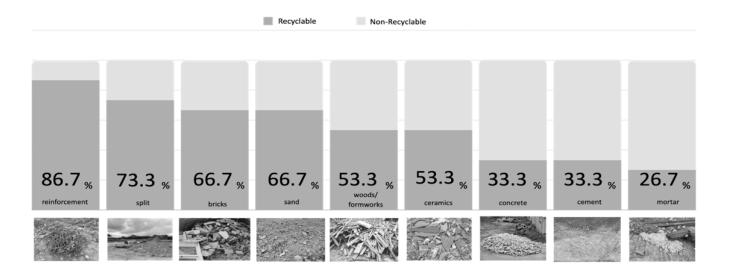
Waste properties by construction waste type.
Overall, only about around 50% of construction waste is considered recyclable, and most waste is still disposed of through third-party services rather than systematically managed on-site. These practices highlight the need for improved waste segregation, planning, and implementation of sustainable strategies across construction projects in Indonesia. The detailed analysis of waste management by the percentage of recyclable waste can be seen in Figure 2.
Implementation of waste recycling by construction waste type.
Figure 2 illustrates the actual recycling rates of various construction waste materials in Indonesia, revealing a notable gap between theoretical recyclability and practical implementation. Reinforcement steel, while highly recyclable at 86.7% potential, is only recycled in 60% of cases, underscoring underutilization despite accessible pathways such as melting for scrap or repurposing in temporary structures. Similarly, split stone (46.7%) and bricks (44.4%) are recycled at moderate rates, suggesting room for process optimization. Notably, wood/formwork and sand are recycled at only 33.3%, despite their moderate recovery potential, especially for temporary applications such as bracing, scaffolds, or filler materials. The recycling rates of ceramics, concrete, and cement—each below 26.7%—indicate persistent barriers, including material contamination, lack of sorting mechanisms, and inadequate local recycling facilities. Mortar, with the lowest recycling rate at 20%, is typically repurposed only for low-grade applications such as access road backfilling.
Strategies of Construction Waste Management in Indonesia
Given the low recycling rate of construction waste, the development and implementation of effective minimization strategies are crucial. Figure 3 presents a life cycle–based framework for construction waste management, organized into four key stages: design, procurement, distribution, and construction. This classification was derived from an initial set of 55 variables (Table 2), which was refined to 35 by removing variables identified as irrelevant by respondents and consolidating those that were overlapping or closely related. The resulting framework offers a more streamlined and practical approach to managing waste throughout the construction project life cycle.
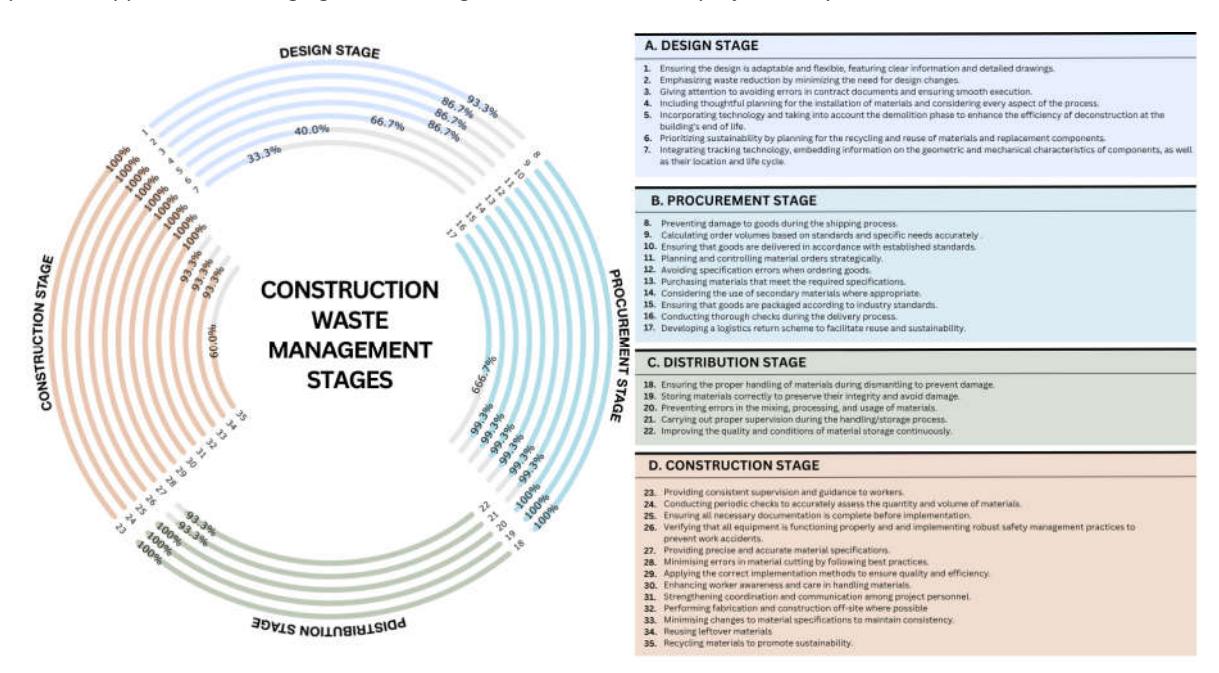
Construction waste management by Project Life Cycle.
Financing Components of Construction Waste Management in Indonesia
Building on the strategy outlined in Figure 3, the survey was further refined to collect detailed information on the financing components of construction waste management in Indonesia, based on the variables listed in Table 3. The survey results seven distinct cost categories (Figure 4): (1) loss and purchase costs, (2) production/management costs, (3) sorting costs, (4) collection costs, (5) transportation costs, (6) recycling costs, and (7) dumping costs. Figure 4 reveals that losses from construction material purchases account for the highest cost burden in construction waste management in Indonesia, reported by 40% of projects. Notably, recycling and dumping costs were the lowest reported, each accounting for only 13.3%, indicating a significant underinvestment in sustainable disposal practices.
Components of waste management financing in construction projects in Indonesia.
Informed by the insights from Figure 4, additional in-depth interviews were conducted to explore the allocation of these financial components, as detailed in Figure 5. This figure indicates that loss and purchase costs constitute the largest share (40%) of construction waste-related expenditures in Indonesia, with estimates ranging from 0.2% - 10% of the total project cost. These costs stem from mismanaged procurement, poor inventory practices, and excess ordering issues that are rarely addressed at the project planning stage.
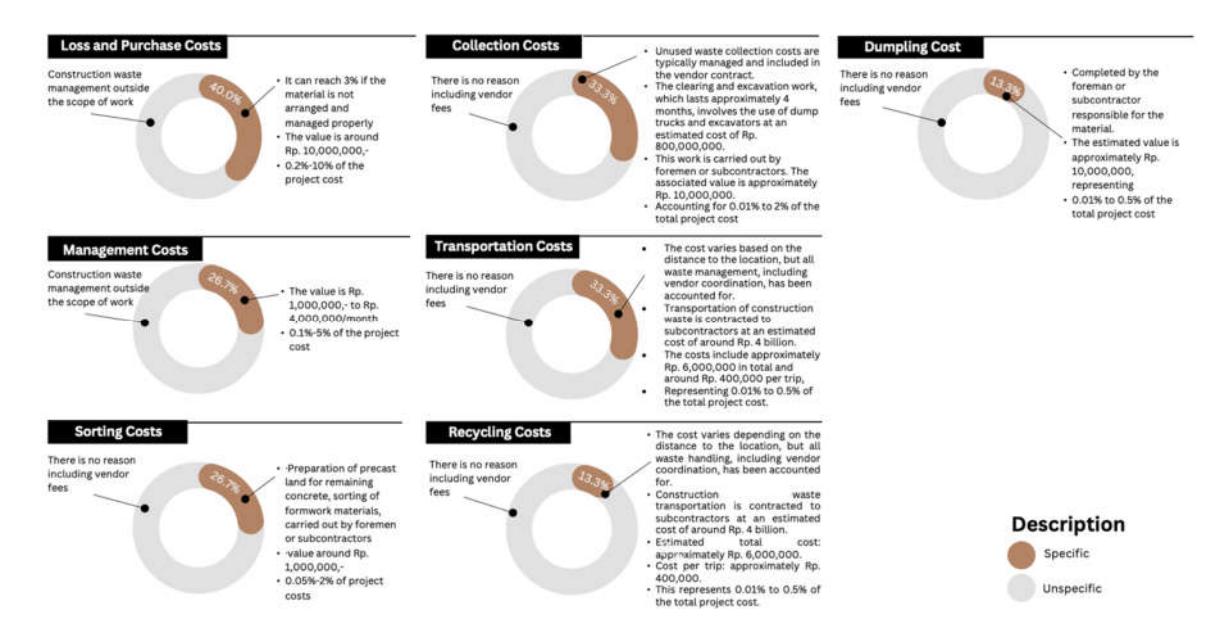
Financing allocation of construction waste management in Indonesia.
In contrast, recycling and dumping costs are the lowest (13.3% each), with values around 0.01%–0.5% of project cost and are frequently embedded within ambiguous vendor contracts. This minimal allocation indicates a reactive rather than proactive approach to construction waste disposal. Accordingly, the development of a cost allocation or proportional distribution model grounded in empirical field data (as presented in Table 5) is essential to establishing the financial parameters necessary for effective construction waste management. This model delineates a range of minimum to maximum cost values, as illustrated in Figure 6, thereby supporting more precise planning and resource allocation.
Figure 6 presents a clear visualization of the cost distribution range—from lowest to highest—for various components of construction waste management in Indonesia based on information of cost range in Figure 5. Notably, losses from construction material purchases represent the most significant financial impact, with a potential peak of up to 10% of the total project cost—far exceeding other components.
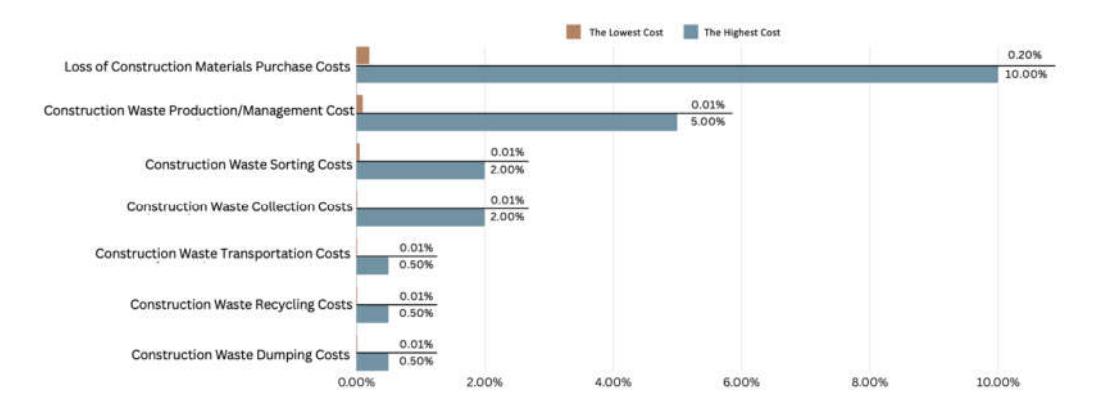
Estimated highest and lowest costs for each construction waste management cost component.
Financing Model for Construction Waste Management in Indonesia
The construction waste management financing model is developed based on the discussion, while acknowledging the limitations in data availability regarding the Total Cost (TC). To address these limitations, the Total Cost (TC) for construction waste management in Indonesia was simulated using the following formula: TC = B1+B2+B3+B4+B5+B6+B7. Where TC represents the total cost associated with the use and reprocessing of construction waste materials; specifically, B1 represents the cost of construction material purchase losses, B2 is the cost of construction waste production/management, B3 covers the cost of waste sorting, B4 includes the cost of waste collection, B5 pertains to the cost of waste transportation, B6 involves the cost of construction waste recycling, and B7 is the cost of construction waste dumping. . Total costs of construction waste management in Indonesia range from 0.39% to 20.50% of the total project cost. The widest cost range is associated with losses from construction material purchases, typically due to errors or excess purchasing, resulting in materials that cannot be returned.
The cost-based model highlights a critical imbalance in resource allocation across the construction project lifecycle, with the highest financial burden—up to 10% of the total project cost—attributed to material purchase losses (B1), while sustainability-related actions such as recycling (B6) and dumping (B7) remain severely underfunded at just 0.01%–0.5% (Figure 7). Such skewed investment priorities reflect a reactive rather than proactive approach, underscoring the need for integrating waste cost planning from the design stage to promote both economic efficiency and environmental sustainability.
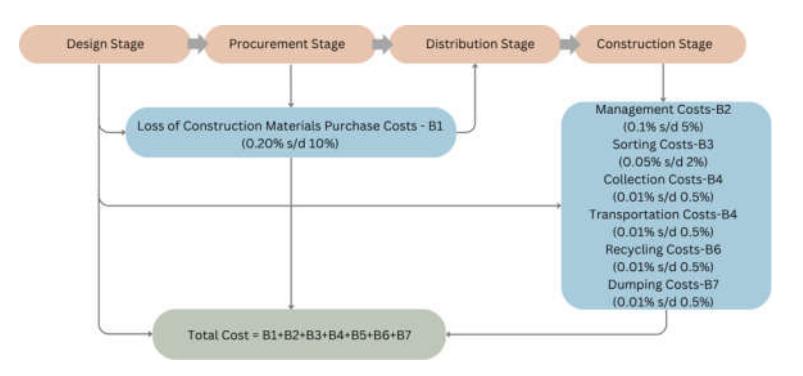
Financing scheme of construction waste management in Indonesia.
Discussion
Types and Management of Construction Waste in Indonesia
The findings reveal that certain materials such as reinforcement steel, bricks, and concrete are frequently reused or recycled into secondary products like paving blocks and aggregates. This pattern aligns with studies from China and Brazil (Huang et al., 2018; Othman and Elsawaf, 2021). However, temporary materials, such as formwork and sand, are recycled at low rates despite their potential. Recycling efforts are often deprioritized due to low perceived financial impact. Additionally, permanent materials used in construction are rarely designed with end-of-life recovery in mind, further limiting recyclability. Indonesia continues to face significant limitations, largely due to insufficient recycling technologies, weak regulatory frameworks, and limited contractor awareness (Al-Raqeb et al., 2023) (Wahyu & Wibowo, 2020). Material recovery remains poor, with many projects still heavily reliant on third-party landfill disposal, underscoring the lack of structured reuse planning and design inefficiencies (Ajayi and Oyedele, 2018). This results also extends previous findings about the 'impact' of limited regulations on solid waste in Indonesia, both nationally and locally, and weak law enforcement (Hansen, 2024). Therefore, construction waste management in Indonesia has not been fully implemented and needs to be reinforced with structured approaches. To address these limitations, several strategies have been proposed and piloted to improve construction waste management across various stages of project development in Indonesia.
Strategies of Construction Waste Management in Indonesia
There is evidence of strategy adoption, particularly in procurement and distribution; however, substantial gaps persist at the design and construction stages. These stages suffer from a lack of integration of recycling principles, inadequate lifecycle monitoring technologies, and weak facilitation of post-construction material reuse. These challenges mirror barriers found in other developing countries, indicating the importance of early-stage design interventions and the use of digital tools such as Building Information Modeling (BIM) to improve outcomes (Fikri et al., 2020; Ajayi & Oyedele, 2018). Moreover, adopting BIM-integrated procurement systems can reduce such losses by 20–25%, especially by synchronizing order volumes with design specifications (Wang et al., 2022). However, the absence of digital integration in most Indonesian construction firms, especially in medium value projects, means that such financial losses often go unmonitored and unaccounted for in most project budgets.
These outcomes highlight that without strategic integration of design-for-deconstruction principles and investment in recycling infrastructure, much of the recyclable material in Indonesia's construction sector will continue to be wasted. Transitioning to a circular economy will therefore require policy enforcement, capacity building, and financial incentives that align on-site practices with circular construction goals. However, the successful implementation of these strategies is closely tied to the availability of adequate financial resources and structured budgeting mechanisms.
Financing Components of Construction Waste Management
The study confirms that financial commitment to sustainable construction waste practices in Indonesia remains notably low. Survey results indicate that expenditures for recycling, transportation, and disposal consistently fall below 0.5% of total project budgets, suggesting a systemic undervaluation of circular economy principles. These costs are frequently embedded within non-specific vendor contracts, which lack transparency and detailed allocation. As a result, the actual investment in sustainable waste management is not only minimal but also largely invisible in formal budgeting processes.
This lack of structured financing undermines the adoption of essential infrastructure and technological solutions. Inefficiencies such as overordering, inaccurate material estimations, and poor inventory control significantly contribute to material loss—patterns that remain prevalent in current Indonesian construction practices (Bossink and Brouwers, 1996). Although digital tools such as BIM and material tracking systems have demonstrated effectiveness in minimizing waste (Wang et al., 2022), their implementation is still limited, especially among small- to medium-scale projects.
Furthermore, the current financial model appears to prioritize loss mitigation over value recovery. A disproportionate portion of waste-related costs is attributed to material purchase losses, while negligible allocations are made for sorting and recycling efforts. This misalignment reflects a reactive approach that contrasts with best practices in advanced economies, where sustainability considerations are systematically integrated into financial planning and procurement processes.
To address these shortcomings, there is an urgent need for the development of a dedicated financing framework that explicitly supports circular construction practices. This includes the itemization of waste-related costs, investment in recycling and sorting infrastructure, and adoption of performance-based incentives. Policy reforms—such as landfill levies, mandatory reporting on waste expenditures, and contractual integration of sustainability-linked budget lines can drive accountability and encourage behavioral change at the project level. Embedding these mechanisms from the design phase onward is critical for shifting industry practices from short-term cost control to long-term resource efficiency and value generation.
Financing Model for Construction Waste Management in Indonesia
Building upon these recommendations, the findings underscore the importance of proactive financial planning integrated from the earliest stages of project design. Embedding the proposed financing model into digital project management platforms—such as BIM—can enhance cost transparency, improve budget forecasting, and streamline sustainability tracking across the construction lifecycle. Prior research has demonstrated that effective design not only reduces project duration and increases cost efficiency, but also strengthens decision-making by providing clearer implementation frameworks (Rady et al., 2022). Nevertheless, many existing economic evaluations still emphasize static design parameters, such as designer perceptions and decision-making behavior, rather than dynamic budget integration for waste control (Wang et al., 2015).
Given the significant influence of early design decisions, this phase should be strategically leveraged—not only to minimize overordering and material specification errors but also to serve as a foundation for cost optimization and sustainable outcomes. To facilitate broader adoption, future studies should focus on validating the model through pilot implementations in real-world projects. This includes assessing its applicability across varying project scales and geographies, testing integration with procurement and contracting systems, and simulating the impact of fiscal policies such as landfill taxation or recycling incentives. Additionally, further exploration into contractor behavior, regulatory compliance, and lifecycle carbon cost implications could enhance the model's robustness and contribute to Indonesia's transition toward a fully circular construction economy.
Conclusions
This study provides a comprehensive analysis of construction waste management in Indonesia, revealing the complex interplay between waste types, strategic practices, and financing mechanisms across the construction life cycle. While materials such as reinforcement steel, bricks, and split stone show high recycling potential, actual reuse remains constrained by inadequate design planning, limited infrastructure, and weak regulatory enforcement. Waste reduction strategies are most effectively applied during procurement and distribution, whereas design and construction phases remain underdeveloped. The absence of digital tools and design-for-deconstruction approaches further limits efficiency and recovery potential.
Financially, material loss represents the most significant waste-related cost—up to 10% of total project budgets—while recycling and disposal receive less than 0.5% of funding. This skewed allocation reflects a reactive model that prioritizes loss mitigation over proactive resource recovery. The proposed financing model, estimating total waste-related costs between 0.39% and 20.5% of project value, provides a realistic framework for integrating sustainability into budget planning. To support Indonesia's transition toward a circular construction economy, this study highlights the urgency of embedding waste management into early design phases, strengthening financial accountability, and reforming contracts to promote resource efficiency. The findings offer actionable insights for stakeholders to structure investment in sustainable practices and build long-term resilience across the sector.
Acknowledgments
We extend our sincere gratitude to the Indonesian Ministry of Education and Culture of the Republic of Indonesia for providing research funding under the Fundamental Research scheme, contract number B/956/UN57.L1/PT.01/2024. We also appreciate the support from Tidar University in facilitating the implementation of this research.
Compliance with ethics guidelines
The authors declare they have no conflict of interest or financial conflicts to disclose.
This article contains no studies with human or animal subjects performed by authors.