
Introduction
The Schrödinger equation holds a significant position and exerts a wide-ranging influence in various contemporary scientific domains and quantum mechanics. However, since its formulation in 1926, no theory has been able to provide conclusive proof of its validity. Scholars concur that the Schrödinger equation is a fundamental assumption in quantum mechanics, offering a probabilistic depiction of the dual nature of matter waves and particles. Its validation can only be achieved through practical experimentation rather than relying on more fundamental assumptions (Gudder et al., 2019; Kiukas et al., 2019; Kramers, 2018). Consequently, researchers are primarily focused on delving deeper into the intricacies of quantum theory (Andrianopoli et al., 2019; Penati et al., 2019; Rama, 2019). Furthermore, they are actively exploring the specific applications of quantum mechanics (Li et al., 2017; Song et al., 2016; Zhao et al., 2019) and developing approximate simplification techniques and solution methods for the Schrödinger equation (Shi & Nie, 2017; Pandir et al., 2019; Shengfan et al., 2019; Troy, 2019; Dai & Yin, 2019).
With the advancement and progress of mechanical theory, quantum mechanics and classical mechanics have become increasingly integrated into people's daily lives. Combining these concepts continuously creates new, challenging fields and problems (AS et al., 2019). However, the absence of theoretical derivation and proof for Schrödinger's equation has always hindered people's comprehension and understanding of quantum mechanics and the thorough interpretation and analysis of specific quantum mechanical problems. Understanding the relationship between classical and quantum mechanics is crucial for the dissemination, development, and in-depth exploration of quantum mechanics and even for the progressive advancement of natural science. Various scholars have investigated the enigma surrounding the connection between classical and quantum mechanics from diverse perspectives in recent years.
Although there is a prevailing belief that classical mechanics is only applicable to the study of objects with speeds significantly lower than that of light and is not suitable for the microscopic realm, scholars have provided evidence for the validity of the three conservation laws and principles of quantum mechanics through the observation of cosmic microwave background radiation (Boriev, 2018). This indicates that the microscopic world still adheres to the laws of
nature that govern the macroscopic world or, at the very least, does not contradict them. Furthermore, based on Einstein's mass-energy equation (Na et al., 2019), the research findings on the wave-particle duality of light reinforce the intrinsic unity between the two realms. Consequently, exploring the concept of energy as a means to delve deeper into this unity emerges as a promising avenue for further investigation.
Scholars have extensively examined and investigated the possibility of a "Quantum Mechanics-Unified Theory of Classical Mechanics" (Mills, 2003). Numerous aspects, including energy conservation, kinetic energy-potential energy, quantum gravity, orbital energy level, and randomness, have been explored to demonstrate this theory's feasibility (McIntyre, 2022). However, due to the inherent nature of randomness, developing a particle trajectory model that aligns with these characteristics is necessary. Additionally, a comprehensive force field is required to adequately explain quantum gravity, as the current demonstration process is imperfect. Consequently, providing rigorous proof linking the classical mechanical motion equation to the Schrödinger equation is impossible.
Feintzeig offered C*-algebras as a mathematical framework for understanding the interconnection between quantum and classical physics, thereby laying the groundwork for philosophical discourse on quantization and the classical limit. The approach was used to study significant problems in theory change, such as reduction, structural continuity, analogical reasoning, and theory development. Using algebraic quantum theory, Feintzeig demonstrated how rigorous mathematical techniques can strengthen philosophical argument in the fields of physics and science, thus offering insightful views on continuity and theory change in physics (Feintzeig, 2022). Vijaywargia and Lakshminarayan recognized classical Koopman channels as quantum channel counterparts, allowing a comparison between their evolution. They compared spectral properties using a coupled kicked rotor and showed that stable classical regions govern quantum spectra. In chaotic systems, spectral density is composed of an annular structure with diminishing size in the classical limit, and the surviving modes are specified by unstable manifolds or stable periodic orbits (Vijaywargia et al., 2025).
Cerisola et al. investigated the equilibrium deviations in nanoscale systems induced by environmental interactions, specifically in the θ-angled spin–boson model. They obtained a general classical equilibrium state with environmental corrections and demonstrated that Bohr's correspondence between quantum and classical is maintained at any coupling strength in the quantum formalism. By categorizing coupling regimes as weak to ultrastrong, the study describes quantum-to-classical crossovers and investigates the competition between quantum corrections and mean force shifts for equilibrium states, with applications to magnetism and exciton dynamics (Cerisola et al., 2024). Blasco and Lluís (Barrett et al., 2023) also presented the Path Integral formulation of Quantum Mechanics, illustrating its applicability to simple systems and its connection to classical mechanics in the classical limit. They established that it is equivalent to Schrödinger's formulation and explored its consequences through the Aharonov-Bohm effect. Finley (Finley, 2021) introduced a deterministic quantum mechanics formalism in terms of velocity functions applicable to n particles, thereby generalizing the domain of Bohmian mechanics to stationary states. The novel formalism provides dynamic particles that apply to all states by unifying Bohmian mechanics with an evident energy-conserving strategy. The ensuing equation comprises two kinetic energy terms and a pressure-like term, which is given as an n-body generalization of the enhanced Madelung equations.
Magri et al. (Magri et al., 2023) highlighted the influence of quantum mechanics on fluid mechanics and spectral theory, advocating for quantum-inspired techniques like symmetry considerations and spectral analysis. They illustrated examples in acoustics and incompressible flows, showing their potential for enhancing fluid dynamics research and teaching. Rozema et al. (Rozema et al., 2024) studied causally indefinite processes in quantum information initially connected with reconciling general relativity and quantum mechanics. They highlighted advantages in metrology and quantum computation, summarized experimental and theoretical advances, and discussed interpretations of results and prospects. Baiardi (Baiardi et al., 2021) investigated computerized quantum mechanical reaction path elucidation and molecular dynamics. Some important strategies involve heuristic rules, external biases, interactive quantum mechanics, transition-state optimization, and reactive molecular dynamics. These methods minimize human effort and bias, and maximize computational chemistry, allowing for unexpected discoveries. Bass & Doser (Bass et al., 2024) discussed quantum sensing as a way to surpass classical measurement limits in particle physics. The most important applications are neutrino properties, tests of fundamental symmetries, dark matter detection, and dark energy studies. Atom interferometry, optomechanical systems, and atomic clocks are the most important technologies for low-energy physics, while quantum dots, superconducting circuits, and spin sensors may apply to high-energy detectors. The paper highlights opportunities and collaboration challenges in implementing quantum sensor applications in future experiments.
Schleich et al. (Schleich et al., 2016) reported the long tradition of quantum physics in Germany and its impact on modern technology. While early quantum technology resulted in semiconductors and lasers, recent developments target the control of single quantum systems. With enormous economic potential, the field is driven by global research initiatives. To remain competitive, Germany must enhance its research infrastructure to be capable of further developing quantum technology. Malo et al. (Yago Malo et al., 2024) discussed the groundbreaking influence of cold and ultracold atomic platforms on quantum simulation, computation, metrology, and sensing. These technologies drive condensed matter physics, cosmology, quantum mechanics, quantum chemistry, and quantum biology. The article highlights three key points: (i) quantum technologies are leading cross-disciplinary research, (ii) quantum many-body physics constitutes the heart of frontier science, and (iii) quantum advancement will have long-lasting influences on society. Emphasizing responsible research and innovation, the paper provides an overview of interdisciplinary use cases where atomic platforms are of particular significance.
In summary, it is essential to construct a trajectory model for particle motion that incorporates randomness and applies the energy principle to examine the power field that adheres to the principles of quantum mechanics. This research path is both viable and worthwhile. Consequently, this study also investigates the transition from classical to quantum mechanics.
Classical mechanics research is centered around the object's motion trajectory. Still, it fails to address the problem of matter fluctuation and cannot provide the particle's motion trajectory in the natural dimension. Conversely, the solution to the Schrödinger equation is a complex plane wave, which does not offer a point of reference. This disparity between classical and quantum mechanics necessitates the expansion of the natural dimension and the establishment of a virtual dimension (the virtual axis issolely used as an auxiliary analysis method and does not affect the equation). By combining the virtual and natural dimensions, matter fluctuation can be displayed through particle movement trajectories, and the time coordinates can describe the space-time trajectory of matter fluctuation (particles operate within this trajectory, and the model will explain random phenomena for observers). An equation can be formulated in classical mechanics by introducing a power field corresponding to the motion trajectory. De Broglie has already established the relationship between material fluctuations and energy, which has been experimentally verified. Therefore, by establishing a force field in the virtual plane that adheres to quantum mechanical phenomena based on the relationship between material fluctuations and energy, Newton's second law can be employed to derive a dynamic equation for matter fluctuations, which can be equivalently transformed into the form of the Schrödinger equation.
Although there has been intense scholarly investigation into the relationship between classical and quantum mechanics, a large gap still exists in the rigorous derivation of the Schrödinger equation from classical principles. The Schrödinger equation is largely regarded as a postulate within quantum mechanics theory, yet no rigorous theoretical derivation using purely classical mechanics has been suggested. Existing approaches, such as Koopman-von Neumann mechanics and Bohmian mechanics, provide other descriptions but fail to complete classical determinism, quantum randomness, energy quantization, and wave-particle duality. Further, the possibility of an underlying force field that could provide a deterministic basis for quantum phenomena is yet to be investigated. Numerous efforts have been made to form correlations between quantum mechanics and classical mechanics, but a widely embraced theoretical approach to merge these two fields does not exist. Furthermore, although mathematical connections have been suggested, a clear derivation of the Schrödinger equation from Newtonian mechanics and a complete physical understanding of quantum effects have not been attained to date. Experimental verification of classical-quantum relations is also limited, and the engineering, physics, and quantum technology ramifications of a link are unexamined. The hypothesis of a virtual axis for dimensional expansion, as proposed in this paper, provides a new perspective, but its correctness and usefulness must be investigated theoretically and experimentally. Filling these lacunae in research, this paper attempts to create a trajectory-based model of both classical and quantum mechanics that provides a way of deriving the Schrödinger equation from classical principles.
Novelty
This study proposes a novel method of wedding quantum mechanics and classical mechanics by utilizing a virtual axisto-dimensional extension, thereby offering new information on material fluctuations and their respective trajectories. Another highlight is the proposal in this study of a force field model that renders the Schrödinger equation derivable from classical mechanics, rather than putting it forth as an absolute postulate. The coupling of Newton's second law with a quantum-mechanics-compatible force field, whose strength is influenced by Planck's constant and is inversely dependent on the distance from a fixed point creates an explicit mathematical and physical link between quantum and classical domains. The profound consequences of this method contribute to an extended understanding of quantum
states, wave functions, and quantum transitions within the context of deterministic particle motion, thus giving an extended view of quantum mechanics. Furthermore, this approach enables new directions of practical applications in engineering, physics, and the development of quantum technologies, especially in fields that demand realistic simulations of quantum effects based on classical mechanics principles. Moreover, the force field approach put forward herein indicates promising relationships to yet unstudied physical effects, such as the interaction with dark matter and the behavior of macroscopic fluctuations, revealing the significant consequences of this work. By the foundation of a novel paradigm of quantum mechanics relying on classical tenets, the present research triggers additional interdisciplinary research and enables concrete progress in quantum theory-based applications.
Expansion of Natural Dimensions
Establishing A One-dimensional Analysis Model
The study of the wave problem in classical mechanics revolves around determining the trajectory of particles in space and time. However, this becomes unattainable within the confines of quantum mechanics, as it describes wave functions in terms of natural dimensions and time. At any given moment, two distinct geometric motion properties are associated with time. This implies that objects can exist simultaneously in two different states of motion (speed, acceleration), which contradicts classical mechanics and deviates from its objective principles.
Classical mechanics requires that the relative time of the state of motion must be unique. In other words, a point on a space-time motion trajectory can only correspond to a unique moment. From the perspective of the observed trajectory, it can be understood that a set of unique information is obtained by observing the motion, and then each piece of information in the set is used as a reference axis to generate a reference system, in which the corresponding points of each set of information are connected to obtain the motion trajectory. For example, when observing the motion of a particle, the position coordinates X, y and Z are obtained at any time t, and the four pieces of information (X, y, Z and t) obtained by observation form a unique information group, and then the space-time motion trajectory under the reference system of X, y, Z and t is obtained. For material fluctuations, the biggest problem is that the observed information group is not unique (for example, at time t, different X, y, Z are obtained according to probability). If the material wave trajectory exists, the information group is not unique, indicating that the observed information is missing, because an objective thing must be uniquely marked by enough information. Accordingly, it is reasonable to speculate that the root cause of the failure to obtain the material fluctuation trajectory is the existence of unknown information that can not be observed at present. Therefore, to meet the needs of classical mechanics analysis, the unknown information of material fluctuation is represented by a virtual quantity; that is, a virtual coordinate axis is extended in the reference system to describe the phenomenon of material fluctuation, as shown in Figure 1.
A graphical representation of a particle's space-time trajectory within the framework of a virtual coordinate system is illustrated. The solid elliptical line denotes a hypothetical trajectory of motion within an expanded dimensional space. Points A and A' depict locations at varying time points in time (t and t₁) where fluctuations are confined along the realspace axis.
Virtual axis and dimensional expansion.
In Figure 1, the axis is a virtual coordinate, which is related to and ; the axis is vertical, but it is not the axis of threedimensional space in daily life. It is a special axis beyond the three-dimensional space. The solid line circle is the motion trajectory of particles in the virtual plane, and its upper point represents the coordinates and motion state of the corresponding physical space points (as shown in the figure). The and points correspond to the same physical space
location 1 , but their speed vectors differ. The virtual spiral is the space-time motion trajectory of particles in the phenomenon of material fluctuations, i.e.1 . Moment ′ represents that particles move in the virtual plane to , which corresponds to the real space 1 location. Therefore, in the graphic model, there are unique kinematic properties (position and velocity) for fluctuating particles at any time, which is the premise of using classical mechanics to solve the problem of matter fluctuations.
Based on the abovementioned modeling approach, the three-dimensional space can be extended to a six-dimensional space to derive the three-dimensional Schrödinger equation logically. Nevertheless, this study does not delve into developing a three-dimensional space extension model, as any spatial issue can be projected and resolved within three dimensions. The dynamic equations employed in classical mechanics for analytical computations are also projection equations based on three coordinate axes. Consequently, the three-dimensional Schrödinger equation should be comprehended as three distinct sets of Figure 1 models and subsequently deduced by the projection relationship.
The study of object motion in classical mechanics involves the examination of a definite trajectory, as depicted in Figure 1. However, the presence of material fluctuations introduces uncertainty and contradicts the principles of classical mechanics. This discrepancy is one of the reasons why classical mechanics is considered inadequate for explaining phenomena at the microscopic level. Upon analysis, it is discovered that a virtual axis's absence or unobservable nature results in random observations of the determined motion trajectory within extended time and space. This topic is further explored in detail in the subsequent discussion.
Observation Randomness Analysis
Because the virtual axis does not exist (or cannot be observed), when the material fluctuations described in Figure 1 are observed in practice, it is equivalent to .
The space-time trajectory axis is projected to − plane, as shown in Figure 2. Figure 2 illustrates that the variation of matter demonstrates a wave-like pattern concerning time. Three observations occurred during the observation time of 1 ,2 and 3 . Then, the observation will appear 2 times as particles in the position 1 and position 2 . If in 1 ∼ 3 , continuous observation occurs during the period 1 position, particles will also appear in this position twice. According to the model in Figure 1, 1 is always observed that the particles are in point. 3 is the time moment of point. The speed vectors of the two points are different, but practical observations cannot be distinguished. Therefore, based only on the analysis of observation results, particles have spatial position uncertainty, and events appearing at a specified location are subject to a probability distribution, called observation randomness. The observation results align with practice if the particle motion is like a model.
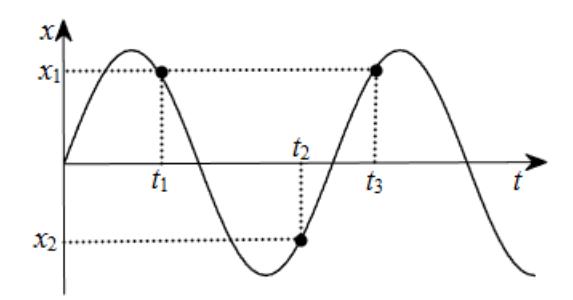
Energy Quantization and Discrete Transitions.
axis is regarded as an imaginary axis. It is equivalent to the wave function in quantum theory (,) (The amplitude does not match the trajectory radius, discussed in the third section). Combined with the observation of randomness, it is very easy to explain the inaccurate problem. Because of the observation position 1 at that time, a different momentum is obtained, and the particles with the same momentum will be in different positions. Different positions and momenta in this model correspond to different waveforms under the same parameters, and the existing quantum mechanics uses the concept of position and momentum to explain. In this model, the probability that the position or momentum has a certain value is the same, which is the circumference of the trajectory. The wave function is used in quantum theory as |(,)| 2 . The countdown describes the probability and |(,)| 2 is proportional to the circumference of the trajectory, so it conforms to the probability interpretation of the wave function. The depiction
above demonstrates the model's logicality and highlights the potential to deduce the dynamic wave equation equivalent to the Schrödinger equation.
Matter Fluctuation Equation based on Classical Mechanics
Equation Establishment
The concepts of classical mechanics have here been extended to provide a link with the Schrödinger equation. Classical mechanics portrays particle motion in terms of deterministic trajectories controlled by Newton's second law, which connects force, mass, and acceleration. Quantum mechanics employs probabilistic wavefunctions, and the step from classical to quantum accounts is not an easy one. In attempting to narrow this gap, the classical formulation has here been modified to permit a wave-like description to arise from deterministic motion.
Dimensional Expansion and Virtual Axis
One of the key changes is the introduction of a virtual axis, which expands the classical description of motion into a new dimension. This new degree of freedom allows material fluctuations to be explained as continuous trajectories instead of discrete, random quantum events. By expanding into this new dimension, a link between classical deterministic motion and quantum wave-like behavior is created. The virtual axis is a theoretical concept that is consistent with the principle of wave-particle duality, allowing quantum phenomena to be explained in terms of trajectory evolution.
According to classical mechanical theory, particles can move on an extended surface, and the plane must have a force field. As there is an unknown force field, it is assumed that free particles in − plane move uniformly around the circumference and receive the field force = − vector, where represents the field force coefficient. Particle vector motion equation is () and is the rotational speed, as shown in Figure3.
Force Field Representation.
A quantum theory-consistent force field with a strength of Planck's constant and inversely proportional to the distance from a certain fixed point is assumed. One obtains from Newton's second law, in this broader framework, a secondorder differential equation for material fluctuations. The force field provides an energy equation, which is the energy quantization of quantum mechanics. The energy formula from classical physics in Eq. (1):
\[U = V_0 \tag{1}\] where: and 0 are the potential energy and kinetic energy in the force field, respectively.
Then, the total energy is as follows in Eq. (2):
\[E = U + V_0 (2)\]
According to the energy relationship of De Broglie in quantum mechanics, Eq.(3) is expressed as follows:
\[E_d = hf (3)\]
In Eq. (3), represents the particle energy described by De Broglie, ℎ is Planck's constant, and refers to the particle fluctuation frequency.
Based on quantum mechanics, there is no unknown force field; naturally, there is no potential energy. Therefore, compared to this model, the energy given by De Broglie should be equal to the particle kinetic energy (or potential energy), that is in Eq. (4),
\[E_d = U = V_0 \tag{4}\]
By classical mechanics, there are in Eq. (5)
\[U = \frac{m(\omega r)^2}{2}\] \[V_0 = \frac{\xi r^2}{2}\] (5)
Because the circular motion frequency of the model particles in this paper is the same as the wave function frequency of quantum mechanics, the angular velocity of particle motion can be expressed as Eq.(6):
\[\omega = 2\pi f \tag{6}\]
Uniting Eq. (3) to Eq. (6) leads to
\[hf = \frac{m(2\pi f r)^2}{2}\] \[hf = \frac{\xi r^2}{2}\] \[(7)\]
By rewriting Eqs. (7) and (8) is obtained as follows:
\[f = \frac{h}{m2\pi^2 r^2} = \frac{h}{m\pi r^2}\] \[\xi = \frac{2hf}{r^2} = \frac{2hh}{m\pi r^4} = \frac{4h^2}{mr^4}\] (8)
Among them, ℏ = ℎ 2 is Planck's constant.
For convenience, = || represents the radius of the trajectory circle, then in Eq. (9)
\[f = \frac{\hbar}{m\pi r^2} = \frac{\hbar}{m\pi R^2}\] \[\xi = \frac{4\hbar^2}{mr^4} = \frac{4\hbar^2}{mR^4}\] (9)
According to Newton's second law, Eq. (10) is expressed as follows:
\[m\frac{d^2\mathbf{r}}{dt^2} = \mathbf{F} = -\xi \mathbf{r} = -\frac{4\hbar^2}{mR^4}\mathbf{r} \tag{10}\]
After simplification, the available material fluctuates in − , the differential equations of motion of the plane are as follows:
\[\frac{d^2r}{dt^2} + \frac{4\hbar^2}{m^2R^4}r = 0 \tag{11}\]
By solving the above second-order differential equation, the motion trajectory of this paper's model can be obtained and expanded on the timeline to get the fluctuating space-time trajectory wave. The following provides proof of Eq. (11) and presents its equivalence as a Schrödinger equation.
Implications and Interpretations
These results imply that wave-like quantum behavior can be naturally produced from a classical deterministic system when an extra dimension is considered. The hypothetical force field creates fluctuations which, when projected onto real space, produce probability distributions in accord with quantum mechanical wavefunctions. In addition, the discreteness of the energy level occurs in the model as a consequence of force field trajectory constraints, with conceptual analogy to boundary conditions that specify discrete energy levels in quantum mechanics.
By embedding classical mechanics in this way through these alterations, a formal equivalence between the deterministic trajectories and the probabilistic wavefunctions has been developed, allowing another point of view for the derivation of the Schrödinger equation.
Proof of Equivalence With the Schrödinger Equation
As shown in Figure 4 by the thick solid line, the space-time trajectory of material fluctuations can be regarded as a special space-time wave propagating on the timeline. The image of the space-time wave function \(\Psi(x,t)\) is derived from the trajectory of material fluctuations.
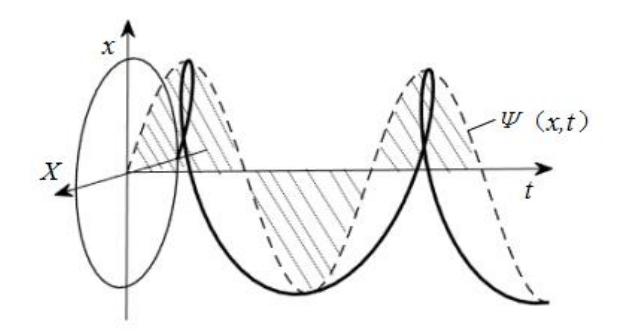
Figure 4 Trajectory Evolution and Matter Fluctuation.
Again, the solution can be written as a wave function of a second-order homogeneous linear differential equation. Set the space-time wave function to Eq. (12):
\[\phi(x, X, t) = \phi(\mathbf{r}, t) = \exp[i(\mathbf{k} \cdot \mathbf{r} - \omega t)] \tag{12}\]
Among them, k refers to the wave as \(|k| = \frac{2\pi}{\lambda}\) and \(\lambda\) is the wavelength.
By deriving the wave function Eq. (12) for time, the partial derivative of the wave function is obtained as follows in Eq. (13):
\[\frac{\partial \varphi(r,t)}{\partial t} = exp[i(\mathbf{k}.\mathbf{r} - \omega t)] \frac{\partial [i(\mathbf{k}.\mathbf{r} - \omega t)]}{\partial t}\] \[= exp[i(\mathbf{k}.\mathbf{r} - \omega t)] - \omega i\] \[= -\omega i \varphi(\mathbf{r},t)\] (13)
where in Eq. (14)
\[\omega = \frac{i}{\phi(r,t)} \frac{\partial \phi(r,t)}{\partial t} \tag{14}\]
Similar to Eq. (12), with standard vector radius, the secondary partial derivative is as follows in Eq. (15):
\[\frac{\partial \phi(\mathbf{r},t)}{\partial \mathbf{r}} = \mathbf{k}i\phi(\mathbf{r},t) \frac{\partial^{2}\phi(\mathbf{r},t)}{\partial \mathbf{r}^{2}} = -|\mathbf{k}|^{2}\phi(\mathbf{r},t) = -\left(\frac{2\pi}{\lambda}\right)^{2}\phi(\mathbf{r},t)\] (15)
According to the De Broglie momentum relationship in Eq. (16):
\[p_d = \frac{h}{\lambda} \tag{16}\]
By combining classical mechanics (Eq.(6)) and standard particle motion (Eq.(8)), the momentum is as follows in Eq. (17):
\[p = m\omega R\] \[= m2\pi f R\] \[= m2\pi \left(\frac{h}{m\pi R^2}\right) R\] \[= \frac{h}{\pi R}\] (17)
Because momentum description does not involve the power field, this model is the same as particle momentum in quantum mechanics, that is in Eq. (18),
\[p = p_d \tag{18}\]
By Eq. (16) and (17), the wavelength expression can be derived as in Eq. (19)
\[\frac{1}{\lambda} = \frac{1}{\pi R} \tag{19}\]
Substituting in Eq. (15) and transforming, Eq. (20) is obtained as follows:
\[\frac{\partial^{2} \phi(r,t)}{\partial r^{2}} = -\left(\frac{2\pi}{\lambda}\right)^{2} \phi(\mathbf{r},t) = -\left(\frac{2}{R}\right)^{2} \phi(\mathbf{r},t) \frac{4}{R^{2}} = -\frac{1}{\phi(r,t)} \frac{\partial^{2} \phi(r,t)}{\partial r^{2}}\] (20)
According to differential equations established for classical mechanics (Eq. (11)), and transforming, Eq. (21) is obtained as follows:
\[\frac{d^{2}r}{dt^{2}} + \frac{4\hbar^{2}}{m^{2}R^{4}} \mathbf{r} = 0\] \[\frac{d^{2}r}{dt^{2}} + \left(\frac{4}{R^{2}}\right)^{2} \left(\frac{\hbar}{2m}\right)^{2} \mathbf{r} = 0\] (21)
The particles in the model make a uniform circle. Its total acceleration vector 2 2 is equal to the normal acceleration vector and in the opposite direction of the vector radius. According to the movement, the relationship between the natural axis system and the vector system, Eq. (22), is obtained as follows:
\[a_n = \frac{v^2}{R} = \frac{(\omega R)^2}{R} = \omega^2 R\] \[\begin{cases} \frac{d^2 \mathbf{r}}{dt^2} = \mathbf{a}_n = -\omega^2 \mathbf{r} \end{cases}\] (22)
Where is the tangent speed and is the normal acceleration.
By transforming Eq.(21) based on Eq. (22), Eq. (23) is obtained as follows:
\[\omega^2 = \left(\frac{4}{R^2}\right)^2 \left(\frac{\hbar}{2m}\right)^2 \tag{23}\]
By substituting Eqs. (14) and (20) Formulas in both sides of Eq.(23), Eq.(24) is obtained as follows:
\[\left(\frac{i}{\phi(r,t)}\frac{\partial\phi(r,t)}{\partial t}\right)^2 = \left(\frac{-1}{\phi(r,t)}\frac{\partial^2\phi(r,t)}{\partial r^2}\right)^2 \left(\frac{\hbar}{2m}\right)^2 \tag{24}\]
By rearrangement of Eq. (24), the expression form of the Schrödinger equation can be obtained as Eq. (25) as follows:
\[i\frac{\partial\phi(r,t)}{\partial t} = -\frac{\hbar}{2m}\frac{\partial^2\phi(r,t)}{\partial r^2} \tag{25}\]
The vector diameter of the equation above differs slightly from the Schrödinger equation, as it encompasses an additional dimension. However, this disparity does not have any impact on the result. Because vector equations can be projected and calculated, to distinguish the latter text, it is mainly expressed differently with function symbols . It indicates the hypothetical axle of the wave function. It does not contain a Hypothetical axle in the wave function of quantum mechanics. it only compares with one more virtual dimension. As shown in Figure 4 in the shadow part, − space-time trajectory wave projection represents the wave function (,).
In addition, particle differential equations of motion of Eq. (11) can also be written as a projection as follows:
\[\frac{d^{2}x}{dt^{2}} + \left(\frac{4}{R^{2}}\right)^{2} \left(\frac{\hbar}{2m}\right)^{2} x = 0\] \[\frac{d^{2}X}{dt^{2}} + \left(\frac{4}{R^{2}}\right)^{2} \left(\frac{\hbar}{2m}\right)^{2} X = 0\] (26)
Again, by substituting Eqs. (14) and (20) Formulas in both sides of Eq. (26), a standard one-dimensional free particle Schrödinger equation can be obtained in quantum mechanics as follows in Eq. (27):
\[i\frac{\partial\psi(x,t)}{\partial t} = -\frac{\hbar}{2m}\frac{\partial^2\psi(x,t)}{\partial x^2} \tag{27}\]
According to the projection principle, no matter how many dimensions are in the differential equations of motion of Eq. (11), the formula has only one more virtual dimension than the Schrödinger equation. As long as it is projected on the real dimension and timeline, the standard Schrödinger equation expression can be obtained. Also, it shows that the equivalence between this equation and the Schrödinger equation has nothing to do with the virtual axis.
General form of the Wave Equation
Assumed that the particles are in an external situation field V(r) of medium fluctuation. According to classical mechanics, the total kinetic energy of particles in this model is as follows in Eq. (28):
\[E = U + V(\mathbf{r}) + V_0 \tag{28}\]
According to quantum mechanics, at power under the action of the force field, the particle will change its fluctuation frequency, and the energy will also change with it. However, based on quantum mechanics, there is no unknown force field, so at this time, the energy given by De Broglie is as follows:
\[E_d = U + V(\mathbf{r}) \tag{29}\]
Because in this model, the momentum of the particle is the same as the momentum described by De Broglie, and the relationship between wavelength and trajectory radius (Eq. (19)) has been proved as \(\lambda=\pi R\), it is possible to deduce the power field problem easily as follows:
According to classical mechanics, kinetic energy and momentum are expressed as follows in Eq. (30):
where in Eq. (31)
\[U = \frac{p^2}{2m} \tag{31}\] and because in Eq. (32)
\[p = p_d \tag{32}\]
So, standard Eq. (29) can be rewritten as follows in Eq. (33):
\[E_d = \frac{p_d^2}{2m} + V(\mathbf{r}) \tag{33}\]
According to De Broglie, momentum and kinetic energy are expressed as follows in Eq. (34):
\[E_d = hf\] \[p_d = \frac{h}{\lambda}\] \[(34)\]
As \(\lambda = \pi R\), Eq. (35) is obtained as follows:
\[\begin{bmatrix} E_d = hf \\ p_d = \frac{h}{\lambda} = \frac{h}{\pi P} \end{bmatrix}\] (35)
By substituting Eq.(33), Eq. (36) is obtained as follows:
\[hf = \frac{1}{2m} \left(\frac{h}{\pi R}\right)^2 + V(\mathbf{r}) \tag{36}\]
Then, there is in Eq. (37)
\[f = \frac{h}{2m} \left(\frac{1}{\pi R}\right)^2 + \frac{V(r)}{h} \tag{37}\]
By circular motion, angular velocity and frequency relationship, Eq. (38) is obtained as follows:
\[\omega = 2\pi f\] \[= 2\pi \left[ \frac{h}{2m} \left( \frac{1}{\pi R} \right)^2 \frac{V(r)}{h} \right]\] \[= \frac{2h}{mR^2} + \frac{V(r)}{h}\] (38)
According to Eq. (22), there is in Eq. (39):
\[\frac{d^2r}{dt^2} = -\omega^2 r \tag{39}\]
To obtain a power field directly based on the wave equation of classical mechanics, Eq.(40) is obtained as follows:
\[\frac{d^2r}{dt^2} + \left(\frac{2\hbar}{mR^2} + \frac{V(r)}{\hbar}\right)^2 r = 0 \tag{40}\]
By arrangement of Eq. (38), Eq. (41) is obtained as follows:
\[\omega = \left(\frac{4}{R^2}\right) \left(\frac{\hbar}{2m}\right) + \frac{V(r)}{\hbar} \tag{41}\]
By substituting Eqs. (14) and (20) Formulas in both sides of Eq.(41), Eqs. (42) and (43) are obtained as follows:
\[\omega = \frac{i}{\phi(r,t)} \frac{\partial \phi(r,t)}{\partial t}\] \[\frac{4}{R^2} = -\frac{1}{\phi(r,t)} \frac{\partial^2 \phi(r,t)}{\partial r^2}\] (42)
\[\frac{i}{\phi(r,t)} \frac{\partial \phi(r,t)}{\partial t} = \left(\frac{-1}{\phi(r,t)} \frac{\partial^2 \phi(r,t)}{\partial r^2}\right) \frac{\hbar}{2m} + \frac{V(r)}{\hbar} \tag{43}\]
By organizing and projecting it in the natural dimension, Eq. (44) is obtained as follows:
\[i\frac{\partial\psi(r,t)}{\partial t} = -\frac{\hbar}{2m}\frac{\partial^2\psi(r,t)}{\partial r^2} + \frac{V(r)}{\hbar}\psi(r,t) \tag{44}\]
The general form of Schrödinger's equation is as follows in Eq. (45):
\[i\hbar \frac{\partial \psi(r,t)}{\partial t} = -\frac{\hbar^2}{2m} \frac{\partial^2 \psi(r,t)}{\partial r^2} + V(r)\psi(r,t)\] (45)
Since the material wave equation has been derived based on classical mechanics, it has been proved to be equivalent to the Schrödinger equation.
Expanded Discussion on Underlying Assumptions
In order to ensure clarity and theoretical consistency, we set out and discuss the underlying assumptions of our proposed model clearly below.
The proposed model is based on a set of basic assumptions that need explicit statement and a more robust defense. To start with, the introduction of an imaginary dimensional axis is key to our treatment. In contrast with classical mechanics, in which particle trajectories are defined solely within measurable physical dimensions, quantum mechanics is inherently about probabilistic descriptions that necessarily defy deterministic trajectories typical of classical physics. To balance this asymmetry, we have proposed a virtual axis, a conceptual, additional analytical dimension, to depict variations of particle states. This hypothesis enables us to view quantum randomness as classical paths projected onto a real axis from an extended dimensional space. Although this virtual axis is not physically visible, it is conceptually warranted as a mathematical construct, like imaginary numbers in electrical engineering and theoretical physics, to enable a more intuitive visualization of quantum effects within a classical framework.
Secondly, our theory presupposes the presence of a quantum-compatible force field, described explicitly in terms of a strength proportional to Planck's constant and inversely proportional to the distance from an immobile point of reference. The suggested hypothetical force field provides a classical analogue of the quantum potential identified in Bohmian mechanics, but essentially differs by being explicitly derived from classical mechanical principles. The field serves as a deterministic basis that replicates the wave-like behavior typical of quantum mechanics and the energy quantization phenomenon, setting up an immediate correspondence between trajectory radius and discrete energy states.
The hypothesis concerning this force field, though conjectural, is philosophically consistent with established quantum principles, i.e., the energy-frequency relationship established by De Broglie. The harmony between them suggests a workable classical interpretation that may be amenable to examination via computational or experimental approaches. By explicating these assumptions, completely detailing their conceptual functions and the logical rationales for their inclusion, our model becomes more theoretically secure. Future efforts will involve empirical testing along with investigations of possible extensions or modifications of these initial assumptions to enhance their utility and physical applicability.
Results
Frequency and Trajectory Radius Problem
In this particular model, the change of energy arises due to the radius of the trajectory encompassing the expanded surface. The energy associated with different radii exhibits variation, which subsequently manifests as a modification in the frequency within the wave function (Eq. (9)). The formula can also be observed. The main reason behind this lies in the fact that whether this paper demonstrates the equivalence with the Schrödinger equation or elucidates the establishment process of the Schrödinger equation, it assumes a specific form for the wave function as follows:
\[\phi = exp[i(\mathbf{k} \cdot \mathbf{r} - \omega t)] \tag{46}\]
Their amplitude is 1 by default, which directly leads to the change of radius on the timeline, but as the change of frequency. The evolution of circular motions into wave-like forms is depicted in Figure 5. The left side illustrates the trajectories of material oscillations in a broad coordinate space, with various radii corresponding to various amounts of energy. Conversely, the right side illustrates the extrapolated vibrational motion in real space, emphasizing the wave function form that is pertinent to the system. As shown in Figure 5, if the radius of the two different orbits is reduced by half, the particle energy (i.e., kinetic or potential energy in this model) becomes 4 times. Corresponding to − plane isometric wave, the frequency becomes 4 times. Therefore, it conforms to the quantum theory's energy and frequency conclusions.
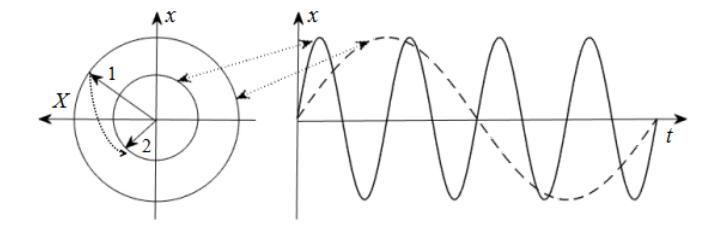
A schematic diagram of the change in the Orbit Radius.
Energy Level Problem
One of the key features of quantum mechanics is the discrete nature of energy levels, energy changes, and energy transmission in particles. In the context of this problem, this model demonstrates the regularity of orbital changes. As depicted in Figure 5, the trajectory of this model does not change arbitrarily. For instance, when a particle transitions from orbit 1 to orbit 2, the tangent velocity of the particle only increases due to the differing tangent velocities of the two orbits. Once the particle reaches the tangent speed of orbit 2 and aligns tangentially with the orbit, it can enter orbit 2, resulting in a subdued change in the orbit. According to a specific law, different orbits correspond to different energies. Considering the conclusion of the discrete change of energy theory (as indicated by (9)), it can be inferred that the radius change of the trajectory in this model follows a regular pattern.
Since this paper primarily focuses on establishing a connection between classical mechanics and quantum mechanics, it will not extensively delve into the discussion of whether the energy level, transitions, and other laws of change adhere to the principles of quantum mechanics. Furthermore, it will not explore the causes of orbit change or deduce its laws. However, the model may indeed exhibit these quantum phenomena.
Equation Equivalence Problem
This paper presents an alternative approach to deriving the wave equation by utilizing the de Broglie relationship and making minor adjustments. The de Broglie relationship, which forms the basis of the Schrödinger equation, has been extensively validated and is widely accepted as accurate. However, quantum mechanics posits the absence of a force field and excludes any potential energy term. Consequently, the particle energy derived from the de Broglie relationship does not incorporate the potential energy associated with the force field. Instead, it represents the particle's kinetic energy in this model, rather than the total energy of particle motion. In contrast, as described by de Broglie, momentum remains unaffected by the power field and remains consistent within this model.
By incorporating the de Broglie relational search for the force field, this approach aligns with both classical mechanics and quantum mechanics. The explored force field adequately accounts for material fluctuations and the observed
randomness inherent in the model, making it suitable for practical testing of material fluctuations. Therefore, asserting that the wave equation derived from classical mechanics is equivalent to the Schrödinger equation is reasonable, leaving no room for doubt.
Problems with the Existence of a Force Field
While the virtual dimension adheres to certain principles of multidimensional space theory, its presence is not an essential requirement in the derivation of wave equations or in establishing their equivalence to the Schrödinger equation within the framework of classical mechanics. The primary purpose of this paper is to utilize the virtual dimension to identify a force field capable of replicating material fluctuations. Consequently, the existence of this force field assumes paramount significance.
In the absence of the force field, this study demonstrates the possibility of employing a distinct force field to replicate material fluctuations, thereby contributing to the advancement of quantum mechanics. Conversely, if the force field is present, one can confidently speculate that it aligns with certain physical phenomena and theories, encompassing:
- 1. The current force field may be connected to dark matter. The hypothesis suggesting the potential for a relationship between the present force field and dark matter relies on the principle that there could be an unknown force that would affect quantum fluctuations in the same manner that dark matter affects large cosmic structures. Given that dark matter does not participate in electromagnetic interactions but has gravitational influences, it might play a role in generating a force field that acts on particle movement at the microscopic scale. The paper presents a force field that is thought to be essential in describing material oscillations in the context of a classical model, with the field's unknown nature leaving open the chance that it could be linked to the fundamental forces linked with dark matter. Dark matter would be expected to be capable of affecting quantum effects, such as wave-particle duality and energy quantization, if it possesses an inherent field or interacts with normal matter via a yet unknown process. This is reinforced by ongoing discussion within theoretical physics that addresses the possible correspondences between quantum mechanics and cosmic events. Though this remains a speculative connection since it lacks empirical substantiation, investigating the possible connection between quantum fluctuations and dark matter may have the potential to reveal new information about both fundamental physics and the nature of quantum mechanics.
- 2. The existence of matter waves is characterized by their wavelength, which is inversely proportional to energy. From the perspective of mechanical waves, which serve as the theoretical basis for material waves, waves must possess wavelengths to propagate. Additionally, this concept provides a valuable complement to quantum mechanics theory. Currently, quantum mechanics theory does not account for wavelengths, yet establishing the Schrödinger equation incorporates the concept of matter wave wavelengths.
- 3. The frequency of material waves is inversely proportional to mass, offering a reasonable explanation for invisible fluctuations in the macroscopic world. As mass increases, the frequency decreases, approaching zero as mass tends towards infinity.
- 4. Energy exhibits an inverse relationship with orbital radius. As energy increases, the radius decreases, and this relationship follows a quadratic pattern. It is evident that external disturbances causing an increase in energy result in a reduction of the fluctuation range, thereby weakening the fluctuations of substances. When the disturbance reaches a significant magnitude, the volatility of matter can vanish, aligning with existing theories and practical observations.
As Table 1 indicates, the current work unambiguously deduces the Schrödinger equation based on Newtonian mechanics principles, unlike earlier approaches that either presume its validity, like de Broglie's wave theory and Bohmian mechanics, or use mathematical constructions that are not directly related to classical forces, like Koopmanvon Neumann mechanics, path integral formulations, and spectral analysis techniques. In contrast with Bohmian mechanics, in which an external guide wave is meant to dictate particle trajectories, the proposed method accounts for wave-like behavior in terms of an internal force field and hence without extra assumptions. Likewise, in contrast with the path integral method founded on a probabilistic sum over a multitude of conceivable paths, this framework possesses a deterministic classical basis and hence guarantees nearer agreement with classical mechanics. While de Broglie's hypothesis postulated the matter wave, the current research continues on this foundation by deriving the Schrödinger-like wave equation directly from Newtonian laws of mechanics, thereby establishing a tangible link between classical and quantum mechanics. In addition, whereas spectral analysis methods utilize quantum-inspired mathematical frameworks to describe classical systems, the current research utilizes classical mechanics itself in describing quantum processes, offering an alternative perspective regarding the correspondence of quantum and classical worlds. This force-field-induced fluctuation model provides a novel insight into the essential relation between quantum and classical mechanics.
| Approach | Key Idea | How It Relates to Our Work | Key Limitation |
|---|---|---|---|
| Koopman-von Neumann | Classical observables in | Preserves determinism, uses | No energy quantization, lacks Born's |
| Mechanics | Hilbert space | wave functions like QM | rule |
| Bohmian Mechanics | Hidden variable theory with pilot waves | Uses deterministic trajectories like our model | Requires nonlocality, does not naturally explain measurement collapse |
| Path Integral (Feynman) | Sum over all possible paths | Both use trajectories, but ours is force-based | No deterministic interpretation |
| de Broglie's Matter Waves | Particles have intrinsic wave properties | Similar use of the energy wavelength relation | Does not explicitly derive the Schrödinger equation |
| Magri et al. (Spectral | Quantum spectral methods | Both explore quantum | Lacks a mechanistic derivation of |
| Theory in Fluid Mechanics) | applied to classical systems | classical connections | quantum effects |
Table 1 Comparative Analysis of Approaches.
Discussion
Engineering Applications of the Proposed Model
The primary aim of this research is to examine a deterministic model in quantum mechanics, but the potential impact of this research goes beyond theoretical physics. The suggested force-field-induced fluctuation model offers potential avenues for application in engineering and technology, specifically in fields where quantum mechanics is particularly important.
Quantum Computing and Information Processing
The deterministic trajectory-based model has the potential to provide alternative computational models for simulating quantum phenomena via classical mechanics. The advancement can contribute to better quantum simulation methods that simplify algorithms applicable to quantum cryptography, quantum optimization, and machine learning.
Nanomaterials Science and Semiconductor Technology
The model's ability to explain wave-like effects through deterministic fluctuations can lead to the development of quantum dots, semiconductor materials, and nanoelectromechanical systems (NEMS). Treating quantum-like behavior from the perspective of classical force fields can enhance simulations in nanoscale engineering and enable the development of low-energy quantum devices.
Precision Metrology and Sensors
Since the model explains quantum fluctuations through deterministic force interactions, it is reasonable to apply it to high-precision measurement devices. Atomic clocks, magnetometers, and optical sensors can potentially be improved using an advanced insight into matter-wave interactions, thus yielding better precision in time measurement and the construction of quantum-improved sensing technology.
Optical and Photonic Engineering
The force-field theory of wavefunction motion can find applications in the areas of wave optics, fiber optics, and photonic signal processing. A classical understanding of wave-particle interactions can lead to new perspectives in the improvement of laser coherence, optical interference devices, and photonic computers. Quantum Thermal Conduction and Energy Structures. As the model incorporates an energy-based force-field mechanism, it may shed new light on quantum thermodynamics and heat transport at the nanoscale. Possible applications are energy-efficient nanodevices, thermal management in quantum systems, and improved quantum energy harvesting technology. By extending classical mechanics to quantum effects via force-field interactions, this model presents a new paradigm for the application of theoretical physics in engineering practice. Research in these directions can culminate in the development of quantuminspired computational techniques, material design at the nanoscale, and the development of high-precision quantum sensing devices.
Limitations and Future Work
Although this work offers a novel strategy for unifying classical mechanics and the Schrödinger equation, certain limitations result from assumptions and idealized situations. It is important to recognize such limitations to establish the boundaries and applicability of the model proposed.
- 1. Idealized Force Field Assumption
- The paper describes a force field according to quantum mechanics to unify classical mechanics and the Schrödinger equation. The proposed force field, however, is theoretical and lacks experimental confirmation. The conjecture that its magnitude is dictated by Planck's constant and inversely proportional to distance may not hold for every quantum system. Research in the future should try to determine if such a force field can be formulated from first principles or manifest in experimental situations.
- 2. Virtual Axis and Extension of Dimensions
- The concept of a virtual axis as a projection aid for mapping material fluctuations into a higher-dimensional framework is essentially a theoretical model, rather than an empirically measurable phenomenon. However, much of it supplies a mathematical model for a wave-particle explanation; its physical meaning is ambiguous. Further investigation is required to ascertain whether this dimension has any measurable effects or whether an alternative approach might yield an equivalent explanation without invoking extra dimensions.
- 3. Applicability to Real Quantum Systems The research is primarily centered on a trajectory-based understanding of quantum events. Nonetheless, it overlooks some fundamental principles of quantum mechanics, including entanglement and nonlocality. Furthermore, it does not discuss the interaction of more than a single quantum particle, which is relevant to most quantum systems. In the future, the research needs to extend the model to the multi-particle case and
- establish whether it can shed light on quantum correlations.
- 4. Classical Interpretation of Quantum Mechanics The model tries to derive the Schrödinger equation from Newtonian mechanics principles; however, quantum mechanics is inherently different due to its probabilistic nature. The deterministic path approach doesn't fully account for quantum uncertainties, superposition, and wavefunction collapse. Future research must investigate whether it is possible to reformulate the model to incorporate probabilistic behavior in a way that is consistent with classical mechanics.
- 5. Discrete Transitions and Quantization of Energy One of the hallmark characteristics of quantum mechanics is the quantized energy levels. The research demonstrates that transitions in energy levels are due to trajectory changes; however, it fails to give a satisfactory reason for the quantization process. In quantum mechanics, discrete energy levels are due to boundary conditions and wavefunction solutions instead of trajectory changes. A more meaningful explanation of the quantization phenomenon can be obtained by examining the relationship between the
- suggested force field and boundary conditions. 6. Lack of Experimental Validation In spite of the methodological soundness of the proposed method, there is a lack of empirical research. Experimental data or numerical simulations that back up the assertion that the derived equations correctly model quantum phenomena are missing. Research in the future must involve simulations that contrast the predictions of the model with well-known quantum mechanical outcomes, as well as possible laboratory tests aimed at determining the viability of the force field hypothesis.
Future Research Directions
Further research is required to verify and extend the force field-driven model proposed here. Empirical verification should be focused on interferometry experiments and simulations aimed at testing the appearance of quantum effects under controlled force fields with high precision. Extension of the model to multi-particle systems and entanglement effects will determine its applicability to complex quantum effects. Treatment of energy quantization and quantum tunneling within this theoretical framework can strengthen its consistency with well-established principles of quantum mechanics.
From the engineering side, the investigation of applications in quantum computing, nanomaterials, and quantum measurement methods may enable substantial progress. On the cosmological side, possible implications such as connections to dark matter or large-scale quantum fluctuations may lead to a better understanding of fundamental
physics. By exploring these avenues, the model's validity and applicability can be tested further, providing new insight into the relationship between quantum and classical systems.
Conclusion
Classical mechanics provides a framework to explain the occurrence of matter fluctuations in the micro world and develop dynamic expressions that are equivalent to Schrödinger's equation. At the very least, it can simulate material fluctuations based on classical mechanics.
While the wave equation presented in this paper may not be proven to encompass all phenomena of quantum mechanics fully, it serves as a valuable tool for learning and comprehending Schrödinger's equations. Furthermore, classical mechanics, being well-established, offers a more concise and easily understandable wave equation with a clear and intuitive physical significance.
There exists a possibility that an unknown force field influences material fluctuations. Even if the force field explored in this paper is incorrect, it is still significant in demonstrating that the Schrödinger equation can be derived under a specific force field. Therefore, research on the relationship between classical and quantum mechanics should not be stopped.
The derivation of the material fluctuation equation, based on classical mechanics, primarily revolves around establishing a force field that aligns with the observed fluctuation phenomenon. The force field investigated in this paper is more likely can reasonably account for certain physical phenomena. Consequently, further extensive research holds great scientific value and necessity.
Acknowledgments
Key Project of Anhui Provincial Department of Education's Higher Education Research Program(2023AH051588).
Compliance with ethics guidelines
The authors declare they have no conflict of interest or financial conflicts to disclose.
This article contains no studies with human or animal subjects performed by authors.