
Introduction
Food and Agriculture Organization Corporate Statistical Database (FAOSTAT) reported an increasing trend in the global use of pesticide to manage pests and enhance agricultural output (Carvalho, 2017; FAOSTAT, 2022), particularly among developing countries (Sarkar dkk., 2021). However, the low effectiveness of pesticide application often leads to residue contamination through environmental media in the surface water, soil, and sediment (Oginawati et al., 2022; Prananditya & Oginawati, 2016), including agricultural products (Ardiwinata & Nursyamsi, 2012; Sari dkk., 2024). Srivastav (2020), stated that agrochemicals, including pesticide residue and fertilizers, significantly affect and contaminate groundwater quality near agricultural areas in different countries. Meanwhile, the increasing demand for clean water due to the expanded population induces groundwater use. Residue of several banned pesticide was reportedly found in wells from Ghana (Affum dkk., 2018) and Lebanon (Al-Hajj et al., 2023). About 40 residues reported were detected in groundwater from several countries near agricultural activities (Ahmad dkk., 2021; Ben Mukiibi dkk., 2021; Oginawati & Pratama, 2016; Susanti dkk., 2020; Wheater, 2000). The Upper Citarum Watershed, as documented by BPS (2020), is one of the primary agricultural areas in West Java, Indonesia. As reported by Redwar (2012), substantial pesticide application in this area may lead to a similar risk of groundwater contamination.
Two popular groups of pesticide have been widely applied in the Upper Citarum Watershed, namely organochlorine (OCP) and organophosphate (OPP). Redwar (2012), identified Kertasari Sub-district as having the highest pesticide application compared to other areas. A previous study found that some banned pesticide in these groups are still used illegally in the Upper Citarum Watershed (Utami dkk., 2020). In 2009, Oginawati and Pratama (2016), examined groundwater quality in different locations and reported high concentrations of seven OCP residue, including
Copyright by authors ©2026 Published by IRCS - ITB J. Eng. Technol. Sci. Vol. 58, No. 2, 2026, 166-185 ISSN: 2337-5779 DOI: 10.5614/j.eng.technol.sci.2026.58.2.2
dichlorodiphenyltrichloroethane (DDT), lindane, and endosulfan. A systematic mapping by Olisah and Adams (2020) showed that OPP were the largest group of chemical formulations used to protect crops, specifically after the ban on OCP. Although OPP is often considered a safer alternative, some compounds remain legally restricted yet still accessible (Olisah & Adams, 2020; Ragnarsdottir, 2000). The persistence and transport depend on environmental conditions (Zainuddin dkk., 2020). Due to the lack of monitoring data for pesticide residue in water media, OCP and OPP residue are more often reported in surface water than groundwater (Sishu dkk., 2022). Despite the limited studies, the Environmental Protection Agency (EPA) in Cohen et al. (1984) has long recognized possible groundwater pollution caused by pesticide remnants.
The Ministry of Energy and Mineral Resources of Indonesia, in press release No. 683. Pers/04/SJI/2019 has emphasized the urgent need to maintain and balance groundwater quality (ESDM, 2019). Groundwater plays a crucial role in daily life, including for household use, irrigation, and crop watering. As illustrated by Arias-Estévez et al. (2008), pesticide can infiltrate groundwater through various pathways, ultimately contaminating the wells used by the surrounding residents (Figure 1). This condition can endanger the well-being of all living organisms, particularly the general public health. Farmers often reside in agricultural areas along with families and communities, increasing the risks of health impacts on the general community (Lebov dkk., 2015; Rother, 2021). According to a previous study, the typical soil and groundwater profiles in the Upper Citarum Watershed were classified as having medium susceptibility to organic pollutant contamination (Suryajaya dkk., 2022). This is crucial for determining the groundwater quality to ensure accurate and comprehensive results (Arias-Estévez dkk., 2008). Therefore, continuous groundwater quality monitoring in central agricultural areas is urgently required.
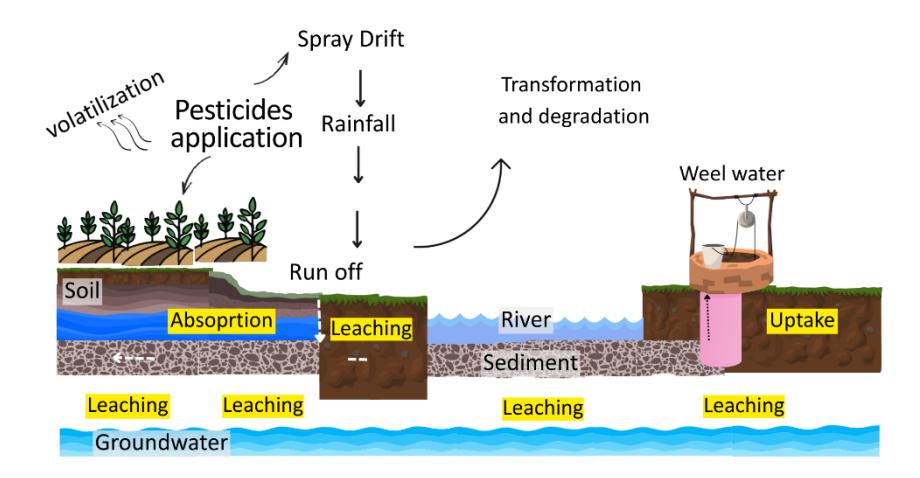
An Illustration of the pesticide pathways after application (adopted from Arias-Estevez et al. (2008)).
Based on the above discussion, this study aims to identify OCP and OPP residue in groundwater from the Upper Citarum Watershed. The potential health risks to the community were calculated to obtain a hazard score for a preliminary survey on selecting evolving substances. The results provide data on possible chemical concerns to determine priority compounds for managing public health risks, particularly in agricultural communities.
Materials And Methods
Site Sampling
This study was conducted at Kertasari Sub-district, located in the Upper Citarum Watershed. The location covers an area of 152.99 km2 , with an altitude ranging from 1,200 to 1,800 meters above sea level, and is divided into eight villages. The Central Bureau of Statistics of Indonesia has documented Kertasari Sub-district as the primary area for plantations and agriculture (BPS, 2020). More than half of the population comprises farmers, as documented by the Bandung District Government (Bandung Regency Government, 2019). The major commodities in the area include potatoes, chili, rice, coffee, and tea (Department of Agriculture, 2018). The sampling sites are shown in Figure 2. Observational data show 3,163 shallow wells owned by residents as of 2023.
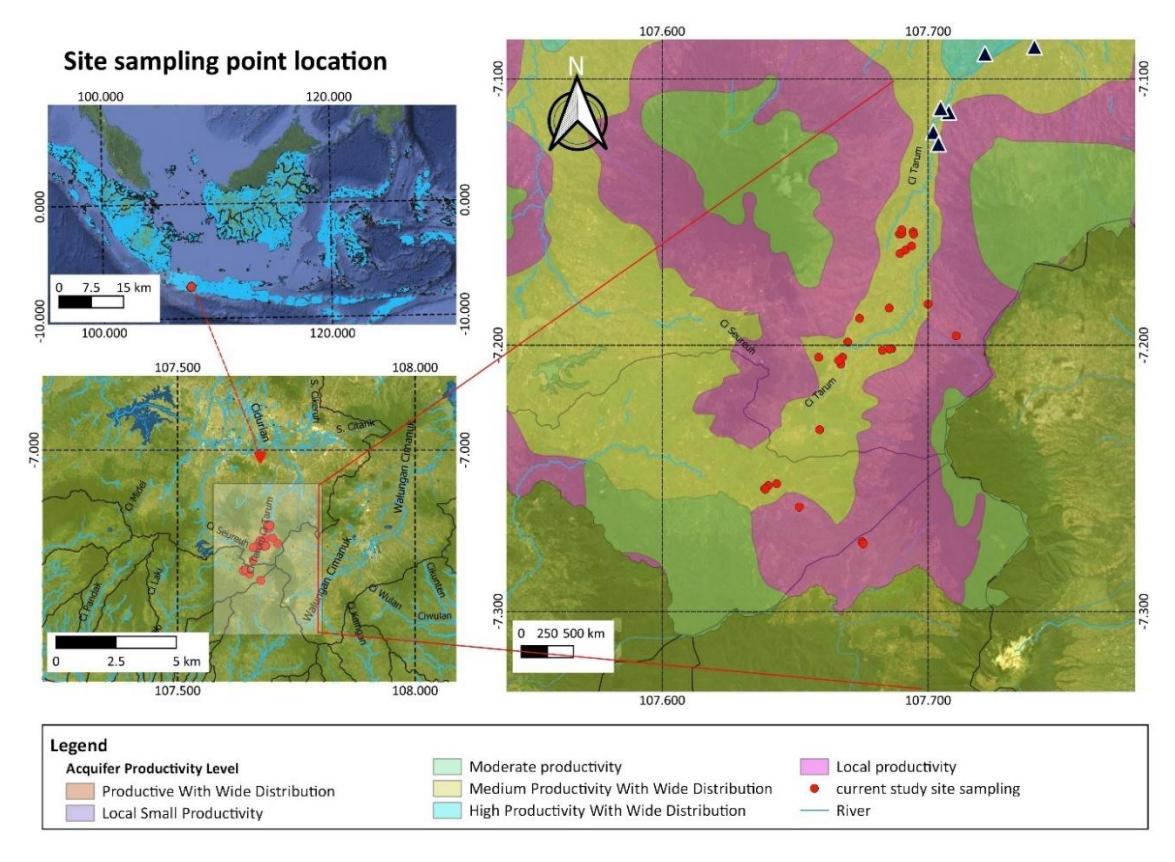
A site sampling location and aquifer productivity.
Sampling
A quantitative approach was used in this study, and random grab sampling of groundwater from the site was conducted between September 2022 and April 2023, with representatives selected based on availability and potential for drinking water use. A total of 31 water samples, measuring 500 mL each, were collected in a glass bottle following the Indonesian National Standard (SNI) 6989.59:2008 procedure. Water was obtained from the wells used for drinking by residents through a simple plastic bucket equipped with a long handle. The sterilized glass bottle was rinsed three times, after which water was collected, stored, and labeled in alphabetical order for clarity and organization. Background field measurements were performed for total dissolved solids (TDS), pH, and dissolved oxygen (DO). Water samples were then stored in a cool box (4°C), and transported to the laboratory for analysis.
Pesticide Residue Analysis
OPP and OPC residues were analyzed at the Agricultural Environmental Research Institute Laboratory, certified for International Quality SNI ISO/ IEC 17025:2017. The residue was prepared and extracted using the QuEChERS method (AOAC, 2007; Hrynko dkk., 2021; Lya dkk., 2020). A 10 mL water sample was prepared using a measuring pipette, transferred to a 50 mL centrifuge tube, and 10 mL of acetonitrile (C2H3N) was added to extract targeted compounds. The mixture was homogenized for approximately 5-10 minutes in the centrifuge at 400 rpm. The purification process was carried out using an essential dispersive solid-phase extraction (SPE), where a part of the initial extract was combined with a large amount of SPE sorbent and then separated using centrifugal force. About 4 grams of magnesium sulphate (MgSO4), and 4 grams of potassium chloride (NaCl) anhydrous were added to avoid excess water, then vortexed for 5 min at 3000 rpm. The supernatant, measuring 1 ml of the extract, was transferred to a vial and injected into the Gas Chromatography-Mass Spectrometry (GC-MS) system. Subsequently, Microsoft Excel and QGIS were used for data analysis.
Two local regulations we used to evaluate the present of OPP and OCP residue in groundwater, first Indonesian government regulation No. 22 of 2021, The implementation of environmental protection and management, attachment No. IV – National water quality: Class 1, 2, 3, and 4, and second is the Governor's decree No. 39 of 2000, attachment No. III for water quality: Class A, B, C, and D. Additionally, for residue which is not included in the regulations, we used The WHO Guidelines for drinking-water quality (GDWQ) and/or other EPA regulations.
Gas Chromatography Analysis
Instrumental analysis of the extracts was performed using a Gas Chromatography Agilent GC 7890B coupled with a mass spectrometer (5975B MSD). The column used was HP-5ms (15 m x 0.25 mm x 0.25 μm), and Helium gas was applied as the carrier with a flow rate of 1.2 ml/minute, and the temperature at 250°C to 300°C. The limit of detection (LOD) referred to the concentration of compositions in the quantification standard divided by three times the ratio of signalto-noise. Limit of quantification (LOQ) and LOD of the standard laboratory were already established (SI.1).
Health Risk Assessment
Health risk associated with pesticide residue was assessed and categorized as a carcinogenic or non-carcinogenic health hazard (Tsakiris dkk., 2015). Risk characterization was based on the calculation of the hazard Index (HI) for both effects. For the estimation of exposure, the estimated daily intake (EDI) was calculated based on the residue concentrations. The EDI residue were computed for all samples in which residue was detected above LOD. Following the approach by Beal et al. (2001), scenarios were modeled using minimum, mean, and maximum concentrations. In line with Buttler-Dawson et al. (2018), the concentration value below the LOQ was substituted with LOD divided by the square root of two. Two groups of the agricultural community were considered in the risk characterization, namely adults and children. For the adult group, the assumed different body weights ranged from 55 to 70 kg. Children were categorized based on existing reference points for the vulnerable segments of the population (U.S. Environmental Protection Agency, 2008). The distributions of the parameters used in this study are listed in Error! Reference source not found.. The two groups of children were assigned 15 kg and 20 kg, respectively, based on body weight (BW) reference.
Table 1 Parameters used in calculating the hazard quotient (HQ) of the residue.
| Parameters | Unit | Value | Ref | |||
|---|---|---|---|---|---|---|
| EDI | mg/kg/day | Calculated by Equation (1) Calculated by Equation (2) | ||||
| HQ | - | |||||
| C | mg/L | Minimum, mean, and maximum concentration | Present study | |||
| CR | L/day | Children: 1.8 Adult: 2 | USEPA Child Specific (USEPA, 2008) USEPA (L. Wang dkk., 2016) | |||
| Bw | Kg | Children: 15kg & 20kg Adult: 70kg | USEPA (USEPA, 1983) | |||
| mg/kg/day | Organophosphate Organochlorine | Chlorpyrifos | • ARfD: 0.005 • CRfD: 0.003 • chRD: 0.001 (A child-specific reference dose) | USEPA (USEPA, 2000c) USEPA (Qiao, 2005) | ||
| Fenitrothion | ARfD = 0.00025 | PubChem1 | ||||
| Malathion | ARfD = 0.02 | PubChem (APVMA, 2024) | ||||
| Diazinon | RfDATSDR = 0.006 | ATSDR (ATSDR, 2008) | ||||
| Parathion | RfD =0.0003 | USEPA (EPA, 2000) | ||||
| ADI | Profenofos | Adult RfD = 0.00199 Children = 0.00012 | PubChem1 | |||
| Methidathion | Adult RfD = 0.002 Children = 0.0015 | PubChem1 | ||||
| DDT | RfD = 0.0005 | USEPA (EPA, 1987); (WHO, 2007) | ||||
| Lindan | RfD = 0.0004 | USEPA (USEPA, 2000a) | ||||
| Aldrin | RfD = 0.00003 | PubChem1 | ||||
| Endrin | RfD = 0.0003 | PubChem1 | ||||
| Endosulfan | RfD = 0.006 | PubChem1 | ||||
| Dieldrin | RfD = 0.00005 | PubChem1 | ||||
| Heptachlor | RfD = 0.0005 | PubChem1 | ||||
1Available data publication on pubchem official website: https://pubchem.ncbi.nlm.nih.gov/
Non-cancer Risk Assessment
Potential exposure pathways for non-cancer health risk assessment included oral ingestion, dermal contact, and inhalation. Each of these pathways significantly affects how contaminants enter the body and may cause adverse health
effects over a specified period. Non-cancer risk hazard was determined by comparing the calculated EDI with the reference doses (Error! Reference source not found.). Additionally, key factors such as BW of individuals, the contact rate (CR) with pollutants, and the mean lifespan (AT) of both children and adults are critical in assessing the EDI of contaminants and the effects on health. The general formula used is shown in Eq. (1):
\[EDI = \frac{C \times CR \times EFD}{BW} \times \frac{1 \times CF}{AT}\] (1)
The estimated daily intake (EDI) is expressed in mg/kg/day; where C represent as the concentration (ppm) of the residue in the water sample, CR is the daily contact of water consumption in a day (L/ day), EFD denotes the exposure frequency and duration, which was set at 350 days/year, the body weight (BW) of exposed individual applied for different groups of children (15 and 20 kg), and adult (55kg to 70 kg), CF is the unit of conversion factor, and AT is the averaging time, corresponding to the mean lifespan (2,190 and 25,550 days for children and adults, respectively).
The potential exposure route (y) of detected pesticide residue (i) was oral and dermal. The oral route was identified as the primary pathway, mainly due to daily intake of water, and exposure, while dermal exposure occurred primarily during bathing. To determine hazard quotient (HQ) for each residue substance, Eq.(2) was applied. The total HQ of specific residue from dermal and oral routes was expressed as HQs or HI (Goumenou & Tsatsakis, 2019; Lipscomb dkk., 2012). When HI exceeds one, this suggests that the compound may be associated with potential adverse effects. Conversely, when the HI is below one, it indicates a lower potential for adverse health effects. The cumulative HI is only meaningful when residue share the same modes of action (MoA) in manifesting adverse effects on human health. The differences in the MoA of OPP and OCP reflect the significant route of exposure. Considering the dermal absorption value of OPP is less than that of OCP, the dermal absorption of OPP is less significant. In contrast, OCP are lipophilic substances, making both dermal and oral exposure significant contributors to the total HI (Eq. (3)).
\[HQ_{i} = \frac{\text{estimated daily intake } (mg/kg/day)}{\text{a Treshold value } (TRV) \left( \frac{mg/kg/day}{} \right)}\](2)
\[HI = \sum HQ_{iy} = HQ_{oral}(i) + HQ_{dermal}(i)\] (3)
The TRV, or threshold value (mg/kg/day), is the reference dose.
Carcinogenic Effect
The risk of developing cancer due to long-term exposure was assessed as the incremental lifetime cancer risk (ILCR). Based on the guidelines for evaluating the risk of cancer-causing agents, the conversion factor was set at 1 × 10⁻⁶ kg/mg (USEPA, 1983). A particular substance is only acceptable in drinking water when the ILCR is < 1 in 10,000 (Commonwealth of Australia, 2002; Pagan dkk., 2020). The calculated ILCR was estimated by multiplying the EDI by the slope factor (SF) using the equation Eq. (4) established by the USEPA (USEPA, 2004).
\[ILCR = EDI \times SF \tag{4}\]
The cumulative cancer risk (ILCRs) was computed by adding the ILCR linked together with each route of exposure (i) in Eq. (5) below:
\[ILCRs = \sum EDI_i \times SF \tag{5}\]
Results and Discussion
Result
The Properties of Water
Samples were selected using the grab sampling method at the study location after the pre-observation stage of groundwater utilization by the community. In general, residents in the location used groundwater to meet daily needs, with the aquifer categorized as moderately productive. Most groundwater sampling sites were residential properties in 100 m of agricultural land or plantations. The well depth measured 4-10 meters, and the short distance to agricultural activities potentially lowered pH levels. The physical profile of the water included measurements of dissolved oxygen (DO), which ranged from 2.5 and 14.3 mg/L. A hydrochemical study conducted by Zan et al. (2019),showed a significant relationship between groundwater depth and DO, with the concentration usually higher in shallower areas of a water
body than in deeper parts. According to Menz et al. (2016), the mean well depth of the site is less than 7 m, DO value is less than 5, and there is a tendency for low oxygen levels due to the limited diffusion or percolation of oxygen from rainwater into the groundwater.
Pesticide Residue
GC-MS instrument was used to analyze 31 groundwater samples for OCP and OPP residue with different values of LOD and LOQ for various compounds already established in a standard laboratory. Based on the results, only 19 samples had four different pesticide residue from both groups with single or combined substances, while 12 samples were below LOQ value. The ratio of the peak area from the chromatogram was calculated to cover concentrations below LOQ by comparing to the standard solution peak at equal retention time, which represents the minimum concentration of residue. A summary of mean, median, maximum, and minimum concentration of residue from the water sample is shown in Error! Reference source not found.. The residue with concentration >LOQ for OCP includes lindane and DDT, and the representatives of OPP were chlorpyrifos and diazinon. According to Utami et al. (2020), the general substitution of OCP with OPP for agricultural activities may lead to a greater presence of contaminants in various environmental media. In this study, the percentage of OPP detection was higher in the samples than in OCP. The chemical properties of OCP and OPP residue with concentration >LOQ are presented in Error! Reference source not found..
Organochlorine
Several factors may influence the fate and behavior of OCP residue in the environment, including application history, agricultural practices, soil, substance physicochemical properties, and meteorological factors, namely rainfall and temperature (Zhu dkk., 2005). Based on the results, only two OCP residue had concentrations >LOQ in the water sample compared to a previous study conducted at a similar site (Oginawati & Pratama, 2016). Although these two substances have already been legally banned, the detected residue concentration is unexpectedly higher than the threshold value, suggesting a possible fresh input through illegal application. A comparison with previous monitoring results shows a clear discrepancy. The previous study reported seven residue with concentrations >LOQ, while this study detected only two (Figure 3). The residue of both substances in the groundwater was significantly related to the history of usage (Li dkk., 2020). Previous studies reported endosulfan as the residue with the highest mean concentration (0.00073 mg/L), followed by heptachlor, dieldrin, lindane, DDT, and dieldrin. Oginawati and Pratama (2016) reported that DDT had the highest concentration of 0.0013 mg/L, while this study recorded a maximum DDT concentration of 0.1062 mg/L, nearly 80 times greater.
Pesticide Mean (mg/L) SD (mg/L) Median (mg/L) Min (mg/L) Max (mg/L) Percentile 5% (mg/L) Percentile 95% (mg/L) Detection frequency (>LOQ) n=31 Detection frequency (>LOD <LOQ) n=31 Organophosphate Diazinon 0.0075 0.0014 0.0055 <LOQ 0,0401 <LOQ 0.0188 2 0 Fenitrothion <LOQ ND ND <LOQ <LOD ND <LOD <LOQ <LOQ Malathion <LOQ ND ND <LOQ <LOD ND <LOD <LOQ <LOQ Chlorpyrifos 0.0347 0.0107 0.0021 0.0116 0.2469 0.0021 0.1729 8 5 Parathion <LOQ ND ND <LOQ <LOD ND <LOD <LOQ <LOQ Profenofos <LOQ ND ND <LOQ <LOD ND <LOD <LOQ <LOQ Methidathion <LOQ ND ND <LOQ <LOD ND <LOD <LOQ <LOQ Organochlorine Aldrin <LOQ ND ND ND <LOD ND <LOD <LOQ <LOQ Lindane 0.0156 0.0075 0.0028 0.0055 0.2459 0.0028 0.0494 4 0 Endrin <LOQ ND ND <LOQ <LOD ND <LOD <LOQ <LOQ Endosulfan <LOQ ND ND <LOQ <LOD ND <LOD <LOQ <LOQ Dieldrin <LOQ ND ND <LOQ <LOD ND <LOD <LOQ <LOQ DDT 0.0225 0.0145 0.0055 <LOQ 0.1062 ND 0.0055 1 0 Heptachlor <LOQ ND ND <LOQ <LOD ND <LOD <LOQ <LOQ
Table 2 Mean, median, minimum, and maximum concentration of residue.
*ND = Not Detected
The disparities in the results can be attributed to differences in site characteristics. This study was conducted at a higher altitude (1,200-1,800 meters above sea level, m) as shown in Figure 3 compared to previous studies (500-1,800 meters above sea level, m) (BPS, 2023; Oginawati & Pratama, 2016). This might affect the trapping of substances in the soil pores, resulting in a higher concentration of DDT and lindane residue in groundwater. As mentioned in Bhandari et al. (2020), DDT and degradation products are found less frequently in shallow than in deeper soils (Gilliom dkk., 2006). However, the environmental factors of the site may affect the fate of the pesticide. Given the long half-life of DDT (> 15
years) (Bhandari dkk., 2020), residue can persist and eventually leach into groundwater. Considering the hydrogeological aspect of site sampling, substances may reach groundwater within a particular time, as reported by (Karan dkk., 2021). The presence of DDT at the site suggests persistent illegal use due to the efficiency in controlling pests and lower prices (Ardiwinata dkk., 2020). A German environmental survey for children and adolescents (GerES V) reported that DDT residue detected in children blood plasma originated from the consumption of fish and breastfeeding (Bandow dkk., 2020), despite being banned for a long time. Considering that consumption habits, such as drinking water, led to oral exposure, the presence of this residue should not be neglected.
| Compounds | Chlorpyrifos | Diazinon | DDT | Lindane | ||
| Chemicals structure | ||||||
| Chemical formula | C9H11Cl3NO3PS | C12H21N2O3PS | C14H9Cl5 | C6H6Cl6 | ||
| Other names | 0,0-diethyl 0-(3,5,6- trichloro-2-pyridinyl)- phosphorothioate (CASRN: 2921-88-2) | O, O-diethyl O-[6- methyl-2-(1- methylethyl)-4- pyrimidinyl] phosphorothioate | p,p'-Dichlorodipheny ltrichloroethane (DDT) (CASRN 50-29-3 | DTXSID4020375) | Gamma hexachlorocyclohexane (CASRN 58-89-9 | DTXSID2020686) | ||
| Molecule weight | 350.6 g/mol | 304.3 g/mol | 354.49 g/mol | 290.83 g/mol | ||
| Melting point | 42 °C | ND | 93.9 to 123 oC | 57.0 to 77.0 0C | ||
| Vapor pressure | 2.49 × 10⁻³ Pa at 25 °C | 9.01x10⁻⁵ mmHg | 1.62x 10 -7 to 2.36 x 10⁻⁶ mmHg | 4.27x10⁻⁵ to 1.63x10⁻² mmHg | ||
| Solubility in water | 2 mg/L at 25 °C | 40 mg/L | 0.025 mg/L at 25oC a | 17 mg/L at 25oC | ||
| Log octanol water partition coefficient | 4.82 to 5.11 | 3.80 to 3.86 | -5.92 to 6.91 | -3.72 to 4.26 | ||
| Carcinogenic | - | IARC Group 2A | IARC Group I | IARC Group I | ||
Table 3 The properties of detected OPP and OCP residue >LOQ.
Source:
Ecotox EPA, CompTox chemical Dashboard (www.comptox.epa.gov/dashboard)
National Pesticide Information Center (http://npic.orst.edu/factsheets
Lindane, also known as Gamma-hexachlorocyclohexane, is a pollutant of concern in the EPA Great Waters program (USEPA, 2000b). Various studies have reported lindane detection in groundwater from agricultural areas, generally at lower concentrations than in the surface water, as observed by Lari et al. (2014) in India, and Snow et al. (2020) in Kazakhstan. In this study, the highest residual concentration in the water samples reached 0.0698 mg/L for lindane. The average of 0.0156 mg/L was more significant than in the previous study, reported at 0.0012 mg/L (Oginawati & Pratama, 2016). Four site samples with lindane had concentrations >LOQ, exceeding the allowed value, as stated by Governor Decree No.39 of 2000-Class A (< 0.004 mg/L). The highest concentration exceeded the allowed value (< 0.056 mg/L) for Class 1 of water in line with Indonesia government regulations No. 22 of 2021. Among other OCP compounds, lindane has a high level of mobility in water due to the significant. As one of the International Agency for Research on Cancer (IARC) group I members, lindane is a carcinogen in humans, but the use is still recommended only to prevent malaria disease vectors (WHO, 2007). A previous study conducted near the site sampling at a different sub-district reported a maximum Lindane residue concentration of 1.2 μg/L (Oginawati & Pratama, 2016), which is approximately eight times lower than the concentration recorded in this study.
(possible carcinogen)
(carcinogen to humans)
(carcinogen to humans)
The continued detection of DDT and lindane, despite long-standing bans, underscores the persistence of these compounds in the environment. Other studies in Mexico reported by Giácoman et al. (2018), showed that DDT and lindane were also detected in groundwater from Karstic Wells. Jemal et al. (2023), also reported that DDT and related metabolites were detected in the Gibe River, Ethiopian water, even though the ban had already started in 1970. NAWQA studies documented in Gilliom et al. (2006), found persistent pesticide or degradation byproducts in groundwater for an extended period, even after discontinued use. This occurs due to the slow flow and the resulting protracted retention of water and pollutants in groundwater systems.
a IRIS.epa.gov
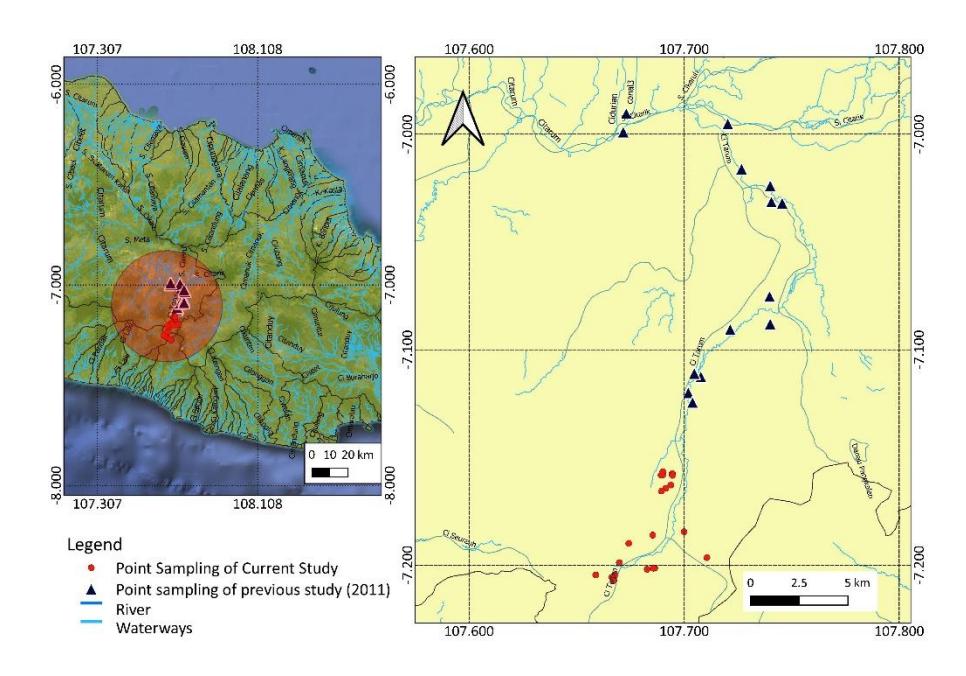
A comparison of site point sampling of the current and previous study.
Organophosphate
This study represents the first investigation on OPP residue in groundwater samples from the Upper Citarum Watershed. Two OPP residues had concentrations >LOQ, namely diazinon and chlorpyrifos (CPF). Diazinon was found at only two sampling sites, while CPF was more prevalent, being detected in 13 samples at varying concentrations. In general, OPP is considered safer than OCP, accounting for almost half of the world pesticide trade (Olisah & Adams, 2020; Ragnarsdottir, 2000). The environment has been found to contain a growing amount of OPP residue, as reported by Zardosht et al. (2023), Safari et al. (2020), and Dehghani et al. (2019). Diazinon had a maximum concentration of 0.0401 mg/L, exceeding the amount detected in groundwater from Iran (0.0093 mg/L) (Safari dkk., 2020). The mean concentration of 0.0075 mg/L is also greater than that reported from Linggi River, Negeri Sembilan, Malaysia (0.0328 μg/L) (Zainuddin dkk., 2020). However, this study showed that the mean and maximum concentrations exceeded EPA drinking water equivalent level (DWEL) guideline 2006 (0.007 mg/L)(ATSDR, 2010). DWEL represents the lifetime exposure level without the risk of causing adverse health effects. The moderate mobility of diazinon in soil facilitates leaching and contamination of groundwater (USEPA, 2008b). In addition, the susceptibility of the soil at the current site may strongly influence the high concentration of diazinon residue. Given the increasing concentration of residue in surface water and groundwater (Safari dkk., 2020; D. Wang dkk., 2017; Zainuddin dkk., 2020), diazinon sprays have recently been deactivated. Although the residue is still acceptable in water resources, it is currently under review to prevent potential health risks, particularly in children and the environment (D. Wang dkk., 2017).
In this study, 13 samples were identified to have CPF residue at concentrations > LOQ, ranging from 0.0116 to 0.2469 mg/L. This residue concentration is higher than water samples examined in Bangladesh (Sumon dkk., 2018) and Iran (Tahmasebi dkk., 2024), with the maximum concentrations of 9.1 µg/L and 0.59 μg/L, respectively. According to Huang et al. (2020), CPF is widely distributed in various natural water resources and has the potential to harm aquatic organisms . The maximum concentration was higher than in other studies in Indonesia, particularly the Shallow Coastal Groundwater Aquifer, Sidoarjo, with a concentration of 0.0021 mg/L (Rochaddi dkk., 2019). Moreover, the mean concentration of 0.0347 mg/L was greater compared to that of a similar study (0.0275 μg/mL) conducted at Linggi River, Negeri Sembilan, Malaysia (Zainuddin dkk., 2020).
CPF is one of the most widely traded OPP, and ranks among the top pesticide globally due to the broad spectrum efficacy (Burke dkk., 2017; Dinham, 2005; Rodríguez dkk., 2023; Wołejko dkk., 2022). The primary route for CPF to groundwater is through soil drift and rainfall that washes off from the point-source area (Arias-Estévez dkk., 2008). Rainwater dilution and soil erosion facilitate CPF transport, thereby increasing the groundwater susceptibility to surface water contamination (Rochaddi dkk., 2019). Once absorbed into the soil, CPF can persist for 60–120 days before biodegradation occurs, making elimination challenging (WHO, 2004). Although microorganisms play a crucial role in CPF biodegradation in water and soil, pH, nutrients, and temperature should be considered in efforts to remedy
contamination (Dar dkk., 2019; Wołejko dkk., 2022). Despite the low solubility, the presence of CPF also depends on the pH of the water. It has excellent stability in solutions with weak acidity or neutrality but undergoes hydrolysis in solutions with strong alkalinity (Kafilzadeh, 2015). Typical groundwater taken from the site has a pH range of pH 4-7, and several publications have reported different half-lives of CPF at various pH values and temperatures. For example, at pH 7 and 25°C, Gidding et al. (2014), reported that the half-life of CPF was 72 days, while Zhang et al. (2012), reported 0.58 days half life. Lockridge et al. (2019), found a significant correlation between soil properties and application rates. Other conditions include a possible longer half-life for CPF substances in water, between 24 and 126 days, as reported by Liu et al. (2001).
Regarding physical and chemical characteristics, CPF has a high frequency of adsorption in soil particles and less leaching due to water solubility, as described in Jaiswal et al. (2017). However, residue was found in sediments, soil, vegetables, food, water, and human fluids (Dar dkk., 2019). This can be attributed to the local history of CPF application in the Upper Citarum Watershed, reaching 26.1 kg/ha/year, primarily for chili farming (Utami dkk., 2020). The large amounts of residue in groundwater, as reported in USEPA and Canada Health (Canada, 2019; Pérez-Indoval dkk., 2021; USEPA, 2003),may be related to the presence on the surface soil for pest control applications. In addition to farming practices, land topography, rainfall, and properties should also be considered (Hossain dkk., 2015; Schwantes dkk., 2020; D. Wang dkk., 2016; Wołejko dkk., 2022).
Health Risk Assessment
Four pesticide residues, with concentrations >LOQ, were considered in the health risk assessment. Both OPP and OCP residues were evaluated for potential noncancerous risk, focusing on the oral and dermal exposure, given that residents rely on groundwater to meet daily needs. Carcinogenic risk assessment was only applied to OCP (lindane and DDT) based on classification by IARC. Two scenarios of community age were determined to calculate HQ, namely adults and children. For adults, body weights of 55 to 70 kg were applied, while for children, body weights of 15 and 20 kg were used to represent the vulnerable part of the community.
The mean daily dose calculation, resulting in HQdermal value for OPP group, was insignificant, as the dermal absorption value was lower than that of OCP group. However, oral exposure was identified as the primary route that may influence the adverse effects of OPP, specifically for children. Zhang et al. reported that neonatal sensitivity increased due to CPF exposure, creating a population-adjustable dose (PAD) for dietary consumption through specific farming products, with a safety factor ten times lower than the general reference dose (RfD) (USEPA, 2000c). Although PAD could not be applied due to the exclusion of groundwater exposure from the guidance, the same principle is relevant, given CPF inhibition of acetylcholine esterase (AChE) during developmental phases. The child-specific reference dose (chRD) for CPF has already been released by the California EPA, which is 0.0001 mg/kg/day (Qiao, 2005). Applying this value is crucial when calculating HQ value for children exposed to CPF.
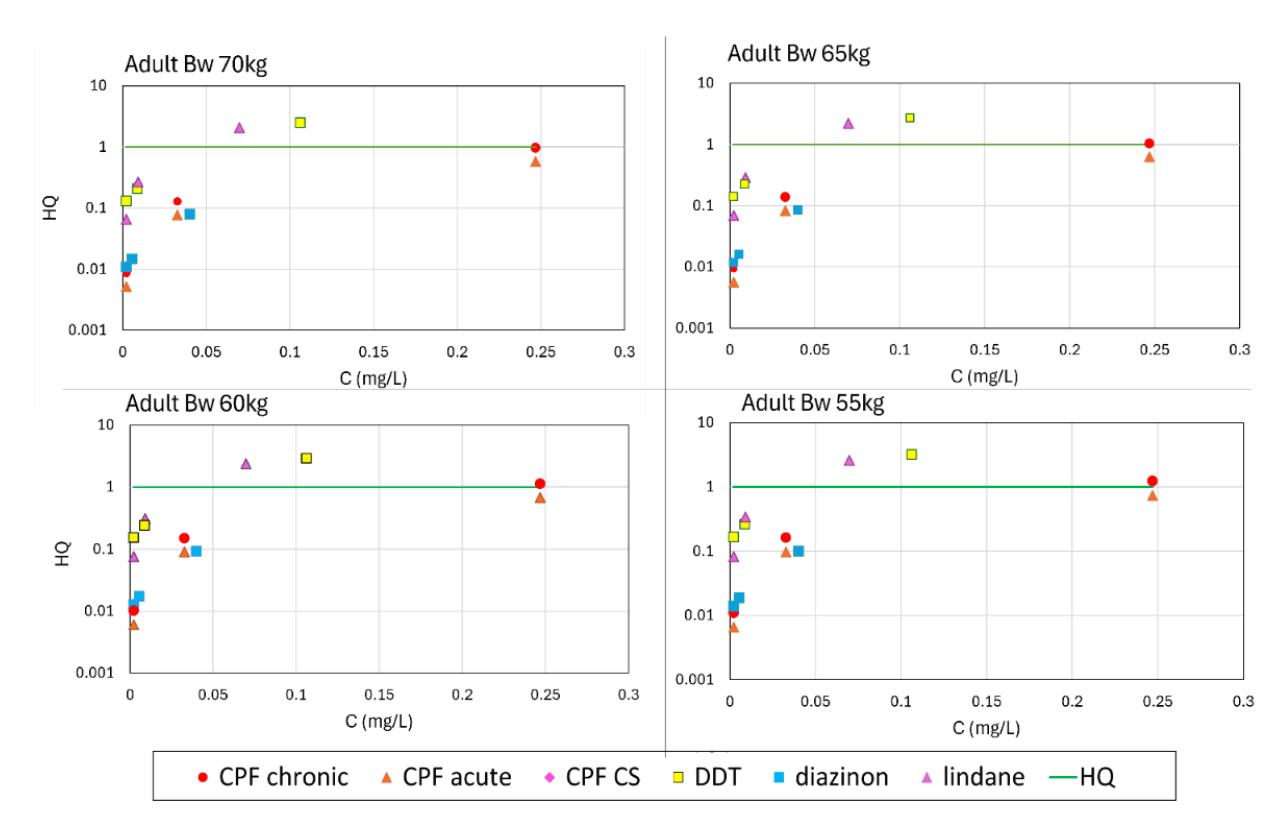
The distribution of HQ for all residue in adult human bodyweight groups.
HQ analysis for adults showed that the most significant risks were associated with DDT and lindane at all maximum concentrations in all scenarios, with HQ>1. The maximum HQ values were 3.174 and 2.607 for DDT and lindane, respectively. A similar result, with HQ >1, was also found in CPF for adult chronic effects in all body weight scenarios. This result may have a significant effect on adult group health with continuous intake. HQ score value comparison for all scenarios in the adult group is plotted in Figure 4. Meanwhile, HQ scores of OPP (CPF, and diazinon) for all scenarios were <1.
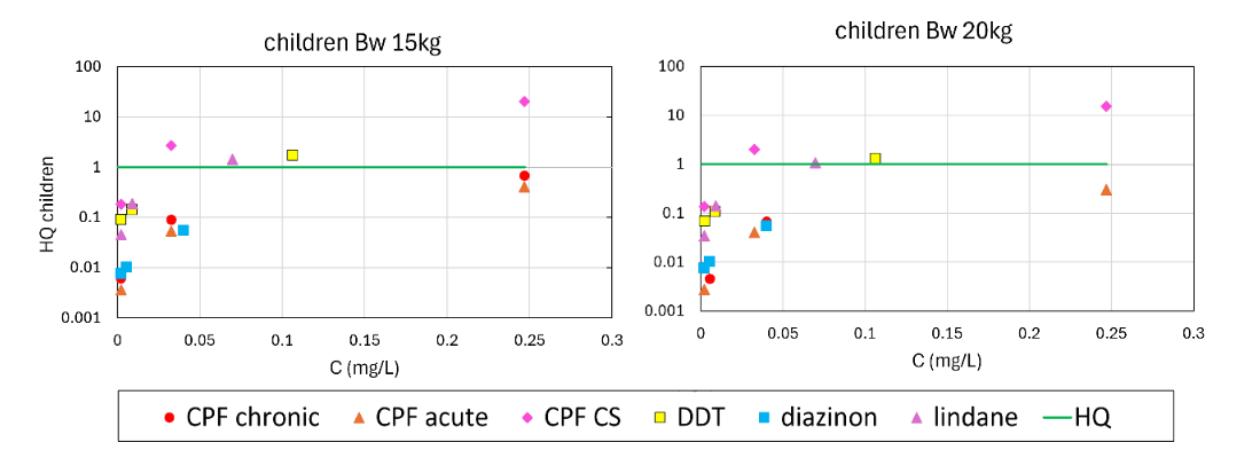
The distribution of HQ for all residue in children.
For children groups (see Figure 5), the chronic HQCPF was < 1, with the scores 0.6764 and 0.5073 for 20 kg and 15 kg body weight, respectively. Diazinon also showed HQDiazinon <1 for all scenarios in two body weight groups of children. The low frequency of detection, along with low utilization data history, may have influenced the HI index in this study. The values of HQDDT and HQLindane were > 1 at maximum concentrations, suggesting potential risk for children. Unexpectedly, when the child-specific assessment (HQCPF-CS) was applied, HQ values were < 1 only at the minimum concentration for both 15 kg and 20 kg body weight groups. HQCPF-CS for the mean and maximum concentration exceeded >1 in all groups, almost similar to that of HQDDT and HQLindane. The significant value of HQCPF-CS should be considered as the primary point of investigation, since children are a vulnerable part of the population.
| cted. |
|---|
| cted. |
| Range | SF (mg/kg /day)-1 | Non | -carcinogenic risk | Carcinogenic risk | ||||
|---|---|---|---|---|---|---|---|---|
| Residue | Concentration (mg/L) | Range | Mea | an | Ran | ge | mean | |
| ٥ | ND - 0.10620 | 0.34 | 1.27E-01 - 3.7 | 9E+00 1.44E+00 ± | 3.18E-01 | 9.88E-06 - | - 5.40E-04 2.46E-04 | 4 ± 7.18E-05 |
| _ | ND - 0.00698 | 1.30 | 3.41E-02 - 2.6 | 1E+00 7.60E-01 ± | 2.20E-01 | 4.63E-07 - | - 1.36E-03 5.93E-0 | 4 ± 1.35E-04 |
| *ND = Not Detected | ||||||||
DDT and lindane, both classified as OCP residue, have low reference dose thresholds due to the potential for bioaccumulation and biomagnification. Among the pesticide assessed, DDT showed the highest HI due to the toxicity and environmental persistence (H. Wang dkk., 2020; Zhu dkk., 2005). Moreover, DDT and lindane are categorized as potential carcinogenic substances, and the ILCR was calculated using Eq. (4), with the slope factor (SF) (mg/kg·day)\(^{-1}\) obtained from the USEPA Integrated Risk Information System (IRIS, Table 4). According to USEPA, the acceptable carcinogenic risk limit is \(10^{-6}\) or one in a million (Baqar dkk., 2018; USEPA, 2019b). In this study, the calculated carcinogenic risk ranged from \(4.63 \times 10^{-7}\) to \(1.22 \times 10^{-3}\) and \(9.88 \times 10^{-6}\) to \(2.80 \times 10^{-4}\) through dermal exposure for lindane and DDT, respectively. The ILCR for DDT exceeded the recommended limit, although EPA stated that concentrations greater than \(1 \mu g/L\) may not be appropriate for application at unit risk. Lindane also presented a significant carcinogenic risk, with a mean value of \(2 \times 10^{-3}\) for the concentration detected through dermal absorption. DDT and lindane cancer risk through the oral route ranged from \(1.163 \times 10^{-5}\) to \(5.4 \times 10^{-4}\) and \(9.88 \times 10^{-6}\) to \(2.80 \times 10^{-4}\) respectively. This result was strengthened by supporting data on existing cancer from the study site.
As the dominant substance detected in groundwater samples, CPF produced HI values between those of lindane and DDT in the general population. The primary mechanisms by which organophosphate groups exert toxicity are inhibiting the activity of acetylcholinesterase (AChE) (Benka-Coker dkk., 2020; Qiao, 2005). Considering prolonged exposure in children may result in different effects, Berkowitz et al. documented significant variation in head circumference among infants whose mothers had CPF metabolite 3,5,6-trichloro-2-pyridinyl (TCPy) in the urine (Berkowitz dkk., 2004). Another metabolite of CPF, dimethyl phosphate, in mother urine was also reportedly associated with neurodevelopment in children (Furlong dkk., 2017). CPF has demonstrated hematological, musculoskeletal, renal, ocular, and dermal effects, which are of significant concern (Nandi dkk., 2022; Wołejko dkk., 2022). Many studies have reported the adverse effects, specifically in children, hence, the United States EPA recently proposed a review of use in agricultural activities and food (EPA, 2021).
Discussion
Due to restrictions on spring water in the Upper Citarum Watershed, people use groundwater directly for daily activities. This has become a widespread custom in numerous areas worldwide, where the availability of clean water is a significant concern (Foster dkk., 2013). The use of groundwater has both advantages and disadvantages, hence, it is crucial to find a middle ground between fulfilling the requirements of the expanding population and safeguarding natural resources for future generations. In this study, the groundwater samples were collected near agricultural activities, where a historical and documented massive use of pesticide may have the potential for contamination (Utami dkk., 2020). Potential contamination of groundwater in Kertasari Sub-district may have resulted from pesticide residue used on the soil surface, specifically OCP and OPP (Oginawati dkk., 2021; Oginawati & Pratama, 2016; Redwar, 2012).
Four different residue were detected in over half of the samples, with concentration >LOD. The high residual concentrations of DDT and lindane are unexpected, given that both have been prohibited from being applied due to the persistence and toxicity. Maintaining the threat of pests at the lowest price could lead to illegal usage by farmers. Due to banned regulations, the pesticide is sometimes sold at low and affordable prices without considering the impact (Sarkar dkk., 2021). The effect of this action should be evaluated to determine possible impact on environmental media, which may be detected as residue with high potential for bioaccumulation and biomagnification in pests and agricultural products (Jayaraj dkk., 2016; Oginawati dkk., 2021). A recent study of hydrogeological and geological factors affecting aquifer pollution showed moderate susceptibility to organic substance contamination due to high porosity. The score was given as the susceptibility index with a hydrogeological method using the Depth, Recharge rate, Aquifer, Soil, Topography, Impact, Conductivity (DRASTIC) approach (Suryajaya dkk., 2022). In a similar condition, almost shallow groundwater near agricultural areas in the United States detected pesticide (Gilliom dkk., 2006). These results underscore the need for governments to strengthen pesticide monitoring and management efforts. The interconnected aquifer present at the sampling site may have affected the mobility of substances, leading to dispersion in various
groundwater locations. Gonçalves et al. (2023) observed the significant correlation between soil matter in the environment and CPF adsorption associated with the psychochemical properties, even though high intensity of rain only contributes a small amount of run-off and leaching. The distributions of CPF and diazinon residue plotted on the heat map are shown in Figure 6. More intense colors represent the higher residue concentration placed in the shallow soil.
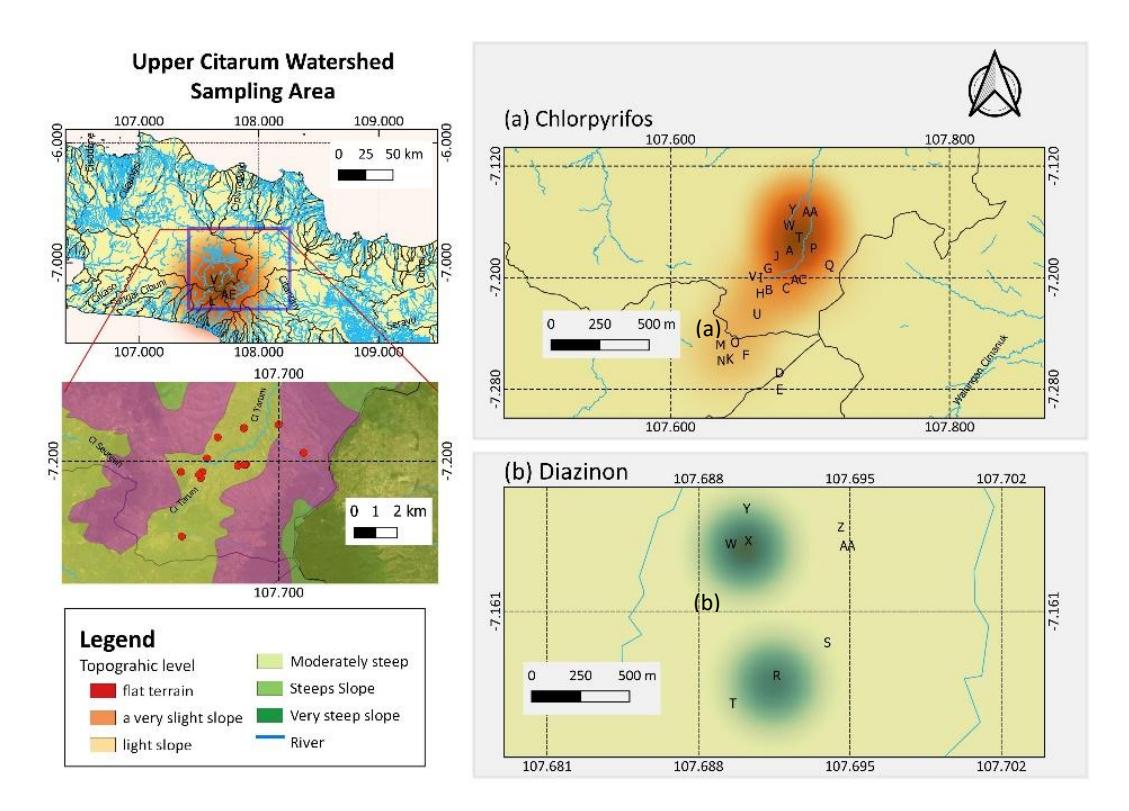
The distribution of OPP residue (a) CPF, and (b) diazinon.
The oral and dermal HQ scores of OCP residue suggest chronic adverse effects on adults and children at the maximum concentration. As endocrine-disrupting chemicals (EDC), OCP residue in groundwater samples potentially poses risks to the health of individuals who are indirectly or non-occupationally exposed (L. Wang dkk., 2016). Children in affected areas may be particularly vulnerable, as exposure has been associated with a decrease in AChE (Suarez-Lopez dkk., 2013). The carcinogenicity risk of DDT and lindane in the groundwater, assessed through dermal and oral exposure, also exceeded the recommended limit, with a value range of more than 10-6 . An ILCR greater than 10−4 indicates a potentially high risk of cancer, implying that prolonged exposure to the residue could increase cancer incidence in both adults and children. However, for DDT, the detected concentration reached 0.1062 mg/L, and using previously calculated SF units may not be appropriate. The highest risk of cancer was observed in the adult group with a body weight of 55 kg, while for children, the group with a body weight of 15 kg also had the highest risk. DDT and lindane are mainly found in human breast milk and adipose tissue (Jayaraj dkk., 2016). As the most vulnerable groups in the community, children may be exposed to residual OCP in the first stage of life due to breastfeeding from exposed mothers. This underscores the longterm vulnerability of children from residual OCP exposure (Karr, 2012).
Although OPP is not persistent and does not accumulate in the human body and tissues, the critical mechanism associated with this group is grounded in inhibiting the vital AChE enzyme. The reference dose of CPF for acute and chronic effects was used to determine the potential impact on residential communities (Canada, 2019; USEPA, 2019a). One of CPF metabolite degradations in groundwater is chlorpyrifos-oxon (CFO), which is documented by Toft et al. (2004) in WHO Guideline as the leading role in CPF toxicity and is less stable than chlorpyrifos. CFO is the first metabolite detected in liver and blood tissues (Timchalk dkk., 2002), and recent studies showed that it has a more significant impact on plasma butyrylcholinesterase (BuChE) than erythrocyte AChE (Balali-Mood, 2009; Nandi dkk., 2022; Shenouda dkk., 2009). In other words, CFO metabolites may disrupt neuropsychological processes and peripheral function by inhibiting plasma BuChE more than AchE, which correlates with neurodevelopment, particularly in children. Therefore, significant prenatal exposure to CPF and postnatal neurological problems, such as cognitive impairment in children, is substantial. Previous studies have reported a significant correlation between exposure to CPF and the alterations in structural integrity of the brain (Crumpton dkk., 2000; Rauh dkk., 2012). A specific reference dose of CPF for children was used to determine HQ value (0.0001 mg/kg/day) (Qiao dkk., 2001). This reference dose resulted in an HQ-specific value in which all scenarios for children exceeded 1. As the dominant residue found in the groundwater, CPF characteristic is less soluble in water. The results underscore the need for early warning of the threat to children development phase. The three primary pathways of CPF effect in animal studies include inhibition of the AChE enzyme, oxidative stress, and endocrine disruption (Nandi dkk., 2022). Low exposure doses of chlorpyrifos have been found to interfere with the development of neural cells, prompting the EPA to consider the exposure to this substance and public health concerns.
The main mechanisms of diazinon, an OPP, are primarily by blocking AChE, similar to CPF. However, evidence from primary cortical culture studies suggests distinct mechanisms of neurotoxicity between the two compounds. Rush et al. (2010) demonstrated that CPF induces glutamate-mediated excitotoxicity, defined by Olney (1997) in Kirdajova et al. (2020), as the cell death mechanism triggered by excessive glutamate release from neurons and glial cells. In contrast, diazinon exposure was associated with apoptotic neuronal death (Rush dkk., 2010). Kerr et. al (1972) in Fricker et al. (2018), described apoptotic neuronal death as one of the typical changes in morphology, a morphological hallmark of neurodegeneration that continues to be investigated in the context of Alzheimer's disease (AD). Diazinon is rapidly metabolized once inside the body and eliminated mainly through urine, with no evidence of accumulation in the tissue. The Agency for Toxic Substances and Disease Registry (ATSDR) reports that most diazinon and metabolites are eliminated from the body in approximately 12 days.
Siriwat et al. (2021) conducted a study in Thailand on children aged 6 to 8, and the results showed higher urine metabolite concentrations of OPP than those from aquaculture farms (Siriwat dkk., 2021). However, the residue distribution and health profile of the community living in the area require further analysis. Medical history data from the community must be collected, focusing on children, who are the most vulnerable members of the community. Future studies should prioritize assessing exposure at sites with elevated OCP levels to better evaluate potential risks to growth, development, and overall health. This study emphasizes the urgent need for investigations on children health in agricultural areas, specifically in the Upper Citarum Watershed. Four potential chemical residues were detected and prioritized for health risk assessment.
Conclusions
In conclusion, groundwater in the study area was naturally isolated from the surface, but based on the hydrological susceptibility index (SI), it is considered moderately susceptible to organic contaminants. The results showed the presence of OPP and OCP residue in groundwater collected from Kertasari Sub-district of the Upper Citarum Watershed, with significant contamination by pesticide residue used in agricultural activities. Pesticide residue in groundwater samples showed that these chemicals were being used extensively. Although two of the residues have been banned, farmers continue to apply both due to the low cost. DDT and lindane were detected in samples from the five sites. Thirteen samples had varying concentrations of chlorpyrifos, and a significant amount of residue was detected. Both OPP and OCP have different mechanisms of adverse health effects in humans. OPP inhibits AChE activity, while OCP acts as an endocrine disruptor and can bioaccumulate and biomagnify in human tissue.
Consuming groundwater polluted with these four harmful substances may lead to health hazards for adults and children. This study found that the maximum concentrations of OCP and OPP exceeded WHO and Indonesian government level limits. DDT concentration (0.1062 mg/L) was greater than the allowed value of Indonesian government regulation No. 22 of 2021-Class 1, 2, 3, and 4 (<0.002 mg/L), and the Governor's decree No. 39 of 2000 for Class A (< 0.03 mg/L), Class B (< 0.042 mg/L), Class B;C;D (< 0.002 mg/L). Lindane had the highest concentration (0.0698 mg/L), and the mean concentration (0.0156 mg/L) exceeded the government regulation for Class-1 government regulation (< 0.056 mg/L), and Class-A the Governor's Decree (< 0.004 mg/L). CPF highest (0.2469 mg/L), and mean concentration (0.0327 mg/L) exceeded WHO guideline of 2004 (< 0.03 mg/L). Diazinon mean (0.075 mg/L) and the highest concentration (0.0401 mg/L) exceeded the DWEL EPA guideline 2006 (< 0.007 mg/L). This study identified the presence of banned pesticide in groundwater, prompting the need for specific policies to reduce the use of CPF and improve the monitoring of groundwater quality. The results underscore the need to build awareness regarding the potential adverse effects of detrimental substances in groundwater. However, several limitations should be addressed in future studies. First, this study focused on the sampling technique of groundwater samples from the site, which should be considered to avoid the possible reaction of residue due to long transportation and temperature changes. Secondly, LOQ determination should be conducted during the analysis with a significant value lower than the allowed concentration. As part of the risk assessment associated with chronic long-term exposure, future studies should develop an appropriate instrument, such as GC or GC/MS-MS, to achieve lower LOD.
Acknowledgement
This study examined the impact of pesticide on children from families of farmworkers (Deviyani dkk., 2024). It aims to promote awareness of children health risks from chemical substances such as pesticide residue, specifically in the agricultural community. This experiment was conducted at the Institut Teknologi Bandung with funding from the Penelitian, Pengabdian Masyarakat, and Inovasi (P2MI) Program for 2022.
Compliance with ethics guidelines
The authors declare they have no conflict of interest or financial conflicts to disclose.
This article contains no studies with human or animal subjects performed by the authors.