

1 Introduction
Automatic rhetorical sentence classification is a form of computational intelligence application that aims to extract sentences from a text document based on categories. By definition, a rhetorical sentence is the way the author conveys meaning to the reader. The technique of classification will be specific for each category. A scientific paper contains several types of rhetorical sentences with specific characteristics. The main characteristic of a rhetorical sentence is that it contains a word-phrase that belongs to the author. A summary can be generated automatically by collecting rhetorical sentences based on sentence categories [1,2]. This research concerns the automatic extraction of rhetorical sentences based on four categories. We add several new features to increase the accuracy of the automatic rhetorical sentence classification.
Rhetorical sentences appear in the rhetorical divisions of a paper [3,4]. We have analyzed a number of technical-experimental papers (i.e. common scientific papers–APA and IEEE [5]) [6]. Their format is typical for technicalexperimental papers. For scientific papers, a prototypical rhetorical division has been established, typically consisting of Introduction, Proposed Solution, Experimental Design, Result, Discussion, Conclusion, etc. This is especially the case for research texts from the exact sciences, where the rhetorical divisions tend to be marked very clearly with section headers [3]. This study used one abstract and five sections (Abstract, Introduction, Related Work, Method, Experimental Result, and Conclusion) to find places where rhetorical sentences appear.
The corpus of this research was a collection of experimental technical papers. We used this type of research papers because no studies have investigated experimental technical papers yet and therefore we introduce the rhetorical sentences that usually appear in this type of paper (i.e. Problem of the research, Data of the research object, the Method used, and the Result of the experiments).
2 Related Works
Several techniques can be applied to extract important sentences. The most common and basic ones are based on the frequency of word appearance [3,7,8]; the position of the sentence in the original paper [8]; and a combination of keyword, location, word instructions and title sentences, along with manual determination of the weight of words [9]. Other studies [4,10] have proposed machine-learning-based approaches to determine the weight of each word automatically. Another technique involves similarity in the contents of sentences (argumentative zoning), such as objectives, problems, conclusion and research results [7,11].
Various features have been implemented to improve the accuracy of the classification techniques. The lexical feature is the simplest and most commonly used [7,12],s because it is relatively simple in its implementation. Researchers have developed lexical features by tokenization of sentences. Tokenization is the process of parsing a sentence or paragraph into units of words, referred to as tokens [3,13]. Each token will be a feature in the classification process [2]. This feature has a positive effect on accuracy.
After these statistical features had been developed, researchers started looking at other possibilities. The concept of natural language processing has gained interest from investigators [14,15]. The researchers began with investigating related features of human language. These features consider the meaning of a word, such as its semantic features, and relations between words and sentences. An easy way to determine the relationship between sentences is classifying them based on rhetorical categories [2,16]. Teufel, et al. [17] introduced 15 rhetorical categories in scientific papers, as shown in Table 1.
Table 1 List of 15 Rhetorical Sentence Categories Developed by Teufel [17].
| Category | Description |
|---|---|
| AIM | Statement of specific research goal, or hypothesis of current paper |
| NOV_ADV | Novelty or advantage of own approach |
| CO_GRO | No knowledge claim is raised (or knowledge claim not significant for the paper) |
| OTHR | Significant knowledge claim held by somebody else. Neutral description |
| PREV_OWN | Significant knowledge claim held by authors in a previous paper. Neutral |
| description | |
| OWN_MTHD | New knowledge claim, own work: methods |
| OWN_FAIL | A solution/method/experiment in the paper that did not work |
| OWN_RES | Measurable/objective outcome of own work |
| OWN_CONC | Findings, conclusions (non-measurable) of own work |
| CODI | Comparison, contrast, difference to other solution (neutral) |
| GAP_WEAK | Lack of solution in field, problem with other solutions |
| ANTISUPP | Clash with somebody else's results or theory; superiority of own work |
| SUPPORT | Other work supports current work or is supported by current work |
| USE | Other work is used in own work |
| FUT | Statements/suggestions about future work (own or general) |
| TEXTUAL | Indication of paper's textual structure. |
Some researchers classify rhetorical sentences only in the abstract of a paper. The rhetorical structure of the abstract is defined by the order of solving the proposed problem according to five categories of rhetorical sentences, i.e. Background, Objectives, Methods, Results, and Conclusions [7,15]. We investigated the spread of rhetorical sentences in the abstract and five section classes in the entire paper. We found that rhetorical sentences appear more often in their matching sections, as shown in Table 2. The occurrence frequency of the Result class in the Abstract was only 17.7%, while it was 55.5% in the Experiment Result section. Hence, extraction of rhetorical sentences is better done on the full text of a paper.
Table 2 Occurrence Frequency of Rhetorical Sentences According to Section Class [10].
| Abstract | Intro | Rel. | Method | Exp. | Conclusion | Reference | |
|---|---|---|---|---|---|---|---|
| work | Result | ||||||
| Problem | 42.1 % | 42.1 % | 4.7 % | 5.2% | 5.2% | - | - |
| Data | 33.3 % | 7.1 % | 6.3 % | 16,6 % | 26.2 % | 9.52 % | - |
| Method | 21.2 % | 14.9 % | 2.2 % | 27.6% | 12.7 % | 14.9 % | - |
| Result | 17.7 % | 2.2 % | - | - | 55.5 % | 22.2 % | - |
Different from Teufel, our method uses only five section classes and classified them automatically using unsupervised learning. We propose to use these five section classes because the format of experimental technical papers is typical. A standard rhetorical division has been established, consisting of Introduction, Proposed Solution, Experimental Design, Result, Discussion, and Conclusion.
We reduced the 15 types of rhetorical sentences from Teufel to 4 because our corpus is a specific type of scientific paper. Teufel used general scientific papers, whereas we used technical-experimental scientific papers. This type of paper has 4 specific types of rhetorical sentences, i.e. Problem, Method, Data and Result. However, we also used Title as a feature. We added the amount of data, re-evaluated the preposition patterns and used a pattern-matching method for the classification process. This finding was the basis for the idea of adding a section class feature.
3 Our Method
In the present study, we implemented a new technique to extract the sectionClass feature and the Title feature. The Title feature is related to the title of the paper. We investigated a number of titles of papers and found that almost all titles contain at least one preposition. A preposition separates rhetorical words or phrases. Each phrase has a different meaning. We utilized the preposition patterns that appear in titles to find out the meaning of a rhetorical word or phrase. The data set contained 744 titles. We collected 56 preposition patterns from the data set and used these patterns for automatic classification of rhetorical phrases. It was found that both features (sectionClass and Title) improved the accuracy value.
This study focused on the classification of rhetorical sentences in four categories: Problem, Method, Data and Result. Some examples of rhetorical sentences for each category are shown in Table 3. One cue that rhetorical sentences have in common is a special word that is often used when authors convey their intent. This word can be used as a feature for identifying the appropriate category. The name of this feature is indicativeWord. This study also investigated sections where rhetorical sentences most often appear. For example, rhetorical sentences about the method used often appear in the Method section and rhetorical sentences about the results are commonly seen in the Conclusion section. Thus, sections can be used as a feature, which is called sectionClass.
To achieve a gold-standard performance of classification, this study also implemented the Title feature. As mentioned before, this feature comes from the title of the paper [18,19]. The result of combining these features is better
precision. In other words, this study proposes the best techniques and features to improve the precision of rhetorical sentence classification.
Table 3 Examples of Rhetorical Sentences for Problem, Method, Data, and Results.
| Category | Sentences |
|---|---|
| Problem | 1. The recognition and storage of complex relations among subjects mentioned in these sources is a very difficult and time consuming task, ultimately based on pools of experts. 2. Hence text mining techniques based on pure linguistic strategies fail to extract information from texts. |
| Data | 1.3.1 Experimental Set-up The experimental corpus, made of 86 documents, annotated by two teams of analysts, has been extracted from two collections of public judicial acts related to the legal proceedings against the same large criminal enterprise. |
| Method | 1. SVMs here are employed to produce a set of possible interpretations for domain relevant concepts. 2. The common idea of these works is that the computation of the function f (as in Eq. 1) is translated into an automatic classification step. 3. SVM classifiers learn a decision boundary between two data classes that maximizes the minimum distance, or margin, of the training points of each class from the boundary. |
| Result | 1. The empirical investigation presented here shows that accurate results, comparable to the expert teams, can be achieved, and parameterization allows to fine tune the system behavior for fitting the specific domain requirements. 2. Although the precision score of Decision Tree and Naïve Bayes are better than the model trained over the bag-of-words (i.e. a simple model), it achieves an overall lower F1 measure (0.31 and 0.4 vs. 0.45) this is due to the higher generalization power of the kernel methods, in fact the simple Bow model is already able to achieve an higher recall level. 3. On some more complex relationship classes, as PP knows PP and PP hangs out at a Pl, the KXBOW kernel achieves lower performances, basically due to the presence of dialectal or syntactically odd expressions. |
The tasks of classification in this paper are: (1) section classification for building the sectionClass feature, (2) title extraction for building the isContainsTitle feature, (3) automatic rhetorical sentence classification, which is the end goal of this study. These tasks are shown in Figure 1.
3.1 Automatic Section Class Classification
In other studies [1,2,15], there is no explanation of how sections were identified and classified. Our method uses Machine Learning to classify sections. There are three steps in the classification process: (1) divide the body of the paper into four zones, (2) classify the content of the paper's zones into two classes, and (3) classify the sections into five section classes. The input of this task are experimental papers and the output are the same papers classified according to the section classes.
3.1.1 Divide the Body of the Paper into Four Zones
This is a new proposition of this study. In this process, we divide the body of the paper into four general zones. We divide the text into four zones because we need to separate the sections from each other and then we extract the sections based on their class.
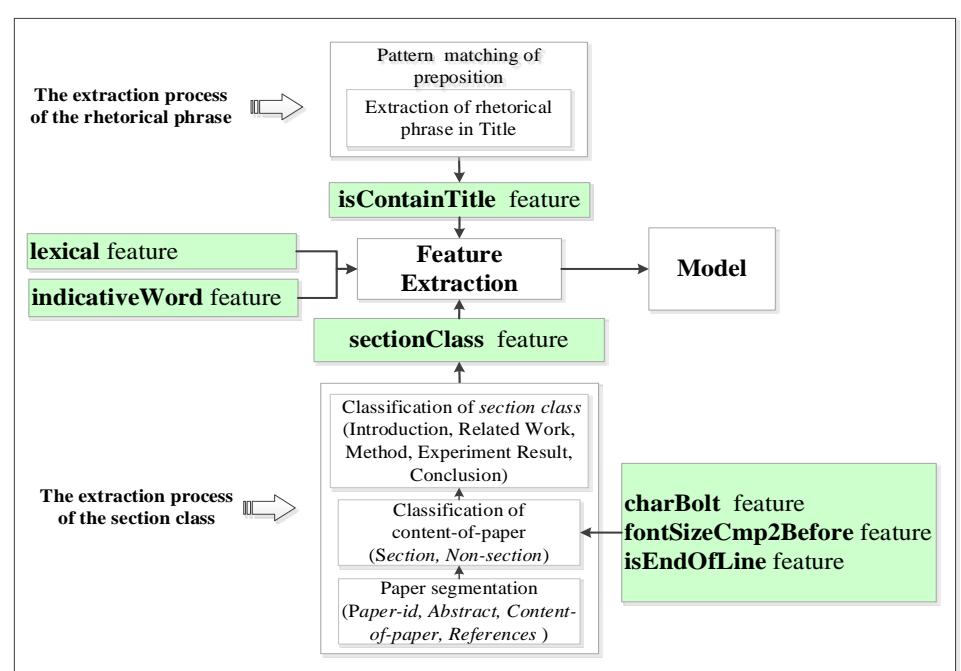
Figure 1 The Extraction processes of the sectionClass and isContainTitle features.
The sequence of the zones is: Paper-id zone at the beginning of the paper, Abstract zone, Content-of-paper zone, and References zone. Our method uses the regular expression method because this method is suitable for segmentation with definite features. The technique is as follows:
The Paper-id zone starts with the initial character of the paper and continues until the word "Abstract" is found.
The Abstract zone starts from the word "Abstract" and continues until the word "Introduction" is found. The regEx pattern for the abstract zone is:
regexAbstract = "(a[ ]*b[ ]*s[ ]*t[ ]*r[ ]*a[ ]*c[ ]*t).
The Content-of-paper zone starts from the word "Introduction" and continues until the word "References" is found.
The regEx pattern is:
regexIntro = "[\n](" + regexPrefixMix + ")[ ]*"+ "((i[ ]*n[ ]*t[ ]*r[ ]*o[ ]*
d[ ]*u[ ]*c[ ]*t[ ]*i[ ]*o[ ]*n)|" + "(o[ ]*v [ ]*e[ ]*r[ ]*v[ ]*i[ ]*e[ ]*w))".
The last zone is the Reference zone. This zone starts from the word "References" and continues until the end of paper.
3.1.2 Section Classification
Each line in the Content of paper zone is classified into two classes: Section and Non-Section, using the Naïve Bayesian algorithm. The number of sections is no more than 10, while the number of lines in a paper is approximately 300.
| Features | Feature value |
|---|---|
| isBoldChar | true, false |
| fontSizeCmp2Before | true, false |
| isPapragraphStart | true, false |
| isStartWithNumerical | true, false |
| isCapital | true, fal se |
| isEndOfLine | true, false |
Table 4 Features for Line Classification.
We used two corpuses, an XML corpus and a PDF corpus. Both corpuses were needed to test new features. These new features are based on the format type of sections. We consider that humans easier recognize the format of a section. Three new features were implemented: BoldChar, fontSizeCmp2Before and EndOfLine, as shown in Table 4. These features give better precision. The three new features can be described as follows:
isBoldChar feature: This feature worked only on a PDF corpus, because bold characters cannot be recognized as such in XML files. The PDF corpus consisted of the original files in PDF format. The XML corpus consisted of the files in XML format. In this study we tried to find a way to synchronize both corpuses. When the name of the file is read in the tag "gate.SourceURL" in the XML corpus, then the system looks for the same file name in the PDF corpus. After that, each line of the PDF file is checked using the isBoldChar feature. The value of this feature will be true if all characters in a line are bold.
fontSizeCmp2Before feature: This feature also worked only on the PDF corpus. Usually, the size of the characters in a section name is different from the other characters in a paper. This feature compares the characters in a line with those in the two previous lines. The reason for this is that the two previous lines belong to the body of the paper, which has normal-size characters. It is not possible to use this feature by comparing the first previous line because that is a blank line. This feature will be marked as true when the size of the characters is bigger than that in the previous two lines.
isPapragraphStart feature: The first line of a section is definitely located in a new paragraph. New paragraphs are marked by a blank line or <enter> before the new paragraph. The value of this feature is true when there are two <enter> characters before a line.
isStartWithNumerical feature: In the standard scientific paper format, a section begins with a numerical value, a roman numeral or a single character. This feature detects whether a line begins with a numerical value, a roman numeral or a single character. The value of this feature is true if the line has one of the three types of characters.
isCapital feature: Each word of the first line of a section always begins with a capital letter. The value of this feature is true if a word begins with a capital letter.
endOfLine feature: This feature will be true if the end of a line has the <enter> character and does not have the <.> character.
This classification produces two classes: (1) the first class contains lines that are identified as the title of a section. We call this the Section class; (2) the second class contains lines that are identified as not the title of a section, so we call this the Non-Section class.
3.1.3 Classifying the Section Class into Five Section Classes
Each line in the Section class is classified into five classes: Introduction, Methods, Related-Work, Experiment-Result, and Conclusion. This classification is done to mark the section classes where rhetorical sentences appear. Then, the Section class is used for feature extraction.
Table 5 List of Features to Classify any Section Class Instance into Five Classes (Introduction, Related work, Method, Experiment-Result, or Conclusion).
| Features | Feature value |
|---|---|
| isFirstSentence | true, false |
| lengthNumeric | Numeric |
| sectionPosition | Numeric |
| isCapital | true, false |
| isPrefixType | true, false |
| isNewParagraph | true, false |
| wordContained | word/ phrase |
Some of the features of section classification are reused in this process with the intention to filter out the lines in a class that do not belong in this class. The features used in the rhetorical sentence classification process are shown in Table 5. The description of these features is as follows:
isFirstSentence feature: This feature represents the sentence position in the paper. We have explained this in our previous research.
lengthNumeric feature: In general, the number of characters in a section line is not larger than the maximum number of characters in one line. This feature value is a numerical according to the number of characters contained in a line.
sectionPosition feature: This feature determines the relative position of a section in the full paper. The value of this feature is the position of the initial character of the section divided by the total number of characters in the paper.
isCapital feature: This feature is also used in an earlier phase. It determines whether each word in a line begins with a capital letter. If so, the isCapital feature is true.
isPrefixType feature: This feature has been described in the first phase.
isNewParagraph feature: This feature has been described in first phase.
wordContained feature: This feature indicates whether a line includes a clue word. Here, we list several clue words that usually exist in a specific section, such as Abstract, Introduction, Relation Work, Method, Experiment Result, Conclusion, References.
3.2 Preposition Pattern Matching for Rhetorical Phrases in Titles
Then we also extracted rhetorical phrases from the title as a feature to classify rhetorical sentences. From our previous study [19], we adopted that the title of a paper contains information about Problem (P), Method (M), and Data (D). We assumed that Problem and Task are the same in experimental research. Method is the proposed way to solve the problem and Data is the object of the research. These phrases are separated by prepositions. To determine the class of a phrase, we employed two annotators, who have the same research field. The results were evaluated together with our supervisors. We analyzed 744 titles of papers and found 56 preposition patterns that appear more than three times, and discovered that the title always contains at least the information of the research problem. The number and sequence of prepositions determine the label of the phrase, as in the following examples:
- 1. <M> Statistical Models <M> for <P> Text Segmentation <P>
- 2. <P> Topic Tiling <P> : <M> A Text Segmentation Algorithm <M> based on <M> LDA <M>
The first example contains one preposition, {... for ...}. The phrase before the 'for' preposition is the Method of the research while after the for preposition is the Problem. The second example has two prepositions {.. : ..based on..}. Before the ':' preposition is the Problem, after the ':' preposition is the Method, and after the 'based on' preposition is the Method.
Table 6 Patterns of Prepositions that Appear More Than Three Times.
| Preposition | Pattern of Preposition |
|---|---|
| NON | P |
| ONE | P - based on - M, P - by - M, P – with - M, P - using - M, P - via |
| - M, P - from - D, P - in - D, M - to -P, M - for - P, D - : - P | |
| TWO | D - : - M - for - P, D - for - D - : - M, D -for - P - based on - M, |
| D - for - P – using - M, D- using - M – for - P, D - using - M - | |
| for - P, M - for - P - in - D, M - for - D - in - P, M - for - D - | |
| using - M, M - for - P - by - M, M - for - P - for - D, M - for - P | |
| - in - D, M - for - P - on - D, M - for - P - using - M, M - for - P | |
| - with - D, M - from - D - for - P, M - from - D (M - for - P), M | |
| - from - D - for – P, M - for- P - using - M, M - in - D - for - P, | |
| M - in - P - : - P, M - in - P - for - D, M - in - P - in - D | |
| M - to - P - for - D, M - to - P - in - D, M - to - P - using - M, M | |
| - to - P - using - M, M - with - D - for – P, M - with - M - for - | |
| D, P - based on - M - for - D, P - for - D - using - M, P - in - D - | |
| : - M, P - in - D - using - M, P - using - M - in - D, P - using - M | |
| - in - P, P - with - M - from - D, using - M - for - P, using - M - | |
| to - P | |
| THREE | M - to - P - with - M - from - D, M - for - P - with - M - to - P, |
| Preposition | Pattern of Preposition |
|---|---|
| M - for - P - from - D - to - P, P - using - M - from - P - to - P, | |
| M - : - M - to - P - from - D, M - for - P - using - M - in - D, M | |
| - for - P - using - M - in - D, P - using - M - in - D - using - M, | |
| using - M - for - P - in - D, using - M - to - P - from - D, using - | |
| M - to - P - in - D |
The conclusions of these observations are: (1) the maximum number of prepositions in a title is 3 (three) and the minimum is null (without preposition); (2) the preposition patterns vary – we found 59 patterns, as shown in Table 6; (3) the most interesting finding of these observations is that both of the examples have information extraction phrases, but they are labeled differently. The first one is Method and the second one is Problem. The reason for their different labels is that they have different prepositions following them. Therefore, the labels of both phrases are also different. Therefore, the conclusion is that the meaning of a phrase depends on its preposition.
First, the Problem, Method and Data phrases are extracted based on their preposition pattern. Next, the phrase is cleaned from its prepositions, articles and punctuation using Stopwords. The remaining phrase is compared to a sentence. If the sentence contains one of the phrases (e.g. Problem), the value of the feature isContainTitleProblem is true.
4 Rhetorical Sentence Classification
After the sectionClass and isContainTitle features have been completed, the next task is rhetorical sentence classification. This study proposes four categories of rhetorical sentences so that all the sentences in a full paper are classified into these four categories. This process uses the XML corpus whose sections are classified into five section classes, after which the rhetorical sentences in each section are identified. Because this classification has a specific goal, the features used are also specific. Table 7 shows the features used in this classification. The features can be described as follows:
Table 7 List of Feature to Classify any Sentence into Four Rhetorical Classes (Problem, Method, Data, and Result).
| Group | Features | Value |
|---|---|---|
| Section | sectionClass | {Abstract, Introduction, Related Work, Method, Experiment Result, Conclusion |
| and References} | ||
| Lexical | Lexical | Numeric |
| Title | isContainTitleProblem | true/ false |
| isContainTitleMethod, | true/ false | |
| isContainitleData | true/ flase |
| Group | Features | Value |
|---|---|---|
| IndicativeWord | indicativeWordProblem | true/ false |
| indicativeWordData, | true/ false | |
| indicativeWordMethod, | true/ false | |
| indicativeWordResult | true/ false |
sectionClass feature: This feature is a result of the first phase and identifies the section class in which rhetorical sentences may appear. The feature value is one of the section classes, i.e Abstract, Introduction, Related-Work, Method, Experiment-Result, or Conclusion.
lexical feature: The lexical feature is a common feature implemented in this type of classification. This feature works by individually checking words based on their grammatical aspect. A lexical unit consists of a word and its grammatical aspect, for example pronoun, verb, noun, etc. This feature uses the term frequency–inverse document frequency concept and then calculates the feature vector for each word.
Table 8 Collection of Indicative Words.
| Problem | Method | Data | Result |
|---|---|---|---|
| Problem | we proposed | learning corpus | the result |
| we focus | in this paper | we used | precision better |
| we discuss | we used | the corpus | than |
| we take | web corpus | recall better than | |
| our method | the data for | result the best | |
| we considered | wikipedia | achieve | |
| this paper proposes | manually | we have proved | |
| this paper also explores | annotate | value | |
| this article | the ace 2004 | summary | |
| we implement | we used ace 2004 | quite well | |
| our dynamic | we took ace 2004 | evaluation | |
| we can take | training data | ||
| our work | data source | ||
| articles are processed | instance | ||
| we automatically | |||
| we describe |
isContainTitle feature: The feature group isContainTitle has three features, i.e. isContainTitleProblem, isContainTitleMethod, and isContainTitleData. These features have very strong semantic dependency on the title of the paper. When a word or phrase contained in the title is also contained in a sentence, then the value of this feature for the sentence is true (according to the title of the label).
indicativeWord feature: This feature group is developed in accordance with the objective of the research. This feature is the result of discussions conducted by our research team to find characteristics of words that can identify rhetorical sentences. The words are kept in a dictionary, as shown in Table 8.
5 Experiment and Result
We performed three experiments: extract the sectionClass feature, extract a rhetorical phrase from the title, and classify the rhetorical sentence that is proposed. The number of lines for each classification is shown in Table 9. In this task, our method uses the Naïve Bayesian (NB) algorithm. This provides a simple approach using probabilistic knowledge with two simplifying assumptions: conditional independence of features, and no hidden attributes influence the prediction. The NB model contains the probability of each class and the conditional probability of each attribute value given a class. The classification process uses the model to find a class with maximum probability given an instance.
Table 9 Number of Lines for Each Classification.
| Classification | Number of instances |
|---|---|
| Stage I (section – nonSection) | 28.304 lines |
| Stage II (five section classes) | 365 lines |
| Stage III (rhetorical sentences) | xx sentences |
5.1 Section – nonSection classifier
The first experiment classified lines into two labels: Section and Non-Section. Then, the experiment was evaluated using F-measure. Learning accuracy achieved 99.45%, i.e. the number of lines classified in the appropriate class was 27.884. The error percentage was 0.65%. Some examples of the errors are shown in Table 10. It is important to investigate the reason why the classification went wrong in different cases.
5.1.1 Section Instances Classified as Non-Section
The first example is "III. EXPERIMENT AND RESULT". All features worked well on this line. However, the isCapital feature value was false, which caused the line to go into the wrong class. The task of the isCapital feature is to check whether the first letter in a line is capital. We tried to change the definition of the isCapital feature, i.e. all the letters in a word have to be in the form of a capital. Then, the adjusted feature was implemented to test each line. However, we still did not get a satisfactory result. Finally, we decided to utilize this feature only to check the first letter.
Table 10 Examples Of Lines That Were Incorrectly Classified.
| Non-Section class | Section class |
|---|---|
| III. EXPERIMENT AND RESULT | A. Data Sets |
| 4. Methods | 9 WordNet Semantic Concepts |
| INTRODUCTION | United Nations Secretary-General |
| FURTHER RESEARCH | 9. Acknowledgements |
The second example is "4. Methods". The values of isStartWithNumerical, and isUpperCase were true, but the value of isCompareTwoLineBefore was false. This specific example had the same font size as the previous two lines. Similarly, for the isBold feature we found that the value was false because the line was not in bold characters.
The third example was not only influenced by isCapital but also by the isStartWithNumerical feature. The feature values of this line were false. Also, "FUTURE RESEARCH" was not found in certain papers, therefore this line was considered Non-Section class.
5.1.2 Non-Section Instances Classified as Section
The phrase "A. Data Sets" can be assumed to be in a sub-section of a paper. However, in this specific case the author's writing style was to number these with the numbers 1, 2 and so on. Then to mark sub-sections he used the alphabetic characters A, B and so on. However, the isStartWithNumeric feature assumes that this line belongs to the Section class. Thus, the isStartWithNumeric feature value was true.
Next, the phrase "9 WordNet Semantic Concepts" was not meant to be in Section class. This was actually the continuation of a sentence on the previous line. Hence, the isCapital and isStartWithNumeric feature values were true. The values of the isCapital and isNewParagraph features in the third line were also true, so that this line automatically went into the Section class.
All features worked well in the last example, i.e. the phrase "Acknowledgments", but the wordContained feature was false because there was no class defined to handle this line. Moreover, this line did not have a numeric character and authors rarely write this phrase in their papers. Therefore this study ignores it.
According to the standard evaluation metrics for document retrieval (the precision value, recall, and F-measure), the precision value of the experiment was 0.65, the recall value was 0.95, and the F-measure was 0.77, as shown in
Table 11. Although precision and recall were very different, the F-measure remained high because of the average of precision and recall.
Then, we investigated the three most influential features in this experiment. They were isBoldChar, fontSizeCmp2Before and isStartWithNumerical.
Table 11 Precision, Recall and F-measure using Naïve Bayesian Classifier.
| Class | Precision | Recall | F-measure |
|---|---|---|---|
| Section | 0.65 | 0,95 | 0.77 |
| nonSection | 1 | 1 | 1 |
The isBoldChar feature was the best-performing one, because one of the characteristics of the section class is that it uses a bold font for class names. Therefore it is very appropriate to implement the isBoldChar features in this classification. Moreover, the size of the class name's font was usually larger than the size of the paper's body font. So the fontSizeCmp2Before feature also caused better precision.
The isStartWithNumerical feature can also be considered as one of the best features, because almost all the section classes began with a numeric value ..., I ..., 1 ..., etc.
Overall it can be concluded that the addition of the three new features considerably contributed to precision, recall and F-measure.
5.2 Classification into five section classes
The second stage of the classification process is to label each line contained in each section class. Each line was classified into five pre-defined section classes. The accuracy of this classification achieved 91.2%. Overall, the precision and recall of this classification achieved good values, causing the F-measure to remain high. The influence of each feature on each section class can be described as follows:
Introduction class: This class is always located at the beginning of a paper. It is always called 'Introduction'. Therefore the indicativeWord feature will be true. Then, the position of the Introduction class is always located below the Abstract class. Thus, the value of the introduction's relative position is almost the same for every paper. This causes the sectionPosition feature to be true. Another common cue of this class is that it is always written on a new line. It is marked by a <.> character to terminate the line and an <enter> character to move to the next line. Each of the first letters of the word is a capital letter, causing the value of the isNewLine and isCapital feature values to be true. Another characteristic is that at the beginning of this section class there is always a blank line. Thus, the value of the isNewParagraph feature is true. Moreover, it is also common to see a numerical value at the beginning of the name of a class. If an author uses this kind of style (numbering), then the class titles will always have the following pattern: 1. Introduction, 2. Related Work, etc.
Related Work class: Some conditions cause the precision and recall of this class to be lower than those of the Introduction class, because this class does not always exist in a paper. Moreover, some authors write this class using a different word or phrase, such as Background. Therefore, the value of this feature is not always true. In other cases, the position of this class in every paper is not always after the introduction. Some authors put it after the Experiment Result class. Meanwhile, other features work well with this class.
Method class: The precision and recall of this class is higher than in previous results. Adding new features increased the recall value to 0.9, whereas the precision value dropped to 0.85. This value did not affect the F-measure, which remained constant (0.9). In a previous research, any section that was considered to belong to the Method class was merged into one class. This study separated the Method class into sections. Each section is still named Method class. This change resulted in better precision and recall values.
Experiment Result class: The precision and recall value in this class were both 0.91. The average increase was 16%. This proves that this feature was used appropriately and in accordance with the characteristics of this class. The same change as discussed under the Method class was also made in the Experiment Result class, because this class is not always present in one section only, sometimes it is present in two separate sections: the Experiment section and the Result section. Therefore we separated this class into sections. Each section is still named Experiment Result class.
Conclusion class: Same as the previous classes. The increase of the F-measure value for this class was 4%. This is a positive response after adding several new features in the section classification process.
The precision, recall and F-measure of the five section classes are shown in Table 12. Another change we implemented in the classification process was not to include the Abstract class anymore because this class does not have a numeric value. Consequently, the isPrefixType feature did not work on the Abstract class. Classification for this class was done separately using the technique of regular expressions.
Class Precision Recall F-measure Introduction 1 0.96 0.98 Related Work 0.94 0.68 0.79 Method 0.85 0.95 0.90 Experiment Result 0.91 0.91 0.91 Conclusion 0.90 0.97 0.94
Table 12 Metric Evaluation for Five Section Classes.
The best-performing three features in this classification were: wordContained, sectionPosition, and firstSentence. As for the wordContained feature: if the name of a class does not vary (except for Method), then this feature value is always true. Those words that can indicate classes that have been saved in our dictionary are quite sufficient to cover all possible words that appear as a class name. SectionPosition feature: The relative position of some sections in a paper is quite similar. Only the Related Work class is sometimes placed after the Experiment Result class. The last feature is firstSentence. This feature is quite determining in accordance with the section characteristic that they always start with a new line.
5.3 Pattern Preposition in Title
The preposition pattern experiments were performed independently. The data used were 434 titles. Testing data that were part of the training data were cleansed of tags to be used for the separator string and added with other data. The experiment consisted of two parts. The first part was to determine preposition matches without involving following string patterns. The second part was to match the following strings patterns.
The first experiment produced 276 matching patterns and the second produced 95 matching patterns with the same following string. Hence, the total amount of correct matches was 276 + 95 = 371. The accuracy value was 86%. Some of the results and the percentages of each class of phrases in their own class are shown in Table 13. We found Method phrases and Problem phrases difficult to distinguish. Both classes can have the same content. In other words, a phrase in a title could be in the Problem phrase class, but in another title it could be in the Method phrase class. The percentage value of these phrases were 21.3%.
Table 13 Number of Phrase Based on Their Class.
| Phrase | Number phrase | % |
|---|---|---|
| Problem | 438 | 73.2 % |
| Method | 427 | 71.4 % |
| Data | 93 | 15.5 % |
| Total numbers | 598 |
The first pattern is correct. The system could identify both rhetorical phrases in accordance with the label. For the second pattern no match was found. This happened because the pattern was not read from the preposition. For the third pattern a match was found. The error occurred because there were two patterns of the same preposition but the label of the string that followed the preposition was different. As shown in Table 14, there were 2 preposition patterns that were the same but had a different label: M - for - D - using - M and M - for - P - using - M. When pattern matching is performed, the system will use the first pattern found.
Table 14 Some Preposition Patterns after the Matching Process.
| No | Output | |||
|---|---|---|---|---|
| 1. | raw: extracting relations of various complexity clean: a seed-driven bottom-up machine learning framework for extracting relations of various complexity Processed: extracting relations of various complexity | |||
| 2. | Result: True raw: large scale learning of relation extraction rules withsupervision clean: large scale learning of relation extraction rules with distant supervision from the web Processed: large scale learning of relation extraction rules with | |||
| 3. | Result: False raw: knowledge management :trends in the Australian corporate environment clean: the role of technology in knowledge management: trends in the Australian corporate environment Processed: the role of technology in | |||
5.4 Rhetorical Sentence Classification
Result: False
In our study, rhetorical sentences were classified into four classes: Problem, Method, Data and Result. The number of instances in the experiment was 770 sentences. Four features were implemented in this classification, sectionClass, lexical, isContainTitle, and indicativeWord. These four features contributed to increase precision. Like the lexical feature, this feature is rich with words, so the lexical feature was also utilized in this classification.
The experimental scenario conducted was to test all the features simultaneously and try to create some combination among the four features. To evaluate this experiment we utilized F-measure because F-measure is a representation of the value of precision and recall. The results of the classification and combination process are shown in Table 15.
Table 15 F-measure Value for Combination of Features using Naïve Bayesian Classifier.
| F-measure | |||||
|---|---|---|---|---|---|
| Features | Problem | Method | Data | Result | |
| sectionClass, isContainTitle, indicative Word | 0.68 | 0.71 | 0.69 | 0.76 | |
| sectionClass, lexical+indicativeWord | 0.67 | 0.71 | 0.69 | 0.77 | |
| sectionClass, lexical | 0.67 | 0.71 | 0.69 | 0.77 | |
| sectionClass,indicative | 0.61 | 0.63 | 0.21 | 0.71 | |
| lexical,indicative | 0.56 | 0.64 | 0.63 | 0.69 | |
| sectionClass | 0.66 | 0.64 | 0 | 0.71 | |
| Lexical | 0.57 | 0.64 | 0.62 | 0.68 | |
| indicativeWord | 0 | 0.31 | 0.8 | 0.48 | |
Overall, the F-measure value of the four features was higher than that of the combined features, except for the value of Result, which was 1% lower than the value of the combined feature without using the isContainTitle feature. IsContainTitle does not work on Result, because titles never contain the rhetorical phrase "result". The F-measure of Data was 0.69. This was caused by the number of occurrences of Data. This was significantly lower compared to the other rhetorical sentence classes.
Besides the Naïve Bayesian algorithm, this study also tried out the support vector machine (SVM) classification algorithm. We compared SVM with the Naïve Bayesian algorithm to determine which one performed better. The Fmeasure values using SVM are shown in Table 16. SVM with the combination of all features was slightly superior in classifying rhetoric sentences. The Fmeasure values increased 1% for the Problem class, 2% for the Method class, 3% for the Data class, and 1% for the Result class.
The lexical feature produced similar F-measure values. However, when the combination of all features using SVM was compared with the Naïve Bayesian classifier, the F-measure values tended to rise 1% only for the Problem class. Likewise, the independent sectionClass, lexical and indicativeWord features generally increased by about 2% when using the Naïve Bayesian classifier.
Table 16 F-measure Value for Combination of Features using SVM Classifier.
| F-measure | ||||
|---|---|---|---|---|
| Features | Problem | Method | Data | Result |
| sectionClass, lexical, | 0.69 | 0.73 | 0.72 | 0.77 |
| isContainTitle, indicativeWord | ||||
| sectionClass, | 0.69 | 0.74 | 0.71 | 0.77 |
| lexical+indicativeWord | ||||
| sectionClass, lexical | 0.69 | 0.74 | 0.71 | 0.77 |
| sectionClass,indicativeWord | 0.59 | 0.63 | 0.14 | 0.70 |
| lexical,indicativeWord | 0.55 | 0.65 | 0.65 | 0.68 |
| sectionClass | 0.60 | 0.63 | 0 | 0.71 |
| Lexical | 0.55 | 0.66 | 0.66 | 0.68 |
| indicativeWord | 0 | 0.34 | 0.07 | 0.44 |
We looked into classifications of rhetorical sentences into classes that were erroneous. Some examples of rhetorical sentences classified in a class that was not appropriate were:
(The sequence of the features is as follows: sectionClass, isContainTitleData, isContainTitleMethod, isContainTitleProblem, indicativeWordMethod, indicativeWord-Problem, indicativeWordResult, indicativeWordData: Class.)
Example 1: Instance: "The method is based on information made available by shallow semantic parsers."
Feature value: Abstract, false, true, false, false, false, false, false: METHOD
Predicted class: PROBLEM
Title: Shallow Semantics for Relation Extraction
XML name: docD4
(The value of inTitleMethod is true and sectionClass is Method. This instance should have been included in the Method class but it was included in the Problem class).
Example 2: Instance: "1) An Evaluation Method of Feature Selection: We used the cohesiveness of clusters to measure the performance of feature selection methods."
Feature values: (exp.-result, false, true, false, false, false, false, false, false: METHOD)
Predicted class: RESULT
Title: Text Clustering with Feature Selection by Using Statistical Data
XML name: docA2
The value of sectionClass was Abstract and the value of inTitleMethod was true. This instance was supposed to be in the Method class, but the indicativeWord "result" (measure and performance) caused the instance to be included in the Result class.
Both examples represent instances that were classified in the wrong class. Almost each sentence that was classified in the wrong class had two categories that occur in the indicativeWord dictionary. We inferred that this was the reason why the instances ended up in the wrong class. Another possible cause is that the list of four categories in the indicativeWord dictionary is not sufficient.
We compared the result of this research with our previous study and found that our new features increased the performance of classification up to 14% using Support Vector Machine (SVM), as shown in Table 17.
Table 17 Improvement of Classification Performance with Our Previous Research.
| F-measure (SVM) | ||||
|---|---|---|---|---|
| Rhetoric class | Last Feature | New Feature | ||
| Problem | 0.67 | 0.69 (2.9 %) | ||
| Method | 0.64 | 0.73 (14 %) | ||
| Data | 0.70 | 0.72 (2.9 %) | ||
| Result | 0.69 | 0.77 (11.5 %) | ||
6 Conclusion and Discussion
The sectionClass feature worked well and can provide a positive contribution when implemented independently so it can increase the value of the F-measure. However, when it was implemented independently on the rhetorical sentence class Data, the sectionClass feature could not identify this sentence as a rhetorical sentence; the value of F-measure was 0 (zero). This was caused by the occurrence percentage of this phrase being far lower than that of other rhetorical sentences, so that this sentence does not dominate in one of the six pre-defined section classes. It also is affected by the number of instances. The occurrence number of this rhetorical sentence is very low compared to that of the other rhetorical sentences. However, when this feature was combined with the lexical
feature, the F-measure value could still reach an average level because the lexical feature is rich with words.
The precision of the isContainTitle feature is low because the assumption of the annotation is still weak. In future research, we will develop a classification for rhetorical phrases, specifying a clear distinction between each phrase.