

1 Introduction
Wireless sensor networks (WSNs) may contain several thousands of homogeneous or heterogeneous sensor nodes, which are deployed to create a smart environment that depends on sensed data from the real world, as shown in Figure 1. These networks are wirelessly connected, thus enabling monitoring and tracking. Each sensor node consists of a sensing unit, a central processing unit, a transmission unit, Global Positioning System, and a power unit
consisting of a small battery and an optional mobilizer. These sensors can communicate with each other or send data to the base station directly. The base station is a node that has a powerful energy supply. It can be a mobile or fixed node that provides connectivity between the network and the user who can access the sensed data [1,2]. The deployment of WSNs in a sensor field can be done randomly. For example, a large number of sensors may be thrown down from an airplane for disaster monitoring applications. Also, WSNs can be planted manually, as for example in fire alarm systems [3].
Figure 1 General overview of wireless sensor networks.
The sensor architectural constraints, including a limited supply of energy (battery supply), is a critical issue in the life of WSNs. Cluster-based routing protocols have been developed to reduce power consumption and extend network lifetime. One of the most prominent protocols that use this technique is Low Energy Adaptive Cluster Hierarchy (LEACH) [4]. LEACH has a number of drawbacks:
- 1. The residual node energy is not considered in the process of cluster-head selection. Therefore, cluster-head failure due to low residual energy cannot be avoided.
- 2. The distance is not considered in the process of cluster-head selection. Therefore, the power consumption of cluster heads located far from the base station is higher than that near the base station.
- 3. It does not consider node heterogeneity.
In recent years, several researchers have proposed algorithms to enhance network lifetime by considering node residual energy and node distance to the base station to select cluster heads. However, improving overall network lifetime is not enough for many applications that require reliable feedback from the network. Thus, the network stability period, which is defined as the moment when the first node dies, should be considered in designing the WSN routing protocol. In this study, our main goal was to improve the stability period of Improved LEACH as proposed by Sarobin & Thomas to achieve better reliability [5].
2 Related Work
Routing protocols nowadays play an important role in reducing power consumption in WSNs. Several researchers have proposed modifications of the LEACH protocol to overcome its limitations. The Improved LEACH (ILEACH) protocol [6] has been proposed to expand network lifetime. ILEACH considers node heterogeneity where advanced nodes are deployed. An energyefficient clustering technique is implemented to stabilize the power consumption of the nodes. The nodes' distance to the base station and their residual energy are used to select the cluster-heads. Thus, the nodes closest to the base station with the most residual energy have the highest probability to be selected as cluster heads. In addition, the non-cluster head nodes are connected to a cluster head node located close to the center point of the non-cluster head nodes and the base station. Joining cluster heads that have these criteria will form unbalanced clusters, which leads to early death of nodes. A performance analysis of the proposed algorithm was conducted. The simulation results showed that the proposed algorithm outperforms the traditional LEACH protocol in terms of network lifetime. The stability period is still considered to be too unreliable for applications that require reliable feedback from the network.
Hybrid-Low Energy Adaptive Clustering Hierarchy H-LEACH was proposed by Azim and Islam [7]. This protocol uses the nodes' residual energy and their maximum energy at every round in calculating the threshold value. If the residual energy is higher than the average network energy, the node is selected as a cluster head. The authors compared their proposed protocol with the LEACH protocol. The simulation results showed that H-LEACH was more efficient compared to LEACH. However, considering only the node residual energy is not enough to stabilize power consumption in WSNs, since node distance has a great impact on power dissipation.
Nguyen, et al. have proposed two energy-aware algorithms in [8]: Distance Based-LEACH (DB-LEACH) and Distance-Based Energy Aware-LEACH (DBEA-LEACH). These algorithms consider the distance from the nodes to the base station and the residual energy of each node as the major factors to determine the selection of cluster head. Both algorithms showed their efficiency by improving the network lifetime. The work introduced a new distributed cluster-head selection algorithm based on the nodes' dissipated energy and their distance to the base station. The authors improved their protocol by adding a multi-hop routing scheme in which only the cluster head closest to the base station transmits its data directly to the base station to reduce energy being dissipated by cluster heads located far from the base station. The results of the simulation showed that the DBEA-LEACH algorithm was more energyefficient compared to DB-LEACH and LEACH in terms of energy consumption and dead nodes. However, the cluster head nearest to the base station will die early because many cluster heads send their data through it.
Taneja and Bhalla [9] have proposed the Three Levels Hierarchical Clustering Protocol (TLHCLP) for WSNs. TLHCLP identifies a predefined radius around the base station. Many nodes will be inside and outside this defined radius. Cluster heads outside the radius search for the nearest cluster head inside the radius area to transmit data to. The cluster heads inside the radius collect the data and then transmit them to the base station. The simulation results indicated that TLHCLP produces better results in terms of network lifetime compared to LEACH.
Deepa, et al. have proposed an enhancement of the existing Quadrature-LEACH (Q-LEACH) protocol in [10]. This protocol is a hybrid protocol that combines the benefits of LEACH and conventional quadrant-based directional routing. It uses an efficient cluster head replacement mechanism so as to save much of the energy that is consumed in cluster head formation and control overhead. The remaining energy of the current cluster head is checked and compared with a predefined energy threshold. If the remaining energy of the current cluster head is higher than the threshold, the current cluster head will not change for the next round. Else, a new cluster head node will be selected. The simulation revealed that Enhanced Q-LEACH is efficient in terms of power consumption, routing overhead and network lifetime. However, the authors did not consider the distance between the nodes and the base station in the cluster-head selection procedure, which has a great impact on power consumption.
An energy-robust clustering algorithm based on LEACH is proposed in Sarobin & Thomas [5]. The authors implemented node heterogeneity, while the nodes have heterogeneous capability. The proposed algorithm (Improved LEACH) makes all nodes send their residual energy information along with their IDs to the base station. The base station sorts the nodes in descending order according to their residual energy level. As a result, a specified percentage of high-energy level nodes are selected as cluster heads. Then the base station will broadcast the chosen cluster head IDs through the network and a cluster formation process is carried out. The simulation results showed an enhancement in terms of network lifetime.
Although the Improved LEACH algorithm yielded good results in terms of network lifetime, this protocol does not solve the network stability issue, where the first node dies early. In this paper, we propose a solution to extend the network stability period.
3 Energy Dissipation Radio Model for Wireless Sensor Node
In this study, we used the energy model proposed by Mittal, et al. [11] in which the transmitter runs the radio electronics to amplify and transmit the signal by dissipating the energy. From the other side, the receiver dissipates energy for the purpose of reception. For relatively short distances a free-space model is used, while for long distances a multi-path fading model is used.
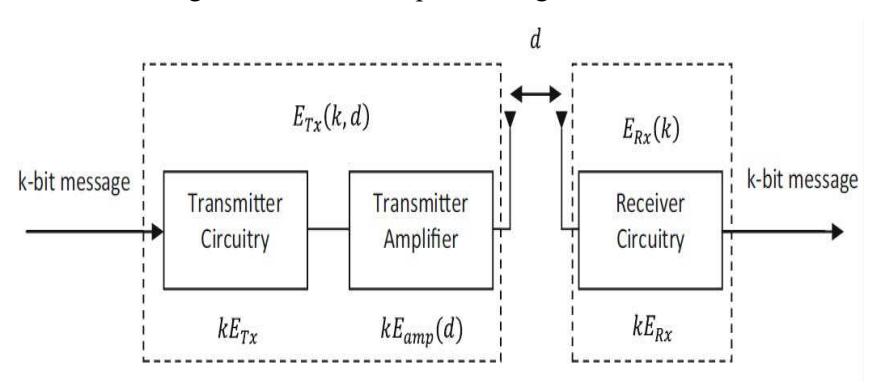
Figure 2 Radio energy model diagram.
In order to achieve an acceptable signal-to- noise ratio (SNR), the radio energy dissipation model shown in Figure 2 is used. When a K-bit message is transmitted over distance d, the amount of energy consumed by the radio can be calculated using Equation (1) or (2), which were used by [12] depending on the distance:
\[ETx(k,d) = k * Eelec + k * \epsilon fs * d2 if d \le d0\] (1)
\[ETx(k,d) = k * Eelec + k * \epsilon mp * d4 if d > d0\] (2)
The energy consumption to receive a K-bit message can be calculated with Eq. (3):
\[ERx = K * Eelec (3)\]
The value of d0 can be calculated using Eq. (4):
\[d0 = \sqrt{(\epsilon f s / \epsilon m p)} \tag{4}\] where:
- 1. Eelec represents the dissipated energy per bit to run the receiver or transmitter circuit.
- 2. ϵfs and ϵmp are amplification factors that depend on the transmitter amplifier model used.
- 3. d represents the distance between sender and receiver.
- 4. ETx denotes the energy spent per bit during transmission.
- 5. ERx denotes the energy spent per bit during reception.
- 6. K is the number of message bits.
4 Proposed Stable Improved LEACH
In this section, the enhanced algorithm named Stable Improved LEACH (SILEACH) is presented, which was developed to achieve fair distribution of energy consumption in wireless sensor networks. Like traditional LEACH, the proposed algorithm has two phases of operation: the set-up phase and the steady state phase. In the set-up phase, cluster-head selection and cluster formation are done. Every node randomly generates a number between (0 and 1) and compares the generated number with the calculated threshold value. The nodes with a number larger than the threshold are chosen as cluster heads. Otherwise, a node will be made a cluster member.
The energy dissipation radio model for wireless sensor networks shows that a node's residual energy and its distance to the base station is an important factor in the network's lifetime. In order to provide energy-efficient selection of cluster heads, we modified the way of threshold calculation by formulating a cost function. This cost function combines both the node's distance to the base station and its residual energy, as shown in Eq. (5).
In addition, the transmission model shows that when the node's distance to the base station increases, the power consumption increases as well. Therefore, we propose to express the node's residual energy and its distance to the base station in percentages to distinguish between nodes with high residual energy and a longer distance to the base station, and nodes with high residual energy and a shorter distance to the base station.
In our experiment, we chose the alpha and beta values that gave the best network lifetime considering all probabilities:
- 1. Alpha = beta means that residual energy and node distance to the base station have equal weight in cluster-head selection.
- 2. Alpha larger than beta means that residual energy is the dominant factor in cluster-head selection.
- 3. Alpha smaller than beta means that node distance to the base station is the dominant factor in cluster-head selection.
Since the base station in the scope of our research was located far from the deployment area, we found that when we set beta larger than alpha, the node distance to the base station was the dominant factor in cluster-head selection.
As a result, the selection of cluster heads improved after each consecutive round as shown in Eq. (5).
\[Cost(n) = (\alpha Ei) + (\beta / di)\] (5)
where:
- 1. Cost(n) is distance to the base station and residual energy cost for each node;
- 2. Ei is the i th node's remaining energy;
- 3. di is the node distance to the base station;
- 4. α and β are percentages assigned to residual energy and node distance to the base station respectively. These percentages were measured during the simulation. We assigned more weight to the node distance to the base station because it has a greater impact on power consumption.
Finally, the threshold value is calculated as in Eq. (6).
\[Th(r) = (p/(1-p*mod(r,round(1/p))))*cost(n))\] (6)
where:
Th(r) is the threshold value of the current round;
P is the percentage of nodes that will become cluster heads;
R is the round number.
After cluster-head selection has been done, the non-cluster head nodes join the cluster heads to form clusters. We modified the way of cluster formation so that the non-cluster head nodes will join the nearest cluster head closer to the base station than the other non-cluster head nodes as shown in Eq. (7) as follow:
\[((NCH to CH < NCH to BS) AND (CH to BS < (NCH to BS)) (7)\] where:
BEGIN
station < (NCH to BS)); 15: Cluster(c); //form a cluster c;
17: if (E(s) <= 0) then 18: set s to dead 19: compute dead nodes
16: end if 20: end if 16: end
- 1. NCH to CH is the distance between a non-cluster head node and its cluster head;
- 2. NCH to BS is the distance between a non-cluster head node and the base station;
- 3. CH to BS is the distance between a cluster head and the base station.
From Eq. (7), we can see that considering the distance between the nodes and the base station is very important because the data transmission consumes the largest part of the energy and the power consumption increases when the distance between the sender and the receiver is increased.
The second phase is the steady state phase, where the nodes sense the environment and send data to their cluster head, which in turn aggregates the data and sends them to the base station. All these operations are repeated each round. The pseudocode of the proposed Stable Improved LEACH algorithm is shown below:
1: Specify the initial probability (p), number of nodes (n), sensor (s);
2: set node Initial energy(s) E0, for s = 1,2, …, n;
     3: specify Eelec, ϵfs, ϵmp
     4: compute distance of each node from BS
     1: for r = 1 to rmax
(I) SET-UP PHASE
     2: if mod(r, round(1/p) = 0) then
     3: reset all nodes to non-CH
     4: end if;
     5: for s = 1 to n
     6: compute Th(s) = (p/ (1-p*mod(r, round (1/p))))*cost (t))
     7: if (temp < Th(s)) & (E(s) > 0 ) then
     8: CH{r} = TRUE; //node s be a candidate cluster head
     9: else
     10: CHs = false;
     11: end if
     12: if (CH{s} = TRUE) then
     13: Broadcast an advertisement message;
     14: Join cluster head that has ((NCH to cluster head < NCH to BS) && (CH to the base
Algorithm 1 Pseudocode of the proposed SILEACH algorithm.
5 Simulation Results
For our simulation we used MATLAB 2014A. All nodes were simulated to be distributed randomly in an area of 100 m x 100 m and the base station's location was placed outside of this region, at point (150, 50), as shown in Figure 3.
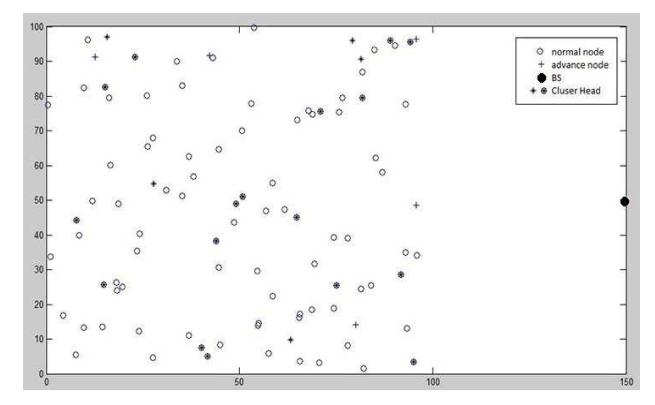
Figure 3 Initial heterogeneous WSN.
We ran the simulation for 1500 rounds. The number of cluster heads was 20% of total alive nodes per round [5]. The test was repeated ten times to check the effectiveness of SILEACH, as shown in Table 1. During the simulation experiment we found that the optimal values for alpha and beta were 40 and 60 respectively, to get a better network lifetime in terms of the first dead node and overall network lifetime. The network stability period and network lifetime were used as the benchmark metrics to compare our protocol with the state of the art Improved LEACH protocol.
Table 1 Implementation parameters.
| Parameter | Value |
|---|---|
| Nodes number N | 100 |
| Size of network | 100 m x100 m |
| Location of base station | (150,50) |
| Normal nodes' initial energy Eo | 0.5 j |
| Special nodes' initial energy Eo + 0.5 | 1 j |
| Percentage of special nodes | 10% of number of nodes |
| Percentage of cluster heads | 20% of number of nodes |
| Packet size | 4000 bit |
| Radio electronics energy, ETx = ERx | 50 nJ/bit |
| Radio amplifier energy, | 100 pJ/bit/m2 |
| Radio amplifier energy, | 0.0013 pJ/bit/m4 |
| Number of rounds | 1500 |
| Α | 40% |
| Β | 60% |
5.1 Network Stability Period
The network stability period is defined as the time required for the first node to die [13]. First dead node (FDN) denotes the number of the round in which the first sensor node dies. Our simulation results showed that the proposed protocol has higher stability compared to the Improved LEACH protocol, as can be seen in Figure 4.
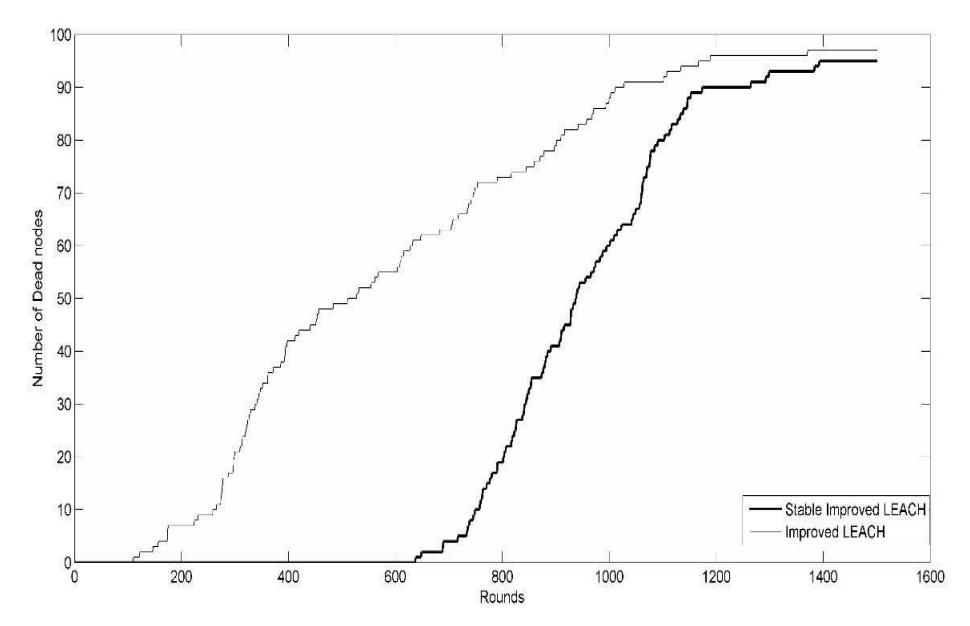
Figure 4 Number of dead nodes vs. number of rounds.
From Figure 4, we can see that the proposed algorithm has a great impact on reducing energy consumption. The first dead node with the SILEAH protocol occurred in round 637 and half of the nodes dead (HDN) occurred in round 937, while the first dead node of the Improved-LEACH protocol occurred in round 109 and half of the nodes dead in round 526. This improvement of the stability period by SILEACH is due to the efficiency of considering both node distance to the base station and node residual energy in the process of cluster-head selection so the nodes that have more energy than the other nodes and are closer to the base station have a higher chance to be selected as cluster head. In addition, the non-cluster head nodes always join the nearest cluster head that is closer to the base station than these nodes themselves.
5.2 Network Lifetime
The network lifetime is defined as the time interval from starting communication until the last dead node [13]. Our simulation results showed that our protocol outperformed Improved LEACH in terms of network lifetime, as shown in Figure 5.
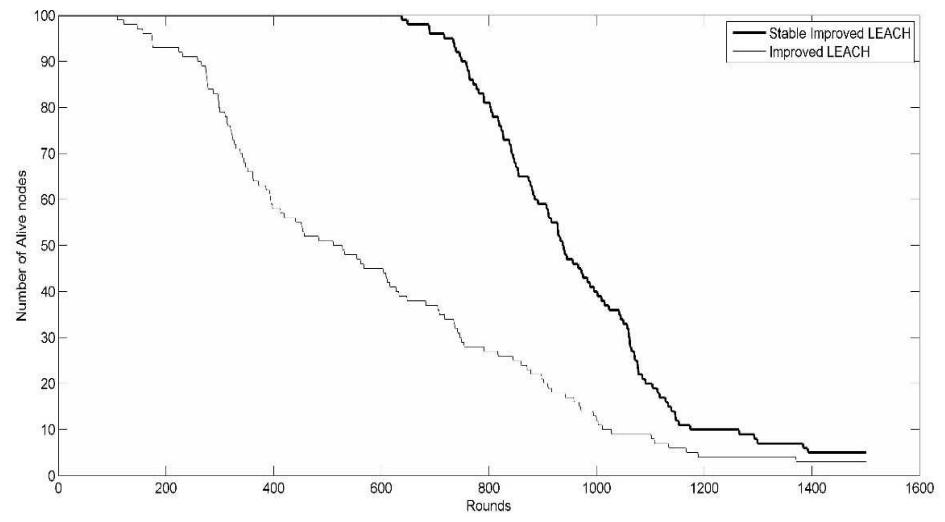
Figure 5 Number of alive nodes vs. number of rounds.
Figure 5 shows that at round 1500, which was the last round, the remaining alive nodes of SILEAH was 7 nodes, which means 93% of the networks' nodes were dead, while the remaining alive nodes of Improved LEACH were 2 nodes, which means 98% of the networks' nodes were dead. These results demonstrate the efficiency of our protocol in terms of energy distribution among the nodes in the processes of cluster-head selection and cluster formation.
A comparison between our proposed protocol SILEACH and the Improved LEACH protocol in terms of network lifetime and stability period is presented in Table 2.
Table 2 Comparison between SILEACH and IMPROVED-LEACH protocols.
| Protocol | FDN | HDN | Remaining nodes at 1500 | Percent of dead nodes at round 1500 | |
|---|---|---|---|---|---|
| Stable Improved LEACH | 637 | 937 | 7 | 93% | |
| Improved LEACH | 109 | 526 | 2 | 98% | |
6 Conclusion
Nowadays, wireless sensor network lifetime and stability are main research concerns because the sensor nodes depend on batteries as their energy source, which are difficult to change when deployed. In this study, the Improved - LEACH routing protocol was used, being a state of the art protocol, as the basis for the proposed protocol to extend sensor node lifetime by considering the nodes' residual energy and their distance to the base station. The Improved LEACH protocol considers only lifetime, ignoring the importance of the network stability period, which is an important factor for applications that require reliable feedback from the network. The proposed protocol (SILEACH) gives nodes that have more residual energy and are closer to the base station a higher chance to be selected as cluster head. Our simulation results showed that SILEACH is able to overcome the limitations of Improved LEACH in terms of network stability period and network lifetime.