

1 Introduction
Vehicle parking systems have become an important part in modern urban planning. Land earmarked for parking itself is economically unproductive [1]. Besides, it is estimated that drivers spend a considerable amount of time [2] in search of parking (blind search), leading to traffic congestion and fuel wastage. Hence, the benefits of smart parking solutions [3] are twofold: offering better parking space utilization and cutting down blind search.
Vision based systems with CCTV surveillance are scalable and cost-effective for large outdoor parking spaces. They have been used for multiple applications, such as occupancy detection, vehicle type detection [4,5] and theft prevention [6]. The existing methods for occupancy detection (finding the presence or absence of cars at parking lots) employ a two-part strategy: extracting relevant features from camera images (obtained from the parking field) and training a classifier. Features such as color, shape and texture of cars or the ground surface are commonly used. The latest approach is to apply deep learning techniques. While these methods provide satisfying results, practical implementation is not very easy. For example, we have to create a 3D model of the whole parking space to use the solution proposed by Huang, et al. [7]. Building a deep learning classifier [8] requires extreme training and tuning. Yet, a model developed for one parking field may not be portable to another with the same level of accuracy.
This work proposes a low-cost, easy-to-implement, vision-based detection-cumguidance system for outdoor parking spaces. The low cost is achieved by using existing surveillance camera feed instead of deploying extra sensors. Transfer learning is proposed for easy implementation. This is a branch of deep learning wherein a new model is developed from a pre-trained model. An analogy with real life is that if you have already mastered riding a bicycle, it will be easy to learn to drive a motorbike [9]. This can be thought of as transferring the existing knowledge to solve a new but related problem. From a vision-based-solution point of view, major issues (noise) with outdoor parking spaces are [7]: (i) shadow, (ii) perspective distortion of the ground scene, (iii) partial occlusion of parked cars by other cars or walking humans, (iv) varying illumination and climatic conditions from day to night. It can also be observed that we loose a clear view of individual parking spaces as we move away from a direct camera view (from ROI-5 to ROI-1 in Figure 2(b)). Hence, instead of processing the entire parking field information at once a more resilient method is to divide the whole CCTV image frame into multiple regions of interest (ROI). This can be a single parking space or a group of parking spaces. ROI selection in this work is based on the amount of subjective perspective distortion and partial occlusion (Figure 2(b)). Individual classifiers were developed to take care of different occupancy conditions and noises for each ROI. Occupancy detection is a binary classification problem. All we want to detect is the presence or absence of cars in each of the ROI. Overall vacant space count in the current frame is found by adding the results from each of the ROI. The count from multiple frames is taken and the most repeated count is posted to the cloud. Additionally, an Android application was developed for real time guidance. The application helps users to get the count of vacant parking spaces and the location for parking.
The rest of the paper is organized as follows: Section 2 provides a detailed review of related works, Section 3 describes the proposed system's architecture and methodology. Section 4 presents a performance analysis to estimate the accuracy of the proposed method. Finally, the conclusions are discussed in Section 5.
2 Related Works
Almeida, et al. [10] created a large and robust dataset for parking lots classification called PKlot. It has images taken from multiple parking fields with different weather conditions (sunny, overcast and rainy). They used textural-based descriptors for the classification of parking spaces. Huang, et al. [7] provided a plane-based method that adopts a structural 3D parking lot model consisting planar surfaces. The method divides the 3D space around a parking space into the faces of a cuboid and conducts classification on each those face patches. For example, if the ground patch is taken, an occupied parking space would feature car tires but a vacant parking space would give the texture of the ground itself. The 3D modeling helps to avoid inter-object occlusion and perspective distortion. Al-Kharusi, et al. [11] proposed a direct image processing approach for occupancy detection. The parking spaces are marked with green dots. Occupancy is detected when the green dots become invisible due to a parked car. Postigo, et al. [12] suggested a computationally efficient method for parking area estimation. Their method is to perform background subtraction and create a transience map, which in turn will be used for occupancy detection. Ling, et al. [13] created an overall system that can learn the topology of parking lots as well as detect the occupancy of identified parking spaces. The algorithm learns the parking lot from the location where parking events occur over time. Fraifer, et al. [14] proposed a design approach for utilizing CCTV images. Using a simulated parking environment, they developed an end-to-end IoT model including an Android application. The authors suggested real-time implementation as a future work. Amato, el al. [8] developed their own dataset (CNRPark) and a CNN based deep learning solution. They manually created a mask to segment out each parking space. The segmented image is given to a CNN classifier to find out occupancy status.
Szegedy, et al. [15] introduced a deep learning model called Inception. It was trained with ImageNet dataset [16] and capable of classifying 1000 classes. Xia, et al. [9] applied transfer learning on Inception-v3 [17] for flower classification. Gogul et al. [18] combined CNN with transfer learning to obtain better accuracy for flower classification. Wang, et al. [5] used deep transfer learning for vehicle type recognition from surveillance images. Training data were generated from labeled web images of different vehicle types. Their classifier architecture is similar to AlexNet [19] with fine-tuning applied to the last two fully connected (FC) layers. Transfer learning has been used in other image classification problems, for accelerated Magnetic Resonance Imaging (MRI) [20], lung pattern analysis [21] and Synthetic Aperture Radar (SAR) target recognition in remote sensing [22]. Howard, et al. [23] introduced the MobileNet CNN model. This is an efficient and lightweight pre-trained deep neural net that uses depthwise separable convolution to reduce computation at its initial layers. Unlike
traditional deep nets, MobileNets are capable of conducting recognition tasks in a timely fashion that is suitable for mobile and embedded vision applications.
3 Methodology
3.1 Proposed System Architecture
Figure 1 depicts the system architecture of the proposed method. It consists of two sub-modules: one for vacant parking space detection and another for giving parking guidance to end users. The faculty parking lot (Figure 2(a)) at our institution was chosen for the proposed work. A 700 TVL CP-plus analog camera was mounted at the parking field. The DVR (digital video recorder) provides 960 × 576 RGB images at 25 fps. There are 8 parking spaces that are in clear view of the camera.
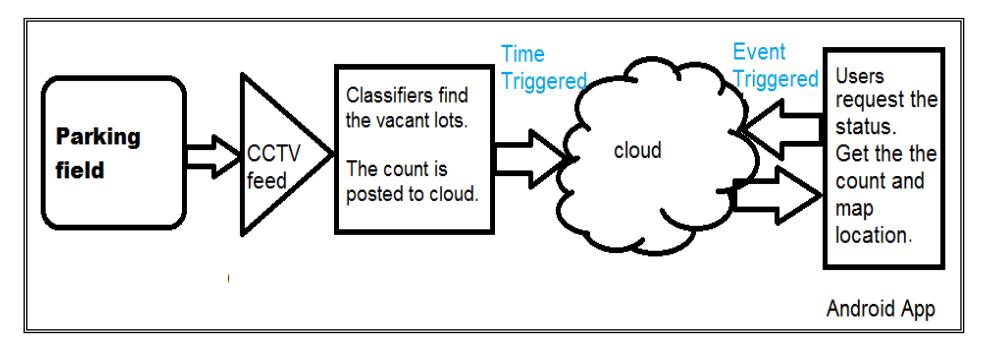
Figure 1 System architecture.
The workflow starts with cropping the captured CCTV frame into five sets of ROI (Figure 2(b)). Then the ROI patches are given to three different classifiers: (i) for ROI-1, (ii) for ROI-2 and (iii) for ROI- 3, 4, 5. This 'divide-and-conquer' approach gives better resilience against issues such as partial occlusion and perspective distortion. The respective classifiers evaluate the number of vacant parking spaces in the corresponding ROI patch.
The results from the three classifiers are added and stored. This process is repeated for eleven upcoming frames. Defining such an observation window helps to avoid occlusion of a parking space by moving cars or walking humans. Among the eleven stored values, the most repeated count is posted to the cloud (parking field location is updated once during initial set-up). The next cycle of the observation window begins thereafter. Using an Android application, users get both a vacant parking space count and the parking location from the cloud.
Figure 2 (a) Faculty parking field at the institution. Eight parking spaces are visible. (b) Different levels of perspective distortion in the CCTV image. ROI-1 (marked in red) denotes the highest distortion. ROI-5 (marked in green) has the least.
The following sections elaborate the design details of the classifiers, the cloud platform and the Android application.
3.2 Transfer Learning: An Overview
Pang & Yang [24] define transfer learning as follows: "Given a source domain DS and learning task TS, a target domain DT and learning task TT, transfer learning aims to help improve the learning of the target predictive function fT (.) in DT using the knowledge in DS and TS, where DS ≠ DT, or TS ≠TT."
In machine learning tasks this can be seen as learning from a pre-trained base model to solve a related problem. For natural image classification, a deep CNN model (AlexNet, Inception, etc.) trained with a large dataset (such as ImageNet) can be taken as the base model. The initial layers of the CNN are constituted by stacking up convolutional ReLU (Rectified Linear Unit) and pooling structures. These layers are responsible for feature extraction. For classification, fully connected (FC) layers followed by a Softmax layer are used.
The features extracted by the initial layers are 'general' for any image dataset, whereas the final layer's extract features are 'specific' to the chosen dataset and task [25]. Hence, we can use CNN as an 'off-the-shelf' feature extractor for a new dataset to train the target classifier [26]. To avoid overfitting on small datasets, the initial layers of the base model are frozen [25]. Using extracted features from the frozen structure, we train only the last few FC layers (of the base model) with our own class labels. This can be thought of as transferring knowledge of the pre-trained model for the new classification task. The crucial part in transfer learning is collecting sufficient data for the new classification task.
3.3 Dataset Collection
The recorded video footage from the DVR across multiple days was collected to create the dataset. The video footage was split into frames and stored. The image dataset was created considering the following scenarios at outdoor parking spaces:
- 1. Images for all climatic conditions sunny, overcast, rainy, shadowy (from trees, building), different illumination cases from morning to evening.
- 2. Images where one parking space is partially occluded by another car.
The next task is defining the ROI for 3 classifiers as described in Section 3.4. Three datasets were created by cropping ROI patches from the frames. The coordinates for cropping were found out manually using Matlab.
3.4 ROI and Classifier Labels
There were 8 parking spaces in the parking field (Figure 2(a)). Since the CCTV camera was fixed, the coordinates of the parking spaces in every frame are the same. Masks were created to segment out the 8 parking spaces into 5 patches (Figure 2(b)). The occupancy status of a parking space is either 'free' or 'busy' (class label 0 or 1).
ROI-1: contains last three parking spaces, which are the farthest from the CCTV camera. For these 3 parking spaces there are 8 occupancy classes (000 to 111).
ROI-2: contains the middle two parking spaces, hence, there are 4 class labels (00 to 11).
ROI-3 to ROI-5: respectively contain the 3 parking spaces that are closest to the CCTV camera. Each has 2 output classes (0 or 1).
The advantage of this kind of labeling is that we can specifically understand the occupancy status (free or busy) of each of the parking spaces.
Figure 3 (a) ROI-1 with class label '111', (b) ROI-2 with class label '01', (c) empty parking space with class label '0' in ROI-3/4/5.
| Class | Occupancy Status | |||||
|---|---|---|---|---|---|---|
| Label | Lot1 (left) | Lot2 (middle) | ||||
| 000 | free | free | Lot3 (right) free | |||
| 101 | busy | free | busy | |||
| 110 | busy | busy | free | |||
Table 1 Sample set of class labels and their meaning for ROI-1 (Figure 3(a)).
3.5 Training the Classifiers Using MobileNet
TensorFlow [27] was used for training the classifiers. Figure 4 depicts the training procedure for the ROI-1 dataset using MobileNet. This is a light-weight CNN model from Google, trained with the ImageNet dataset, capable of classifying 1000 classes. It uses depth-wise separable convolution at the initial layers to reduce the number of computations and training parameters to produce a small-sized model (around 5MB) at the cost of reduced accuracy. This makes MobileNets suitable for embedded platforms like Raspberry Pi. For the proposed method, MobileNet_v1_1.0_224 was used. The input for this model are 224 × 224 RGB images and it achieved a maximum accuracy of 70.7% on the ImageNet dataset. As the ImageNet contains many car images and MobileNet has learned to understand the features of cars, it is a suitable choice for parking space classification tasks.
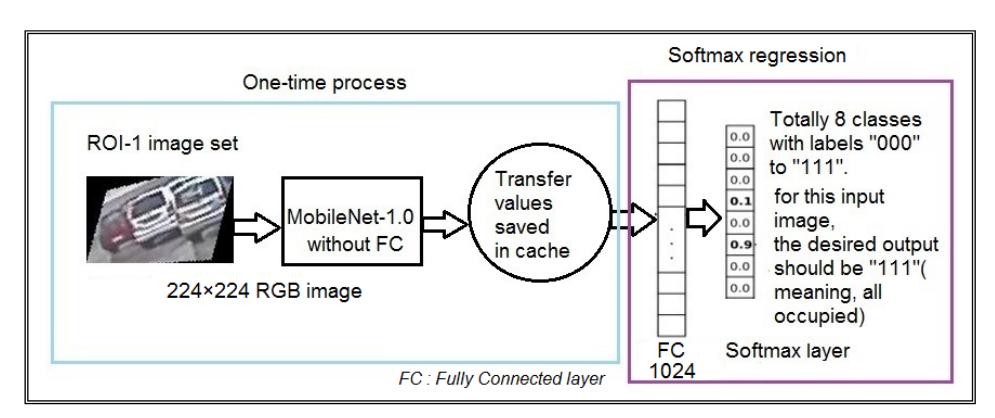
Figure 4 Schematic of transfer learning with MobileNet (using TensorFlow).
The transfer learning process using TensorFlow starts with freezing the initial layers of the base model (MobileNet). When the new image dataset is given to this frozen structure, it outputs 'transfer values' (called 'bottlenecks' in TensorFlow terminology) for each image. These values will be cached in the system memory. This is a one-time process. Transfer values represent the features extracted from new images. The fully connected layer (of the MobileNet) undergoes supervised learning using these transfer values as input and the ground truth label of the new dataset as the desired output. Ten-fold
cross validation [28] was used to construct the training dataset and the testing dataset. Softmax regression with stochastic gradient descent (to minimize cross entropy) was used for training [28,29]. Training was conducted on a 64-bit Windows 7 machine with Intel i5 CPU with 4 GB of RAM. Table 2 summarizes the details of the training.
| Classifier | Labels | Avg. Number of Images per Class | Number of Training Steps | Training Accuracy | |
|---|---|---|---|---|---|
| Classifier 1 (for ROI-1) | 8 labels (000 to 111) | 300 | 500 | 99% | |
| Classifier 2 (for ROI-2) | 4 labels (00 to 11) | 280 | 500 | 99% | |
| Classifier 3 (for ROI-3,4,5) | 2 labels (0 or 1) | 250 | 500 | 99% | |
Table 2 Details of training.
3.6 Cloud Platform
ThingSpeak (https://thingspeak.com) was used for developing the IoT part of the proposed work. This is a MATLAB-owned IoT platform that provides a free evaluation service for small non-commercial projects. The platform gives RESTful (Representational State Transfer) web service with the HTTP (Hypertext Transfer Protocol) POST and GET methods. These methods can be directly implemented using MATLAB commands. The 'posted' data (vacant parking space count) are saved to the owner's channel (Figure 5(a)) in the ThingSpeak cloud.
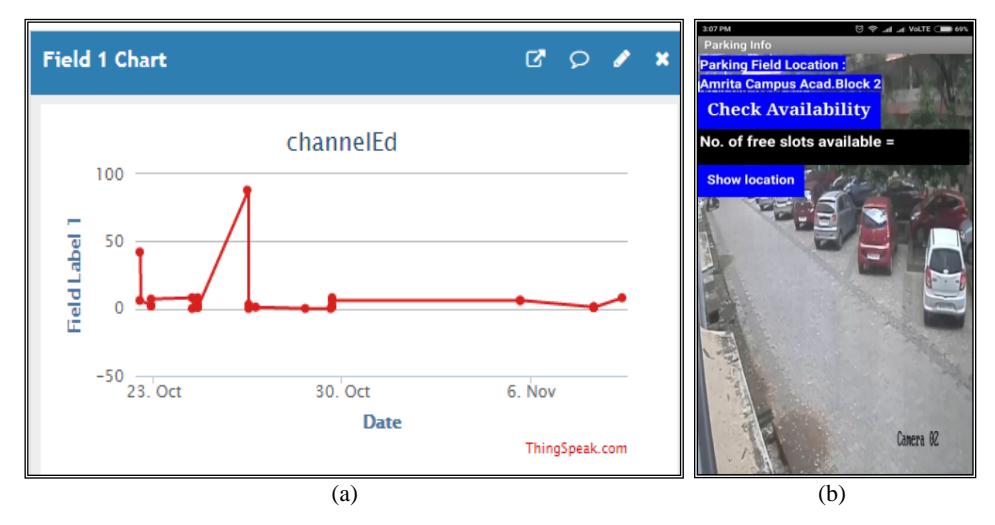
Figure 5 (a) Line graph showing update history to the channel. (b) Android application user interface.
3.7 Android Application
The Android application helps users to enquire the current vacant parking space count and parking field location. MIT's App Inventor was used to develop the application (Figure 5(b)). The below functionalities were implemented:
- 1. Enquiry of vacant parking spaces: an HTTP GET request will be initiated. The response value (the count) from the cloud will be displayed in the application.
- 2. Enquiry of location: an activity will be started for invoking the Google Maps application on the phone. When Google Maps launches, it displays the location of the parking field.
The application was implemented and tested successfully on a Xiaomi Redmi Note 4 smartphone running Android 7.0.
3.8 Sample Workflow
When a new test frame comes in, it will be given to ROI extraction. Then, the classifiers for each of the ROI will be called. It outputs the classes with different Softmax scores. The class with the highest score is taken as the desired output. The output label of each classifier is a string containing 1s and 0s. Outputs from 3 classifiers will be assimilated into an array of size 8 (corresponding to 8 parking spaces). For example, if the input frame is Figure 2(a), the combined output from three classifiers should (ideally) be the string 00000000 and for figure 2(b) it should be 11111111. The number of vacant parking spaces is calculated by counting the number of zeros in this array. This count will be stored in another array. The process will be repeated for 11 upcoming frames and most the repeated number among the eleven counts will be uploaded to the cloud.
4 Performance Evaluation
To test the accuracy of the proposed method, an image repository was created. It contained 100 images corresponding to 9 states of occupancy (0 = all occupied to 8 = all vacant). The images were CCTV frames from multiple days with different levels of illumination. Table 3 summarizes the confusion matrix. Accuracy was estimated at 88%. As transfer learning is essentially a data driven approach, the accuracy can be improved by providing the classifiers with more image samples.
Accuracy = (true positives + true negatives) / Total = 795 / 900 = 88.34%.
Table 3 Confusion matrix.
| Actual number | Predicted number of vacant parking spaces | ||||||||
|---|---|---|---|---|---|---|---|---|---|
| of vacant parkings spaces | 1 | 2 | 3 | 4 | 5 | 6 | 7 | 8 | |
| 0 | 0 92 | 6 | 2 | 0 | 0 | 0 | 0 | 0 | 0 |
| 1 | 5 | 87 | 7 | 1 | 0 | 0 | 0 | 0 | 0 |
| 2 | 0 | 13 | 80 | 7 | 0 | 0 | 0 | 0 | 0 |
| 3 | 0 | 0 | 8 | 83 | 6 | 3 | 0 | 0 | 0 |
| 4 | 0 | 0 | 2 | 10 | 82 | 6 | 0 | 0 | 0 |
| 5 | 0 | 0 | 0 | 3 | 6 | 87 | 4 | 0 | 0 |
| 6 | 0 | 0 | 0 | 0 | 2 | 5 | 93 | 0 | 0 |
| 7 | 0 | 0 | 0 | 0 | 0 | 0 | 9 | 91 | 0 |
| 8 | 0 | 0 | 0 | 0 | 0 | 0 | 0 | 0 | 100 |
5 Conclusions
Although existing methods in the literature have provided satisfactory solutions to vacant parking space detection from surveillance images, its practical implementation is laborious and time-consuming in terms of extracting the right features and training the classifier. This work addressed these issues by using the transfer learning technique. The method automatically extracts suitable features from a new dataset using a pre-trained CNN model in order to train a simple classifier. In this paper, transfer learning was conducted using MobileNet followed by Softmax classification. Problems due to varying illumination conditions, perspective distortion and partial occlusion were addressed by dividing the CCTV frame into different regions. Datasets for each of the regions were created from the recorded CCTV video available in the DVR. Then multiple classifiers were trained for each of the regions. An end-toend application model for parking guidance system with IoT and an Android application was also presented. The accuracy of the proposed method was estimated to be 88%. While the proposed method is suitable for small parking spaces, its generalization for large parking fields needs to be tested.