

1 Introduction
Massive Machine Type Communication (mMTC) can be used to connect a large number of sensors over a wide coverage area [1]. One of the areas where mMTC can be applied is in Wireless Sensor Networks (WSNs). Sensor nodes within the WSN communicate over short distances using a wireless connection and collaborate to perform tasks, such as environmental monitoring, military surveillance, or controlling industrial processes. It is useful when the sensing information can be regularly accessed by users [2]. Sensing information owned by each sensor node can be sent at the same time through the same medium, which can cause collision [3]. When this happens, the sensing information sent by the sensor node cannot be received by the sink node and the sensor node must re-send the sensing information. This causes energy wastage in the WSN. A
Medium Access Control (MAC) protocol is needed to solve this issue by arranging the access of a large number of sensor nodes at the time of data transmission.
Previous research on MAC protocols for MTC has been done in [4-6]. Wang [4] proposed and designed MAC protocol-based contention, i.e., Adaptive Traffic Load Slotted MACA (ATL S-MACA), which is a development of Slotted MACA (S-MACA), which uses an adaptive method and can be used in MTC. Wang adopted the request-to send (RTS), clear-to-send (CTS), and DATAacknowledgement (ACK) procedures from S-MACA, which were modified to adaptively control RTS contention based on a statistical estimation of the traffic load. The basic idea of ALT S-MACA is the observation that S-MACA achieves maximum throughput at some value of traffic load, Gopt, and then drops rapidly. ALT S-MACA increases the occurrence of collision because all nodes are allowed to send RTS packets at the beginning of the slot [7].
Liu [5] proposed and designed a hybrid MAC protocol for MTC, that combines the benefits of protocol-based contention and reservation. In this scheme, each frame is formed from two periods, i.e., the Contention Only Period (COP) and the Transmission Only Period (TOP). The COP is based on the CSMA/CA access method and, in general, is used for devices that are competing for the transmission slot during the TOP. The device wins the competition is allowed to send data as long as it provides communication data of the Time Division Multiple Access (TDMA) type. To reach the optimal trade-off between the contention and transmission period in each frame, Ref. [5] formulated optimization to maximize the throughput during the TOP (which is related to COP duration). Liu's hybrid MAC protocol [5] causes additional delay and requires more energy due to the time needed for the COP and the need for contention [7].
Tarchi, et al. [6] proposed a contention-free MAC protocol based on polling that can be used for MTC-based Orthogonal Frequency Division Multiple Access (OFDMA). The proposed protocol uses a radio cognitive technique and an MTC device that is assumed to be a secondary user. Ref. [6] considers network access based on the framing information broadcast by the base station on resource allocation for the main user (in terms of sub-channels and time slots) in each frame. In the protocol proposed by, Tarchi, et al., MTC devices listen to these broadcasts and use unused resources to communicate between MTC devices. The proposed protocol guarantees the delay and throughput from the MTC device. The token passing strategy is not efficient on MTC devices with unstable traffic [7].
Sefuba, et al. [8] proposed an energy-efficient MAC protocol for cluster-based WSNs based on distance, residual energy, and channel quality to improve the energy and delay performance of WSNs. They used a model for a cluster-based WSN scenario adopted from LEACH. Meanwhile, the proposed MAC protocol is time-slotted and its operations are separated into intra-cluster communication and inter-cluster communication. The proposed protocol uses adaptive intracluster scheduling and intra-cluster relay selection diversity. The sensor node transceiver module in the proposed model transition consists of three states, namely Sleep, Active, and Back off, depending on the schedule. It also has cooperative communication between the cluster and the base station. The cooperation between nodes is decided based on the received SNR. If it is below the threshold, the nodes cooperate to improve network reliability. The network is simulated for one hundred stationary sensor nodes distributed randomly over a two-dimensional 500 × 500 m geographic network area. The interarrival of packets at each node in the network is exponentially distributed, follows a Poisson process, and is independent per sensor node. From a series of simulations, it was seen that there was an increase in performance in terms of energy consumption, channel capacity, throughput, and delay in wireless sensors using this framework.
From the research that has been done, it can be seen that the hybrid MAC protocol can considerably enhance performance compared to the MAC protocol based on reservation or contention. All researchers assumed that nodes must compete to be able to support all traffic; none of them considered a fixed slot to facilitate periodic traffic. Also, all system models used a base station; none used a highaltitude platform system (HAPS).
Therefore, we suggest a MAC protocol for mMTC, especially for WSN-based HAPS. The main contributions of this study are:
- 1. A MAC protocol is proposed for mMTC, especially for WSN-based HAPS. The MAC protocol arranges periodical transmission of Round Robin data (sensing result data), Interrupt data (related to events or occurrences in a particular node sensor), and Query data (requested by the cluster head). The MAC protocol considers the initial slot for transmission of Round Robin data, which is randomized or reserved. The slot for transmission of the next Round Robin data will follow the same pattern as the initial slot for the transmission of Round Robin data.
- 2. The performance of the proposed MAC protocol was evaluated by simulation using Matlab. The performance evaluation indicator used was network efficiency.
2 Overview Massive Machine Type Communication
Massive Machine Type Communication (mMTC) happens between machines that can communicate or compute without human intervention [9]. mMTC connects large numbers of devices, such as smart meters, sensors, or smart grid equipment over a wide coverage area [1]. One of the applications Of mMTC is monitoring and sensing [10,11] modeled by a WSN.
A WSN is a smart network application systems that collects, integrates, and transmits data autonomously [12]. Sensor nodes within a WSN are usually scattered over the coverage area. Each sensor node that is scattered has the potential to collect data and route data to the sink node (base station). The sink node collects data from the sensor nodes to be forwarded to the user via the Internet or satellites. The sink node was replaced by an HAP station in this research.
The main obstacle in the usage of WSNs is the limited power that is owned by each sensor node. One of the solutions to resolve this is by using clustering, which has been done by us in a previous research [13].
3 Model System
The model system that we use here refers to our previous research [13]. In [13], the WSN system consists of 250,000 sensor nodes, using an HAP station as the sink node. The HAP station is located at an altitude of 20 km from the ground's surface and has a coverage diameter of 63 km. The WSN system proposed in [13] uses clustering to overcome the limited power in the sensor nodes by considering the HAP station's movement, whether vertical, horizontal, or inclination. From the result of our previous research, the 250,000 sensor nodes formed eleven clusters by considering the vertical, horizontal, and inclination movements of the HAP station [13], as shown in Figure 1-(a).
In Figure 1, the x symbol represents the CH node. In the WSN system-based HAP station, the sensor nodes send the result of sensing information that belongs to the individual CH nodes, as can be seen in Figure 1-(b). The CH node is responsible for collecting the sensing information from all sensor nodes that are in the cluster and afterward, the CH node will forward the information to the HAP station. To overcome interference in the uplink, the information transmission from the CH to the HAP station is arranged by Power Domain Non-Orthogonal Multiple Access (PD NOMA) based on deep learning.
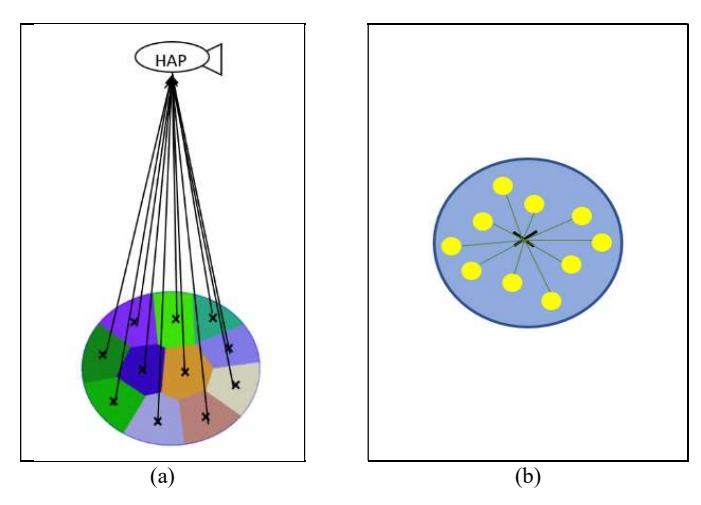
Figure 1 Model system of WSN-based HAP station: (a) 11 CHs are connected to the HAP station; (b) intracluster presentation.
Inside one intracluster, there are 23,000 sensor nodes that send information to the CH node. The information that is sent by each sensor node includes information from the sensing result, events in that specific sensor node, and information that is requested by the CH node. All the information can be sent by the sensor nodes at the same time through the same medium, so collision can occur. If this happens, the sensor node must resend the sensing information. This causes energy wastage in the WSN. Therefore, information transmission from each sensor node to the CH node is arranged by the proposed MAC protocol in order to avoid collision.
4 Proposed MAC Protocol
A MAC protocol is proposed to control the shared use of a WSN intracluster medium and prevent collision. In the WSN intracluster, the behavior of the sensor node is modeled by a Markov model, as shown in Figure 2. Every sensor node can be in four different states: Off, Round Robin, Interrupt, and Query. A sensor node is in the Off state (S1) if the sensor node has no data to send. A sensor node is in the Round Robin (S2) state if the sensor node has sensing data that must be sent to the CH node. A sensor node is in the Interrupt (S3) state if there is information regarding events the sensor node that must be sent to the CH node. A sensor node is in the Query state if data is requested by the CH node.
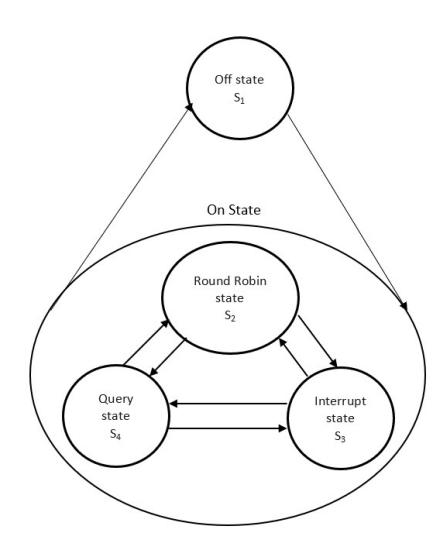
Figure 2 Node's state transition diagram.
The transition probability matrix P for the sensor node state behavior is as in Eq. (1):
\[P = \begin{pmatrix} P_{S_{I}S_{I}} & P_{S_{I}S_{2}} & P_{S_{I}S_{3}} & P_{S_{I}S_{4}} \\ P_{S_{2}S_{I}} & P_{S_{2}S_{2}} & P_{S_{2}S_{3}} & P_{S_{2}S_{4}} \\ P_{S_{3}S_{I}} & P_{S_{3}S_{2}} & P_{S_{3}S_{3}} & P_{S_{3}S_{4}} \\ P_{S_{4}S_{I}} & P_{S_{4}S_{2}} & P_{S_{4}S_{3}} & P_{S_{4}S_{4}} \end{pmatrix}\] \[(1)\]
The transition probability is determined by the transition events. \(P_{S_IS_I}\) is the probability when the sensor node is in the Off state. The sensor node will be in the Off state within a certain time interval. \(P_{S_IS_I}\) is expressed by Eq.(2):
\[P_{S_1S_1} = 1 - \frac{1}{\mu_{S_1}} \tag{2}\]
\(\frac{I}{\mu_{S_I}}\) is the time that is needed for a node to go to the Off state. The sensor node will go to the Round Robin state with probability \(P_{S_IS_2}\) when the sensor node has sensing data that must be sent to the CH. \(P_{S_IS_2}\) is expressed by the Eq. (3)
\[P_{S_1S_2} = \frac{1}{\mu_{S_1}} \cdot P_{RR}\] \[P_{S_IS_2} = \frac{1}{\mu_{S_I}} \cdot (I - P_I - P_Q)\] (3)
\(P_{RR}\) is the probability of a Round Robin data, \(P_I\) is the probability of an Interrupt data, \(P_Q\) is the probability of a Query data. The sensor node goes from the Off state to the Interrupt state with probability \(P_{S_IS_3}\) if the sensor node has information about events in its node. \(P_{S_IS_3}\) can be found using Eq. (4):
\[P_{S_I S_3} = \frac{l}{\mu_{S_I}} \cdot P_I \tag{4}\]
The sensor node will go from the Off state to the Query \(P_{S_1S_4}\) state if the sensor node has data requested by the CH node. \(P_{S_1S_4}\) can be found using Eq. (5):
\[P_{S_1 S_4} = \frac{1}{\mu_{S_1}} \cdot P_Q \tag{5}\]
The sensor node will exit the Round Robin state only if the sensor node has completed transmitting its sensing data, so the probabilities of \(P_{S_2S_3}\) and \(P_{S_2S_4}\) are defined as zero.
\[P_{S_2S_2} = P_{S_2S_4} = 0\]
If the sensor node still has sensing data that must be sent, then the sensor node remains in the Round Robin state with probability \(P_{S_2S_2}\). \(P_{S_2S_2}\) can be found using Eq. (6):
\[P_{S_2S_2} = I - \frac{I}{\mu_{S_2}} \tag{6}\]
\(\frac{I}{\mu_{S_2}}\) is the time it takes the node to go to the Round Robin state. The sensor node will go from the Round Robin state to the Off state when its sensing data transmission has been completed with probability \(P_{S_2S_I}\). \(P_{S_2S_I}\) can be found using Eq. (7):
\[P_{S_2S_I} = \frac{I}{\mu_{S_2}} \tag{7}\]
The sensor node will exit the Interrupt state only when the specific sensor node has completed transmitting its event information so that probability \(P_{S_3S_2}\) is equal to \(P_{S_3S_4}\) and is defined as zero.
\[P_{S_3S_2} = P_{S_3S_4} = 0\]
If the sensor node still has event information from the sensor node that must be sent, the sensor node remains in the Interrupt state with probability \(P_{S_3S_3}\). \(P_{S_3S_3}\) can be found using Eq. (8):
\[P_{S_3S_3} = I - \frac{I}{\mu_{S_3}} \tag{8}\]
\(\frac{1}{\mu_{S_3}}\) is the time needed for the node to go to the Interrupt state.
The sensor node will go from the Interrupt state to the Off state when the information transmission event from that specific sensor node is completed with probability \(P_{S_3S_1}\). \(P_{S_3S_4}\) can be found by using Eq. (9):
\[P_{S_3S_I} = \frac{I}{\mu_{S_2}} \tag{9}\]
The sensor node will exit the Query state only when the sensor node has completed the data transmission requested by CH is complete, so probabilities \(P_{S_4S_2}\) and \(P_{S_4S_3}\) are defined as zero.
\[P_{S_4S_2} = P_{S_4S_3} = 0\]
If the sensor node still has data that is requested by CH that has to be sent, then the specific sensor node will be in the Query state with probability \(P_{S_4S_4}\). \(P_{S_4S_4}\) can be found by using Eq. (10):
\[P_{S_4S_4} = I - \frac{I}{\mu_{S_4}} \tag{10}\]
\(\frac{I}{\mu_{S_4}}\) is the time that is needed for a node to go to the Query state. The sensor node will go from the Query state to the Off state when the data transmission requested by the CH node has been completed with probability \(P_{S_4S_I}\). \(P_{S_4S_I}\) can be found using Eq.(11):
\[P_{S_4S_1} = \frac{1}{\mu_{S_4}} \tag{11}\]
In the proposed MAC protocol, the initial slot for transmission of Round Robin data is randomized or reserved. Interrupt and Query data transmission can be done at any time if there is Interrupt and Query data that must be sent. A flowchart of the proposed MAC protocol can be seen in Figure 3.
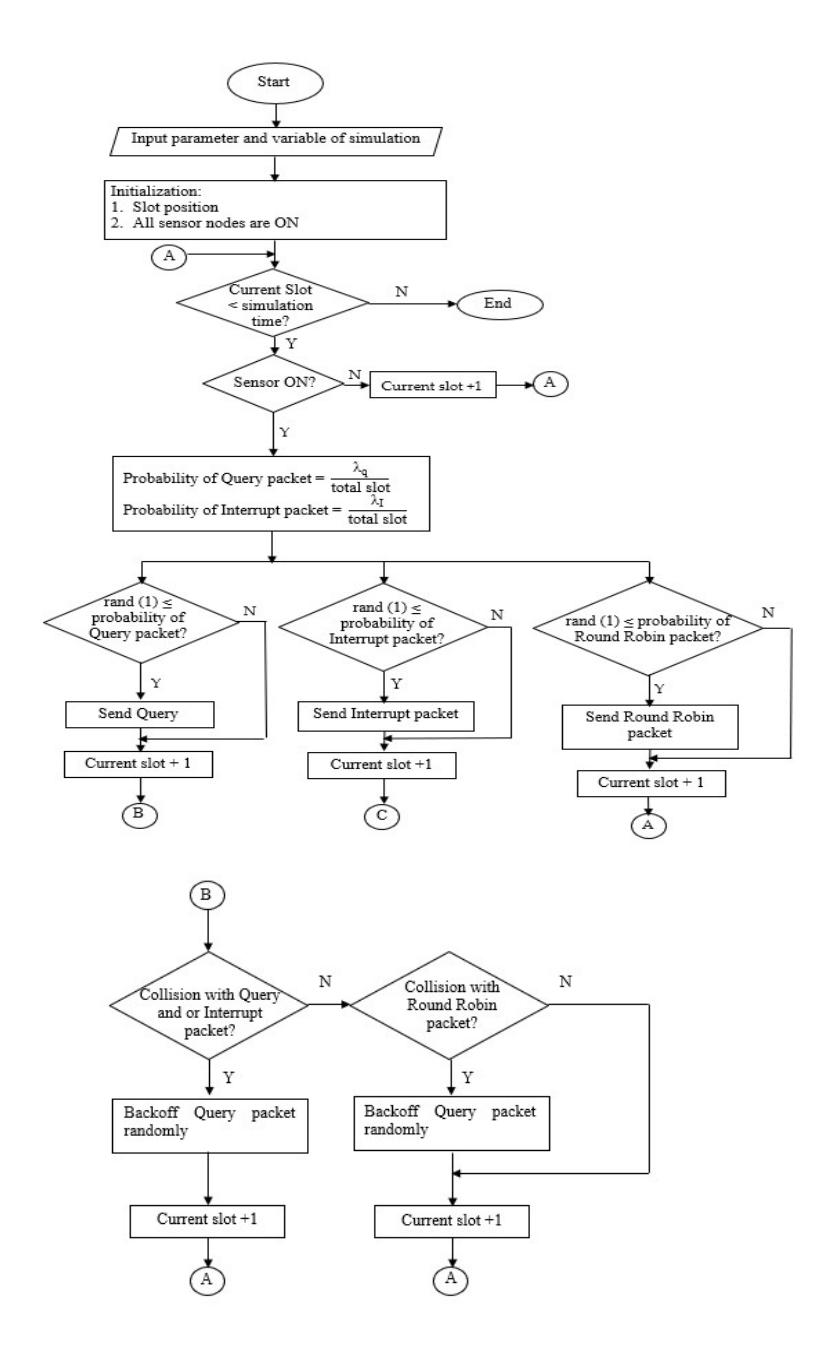
Figure 3 Flowchart of the proposed MAC protocol.
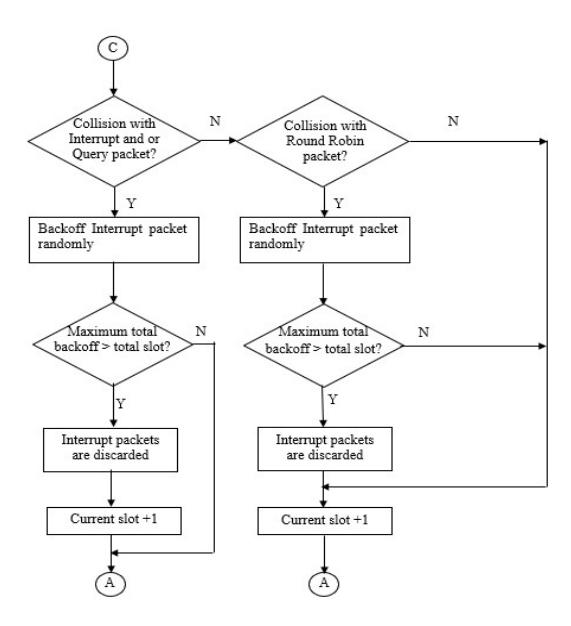
Figure 3 Continued. Flowchart of the proposed MAC protocol.
5 Performance Measures
The performance indicator used for evaluation used the proposed MAC protocol was network efficiency. Network efficiency is gained by using Eq. (12):
Network efficiency= \[\frac{network throughput}{bit rate} \times 100\%\]
Throughput is the number of successfully sent data per unit time (bps).
6 Performance Analysis
We analyzed the proposed MAC protocol by simulation using Matlab. Simulation was done for intensive Round Robin data transmission every eight hours, with an observing time of one day, for both randomized and reserved slots. Interrupt and Query data can be sent at any time if Interrupt and Query data has to be sent. The simulation parameter for the proposed MAC protocol can be seen in Table 1.
The simulation results for the proposed MAC protocol with Round Robin data that are sent every eight hours in one-day observation with a random initial slot for transmission can be seen in Figure 4. It can be seen that the arrival rate of interrupt data = 1 arrival/8 hours, giving network efficiency that is more optimal compared to the arrival rate of Interrupt data = 3 or 5 arrivals/8 hours.
| Item | Value |
|---|---|
| Link capacity | 30 kbps |
| Round Robin data size | 208 bit |
| Interrupt data size | 2080 bit |
| Query data size | 2080 bit |
| PON | 1 |
| Probability of Round Robin data that is ready to be sent (𝑃்) | 1 |
| Round Robin data transmission | every 8 hours |
| Interrupt data arrival rate | 1, 3, and 5 arrival/periods |
Table 1 Simulation parameters.
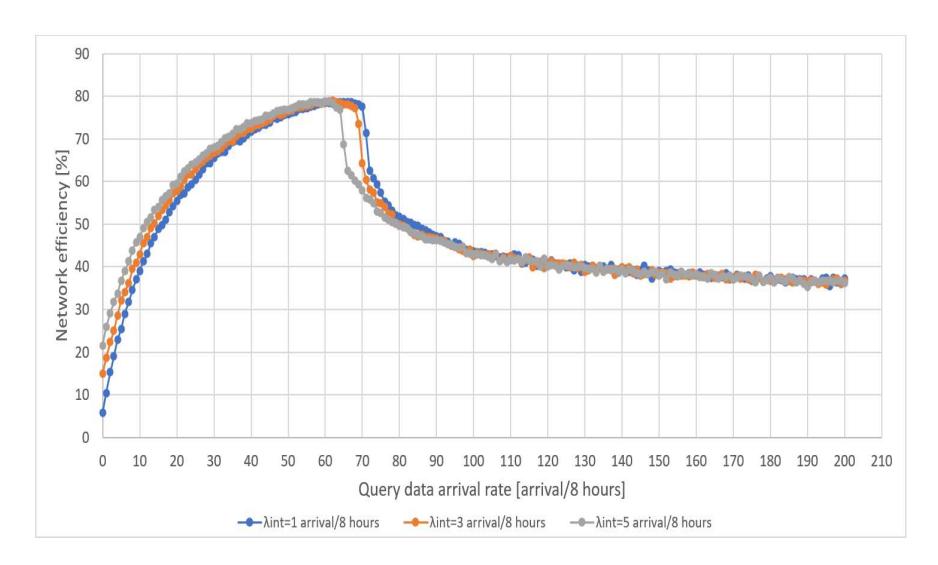
Figure 4 Network efficiency from proposed MAC protocol with Round Robin data that is transmitted every 8 hours, initial transmission of randomized Round Robin data.
When the arrival rate of interrupt data = 1 arrival/8 hours, the query data rate = 69 arrivals/8 hours and gives optimal network efficiency, i.e., 78.91%. When the query data rate = 69 arrivals/8 hours and the arrival rate of interrupt data = 1 arrival/8 hours, the effect of the number of nodes on efficiency is obtained, as shown in Figure 5.
It can be seen that the number of sensor nodes that are suitable for intensive monitoring (every 8 hours in one-day observation) with a randomized initial slot for transmission of Round Robin data was from 1,000 to 55,000 sensor nodes. Because of the specific range, network efficiency was above 1%. As can be seen in Figure 5, the number of sensor nodes resulting in optimal network efficiency was 23,000.
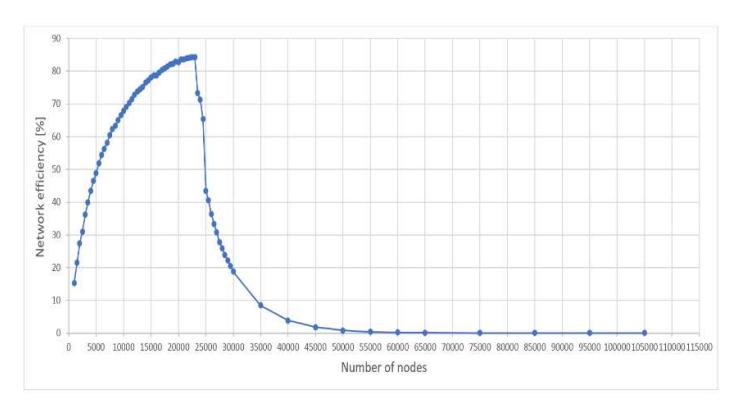
Figure 5 The effect of the number of nodes on the network efficiency of the proposed MAC protocol with Round Robin data sent every 8 hours and a randomized initial slot for transmission of Round Robin data.
The simulation results for the proposed MAC protocol with Round Robin data that are sent every 8 hours in one-day observation with a reserved initial slot for transmission can be seen in Figure 6.
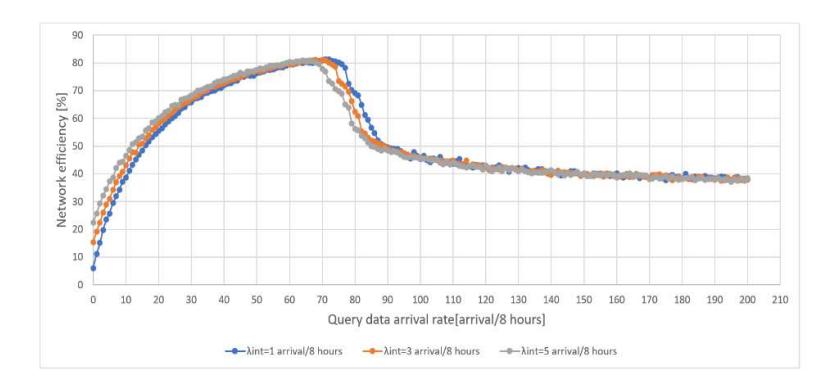
Figure 6 Network efficiency from proposed MAC protocol with Round Robin data transmitted every 8 hours, initial transmission of reserved Round Robin data.
In Figure 6, it can be seen that the arrival rate of Interrupt data = 1 arrival/8 hours, giving a network efficiency that is more optimal compared to the arrival rate of Interrupt data = 3 or 5 arrivals/8 hours. When the arrival rate of interrupt data = 1 arrival/8 hours, the Query data rate = 71 arrivals/8 hours, giving optimal network efficiency, i.e., 81.38%. And when the Query data rate = 71 arrivals/8
hours and the Interrupt arrival rate = 1 arrival/8 hours, the effect of the number of nodes on efficiency is obtained, as shown in Figure 7.
Figure 7 The effect of the number of nodes on the network efficiency of the proposed MAC protocol with Round Robin data sent every 8 hours and a reserved initial slot for transmission of Round Robin data.
In Figure 7, it can be seen that the number of sensor nodes that is suitable for intensive monitoring (every 8 hours in one-day observation), with a reserved initial slot for transmission of Round Robin data, is from 1,000 to 45,000 sensor nodes. Because of the specific range, network efficiency is above 1%. As can be seen in Figure 7, the number of sensor nodes resulting in optimal network efficiency is 23,000.
From Figures 4 and 6, it can be seen that the MAC protocol with a reserved initial slot for transmission of Round Robin data gives a network efficiency that is considerably greater than for a randomized slot. This is because the Round Robin data occupies a definite slot.
When compared with [8], the data sent from the sensor nodes to the CH node is only data from sensing and the time between packet arrivals is a Poisson process. Meanwhile, in this study, it can be seen in Figures 4 and 6 that the data sent from the sensor nodes to the CH node is data from sensing (Round Robin data) as well as data that contains information about events in the sensor node (Interrupt) and data requested by the CH node (Query). In addition, Figures 4 and 6 show that the time between arrivals of Interrupt and Query data in this study is a Poisson
process, while the time between arrivals of Round Robin data sent every 8 hours is a deterministic process.
Ref. [8] only evaluated 100 sensor nodes, while in this study, evaluation was carried out for 23,000 sensor nodes. Also, Ref. [8] did not evaluate the range of sensor node numbers that is suitable for monitoring. Ref. [8] evaluated energy consumption, channel capacity, throughput, and delay because its goal was to produce an energy-efficient MAC protocol. Meanwhile, in this study, the aim was to produce a MAC protocol that can support a large number of nodes by considering optimal network efficiency.
7 Conclusion
A MAC protocol was proposed that can support a WSN system-based HAP station for monitoring every eight hours. From the analysis, it can be seen that the proposed MAC protocol with a reserved initial slot for sending Round Robin data has greater network efficiency than a random initial slot for sending Round Robin data. The proposed MAC protocol can support a large number of nodes, namely 55,000 sensor nodes for monitoring every eight hours.