

1 Introduction
A substantial growth in the demand for reliable and high-speed data connectivity over wireless communication channels has led to considerable attention for the utilization of effective modulation and multiplexing techniques to enhance the performance of the system, including by improving spectral and bandwidth efficiencies, network capacity, and quality of service. In this matter, higher-order modulation techniques, such as M-ary phase shift keying (PSK), have been
Received June 29th, 2023, 1st Revision January 7th, 2024, 2nd Revision March 27th, 2024, Accepted for publication April 24th, 2024.
Copyright © 2024 Published by IRCS-ITB, ISSN: 2337-5787, DOI: 10.5614/itbj.ict.res.appl.2023.18.1.3
widely implemented over basic modulation, i.e., BPSK. To enlarge the dimensionality of the M-ary PSK signal, it can be repeated N times at various frequencies within the NB bandwidth. Moreover, by increasing the number of modulation orders (M) employed, this modulation technique can achieve a higher data transmission rate and spectral efficiency with the same bandwidth and power as basic modulation. M-ary modulation, on the other hand, is susceptible to the phase noise caused by the phase difference of each unique code [1]. This effect could lead to performance degradation of the wireless communication system, where noise and fading effects cannot be neglected.
Orthogonal frequency division multiplexing (OFDM), well-known as a multicarrier modulation technique, has been adopted in high data rate wireless communication applications due to its robust performance under multipath fading channels [2-4]. Moreover, in comparison with single carrier modulation, this modulation can achieve high modulation performance, i.e., spectral efficiency, which allows the transmission of more data within a given bandwidth, due to the implementation of an efficient computational algorithm using fast Fourier transform and its inverse (FFT/IFFT) [5]. Despite having these advantages, this multicarrier modulation technique suffers from poor power efficiency, as FFT computation and forward error correction (which is employed to obtain error control in data transmission) are supposed to be active continuously [6]. In addition, it is also sensitive to phase noise and frequency offset errors, which can lead to degradation of the signal quality due to inter-carrier interference [7-8].
Performance evaluation of orthogonal wavelet division multiplexing (OWDM), also known as wavelet packet modulation, is presented and discussed in this paper. This is an expansion of earlier works that have been reported in [9-10]. Generally, wavelets can be considered as finite waves in the time and frequency domains, where the dissolution and translation results have orthogonality that is independent of the phase. Due to their flexibility, orthogonality, and bandwidth efficiency, wavelets have been widely utilized in wireless communication systems [11-13]. The functions derived from this structure, called basic wavelet packets, reflect the decomposition at a constant level. As decomposition symbols of the wavelets overlap each other in the time and frequency domains, the requirement of a cyclic prefix can be neglected. Moreover, unlike the OFDM system, here, a wavelet function is adopted as the orthogonal signal source and developed using uniform filter banks for analysis and decomposition processes. With the involvement of a fractal wavelet packet transform in the M-ary PSK system, it was expected that the dimensionality of the higher-order modulation signal could be improved, thereby achieving higher spectral efficiency.
Zhang, et al. [14] have shown that wavelet packets are promising candidates for user signature waveforms in code division multiple access communication
systems due to their good orthogonality property. They proposed that in conventional multicarrier COMA systems, the multi-channel signals are modulated on subcarriers of sinusoid waveforms, using FFT to achieve fast computation. To combat the multipath channel effect, a guard interval is inserted between consecutive data symbols. On the other hand, wavelet packet waveforms have the property of localization in both the time and frequency domains. This property enables the time domain diversity of the multicarrier signal so that the need for guard intervals is eliminated by time domain diversity combining (TDDC). Comar and Frazier [15] explored a communications system that uses a combination of wavelet packet modulation (WPM) and Alamouti coding. In this system, positive and negative pass mirror filters as well as high and low pass mirror filters are used. They applied Alamouti coding across consecutive time symbols as well as across symbols in frequency adjacent subcarriers. Mirror filtering provides opportunities for spectral shaping, transmitting around existing signals, and physical layer security. Alamouti coding provides the opportunity for more robust communication.
2 Overview of System Model
It is well known that a wavelet packet is an alternative way to combine sine and cosine waves. In comparison with the OFDM system, by exploiting a wavelet packet, a signal can be decomposed into two mutually orthogonal signals and so on, where the orthogonality is not restricted by the phase changes. Therefore, the performance of the system over additive white Gaussian noise as well as multipath propagation channels can be improved with low distortion and high transmission efficiency. The proposed system model of M-ary PSK with fractal wavelet packet transform is depicted in Figure 1. On the transmitter side, it consists of a M-ary PSK modulator for signal translation, a serial-to-parallel (S/P) converter that provides N-bit parallel outputs, and an inverse discrete wavelet packet transform (IDWPT), which utilizes a synthesis filter bank structure. Meanwhile, other subsystems that possess the opposite working principle are arranged on the receiver side, including a M-ary PSK demodulator, a parallel-toserial (P/S) converter, and a discrete wavelet packet transform (DWPT), which employs analysis filter bank structure. Here, the decomposition and reconstruction levels of the synthesis and analysis filter structures are controlled in order to improve the transmission efficiency. In addition, with the presence of equalization on the receiver, the multipath propagation effect from the fading channel can be reduced. The equalization technique applied in this work is an adaptive filter that provides the inverse of the autocorrelation function of the system.
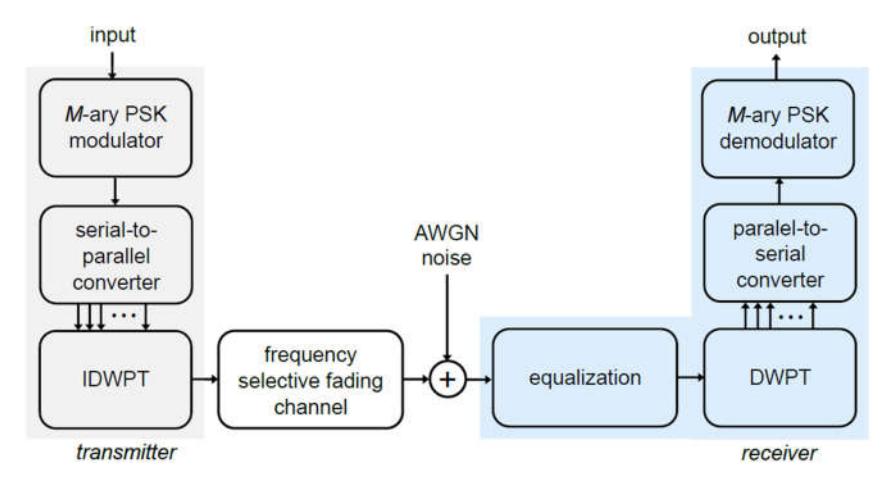
Figure 1 System model of M-ary PSK with fractal wavelet packet transform over AWGN and fading channels.
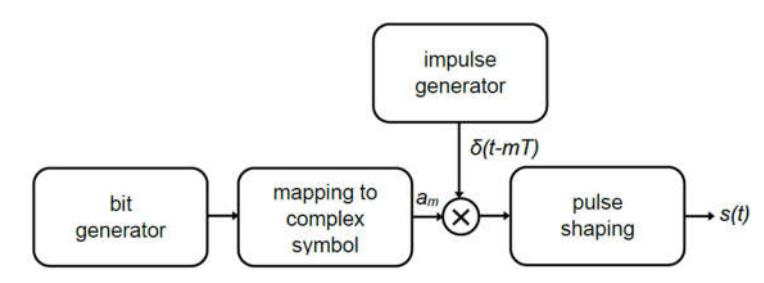
Figure 2 Representation of M-ary PSK system as equivalent lowpass model.
In this work, as carrier and symbol synchronization are assumed ideal. Thus, the signal of M-ary PSK can be represented as the equivalent lowpass model illustrated in Figure 2. In this equivalent model, a pulse shaping filter is involved aiming to reduce the transmission bandwidth and control inter-symbol interference. The output signal of s(t) in lowpass form is given in Eq. (1), where am is a sequence of discrete symbols, u(t) is pulse shaping as a unit step function, and T is the sampling period. A finite set orthogonal subspace can be generated as represented in Eq. (2) on the assumption that ( − ) is the scaling function of wavelet packet Wn. Moreover, by substituting () = √22 − in Eq. (2), a new signal is produced as formulated in Eq. (3). It should be noted that Eq. (3) is also supposed to be exposed at the receiver side before the M-ary PSK demodulator, thus a synthesis unit at the transmitter end is required.
\[s(t) = \sum_{m=-\infty}^{\infty} a_m u(t - mT)\] (1)
\[W_{2l}^0 = \bigoplus_{(l,n)} W_{2l}^n \tag{2}\]
\[s(t) = \sum_{m} \sum_{l,n} a_m \sqrt{2^l} W_n (2^l t - m)\] (3)
\[s_{l+1}^n = \sum_{k \in \mathbb{Z}} h_{i-2k} s_l^{2n}(k) + \sum_{k \in \mathbb{Z}} g_{i-2k} s_l^{2n+1}(k)\] (4)
\[s_1^{2n} = \sum_{k \in \mathbb{Z}} h_{k-2i} s_{l+1}^n(k) \tag{5}\]
\[s_1^{2n+1} = \sum_{k \in \mathbb{Z}} g_{k-2i} s_{l+1}^n(k) \tag{6}\]
In addition, the synthesis process, or reconstruction process, is carried out in the IDWPT subsystem. In the process, for one synthesis level, the signals at two nodes are passed through the given filters with an impulse response of h(n) and g(n), respectively, and form a single node. The output signal of this node can be written as Eq. (4). Otherwise, the analysis process or, conversely, the decomposition process takes place in the DWPT subsystem. Here, the single node input signal from the equalization unit is transmitted to the analysis filter banks, which have an impulse response of h(-n) and g(-n) to construct two nodes. The output signal at each node is represented as Eqs. (5) and (6). If the output of the IDWPT and DWPT processes is represented as a vector matrix of \(\mathbf{W}\) and \(\mathbf{W}^{-1}\), respectively, then it involves a product of vector matrices that produces the identity matrix of \(\mathbf{I} = \mathbf{W} \cdot \mathbf{W}^{-1}\) at the receiver end, so that the received signal of M-ary PSK can be recovered.
3 Performance Evaluation Results and Discussion
It has been shown that MC-CDMA using wavelet packets has better performance than DFT-based MC-CDMA [14]. The performance reached a bit error rate (BER) of \(10^{-2}\) at \(E_b/N_o\) of 20 dB. Better performance has also been shown by Comar and Frazier [15], where the performance using Alamouti coding was even better than in previous experiments with other codings.
In this work, the proposed fractal wavelet packet transform on the M-ary PSK OWDM system was characterized and evaluated over a multipath fading channel, i.e., a frequency selective fading channel with Rayleigh distribution, in the presence of AWGN noise. Before further discussing the performance results of the proposed system, it is worth demonstrating the orthogonality of M-ary PSK signals, such as QPSK, 16-PSK, and 32-PSK, in response to the cross-correlation function expressed in Eq. (7), where \(s_i(t)\) and \(s_j(t)\) are the i-th and j-th M-ary PSK symbols, respectively. If each signal is orthogonal to each other, then cross-correlation becomes null, while on the other hand when \(s_i(t)\) and \(s_j(t)\) are equal, cross-correlation with a finite value will be obtained.
\[E\left|s_{i}(t)s_{i}(t-\tau_{s})\right| \qquad \forall i,j \tag{7}\]
The cross-correlation result of the M-ary PSK system at the transmitter for the bit rate of 1 Mbps is depicted in Figure 3. It is demonstrated that the null area, which has a cross-correlation value of zero, will shrink as the modulation order rises. This effect indicates that the signal's orthogonality has decreased. In fact, this is an inevitable issue when a higher order modulation technique is applied in the system. In comparison with QPSK and 16-PSK, the 32-PSK system provides a smaller phase difference, which then causes the system to be more sensitive to phase errors and worsens the performance of the system. Thisis also corroborated by the signal constellation at the receiver side after the signal has been processed by the equalization subsystem for Eb/N0 at 10 dB.
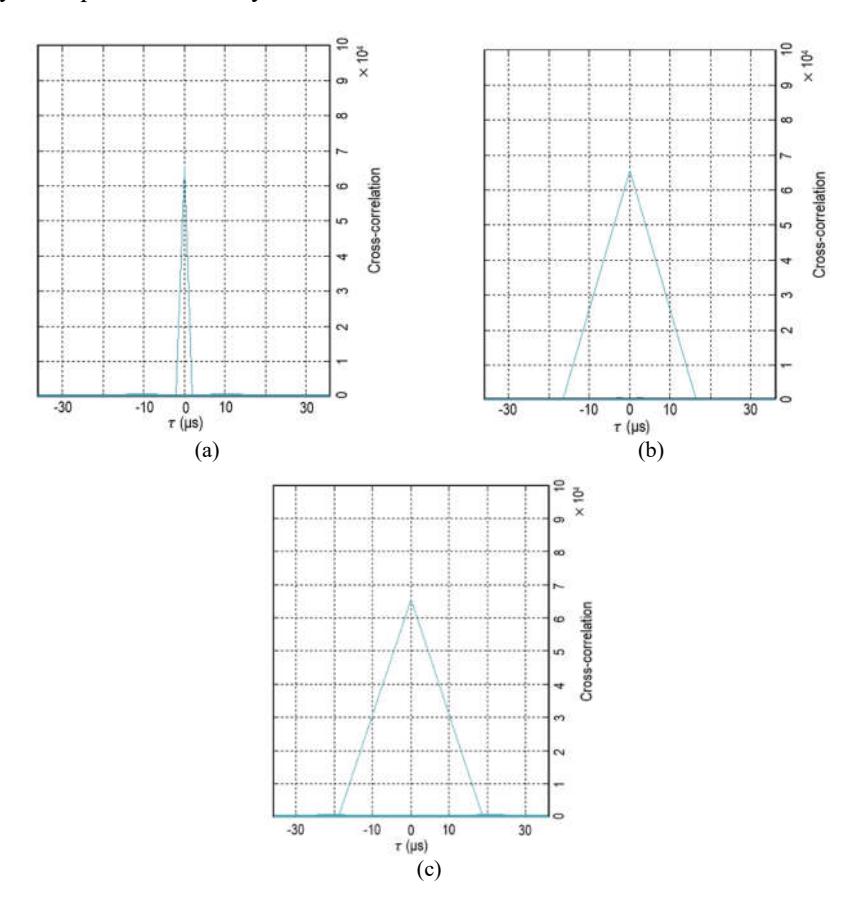
Figure 3 Cross-correlation result: (a) QPSK, (b) 16-PSK, (c) 32-PSK.
As given in Figure 4, before equalization, M-ary PSK symbols tend to be concentrated in a single constellation point, where in this case the symbol error
probability is equally likely. Meanwhile, after equalization has been performed, each symbol of the received M-ary signal, for instance, QPSK, is recovered to its initial constellation points. However, it becomes more challenging when the modulation order increases in value, i.e., 32-PSK.
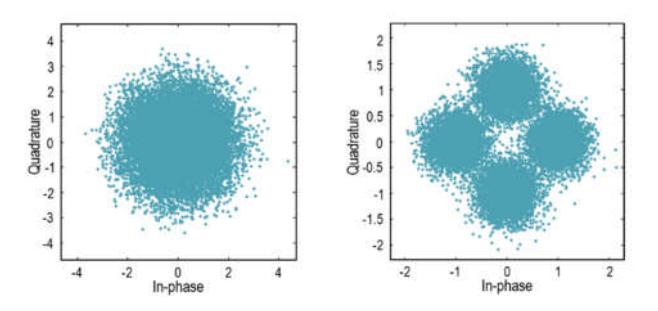
Figure 4 Constellation of QPSK signal at the receiver before (left) and after (right) the equalization process.
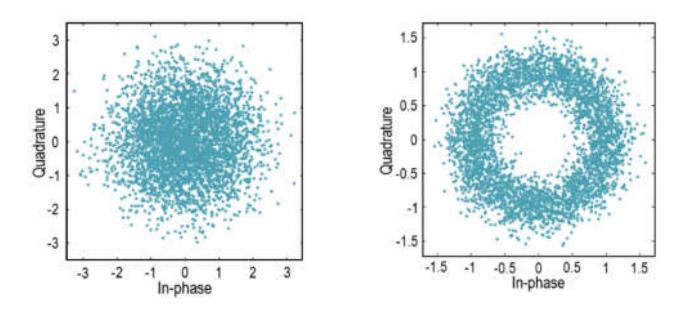
Figure 5 Constellation of 16-PSK signal at the receiver before (left) and after (right) the equalization process.
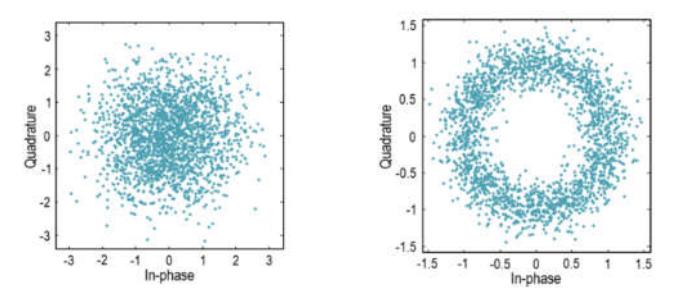
Figure 6 Constellation of 32-PSK signal at the receiver before (left) and after (right) the equalization process.
Figures 7 and 8 depict the bit error rate results of the proposed QPSK OWDM in comparison with higher order modulation, such as 32-PSK, and QPSK OFDM with different numbers of subcarriers. The BER AWGN channel is the limit of the theoretical BER that can be obtained for digital modulation in the AWGN channel. Both QPSK with adopted OWDM and OFDM systems configured with 16 subcarriers possesses a dimensionality of 21+4, so that the maximum bit efficiency of the modulation systems is 5 bits/Hz, or the same asthe bit efficiency for a 32-PSK system.
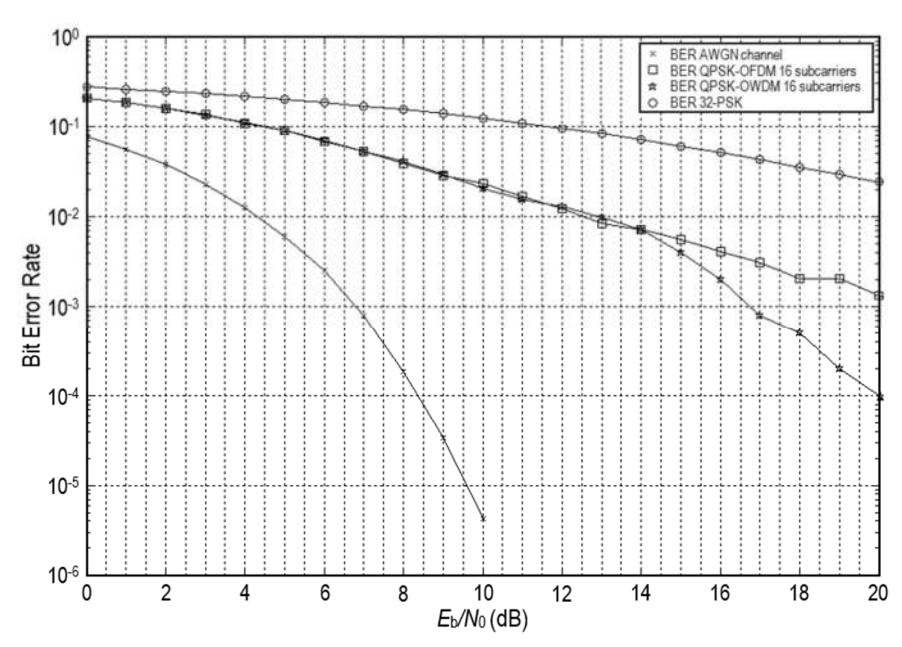
Figure 7 Bit error rate performance of QPSK OWDM with 16 subcarriers in comparison with QPSK OFDM and 32-PSK.
The simulation result plotted in Figure 7 shows that the utilization of the fractal wavelet packet transform on the QPSK system provides a comparable performance with the QPSK OFDM system for Eb/N0 below 14 dB, and progressively improves its performance with a BER value of 1 × 10⁻⁴ when Eb/N0 reaches 20 dB. This performance is significantly better than that for 32-PSK which has equal bit efficiency to QPSK OWDM. From the simulation result, 32- PSK could only achieve a BER of 2.5 × 10⁻³ for Eb/N0 at 20 dB. Moreover, when 64 subcarriers are applied, as shown in Figure 8, there is a minor difference in system performance between QPSK OWDM and QPSK OFDM. However, for Eb/N0 of 20 dB, the proposed QPSK OWDM system outperforms the QPSK OFDM with a BER of 1 × 10⁻⁴ and 1.5 × 10⁻³ , respectively. Regarding the number of basic functions, QPSK OWDM and QPSK OFDM with 64 subcarriers have a dimensionality of 21+6, where the maximum bit efficiency is 7 bits/Hz. This bit efficiency is still higher than that of the 32-PSK system at 5 bits/Hz, or the same efficiency as the 128-PSK system. The performance of the QPSK OWDM system with 64 subcarriers is much better than the performance of the 32-PSK system, and obviously, 128-PSK that is worse than 32-PSK.
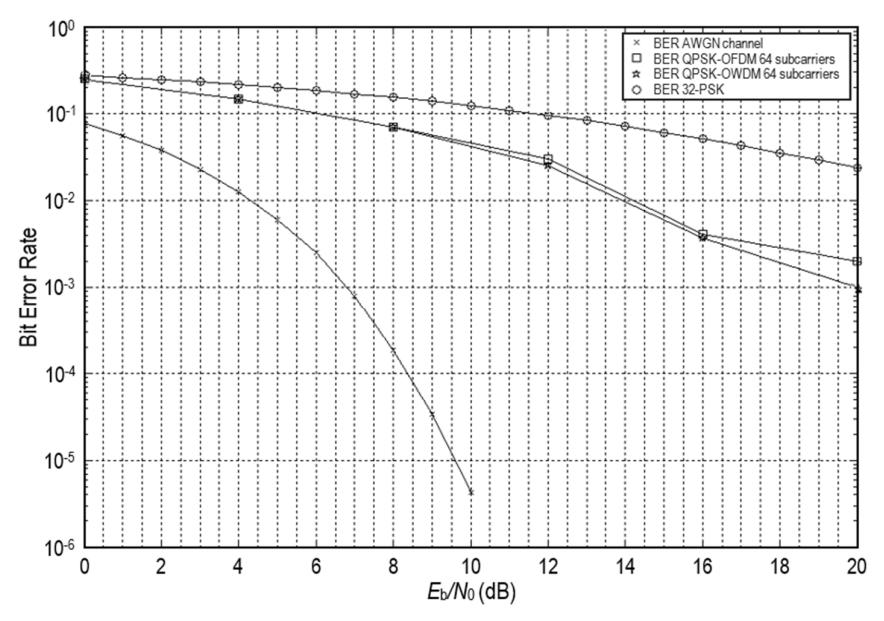
Figure 8 Bit error rate performance of QPSK OWDM with 64 subcarriers in comparison with QPSK OFDM and 32-PSK.
Furthermore, the auto-correlation of the proposed fractal wavelet modulation with 16 subcarriers at the receiver is given in Figure 9. It resembles the crosscorrelation function of the QPSK signal at the transmitter side, as shown in Figure 3(a), but with different maximum amplitude, first null point, and slope gradient. As both signals seem to correspond to each other, it can be inferred that the proposed M-ary PSK incorporated wavelet packet modulation with 16 subcarriers could achieve satisfactory performance of modulation. In addition, the power spectral density, which is equal to the Fourier transform of the auto-correlation function, is inversely proportional to (1/f) 2 , so the output spectrum will be a finite spectral wave.
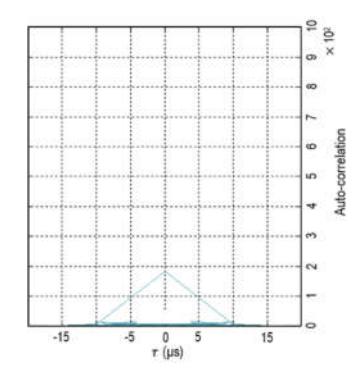
Figure 9 Auto-correlation result of QPSK OWDM with 16 subcarriers.
The normalized spectral density plotted in Figure 10 shows that the QPSK OWDM signal provides a lower bandwidth than the QPSK signal due to its lower gradient, which indicates that the proposed wavelet packet modulation could achieve better utilization of bandwidth compared with the basic modulation. Moreover, if the data rate is set to 1 Mbps, then the maximum bandwidth obtained is 105 Hz. According to the performance result where the lowpass transmission bandwidth is 0.5 × 10⁵ Hz, thus the proposed QPSK OWDM with 16 subcarriers has a transmission bandwidth of 105 Hz.
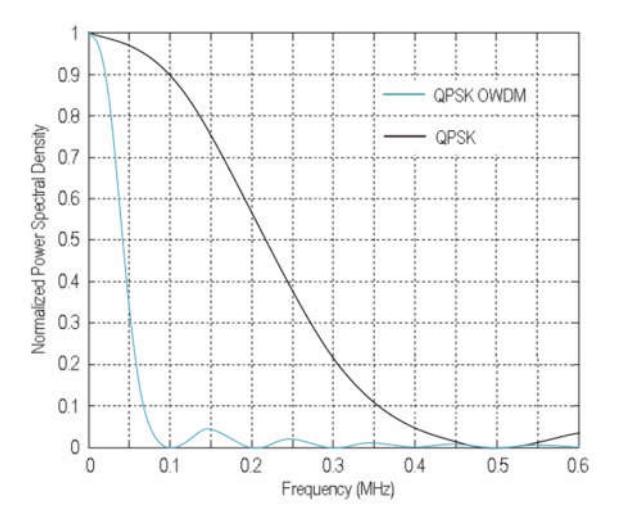
Figure 10 Power spectral density of QPSK OWDM with 16 subcarriers in comparison with QPSK.
Several studies about the comparison between OFDM and OWDM have been conducted for years, such as by Daoud, et al. [16]. However, the implementation of the system may have several problems such as the inter-symbol interference for the MIMO systems, because of which OWDM has been eclipsed by OFDM. For example, Shoukath and Fariz [17] have analyzed the MIMO system for OFDM, which shows the ability of OFDM to combat inter-symbol interference due to multipath transmission. Since wavelets symbols may consist of several frequencies, mitigation should be done more intensively.
4 Conclusion
The proposed system model of fractal wavelet packet transforms on a higher order modulation of the PSK system intended for wireless communication application over the Rayleigh frequency selective fading channel was discussed. The performance of the proposed system, evaluated using QPSK modulation, called QPSK OWDM, exhibited good improvements in bit error rate performance and outperformed higher order modulation, such as the 32-PSK, and QPSK OWDM systems, for different numbers of subcarriers. It was also shown that the spectrum efficiency of the OWDM system was 2N times higher than that of the basic M-ary PSK system, where N is the number of decomposition levels. By utilizing 16 subcarriers, the proposed QPSK OWDM system could attain better utilization of channel bandwidth, which is five times narrower compared with the QPSK system, or simply put, the proposed system model could provide a high data transmission rates while maintaining its bandwidth efficiency. These improvements are beneficial for wireless communication as high data rate and good performance are required simultaneously.