

1 Introduction
Wireless sensor networks (WSNs) contain several nodes with sensors to monitor site conditions [1]. Sensor nodes may be located in areas that are difficult for humans to access due to their safety, distance, and also communication capabilities [2]. A ZigBee-based WSN is a sensor network that utilizesthe ZigBee standard, which is the key technology to implement massive and real-time monitoring, for example in smart cities, since it has low power consumption, a low price, and a large network capacity, and is reliable and secure [3]. ZigBeebased WSNs can have up to tens of thousands connected nodes. However, if only a radio frequency (RF)-based wireless ad-hoc network is used in a large-scale sensor network, it requires too many hops, which causes address assignment and time delay problems [3], triggering hazardous network congestion [2]. The further the distance between the nodes, the more time delay, which leads to poor quality of real-time data transmission.
Other issues in large-scale WSNs involve their energy consumption, which also affects the network coverage and lifetime. Reducing energy consumption is important to extend and improve the lifetime of WSNs [4,5]. Darif, et al. [6] examined energy consumption optimization in WSNs using IR-UWB. Clustering is one method that has been developed to overcome energy consumption issues. This is a method used for grouping sensor nodes into clusters with a cluster head (CH). The CH has a data aggregation function that helps in reducing the cost of transmission [7]. Different types of clustering algorithms and techniques have been proposed, such as hierarchical, distributed, and centralized techniques. Haitimi, et al. [8] studied a hexagonal WSN model, which showed the best results in terms of the largest number of packets transmitted in the network utilizing the available energy to achieve maximum efficiency.
WSNs using radio frequency transmission has limitations related to the capacity and latency required to accommodate large-capacity sensor networks. Challenges in WSNs with a large number of nodes and a wide range are latency or delay and the quality of data transmission. Therefore, it is necessary to develop a network design with a transmission technique that accommodates a large capacity and low latency. Optical technology provides a significant contribution to the development of telecommunication, including high capacity and low latency of data transmission, where the transmission bit rate can reach 1,125 Tb/s, as stated in Madry, et al. [9]. To cover the need for high scalability, high speed, low latency, and low-cost architectures, optoelectronics has been widely developed in recent times. This is due to its ability to provide high scalability and high performance at a manageable cost by imposing optical links in suitable locations when designing the architecture [4].
In the present paper, a hybrid ZigBee-Fiber Optic (FO) system is proposed that was designed as an alternative solution for large-scale and long-range WSNs. The proposed WSN combines ZigBee with fiber optic transmission. The performance characteristics of the proposed ZigBee-FO system were compared with a ZigBee-WiFi system. This study aimed to identify the performance of the hybrid ZigBee-FO to extend the range between the coordinator node and the monitoring center. The performance analysis included the throughput, interval delay per meter, and package loss and error, which were compared with those of a ZigBee-WiFi-based WSN.
2 Basic Theory
WSNs are widely used for health, military, environmental, agricultural, transport systems, and security applications [10]. Sensors are used to capture or collect information from the surroundings and then transmit it to a node (point) via wireless media such as Wi-Fi, Bluetooth, infrared, or others [11,12]. The use of ZigBee wireless technology is due to its rapid adoption for building wireless sensor networks with low transmission speeds, up to 250 kbit/s. ZigBee was designed to work with low power consumption and in low-level personal networks. ZigBee is a wireless communication protocol standard in IEEE 802.15.4. ZigBee's standard characteristics are working in the 915 MHz and 2.4 GHz frequency bands, 10-100m range, 255-65,000 nodes, 1 mW power consumption, and data rates up to 250 kbps [12].
The range of a WSN can be extended using a hybrid method between the RFbased network and an optical-based technique such as radio over fiber (RoF), which is a process of sending radio signals over fiber optic cables. RoF is widely used because by using fiber optic cable as a transmission medium, a wider bandwidth and greater transmission speed can be obtained compared to ordinary feeder cables. The transmitted signal can be in the form of an RF signal, an IF signal, or a baseband signal [13]. RoF technology combines the high bandwidth of optical communication with the flexibility of wireless communication. In the RoF system, radio-frequency and microwave signals can be directly modulated on the optical carrier and transmitted through the fiber cable, so the distance between the RF wireless device can be extended over the fiber optic link [14]. Fiber optic communication enables telecommunication links to be made over greater distances with lower levels of loss in the transmission medium [15]. Thus it is able to extend the range of a network, as discussed in Souza, et al. [16]. A Raman laser provided the power transmitted over a 10-km single-mode fiber (SMF) cable to the low consumption driving electronics of a remote RF receiver. An optical amplifier such as EDFA can be utilized to amplify every 40 km of the transmission network, as discussed in Jihad, et al. [17].
3 Methodology
This study implemented a WSN with a ZigBee network interconnected with optical transmission to enhance the performance of the WSN and extend its range. The experiment compared the performance between a ZigBee-Wifi WSN and the proposed ZigBee-FO WSN. The components and the experimental setup, as shown in Figure 1, consisted of sensor nodes with a ZigBee Xbee S2C radio module (as router and coordinator), an Xbee Gateway, a media converter, a single-mode duplex FO cable of 1310 nm with a length of 5 m, and a personal
computer. The specifications of all components used in the experiment are provided in Table 1.
The experiment was conducted to investigate WSN performance, including throughput, delay per meter, and package loss and error. Throughput is the ratio of the number of packets that have been successfully sent within a certain of time or the speed of data transmission. The throughput is obtained by calculating the number of bits that were successfully transmitted and the time needed to transmit the data. Interval delay or the interval delay per meter is the calculation between the interval delay time relatively to the distance. Packet loss is obtained by calculating the ratio between the data received and the total data sent. Packet error is obtained by comparing the content (the similarity of the received bit) of the received packets to the transmitted packets. The transmitted data was taken at the sensor node, while the received data was displayed on the PC in the monitoring center through Digi Device Discovery.
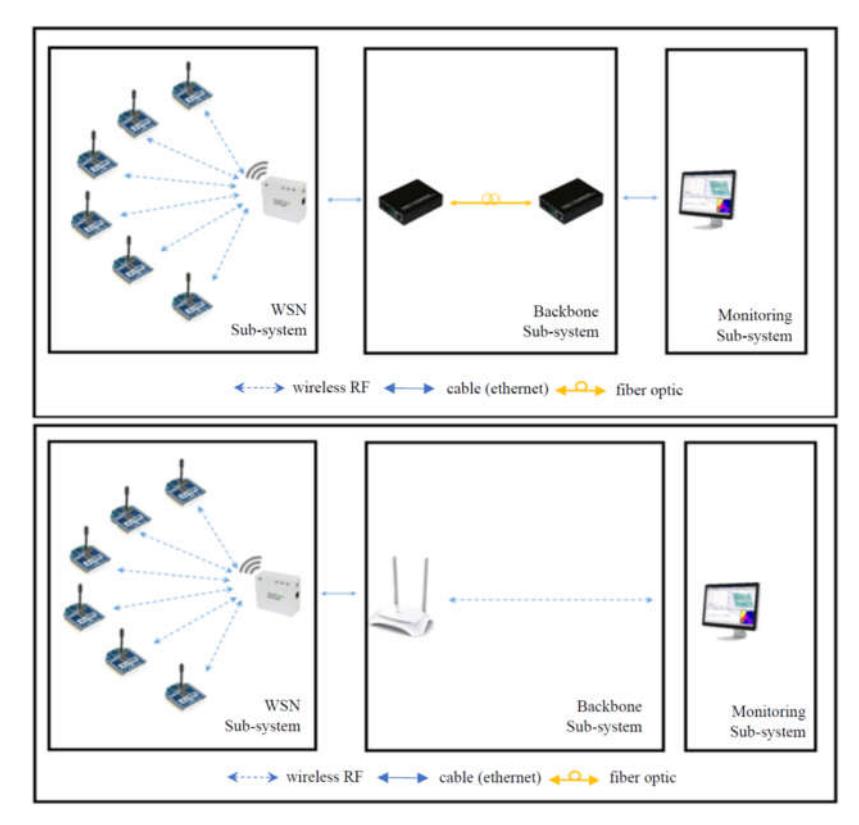
Figure 1 Experimental system design: (a) ZigBee network extended using optical transmission and (b) ZigBee network extended using radio frequency transmission.
Component Specification Transceiver ZigBee S2C Transmission Frequency 2.4GHz to 2.5GHz Indoor Range/Outdoor RF LoS Range 200 ft/ up to 4000 ft Transmit Power Output 6.3 mW (8 dBm) Boost, 2 mW (3 dBm) Normal RF Data Rate 250,000 bps Operating Current 33 mA (at 3.3 V, Normal), 45 mA (at 3.3 V Boost) Digi XBee ZigBee Gateway Protocols UDP/TCP, DHCP Python Version 2.7.1 Processor and Memory Freescale i.MX28, 20 MB RAM, 10 MB file space Transmit Power/Receive Sensitivity Digi XBee ZB SMT transmit power 6.3 mW (+8 dBm); receiver sensitivity (1% PER) -102 dBm; Data Rate Up to 72.2 Mbps 10/100Mbps Media Converter Standards and Protocols IEEE 802.3, IEEE 802.3u, IEEE 802.3x Wavelength 1310nm Network Media 100BASE-FX Single-mode Fiber Extends fiber distance up to 20 km (12.4 miles) Personal Computer and Software Processor Intel Core i3-7100U CPU @ 2.40GHz 2.40 GHz Installed RAM 4,00 GB Software Windows 10 (19045.3803) Digi XCTU Digi Device Discovery Digi Device User Interface
Table 1 Specification of components used in the experiment.
4 Results and Discussion
This study analyzed the performance of a WSN with a range that was extended using optical fiber transmission (ZigBee-FO WSN), in terms of throughput, time delay, and package loss and error. The experiment was conducted with different numbers of nodes, different numbers of sensors in one node, and different data capacities.
4.1 Throughput
Figure 2 is the data result of the throughput performance between two nodes, with variation of capacity. The throughput is increased when it is used to send more data. It can be observed that the throughput for the ZigBee-FO WSN had an increasing slope of 86.5, which is higher compared to the ZigBee-WiFi with 81.4.
This indicates that ZigBee-FO was able to send the data faster than ZigBee-WiFi and performed better in terms of capacity.
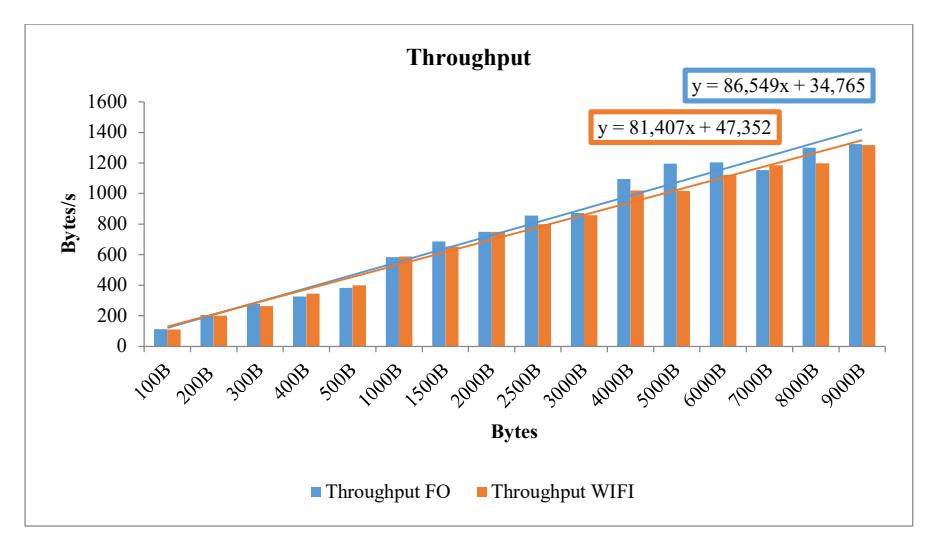
Figure 2 Throughput between nodes with various capacities.
Figure 3 shows the throughput of the network for different numbers of nodes. When the WSN consisted of more nodes, the throughput decreased. However, the throughput of ZigBee-FO had a higher rate by about 12% compared to ZigBee-WiFi.
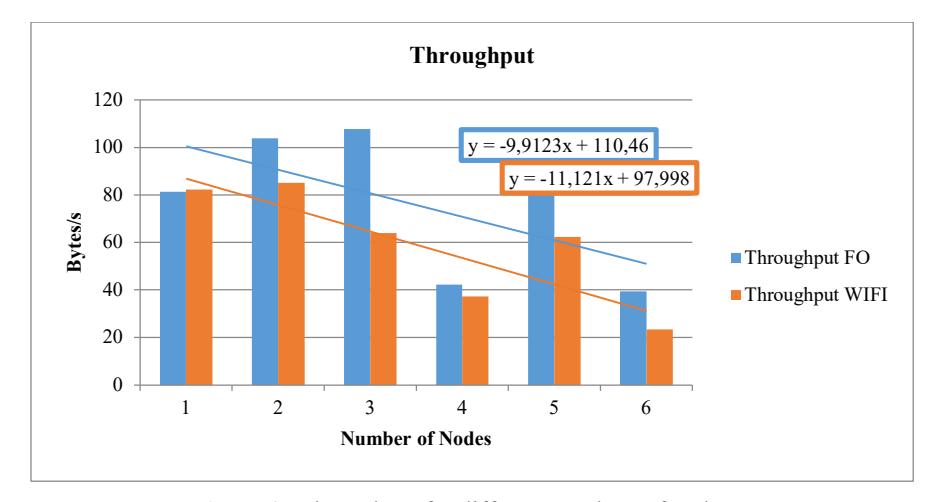
Figure 3 Throughput for different numbers of nodes.
Further analysis was done to investigate the throughput for a one-node WSN with multiple sensors, as shown in Figures 4 and 5. For the multi-sensor-WSN, the throughput followed the capacity of the data sensor. The throughput of ZigBee-FO also worked with a higher rate of throughput by about 17% compared to ZigBee-WiFi.
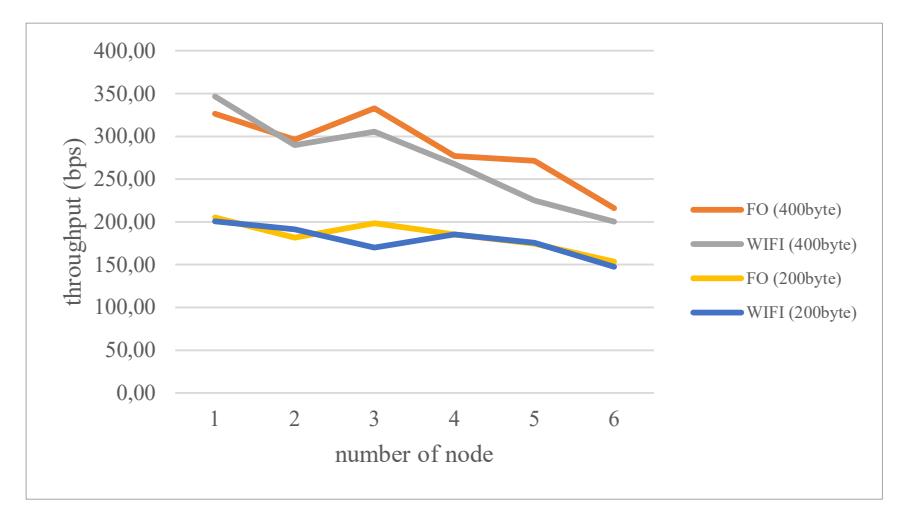
Figure 4 Throughput with a payload of 200 bytes and 400 bytes.
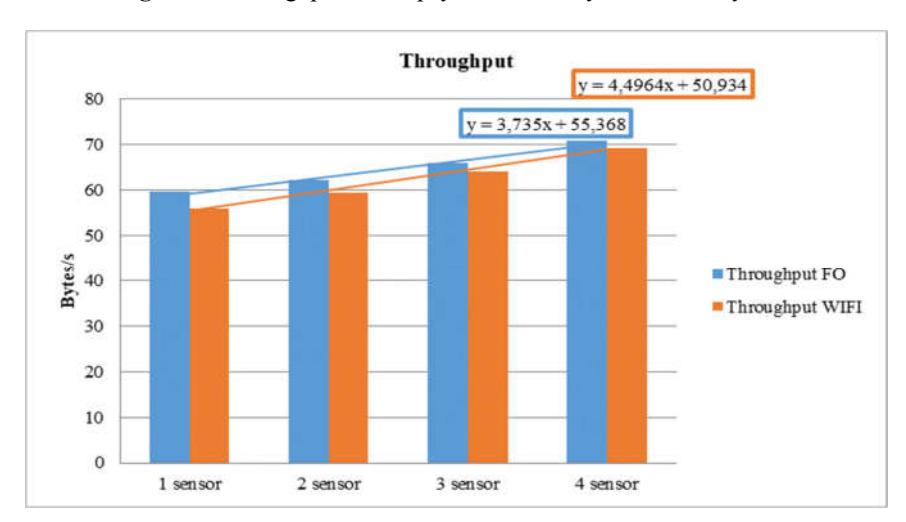
Figure 5 Throughput with number of sensors in one node.
4.2 Delay of Data Transmission
The following discussion analyzes the performance in terms of delay per meter, which indicates the quality of WSN transmission within a certain range. A lower delay per meter provides better ability to extend the range or coverage of the sensor network.
In Figure 6, it can be seen that the delay per meter for ZigBee-FO was about 5 times lower than for ZigBee-WiFi, i.e., its delay was reduced by 83.3%. This means FO can send data faster than WiFi. From this figure, it can be analyzed that ZigBee-FO was able to maintain lower delay at higher capacity transmission, while ZigBee-Wifi WSN increased the delay. This is because FO uses an isolated line, so the signal is not getting interfered with by the environment or other electromagnetic waves.
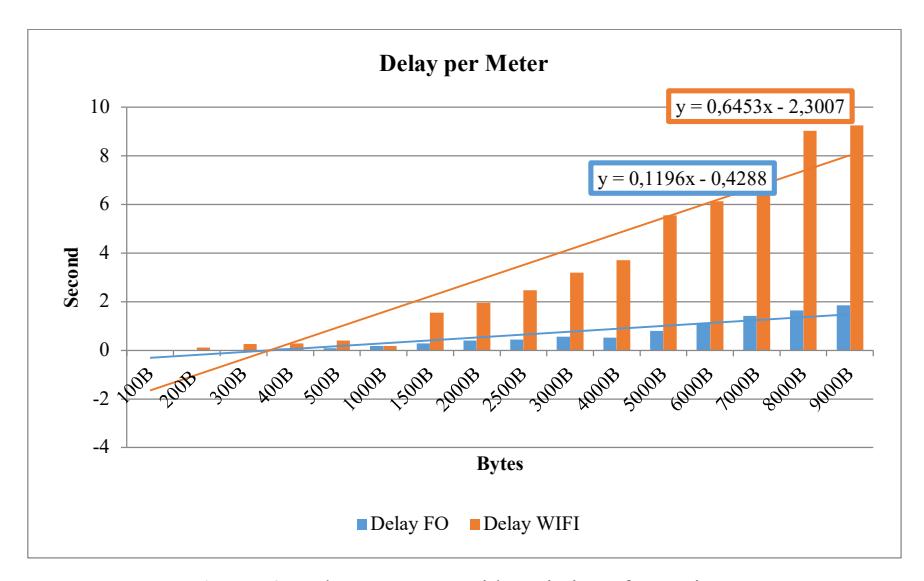
Figure 6 Delay per meter with variation of capacity.
Figure 7 shows that when the WSN consists more nodes, the trend of time delay decreased. This is because there are many nodes that forward the data to a coordinator node. This figure shows that the FO-based WSN still works with a lower time delay.
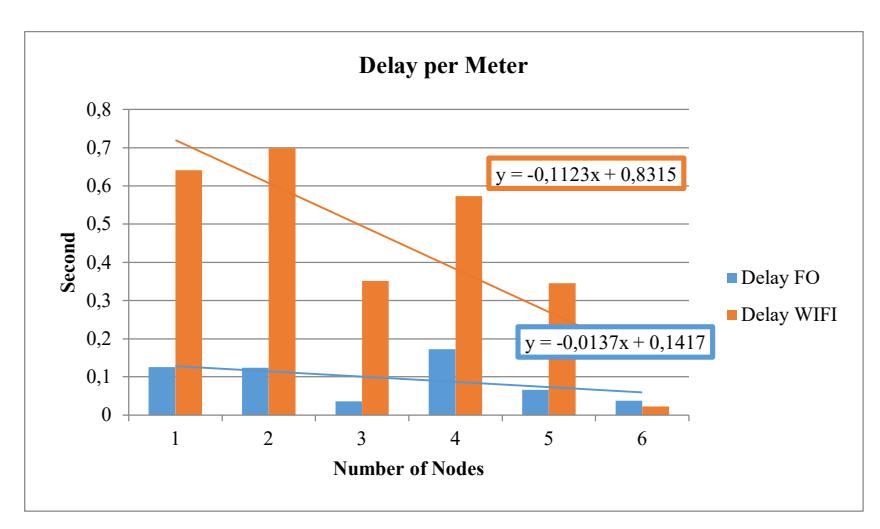
Figure 7 Delay per meter with variation of the number of nodes.
Figure 8 shows the time delay of the network with a different number of sensors in one node. For more sensors in one-node WSN, the time delay increased. It needs more time to send more sensor data. The time delay of ZigBee-FO was lower than that of ZigBee-WiFi.
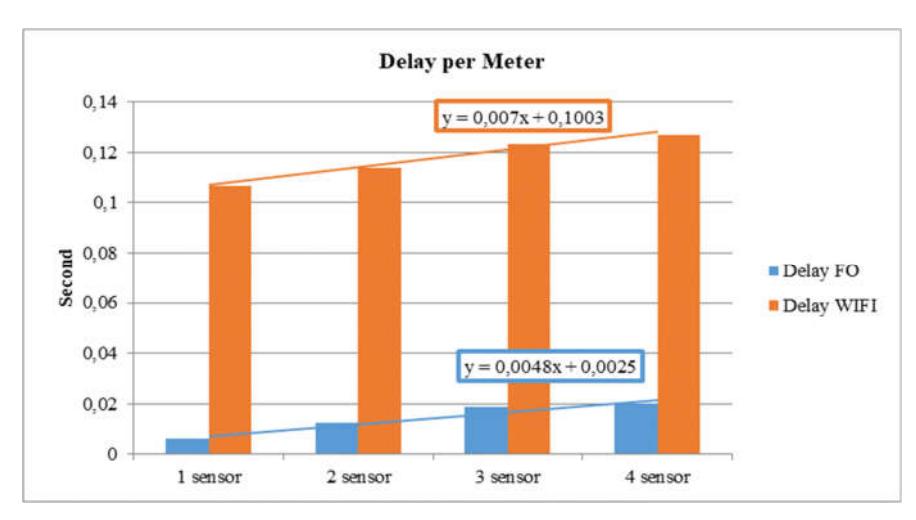
Figure 8 Delay per meter with the number of sensors in one sensor node.
4.3 Package Loss and Error
From Figure 9, it can be seen that the more bytes of data sent, the greater the error. For data transmission of 100 to 3,000 bytes, all data was sent and received with the same packet payload. All data was sent and received successfully and the produced package loss and error was 0%. However, when the data transmission was about 4,000 to 9,000 bytes of data, several data were lost or error.
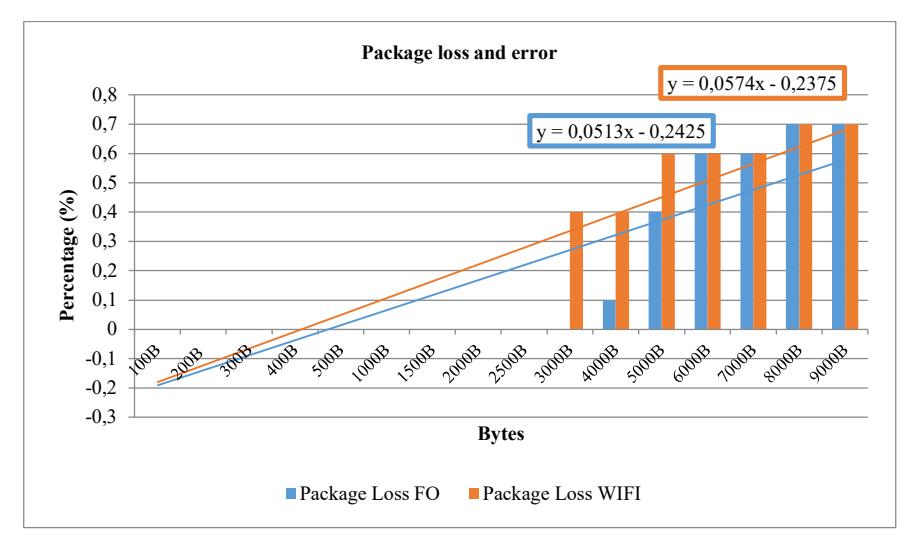
Figure 9 Delay per meter with variation of capacity.
Figure 9 also shows that the package error for ZigBee FO was lower than for ZigBee-WiFi. This means that FO sends data more accurately with less loss than ZigBee-WiFi.
5 Conclusion
Hybrid ZigBee-fiber optic WSNs are beneficial in extending the range of WSNs. The experimental result showed that the hybrid ZigBee-fiber optic WSN provided a throughput that was about 12% greater than that of ZigBee-Wifi WSN, and it transmitted the sensor data with a significantly lower delay, reduced by about 83.3%, compared to ZigBee-Wifi. The package loss and error of the ZigBee-FO was 35.7% lower than that of ZigBee-Wifi. The throughput increased with the increasing number of nodes or capacity. The interval delay parameter increased with more nodes but ZigBee-Optic WSN had a lower average time delay. Since FO uses an isolated transmission line, the signal is not easily interfered with, especially with the occurrence of other electromagnetic waves.
Acknowledgement
This publication was funded by a Regular Fundamental Research Grant 2023, from Ministry of Education, Culture, Research, and Technology, Republic of Indonesia, and facilitated by the Electrical Engineering Laboratory, University Al Azhar Indonesia.