

1 Introduction
As defined by the Ministry of Health of Indonesia, visually impaired people are those with partial vision impairments that cannot be fixed by ordinary means such as glasses. Low vision refers to individuals with partial vision impairments as members of the visually impaired, or diffable netra (DN). According to estimates, 1.5% of Indonesians are blind [1]. Further, a study conducted by the Vision Loss Expert Group found that Indonesia has the highest percentage of people with vision impairment of any country in the world [2]. It has been reported that 20% of all Indonesians with disabilities in the categories of 'very poor', 'poor', and 'almost poor' were blind, according to data from the Center for the Study of Disabilities, University of Indonesia (2010) [3]. The limitations caused by disabilities are possessed by people at the lower middle economic level.
Therefore, visually impaired people lack access to special tools to facilitate their daily lives. In the 2003 Indonesian census, 24.45% of disabilities were found in children and adolescents aged 0-18 and 21.4% in school-age children [4].
There are several smart sticks available to assist DNs, including WeWalk [5] and BriCane [6]. Both WeWalk and BriCane use ultrasonic sensors to detect obstacles within a 3 meter detection radius. Although this is effective for near-distance sensing, they cannot be used by DNs to navigate and perform remote sensing (>3 m) on roads. The lack of tools to recognize the objects around them also reduces the level of independence of DNs. Students, teachers, and professional musicians are some examples of DN productive activities that require high levels of independence. Because of limited support and facilities from their families or communities, DNs in Indonesia still cannot engage in these activities. Compared to similar products from abroad, BriCane is relatively inexpensive. For BriCane, the price ranges from IDR 2 to 3 million, while for imported canes like WeWalk the price is double that [6]. For people in a lower middle economic level society, IDR 2 to 3 million is not an insignificant amount. Based on data from the Ministry of Health's Research and Development Agency, disability and blindness prevalence are higher in the lower-income index [7, 8].
On the other hand, the mobile phone is almost a 'primary' need for everyone, including people with low vision. Deep learning and mobile phone technology may be combined to develop an assistance system for low-vision patients. According to a survey conducted by a non-profit organization [9], 71.4% of visually impaired respondents use smartphones. Moreover, the survey suggests that assistive devices are primarily developed on smartphones but still require sensors and embedded systems, which are more costly. Table 1 shows some systems that facilitate DN from previous studies. These systems serve several purposes, such as navigation and environmental recognition.
Based on the YOLO3 model, Lee et al. [10] developed an assistant system for the visually impaired. Object recognition accuracy was 96.46%, Korean text detection accuracy was 98%, and face detection accuracy was 72.6%. However, each subtask is performed independently. In [11], Nguyen et al. used a web-based system to detect objects with sound feedback for low vision. With SSD-MobileNetV2, the system gets a fast, small, and specific model optimized for mobile implementation. The model's confidence score decreased as the number of detected objects increased. Won et al. [12] developed a transfer learning-based object detection system that uses Faster Region-Convolutional Neural Network Inception V2 (Faster R-CNN) and Single Shot Detector MobileNetV1. In the analysis, the R-CNN model produced better results for mAP but took longer to infer than SSD according to the results.
| Category | Technology | Accuracy | Reference |
|---|---|---|---|
| Object detection, text detection, face detection | YOLO3 | 96.46%; 98%; 72.6% | [10] |
| Object detection (people, cars, dogs) | SSD-MobileNetV2 | >90% | [13] |
| Object detection (40 objects) | SSD-MobileNetV1, Faster R-CNN Inception V2 | 89.61% | [14] |
| Object detection (technology, text, person, plant, color) | CNN | 91.5% | [15] |
| Object recognition (outdoor objects) | ResNet50, Inception V3, VGG19 | 94.78%; 96.39%; 90.88% | [16] |
| Object detection | YOLO | 85.5% | [17] |
| Obstacle detection | Adaboost | 84.7% | [18] |
| Obstacle detection, navigation | Sensor, RFID, GPS (NavCane) | _ | [19] |
| Navigation: crosswalk detection | YOLOv4, RGB Camera | 93.46% | [20] |
| Navigation system | NFC, RFID, iBeacon | _ | [21] |
Table 1 Previous work of assistant system for visually impaired people.
Reference [15] shows that CNN can be used indoors and outdoors to classify objects with high precision. Reference [16] only used CNN to detect outdoor objects. Inception V3, ResNet50, and VGG19 were the CNN models used to build the system. The accuracy of ResNet50 was 94.78%, that of Inception V3 was 96.39%, and that of VGG19 was 90.88%. Many pre-trained models are available for object detection and classification, including MobileNet, VGG, ResNet, Inception, and YOLO. A pre-trained model may perform differently in terms of accuracy, latency, size, etc. Model architecture parameters, such as Adam, RMSprop, and SGD [16], also affect accuracy. According to [22], YOLACT image classification library provides a higher confidence level than TensorFlow but with a large delay.
In addition to object detection, deep learning can also be used to develop a navigation system for low vision. Developers can explore deep learning, particularly object detection, to warn of obstacles while navigating [19, 23] and it can be used for navigation as well. Reference [20] detects crosswalks and recognizes traffic lights to create a navigation system for the visually impaired. A navigation system called TARSIUS [21] also provides code information via vibration, sounds and vocal instructions like 'turn right'. Reference [24] used the same concept to develop an assistive cane with three ultrasonic sensors.
We aimed to increase DN's independence by developing the LoVi application, a smart assistant for low vision (LoVi), utilizing deep convolutional neural networks. Sherpa refers to Tibetans who act as climbing guides in the Himalayas
[25]. Based on the same spirit, the LoVi application aims to be a reliable guide for DNs or LoVi because it is embedded with advanced technologies from the present era of machine learning (ML).
2 LoVi Application Design
This paper presents the LoVi image classification application for Android. Using Android and artificial intelligence technology, LoVi was designed to help people with low vision perform daily tasks. Figure 1 illustrates its two subsystems: the LoVi mobile interface and the Sherpa model based on LoVi deep convolutional neural networks. LoVi displays three modes: outdoor, indoor, and currency. In addition, the Sherpa model needs to be capable of classifying images based on the mode selected in the application. Using TrotoarNet for outdoor use, IndoorNet for indoor use, and CurrencyNet for currency use, smartphones can run LoVi applications with lower power consumption. LoVi displays the three modes it offers users when they open it for the first time. The LoVi app's first interface guides the user through the process of classifying images (videos split into frames) detected by the smartphone. Based on the selected mode and realtime, the Sherpa model will then generate predictions based on the accuracy values and categories. Sound is used to communicate prediction results that meet a minimum accuracy threshold. In the event the prediction accuracy exceeds the threshold, a sound that mentions the category with the highest accuracy is played. Then, if the user presses the back or exit button, the LoVi application is terminated.
2.1 User Interface of Lovi App
Figure 2 illustrates the LoVi application user interface. The first interface displays the LoVi application logo. The second interface displays three buttons based on the user's mode option. It appears for a few seconds and switches to the second interface when the application is opened. For mode selection, the application activates the guidance voice. The application will switch to the next activity after pressing the mode button. This activity uses the smartphone camera to capture real-time frames that the Sherpa model uses as input for inference. The secondary window (right side) reflects only the top three accuracies of the categories. If the category with the highest accuracy meets the threshold, the feedback sound will be activated. The TrotoarNet, IndoorNet, and CurrencyNet models were first evaluated with the same threshold value. As a result of observing the trial, we discovered that the results tended to fall into a particular category. Thus, the thresholds were adjusted accordingly.
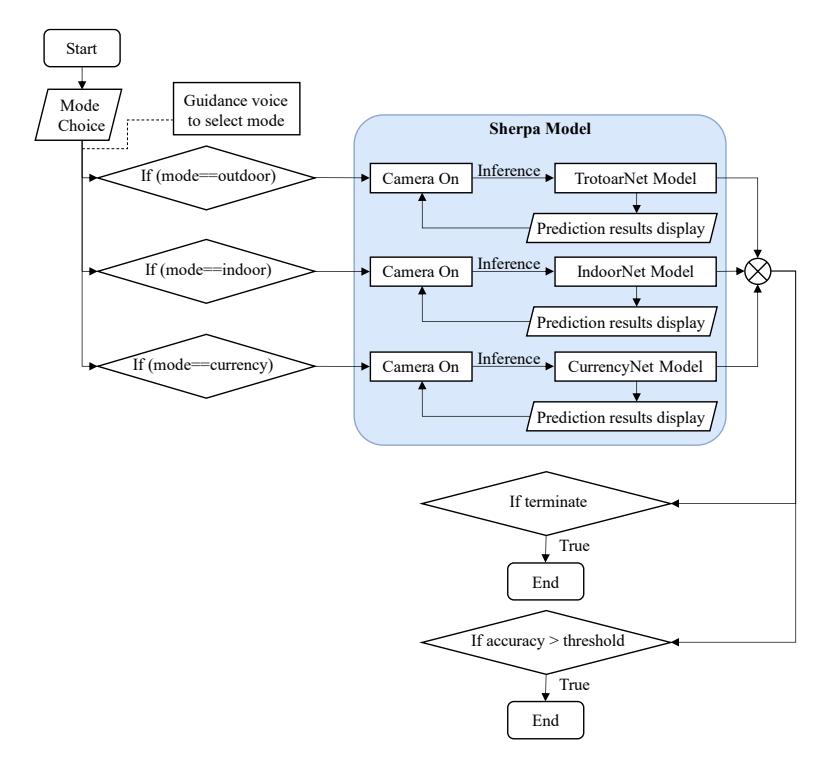
Figure 1 Flowchart of LoVi app.
Figure 2 User interface of LoVi app.
2.2 Preprocessing Dataset
The dataset was preprocessed into 224 x 224 dimensions and divided into 60% training, 30% validation, and 10% testing data. Tests were performed on the pretrained Sherpa model to establish a baseline model for testing the NN-
Architecture. The NN-Architecture Sherpa model and pre-trained model testing process are shown in Figure 3.
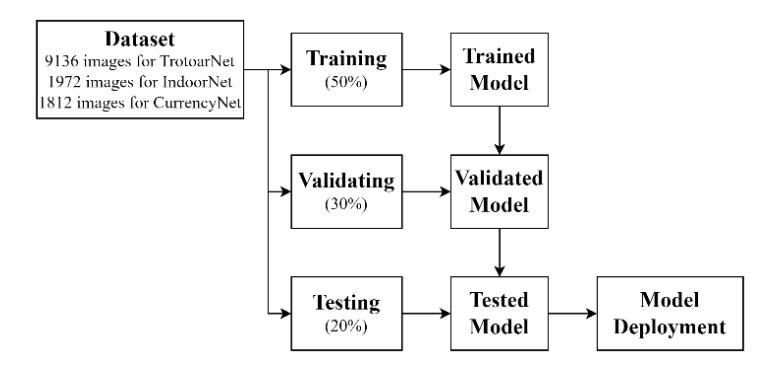
Figure 3 The flow of testing the Sherpa model along with the dataset distribution scheme, from training and testing to the final architecture.
In LoVi, the final architecture of the Sherpa model was derived from these test types. Table 2 shows variations in testing the pre-trained and Sherpa models, including test accuracy, number of parameters, latency, frames per second (FPS), and model size. The only parameters that were used to measure the NN-Architecture were accuracy and size. Table 3 shows a list of labels for each model and the average accuracy of the testing dataset.
Table 2 Variations in testing pre-trained models and NN-architecture.
| Testing | Parameter | Variation | |||
|---|---|---|---|---|---|
| Pre-trained - model | EfficientNet, DenseNet 169, Inception-Resnet version 2, Inception version 3, MobileNet small, ResNet 50 version 1, ResNet 101 version 1, ResNet 152 version 1, VGG 16, VGG 19, dan Xception | ||||
| Unit size | 16, 32, 64, 128, 256, 512, 1024, 2048 | ||||
| Activation function | hard_sigmoid, softsign, softmax, sigmoid, ReLU | ||||
| Learning rate | 0.00001, 0.0001, 0.001, 0.01, 0.1 | ||||
| NN | Optimizer | SGD, RMSprop, Adam, Adadelta, Adagrad, Adamax, Nadam | |||
| Architecture | Loss function | mean_squared_error, mean_absolute_error, mean_absolute_percentage_error, mean_squared_logarithmic_error, kullback_leibler_divergence, cosine_proximity, squared_hinge, hinge, categorical_hinge, logcosh, categorical_crossentropy, binary_crossentropy, poisson | |||
| ModelID | Function | Label | Dataset |
|---|---|---|---|
| IndoorNet | Helping LoVis to navigate outdoors, especially on sidewalks | bottle, fruit, glass, scissors, keyboard, chair, laptop, table, monitor, mouse, person, toothpaste, plate, knife, mobile phone, spoon, toothbrush, bag, and unrecognizable object | 1972 images |
| TrotoarNet | Helping LoVis to identify objects in the room, such as bottles, smartphones, plates, etc. | turn right, turn left, stop, and straight | 9136 images |
| CurrencyNet | Helping LoVis to classify rupiah currency (paper type) according to its nominal value | IDR 1.000, IDR 2.000, IDR 5.000, IDR 10.000, IDR 20.000, IDR 50.000, IDR 100.000, and unrecognizable object | 1842 images |
Table 3 Details of the deep learning model on Sherpa.
A total of five variables were tested in the NN-Architecture test: units, unit size, activation function, learning rate, optimizer, and loss function. The pre-trained model and the NN-Architecture models were tested on all ModelIDs (TrotoarNet, IndoorNet, and CurrencyNet). In order to create the Sherpa model, 150x training and 150x testing were required. The training-to-testing process was built into the same program to train and test Sherpa models, import libraries, and then read preprocessed datasets for training and validation. This dataset was inserted into the training process. A deep convolutional neural network (CNN) model architecture was created before training began, and a fully connected layer was added before the output layer. As a result of completing the training process, the program saved the model in *.h5 format and the training process graph in the specified directory and then proceeded to test the model.
2.3 Sherpa Model Deployment
The developed Sherpa model became the LoVi application's core, consisting of TrotoarNet, IndoorNet, and CurrencyNet. TrotoarNet categorizes sidewalks into four categories, i.e., turn right, turn left, go straight, and stop. IndoorNet classifies objects in a room, including laptops, scissors, glasses, and more. Then CurrencyNet classifies rupiah banknotes (paper type) from IDR 1,000 to 100,000, and one additional category 'no money'. Coins were not included in the LoVi application due to their relative ease of identification. In order to use the Sherpa model in the LoVi application, we converted the model to an edge-supported format following the steps in Figure 4. A dotted line in Figure 4 indicates that this process does not occur continuously but is only considered in optimizing application functions. Using a CNN model architecture, we built the Sherpa
model. We converted the model into a lite version using TensorFlow Lite. Additionally, the model was optimized to reduce the deployment size in LoVi. Our optimization consisted of changing the data type of the model that was deployed in the application to an 8-bit integer to reduce the size and processing time.
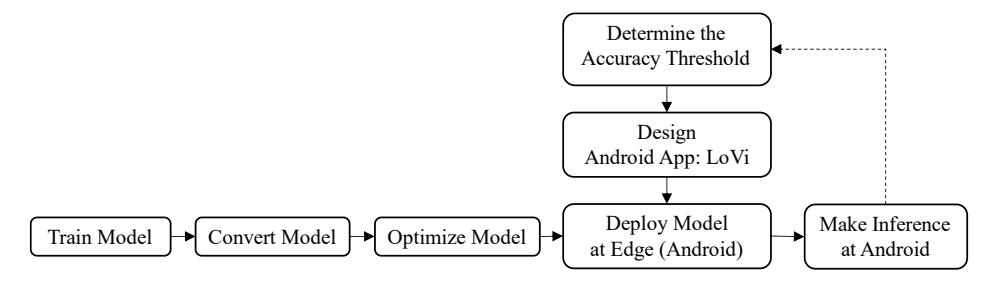
Figure 4 The flow of Sherpa model deployment into the LoVi application.
3 Results and Discussion
3.1 Sherpa Model Testing
The Sherpa model was tested in three stages: (1) determining the best pre-trained model and the baseline, (2) determining the best neural network architecture (NN-Architecture), and (3) testing the final architecture of the Sherpa model. The first stage is detailed in Appendix A, while the rest is included in this subsection.
3.1.1 NN-Architecture
In the NN-Architecture test, Table 4 shows the baseline Sherpa model. This baseline was obtained from the analysis of the pre-trained model test so that the optimum pre-trained model was obtained, which was VGG16, taking into account test accuracy, latency, model size, and frame rate. This subsection of the test used the default parameters of the NN-Architecture. As described in Appendix A, this parameter corresponds to the fully connected layer architecture. In testing the NN-Architecture, we sought to determine the optimal unit size, activation function, learning rate, optimizer, and loss function parameters to outperform the Sherpa baseline. Figure A.1 illustrates the accuracy and size of the model when unit size variation was carried out on ModelID, using the pre-trained VGG16 model that was determined in the previous test. As the unit size increased, the model accuracy and size increased as well. Depending on the type of ModelID, accuracy varied, while model size tended to remain the same. We trained each model 24 times to get this data. Compared to the baseline Sherpa model (unit size = 1024), unit size 128 was most optimal because accuracy was maintained at >90% while model size decreased by 69% (~180 MB) to 81 MB.
Figure 5 shows the activation functions: sigmoid, hard_sigmoid, softsign, and softmax. The test showed that sigmoids on fully connected layers resulted in accuracy better than the baseline Sherpa model (activation function = ReLU-ReLU- Softmax), which were +4.5% in IndoorNet, +6% in TrotoarNet, and +3% in CurrencyNet. In addition to the baseline Sherpa model, none of the other activation functions increased the accuracy for the three ModelIDs. Also, we conducted 12 times model training. With 66 times total model training, Figure 6 shows the learning rate, optimizer, and loss function tests. The accuracy from the variation of the learning rate did not exceed the accuracy from the baseline Sherpa model (learning rate = 0.0001). Furthermore, the variations in the optimizer and loss function in Figure 6(b) and 6(c) did not result in better accuracy than the baseline Sherpa model (optimizer = RMSprop, loss function = categorical_crossentropy).
Table 4 Baseline Sherpa model.
| ModelID | Pre trained model | Val_Acc (%) | Test_Acc (%) | Latency (ms) | imag es/s | NOPs (million) | Model size (MB) |
|---|---|---|---|---|---|---|---|
| IndoorNet | VGG 16 | 98.08 | 94.56 | 76 | 13 | 41.4 | 261 |
| TrotoarNet | VGG 16 | 85.70 | 91.20 | 26 | 38 | 41.4 | 261 |
| CurrencyNet | VGG 16 | 96.32 | 94.79 | 42 | 24 | 41.4 | 261 |
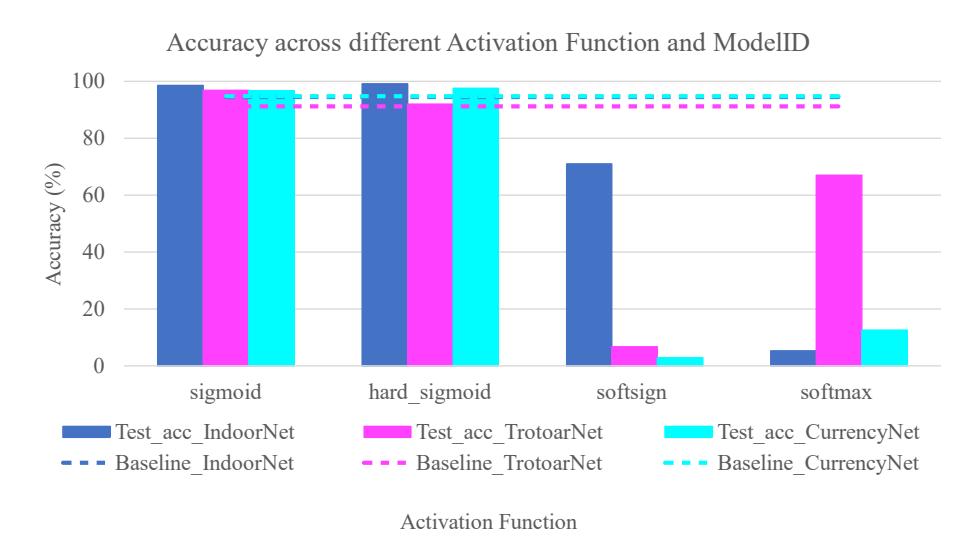
Figure 5 Accuracy of the activation function test results.
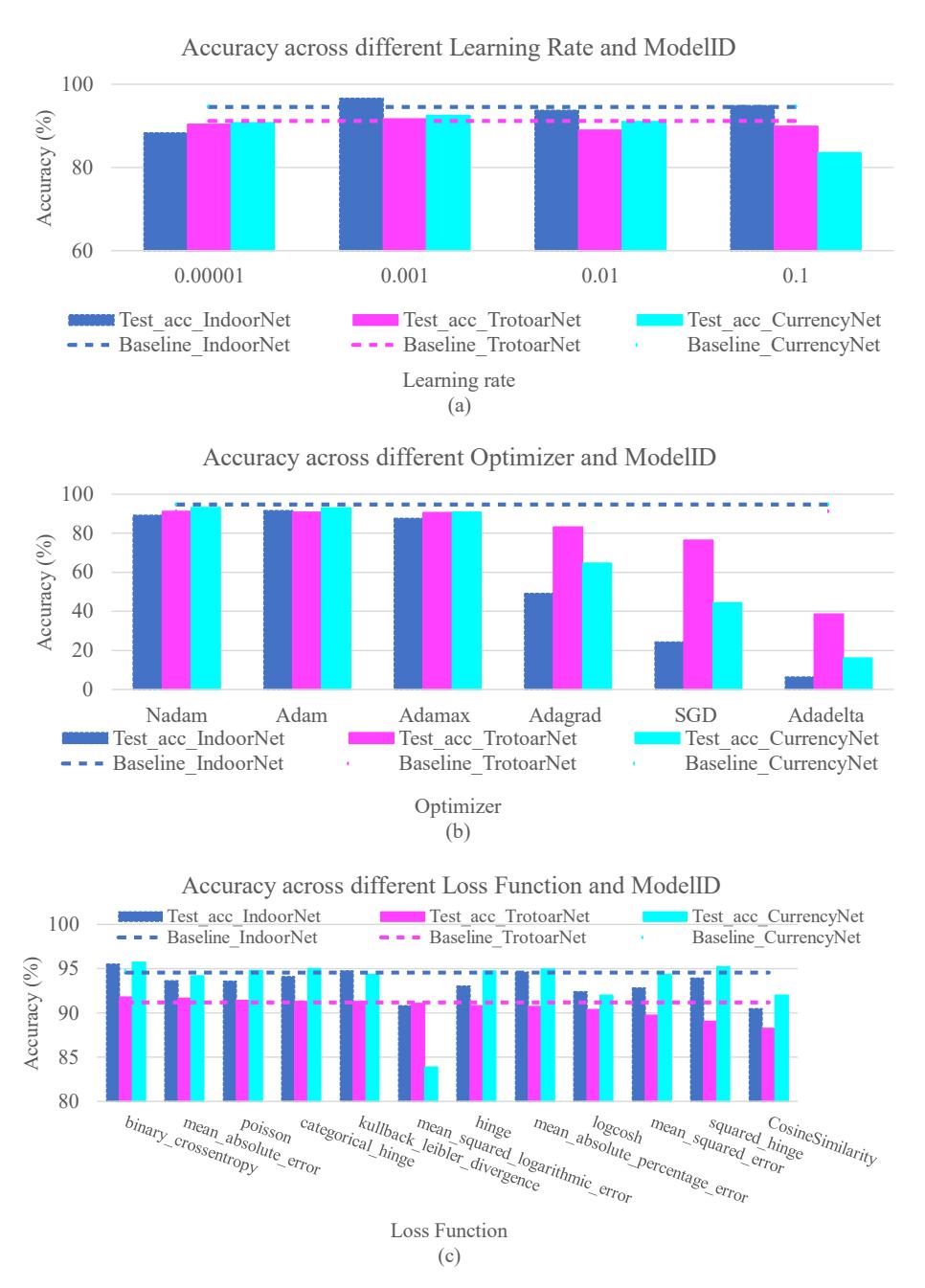
Figure 6 Accuracy of (a) learning rate, (b) optimizer, (c) loss function, against ModelID.
3.1.2 Sherpa Model Analysis
In order to get the baseline Sherpa model, we made a ranking based on four aspects: model size, latency versus NoPs, latency versus accuracy, and FPS, then averaged them to get the final ranking. A Sherpa model with the smallest NoP size is needed to prevent overloading the smartphone's processing. The NoPs in Figure A.4(b) are proportional to the model size. Table 5 shows the top 3 ranking models, which were VGG16, VGG19, and MobileNet.
| Table 5 | Ranking results of pre-trained models for determining the baseline Sherpa |
|---|---|
| model. |
| Pre-trained model | Model size | Latency vs NoPs | Latency vs Accuracy | FPS | Average |
|---|---|---|---|---|---|
| VGG 16 | 1 | 1 | 1 | 1 | 1.00 |
| VGG 19 | 2 | 2 | 2 | 2 | 2.00 |
| MobileNet small | 3 | 3 | 4 | 3 | 3.25 |
| Inception V3 | 5 | 5 | 7 | 4 | 5.25 |
| Xception | 8 | 6 | 5 | 5 | 6.00 |
| EfficientNet | 4 | 4 | 10 | 7 | 6.25 |
| ResNet 50 v1 | 9 | 7 | 3 | 6 | 6.25 |
| DenseNet 169 | 7 | 8 | 9 | 9 | 8.25 |
| ResNet 101 v1 | 10 | 9 | 6 | 8 | 8.25 |
| Inception-Resnet V2 | 6 | 10 | 11 | 11 | 9.50 |
| ResNet 152 V1 | 11 | 11 | 8 | 10 | 10.00 |
Pre-trained models are better if they are more accurate and have lower latency. As shown in Figure A.2, 6 out of the 11 pre-trained models used in the Sherpa model yielded greater than 80% accuracy, i.e. MobileNet, ResNet50, ResNet101, ResNet152, VGG 16, and VGG 19. Table 5 shows the ranking results based on latency versus accuracy. If we want at least 10 frames per second, we can tolerate 100 ms of latency with the Sherpa model. In accordance with these specifications, only two pre-trained models met the specifications for all ModelIDs (Figure A.1). VGG16 performed the best in all aspects. Testing the pre-trained model was used as a baseline for testing the Sherpa model, which is shown in Table 6 with the architecture and parameters of the fully connected layer shown in Figure A.4(a) and Table 6.
Table 6 NN-Architecture from the baseline Sherpa model.
| Parameters | Architecture |
|---|---|
| Pre-trained model | VGG16 |
| Unit size | 1024 |
| Activation function | ReLU, ReLu, Softmax |
| Learning-rate | 0.0001 |
| Optimizer | RMSprop |
| Loss function | categorical_crossentropy |
The final architecture was obtained from the results of the NN-Architecture test, which can be seen in Table 7. The final architecture was the reference for training the final Sherpa model, which became the core of the LoVi application. Based on the final architecture training results, a significant increase in the performance of the Sherpa model was obtained when compared to the baseline (Table 8), especially in the accuracy and size of the model. We used two metrics in terms of accuracy: testing accuracy and validation accuracy. Training accuracy measures how well the model is learning from the training data. It was calculated as the percentage of correctly predicted instances. As with training accuracy, validation accuracy evaluates the model's generalization ability to new, unseen data. It was calculated similarly to training accuracy.
Table 7 Comparison of the final and baseline Sherpa model architecture.
| Parameters | Final | Baseline |
|---|---|---|
| Pre-trained model | VGG16 | VGG16 |
| Units | 128 | 1024 |
| ActivationFunc | Sigmoid (3x) | ReLU, ReLu, Softmax |
| learning-rate | 0.0001 | 0.0001 |
| Optimizer | RMSprop | RMSprop |
| loss function | categorical_crossentropy | categorical_crossentropy |
Table 8 The results of the final and baseline architecture of the Sherpa model.
| IndoorNet | TrotoarNet | CurrencyNet | ||||
|---|---|---|---|---|---|---|
| Result | Final | Baseline | Final | Baseline | Final | Baseline |
| Testing accuracy (%) | 95.5 | 94.56 | 96.79 | 91.20 | 93.35 | 94.79 |
| Validation accuracy (%) | 96.64 | 98.08 | 86.45 | 85.70 | 96.32 | 96.32 |
| Latency (ms) | 77.08 | 76.42 | 24.75 | 26.36 | 38.16 | 41.88 |
| Images/s | 13 | 13 | 40 | 38 | 26 | 24 |
| NoPs (million) | 17.9 | 41.5 | 17.9 | 41.5 | 17.9 | 41.5 |
| h5 size (MB) | 81 | 261 | 81 | 261 | 81 | 261 |
3.2 LoVi App Testing
Figure 7 shows the LoVi application's test result with TrotoarNet, IndoorNet, and CurrencyNet. As shown in Figure 8, the Sherpa model's accuracy decreased after conversion to the lite version before being deployed in LoVi. We know from Figure 8 (a) that TrotoarNet was accurate in all four categories before converting to the lite version. While the lite version model yielded 5.13% accuracy loss, the quantization process resulted in 2.66% accuracy loss. However, TrotoarNet still had an accuracy value above 80% on average. Figure 8 (b) shows that IndoorNet only lost 1.38% accuracy when converted to the lite version model. IndoorNet's accuracy was also reduced by 2.10 % by quantization, from 91.74% to 89.65%. According to Figure 8 (c), the average accuracy of CurrencyNet after conversion and optimization was still over 80%. Only the image of an IDR 20,000 bill had an accuracy below 80%.
Hence, based on three results of testing the model's accuracy before deployment, it is evident that quantification did not significantly decrease the accuracy value. As a result, the quantized model was still suitable for TrotoarNet, IndoorNet, and CurrencyNet, as the accuracy per category remained above 80% in almost all categories.
Our performance test included reviewing the model's size and inference time after quantization in the LoVi application and its accuracy. It is possible to see the model size directly in the existing model details. Figure 9 (a) shows how the Sherpa model (VGG16 and MobileNet) is used in the LoVi application to calculate the inference time. In the graph, the model's size is also shown before and after quantization. The figure shows a 73.56% reduction in model size before and after quantization. Furthermore, the inference time was reduced by 67.65%. According to Figure 9 (b), LoVi's performance on a smartphone was linear over time. For approximately five minutes, the smartphone consumed about 17 to 22 mAh. The TrotoarNet, IndoorNet, and CurrencyNet models, trained on MobileNet and quantized into an 8-bit integer model, consumed the same amount of smartphone power. However, the inference time differed by more than 50%.
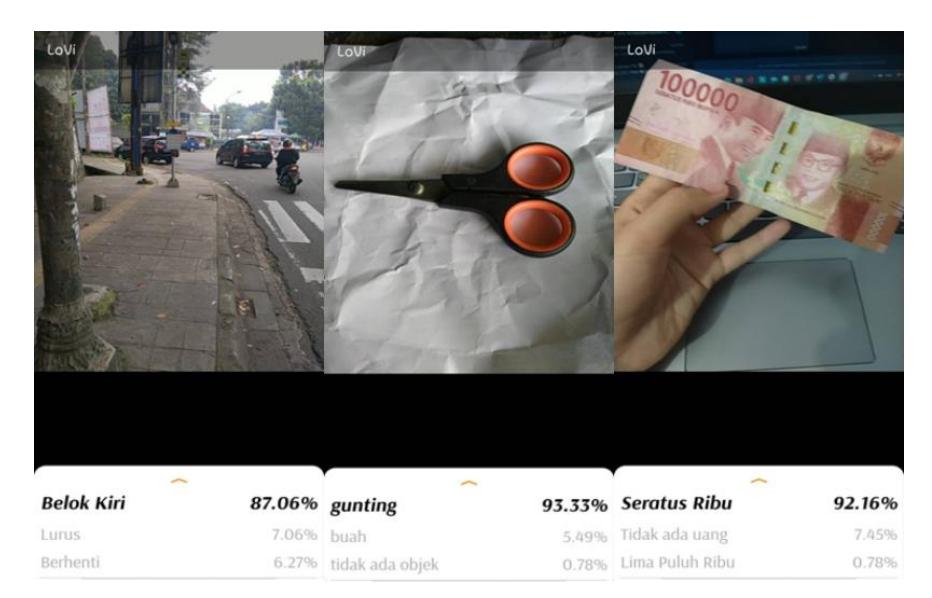
Figure 7 Recognition by LoVi app. Translations of the text from the left image: Belok Kiri [Turn Left], Lurus [Straight Ahead], Berhenti [Stop]; from the middle image: gunting [scissors], buah [fruit], tidak ada objek [no object detected]; from the right image: Seratus Ribu [One Hundred Thousand], Tidak ada uang [No money detected]; Lima Puluh Ribu [Fifty Thousand].
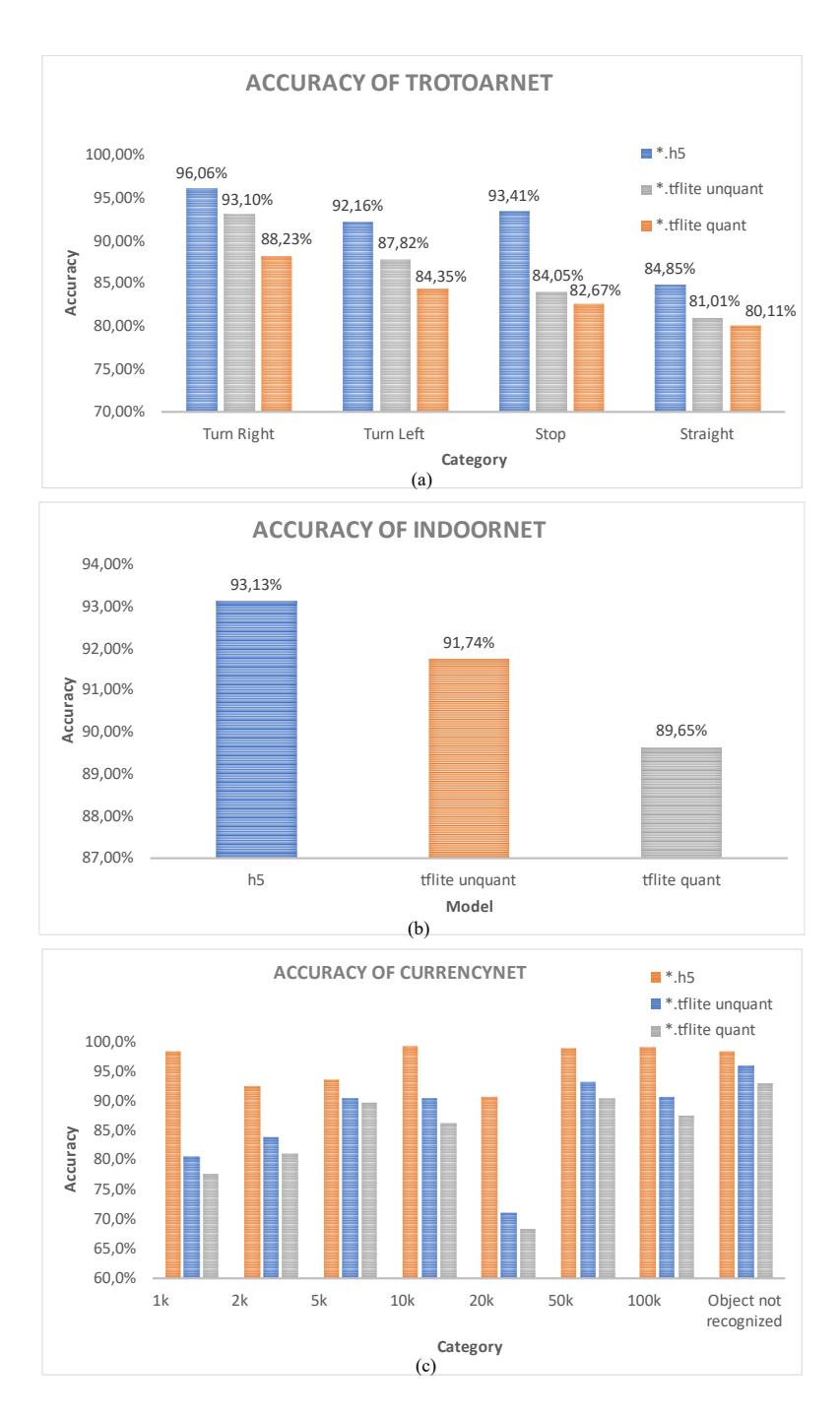
Figure 8 Decreased accuracy of the Sherpa model due to the conversion process for: (a) TrotoarNet, (b) IndoorNet, (c) CurrencyNet.
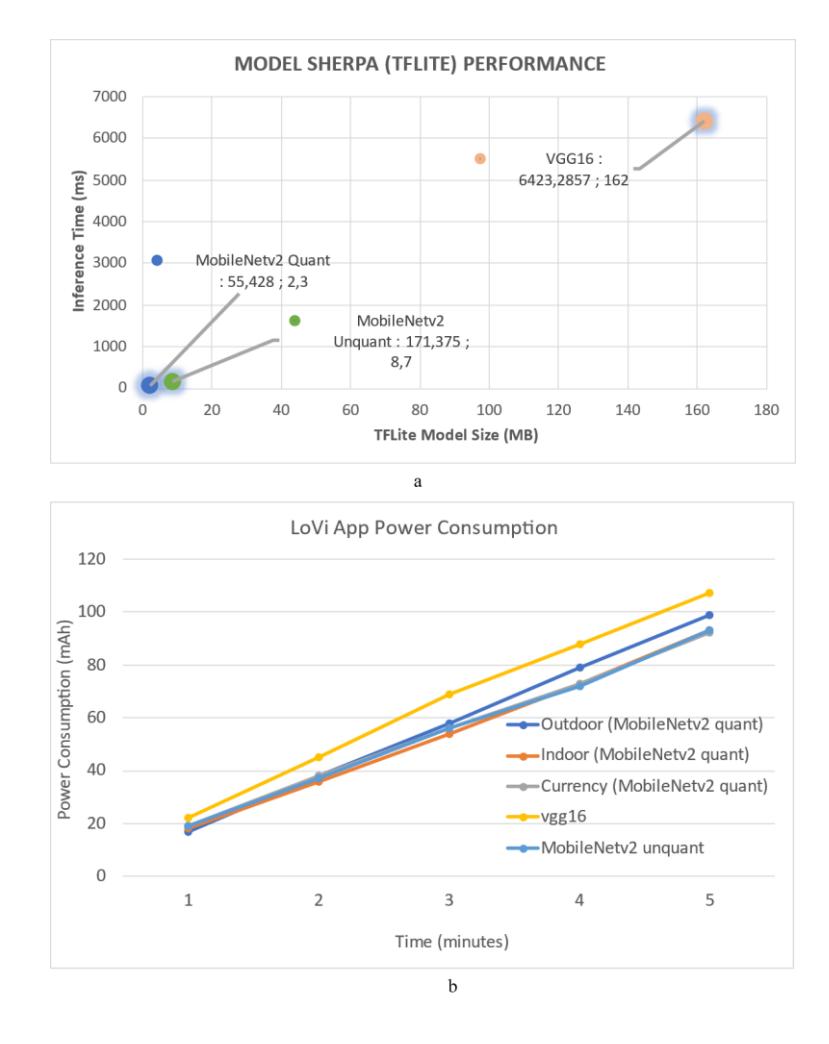
Figure 9 Test results of (a) the inference time and size of the Sherpa model, and (b) the smartphone power consumption by the LoVi app.
4 Conclusion
LoVi was developed to make outdoor navigation easier for people with low vision. It can also identify indoor objects and Indonesian banknotes (paper type). Approximately 80% of the model used in the LoVi application was accurate. Moreover, the LoVi application allows users to hear prediction results via voice, making it easy for low-vision users.
In terms of performance, the pre-trained model and NN-Architecture test variations differed depending on the ModelID (IndoorNet, TrotoarNet, and
CurrencyNet) created. Based on the NN-Architecture test, there were five variations: (1) units/unit size, with optimum performance when unit size = 128, which reduced 69% (-180MB) of the baseline model size while maintaining a test accuracy of >90% (91.42% on IndoorNet, 91.25% on TrotoarNet, and 93.76% on CurrencyNet); (2) activation function, with optimum performance when the activation function = sigmoid, with test accuracy increasing significantly compared to the Sherpa baseline model, i.e., 98.64% (+4.08%) on IndoorNet, 96.88% (+5.68%) on TrotoarNet, and 96.8% (+2.01%) on CurrencyNet. The Sherpa model performed better when the baseline parameters were used, i.e., learning rate = 0.0001, optimizer = RMSprop, and loss function = categorical_cross-entropy, in testing the variables (3) learning rate, (4) optimizer, and (5) loss function.
Inference time was reduced by 67.65% as a result of the optimization results used in the development of the TFLite model. It is therefore a relatively good choice for the LoVi application. The chosen model is based on transfer learning from MobileNet, quantized into 8-bit integers.
Acknowledgments
This work was partially supported by the School of Electrical Engineering and Informatics, Bandung Institute of Technology.