

1 Introduction
Massively multiplayer online games (MMOGs) have evolved into an international avenue of entertainment that brings together thousands of individuals to play collectively as the internet and virtual worlds continue to expand rapidly [1]. These games feature complex, realistic virtual world team collaboration environments, in addition to providing good playability. In such environments, players are expected to act in collaboration with other members in highly flexible and high-pressure scenarios to complete tasks or accomplish goals. As a result, MMOGs have become an ideal platform for studying behaviors such as virtual teamwork, emotion regulation, and leadership.
Both emotional intelligence (EI) and transformational leadership (TL) are human attributes perceived as necessary for enhancing team effectiveness (TE) and have been heavily studied in physical organizational contexts [2-4]. Notably, however, this phenomenon has not been systematically studied in the context of virtual environments, such as MMOGs. EI is considered the primary determinant of a person's ability to interact effectively in relationships and work collaboratively with others [5]. Likewise, in many real-world businesses, TL is a style that has proven to be more effective and successful because it motivates employees and enhances team cohesiveness. However, the applicability of these findings to MMOG virtual teams remains unclear, as most studies have primarily focused on traditional workplaces or physically co-located teams [6].
There are several gaps in the existing literature. First, the characteristics of presence in virtual teams, such as the high interactivity of the MMOG environment and the pressure-laden context, have not been considered in the context of emotional intelligence, leaving an essential ambiguity about how emotional management by emotionally intelligent players facilitates collaboration. Although we know that emotional intelligence can affect real team performance [7], the effect of emotional intelligence also requires further study in virtual team settings, such as gaming environments. Second, it is unclear how transformational leadership works in MMOGs, especially in a rapidly changing remote collaboration contexts, as there remains the outstanding issue of how leaders motivate team members. Finally, there has been an inadequate amount of research on team effectiveness concerning the playability of games. Team collaboration is crucial to the playability and player experience of a game. However, there is a lack of theoretical and empirical analysis on how emotional intelligence and transformational leadership contribute to the relevant aspects of playability and player experience.
Thus, to fill these gaps, this research investigated the nature of the relationship between emotional intelligence and transformational leadership in influencing team effectiveness within the context of MMOGs, while also analyzing the broader implications of these two variables on overall game playability. This paper employs the Input–Process–Output (IPO) model as a theoretical framework and examines relevant variables using various statistical analyses. The study, therefore, fills these research gaps and provides a guided theory that enhances the broader theoretical understanding of virtual team coordination and apart from that also offers practical implications for game developers to improve player experience and team collaboration effectiveness.
2 Literature Reviewer
2.1 Playability in MMOGs
Playability is a measure of how good the experience players have with a game system. It includes factors such as whether the game is engrossing, demanding, and capable of keeping players interested. Raith et al. discovered that in MMOGs, playability comprises not just the game's rules, mechanics, objectives, and design but also the interactive experience between players and the game system [8]. Research indicates that evaluating player feedback (in-game feedback systems, in-game behavior records, etc.) and emotions provides a more comprehensive understanding of how a game affects players, offering developers valuable insights for optimization [9]. Additionally, studying playability helps to uncover the behavioral patterns and psychological responses of players within virtual environments [20]. Such studies not only assist developers in improving game design but also provide new insights into understanding player behavior.
Given that MMOGs frequently involve structured team formats, such as guild raids, arena matches, and party-based missions, investigating their playability provides valuable insights into collaborative game design. Teams in MMOGs are not merely interactive groups; their dynamics and the interactions among members play a crucial role in determining the game's success or failure [2]. Dawai et al. found that players with higher emotional intelligence performed exceptionally well in self-management, collaboration with others, and efficient task completion [11]. However, they only addressed team efficiency and did not comprehensively examine team effectiveness. Additionally, players with transformational leadership skills can effectively guide teams, resolve conflicts, and motivate team members, which helps teams collaborate more effectively and improve team efficiency [12, 13]. From an individual perspective, emotional intelligence and leadership skills clearly influence team effectiveness and enhance collaborative experiences in virtual environments.
Although MMOG playability is increasingly studied, most existing research did not explore the role of emotional intelligence and leadership in shaping teambased play experiences. This research gap opens up significant avenues for future academic inquiry, particularly in the practical applications of emotional intelligence and leadership in MMOGs.
2.2 Emotional Intelligence (EI)
Emotional intelligence refers to an individual's ability to perceive, understand, and regulate emotions, as well as to respond effectively to emotional situations [14]. Team members with high EI can manage their own feelings and empathize with others, leading to improved communication efficiency, enhanced
collaboration, and the stimulation of innovative thinking [2,5]. In MMOG teams, players with high EI maintain composure under pressure or after mistakes, mitigating potential disruptions to team cohesion. Additionally, they facilitate team performance and effective information sharing by clearly articulating strategies and providing emotional support to teammates [15]. These abilities improve the overall teamwork experience, increasing team satisfaction and adaptability.
When confronted with unexpected changes or complex challenges, high-EI members rapidly adapt strategies and foster environments that promote novel solutions, thereby enhancing team creativity and competitiveness [16]. Such behaviors enhance performance by reinforcing trust and member satisfaction. Furthermore, high-EI individuals mitigate specific limitations of virtual settings, including the absence of nonverbal cues and diminished emotional presence, through deliberate communication and expressive clarity. These actions strengthen team resilience and support sustained task coordination [4].
In MMOG teams, individuals with high EI demonstrate superior performance in teams of task completion time, error minimization, and team member satisfaction. They also reduce team friction, fostering greater cohesion and long-term stability [2]. Thus, EI emerges as a critical factor not only in optimizing virtual TE but also in ensuring the team's viability and overall success [5]. Therefore, we propose the following hypothesis:
Hypothesis 1: Emotional intelligence positively influences team effectiveness in MMOGs.
2.3 Transformational Leadership (TL)
Transformational leadership (TL) is widely acknowledged as an effective strategy for enhancing team performance by fostering collaboration, trust, and motivation among team members [17]. Transformational leaders inspire their followers to prioritize collective goals over individual interests, thereby cultivating a cohesive and high-performing team environment [6]. Empirical studies have consistently shown that TL significantly enhances team effectiveness, as reflected in increased team member satisfaction, improved team effectiveness, and strengthened team viability [14].
Research by Greimel et al. highlighted that teams led by transformational leaders report higher levels of job satisfaction and emotional well-being, as members perceive their contributions as equally valued [18]. Additionally, transformational leaders employ inspirational motivation to emphasize goal alignment, fostering a shared commitment to collective objectives. This leadership style is strongly correlated with improved team performance, particularly in dynamic and complex environments, where adaptability is essential [19]. Moreover, transformational leaders' ability to cultivate robust interpersonal relationships among team members facilitates constructive conflict management, preserving positive team dynamics [7]. These attributes make TL instrumental in promoting the long-term sustainability and adaptability of teams, even under challenging conditions [19].
In summary, TL is a critical driver of team efficiency, contributing to enhanced team member satisfaction, exceptional team performance, and sustained team viability [18]. Nevertheless, in the context of MMOGs, the mechanisms through which leaders inspire and care for their teams remain underexplored. Drawing on previous research findings on team dynamics, we hypothesize that TL positively influences team collaboration in MMOGs. Therefore, we propose the following hypothesis:
Hypothesis 2: Transformational leadership positively influences team effectiveness in MMOGs.
2.4 Team Effectiveness (TE)
Team effectiveness is defined as the capacity of team members to work collaboratively toward shared objectives, encompassing key dimensions such as communication, cooperation, and problem-solving abilities [20]. By contrast, game playability pertains to the quality of players' experiences during gameplay, characterized by elements such as enjoyment, challenge, and satisfaction [21]. In multiplayer gaming environments, the quality of team collaboration and interaction plays a pivotal role in shaping overall game playability [1]. Efficient teams, through effective communication and coordinated actions, can significantly enhance players' immersion and enjoyment [22]. Furthermore, a high level of synergy and well-developed strategies among team members can accelerate game progression, fostering deeper player engagement [12]. Conversely, internal team conflicts or communication breakdowns may detract from the gaming experience, ultimately diminishing player satisfaction.
Despite its importance, research examining the interplay between TE and game playability remains in its infancy. Notably, the influence of individual EI and leadership within this context has yet to be thoroughly investigated. Evidence suggests that high-performing teams, through effective task delegation and communication, can substantially minimize resource inefficiencies and time delays, thereby improving the fluency and effectiveness of task completion [10]. Therefore, we propose the following hypothesis:
Hypothesis 3: Team effectiveness positively influences playability in MMOGs.
2.5 Theoretical Foundation
This study used the Input–Process–Output (IPO) model to construct a relationship model between individual traits, team interaction, and user experience in virtual game teams. This model is widely used in the fields of organizational behavior and team research and can effectively analyze how teams transform individual inputs into collective outputs, with the key lying in the intermediate process mechanisms [23]. In the context of MMOGs, team collaboration heavily relies on leadership expression, emotional interaction, and goal alignment among players. Therefore, the IPO model provides a clear framework for understanding the behavioral dynamics at play.
This study used TL and EI as input variables for the model. TL emphasizes enhancing team cohesion and performance through inspiring visions, individual care, and intellectual stimulation [17]. Meanwhile, EI, as an individual's ability to regulate their own emotions and understand others, also plays a key role in team conflict management and communication [24]. The study is grounded in social cognitive theory [25], which posits that such abilities originate from learning, feedback, and regulation in social interaction processes and possess strong behavioral influence.
Team effectiveness (TE) as a process variable, reflects players' coordination abilities, task performance levels, and tendencies to maintain team cohesion. Referring to the team effectiveness model proposed by Kozlowski and Ilgen, the study divided TE into three dimensions: task performance, team persistence, and member satisfaction [26]. TE not only concentrates the effects of input variables but also serves as a key mechanism to determine whether players achieve a positive experience.
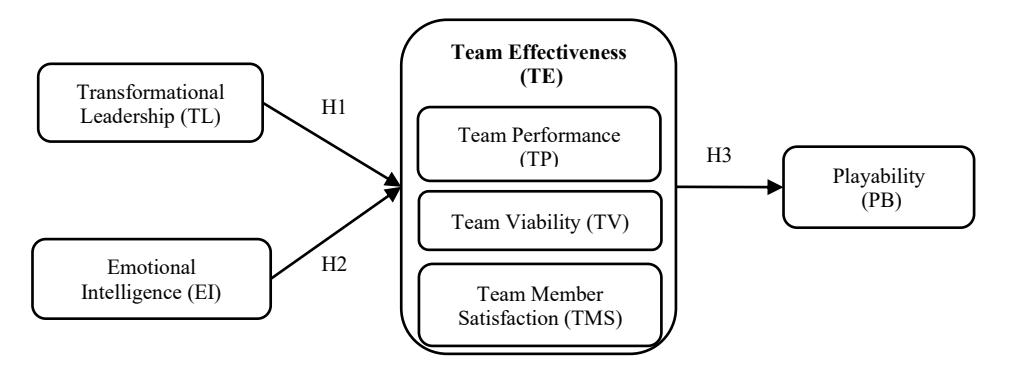
Figure 1 Proposed conceptual model.
3 Method
This study employed a combination of cross-sectional and quantitative research methods. The study required the collection of players' characteristics, behaviors, and attitudes toward gaming. The cross-sectional method [28] facilitates the onetime collection of a large volume of data, enabling a more accurate description of the current state of players' gaming experiences and any underlying patterns. Quantitative research primarily utilizes mathematical techniques to analyze the collected data and conduct statistical analysis [29]. This study collected a large amount of primary data, objectively reflecting players' emotions and the role of leaders during team collaboration. Quantitative research helps researchers systematically analyze the data. Through result equation models and multivariate research algorithms, the study explores the path relationships between variables. By combining these two methods, the study could effectively test the relationships between variables, providing empirical evidence for theoretical construction and causal inference.
3.1 Sample
This study focused on players of large-scale multiplayer online games (MMOGs) in China. The selected games include Honor of Kings, PlayerUnknown's Battlegrounds, CrossFire, World of Warcraft, and League of Legends. These games were selected based on preliminary testing, which confirmed that the above five categories have a large player base. Additionally, they encompass diverse team-based gameplay styles, including squad battles, large-scale confrontations, guild wars, and 5v5 matches. These games span both mobile and PC platforms, enabling a comprehensive analysis of how individual leadership influences TE across various games and team settings, as well as an objective assessment of players' gaming experiences. This study employed purposive sampling, a non-probabilistic method known for its ability to select sample groups accurately tailored to specific research objectives. This approach is particularly well-suited for the targeted demographic of this research—Chinese players of MMOGs (aged above 18). By focusing on active participants or individuals with team collaboration experience, purposive sampling enables an in-depth exploration of unique behavioral patterns and related factors that influence game playability, which were the core focus of this study.
3.2 Measurement
In this study, we chose to use Partial Least Squares Structural Equation Modeling (PLS-SEM) to test the hypothesized relationships. It is particularly suitable for studies where factor analysis and multiple regression analysis explain and predict relationships between underlying variables [29]. It is ideal for exploratory studies and non-normally distributed data, focusing on a prediction-oriented approach, supports complex model structures, and can handle both reflective and formative indicators. The present study measured the hypothesized relationships between EI, TL, TE, and PB.
Through path analysis, PLS-SEM can reveal direct effects, indirect effects, and effect sizes between variables while effectively avoiding multicollinearity issues. This measurement method not only comprehensively reveals the complex causal relationships between EI and TL in the MMOG environment but also comprehensively assesses how EI influences TL, how TL influences TE, and how these factors collectively enhance PB. It provides strong theoretical and practical support for MMOG game development. For studies emphasizing model prediction and providing reliable predictions, it also performs exceptionally well. Multiple quality tests, including PLSpredict, coefficient of determination (R²), and predictive correlation (Q²), support these predictions. These tests collectively ensure the robustness and accuracy of the model.
3.3 Data Collection
The questions in the questionnaire were taken from existing literature by experts or scholars and were slightly adapted to ensure the reliability of the data collection. EI was measured by the Wong and Law Emotional Intelligence Scale [30]. TL was measured using items adapted from the transformational leadership component of the Multifactor Leadership Questionnaire [31]. We measured the group's effectiveness using the Virtual Team Effectiveness Scale, focusing on communication, collaboration, and task accomplishment [32]. A subset of questions from the Game Experience Questionnaire (GEQ) was used to measure playability [33]. These related issues, together formed the specific questions in this questionnaire. Thus, the feasibility and credibility of the questions were ensured.
Given that the researchers and participants were based in different countries, data collection was conducted online using the Chinese platform Questionnaire Star. Participants had to be at least eighteen years old. To facilitate participant comprehension, the questionnaire was prepared in a bilingual format (English and Chinese). The data collection period was set at one month to obtain enough valid responses for the subsequent research.
4 Result
To ensure an adequate sample size for this study, a total of 1,038 valid questionnaires were collected during the data collection period, with 6 questionnaires deemed invalid or incomplete. This data collection process adhered to the sample size requirements for PLS-SEM as outlined by Hair et al.
[34]. The proportion of missing or invalid data in the questionnaires was kept below 5%, which minimizes the risk of bias or erroneous results. Statistical analyses were performed using SmartPLS 4.0.
4.1 Demographic Analysis
The population data presented in Table 1 indicates that most game players fell within the age range of 18-35 years, comprising 89.34% of the total, with a slightly higher proportion of male players compared to female players. Most players reported having 2-5 years of gaming experience (43.42%), whereas the proportions of novices (18.05%) and veteran players (38.53%) were relatively minor. These findings suggest that the gaming market predominantly caters to a younger demographic and players with moderate experience.
| Demographic Characteristic | Option | Percentage | |
|---|---|---|---|
| Gender | Male | 64.29% | |
| Female | 35.71% | ||
| Age | 18-25 years | 74.77% | |
| 26-35 years | 13.82% | ||
| 36-45 years | 8.46% | ||
| 46-55 years | 1.53% | ||
| Above 56 years | 0.67% | ||
| Years spent playing | < 2 years | 18.05% | |
| ≥2 and < 5 years | 43.42% | ||
| ≥5 and < 10 years | 28.57% | ||
| ≥ 10 | 9.96% | ||
| Arena of Valor | 40.23% | ||
| The massively | PUBG | 35.81% | |
| multiplayer game you | Crossfire | 9.49% | |
| play most often is | World of Warcraft | 3.57% | |
| League of Legends | 10.90% | ||
Table 1 Respondent Profile
4.2 Measures of Reliability and Validity
Since the data was collected using a single online survey method, there was a potential risk of standard method bias (CMB) [35]. To assess this, the variance inflation factor (VIF) was calculated for all indicators; and the results showed that all VIF values were below 3.3, indicating that the data collection was not significantly influenced by CMB [29]. Additionally, the standardized root mean square residual (SRMR) was measured. The results revealed that the SRMR values for the saturated model (0.034) and the estimated model (0.057) were both below the threshold of 0.08 [35], suggesting that the model exhibited a good fit.
Subsequently, the reliability and validity of the model were calculated, with the results presented in Table 2 and Figure 1. According to Hair et al. [29], the thresholds for Cronbach's alpha, composite reliability, and outer loadings were greater than 0.7. Additionally, the average variance extracted (AVE) should exceed 0.5. The results of this study met all these criteria, indicating that the data is both valid and reliable.
Table 2 Measurement Reliability
| Items | Loading | Cronbach's alpha | Composite reliability (rho_a) | Composite reliability (rho_c) | Average variance extracted (AVE) | |
|---|---|---|---|---|---|---|
| Emotional | EI1 | 0.822 | 0.825 | 0.826 | 0.884 | 0.656 |
| Intelligence (EI) | EI2 | 0.824 | ||||
| EI3 | 0.814 | |||||
| EI4 | 0.779 | |||||
| Playability (PB) | PB1 | 0.759 | 0.932 | 0.932 | 0.942 | 0.594 |
| PB2 | 0.768 | |||||
| PB3 | 0.783 | |||||
| PB4 | 0.775 | |||||
| PB5 | 0.769 | |||||
| PB6 | 0.778 | |||||
| PB7 | 0.778 | |||||
| PB8 | 0.773 | |||||
| PB9 | 0.776 | |||||
| PB10 | 0.749 | |||||
| PB11 | 0.772 | |||||
| Transformational | TL1 | 0.784 | 0.917 | 0.917 | 0.931 | 0.600 |
| Leadership (TL) | TL2 | 0.784 | ||||
| TL3 | 0.751 | |||||
| TL4 | 0.788 | |||||
| TL5 | 0.767 | |||||
| TL6 | 0.783 | |||||
| TL7 | 0.774 | |||||
| TL8 | 0.767 | |||||
| TL9 | 0.773 | |||||
| Team Member | TMS1 | 0.914 | 0.906 | 0.907 | 0.941 | 0.842 |
| Satisfaction (TMS) | TMS2 | 0.914 | ||||
| TMS3 | 0.926 | |||||
| Team Performance | TP1 | 0.839 | 0.788 | 0.788 | 0.876 | 0.702 |
| (TP) | TP2 | 0.842 | ||||
| TP3 | 0.834 | |||||
| Team Viability | TV1 | 0.791 | 0.883 | 0.884 | 0.911 | 0.632 |
| (TV) | TV2 | 0.782 | ||||
| TV3 | 0.807 | |||||
| TV4 | 0.794 | |||||
| TV5 | 0.786 | |||||
| TV6 | 0.808 |
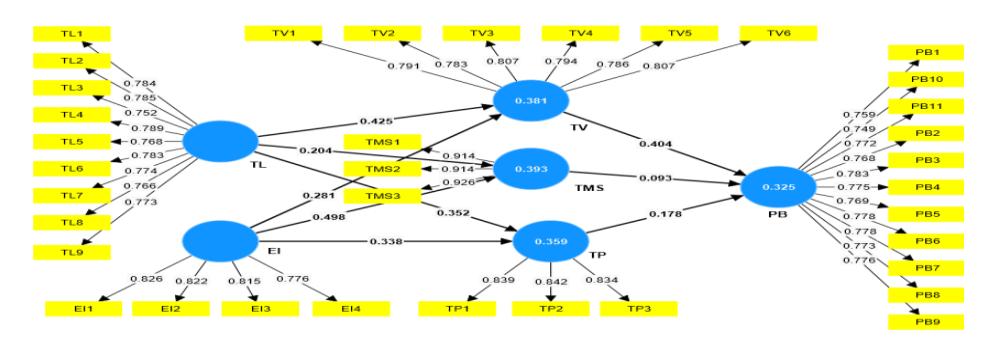
Figure 2 Measurement model.
For the assessment of discriminant validity, the heterotrait-monotrait (HTMT) ratio of correlations was employed. Discriminant validity is evaluated using the standard threshold of HTMT < 0.85 [36]. As shown in Table 3, the HTMT values for all loading factors were within the acceptable range, confirming the validity of the constructs.
Table 3 Heterotrait-Monotrait Ratio (HTMT)
| EI | PB | TL | TMS | TP | TV | |
|---|---|---|---|---|---|---|
| EI | ||||||
| PB | 0.476 | |||||
| TL | 0.584 | 0.572 | ||||
| TMS | 0.695 | 0.388 | 0.501 | |||
| TP | 0.641 | 0.496 | 0.615 | 0.561 | ||
| TV | 0.582 | 0.589 | 0.63 | 0.498 | 0.603 |
Note: EI = Emotional Intelligence; PB = Playability; TL = Transformational Leadership; TMS = Team Member Satisfaction; TP = Team Performance; TV= Team Viability.
4.3 Structural Model
After testing reliability and validity, we proceeded to validate the hypothesized model. Upon achieving satisfactory reliability and validity, we proceeded to test the hypothesized model. Following the methodology of Hari et al., a structural model analysis was conducted using 5,000 bootstrap samples. The study assessed the T-value (T > 1.96), ensured the bias remained as close to 0 as possible, and examined the 2.5% and 97.5% confidence intervals to fall within the range of [- 1, 1] [29]. As demonstrated in Table 4 and Figure 3, all model pathways met these criteria.
The results in Table 4 reveal a positive correlation between TL and TE (ß = 0.412, P < 0.001, t = 14.433), thereby supporting hypothesis H1. Additionally, EI shows a positive correlation with TE (ß = 0.455, P < 0.001, t = 16.068), confirming
hypothesis H2. Finally, TE is positively correlated with playfulness (ß = 0.455, P < 0.001, t = 16.068), which substantiates hypothesis H3.
The analysis further validates the indirect pathways. As shown in Table 4, the TL → TE → PB pathway (ß = 0.227, p < 0.001, t = 10.389) is significant. Similarly, the EI → TE → PB pathway (ß = 0.250, p <0.001, t = 12.774) is also supported. These results indicate that TL and EI can indirectly influence player's experiences of game playability. Moreover, TE plays a crucial mediating role in these relationships. This analysis highlights the significant mediating role of team effectiveness, suggesting that both TL and EI can enhance player's gaming experience by improving team effectiveness. These findings carry essential theoretical and practical implications for understanding the connections between leadership, emotional intelligence, and user experience in game environments.
Subsequently, an analysis of the total effects was conducted, with detailed results shown in Table 5. The findings indicate that TE exerts the most potent effect on playability, with an effect size of 0.55. Additionally, the total impact of EI and TL on playability exceeds 0.15 [36], suggesting a moderate impact. These results further confirm the significant effect of EI and TL on playability.
Table 4 Structural Model Examination
| HYP | Sample mean (M) | Standard deviation (STDEV) | T statistics (|O/STDEV|) | Bias | 2.50% | 97.50% | P values | Decision | |
|---|---|---|---|---|---|---|---|---|---|
| H1 | TL -> TE | 0.412 | 0.028 | 14.433 | 0.001 | 0.354 | 0.467 | 0.000 | Yes |
| H2 | EI -> TE | 0.455 | 0.028 | 16.058 | -0.001 | 0.400 | 0.510 | 0.000 | Yes |
| H3 | TE -> PB | 0.550 | 0.029 | 19.143 | 0.000 | 0.000 | 0.489 | 0.604 | Yes |
| TL -> TE - > PB | 0.227 | 0.022 | 10.389 | 0.001 | 0.185 | 0.272 | 0.000 | Yes | |
| EI -> TE - > PB | 0.250 | 0.020 | 12.774 | 0.000 | 0.212 | 0.290 | 0.000 | Yes |
Note: EI = Emotional Intelligence; PB = Playability; TL = Transformational Leadership; TE = Team Effectiveness.
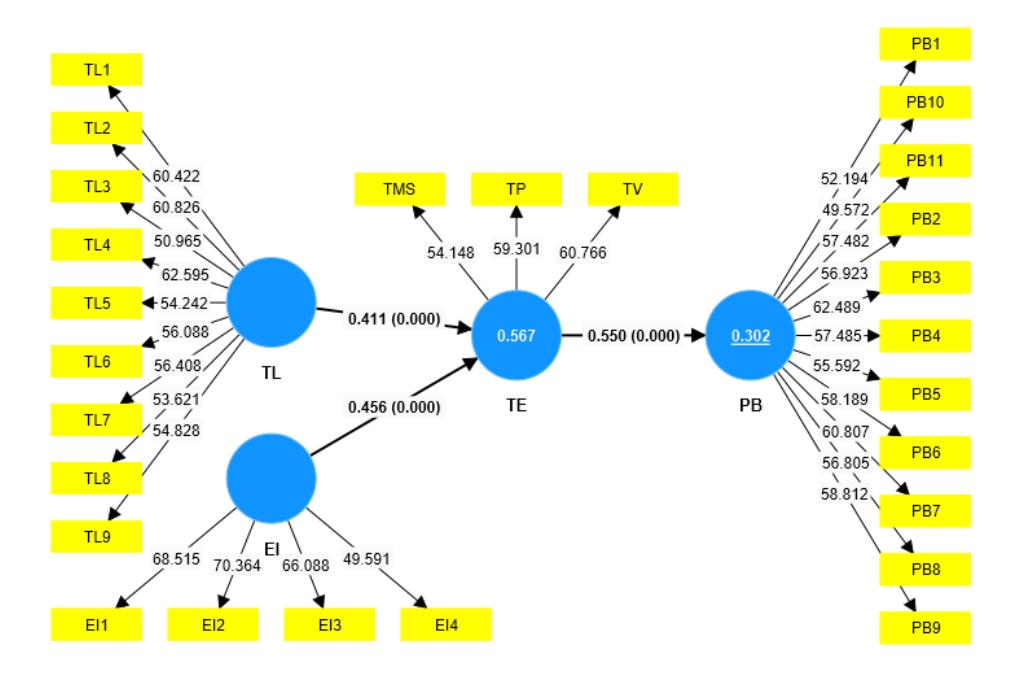
Figure 3 Result of hypotheses testing.
Table 5 Total Effect
| EI | PB | TE | TL | |
|---|---|---|---|---|
| EI | 0.251 | 0.456 | ||
| PB | ||||
| TE | 0.550 | |||
| TL | 0.226 | 0.411 |
Note: EI = Emotional Intelligence; PB = Playability; TL = Transformational Leadership; TE = Team Effectiveness.
4.4 Predictive Model Assessment
The results from PLS_predict indicate that, for nearly all items, the root mean square error (RMSE) obtained by the Linear Model (LM) is lower than the RMSE produced by the PLS-SEM. This suggests that the LM outperforms the PLS-SEM in predictive accuracy, a conclusion that also holds when considering the mean absolute error (MAE). Furthermore, when applying the Cross-Validation Predictive Ability Test (CVPAT), the average loss for LM was found to be smaller than that for PLS-SEM. In contrast, PLS-SEM outperforms the naive Indicator Average (IA) benchmark in both PLS_predict (as indicated by positive Q² values) and CVPAT (as demonstrated by a significantly negative difference in average loss). Therefore, the PLS-SEM model shows a certain level of predictive capability, surpassing the IA benchmark; however, it falls short of achieving the more stringent LM benchmark. This suggests that the PLS-SEM model has high predictive strength.
| Table 6 | Predictive Model Assessment |
|---|
| PLS_predict | CVPAT | |||||
|---|---|---|---|---|---|---|
| Construct | Item | Q²predict | PLS SEM_RM SE | LM_R MSE | IA average loss difference (p-value) | LM average loss difference (p-value) |
| PB | PB1 | 0.158 | 1.299 | 1.294 | - 0.326(0.000 | 0.016(0.266) |
| ) | ||||||
| PB2 PB3 | 0.157 0.171 | 1.316 1.279 | 1.305 1.263 | |||
| PB4 | 0.164 | 1.278 | 1.269 | |||
| PB5 | 0.159 | 1.307 | 1.303 | |||
| PB6 | 0.163 | 1.284 | 1.285 | |||
| PB7 | 0.158 | 1.282 | 1.275 | |||
| PB8 | 0.171 | 1.270 | 1.261 | |||
| PB9 | 0.163 | 1.283 | 1.278 | |||
| PB10 | 0.160 | 1.306 | 1.305 | |||
| PB11 | 0.175 | 1.288 | 1.286 | |||
| TE | TMS | 0.374 | 0.792 | 0.792 | - 0.368(0.000 ) | -0.002(0.623) |
| TP | 0.356 | 0.803 | 0.808 | |||
| TV | 0.370 | 0.794 | 0.793 | |||
| Overall | - 0.335(0.000 ) | 0.012(0.266) | ||||
Note: EI = Emotional Intelligence; PB = Playability; TL = Transformational Leadership; TE = Team Effectiveness; TMS = Team Member Satisfaction; TP = Team Performance; TV = Team Viability.
4.5 Age Effects on EI and TL
The median for all age groups for EI is somewhat near 0, suggesting that most people keep a more neutral level of EI. For the 18-25 age range, the median is slightly higher, implying that young individuals might have an edge in emotional regulation and emotional understanding, which may be connected to their adaptability and learning capacity. Reflecting the relative maturity and stability of adults in this stage of emotional intelligence, the median EI for the three age groups 26-55 is very consistent. Although remaining relatively near zero, the median for the 56+ age group shows a broader distribution, indicating more individual variances, which could be impacted by several elements, including physical condition and life experience.
For TL, the medians likewise show relative constancy over the 18-55 age groups, showing that leadership ability is somewhat steady across these three age groups, which may be connected to the fact that they are at the peak of their career
development. However, the 56+ age group exhibited a notable drop in the median, implying that, at this point; there might be a correlation between declining adoption of new technology and change. Simultaneously, the broader range of upper and lower whiskers in this group, where the lower border stretches farther in particular, reflects a more notable drop in TL qualities for some members of this age range. The solidification of ideas due to age, a reduced sensitivity to innovation, or a reduced receptivity to new ideas may be partly responsible for this degradation.
The medians show a tendency whereby the median TL ability falls dramatically in the 56+ group while the median EI is relatively constant over the age range. This implies that even though people might be able to sustain high degrees of EI, leadership skills, especially those connected to change, may fade with age.
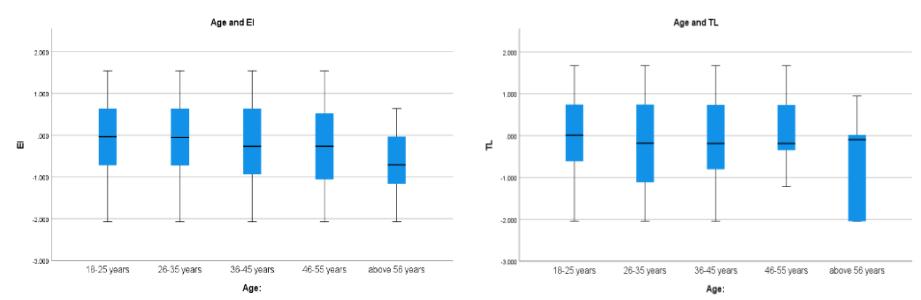
Figure 4 Age effects on EI. Figure 5 Age effects on TL.
5 Discussions
5.1 Findings
In the context of MMOGs, this study investigated the relationships between transformational leadership, emotional intelligence, team effectiveness, and perceived playability. The findings provide important insights, notably on the impact of EI and TL on MMOG playability. These findings advance our understanding of how these constructs interact in virtual gaming environments. The study's precise findings are as follows:
First, the findings show that TL has a significant positive effect on team effectiveness. This finding is consistent with a study conducted by Loyless, who found that TL improves team performance by encouraging team members internally [37]. However, Margara et al. (2024) revealed that embedding transformational leadership elements in VR-based training simulations enhanced team decision-making and trust development, demonstrating TL's efficacy in structured but immersive digital settings [38]. The current research indicates that the impact of transformative leadership extends beyond traditional settings and is crucial in virtual teams within MMOGs. EI was also discovered to have a positive impact on TE. This demonstrates that people with high EI can perceive and respond to the emotional states of others, resulting in improved communication and collaboration within teams. According to Wang et al., emotionally intelligent people enhance team dynamics by expertly managing interactions and resolving conflicts [39]. Likewise, Araújo et al. observed that software engineering students with higher EI were more successful in group projects, showcasing EI's influence across learning and problem-solving contexts [40]. Finally, the study indicated that TE has a significant impact on playability. This finding confirms earlier studies emphasizing the necessity of cohesive collaboration in developing engaging and immersive gaming experiences. For example, Chen et al. discovered that increased TE in online games increases player pleasure by promoting a sense of accomplishment, mutual support, and collaborative engagement [41]. Similarly, Wang et al. have claimed that efficient teams have better communication, clearer role assignments, and less conflict, all of which contribute to a happier team atmosphere [23].
While the overall findings are consistent with theoretical expectations, specific details warrant deeper examination. Notably, the study revealed that the indirect effect of EI on playability (β = 0.250) exceeds that of TL (β = 0.227). This surprising result suggests that in MMOG environments, individual emotional regulation may have a more direct impact on team collaboration and player experience than leadership styles. This observation likely reflects the highly interpersonal nature of virtual team interactions. EI plays a pivotal role in overcoming communication barriers and fostering a cohesive gaming experience. This is consistent with the findings of Papouts et al, emphasizing that games designed to enhance emotional intelligence not only improve collaborative abilities within the game but also translate into greater interpersonal sensitivity and cooperative abilities in non-game environments [42]. This highlights the central role of emotional intelligence in teamwork, particularly in time-sensitive or high-risk situations.
Many tasks in MMOGs are designed to incorporate real-time interaction and entertainment-oriented challenges, often requiring team members to respond promptly to changing in-game conditions and sustain coordinated actions during gameplay [1]. EI enables individuals to effectively manage stress and complex emotional dynamics, thereby enhancing both team performance and player experience. By contrast, the impact of TL may be more limited in this context. Although leaders can motivate the team and set clear objectives, their influence on immediate interactions and rapid decision-making may be less pronounced in fast-paced MMOG environments. These findings not only emphasize the importance of EI in virtual gaming teams but also suggest that leadership styles may need to adapt to the unique characteristics of collaborative games.
The effect of age on EI and TL was also examined. It can be seen that there is no significant difference in the impact of age on EI. However, for TL, it was found that players over the age of 56+ were generally less capable of TL, probably due to the inherent old-fashioned thinking of the players and the lack of encouraging leadership.
5.2 Implications
5.2.1 Theoretical Implications
The current study examined the perspective of individuals in MMOG teams and included EI and TL into the IPO model's input factors, expanding the model to quantify the impact of individuals on teamwork in MMOG gameplay. The study found that team efficacy has a significant effect on playability via effective mechanisms in virtual gaming settings, providing a novel theoretical perspective on virtual teams in MMOG research. Additionally, the study emphasizes the positive impact of EI on both TE and playability, highlighting its role as a key driver of team cohesion. These results open new directions for investigating emotional regulation in high-pressure, high-interaction MMOG scenarios. While TL also facilitates team collaboration, its influence is comparatively less pronounced than that of emotional intelligence. Nevertheless, the study extends traditional leadership theories by illustrating how leadership behaviors can adapt to the demands of virtual, high-intensity team tasks. This contributes valuable theoretical insights into tailoring leadership styles for digital collaborative environments.
5.2.2 Practical Implications
This study offers novel insights into the interaction between emotional intelligence, transformational leadership, and TE within the context of MMOGs, providing actionable recommendations for game developers.
The findings highlight the crucial role of EI in shaping virtual team dynamics. Players with high EI enhance team cohesion, collaboration, and satisfaction, directly contributing to a better gaming experience. Developers could incorporate emotion centered training tools into games, such as real-time feedback systems or scenario-based modules, to support players in understanding and managing their emotions during gameplay [5, 23]. For instance, features that detect stress indicators (frequent in-game errors or communication breakdowns) could offer adaptive strategies or guidance to alleviate emotional tension, fostering stronger team cohesion.
Additionally, the study indicates that TL significantly improves team efficiency, albeit through less direct mechanisms than emotional intelligence. To address this, gaming communities and developers could establish leadership development pathways, utilizing task-based challenges to identify and train potential leaders. For example, dynamic role-assignment systems could assign leadership roles during specific missions, promoting decision-making, conflict resolution, and team motivation. Leaderboards and in-game rewards would further incentivize leadership engagement, cultivating robust leadership skills among players [43].
Finally, the study underscores the role of team efficacy as a critical mediator between individual player attributes and overall playability. Effective communication, task delegation, and conflict mitigation significantly enhance player satisfaction and immersion. Advanced matchmaking algorithms could prioritize complementary player traits, such as pairing high-EI players with emerging leaders. By anakyzing past player data, which includes communication styles, task completion rates, and conflict resolution tendencies, these algorithms can assemble well-balanced teams, maximizing collaborative efficiency [44].
5.3 Limitations
This study had two limitations that should be addressed. It predominantly utilized a cross-sectional design, which, although useful for discerning correlations among variables, compromises causal specificity [28]. To address this restriction, subsequent research can implement a longitudinal design to examine prolonged team interactions, emotional adaption, and leadership behavior. This methodology would enable researchers to monitor temporal changes, validate causal sequences, and investigate the enduring impacts of leadership and emotional intelligence on cooperative outcomes [45]. Furthermore, altering leadership styles via a sequence of experiments within a virtual gaming environment can enhance causal inferences.
The second limitation was cultural distinctiveness. This study included regional restrictions, as all participants were Chinese players, which may limit the generalizability of the findings. The influence of cultural elements on leadership, emotional expression, and variations in team performance is highly contentious [46]. To improve the study's generalizability, subsequent research should examine participants from various countries with more heterogeneous samples and conduct cross-cultural comparisons.
6 Conclusion
MMOGs provide dynamic and high-pressure virtual environments, making them an ideal platform for studying the interaction between individual and team
factors. This study utilized MMOGs as a backdrop to explore the impact of individual EI and TL on TE and further clarified the role of TE in enhancing game playability. The study employed the IPO model, integrating social cognitive theory and user experience theory to construct the research framework. The results indicate that both EI and TL exert significant positive effects on TE, with TE playing a crucial mediating role in this process, effectively driving improvements in game playability. Notably, EI's indirect influence on playability is greater than TL's, underscoring the pivotal role of emotional regulation in fostering team cohesion and optimizing collaborative gaming experiences.
This study systematically examined the impact of individual characteristics (EI and TL) on team dynamics and player experience in MMOGs, addressing gaps in the existing literature on the mechanisms of virtual team interaction. The findings emphasize that relying solely on traditional leadership models in digital gaming environments may fail to stimulate collaborative effectiveness. Instead, it is essential to integrate players' emotional capabilities and team characteristics to develop adaptive leadership strategies and emotional support mechanisms, thereby fostering higher-quality collaborative experiences and player satisfaction. Future research should explore player dynamics across different cultural contexts or investigate the evolution of EI and TL in gaming environments through longitudinal studies. The influence of team relationship factors on game playability can also be extended to examine team dynamics in MMOG environments.