

1 Introduction
A campus can be conceptualized as a system of systems where interconnected components collaborate to achieve institutional goals [1]. In the era of rapid digital transformation and disruption, higher education institutions (HEIs) are under increasing pressure to enhance operational efficiency and competitiveness. One proposed solution is the adoption of a smart campus—an institution that leverages intelligent systems to improve service quality, solve operational challenges, and adapt to environmental changes [2]. While several models have been developed to conceptualize smart campuses—such as MIT's iCampus [3], Pagliaro's SC2 [4], and the UMA Smart Campus developed by the University of Malaga [5]—these frameworks primarily focus on specific applications or technologies rather than offering comprehensive, measurable implementation of smart systems. Furthermore, none of these existing models include a structured measurement model that captures the degree of smart system adoption across an institution's functions. This research addresses this gap by proposing a holistic smart campus framework that incorporates a precise definition, a smart service model, and a robust measurement instrument grounded in the anthropocentric, systemic, and technological dimensions of smartness [6].
HEIs face numerous challenges in implementing smart systems, including uncertainty in assessing their current level of digital maturity, fragmented or siloed smart initiatives without strategic alignment, limited stakeholder engagement in smart transformations, and insufficient mechanisms to evaluate the impact of smart services on institutional goals [7]. To address these issues, this research employed the Design Science Research Methodology (DSRM) [8] to develop a smart campus framework and its associated measurement model. This study was driven by the central question: How can a framework be designed to evaluate and guide the development of smart campuses?
The key contributions of this study include: A unified definition of a smart campus that integrates human, system, and technological factors [6], a structured service model segmented into Smart Tridharma, Smart Management, and Smart Living domains [6], a validated measurement instrument tested across 10 Indonesian HEIs, showing high reliability (Cronbach's Alpha > 0.8) and construct validity [6], a multi-level maturity assessment based on the Capability Maturity Model (CMM) adapted to the smart campus context [9].
2 Method
DSRM is a research methodology used to answer existing problems by designing effective and efficient solutions [7]. The primary objective of DSRM is to generate new knowledge in the form of artifacts, models, or processes to address practical problems or enhance system performance. The smart campus framework design process in this study used this methodology.
Selection of Participating Institutions
The institutions selected for evaluation were 10 universities in Indonesia, comprising both public and private higher education institutions (HEIs). The selection criteria included geographical diversity to ensure representation from multiple regions, institutional types, including large public universities and smaller private colleges, and willingness to participate based on institutional consent and access to administrative data.
A total of 9,961 respondents were involved, including students, lecturers, and structural officials, ensuring representation from multiple stakeholder groups within each institution. The smart campus framework developed in this study consists of three smartness perspectives: 1) anthropocentric smartness refers to the human smartness involved in delivering campus services; 2) a systemic evaluation assesses the smartness of the system itself by examining whether campus services are supported by automated smart system cycles, where the degree of automation and integration of these cycles determines the level of systemic smartness; 3) technological smartness focuses on the extent to which information technology is utilized in service delivery.
The measurement instrument was constructed using indicators adapted from the Capability Maturity Model (CMM) [10], structured into a Likert-based survey for anthropocentric factors and binary yes/no questions for systemic and technological perspectives.
2.1 Data Processing and Validation
A custom web application was built using PHP and MySQL to automate data collection and processing. The system ensured consistency in data entry and enabled real-time monitoring. Data analysis included reliability testing via Cronbach's Alpha (α = 0.883), exceeding the 0.8 threshold, validity testing using Pearson product-moment correlation, triangulation through interviews with campus administrators and comparison with uploaded system documentation. The smartness level for each campus was calculated as the average of all service scores and categorized into four maturity levels. We propose to operate a measurement model based on anthropocentric, systemic, and technological dimensions. Table 1 contains an explanatory description of each level of system smartness.
| Smartness Perspective | 4 | 3 | 2 | 1 |
|---|---|---|---|---|
| Systemic | Initiative | Responsive | Reactive | Impulsive |
| Technology | Technology is used in all system | Technology is used as needed | Technology is used in some systems | Doesn't use technology |
| Anthropocentric | Exemplary | Proficient | Sufficient | Unsatisfactory |
Table 1 Smartness level.
2.2 Comparative Analysis with Global Smart Campus Models
When compared to existing global smart campus models such as MIT's iCampus [3], Pagliaro's SC2 [4], and the UMA Smart Campus [5], this framework offers a more holistic and measurable approach. While many international models emphasize infrastructure or technological applications, the proposed framework incorporates governance, service integration, and human-centered indicators. This makes it particularly adaptable to varied institutional contexts, especially in developing countries like Indonesia.
2.3 Research Steps and Framework Development Flow
The development of the Smart Campus Framework followed the Design Science Research Methodology (DSRM), as depicted in the flowchart below (Figure 1). Each phase was designed to systematically build, implement, and validate the framework. The first step was problem identification, which analyzed the lack of integrated smart campus models and measurement systems. This was followed by making an objective definition to develop goals for creating a smart campus model and a tool for assessing smartness. The Design and Development step then created the smart campus model (Smart Tridharma, Smart Management, and Smart Living), developed smartness indicators across anthropocentric, systemic, and technological dimensions, and created and validated the questionnaire. The Demonstration step carried out a pilot-test of the model on 10 Indonesian HEIs using a web-based survey platform. In the next step, evaluation was done by conduct expert judgment (Ex Ante) and campus-level validation (Ex Post). The final step was communication: the findings were disseminated through reports, visualizations, and scholarly publications.
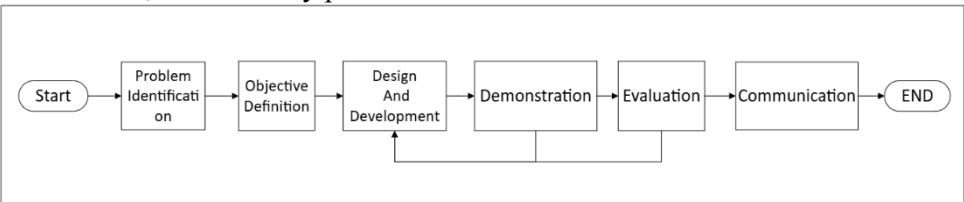
Figure 1 Research steps.
3 Results
The criteria for establishing a smart campus must be clear to make a definition of what a smart campus is. In this study, the notion of a smart campus refers to deploying a smart system, which has not been explored by prior research. The definition of a smart system in this research is: a system that can respond to stimuli by applying knowledge so it will solve crucial and complex problems.
3.1 Smart Campus Definition and Model
The following are the smart campus criteria: a smart campus makes use of information technology in campus management [6,11]; can improve the quality of service for all stakeholders, where stakeholders obtain benefits/solutions from the existence of the smart campus [10]; can solve campus problems in a smart way [12]; is able to achieve the university's vision by providing services that can be adapted according to the needs of each stakeholder [13]. Based on the characteristics listed above, we can say that a smart campus uses a smart system to fulfill its mission and realize its vision. Table 2 illustrates how we might specify a smart campus model using the principles above.
Table 2 Specifications of smart campus model.
| Smart Campus Model • Uses a smart system | |||
|---|---|---|---|
| Requirement | |||
| • Can carry out campus operations, governance, and | |||
| strategy | |||
| Impact | • Achieve the campus vision, mission, and goals | ||
| • Can improve service quality for stakeholders | |||
| • Can achieve efficiency | |||
| Input | Students, lecturers, educational staff, | ||
| Output | alumni | ||
| Achievement of vision, mission, and goals, solutions for | |||
| the community | |||
The proposed smart campus model answers the requirements in Table 1. The design of the smart campus model can be seen in Figure 2. The smart campus services consist of three service domains: Smart Tridharma, Smart Management, and Smart Living. Each service domain is divided into one or more services grouped into one cluster, and services per cluster will have one or more services to stakeholders.
For smart campus services to provide excellent service and achieve the vision, mission, and goals of the campus, they must be supported by three pillars: anthropocentric, systemic, and technological [9]. If the pillars become smart, each service will provide smart solutions, enabling problems related to horizontal operations to be addressed wisely and those related to vertical disruptions to be solved effectively. The smart campus model presented in Figure 2 was developed by the authors based on principles synthesized from existing smart campus literature and specification of the smart campus model and adapted to the Indonesian higher education context. Unlike earlier models that focus solely on infrastructure, our model integrates anthropocentric, systemic, and technology dimensions into a cohesive service-based structure.
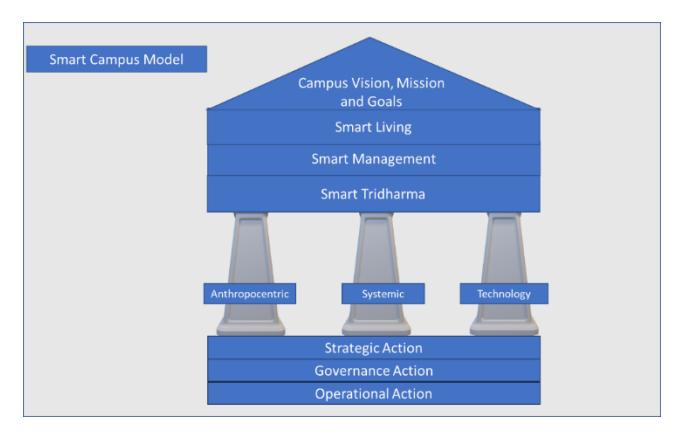
Figure 2 Smart campus model.
3.2 Smart Campus Measurement Model
Measurement means activities carried out to measure something by assigning numbers to the object measured. Measurements can be the basis for searching for correlations or interpretations and comparing measurement results with theoretical predictions. The smart campus measurement model measures a service's smartness by examining its ability to perform the types of actions associated with smartness. In this research, the assessment of campus smartness is based on a smart system designed to support the mission of achieving the campus vision.
The basic concept behind the measurement model is to guide decision-makers to reach the desired campus smartness level for the specified dimensions. We designed a maturity model using a level perspective to measure the smartness of the campus. The measurement model refers to the Capability Maturity Model (CMM) as the best model for measuring organizational maturity by checking whether the indicators measured are applied. Models such as the CMM utilize a Likert questionnaire to assess smartness [14].
The goal of the questionnaire was to figure out each campus's system's level of smartness. The evidence was gathered from programs in screenshots or user guides to demonstrate that the system characteristics matched the responses. Open-ended questions were asked to find how the respondents addressed the issues that arose based on their positions. This study used a Likert scale (1-5) for the anthropocentric perspective questionnaire. Respondents were selected from among students, lecturers, and structural officials. The following are examples of the types of questions used:
- 1. Does the service quality of the e-learning system help you in teaching? Respondents can answer: very satisfied, satisfied, neutral, dissatisfied, or very dissatisfied.
- 2. What is the processing speed of the e-learning system? Respondents can answer: very fast, fast, neutral, slow, or very slow.
- 3. Is the e-learning system easy to use? Respondents can answer: very easy, easy, neutral, difficult, or very difficult.
We employed binary yes/no questions for systemic and technological viewpoints. The list of questions was as follows:
- 1. Can data be automatically collected by the system? Yes or no (to gather data continually without human intervention, it will eventually be able to look for open data sources by itself.)
- 2. If so, can the system process and analyze data so that only human decisionmaking is required? Yes or no.
- 3. Is it possible for the system to make decisions based on the outcomes of the data analytics conducted? Definitely or not.
The interviewers requested documentation to demonstrate the existence of such a system based on the questions asked. Following that, campus administrators were asked to respond to verify the evidence. Following data collection, the smartness level was determined by averaging all values from each system to provide the campus smartness level assessed from all three perspectives. Every questionnaire question was examined from an anthropocentric, systemic, and technological perspective, and the results were mapped into the appropriate smartness level. The process of analysis involved cross-referencing each question's response with the evidence that was uploaded, examined, and scored at every smartness level. Next, the average of all 18 services systems was calculated to ascertain the campus's level of smartness. Following data analysis, campus administrators were interviewed, and many campuses were visited to verify the information from the questionnaire (samplings). Examples of the outcomes from the smart campus measurement assessment of the private campus X are shown in Table 3.
Out of 10 campuses, all campuses evaluated for anthropocentric smartness have already reached levels 3 and 4. This means that the ten campuses have integrated anthropocentric smartness into their campus management. Average systemic smartness is still at level 2. This means that systemic smartness must be increased through the use of smart systems in campus management. For technological smartness, most campuses are still at level 2, which means that technology must be implemented in the development of smart systems on campus for technological smartness to improve. Table 4 summarizes the maturity levels of anthropocentric, systemic, and technological smartness across the ten campuses
Compared to existing smart campus models such as the SC2 model by Pagliaro, the iCampus by MIT, and the UMA Smart Campus by the University of Malaga, this study presents a more comprehensive framework by integrating anthropocentric, systemic, and technological dimensions into a unified measurement model. Unlike prior frameworks, which often emphasize infrastructure and digital service deployment, our model emphasizes the interaction between human actors and smart systems, supported by empirical measurements of maturity levels. This multidimensional approach provides deeper insights into campus smartness, allowing decision-makers to identify targeted areas for improvement. This comparative advantage demonstrates the model's potential applicability across varied institutional contexts.
Table 3 Measurement of smartness level.
| Services | Anthropocentric | Systemic | Technological |
|---|---|---|---|
| Smart Research | 4 | 4 | 3 |
| Smart Academic | 4 | 3 | 3 |
| Smart E-Learning | 3 | 2 | 3 |
| Smart New Student Admission | 3 | 3 | 2 |
| Smart Student | 3 | 4 | 3 |
| Smart Community Service | 2 | 2 | 2 |
| Smart E-Office | 3 | 2 | 2 |
| Smart Internal Quality Assurance | 4 | 3 | 3 |
| Smart Human resources | 3 | 4 | 3 |
| Smart Finance | 3 | 3 | 3 |
| Smart Cooperation | 3 | 3 | 2 |
| Smart Canteen | 3 | 3 | 2 |
| Smart Sport Center | 2 | 2 | 2 |
| Smart Internet | 2 | 2 | 2 |
| Smart Classroom | 3 | 3 | 3 |
| Smart Safe and secure | 3 | 3 | 3 |
| Smart Parking | 4 | 3 | 3 |
| Smart Payment | 4 | 3 | 3 |
Table 4 Summary of smart level determination for ten evaluated campuses.
| Campus | Anthropocentric | Systemic | Technological |
|---|---|---|---|
| Public A University Bandung | 3.44 | 2.89 | 2.89 |
| Private B University Bandung | 3.11 | 2.88 | 2.61 |
| Public C University Bandung | 3.35 | 2.36 | 2.39 |
| Private D University Padang | 2.43 | 2.09 | 2 |
| Private E University Jakarta | 3.73 | 2.81 | 2.91 |
| Private F University Surabaya | 4 | 3.25 | 3.32 |
| Private G University Riau | 4 | 2.97 | 2.97 |
| Private H University Medan | 3.82 | 2.3 | 2.73 |
| Private I University Garut | 3.59 | 1.97 | 2.12 |
| Private J University Jakarta | 3.33 | 2.19 | 2.3 |
3.3 Evaluation of Smart Campus Framework
One of the main goals for evaluation in DSRM is to determine how well a designed artifact or collection of artifacts achieves its intended environmental utility [15]. There are two perspectives related to the evaluation of DSRM, namely the Ex Ante and the Ex Post perspective. In this research, the Ex Ante perspective tested whether the model is valid by existing requirements (expert judgment). The Ex post perspective testing is whether the measuring tool used can measure smart campus smartness based on user opinions.
Evaluation, which in design research entails actions to guarantee that the design satisfies the defined criteria and specifications, is done at this point. This can be accomplished by testing the design to ensure the smart campus framework complies with current specifications. In design research, evaluation entails quantifying and evaluating the quality and performance of designs. Field data gathering or real-world design performance monitoring are methods used for assessment. Evaluation is carried out by an impartial third party. The evaluations use an expert judgment approach as an independent party due to the research's time constraints. The smart campus framework assessment used expert judgment. Expert professors and researchers with over ten years of expertise in their respective fields from multiple Indonesian campuses attended a Zoom conference to understand the smart campus framework, as indicated in Table 5.
Name Academic Experience Position FP 26 years Lecturer, Dean from 2011 YMD 23 years Lecturer, Vice-rector (2016-2020) SF 13 years Lecturer, researcher SCCIC TMZ 17 years Lecturer, IT Director, Dean (2020-2024) W 14 years Lecturer, Vice-rector (2016-2020) SS 32 years Professor, Chairman of the Senate University ACN 29 years Lecturer, Researcher SCCIC JK 25 years Lecturer, Department Head (2020-2024) HT 22 years Professor, Lecturer, Dean (2016-2020) OP 32 years Lecturer, vice-rector from 2016
Table 5 Experts involved in evaluating the model.
The experts provided feedback via Google Forms, offering insights and suggestions. This feedback was essential in refining the framework's definition, structure, and indicators. The process also strengthened the decision to evaluate smartness through anthropocentric, systemic, and technological dimensions. To illustrate the depth of expert engagement, several key insights were recorded during the evaluation phase:
"The anthropocentric measurement is especially valuable because it highlights the often-overlooked human element in digital transformation efforts." – Professor SS, Senate Chairman
"Systemic smartness, as defined here, reflects a realistic progression for most campuses; it acknowledges the partial automation that still requires human oversight." – Dr. YMD, former Vice-Rector
"The model's clarity helps us map out our institution's position and plan digital initiatives more strategically." – Dr. FP, Dean.
These perspectives not only validate the framework's relevance but also demonstrate its practical utility in supporting institutional decision-making and strategic planning.
4 Discussion
The evaluation results provide several important insights into the current state of smartness across higher education institutions and the strengths of the proposed smart campus framework.
First, the findings indicate that anthropocentric smartness—which refers to human engagement, awareness, and the capacity to interact with digital systems—is consistently more mature than systemic and technological smartness across all ten HEIs studied. This suggests that while faculty, staff, and students are relatively prepared to engage in smart campus initiatives, the supporting automation processes and underlying technological infrastructure still require significant development.
Second, when compared to existing smart campus models such as iCampus [3], SC2 [4], and UMA [5], the proposed framework offers a more holistic perspective. While prior models largely emphasize digital infrastructure or specific applications, this study introduces a multidimensional framework that incorporates measurable indicators across the anthropocentric, systemic, and technological dimensions. This integrative approach enables institutions to assess their smartness more comprehensively and generate targeted improvement strategies.
Third, as detailed in Section 3.3, the expert judgement process confirmed the framework's relevance, flexibility, and practical applicability. Experts especially appreciated the anthropocentric dimension, noting that it addresses a commonly overlooked aspect of digital transformation: human readiness and interaction. This feedback supports the framework's ability to bridge the gap between
technological advancement and user-centric implementation, building upon and extending the automation-heavy focus of previous models [6].
Lastly, the study acknowledges several limitations. The use of a self-evaluation method and the limited geographical scope of participating institutions may introduce subjective bias. Additionally, the absence of real-time operational data restricts the depth of system-level evaluation. Future research should aim to apply the framework to a broader range of campuses and explore the integration of realtime system data and performance analytics to enhance the robustness and generalizability of the model.
5 Conclusion
This study developed a smart campus framework using the Design Science Research Methodology (DSRM). This framework guides both a smart campus model and its measurement, built on a smart system cycle of sensing, understanding, decision, action, and learning, offering a blueprint for higher education institutions. The model includes three key service domains: Smart Tridharma, Smart Management, and Smart Living, all designed to benefit stakeholders. Each service integrates anthropocentric, systemic, and technological smartness across its operations. The Smart Campus Measurement Model, validated through pilot-testing at 10 Indonesian campuses, assesses smartness across these dimensions, showing positive impacts on knowledge, productivity, and efficiency.