

L lntroduction.
In most industrial processes foam formation causes desirable or undesirable problems. In undesirable cases the formation of foam must be prevented or destructed, as is applied in water boilers, leather tanning, latex dipping processes etc. On the other hand one must promote foam formation for example in fire fighting mixture, soap solution, in ore flotation and in the manufacture of foam products like bread, foam rubber and plastic sponges.
Foam products are made for divergent purposes. In case of foam refractory, its high porosity is wanted for a good thermal insulation.
The effect of porosity on thermal conductivity has received a good deal of attention in recent years, viz. it rvas shown that the larger the porositv the smaller the value of the thermal conductivitv. 1)
'; Chem. drs. Lab. Kimia Koloid Teknik Bag, Kimia Teknik, Inst. Teknol. Bandung.
'fhe common method of producing pores in a fire clay product is to introduce to the plastic clay mix an organic material that later on carr be burned ollt to leave holes in the brick. Ground rvood, cork and other material of the same type are usually added to the plastic clay. So does the brick maker in Java, r'ho adds excrements of buffalo to the clay slip up to no\\r.
u,l.NoEn z) added flakes of naplithalene to the clay mix, that rn'hen later on the *'are is dried at high temperature, the naphthalene can be sublimed, and leaving pores in the dried clay product.
Introducing into the clay, bubbles of gas by chemical reaction as u'as introduced bv ERICSoN 3), that are sufljciently stable to remain in the mix until the material is dried and burned, one can obtain porous clay rvare. In this process, shale ashes, lime and metals such as Zn or Al lvere adapted to react ivith the other ingredients to generate gas rvhen rvater is added a).
ERIcsoN 5) and Roos 6) obtained products having considerable stability by mixing a preformed foam into the clay slip.
Still another method u'as introduced by MocHEL ?), rvho made bubbles in a sticky solution first, and then addirrg the refractorv powder to the mixture.
Coalescing of individual bubbles into larger ones carl be more or less prevented by adding to the clay mix, a setting agent e.g. gypsunl plaster as was done by HUSAIN and nor-r e).
All the above mentioned processes \\ere patented in the U.S.A. The present investigation of the author rvill shorv that it is possible to get a stable foam by beating a clay slip in the presence of a gelling agent, viz. sodium fluosilicate. Used as foaming agent was a sclution of "Teepol", a secondary sodium alkyl sulphate s), a detergent made by the Sheil Chemical Co.
lL Formation of clay-based foam.
- 1. Colloid Chemical Theory of Foam Svstems.
- a. Foam svstent.
A foam can be considered as a type of emulsion, in tvhich the inner phase is a gas, usually air. In agreement tvith the concept that iolloid systems are dispersed systems, in tvhich at least one dimension of one phase is very small 10), a foam can thus be placed on the list of colloid systems.
In foam brick the dispersed phase consists of bubbles of air, which are dispersed throughout the continuous solid clay phase. Such a solid foam is formed by introducing air in a clay slip and afterwards allowing the water to evaporate.
In consequence of foaming phenomenon, the interface between the water containing the clay particles and the air are increased enormously than beforehand.
Due to the existence of the so called surface tension of the water, energy is required to generate an increase in surface area of the liquid.
b. Surface tension.
Surfase tension arises from a tendency of a liquid to reduce its surface to a minimum resulting from the attraction forces which tend to pull the surface molecules into the interior, and is measured in an atmosphere saturated with the liquid vapour <sup>11</sup>).
Surface tension is usually denoted by the symbol \(\gamma\) and is numerically equal to the work necessary on creating a unit area of new surface.
In the basic thermodynamic function:
\[dU = \eth Q + \eth W + \mu dv \tag{1}\] the quantity of work done \(\eth w\), for a liquid-gas interface which undergoes extension of its area, can be replaced by \(\gamma dA\), so we obtain
\[dU = \delta Q + \gamma dA + \mu d\nu \tag{2}\] or because
\[\delta Q = TdS \tag{3}\]
(2) becomes
\[dU = TdS + \gamma dA + \mu dv \tag{4}\] where for the system, *)
*) Most of the symbols are borrowed from:
KRÖNIG, R. Leerboek der Natuurkunde, 3de verbeterde druk, Scheltema & Holkema's Boekhandel en Uitgeversmaatschappij N.V., Amsterdam (1951).
2. ZERNIKE, Thermodynamica en Statistiek in de Chemie, 2de druk, N.V. Uitgevers-Maatschappij AE. E. Kluwer, Deventer-Djakarta (1950).
U: internal energy
\(\partial Q\): a small quantity of heat given to \(\partial W\): a small quantity of work done on μ : energy required to add a unit of substance to the system passing along a quasistatic manner at constant surface area of the interface <sup>12</sup>)
v: quantity of substance in the system
T: absolute temperature
S: entropy
\(\gamma\): surface tension A: surface area.
F: free energy, (U-TS), see below
When then the gas phase, is saturated with the liquid vapour, then there exists equilibrium of mass transfer through the liquid-gas interface, e.i. \(d\nu = 0\), so equation (4) becomes.
\[(d\mu)_{\mathsf{V}} = Tds + \gamma dA \tag{5}\]
The free energy \((F)_{\nu}\), for \(\nu\) is constant, which is formulated as \((F)_{\nu} = (U)_{\nu} - TS\) (6)
gives after differentiation
\[(dF)_{V} = (dU)_{V} - TdS - SdT \tag{7}\]
Substitution of (5) in (7) gives
\[(dF)_{V} = SdT + \gamma dA \tag{8}\]
When the phenomenon occurs isothermally, then we obtain \((dF)_{V,T} = \gamma dA\)
or
\[\gamma = \left(\frac{dF}{dA}\right)_{\nu,T} \tag{10}\]
(9)
At constant temperature, a system consisting of a liquid phase and a gas phase, which is saturated with vapour of the liquid, has, if the system has still the two phases in equilibrium, a constant vapour pressure too, hence equation (10) can be written as
\[\gamma = \left(\frac{dF}{dA}\right)_{\nu,T,P} \tag{11}\]
For a liquid having more than one constituent in equilibrium with its vapour mix, equation (11) becomes
\[\gamma = \left(\frac{dT}{dA}\right)_{\nu_1, \nu_2, \nu_3, \dots, T, P}.\] (12)
Therefore surface tension is defined as a quantitv, rvhich is numer; cally equal to the free energy increase in a system on creating a unit area of nerv surface at constant composition, temperature and pressure.
c. Surface tensiort lozoering by addition of soap or its substihie.
Soaps or their substitutes can reduce the surface tension of water at the gas-liquid interface, thus facilitating the lbrmation of foam in water. The soap acts, then as foaming or frothing agent.
The relation between surface tension and concentration of surface-active agent is usually expressed by the surface concentration equation of Gibbs 13)
\[a = \frac{\alpha}{RT} \frac{d\gamma}{d\alpha} \tag{13}\] where 4 : amount of solute per unit area of surface adsorbed or concentrated in the surface or interfacial layer
a : activity of the solute (a : fc for c: concentration and f : activity coefficient)
R: gas constant
T : absolute temperature
T : surface tension
From the above equation it follows that the adsorption of a dissolved substance is positive when dy/dc is negative, that is when further addition of the solute lowers the surface tension.
Experience has shorvn that relatively lou' concentrations of highly surface-active substances lower the surface tension of rvater to a marked degree, and thereafter the surface tension remaining approximately constant, or even passing through a minimum follorved by a shallorv maximum but still at a surface tension far below that of the solvent 1a).
d. Stabilizing of foam.
A stable foam in rvater can be formed, rvhen finely divided unsoluble solids pass into the interface of the rvater and the gas phase and building mechanicallv strong films. Finely divided clay that may or may not be of colloidal dimension is usuallv used as foam stabilizer 15).
Thus in the present experirnents, we are dealing rvith the building of foam of clay, the finely divided portion of which acts as foam stabilizer.
2. Gelling of Clay-Water System.
tt. Kaolin, the basic rnaterial for the processing.
Kaolin is one of the most important varieties of clays, crrntaining as its main constituent the mineral kaolinite, rvhich has the empirical oxide formula A1sOB.2SiO2.2LI2O. Kaolinite particies are hexagonal plates n'ith variable thickness and diameter; it has been reported that lnost of the particles are 50nrp ir diameter and 10mg. thick 16).
Clays may be considered to be formed by natural hydrolysis of feldspar, a potassium aluminosilicate, and various alkaline alumiirosilicates, by atmospheric action u) ;
\[K_2O.A1_2O_3.6SiO_2 + 2H_2O + CO_2 \rightarrow A1_2O_3.2SiO_2.2H_2O + 4SiO_2 + K_2CO_3\] (I)
I t
I
'fhc combined l'ater of clays present as hydroxyl group as denoted by the forrnule A1, (OH)+(SirOr)tu), rvhich corresponds to the atornic arrangement alter u.q,usnnrs) as shorvn in Figure 1.
According to reaction (I), normal clays ahvays contai;r besides undecomposcd f'eldspar and silica, more or less metals, particularly alkalies and alkaline earths. A substitution of the trivalent for the tetravalent silicon leaves one negative charge upon the lattice which has to be compensated by free positive ions upon or lrear its surface tn). No doubt, ions of the above alkalies and alkaline earths are bonded by the negative clay forming the so callcd salts of clay.
Tropical soils in rainy regions hale much of the metals washed out by water, leaving the acid or hydrogen clay 20)
b. Electric charge on clay particles.
Under neutral or alkaiine conditions, by ionizatioir of the salts of clay or hydrogen clays, the clay particles become thus negatively charged. That this is the case rvas first performed by REUSS 21) in 1808 by treating a clay hydrosol to electrolysis, which showed that the clay particles moved to the positive electrode, a phonomenon that is usually called cataphoresis or electrophoresis.
According to FORD, LOOMIS and FIDIAM 22) broken edges on clay particles exposing aluminum ions will be positive,
Figure 1 Atomic arrangement in kaolinite after HAUSER <sup>18</sup>). TH. 1 No. 2 PROCEEDINGS 1961
whereas the other edges will be negative. Direct evidence for positive edge sites kaolinite was found earlier by THIESSEN <sup>23</sup>) and later by MERING and his coworkers <sup>24</sup>) who obtained electron micrographs showing very clearly the attachment of negative gold sols at the edges of the clay flakes.
c. Flocculation and gelling of clay particles in water.
In a salt free system and slightly acid conditions, positive charges can develop on the edges of the clay plates giving rise to an edge-to-face type flocculation, because of the existence of electrostatic attraction between positive edge and negative face of the clay particles <sup>25</sup>). Such a flocculated system is often described as resembling a house of cards <sup>25,26</sup>) as is shown in Figure 2. <sup>26</sup>)
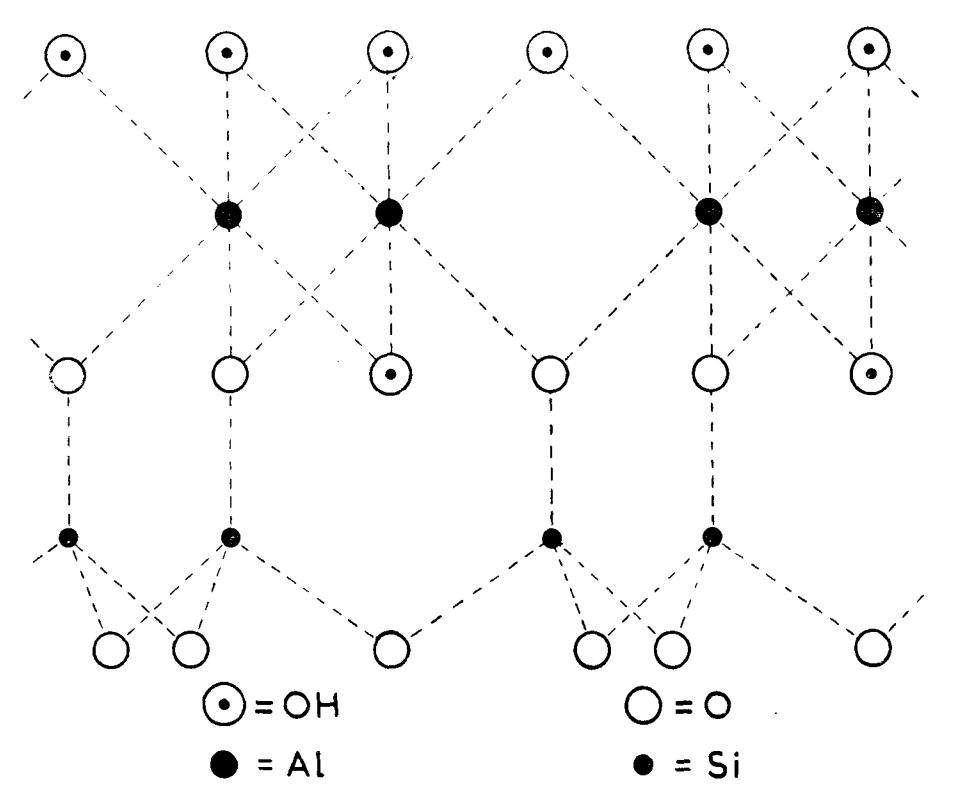
Figure 2. House of cards flocculated system of kaolinite particles. 26). INSTITUT TEKNOLOGI BANDUNG
When the clay suspension is dense enough, a firm gel can be built-up.
By addition of small amounts of electrolyte, clay suspension which exhibits little or no gelling tendency can be converted into a gel <sup>27</sup>).
Because there is no sharp limit between gel formation and the formation of flocculatous precipitates <sup>28</sup>), in the present investigation the author used sodium fluosilicate as gelling agent, which has a delayed gelling action, and which is commonly used in the rubber industry for the preparation of foam rubber from latex.
d. The terms gel and xerogel.
HERMANS <sup>29</sup>) assigns the term gel to a system characterized by the following points:
- i) there are coherent colloid disperse systems of at least two components;
- ii) they exhibit mechanical properties characteristic of the solid state;
- iii) both the dispersed compenent and the dispersion medium extent themselves continuously throughout the whole system.
In case of gelled clay system, after evaporation of the water, a harder and a stronger system which is called xerogel is formed. The evaporation process is accompanied by a shrinkage corresponding approximately to the volume of liquid removed <sup>30</sup>).
e. Sodium fluosilicate, the gelling agent.
As said in c. in the present experiments sodiumflu osilicate is used for the gelling of clay system. The rather high acidity of the salt in water and its low solubility, viz. 0,76 grams in 100 grams of water at 25°C. <sup>31</sup>), makes it most suitable, thus prevents overdosage and local high concentration of acid formed to hydrolysis, which after KUBELKA and PRISOUPIL goes as follows <sup>31</sup>):
\[2H_2O + SiF_6^- \rightarrow 4H^+ 6F^- + SiO_2\] (II)
Sodium fluosilicate was used since 1925 as coagulant for rubber latex by srEVENs ez; and for the first time as gelling agent ; for the manufacture of foam rubber in 1929 by the DUNLoP RUBBER Co., Ltd. 33).
In the presence of sodium fluosilicate the pH of the clay slip decreases, hydrogen ions adsorbed on the clay particle, so the effective negative charge on the particles diminishes, thus facilitating the approaching to each other of individual particles follos'ed by the formation of a gel.
III. Preparation of green foam brick
1. N'lixing the Ingredients.
Kaolin from the island Bangka, commonll' called Bangka clay, was used for the experiments. Lumps (composed of sticked frne porvder) of the mineral rvere crushed in a mortar, aird dried f<.rr at least five hours in a drying over) at 110"C.
The cooled crushed clay u'as then grinded in a han'rmer mill, and afternards screened. The portion smaller than the mesh number E0 of the U.S. Sieve Series, u'hich correspontls to 0.1 t-7 rnm. 3r), rvas used as the starting material for the foam clay u'are.
The mixture used by the author for preparing the foam pro- t duct in laboratorv scale had the follou'ing cornposition (in grams). I
| 700 | |
|---|---|
| 390 | ( |
| +.2 | |
| 11.2 | |
The above compounded mix u.as used for the preparation of trvo samples, rvhich rvere cast in trvo same moulds having the dimension of 20 cm. in length, 7 cm. in rvidth, and 5 cm. in height, made of galvanized iron sheet.
The liquid part of the ingredient for the mirture \vas prepared by making a bentonite suspension of 1-5!,u in the "Teepol" e) solution first, follorved by addition of the scdium fluosilicate to the bentonite slip until a proper dispersion rvas formed. Here the bentonite was used as dispersing agent for the practically insoluble sodium fluosilicate in water. The mixing procedure was as follorvs, 'to 24 g. 2.2% "Teepol" solution, rvhich was placed in a mortar rvas added 4.2 g. bentonite slowly. The mixture was then homogenized by grinding with a pastile and finally thc 11.2 g. of the sodium fluosilicate added there in, under thouroughly grinding. About a third portion of the bulk surfactant solution rvas then poured little by little in the mortar, the viscous slip formed was transfered to a beaker, n'hile the rest or the solution was used for rinsing the mortar. The *'hole amount of the dispersion was then prepared to be used for the process.
The dispersion u-as aftenvards added to the 700 g. kaolin portion by portion n-hich ri'as placed in a pan, under, thouroughly kneeding and stirring by means of a spatula. By such treatrrent one should obtain a clay slip har-ing a consistency like that of ice cream. This mixing period lasted about 5 minutes.
The niixture was then beated. For the experiments the author used a common egq beater consisting a curled iron tvire as the beating pert, u'hich is attached on the top of a rvooden handle.
After 10 minutes beetins u'ith a beating interrsity of three strikes per second, the loarned slip I'as transfered bv means of a tro-*.el to the trvo n.rolrlcls.
The follorving paragraph u'ould eluciclate the castine procedure done by the author.
2. Casting the Foamed Slip.
-^!)
I
Before being used, the inner rvalls of the mould rvere rvetted rvith tl-re "Teepol" solution and aftenlards coated l.ith sawdust having a srain size smaller than the mesh number 60 of the U.S. Sieve Series, u'hich corresponds to 0.250 mm. 32) Such treatment rvould make the releasing of the cast ware from the mould easier, and the more because in the presence of the saw-dust layer, creeping of the clav s'are due to shrinkage during the evaporation process of the u-ater, can run very smoothly. The air chick proceeds betrveen the clay rvare and the rvali of the mould, after the system
has been allowed to stay during the drying period, facilitiates the evaporation process too.
The foamed clay body can be released 3 days after it was cast.
3. Drying the Clay Gelled Foam.
The releasing of the foam product was done as follows. A wooden plank having the dimension conformable to the open side of the mould was placed on the mould opening, followed by turning the system upside down and at last lifting the mould carefully leaving the green ware lain face down in the plank.
The product was then dried at room temperature during one week or more.
IV. Conclusions.
- 1. "Teepol" proves to be useful for the foaming prosess of clay slip.
- 2. A firm clay gel can be produced by using sodium fluosilicate as gelling agent.
- 3. Coating of the inner walls of the mould with saw-dust makes the releasing of the cast clay ware from mould easier.
- 4. Physical data of the foam brick will be reported in Part II of this investigation.
V. References.
- 1. Murray, P., Livey, D.T., and William, J. in W.D. Kingery's Ceramic Fabrication Processes, 159, The Technologi Press of Massachusetts Institute of Technology and John Wiley & Sons, Inc., New York; Chapmen & Hall, Limited. London (1958).
- 2. Norton, F.H., Refractories, 142, 3rd. ed., McGraw-Hill Book Company, Inc., New York; Toronto: London (1949).
- 3. Ibid: Ref. 2, 143.
- 4. Chem. Abstr. 25,5747 (1931).
- 5. Ibid. Ref. 2,144.
- 6. Ibid. Ref. 2,144
- 7. Chem. Abstr. 45, 6818c (1951).
- 8. Ibid. Ref. 2, 144
- 9. Van Alphen, J. Rubber Chemicals, 111, Elsevier Publishing Company Amsterdam; London; New York; Princeton (1956).
- 10. Weiser, H.B., A Textook of Colloid Chemistry, 6, 2nd ed. John Wiley & Sons. Ins., New York; Chapman & Hall, Limited, London (1956).
- 11. Hauser, E.A., and Lynn, J.E., Experiments in Colloid Chemistry, 45, McGraw-Hill Book Company, Inc., New York; London (1940).
- 12. De Boer, J., in R. Krönig's Leerboek der Natuurkunde, 662, 3de verbeterde druk, Scheltema & Holkema's Boekhandel en Uitgeversmaatschappij. N.V., Amsterdam (1951).
- 13. Ibid. Ref. 10., 17-19.
- 14. Mc. Bain, J.W., Colloid Science 57, D.C. Heat and Company, Boston (1950)
- 15. Ibid. Ref. 10,355.
- Hofman, U., in A. Kuhn's Kolloid Chemisches Taschenbuch. 198,4 te erweiterte Auflage, Akademische Verlagsgesellschaft, Geest & Portig, K.G. (1953).
- 17. Lewis, W.K., Squires. L., and Broughton, G., Industrial Chemistry of Colloidal and Amorphous Materials, 450, The Macmillen Company New York (1952).
- 18. Ibid. Ref. 14, 383.
- 19. Bridley G.W., in W.D. Kingery's Ceramic Fabrication Processes (see Ref. 1), 12.
- 20. Ibid. Ref. 14, 378.
- 21. Ibid. Ref. 17, 187
- 22. Ibid. Ref. 14, 396
- 23. Ibid. Ref. 19, 17-18.
- 24. Ibid. Ref. 19, 18
- 25. Ibid. Ref. 19, 18
- 26. Ibid. Ref. 16, 303
- 27. Ibid. Ref. 17, 248
- Hermans, P.H., in H.R. Kruyt's Colloid Science, Volt. II, 490, Elsevier Publishing Company, Inc., New York; Amsterdam; London; Brussels (1949).
- 29. Ibid. Ref. 28, 484.
- 30. Ibid. Ref. 17, 225.
- 31. Hampel, C.A., Chem. Eng. News. 27, Part II, 2421 (1949).
- 32. Chem. Abstr. 20, 311 (1926).
- 33. Barron, H., Modern Rubber Chemistry, 255, D, van Nostrand Company, Ins., New York (1948); Chem. Abstr. 25, 473 (1931).
- 34. Perry, J.H. Chemical Engineerings' Handbook, 963, 3rd. ed., McGraw-Hill Publishing Company Ltd., New York; London; Toronto (1953).