

I. INTRODUCTION.
NGC 6649 is a galactic cluster situated at R.A. l8t'2'7y9, Dec. - 10o28' (1900); lr :349'4, bI - - 2'.3 and III :2116, bII -. --018. According to Tmmpler (1930) it is of class I2m and has an angular diameter of 7.5.
NGC 6649 has been investigated by several astronomers. The distances which they have obtained for this cluster range from 550 to 3850 pc. The distance determined by Trumpler (1930) is 1830 pc., while Shapley (1930) has estimated it between 2090 and 3310 pc. The greatest distance 3850 pc. was derived by Collinder (1931). Charlier (1918) was the first who made an estimate of thc distilnce of NGC 6649; he tbund a value of 550 pc. This is in good agreemerlt with the determination of Cufiby (1940). He gave a value of 570 pc. The nrost recerrt deternrination was nade by Barkhatova (1950); she obliiined il distancc of 800 pc.
Photoelectric observations of one of the stars in the cluster region (the star denoted No. 64 by Cuffey, 1940) have shown that this star is a possible Cepheid variable (Roslund and Pretorius, 1962). An accurate determination of the distance of NGC 6649 is thus very important. In this paper the result of a new distance determination is given.
Star No. 42 is the visual double star ADS 11441. Although it fits the colour-magnitude diagram, it is probably a foreground star.
An identification chart for the stars in NGC 6649 is given in Fig. 1. The numbers of the stars on this chart are those used by Cuffey (1940).
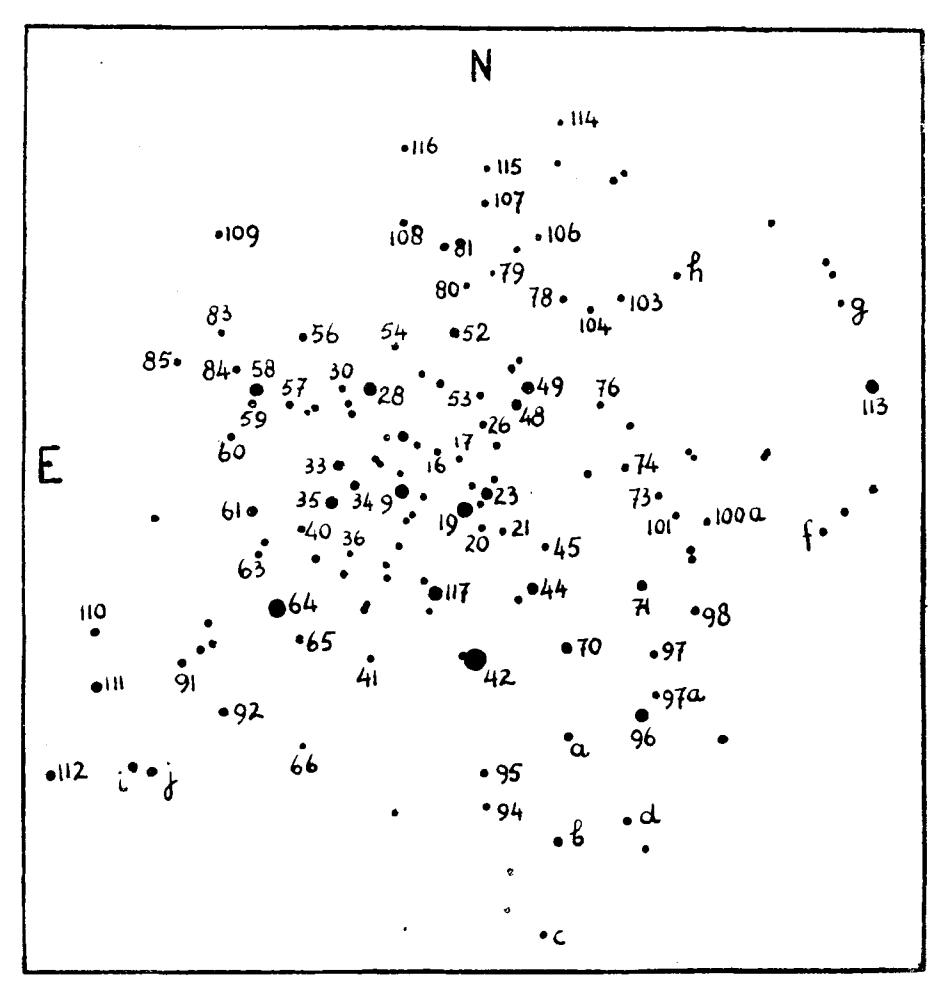
Fig. 1. Identification chart for stars in NGC 6649.
TABLE I. List of stars measured ohotoelectricallv
| B-V | U-B | ||||||||
|---|---|---|---|---|---|---|---|---|---|
| 9 | tt.7 6 | 0.20 | Std | 78 | l5 t l | 1.10 | I | ||
| t7 | 13.88 | 2 | 79 | 15.35 | 1.21 | I | |||
| l 9 | 12.09 | Std | 80 | 15.54 | Ll5 | I | |||
| 2 l | t4.28 | 2 | 8 1 | 14.08 | 1.50 | 2 | |||
| ) R | 12.39 | 2 | 91 | 14.54 | Ll0 | 2 | |||
| J J | 12.72 | l. l 3 | 0.57 | 2 | 95 | 15.05 | 1.05 | 2 | |
| 31 | 13.16 | l.t5 | 0.49 | 2 | 96 | t3.32 | 1.04 | 0.43 | 2 |
| 3 5 | 13.04 | l.n | 0.54 | 2 | 97 | 14.81 | 1. l 0 | I | |
| 40 | 14.38 | l.lr | 2 | 97a | 15.56 | 1.6+ | 2 | ||
| q : | 9.s2 | 1.91 | 1.32 | I | 103 | 14.40 | t.2l | I | |
| 52 | 13.07 | 1.29 | 0.58 | 2 | 104 | 14.20 | t.2l | I | |
| 54 | I A 1 A | 1.30 | 2 | 101 | 14.31 | r.3,1 | I | ||
| 56 | 13.89 | 1.25 | 2 | 108 | 11.78 | 1.27 | I | ||
| 59 | 14.07 | 2.10 | I | 109 | 14.63 | 2.58 | 2 | ||
| 60 | 15.21 | 1.21 | 2 | u0 | 14.04 | 2.t1 | z | ||
| 6 l | 13.48 | t.l4 | 0.5 I | 2 | lll | r 3.30 | ?25 | 2 | |
| 64 | Var. | Var. | t2 | 113 | 12.11 | 1.02 | 0.1-+ | 2 | |
| 10 | 13.84 | r.t4 | 0.44 | 2 | l 4 | l4. iilJ | l.oi | 2 | |
| 7 l | I +.O-1 | l.l9 | I | r15 | t 4.41 | 1.28 | 2 | ||
| 1 4 | 14.23 | 1.20 | I | 116 | 14.40 | l.16 | I | ||
| n7 | 12.03 | 2.50 | 2 |
2. PHOTOELECTRIC PHOTOMETITY.
Forty-one stars in NGC 6649 were observed photoelectrically by li4r. Willem Pretorius with the 60 inch Rockefeller reflector at tlie Boyderr Observatory, South Africa. This photoelectric sequence reduced to the UBV system defines the photometric scale and zero point for the photographic photometry.
The photoelectric obserr.lLiions u'ere nitrde on four nights between September 6 and 14, 1961. l\\o stars. Nos. 9 and 19 of Cuffey's list were selected as photontetric standard stars and scrc obsclre<l scveral tinies
during each observing ni-eht. The zero point of the nagnitude scale was transferred from observations of standard stars in the Harvard Region E7 (Cousins and Stoy, 1961). The relation between the instrumental system of the Rockefeller reflector and the Johnson UBV system was determined from observations of stars in the same region.
The internal mean error in one photoelectric determination of the apparent visual magnitude V and the colours B-VandU-B is about +0.015 mag. for a star of magnitude V : 12.0, B : 13.0 and U : 12.0, respectively. For fainter stars the accuracy is considerably less. The corresponding mean errors exceed + 0.10 mag. for stars fainter than V : 14.7, B : 16.0 and U : 15.2.
The result of the photoelectric nleasurements is given in Table L Col. I gives the number of the star according to the chart in Fig. I and Col. 5 the number of nights on which the star rvas observed.
.]. PHOTOGRAPHIC PHOTOMETRY.
Seventy-three stars in NGC 6649 were measured on photographic plates taken with the 20 - 28 inch Unesco Schmidt type telescope at Lembang. The plates used were Eastman Kodak IIa-0 behind a 2 mm Schott GGl3 filter for the determination of the blue magnitudes and for the visual magnitudes Eastman Kodak 103a-D combined with a 2 mm Schott GGI I filter. Six plates in the biue and four plates in the visual region were measured with the Eichner variable iris diaphragm photometer of the Bosscha Observatory. A specification of these plates is given in Table 2. In order to minimize the influence of an eventLral tilt of the plates relative to the focal plane, pairs of plates were taken with the telescope reversed and not reversed. In Table 2 this is indicated in Col. 5 by respectively an N (north) or an S (south).
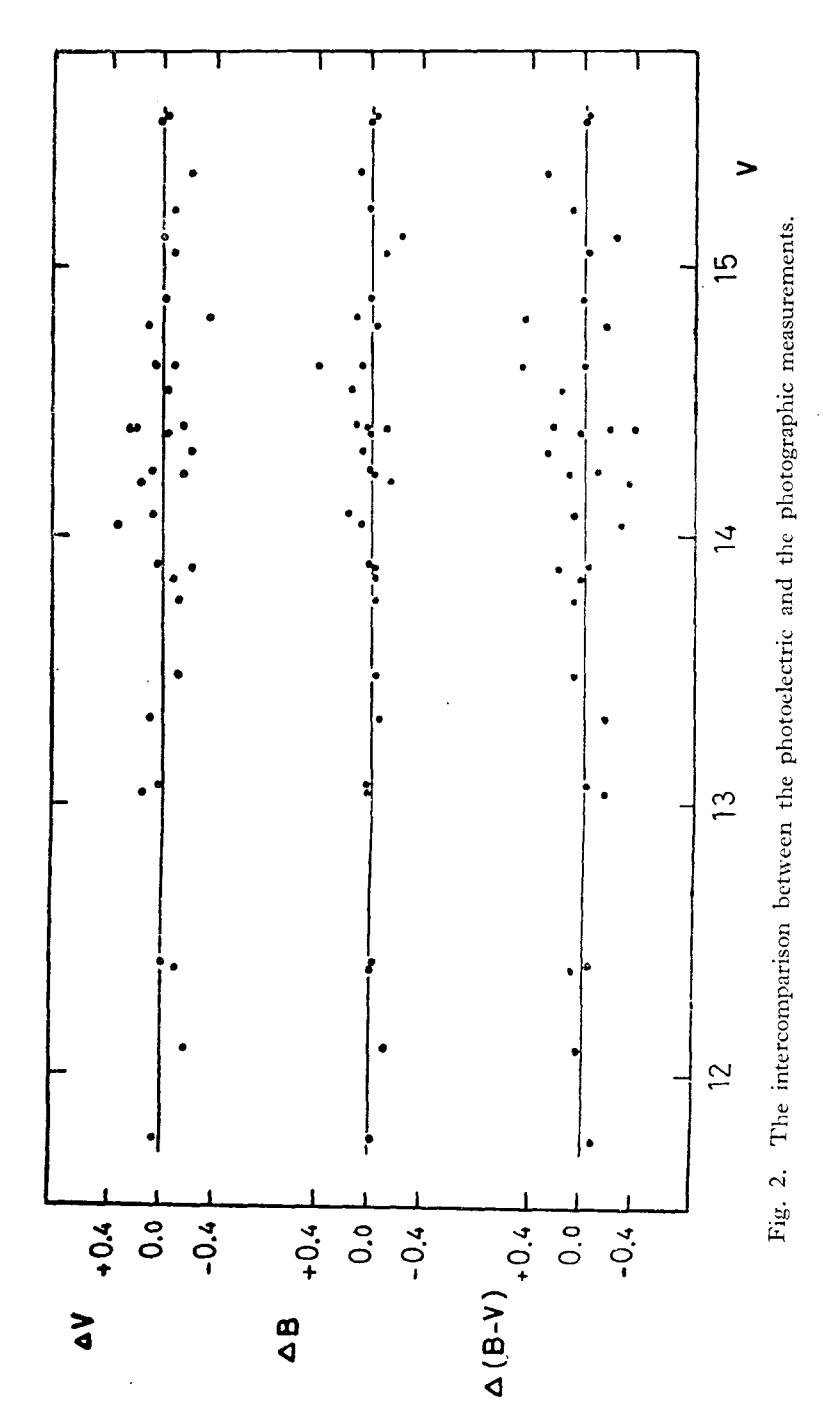
The stals nreasured photoelectrically rvere used in constructing calibration curves for the photographic phototnetry. In order to investigate the existence of any nra-unitude or colour equations belween our photographic system and the standard systen, the photographic and the photoelectric measurements of the standard stars rvere intercornpared. The result of this intelcomparison is illustrated in Figs. 2 and 3. These figures show that no magnitude or colour equations are present. Consequently, the photographic data reported in this paper are in the Johnson UBV system. From the intercomparison it is also lbund that the dispersion betrveen the photographic and tlie photoelectric observatit'rns is about + 0.04 mag. for B magnitudes and -;0. l0 mag. for V magiriLud('s and B - V colours tbr stiLr-. [.rishter than apparent visual nrlcnitude i4.0.
INSTITUT TEKNOLOGI BANDUNG
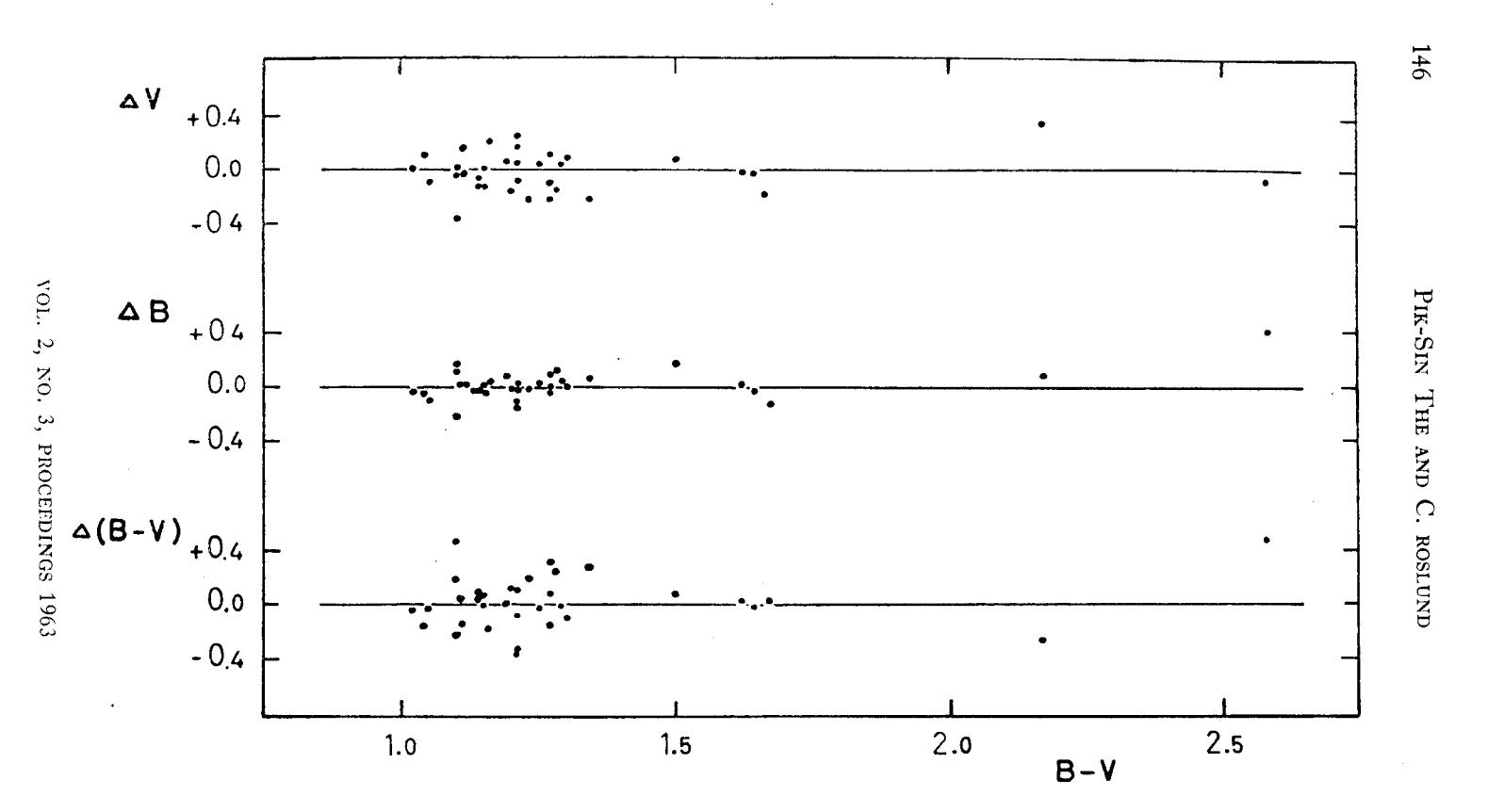
Fig. 3. The intercomparsion between photoelectric and photographic measurements.
The result of the photographic photometry is given in Table 3, in which the stars are identified according to their numbers in Fig. 1.
TABLE 2. List of photometric plates.
| Colour | Plate No. | Date 1961 | Emulsion | Filter | Exp. time | Telescope |
|---|---|---|---|---|---|---|
| V | 129 130 145 146 | Spt. 6-7 6-7 10-11 10-11 | 103a-D | GG11 | 3 min. 1 1 3 | S S N N |
| В | 131 132 133 148 149 150 | Sept. 7-6 6-7 6-7 10-11 10-11 | IIa-0 | GG13 | 10 3 1 10 3 1 | S S N N |
4. DISCUSSION OF THE PHOTOMETRY.
The colour-magnitude diagram for eighty stars in the cluster region of NGC 6649 is shown in Fig. 4. The filled circles represent the individual photoelectric observations from Table 1, while the open circles represent the data obtained photographically in Table 3.
Fig. 4 shows that the observed cluster sequence of stars runs almost vertically from the 12th to the 16th apparent visual magnitude. This feature was also obtained by Cuffey (1940). The upper end of the sequence is bent towards the red side of the diagram. In the lower part of the magnitude-colour diagram the scatter in colour is considerable, indicating that a number of field stars have been included in the observations or that the number of photoelectrically measured stars is too small to control adequately the photographic calibration curves for the faintest stars. Even for the brighter stars the stellar sequence is rather wide. This may be due to differential interstellar absorption across the cluster. No attempt has been made to correct for such an effect.
It is of interest to note the general similarity of the colour-magnitude diagram of NGC 6649 with those of other clusters containing a cepheid variable.
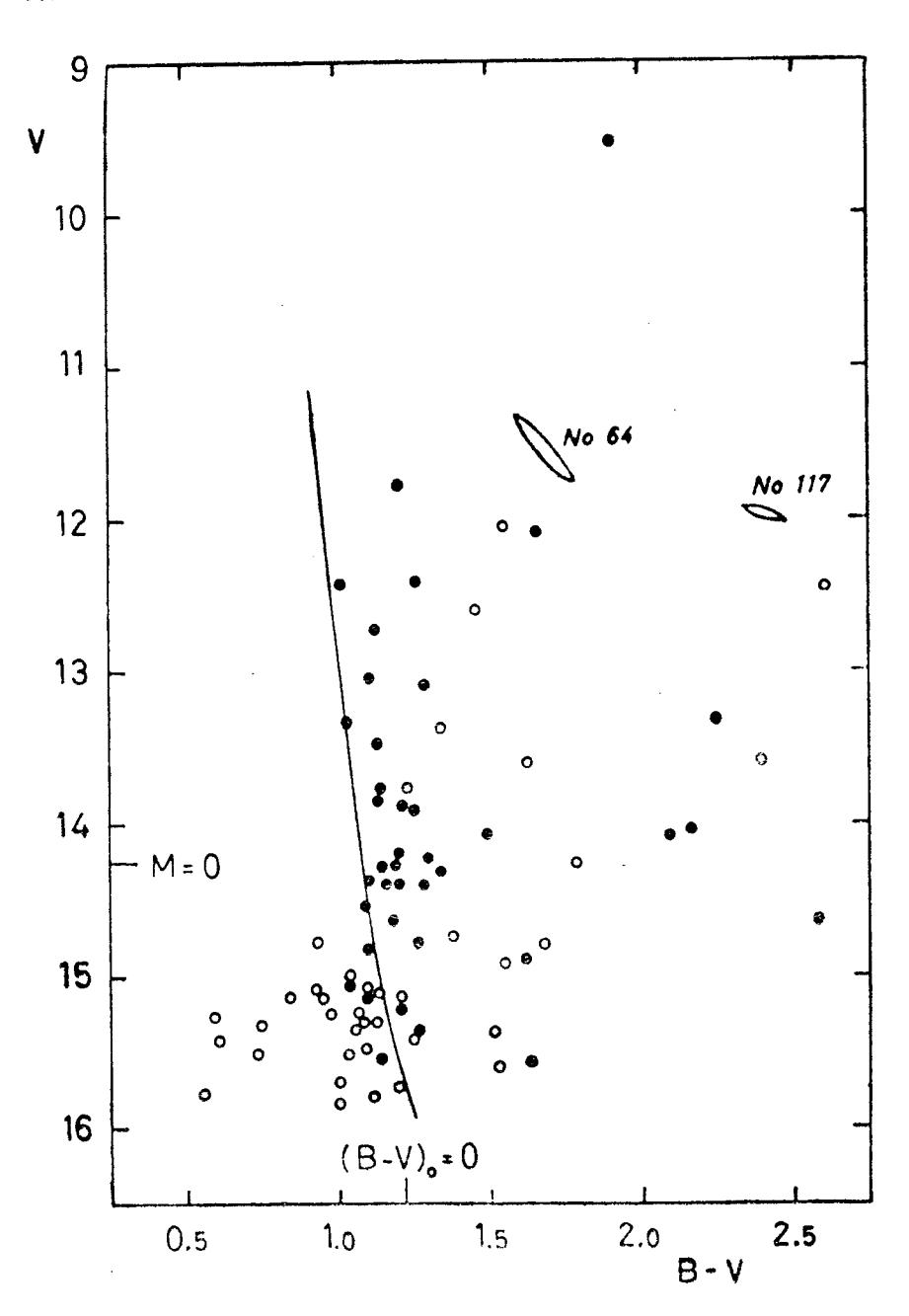
Fig. 4. The colour-magnitude diagram of NGC 6649. Filled circles represent photoelectric measurements and open circles photographic measurements.
The amount of interstellar absorption in front of the cluster is determined from the two-colour diagram shown in Fig. 5 for stars with measured U-B colours. The large dots represent stars in the center of the cluster (inside ring No. 3 in Cuffey's paper) and the small dots stars in the outer regions of the cluster. According to Johnson (1958) the slope of the reddening line can be written as \(E_{(U-B)}/E_{(B-V)}=X+0.05.E_{(B-V)}\), where the quantity X is a function of spectral type and luminosity class. In the same paper Johnson gives X as a function of the intrinsic colours for stars on the main sequence. The stars in NGC 6649 with known U-B colours are probably slightly evolved from the main sequence. However, for B stars in the luminosity interval III — V it can be assumed that X does not change significantly with luminosity class owing to the constancy of the colours B-V and U-B over this luminosity range. For such stars Johnson's nomogram can be used for derivation of their intrinsic colours. Excluding the brightest stars in NGC 6649 which may be supergiants, the mean intrinsic colour of the stars
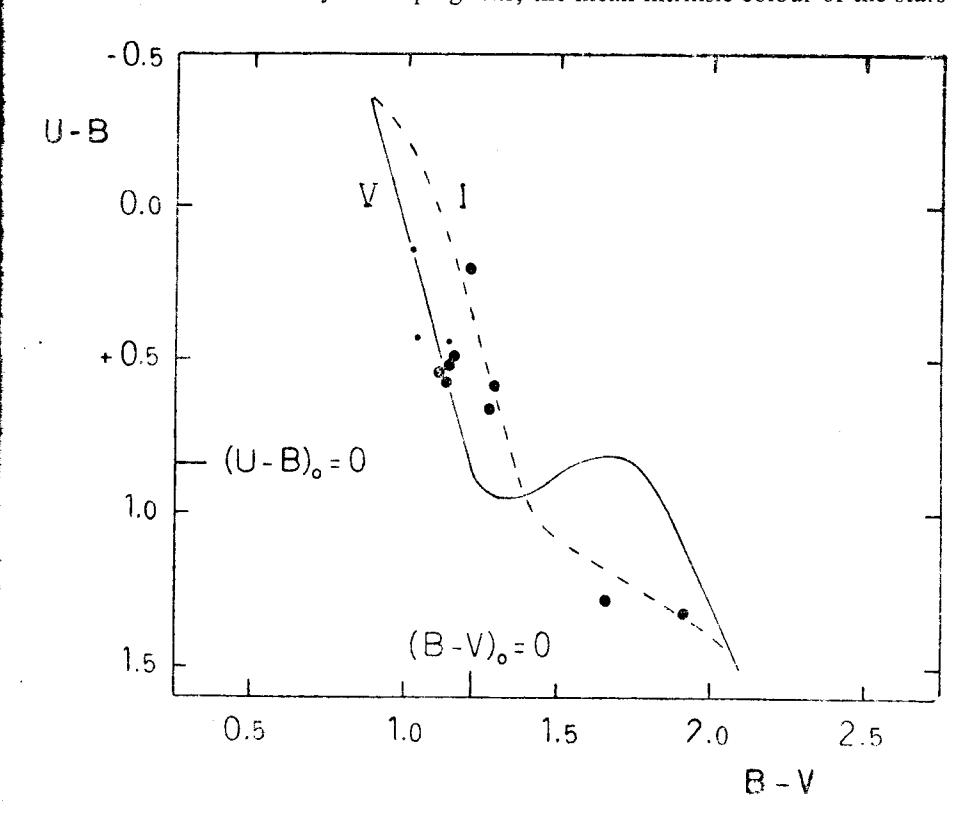
Fig. 5. The two-colour diagram of NGC 6649 for stars measured photoelectrically. The line denoted V represents main sequence stars and the dashed line denoted I stars of luminosity class I.
situated in the centre of the cluster, Nos. 33, 34, 35 and 6l is (B - V)o - - 0.09, giving mean colour ercess for these four stars E,u-r.) == 1.22 and an absorption Av : 3.66, if the ratio of total-to-selective absorption is Ai,/E16 -v) : 3.0. It is here assumed that all stars in the cluster region are effected by the same amount of interstellar absorption.
After correcting the observed B - V colours for the interstellar reddening the absolute visual magnitudes M, uhich the stars would have if they were on the zero-age main sequence, are obtained from the calibration by Johnson and Iriarte (1958). The individual distance moduli V - M for each cluster star which have been observed photoelectrically are calculated and plotted against the observcd apparent visual n-ragnitudes V. See Fig. 6. As in Fig. 5 the large dotsrepresent stars in the centre of the cluster. The standard evolutionary deviation curtve (Johnson, 1960) is adjusted tor the best fit to the points in Fig. 6. It is seen immediately that the observed cluster sequence does not reach the unevolved main sequence. Therefore, the determination of the distance modulus can be subject to errors, because rve have no observations of
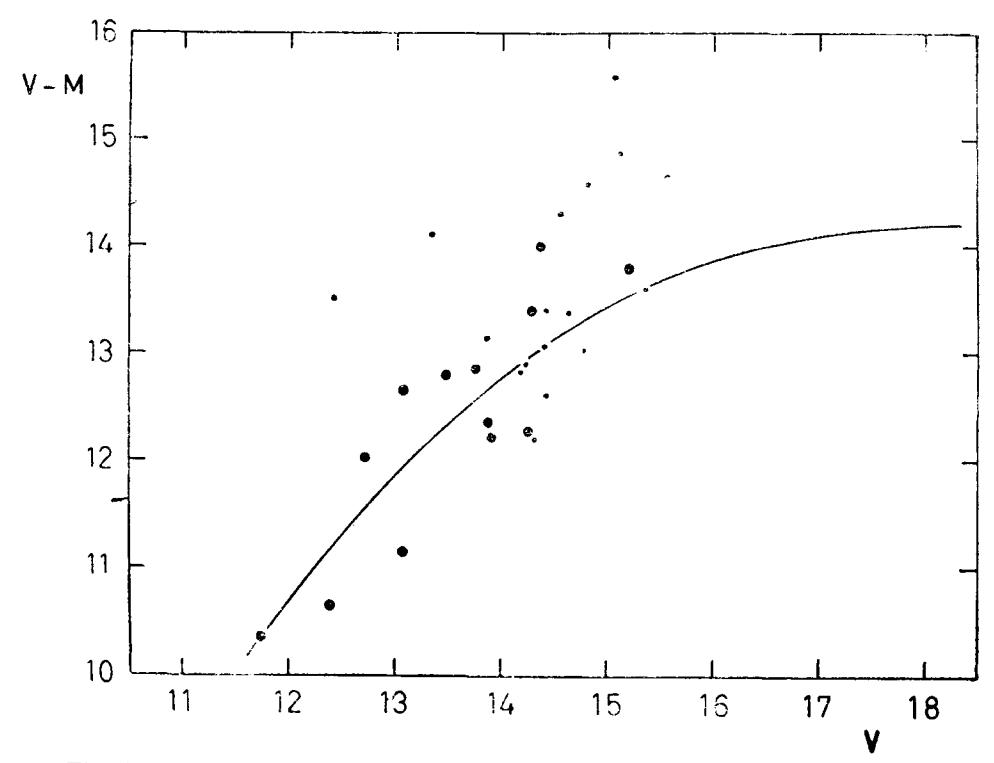
Fig. 6. '['l,e evolrrtionarl' rler-iation curve of N(]C 6649 for pirototl rctricail v. stars nre'itsttretl
unevolved main sequence stars in NGC 6649. The apparent visual distance modulus obtained from Fig. 6 is 14.25 mag, with an estimated mean error of \(\pm\) 0.25 mag. The true distance modulus of NGC 6649 is 10.6 \(\pm\) 0.3 mag., corresponding to a distance of 1300 \(\pm\) 200 parsecs.
TABLE 3. List of stars measured photographically.
| No. | V | B V | No. | V | B V | No. | V | B V |
|---|---|---|---|---|---|---|---|---|
| 9 | 11.70 | 1.29 | 61 | 13.59 | 1.05 | 101 | 15.13 | 0.95 |
| 16 | 15.09 | 1.14 | 63 | 15.77 | 0.56 | 103 | 14.14 | 1.58 |
| 17 | 14.09 | 1.03 | 65 | 15.26 | 0.60 | 104 | 14.02 | 1.54 |
| 19 | 12.26 | 1.62 | 66 | 15.51 | 0.74 | 106 | 15.77 | 1.13 |
| 20 | 15.42 | 0.75 | 70 | 13.90 | 1.10 | 107 | 14.52 | 1.05 |
| 23 | 12.59 | 1.46 | 61 | 14.56 | 1.18 | 108 | 14.66 | 1.42 |
| 26 | 14.92 | 1.57 | 73 | 15.34 | 1.07 | 109 | 14.71 | 2.09 |
| 28 | 12.48 | 1.18 | 74 | -14.37 | 1.07 | 110 | 13.69 | 2.44 |
| 30 | 13.60 | 1.63 | 76 | 15.30 | 1.13 | 112 | 13.57 | 2.40 |
| 34 | 13.87 | 1.07 | 78 | 15.11 | 1.32 | 113 | 12.40 | 1.06 |
| 1.32 | | | 12.10 | 1.00 | |||||
| 35 | 12.88 | 1.25 | 79 | 15.56 | 0.96 | 114 | 14.89 | 1.59 |
| 36 | 15.07 | 1.10 | 80 | 15.52 | 1.15 | 115 | 14.55 | 1.02 |
| 40 | 14.41 | 1.07 | 81 | 14.00 | 1.41 | 116 | 14.18 | 1.34 |
| 41 | 15.07 | 0.93 | 83 | 14.73 | 1.39 | a | 15.80 | 1.12 |
| 44 | 13.77 | 1.25 | 84 | 15.40 | 1.26 | b | 15.70 | 1.01 |
| 45 | 15.47 | 1.10 | 85 | 14.81 | 1.68 | e | 15.05 | 1.05 |
| 48 | 13.35 | 1.35 | 91 | 14.25 | 1.79 | d | 15.60 | 1.54 |
| 49 | 12.43 | 2.61 | 92 | 15.24 | 1.07 | e | 15.51 | 1.04 |
| 52 | 13.02 | 1.30 | 94 | 14.57 | 0.91 | ſ | 15.23 | 0.98 |
| 53 | 15.29 | 1.08 | 95 | 15.13 | 1.07 | g | 15.35 | 1.52 |
| : | ||||||||
| 54 | 14.41 | 1.39 | 96 | 13.21 | 1.20 | h | 15.13 | 0.85 |
| 56 | 13.84 | 1.27 | 97 | 15.16 | 0.63 | i | 15.84 | 1.01 |
| 57 | 14.77 | 0.94 | 97a | 15.58 | 1.65 | j | 15.42 | 0.61 |
| 58 | 12.03 | 1.55 | 98 | 15.74 | 1.21 | |||
| 60 | 15.29 | 1.10 | 100 a | 15.14 | 1.21 | : | : : : | |
| : | | |
5. VARIABLE STARS IN NGC 6649.
Photoelectric observations have shown that the star No. 64 in NGC 6649 is an intrinsic variable (Roslund and Pretorius, 1962). From the observations alone it has not yet been possible to draw any definite conclusion about which type of variable it belongs to. But if the star No. 64 is a physical member of the cluster, its position in the colour-magnitude diagram strongly suggests it to be a Cephcid variable.
Photoelectric observations of the star No. 117 repeated in June and July, 1962 indicate that this star may also be a variable. In 1962 the following values were obtained for its magnitude and colour, V = 11.93 and B - V = 2.31, compared with V = 12.03 and B - V = 2.50 in 1961.
Further photoelectric observations of the stars Nos. 64 and 117 are planned for the next observing season.
ACKNOWLEDGEMENTS.
It is a great pleasure to acknowledge the Warner and Swasey Observatory and Unesco, South East Asia Science Cooperation Office in securing photographic supplies for this research, and also Biro Ilmu Pengetahuan of the Department of Higher Education and Sciences, for its financial support for this project.
REFERENCES.
Barkhatova, K.A., 1950, AZh., 27, 185.
Charlier, C.V.L., 1918, Lund Medd., Ser. 2, No. 19.
Collinder, P., 1931, Lund Ann., 2.
Cousins, A.W.J., and Stoy, R.H., 1961, R.O. Bull., 49.
Cuffey, J., 1940, Ap. J., 92, 303.
Johnson, H.L., 1958, Lowell Obs. Bull., 4, 37.
Johnson, H.L., 1960, Lowell Obs. Bull., 5, 17.
Johnson, H.L., and Iriarte, B., 1958, Lowell Obs. Bull., 4, 47.
Roslund, C., and Pretorius, W., 1962, Lund Med., Ser. 1, No. 205.
Shapley, H., 1930, Star Clusters, page 233.
Trumpler, R.J., 1930, L.O.B., 14, 174.