

1. INTRODUCTION.
In the process of manufacturing baker's yeast several raw materills can be used for preparing the fermentation mash.
Malt and corn are used as raw materials in the Vienna Process. At the beginning of the 20th century many variations of this process were investigated.
However after World War I prices of grain increased and yeast makers found in molasses a more reasonable source of sugar (2).
To supply the deficiency of assimilable nitrogen in molasses, now usually inorganic ammonium compounds, such as the sulfate, phosphate and ammonia are used.
Phosphorus is also essential for yeast growth and activity; this element is supplied by adding phosphoric acid or its salts to molasses wort.
In the Molasses-Ammonium Process a mixture of beet and cane molasses plus inorganic nitrogen- and phosphorus-enrichments are the ingredients for preparing the medium (1, 2, 3, 4).
The Heykenskjold method uses sulfite waste liquor and a small quantity of molasses for the medium preparation.
Many other variations which are protected by patents, are proposed for preparing the fermentation medium with the same basic materials (6, 7, 8 and others).
Active dried yeast is baker's yeast which has been dried by a special process, so that viability and activity are preserved. This product can be stored for several months under tropical conditions, keeping its desired characteristion for baking purposes.
The raw materials for preparing the medium in which the yeast cells are propagated are the same as in producing common baker's yeast or compressed yeast.
In this study, and extract of germinating soybeans was used as enrichment in a medium of blackstrap cane molasses (MSE-medium). The resistance against drying of yeast cells is produced in this MSE - medium were compared with those from a medium containing molasses, (NH<sub>4</sub>)<sub>2</sub>SO<sub>4</sub> and KH<sub>2</sub> PO<sub>4</sub> (MAP - medium).
Fig. 1. Diagram of apparatus for fermentation.
2. MATERIALS.
2.1. Molasses.
The molasses used in the following experiments was blackstrap molasses, which has been received as a mixture of the molasses production during the milling period in 1960 of the cane-sugar factories "Gempol" and "Djatiwangi" in West-Java, Indonesia and was kindly supplied by the Pusat Perkebunan Negara, Tjabang Djawa Barat.
This mixture contains 53.60% (w/w) total sugar, 41.09% (w/w) fermentable sugar, 0.2% (w/w) nitrogen and no detectable amount of phosphorus (9).
2.2. Soybeans.
The soybeans were obtained from the Balai Penjelidikan Teknik Pertanian, Bogor, Indonesia and was assigned as "Variety no. 29".
The beans are straw yellow colored and approximately 4 x 6 mm. in size.
2.3. Yeast.
The yeast was a strain of Fleischmann yeast, which was obtained by the senior author in lyophilized culture from Dr. Lynferd J. Wickerham, Principal Zymologist of the Northern Utilization Research and Development Division, Peoria, Illinois, U.S.A. of the U.S. Department of Agricul - ture.
In our laboratory this yeast culture is assigned as culture no.ITB R5 and is maintained under paraffin-oil on slants containing 2% glucose, ½% yeast-extract (Difco), 1% pepton (Difco) and 3% agar.
3. APPARATUS.
3.1. Apparatus for fermentation.
The fermentation were carried out in a Woulff's flask A of 4 liter.
Air for aeration was supplied by compressed air from compressor F and its velocity was measured by rotameter E. It then passed the water containing flask D to be freed from eventually particles before entering cottenfilter C to be sterilized.
This sterile air came into the fermentation medium through an aerator, which consisted of a 15 cm. rubber pipe with an inside diameter of 0.5 cm. and perforated with 30 holes of 0.1 to 0.2 mm. The end of the rubber pipe was closed by a glass stopper.
3.2. Dryer.
This apparatus was used for drying the yeast, which had been centrifuged and pressed in strands.
Fig. 2. The dryer.
It consists of a wooden column 150 cm. high and 40 x 40 cm. cross section.
Air is introduced at the bottom by a fan A which can be regulated by a variac.
By passing a nichrom wire B of 500 Watt capacity, also provided by a variac, the air is heated.
The warm air then passes a diffuser C, consisting of a double wire gauze, so that the temperature at the drying stage D becomes homogenous.
The top of the dryer is closed with a cover, perforated by openings of 1 cm. diameter.
In this way a steady stream of warm air will pass the column and the temperature can be maintained at about 30°C
4. METHODS
4.1. Medium preparation.
Soybeans which has been soaked and germinated were crushed in a Waring blender (National Electric Blender; 16.000 r.p.m.) during 1 minute with a certain amount of water.
This suspension of soybean was cooked for one hour and then mixed with a solution of molasses.
A precipitation will be formed, which was then separated by a centrifuge (MSE) during 20 minutes at 190 r.p.m.
The clear supernatant was diluted with tap water and sterilized at \(120^{\circ}\)C. for 15 minutes. The initial p<sub>H</sub> was + 4.5.
The exact amounts of the ingredients will be described later.
4.2. Fermentation.
To 2 liters of medium a 24 hours inoculum of Fleischmann Yeast ITB R5 were inoculated.
Aeration was performed by 1.7 liter/minute sterile air from the air compressor.
The fermentation was stopped after 38 hours at room temperature \((23 - 28^{\circ}C)\).
4.3. Separation and drying.
The yeast was separated by centrifuging for 20 minutes at 1800 r.p.m.
To purify the yeast, repeated dilution with 0.9 % salt solution and reseparation was done twice.
The wet yeast was then pressed in a pressing apparatus to make strands of 5 cm length and about 1 mm diameter.
These strands were then dried in the dryer at 30-31°C for 4 hours on a metallic wire gauze.
4.4. Analysis.
a. Sugar content.
The sugar content of the fermentation broth were determined by the Lane & Eynon method (3).
To get a more accurate result for sugar - contents below 5 /oo, a 10 times dilution of the Fehling standar and methylene blue indicator solution were used.
The decrease of sugar - content in the fermentation medium is considered to be a measure of the increase of yeast cells. This was confirmed by preliminary experiments (10).
b. Live and dead yeast cells.
The percentage of living yeast cells were determined by suspending the dried yeast in a 0.9% NaCl - solution.
For loopfuls of this suspension on a microscope slide was mixed with one loopful of a methylene blue solution, which was prepared from 0.5 g. methylene blue, 30 ml. ethylalcohol and 100 ml. distilled water.
Dead yeast cells become blue, while living cells remain unstained.
The percentage of live and dead cells were counted microscopically.
5. EXPERIMENTAL RESULTS AND DISCUSSION.
5.1. Preliminary experiments (9).
Preliminary experiments showed, that soybean-extract, added to a molasses solution, had a better stimulating effect on the growth of yeast than extracts made from corn (Zea mays) or Phaseolus radiatus.
Extract from germinating soybeans is better than from soaked soybeans.
5.2. Effect of the Amount of germinating soybeans.
In these experiments, the fermentation medium contained 2.5% molasses and an extract from soybeans; these soybeans have been soaked for 30 minutes and germinated for 48 hours at room temperature (23 - 28°C). The inoculum contained approximately 4.10° cells.
TABLE 1. Effect of amount of germinating soybeans.
| o/oo sugar in fermentation broth | |||||||||||
|---|---|---|---|---|---|---|---|---|---|---|---|
| % of soy- beans. Fermenta- tion time ( hours ) | 1,25% | 1.50% | 1.75% | 2.00% | 2.25% | ||||||
| 0 | 12.5 | 12.5 | 12.5 | 12.5 | 12.5 | ||||||
| 14 | 9.8 | 8.3 | 8,8 | 8.3 | 8,8 | ||||||
| 15 | 8.5 | 7.4 | 7.9 | 7.6 | 7.9 | ||||||
| 16 | 7.8 | 6.5 | 6.9 | 6.8 | 7.4 | ||||||
| 17 | 6.9 | 6.2 | 6.4 | 6.1 | 7.0 | ||||||
| 18 | 6.0 | 5.9 | 5.5 | 5.5 | 6.0 | ||||||
| 19 | 5.9 | 5.8 | 5.1 | 5.1 | 5.3 | ||||||
| 20 | 5.5 | 5.3 | 4.7 | 4.5 | 4.7 | ||||||
| 21 | 5.4 | 5.1 | 4,4 | 4.3 | 4.4 | ||||||
| 22 | 5.0 | 4.7 | 4.1 | 3.9 | 4.0 | ||||||
| 23 | 4.8 | 4.4 | _ | 3.6 | 3.8 | ||||||
| 24 | 4.6 | 4.3 | 3.7 | 3.4 | 3.4 | ||||||
| 38 | 3.4 | 2.9 | 2.7 | 3.0 | 3.0 | ||||||
Table 1 and figure 3 show, that percentages of soybeans higher than 1.75% do not increase the rate of fermentation considerably.
Since increase in soybean-percentage caused more foaming during fermentation, the percentage of 1.75% soybean was used in the following experiments.
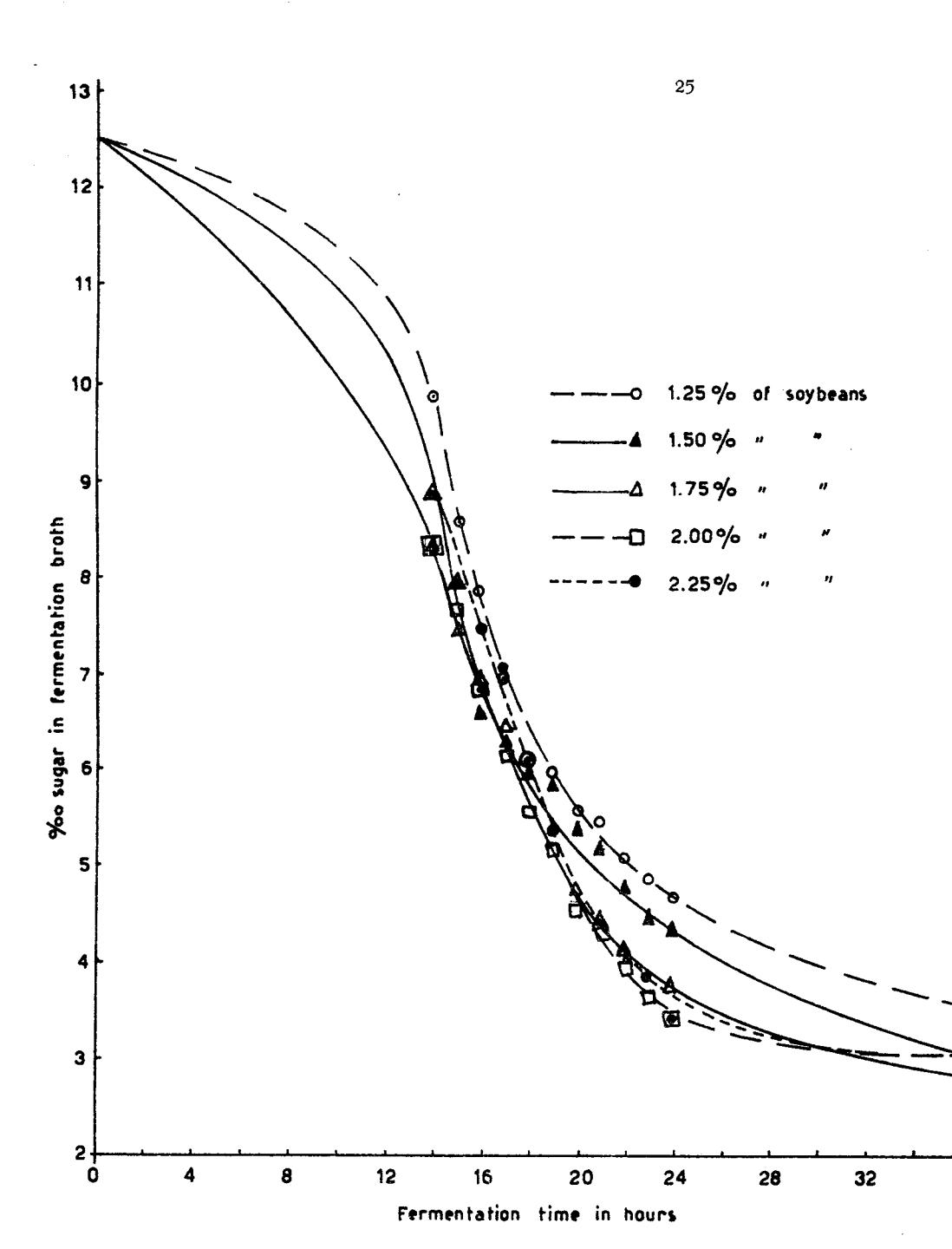
Fig. 3. Effect of the amount of germinating soybenas.
5.J. Effect of gernination time of the soybeans.
The extract prepared from soybeans, which has been soaked for J0 minutes and gerninated for 48 hours, is a nilky rshite liquid.
This extract nixed vith nolasses-solution causes precipitation; after cooking, a fairly compact coagulant is formed, which can easily be separated fron the elear liquid.
$oybeans which hsve been gelminated for 96 hours have a greenish colour and hypocotyledoas of 2-5 cm.
fts erbract ig a greenish, turbid liquid.
lfhen mired vith a molasses-solution, only a slight precipitation occurs.
After cooking and centrifuging, the coloured substan ces originated fron the molasses rernain in the liquid. lfhen this liquiil is used. for produciag yeast, then the eolour of the dried yeast will. be brovxo
A gemination time of 168 hours givea approrinately the same regult as a germination tine of 96 hours"
Table 2 and figure & indicate, that a gemination tine of 96 hourg is much better than 48 hours.
Thie is probably drre to the fact, Lhtal- in 96 hours gerrninatioarm.ore material of the soybean beeomes soluble becauee of enzlmatic action. The extract thus contains more soluble substances and possibly aleo nore vita^rlins i and other grorth factors, which etinulate the netabolisn and grorth of the yeast cells.
Figure 4 shovs that 168 hours gemination time cor pared vith 96 hours gemination does not inprove the grorth of yeast cells.
In the first 15 hours, the fermentation does not go as faet as vith 95 hours germination and at the end the fernentation ig less eomplete.
Considering the longer time needed for germination, it is not profitable to use an ertract of soybeans, vhich are gero.inated. f or 168 hours.
Based on the above results the folloving considerations have been made.
A fementation with a mediurn prepared rrith soybeans rshich heve been ger:minated f or 96 hours should be a.
TABLE 2. Effect of germination time of the soybeans.
| o/oo sugar in fermentation bro | |||||||||
|---|---|---|---|---|---|---|---|---|---|
| 48 | 96 | 168 | |||||||
| 12.5 | 12.5 | 12.5 | |||||||
| 8.8 | 6.5 | 8.1 | |||||||
| 7.9 | 5.0 | 5.3 | |||||||
| 6.9 | 2.9 | 2.6 | |||||||
| 6.4 | 2.5 | _ | |||||||
| 5.5 | 1.8 | 1.3 | |||||||
| 5.1 | 1.6 | _ | |||||||
| 4.7 | _ | 1.2 | |||||||
| 4.4 | 1.2 | 1.05 | |||||||
| 4.1 | 1.1 | 1.0 | |||||||
| 1.0 | 1.0 | ||||||||
| 3.7 | 0.9 | 0.98 | |||||||
| 2.7 | 0.7 | 0.90 | |||||||
| 12.5 8.8 7.9 6.9 6.4 5.5 5.1 4.7 4.4 4.1 | 12.5 8.8 6.5 7.9 5.0 6.9 2.9 6.4 2.5 5.5 1.8 5.1 1.6 4.7 4.4 1.2 4.1 1.1 - 1.0 3.7 0.9 | ||||||||
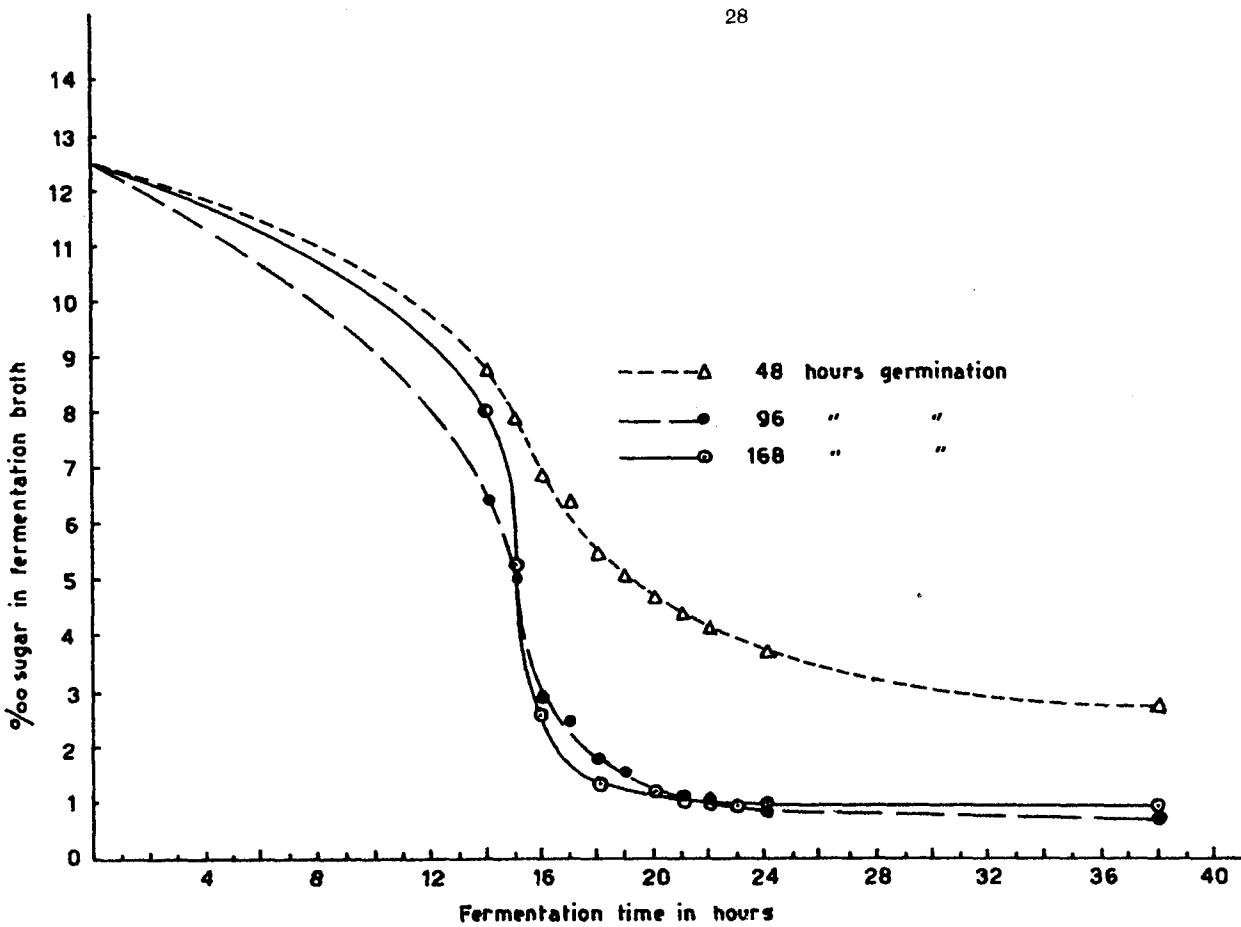
Fig. 4. Effect of germinating time.
good one, but the preparation of the medium is more difficult, the product will be brown coloured and not attractive.
On the other hand, a medium prepared from soybeans which have been germinated for 48 hours will gave a slightly less active fermentation, but the preparation of the medium will be easier, the product will be lighter in colour and more attractive.
To combine the benefit of both methods for further fermentations, half of the soybeans for preparing the extract is germinated for 48 hours and the other half for 96 hours.
Current experiments in our laboratory indicate, that with other soybean varieties and other storage period of the raw soybeans, the required soybean amount and its germination time for obtaining the optimum conditions will probably vory.
5.4. Comparison of resistance against drying between yeast from molasses—ammonium—phosphate medium (MAP—medium) and from molasses—soybean—extract medium (MSE - medium).
In one series of fermentations the medium was prepared from 2.5% molasses, 0.21% mo \((NH_4)_2SO_4\) and 0.03% \(KH_2PO_h\) (MAP-medium).
In another series it was prepared according to chapter 4.1 from molasses and soybean extract (MSE-medium)
In both series, fermentations and processing of the yield were carried out in the same way as stated in in chapters 4.2 and 4.3
During the drying process the percentages of live and dead cells were determined from samples taken at definite intervals.
Table 3 and figure 5 show the results of these series of experiments.
Yeast cells produced from MAP-medium were killed within 2½ hours at drying temperatures between 27°C and 34°C. On the other hand, yeast cells produced from MSE-media with soybean-extract of different percentages and sidferent germination times were for about 90% resistant against a drying period of 4 hours.
TABLE 3. Resistance against drying.
A. Yeast cells from a medium containing 2.5% mollases, 0.21% \((NH_4)_2SO_4\) and 0.03% \(KH_2PO_4\). (MAP - medium).
| % living yeast cells. | ||||||||||
|---|---|---|---|---|---|---|---|---|---|---|
| Drying- time (hours) Dry-\ning tem- peratura C | 0 | 122 | 1. | 1 2 | 2 | 212 | 3 | 4 | 5 | 6 |
| 30°C | 100 | 0 | ||||||||
| 28 - 29°C | 100 | 88 | 0 | |||||||
| 27°C | 100 | 81 | 62 | 31 | ||||||
| 30 - 32°C | 100 | 93 | 92 | 79 | ||||||
| 31 - 34°C | 100 | 84 | 73 | 0 | ||||||
| 31 - 33°C | 100 | 81 | 68 | 72 | 0 | |||||
| l | l | |||||||||
VOL 3, NO. 1. PROCEEDINGS 1964
TABLE 3. (Continued).
B. Yeast cells from a medium containing 2.5% molasses and germinating soybeans (MSE - medium).
| Time of germinat- | % living yeast cells | |||||||||||
|---|---|---|---|---|---|---|---|---|---|---|---|---|
| ion(hours) | Drying-time (hours) Drying temperature C | 0 | 1/2 | 1 | . 1% | 2 | 2% | 3 | 4 | 5 | 6 | |
| 1.25% 1.50% 1.75% 2.00% 2.25% 1.75% 1.75% | 48 48 48 48 96 168 Half of the amount 48 hours, the other half 96 hours. | 31 - 32°C. 30 - 31°C 31 - 32°C 31 - 32°C 30 - 31°C 30 - 32°C 31 - 32°C 30 - 31°C 30 - 31°C 30 - 31°C 30 - 31°C | 100 100 100 100 100 100 100 100 | 100 100 100 100 100 100 | 90 100 100 100 100 | 100 | 93 98 80 96 90 88 85 87 | 80 87 | 79 80 | |||
DRIED YEAST PRODUCTION
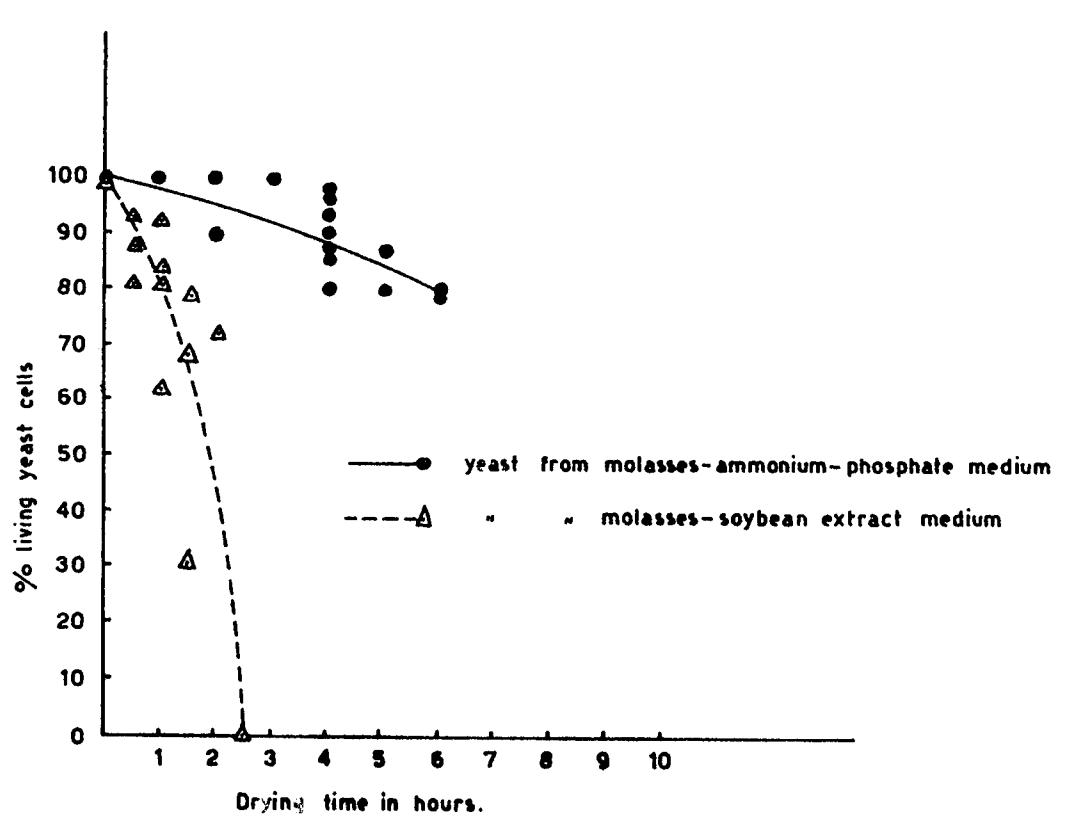
Fig. 5. Comparison of resistance against drying at temperature between 30°C and 32°C of yeast cells produced from molasses-ammonium-phosphate medium and from molasses-soybean-extract medium.
at temperatures between 30°C. and 32°C.
THE REPORT OF THE PARTY OF THE PARTY OF THE PARTY OF THE PARTY OF THE PARTY OF THE PARTY OF THE PARTY OF THE PARTY OF THE PARTY OF THE PARTY OF THE PARTY OF THE PARTY OF THE PARTY OF THE PARTY OF THE PARTY OF THE PARTY OF THE PARTY OF THE PARTY OF THE PARTY OF THE PARTY OF THE PARTY OF THE PARTY OF THE PARTY OF THE PARTY OF THE PARTY OF THE PARTY OF THE PARTY OF THE PARTY OF THE PARTY OF THE PARTY OF THE PARTY OF THE PARTY OF THE PARTY OF THE PARTY OF THE PARTY OF THE PARTY OF THE PARTY OF THE PARTY OF THE PARTY OF THE PARTY OF THE PARTY OF THE PARTY OF THE PARTY OF THE PARTY OF THE PARTY OF THE PARTY OF THE PARTY OF THE PARTY OF THE PARTY OF THE PARTY OF THE PARTY OF THE PARTY OF THE PARTY OF THE PARTY OF THE PARTY OF THE PARTY OF THE PARTY OF THE PARTY OF THE PARTY OF THE PARTY OF THE PARTY OF THE PARTY OF THE PARTY OF THE PARTY OF THE PARTY OF THE PARTY OF THE PARTY OF THE PARTY OF THE PARTY OF THE PARTY OF THE PARTY OF THE PARTY OF THE PARTY OF THE PARTY OF THE PARTY OF THE PARTY OF THE PARTY OF THE PARTY OF THE PARTY OF THE PARTY OF THE PARTY OF THE PARTY OF THE PARTY OF THE PARTY OF THE PARTY OF THE PARTY OF THE PARTY OF THE PARTY OF THE PARTY OF THE PARTY OF THE PARTY OF THE PARTY OF THE PARTY OF THE PARTY OF THE PARTY OF THE PARTY OF THE PARTY OF THE PARTY OF THE PARTY OF THE PARTY OF THE PARTY OF THE PARTY OF THE PARTY OF THE PARTY OF THE PARTY OF THE PARTY OF THE PARTY OF THE PARTY OF THE PARTY OF THE PARTY OF THE PARTY OF THE PARTY OF THE PARTY OF THE PARTY OF THE PARTY OF THE PARTY OF THE PARTY OF THE PARTY OF THE PARTY OF THE PARTY OF THE PARTY OF THE PARTY OF THE PARTY OF THE PARTY OF THE PARTY OF THE PARTY OF THE PARTY OF THE PARTY OF THE PARTY OF THE PARTY OF THE PARTY OF THE PARTY OF THE PARTY OF THE PARTY OF THE PARTY OF THE PARTY OF THE PARTY OF THE PARTY OF THE PARTY OF THE PARTY OF THE PARTY OF THE PARTY OF THE PARTY OF THE PARTY OF THE PARTY OF THE PARTY OF THE PARTY OF THE PARTY OF THE PARTY OF THE PARTY OF THE PARTY OF THE PARTY OF THE PARTY OF THE PARTY OF THE PARTY OF THE PARTY OF THE
6. SUMMARY.
Soybean-extract prepared from germinating soybeans has a stimulating effect on the growth of yeasts when mixed in a molasses medium.
The optimum amount of the original soybeans for preparing the extract is about 1.75% (w/v) of the final medium.
A satisfactory medium for yeast propagation was obtained by mixing a 2.5% molasses solution with an extract of soybeans, which was prepared from a mixture of soybeans of which half of the amount were germinated for 48 hours and the other half for 96 hours.
In spite of the not superior method of drying, a remarkable difference was observed of the resistances against drying between yeast cells grown in MSE-medium and in MAP-medium.
Yeast cells produced from MSE - medium were for 90% resistant against a drying period of 4 hourst at temperatures between 30°C. and 32°C.
This was in strong contrast with yeast cells produced from MAP - medium, which were killed within 2½ hours drying.
7. REFERENCES.
- 1. Prescott, S.C. & Dunn, C.G., Industrial Microbiology. Megraw-Hill Book Co., Inc., New York (1959).
- 2. Underkofler, L.A. & Hickey, R.J., Industrial Fermentations I, Chem. Publ. Co., Inc., New York (1954).
- 3. White, J., Yeast Technology, John Wiley and Sons, Inc., New York (1954).
- 4. Walter, F.G., The Manufacture of Compressed Yeast, Champan & Hall Ltd., London (1953).
- 5. Markley, K.S., Soybeans and Soybean Products I, Interscience Publishers, Inc., New York (1950).
- 6. Schultz, A., Baker's Yeast, U.S. Patent 2,029, (1936), Cited in Chem. Abstr. 30, 1890 (1936).
- 7. Pollak, A., Yeast, U.S. Patent 2,094,023 (1937), Cited and Chem. Abstr. 31, 8108 (1937).
- 8. Browns, H.H., Yeast, U.S. Patent 2,166,359 (1939), Cited in Chem. Abstr. 33, 8912 (1939).
- 9. Ko Swan Djien, Penjelidikan Kemungkinan2 penggunaan molasses I, Unpublished report (1961).
- 10. Ko Swan Djien, Penjelidikan kemungkinan2 penggunaan molasses II, Unpublished report (1962).