

1. INTRODUCTION.
Many recent metallurgical investigations have to be done on single crystals in order to obtain a more accurate result. For example in studying the effect of grain boundaries or the effect of orientation on the properties of a certain metal, a research on single crystals has to be done. Unfortunately, up to now only the growing of single crystals of some highly pure metals is well known, but only a little about the growing of single crystals of alloy metals. The author of this paper wants to investigate the influence of age hardening process on single crystals, therefore single crystals of an age hardenable alloy must be made.
The general steps of growing single crystals has been outlined by many investigators. But it must be noted that a series of specific treatment must be employed for a particular metal or alloy. It is this specific treatment, that must be discovered for each metal or alloy in order to obtain single crystals out of them.
In this paper a specific treatment for growing single crystals of 6061 aluminium alloy by "strain anneal" method is described in detail, which may serve for further investigations.
2. CF{OICE, OF MATER]AL AND METHOD.
The method of growing single crystals of several Jrighly pure metals and some alloy har.e been established. But usually the allol's are laboratory made alloYs, so it can be sa.id that there are no fcreign substances ercept the composing elements. fherefore it $'ill be interesting to investigate the method of growing single cry.stals of a commercial alloy, in which some other elements are added to the main composing elements.
In this investigation the 6061 aluminit-m allot'is chosen as the subject. the reasons of this are:
- 7. 6061 aluminium alloy is a commercial alloy.
- 2. The alloy is age hardenable.
By chosing tbis alloy, it is possible to make an investigation on the efibct of age hardening on the properties of single crl'stals.
There are many nethods of growing single crystals, but here the "strain anneal" method is chosen, because this methoci needs only standard equipments. So it is possible to carry out the work in any adequately equiped metallurgical laboratory.
3. BASIC T'[{E.ORY OF THE SI'RAIN ANNE,AL ME,THOD.
Strain anneal method actually is a recrvstallization process, in which metal resumes its condition from an unstable high energy state. Since it is a process of recrystallization, so it involves nucleation and growth processes. f'hus strain anneal method is based on three basics, they are:
- 7. Unstable condition,
- 2. Nucleation and
- 3. Growth.
Unstablc condition can be brought rrp by straining thc test specimcn and nucleation and growth will proceed dur:ing the urnealing process. l'he tbrmation of nuclei is caused by the driving fcrrce, which is produced by the unstable condition, in this case the strain of the test specimens. So it is clear, that the higher the degree of stra-ining, the higher the driving force and the higher the number of the nuclei. Consequentlv, it will produce a large number of crvstals of small size.
It is obvious that in the process of growing sinule crystals, a sn-rall number of nuclei which will produce large crystals, is preferable. Therefore the degree of straining must be kcpt as low as posible, to obtain a small driving force. f'he lowering the degree of straining is limited by the critical diameter of the nuclei to be formed. Thermodynamics state that a nucleus is stable if its diameter is larger than the critical diameter
(see Appendix). Thus the degree of straining must be chosen so that it will produce a small number of stable nuclei. This strain is called the critical strain.
The growth process will follow immediately after the nucleation. Since the growth rate is higher at high temperature, it is preferable to have a high temperature annealing process. It must be noted that at different temperatures the critical diameter of the nuclei is difterent. It is the purpose of this research to find out the best combination between the critical strain an the annealing temperature.
4. MAT'ERIAL AND EQUIPMENT.
It has been stated that the material is 6061 aluminium alloy. T'his allo,v has a composition as follows (Aloca specification):
It{S Si Fe Cu Cr Zn f i Al .90% .57% .46o,L .26o/o .24o/o .06% .02% rest the alloy is received in the forrn of a condition, which means that the alloy hardening process. plate with thickness of $", in T6 has undergone an artificial age
The main equipments which are used in this work are:
- 1. "Stanat" rolling mill, for preparing the specimens.
- 2. "fnstron" tensile test machine, for straining the specimens.
- 3. "Heavy Duty" electric resistance furnace, in which the test specimens are annealed.
5. METHOD OF GRO'iilNG T'HE CRYSTALS.
The plate is cut into srnall pieces with dimensions of l" x f," x 12", the cut specimens are then annealed for 15 hours at a temperature of 750 F to soften them from the age hardened condition.
At this soft condition the cut specimens are rolled in the rolling mill to obtain their final diameter without intermediate annealing. Tb obtain a 2 mm. final diameter, the cut specimens are rolled through 12 reduction holes of the rolling mill, in which the rolling direction is reversed for er.ch pass. It must be noted that the rolling ciirection in this rvork is held parallel to the rolling direction of the plate. f'hen the specimens are washed in Lacombe's reagent (50 parts I{NOB, 47 parts HCL and 3 parts HF) followed by rinsing them in running v'ater.
The strain anneal process which has been modified tbr this particular alloy consists of the following steps:
- 1. Annealing of the aforemention prepared specimens at 1020 F for 40 minutes. Cooling on top of a flat metal plate.
- 2. Straining of the specimens up to 3.7%, annealing at 1020 F for 40 minutes. Cooling on top of a flat metal plate.
- 3. Straining the specimens up to 3.7%, annealing at 1020 F for 40 hours. Cooling on top of a flat metal plate.
- 4. Etching of the specimens in Lacombe's reagent to reveal the crystals. This is followed by washing them in water and dipping them in nitric acid and washing them in water again.
The above speps allow about 70% of the test specimens grow into single crystals which have an average length of 2.5 cm.
Fig. 1 Schematic diagram showing some of the equipments.
6. CONCLUSIVE REMARK.
The method described in this paper is the result of a series of experiments by varying the critical strain from 1.5% to 5.0%, the annealing temperature from 550 F. to 1050 F, which is close to the melting temperature of the alloy (1100 F). and the annealing time from 24 hours to 48 hours. The selection of this variation is based on the information that pure aluminium (99.999% Al.) has a critical strain of 1.8% and aluminium of 99.0% has a recrystallization temperature of 550 F.
It is known that the size of the crystal produced depends on the previous grain size. So it is the purpose of the first strain anneal process, which is described as step no 2 of the method, to coarsen the grain to a certain value, which makes possible the forming of a more larger grain on the second strain-anneal process, which is described as step no 3. The degree of straining of this first strain-anneal process of this method is also found experimentally, by varying the strain from 0.0% to 6.0%.
7. ACKNOWLEDGEMENT'S.
The author of this paper wants to thank Prof. Dr. Ir. R.M. Soemantri and Ir. O. Diran M.S.A.E. for their critics and encouragement given to the author.
8. REFERENCES
- 1. Harsono Wirjosumarto, "A Study of the Deformation Effect of Prestraining Prior to the Aging Process of Single Crystals of 6061 Aluminium Alloy", Thesis. University of Kentucky 1963.
- 2. R.W.K. Honeycombe. "The Growth of Metal Single Crystals", Metallurgical Reviews, 1959, vol 4, no 13, p 1.
- 3. Albert G. Guy, Elements of Physical Metallurgy, (Addison-Wesley Publishing Company Inc., Reading, Massachusetts: 1959), p 146.
- 4. Ibid, p 423.
APPENDIX.
When a nucleus is formed, there exists at least two changes of energy. The changes are:
- 1. The need of its interface or surface energy,
- 2. The release of its volume energy.
The total free energy of the nucleus is the difference of the two:
\[\triangle f = 4\pi r^2 \gamma - (4/3)\pi r^3 \triangle F_v\] (1)
in which:
f = free energy of the nucleus, r = radious of the nucleus,
\(\gamma = interface\) energy per unit area,
\(\triangle F_{\mathbf{v}} = \text{volume energy per unit volume.}\)
The maximum total free energy of the nucleus can be computed by differentiating equation (1). The maximum value is reached when the nucleus has a radius of
\(r^*=\frac{2\gamma,}{\triangle\;F_v}\) Here \(r^*\) is called the critical radius of the nucleus.
The relation between the total free energy and radius and the distribution of the interface and the volume energy can be seen clearly in fig. 2.
Thermodynamics state that a substance is stable, if it possesses the lowest free energy. Figure 2 shows clearly that nuclei with radius of lower than the critical radius will be destroyed and those with larger radius will grow into large crystals which possess lower free energy.
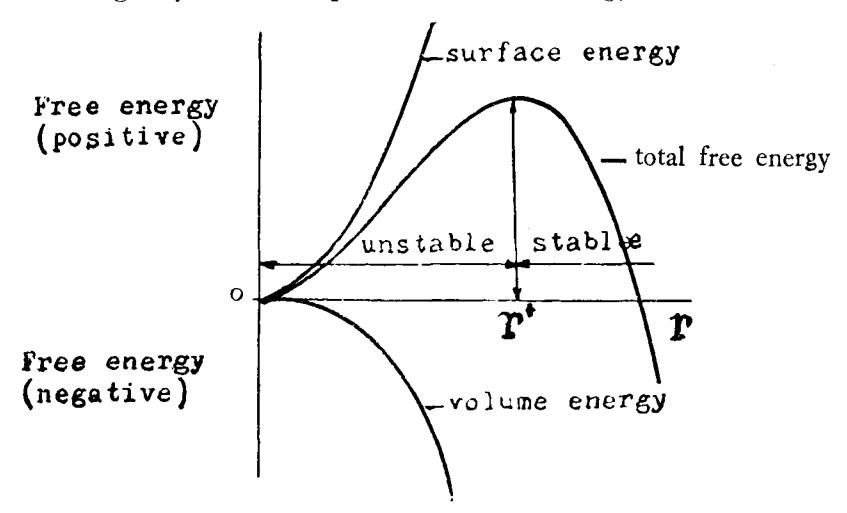
Fig. 2 Relation between the total free energy and the nuclear radius.