

METHODS AND EXPERIMENTAL RESULTS
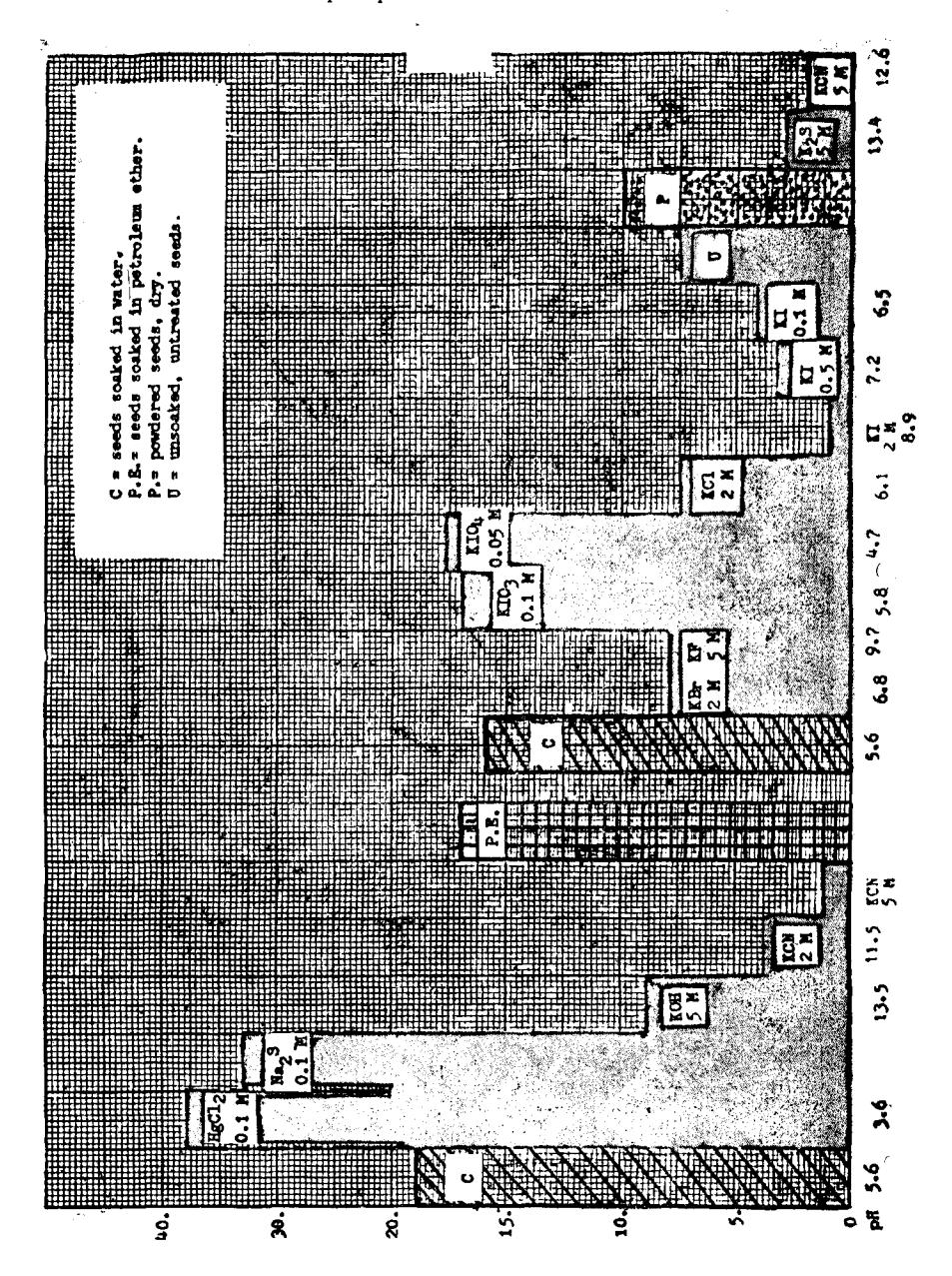
a). Lettuce seeds var. New York were soaked in different solutions for 6 hours. The treated seeds were then dried in dessicators for two nights. After this treatment the seeds were ready for Electron Spin Resonance spectrometric study of magnetic centers. Most of the chemicals used in these experiments are known as metabolic inhibitors (5, 7), which in their solid state do not give signals. The relative number of unpaired electrons was calculated from the product of the height times the square of the width of the derivative curve. The absolute number was calculated from pitch standards. The result suggests that the ESR signal in lettuce seeds can be modified by chemicals (fig. 1). The most effective agents are KCN, K<sub>2</sub>S
- and KI. These salts reduced the relative number of spins to about 10% of that of the untreated seeds. It seems that the relative number of spins is not dependent of pH. Two molar of KBr and 2 M of KF solutions, which have different pH, gave the same effect. On the other hand, 5 M solution of K<sub>2</sub>S and 5 M solution of KOH, both have the same pH, changed the amount of free radicals differently.
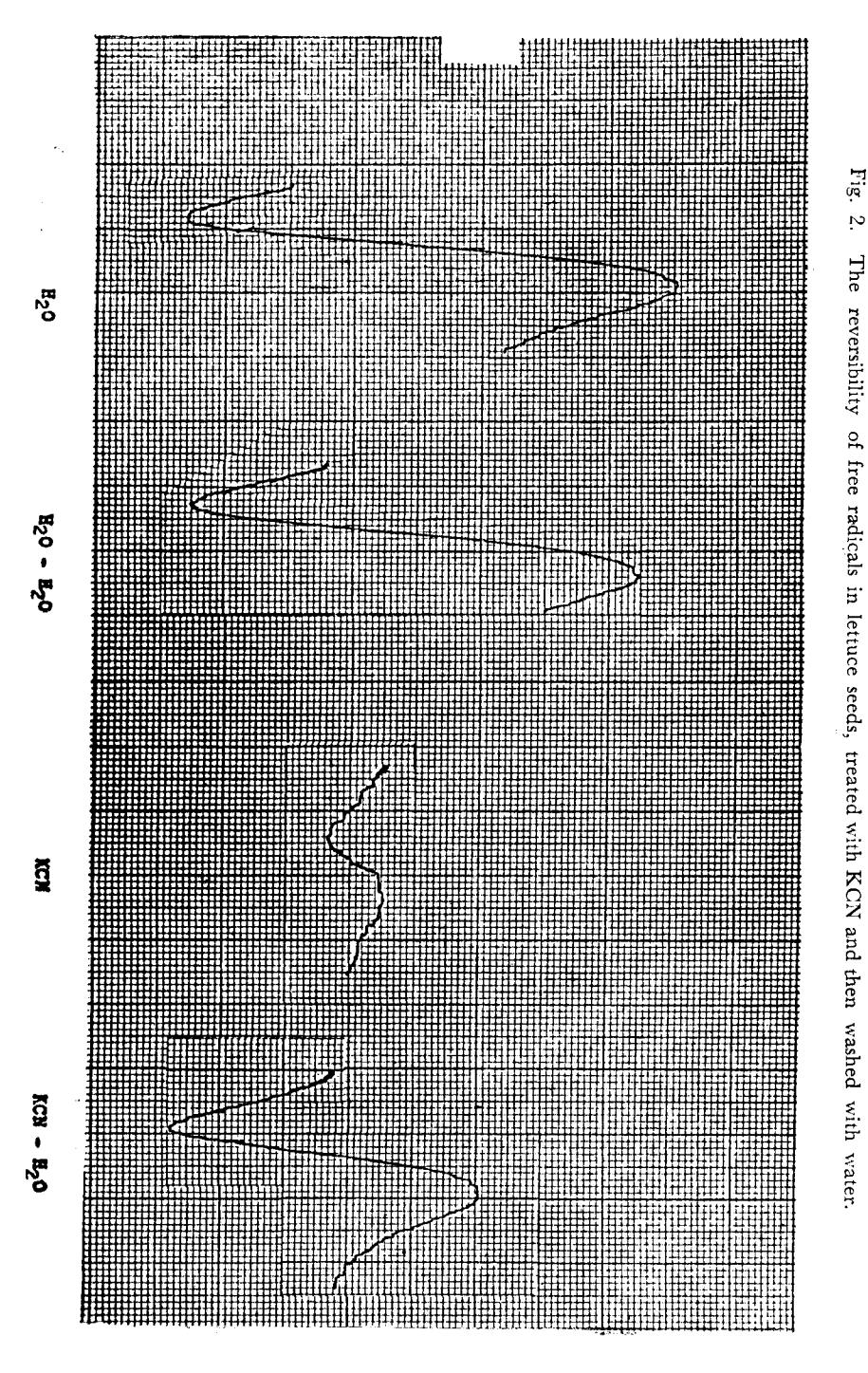
- b). When the treated seeds were washed in water for a couple of hours after the measurements and were dried again, the relative number of spins showed an increase and reached almost the original level (fig. 2 and fig. 3). This fact suggests that the effect of 5 M KCN and 2 M KI is reversible.
- 2. In another experiments the seeds were first boiled before the treatments. Boiled seeds treated with KCN solution of low concentration increased the number of spins, but the number decreased again when solutions of higher concentration were used. The opposite was true when KOH solutions were used. KI and the control seem have no effect (Table 1).
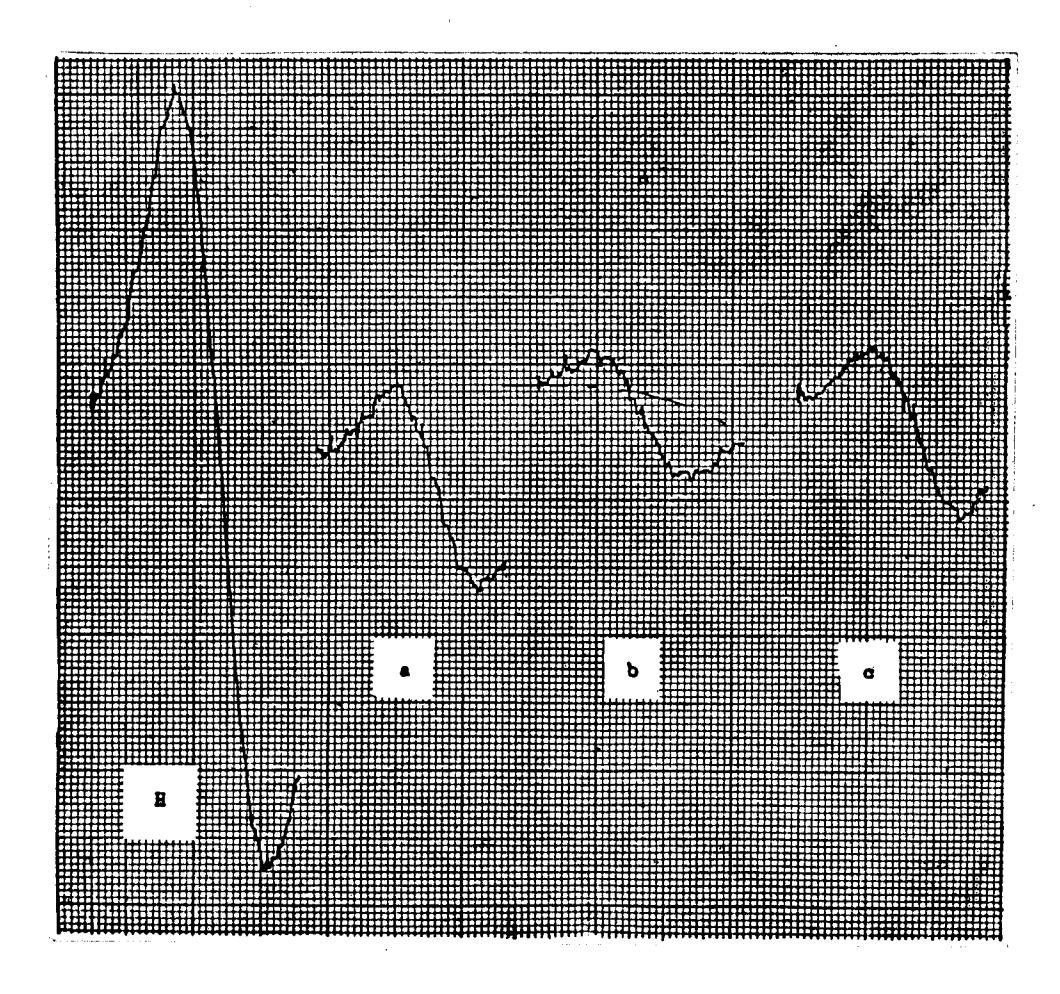
- 3. In the next experiment the seeds were soaked for an hour with 1 to 15 minutes interval, to see when the KI solution is the most effective. The result is shown in fig. 4. Approximately the same reduction of the relative number of spins (about 1/5 of that of the control) were detected in 1 minute as well as in 30 minute soaking times.
Table 1. Relative number of spins in lettuce seed, boiled for 10 minutes in water and then soaked for 6 hours in solutions
| T T | 1 | • | - 1 | |||
|---|---|---|---|---|---|---|
| n | h | \(\sim\) | 1 | • | 4 | |
Boiled
| \(hw^2\) | spin/cm | spin/seed | sample | spin/seed | spin/cm | hw² |
|---|---|---|---|---|---|---|
| 28.4 | \(3 \times 10^{15}\) | standard | \(3 \times 10^{15}\) | 28.4 | ||
| \(6.9^{\circ}\) | \(9.1 \times 10^{12}\) | control | \(7.7 \times 10^{12}\) | 5.8 | ||
| 6.6 | \(8.7 \times 10^{12}\) | 0.05 M KCN | \(15.1 \times 10^{12}\) | 11.4 | ||
| 2.9 | \(3.8 \times 10^{12}\) | 0.1 M KCN | \(14.9 \times 10^{12}\) | 11.2 | ||
| 1.8 | \(2.4 \times 10^{12}\) | 0.2 M KCN | \(11.8 \times 10^{12}\) | 8.9 | ||
| 1.5 | \(2.0 \times 10^{12}\) | 0.5 M KOH | \(1.6 \times 10^{12}\) | 1.2 | ||
| 22.3 | \(29.3 \times 10^{12}\) | 2 M KOH | \(0.7 \times 10^{12}\) | 0.5 | ||
| 44.6 | \(3 \times 10^{15}\) | standard | \(3 \times 10^{15}\) | 44.6 | ||
| 8.7 | \(7.3 \times 10^{12}\) | control | \(6.8 \times 10^{12}\) | 8.1 | ||
| 1.3 | \(1.1 \times 10^{12}\) | 2 M KI | \(1.9 \times 10^{12}\) | 2.3 |
Fig. 1. Relative number of spins after 6 hours soaking in solutions of different pH Relative number of spins per seed.
VOL. 4, No. 2, PROCEEDINGS 1968
Fig. 3. The reversibility of free radicals in lettuce seeds, treated with KI and then washed with water.
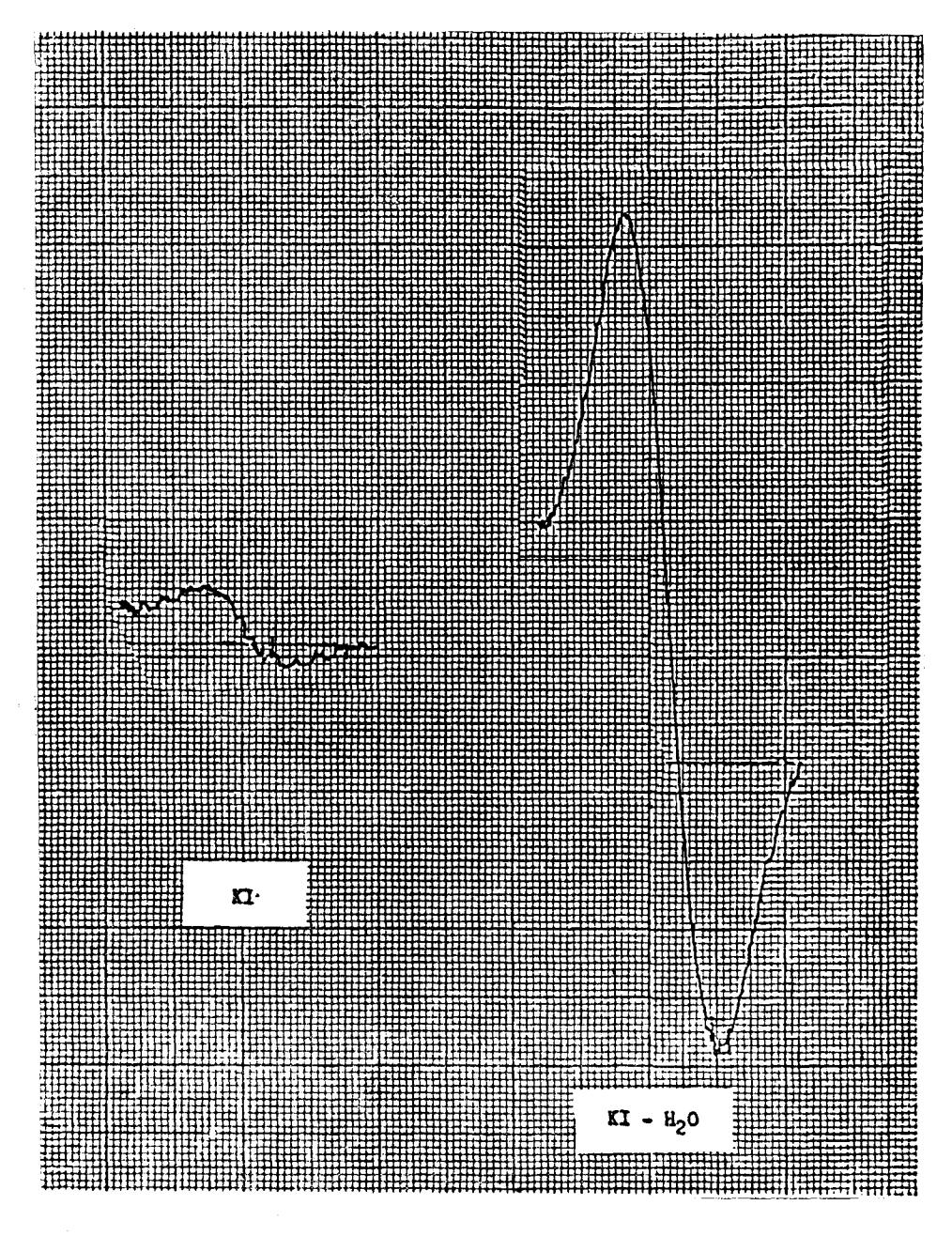
Fig. 4. The effect of KI on the relative number of free radicals of the seeds after the seeds have been soaked for different times. a=1 minute, b=30 min., c=5 min. H= soaked in water.
- The short-time effectivene,ss of KI arose a question that KI might change mostly the outer part of the seeds only. It is therefore interesting to investigate the rela.tive nunr,bers of free radicals in the seed coat, the embryo and the endosperm. These three parts rvere separated after boiling the secds, taking advantagc of the fact that boiling has no effect on the ntunber of free radicals. The free radicals in the wholc seeds (hw2 - 3B.l) were found to be divided 593% in the seecl coat (hw3 - 22.6), 24.8% in the enrbryo (h*' - 9.4), and 11.6/o in the endosperm (hw2 - 4.4). 4.
- 5. a). The effect of the chemical substances on the nespiration of lettuce seeds was also stud,ied. The m,ethodof Warburg (12) was used.The seeds were soaked in the flasks for 2 hours before the manorneters were read. The solutions were added after the sccond reading. According to the expcctation (5.7), the chemicals were found to inhibit the respiration (see table 2). No respiration was dretected in the boiled seeds., 'These results and the above mentioned ones suggest that the relative number of free radicals (fig. 1) is not necessarily dependent of the nespiratory activity. HgCl, is known to be as effective nespirratory inhi,bitor as KCN, but seeds treated with 0,1 lvl HgCl2 showed nelative number of spins 30 times greater than that of sceds treated with 5 M KCN. KRr, KCl, KI and KCN solutions of the same molarity (2 M) showed the sarne effect on thc rcspiration, but their effects on ESR signals wcre not the same. Whether or not the respiratory activity depends on the free radicals, is not known.
- After the ESR measurements, the same seeds we,re put in the War,bu,rg flasks and theirr respiration was measured again. The results are surnmarized in table 3. The results su,ggest that the respiration of thc chemically inhibited lettuce seeds could be detected and was raised after the soeds were washed in water. This fact seems to be in accordance with and in relation to the results shown in fig. 2 and fig. 3. b).
- The ESR-investigated seed,s were than sown on filter papers placed in petri dtishes. Water was added and the effect of the chemicals on germination was followed during 4 days after the seeds had been sown. 6.
Table 2. Oxygen consumption in lettuce seeds (in \(\mu 1/100\) seeds/30 minutes). (All chemicals were added at \(3\frac{1}{2}\) hour).
| Time after moistening (hours) | Control | 2M KCN | 5M KCN | 0.1M HgCl2 | Control | 2M KBr | 2M KCl | 2M KI |
|---|---|---|---|---|---|---|---|---|
| 3 to \(3\frac{1}{2}\) | 31.73 | 30.96 | 32.65 | 35.93 | 21.10 | 21.70 | 21.52 | 19.24 |
| 3½ to 4 | 33.51 | 15.41 | 15.18 | 29.83 | 22.13 | 9.19 | 9.58 | 7.79 |
| 4 to 4½ | 32.14 | 9.68 | 5.28 | 15.54 | 20.75 | 3.30 | 6.46 | 4.38 |
| \(4\frac{1}{2}\) to 5 | 32.35 | 7.76 | 2.40 | 8.88 | 22.76 | 0.6 | 1.94 | 0.96 |
| 5 to \(5\frac{1}{2}\) | 31.70 | 3.46 | 0.87 | 4.43 | 22.43 | 0.47 | ||
| \(5\frac{1}{2}\) to 6 | 31.67 | 0.68 | 1.06 | 23.68 |
₹.~ ...................................
. . . . .
Table 3. The "recovery" of the respiratory activity in treated lettuce seeds after having been washed with water (\(O_2\) uptake in \(\mu 1/100\) seeds/30 minutes).
| Time after beginning (hours) | Control (wet) | Control (redried) | 5M KCN (redried) | Control (redried) | 2M KBr (redried) | 2M KC1 (redried) | 2M KI (redried) |
|---|---|---|---|---|---|---|---|
| 1½ to 2 | 29.90 | 32.20 | 8.90 | 32.15 | 10.31 | 7.11 | 12.89 |
| 2 to \(2\frac{1}{2}\) | 34.20 | 26.08 | 12.95 | 29.46 | 15.47 | 16.59 | 15.93 |
| \(2\frac{1}{2}\) to 3 | 32.80 | 27.50 | 14.40 | 32.20 | 20.63 | 21.37 | 17.87 |
| 3 to 3½ | 29.90 | 25.30 | 11.10 | 25.59 | 20.76 | 18.95 | 17.79 |
| \(3\frac{1}{2}\) to 4 | 31.40 | 34.28 | 16.40 | 34.22 | 17.61 | 21.31 | 15.89 |
| 4 to 4½ | 32.60 | 31.60 | 13.90 | 30.99 | 17.63 | 19.00 | 23.87 |
Solutions of 10 -a M NaN3, 0.1 M HgCl 2 and 2 M KF were found to be the most effective. T'he seeds lost their germination power after having ibeen treated in these solutions. Sol,utions of 2 M KCN, 2 M KBr, 2 I\{ KCI ,and 2 M KI were found to have no effect ou germination. Normal growth was detected in all cases but those of KI treatment. Solutions of 0,1 IvI to 2 M KI suppressed root hair development and chlorophyl production, and the leaf blades grew in a hor'izontal plane. These facts are in agreement with the results quoted by Hochster and Quastel (5).
The great effectiveness of KI was also found in the case of gammairradiated seeds (see table 4). The rolative numbor of spins of KI treated gamrna-i'rradiated seeds is alrnost the same as that of the unirradiated seeds soaked in water, and about ll3 of. that of the irradi,ated seeds soaked in water (control). 7
Table 4. Relative nurniber of free radicals in i,rradiated lettuce seeds, and therr treated with chemicals. The ganlma irradiation dose is r.0 Mrads.
| Sample | hlv2 | spin/cm | spin/seed | note |
|---|---|---|---|---|
| Standard | 30.0 | 3 x 10¹⁵ | ||
| Irrad., unwet. | 195.0 | 2.4 x 10tr | I day after irra'd,iation | |
| Irrad., in H2O | 169.5 | 2.1 x 101r | soaked for 3 hours | |
| Irrad., in 2M KCN | q, 1 | 1.1 x 101{ | ||
| Irrad., in 2M KsS | 115.6 | 1.4 1 1gt+ | ||
| Unirrad., in HsO | 10.1 | 1.3 X 10¹³ | ,""U"0 a. 6 hours, | |
| Irrad., in H2O | 23.8 | 2.9 x 10ra | 12 days after irradriation | |
| Irrad., in 2M KI | /.6 | 1.0 x 10¹³ |
None of these gamma-irradiated seeds showed any indication of respiration nor germination. This fact supports the conclusion that there is no correlation between the relative number of free radicals and the respiration or germination.
DISCUSSION AND CONCLUSION
The experiments showed that the ESR signals in lettuce seeds can be modified by chemical substances. KI showed the greatest effectiveness. Seeds which were soaked for 1 minute had almost the same relative number of free radicals as those which were soaked for 1 hour. Fig. 1 also showed that the changes in free radicals amount are not due to the cation, \(K^+\), and that the change is independent of pH. The type of signals suggests that the magnetic centers are free radicals rather than transition metal cations or F centers. Even though the signal gave a single peak, it cannot be assumed that only one species of free radicals is present. The result of petroleum ethersoaked seeds suggest that the relevant molecules are not lipids.
The effect of KCN and KI was found to be reversible (fig. 2 and fig 3). The reversibility was also shown in the respiration experiments (Table 2 and table 3). It is hard to say however, whether or not the free radicals are necessary intermediates in a biological oxidation — reduction system (1, 2, 9, 13). The boiled seeds which have almost the same number of free radicals as the unboiled seeds, and the gamma-irradiated seeds which contain 10 to 20 times as many free radicals as the un-irradiated seeds (Table 4), did not show respiratory activity. These seeds also lost their germination power. It may be concluded, therefore, that the relative, number of free radicals in lettuce seeds is not necessarily dependent of the respiratory activity. Whether or not the respiratory activity depends on the amount of free radicals, is not known.
Since the boiled seeds had almost the same relative number of free radicals as the unboiled seeds (table 1), is it hard to conclude whether or not the free radical content is associated with the protein component (1, 2, 9, 13).
The short-time effectiveness of KI and the different free radical contents in the different parts of the KI-treated seeds, lead to a conclusion that KI changes the free radicals amount in the seed coat first, and later on it penetrates and induces the embryo. Further investigation in this problem is suggested.
ACKNOWLEDGEMENTS
The encouragement, and excellent cooperation of Dr. A. H. Haber of Oak Ridge National Laboratory USAEC, Biology Division, are gratefully acknowledged. Thanks are also due to the Kentucky Research Foundation of the University of Kentucky, which has made this research possible.